


 Скачать презентацию MODERN STRATEGIC ANALYSIS structures of growing company Dr
Kozlov_SM_9_08_11_16_structures.ppt
- Количество слайдов: 18
 MODERN STRATEGIC ANALYSIS: structures of growing company Dr. Prof. Aleksandr Kozlov 08/11/201
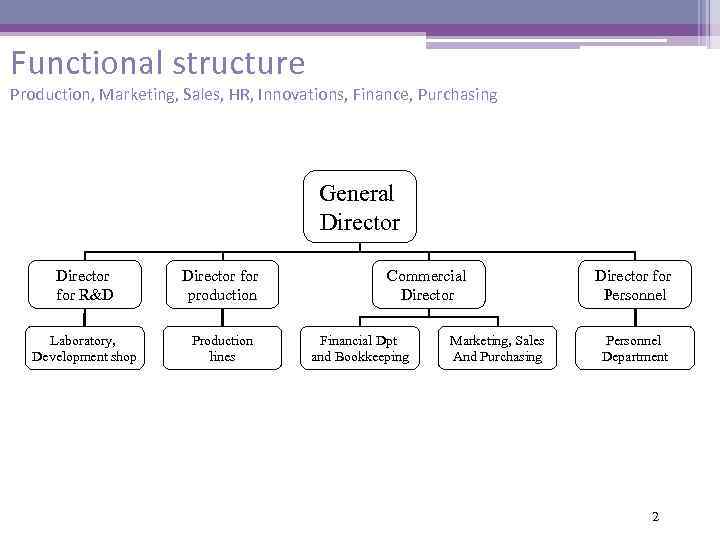 Functional structure Production, Marketing, Sales, HR, Innovations, Finance, Purchasing General Director for R&D Director for production Laboratory, Development shop Production lines Commercial Director Financial Dpt and Bookkeeping Marketing, Sales And Purchasing Director for Personnel Department 2
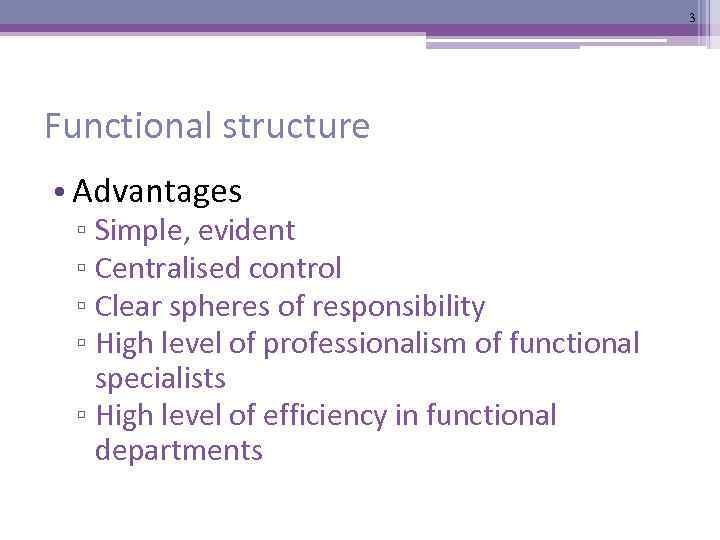 3 Functional structure • Advantages ▫ Simple, evident ▫ Centralised control ▫ Clear spheres of responsibility ▫ High level of professionalism of functional specialists ▫ High level of efficiency in functional departments
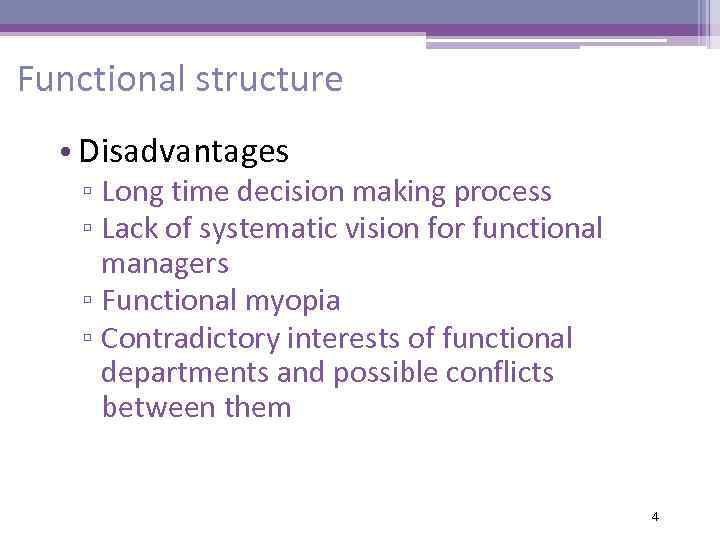 Functional structure • Disadvantages ▫ Long time decision making process ▫ Lack of systematic vision for functional managers ▫ Functional myopia ▫ Contradictory interests of functional departments and possible conflicts between them 4
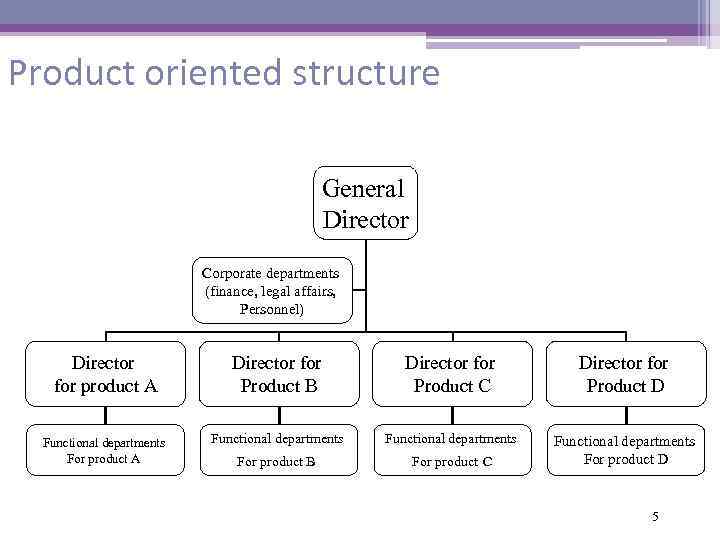 Product oriented structure General Director Corporate departments (finance, legal affairs, Personnel) Director for product A Director for Product B Director for Product C Director for Product D Functional departments For product A Functional departments For product B For product C Functional departments For product D 5
 Product oriented structure • Advantages ▫Gives chance to make focus on the particular product, taking into accounts specifics of it’s sales ▫Allows to investigate market details for every product ▫Allows to build a team of professionals in sales of every product ▫Increases responsibility of managers in specific product sales ▫Allows to calculate precise profitability of every product 6 ▫
 7 Product oriented structure • Disadvantages ▫ Managers of product groups are demonstrating a “product egoism” ▫ Doubling of management functions ▫ Barriers in coordination between different product groups
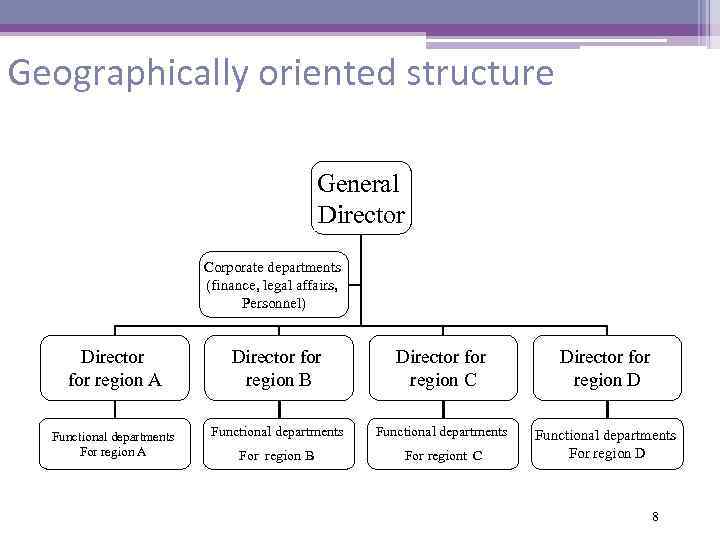 Geographically oriented structure General Director Corporate departments (finance, legal affairs, Personnel) Director for region A Director for region B Director for region C Director for region D Functional departments For region A Functional departments For region B For regiont C Functional departments For region D 8
 9 Geographically oriented structure • Advantages ▫Allows to take into account peculiarities of every geographical market ▫Delegation of responsibility to lower level of hierarchy ▫ Barriers in coordination between different product groups ▫ Regional branches are the good school for managers preparing them to successful carrier
 10 Geographically oriented structure • Disadvantages ▫ Difficult to keep one nad individed corporate image ▫ Doubling of management functions ▫ Makes the structure more complicated since geographical departments have to be built
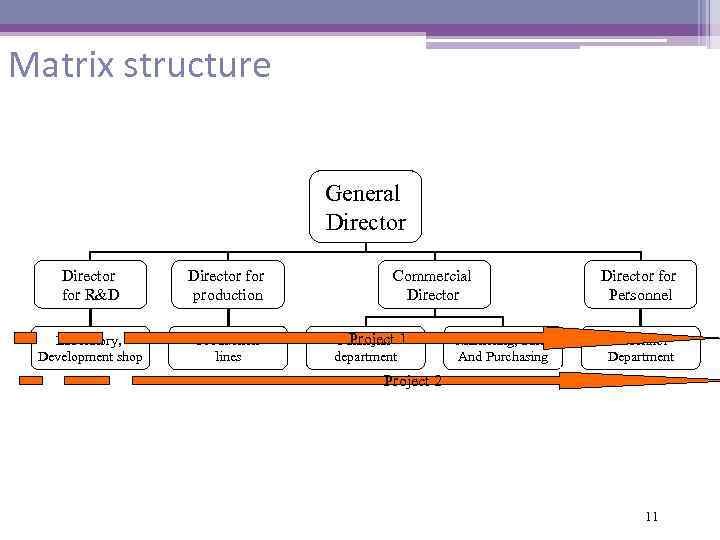 Matrix structure General Director for R&D Director for production Laboratory, Development shop Production lines Commercial Director Project Financial 1 department Marketing, Sales And Purchasing Director for Personnel Department Project 2 11
 12 Matrix structure • Advantage ▫ Gives flexibility in decision making for big companies • Problems ▫ Difficult to run because of two lines of responsibility (linear and project) ▫ Depends on ability of staff involved into a project to work in teams
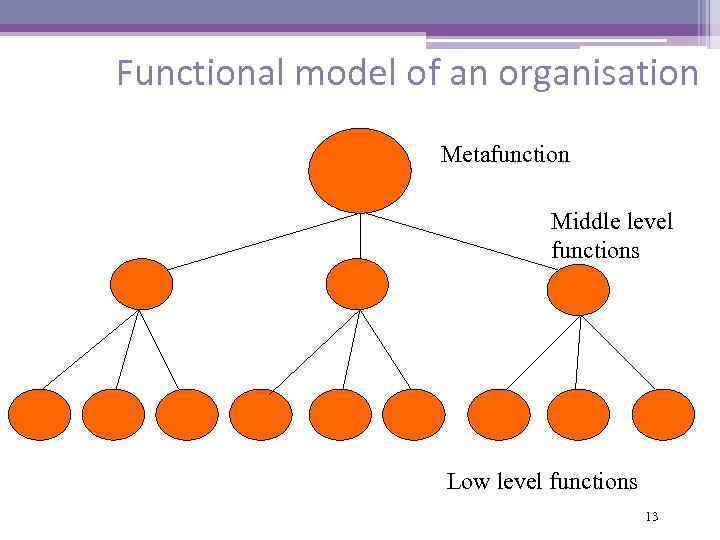 Functional model of an organisation Metafunction Middle level functions Low level functions 13
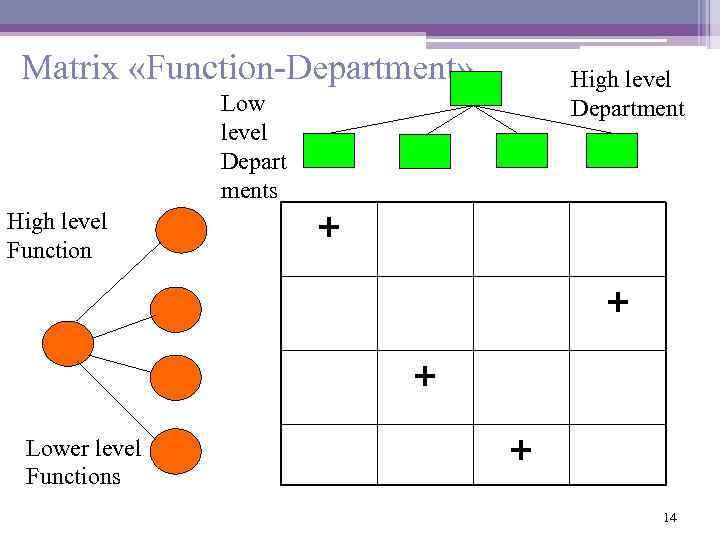 Matrix «Function-Department» High level Department Low level Depart ments High level Function + + + Lower level Functions + 14
 15 Flexible organisational structures • Flexibility is defined as the ability of the company proactively, reactively or inherently to implement changes in its components and its relationships with environment
 16 Flexible organisational structures Ad Hoc Structures • Ad hoc team is to be created to handle a temporary project. • Ad hoc teams are flexible because they enable companies to handle special projects quickly and then dissolve the team after the work is completed.
 17 Flexible organisational structures Network A network organizational structure consists of multiple organizations that work together to produce goods or provide services. It is more complicated and complex than any other structure Managers in network structures spend most of their time coordinating and controlling external relations I. E. While business giants risk becoming too clumsy to proact, act and react efficiently, the new network organizations contract out any business function from “mother” company
 18 Flexible organisational structures Virtual A special form of boundaryless organization, existing within a network of alliances, using the Internet The virtual organization is not physically existing as such