


 Скачать презентацию MODERN STRATEGIC ANALYSIS Strategy Implementation Dr Prof Aleksandr
Kozlov_SM_13_13_12_16_Russian.ppt
- Количество слайдов: 48
 MODERN STRATEGIC ANALYSIS Strategy Implementation Dr. Prof. Aleksandr Kozlov 13/12/2016
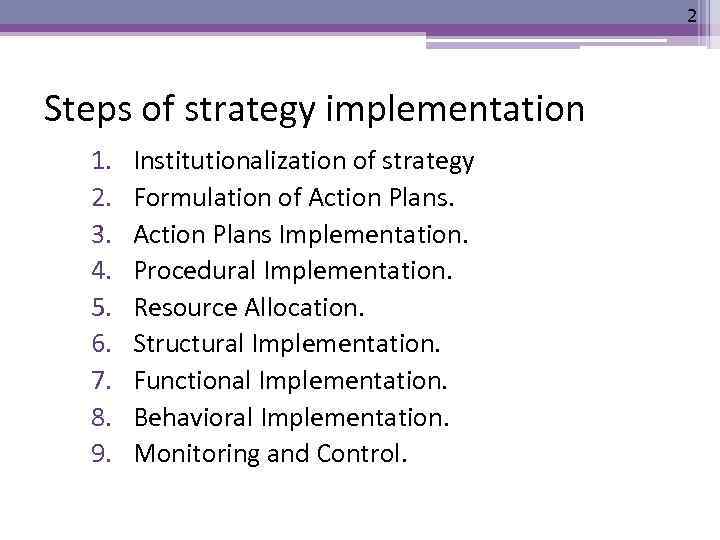 2 Steps of strategy implementation 1. 2. 3. 4. 5. 6. 7. 8. 9. Institutionalization of strategy Formulation of Action Plans Implementation. Procedural Implementation. Resource Allocation. Structural Implementation. Functional Implementation. Behavioral Implementation. Monitoring and Control.
 3 Steps of strategy implementation 1. Institutionalization of strategy ▫ It involves two aspects: Communication of strategy: Once the strategy is formulated it must be communicated to those persons who would implement it. Strategy communication is a process of transferring the strategy information from the formulators to the implementers. Securing Acceptance of Strategy: It is not enough to communicate the strategy to the members of the organizations, but it is equally important to secure their acceptance of the strategy, so that they implement effectively.
 4 Strategy implementation 90% of well-articulated strategies fail to be successfully executed Robert Kaplan & David Norton Harvard Business School, 2001
 5 Steps of strategy implementation 2. Formulation of Action Plans. ▫ The management has to frame action plans in respect of several activities required to implement a strategy. ▫ The action plans may be in respect of purchasing new machinery, appointing additional personnel, developing a new process, etc… ▫ The type of action plan depends upon nature of strategy. While framing a manager should check out the objectives, activities to perform &resources required to perform the action plans.
 6 Steps of strategy implementation 3. Action Plans Implementation. • Phases of project Implementation ▫ Conception Phase Project ideas are generated during the process of strategic alternatives & strategic choice ▫ Project Analysis Phase – The project ideas have to be arranged according to priority for the purpose of development. ▫ Planning Phase – management undertakes detailed planning of project for different areas of project such as production schedules, plant design & layout, technical arrangements, marketing, finance, etc… ▫ • Organizing Phase – The management must organize for necessary resources such as manpower, finance, systems and procedures to implement the project. ▫ Implementation Phase – During this phase, the management must undertake engineering, order placement for equipment & material etc… Operation Phase – The final phase involves handing over the plant to the operating personnel for operation purpose. At this stage the production starts
 7 Steps of strategy implementation 4. Procedural Implementation • Procedural implementation takes place by following the rules and regulation in terms of wastage cost, utility, etc. ▫ It involves completing all procedures and formalities as prescribed by the governments both state and central. The steps vary from industry to industry. There may also be frequent changes in policies
 8 Steps of strategy implementation 5. Resource Allocation • It involves allocation of resources to both inside he company and outside the company. • It has to make decisions regarding short term and long term allocation.
 9 Steps of strategy implementation 6. The structural implementation It involves designing of the organization structure and interlinking various units and subunits of the organization.
 10 Steps of strategy implementation 7. Functional implementation It deals with the development of policies and plans in different areas of functions which and organization undertakes.
 11 Steps of strategy implementation 8. Behavioral implementation It deals with those aspects of strategy implementation that have impact on behavior of people in the organization. Since human resources form an integral part of the organization, their activities and behavior need to be directed in a certain way.
 12 Steps of strategy implementation 9. Monitoring and control Evaluation and control have to be done for future course of action as well. To get successful results and to achieve organizational objectives, there has to be continuous monitoring of the implementation of strategy. The evaluation and control of strategy may result in various actions that the organization may have to take for successful well being, such actions may involve any kind of corrective measures concerned with any of the steps involved in the whole process.
 MODERN STRATEGIC ANALYSIS Theme 6. Strategic leadership. Russian aspects Dr. Prof. Aleksandr Kozlov 13/12/2016
 14 Hofstede model of cross-cultural differences • Five cultural dimensions ▫ ▫ ▫ Power Distance Index (PDI) Individualism (IDV) Masculinity (MAS) Uncertainty Avoidance Index (UAI) Long-Term Orientation (LTO) (developed later and not so well researched)
 15 Hofstede model of cross-cultural differences • Power Distance Index (PDI) ▫ It is the extent to which the less powerful members of organizations and institutions accept and expect that power is distributed unequally ▫ It reflects a distance between representatives of different levels of organisational hierarchy
 16 Hofstede model of cross-cultural differences • Power Distance Index (PDI) ▫ A High Power Distance ranking indicates that inequalities of power and wealth have been allowed to grow within the society. These societies are more likely to follow a caste system that does not allow significant upward mobility of its citizens. ▫ A Low Power Distance ranking indicates the society deemphasizes the differences between citizen's power and wealth. In these societies equality and opportunity for everyone is stressed.
 17 Hofstede model of cross-cultural differences • Individualism (IDV) ▫ It is the degree to which individuals are integrated into groups ▫ Actually it’s a characteristic of society, not the organisation only ▫ On the individualist side there are societies in which the ties between individuals are loose: everyone is expected to look after him/herself and his/her immediate family ▫ On the collectivist side, there are societies in which people from birth onwards are integrated into strong, cohesive ingroups which continue protecting them in exchange for unquestioning loyalty
 18 Hofstede model of cross-cultural differences Individualism (IDV) • A High Individualism ranking indicates that individuality and individual rights are paramount within the society. Individuals in these societies may tend to form a larger number of looser relationships. ▫ A Low Individualism ranking typifies societies of a more collectivist nature with close ties between individuals. These cultures reinforce extended families and collectives where everyone takes responsibility for fellow members of their group AVK SPb. GPU PUT
 19 Hofstede model of cross-cultural differences • Masculinity (MAS) ▫ MAS versus its opposite, femininity, refers to the distribution of roles between the gender’s typical behavior ▫ men's values from one country to another contain a dimension from very assertive and competitive and maximally different from women's values on the one side, to modest and caring and similar to women's values on the other. ▫ The assertive pole has been called 'masculine' and the modest, caring pole 'feminine‘ independently of gender.
 20 Hofstede model of cross-cultural differences • Masculinity (MAS) ▫ A High Masculinity ranking indicates the country experiences a high degree of gender differentiation. In these cultures, males dominate a significant portion of the society and power structure, with females being controlled by male domination. ▫ A Low Masculinity ranking indicates the country has a low level of differentiation and discrimination between genders. In these cultures, females are treated equally to males in all aspects of the society.
 21 Hofstede model of cross-cultural differences • Uncertainty Avoidance Index (UAI) ▫ A High Uncertainty Avoidance ranking indicates the country has a low tolerance for uncertainty and ambiguity. This creates a rule-oriented society that institutes laws, rules, regulations, and controls in order to reduce the amount of uncertainty. ▫ A Low Uncertainty Avoidance ranking indicates the country has less concern about ambiguity and uncertainty and has more tolerance for a variety of opinions. This is reflected in a society that is less rule-oriented, more readily accepts change, and takes more and greater risks
 22 Hofstede model of cross-cultural differences • Uncertainty Avoidance Index (UAI) ▫ It deals with a society's tolerance for uncertainty and ambiguity; ▫ It indicates to what extent a culture programs its members to feel either uncomfortable or comfortable in unstructured situations. ▫ Unstructured situations are novel, unknown, surprising, different from usual. Uncertainty avoiding cultures try to minimize the possibility of such situations by strict laws and rules, safety and security measures
 23 Hofstede model of cross-cultural differences • Long-Term Orientation (LTO) ▫ Values associated with Short Term Orientation are respect for tradition, fulfilling social obligations, and protecting one's 'face‘ ▫ Members of LTO-societies develop plans for long period of time sometimes even longer then their life ▫ Members of STO-societies are more flexible, ready to change their life, to use opportunities
 24 Hofstede model of cross-cultural differences • Long-Term Orientation (LTO) ▫ High Long-Term Orientation ranking indicates the country prescribes to the values of long-term commitments and respect for tradition. This is thought to support a strong work ethic where long-term rewards are expected as a result of today's hard work. However, business may take longer to develop in this society, particularly for an "outsider". ▫ A Low Long-Term Orientation ranking indicates the country does not reinforce the concept of long-term, traditional orientation. In this culture, change can occur more rapidly as long-term traditions and commitments do not become impediments to change.
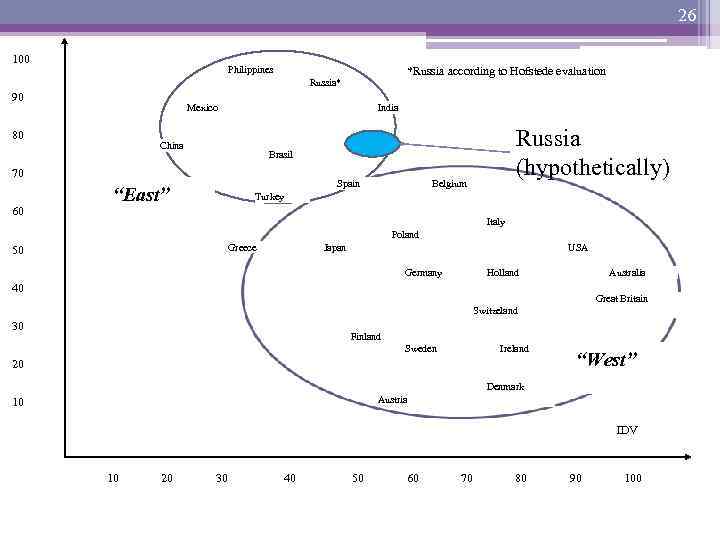
 25 Russia according to Hofstede indexes • Power Distance Index (PDI) Russia – 93 (USA - 40, China – 68, Australia – 11) • Individualism (IDV) Russia – 39 (USA - 91, China – 20, France. Sweden -71) • Masculinity (MAS) Russia - 36 (USA - 62, China – 66, France - 43, Sweden - 5) • Uncertainty Avoidance Index (UAI) Russia – 95 (USA - 46, China – 30, France - 86. Sweden -71) • Long-Term Orientation (LTO) Russia – no information (USA - 29, China – 118, France - 39. Sweden - 33)
 26 100 Philippines *Russia according to Hofstede evaluation Russia* 90 Mexico 80 India China 70 60 Russia (hypothetically) Brasil Belgium Spain “East” Turkey Italy Poland Greece 50 Japan USA Germany Holland Australia 40 Great Britain Switzeland 30 Finland Ireland Sweden 20 “West” Denmark Austria 10 IDV 10 20 30 40 50 60 70 80 90 100
 27 The Russian character A complex and contradictory one: Respect for spirituality and books Disdain for the intelligentsia that produce them A distrust of wealth A sense of generosity and social sensitivity A need for a supreme authority Cynicism about everyday law and distrust to the authorities 27
 28 "The severity of Russian law is compensated with its loose observance”
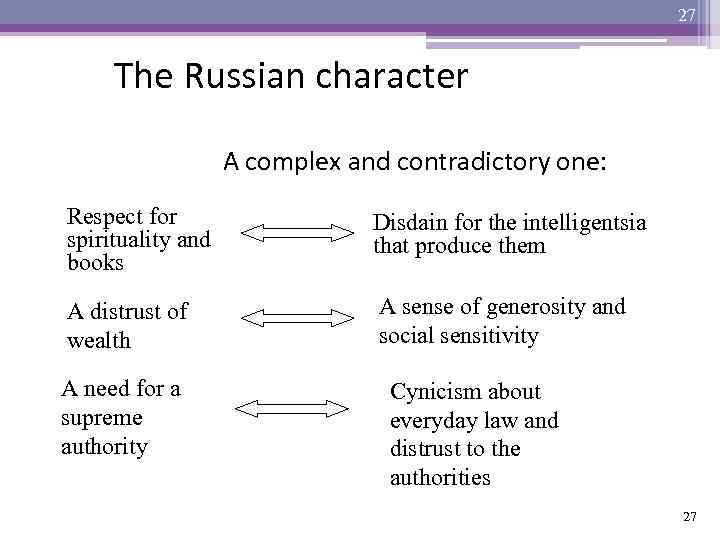
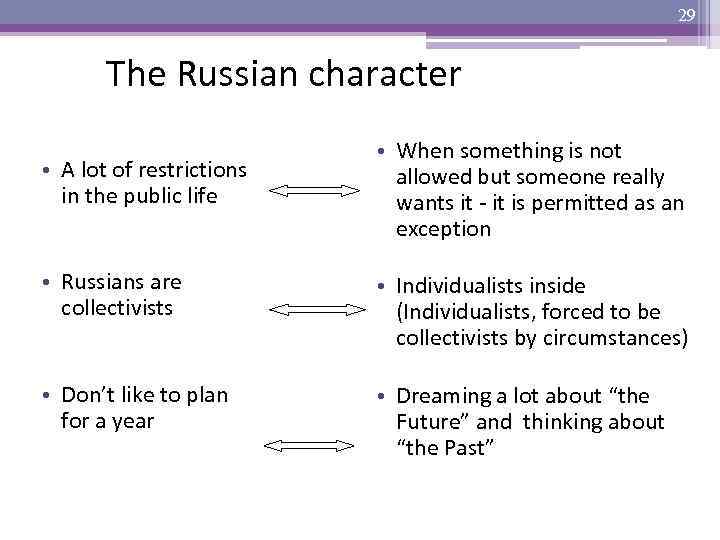 29 The Russian character • A lot of restrictions in the public life • When something is not allowed but someone really wants it - it is permitted as an exception • Russians are collectivists • Individualists inside (Individualists, forced to be collectivists by circumstances) • Don’t like to plan for a year • Dreaming a lot about “the Future” and thinking about “the Past”
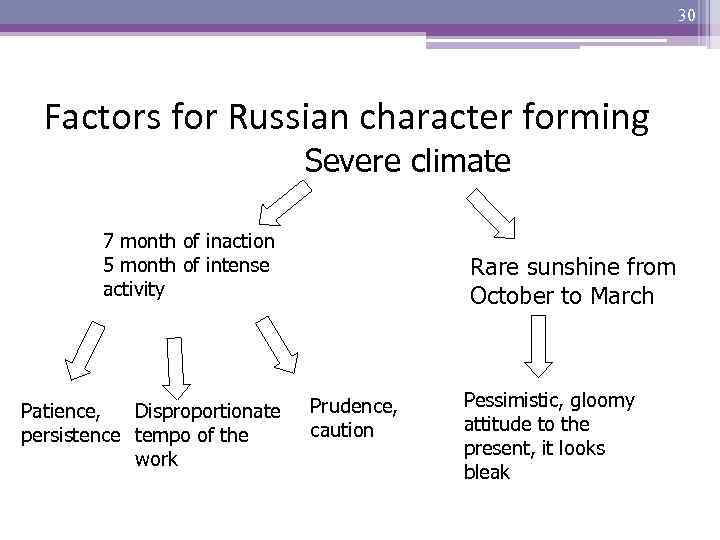 30 Factors for Russian character forming Severe climate 7 month of inaction 5 month of intense activity Patience, Disproportionate persistence tempo of the work Rare sunshine from October to March Prudence, caution Pessimistic, gloomy attitude to the present, it looks bleak
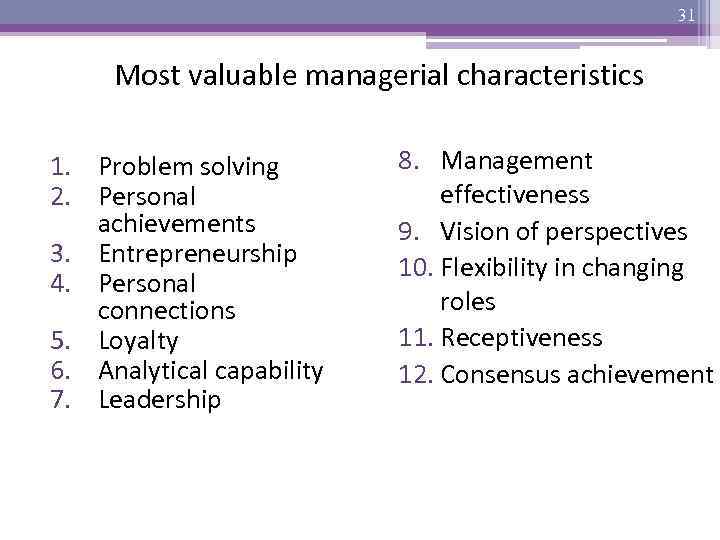 31 Most valuable managerial characteristics 1. Problem solving 2. Personal achievements 3. Entrepreneurship 4. Personal connections 5. Loyalty 6. Analytical capability 7. Leadership 8. Management effectiveness 9. Vision of perspectives 10. Flexibility in changing roles 11. Receptiveness 12. Consensus achievement
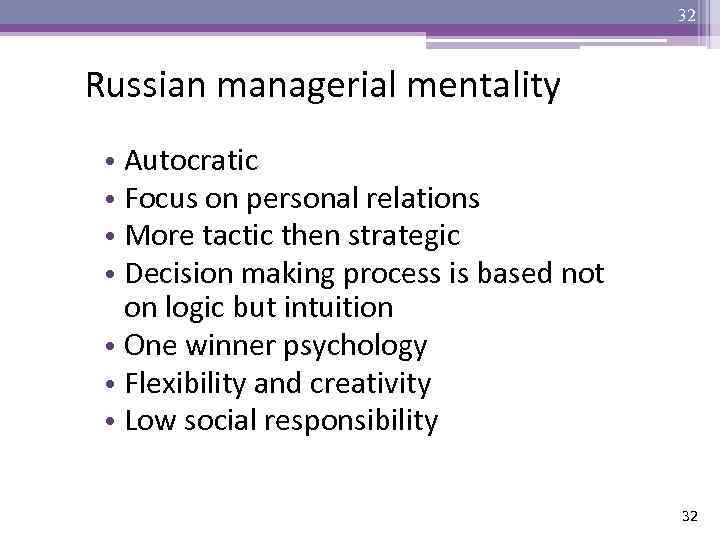 32 Russian managerial mentality • Autocratic • Focus on personal relations • More tactic then strategic • Decision making process is based not on logic but intuition • One winner psychology • Flexibility and creativity • Low social responsibility 32
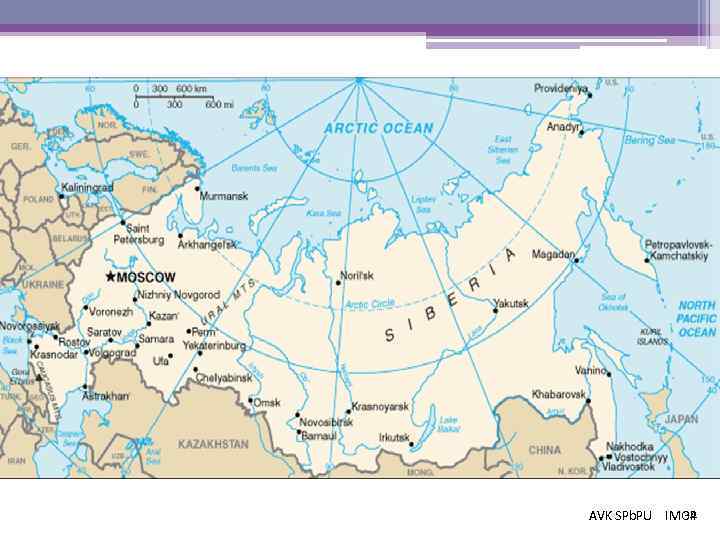
 Main grounds for Russian mentality formation • Historical and political grounds • Geographical grounds AVK SPb. PU IMOP 33
 AVK SPb. PU IMOP 34
 st stage 1 The Moscow Princedom is the part of Tartar Empire • The end of the XIII century – the middle of XV century 35
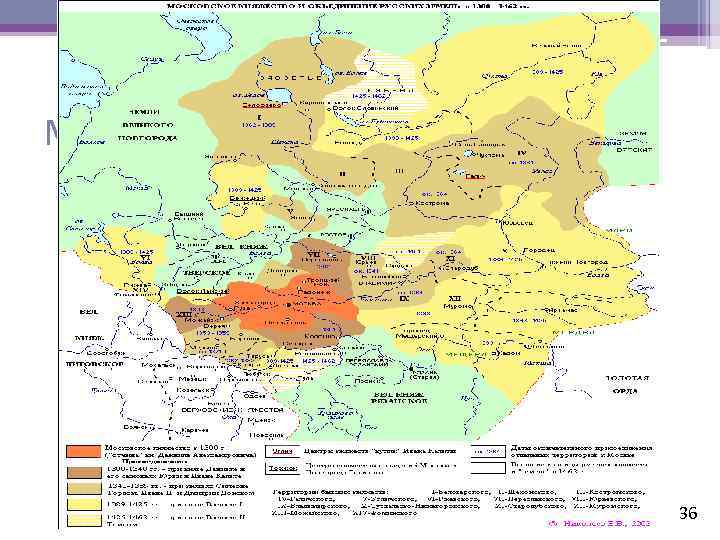 Moscow Rus’ 36
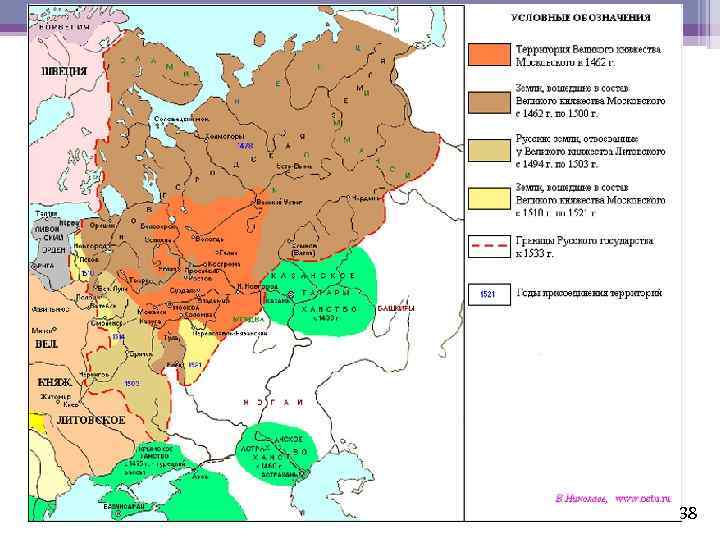
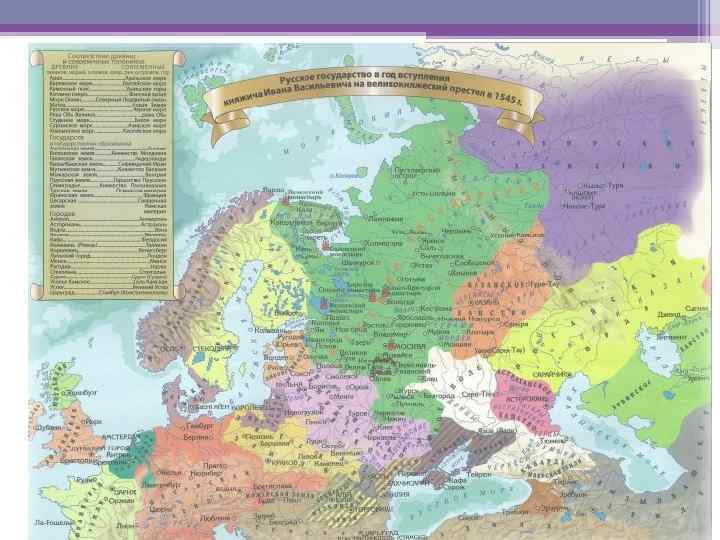
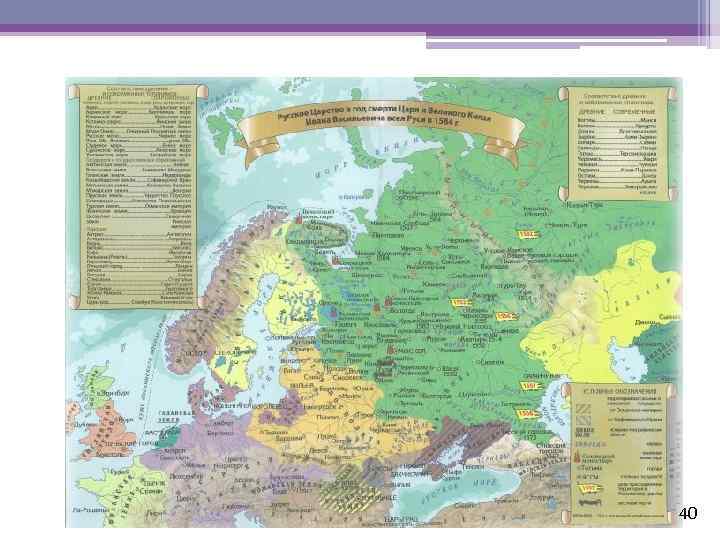
 2 nd stage. The Moscow Princedom is an independent state under Rurick dynasty governance • The middle of XV century – the end of XVI century (Vassily II– Ivan IV (The Terrible) 37
 38
38
 40
40
 3 rd stage • Moscow Tzarstvo is absorbing other parts of Tartar Empire under rule of Romanov dynasty • The beginning of XVII – the beginning of XVIII century 41
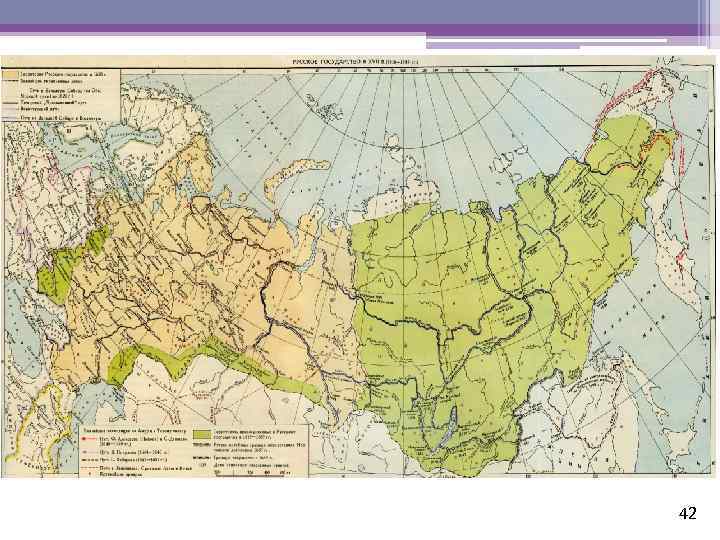 42
42
 4 th stage • Russian Empire under rule of Romanovs, Bolsheviks and etc. • The beginning of XVII up to present time 43
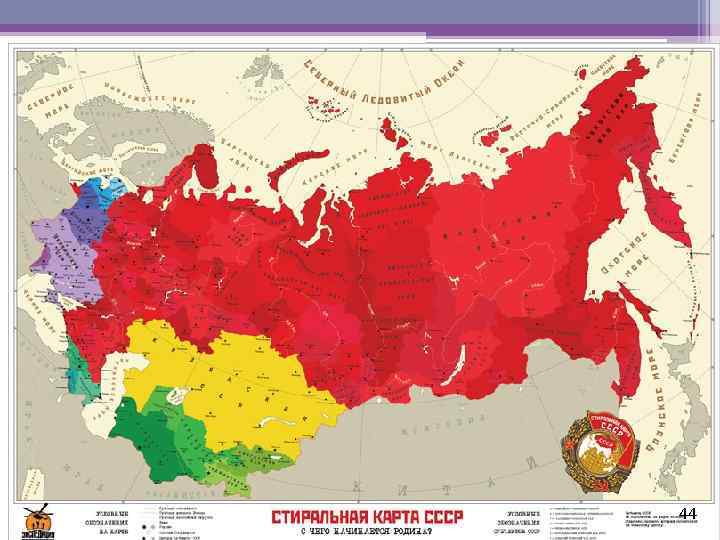 44
44
 Russian managerial mentality That’s why the dominating managerial style is autocratic one 45
 46 Russian managerial mentality • Over the centuries, Russia has developed its own distinct model of effective leadership, which has a strong impact on politics, business, and social life. The country’s most admired leader of all time – Tsar Peter the Great. • Peter, a visionary, assertive, decisive, and combative and, at the same time, protective and sensitive to rank -and-file people, remains in the Russian collective memory a role model of the effective leader
 47 Russian managerial mentality • There are few positive cases of succession at the top of Russian society. The majority of incoming leaders were not trained or prepared for their jobs. • Leaders such as Alexander Nevsky, Ivan the Terrible, Lenin, and Stalin left a mess after their deaths. • The only Russian monarch who devoted a significant amount of time and designed a special program to develop a successor was Catherine the Great, a former German Princess without a drop of Russian blood. 47
 48 Russian managerial mentality • That exception only proved the rule. ▫ What typically prevailed were short-term thinking, unlimited desire to hold on to power, and fear of being overthrown by potential successors. ▫ It prevented Russian leaders from fulfilling the role that no real leader should fail at: developing other leaders who would eventually replace them. 48