


 Скачать презентацию Modern Physics Waves and Optics Special relativity Quantum
93dc0d9865d7c51301306b118b741d6f.ppt
- Количество слайдов: 66
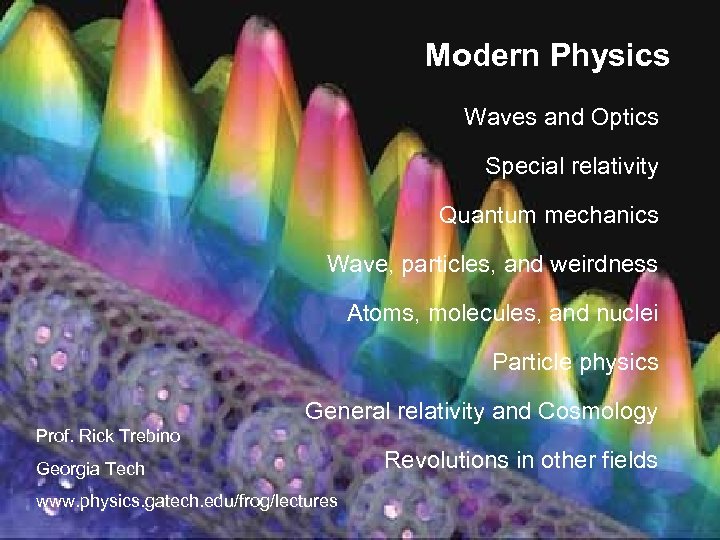 Modern Physics Waves and Optics Special relativity Quantum mechanics Wave, particles, and weirdness Atoms, molecules, and nuclei Particle physics General relativity and Cosmology Prof. Rick Trebino Georgia Tech www. physics. gatech. edu/frog/lectures Revolutions in other fields
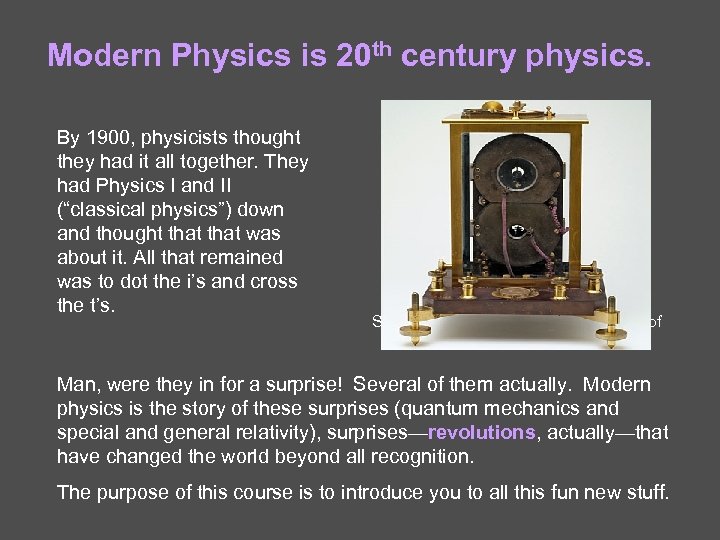 Modern Physics is 20 th century physics. By 1900, physicists thought they had it all together. They had Physics I and II (“classical physics”) down and thought that was about it. All that remained was to dot the i’s and cross the t’s. Scanning-tunneling microscope image of individual atoms Man, were they in for a surprise! Several of them actually. Modern physics is the story of these surprises (quantum mechanics and special and general relativity), surprises—revolutions, actually—that have changed the world beyond all recognition. The purpose of this course is to introduce you to all this fun new stuff.
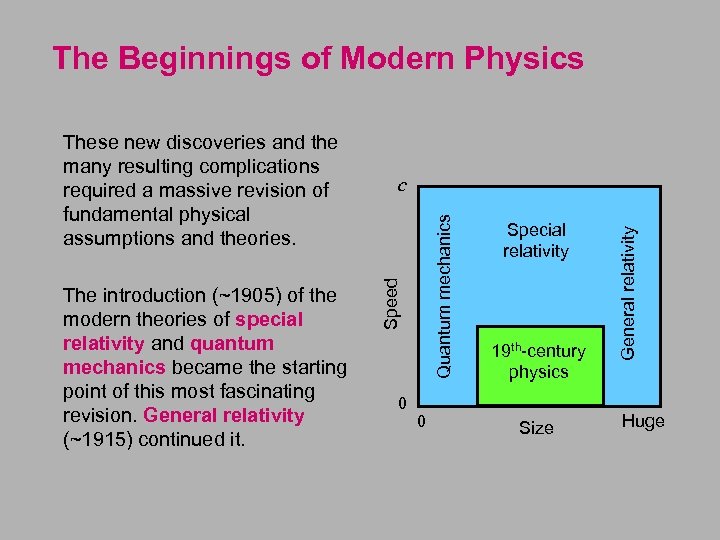 The Beginnings of Modern Physics 0 0 Special relativity 19 th-century physics Size General relativity Quantum mechanics The introduction (~1905) of the modern theories of special relativity and quantum mechanics became the starting point of this most fascinating revision. General relativity (~1915) continued it. c Speed These new discoveries and the many resulting complications required a massive revision of fundamental physical assumptions and theories. Huge
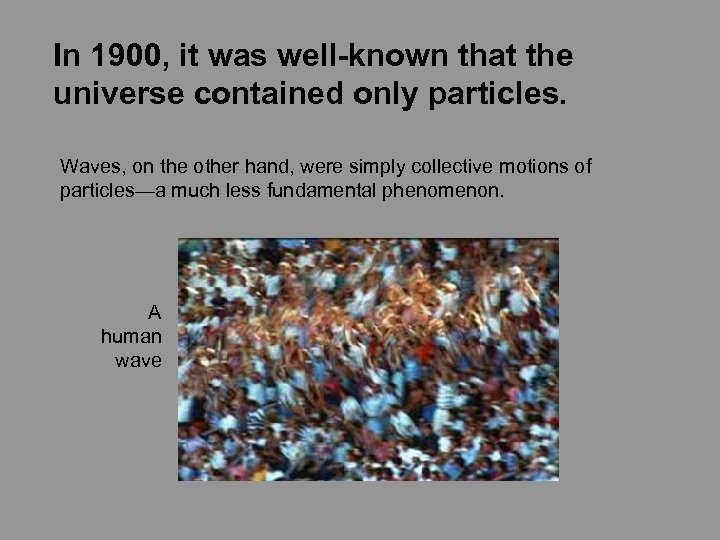 In 1900, it was well-known that the universe contained only particles. Waves, on the other hand, were simply collective motions of particles—a much less fundamental phenomenon. A human wave
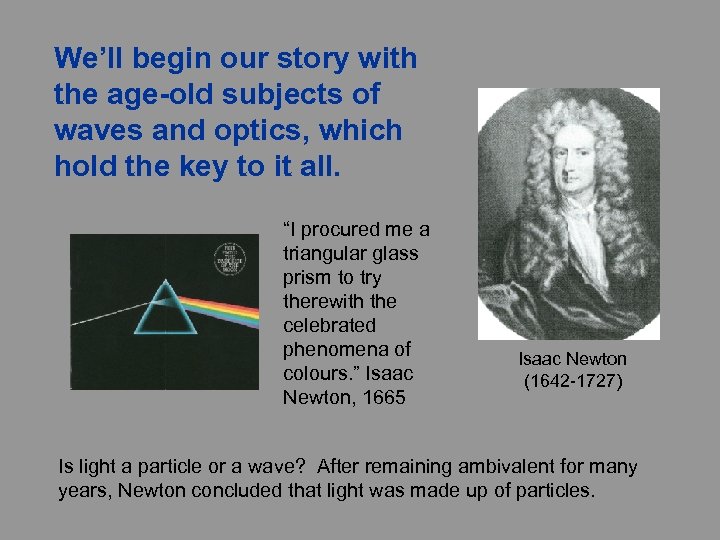 We’ll begin our story with the age-old subjects of waves and optics, which hold the key to it all. “I procured me a triangular glass prism to try therewith the celebrated phenomena of colours. ” Isaac Newton, 1665 Isaac Newton (1642 -1727) Is light a particle or a wave? After remaining ambivalent for many years, Newton concluded that light was made up of particles.
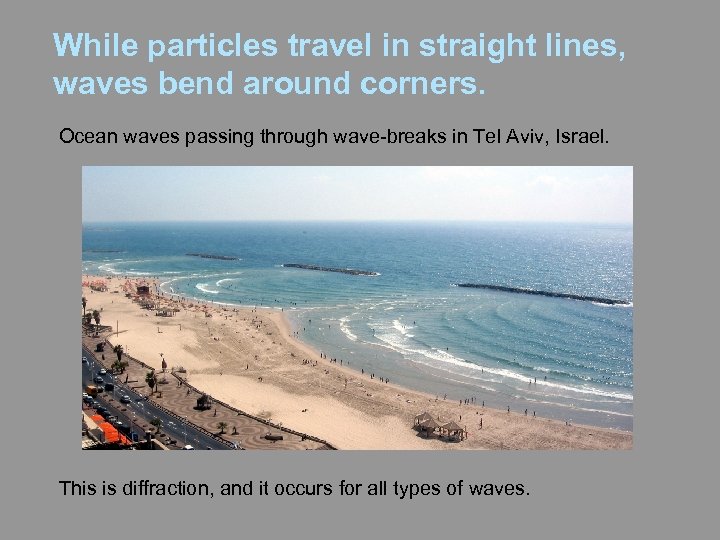 While particles travel in straight lines, waves bend around corners. Ocean waves passing through wave-breaks in Tel Aviv, Israel. This is diffraction, and it occurs for all types of waves.
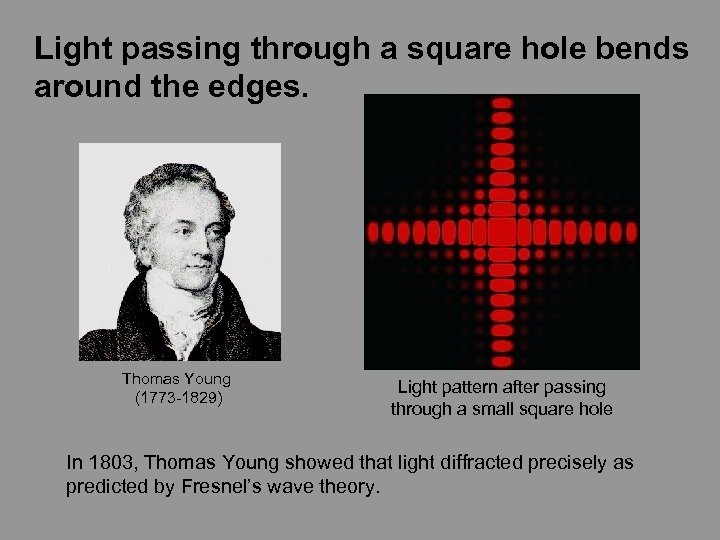 Light passing through a square hole bends around the edges. Thomas Young (1773 -1829) Light pattern after passing through a small square hole In 1803, Thomas Young showed that light diffracted precisely as predicted by Fresnel’s wave theory.
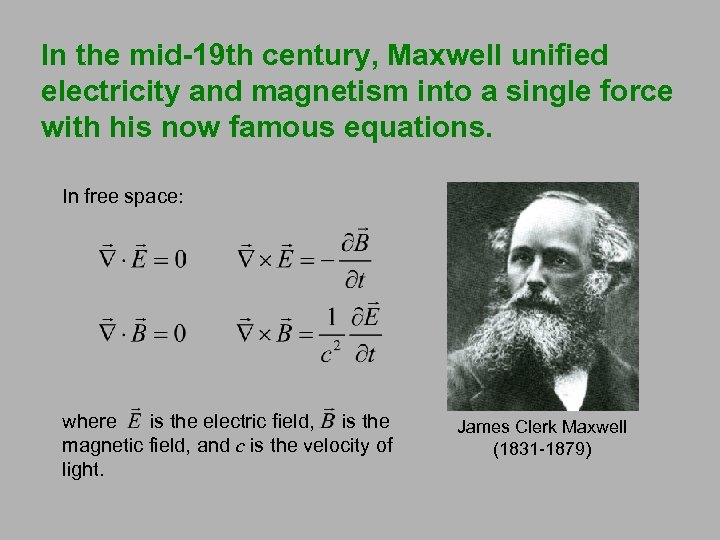 In the mid-19 th century, Maxwell unified electricity and magnetism into a single force with his now famous equations. In free space: where is the electric field, is the magnetic field, and c is the velocity of light. James Clerk Maxwell (1831 -1879)
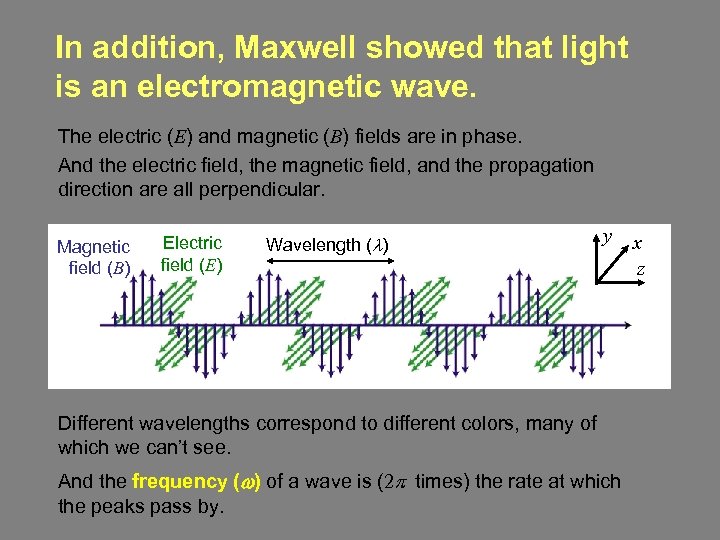 In addition, Maxwell showed that light is an electromagnetic wave. The electric (E) and magnetic (B) fields are in phase. And the electric field, the magnetic field, and the propagation direction are all perpendicular. Magnetic field (B) Electric field (E) Wavelength (l) y Different wavelengths correspond to different colors, many of which we can’t see. And the frequency (w) of a wave is (2 p times) the rate at which the peaks pass by. x z
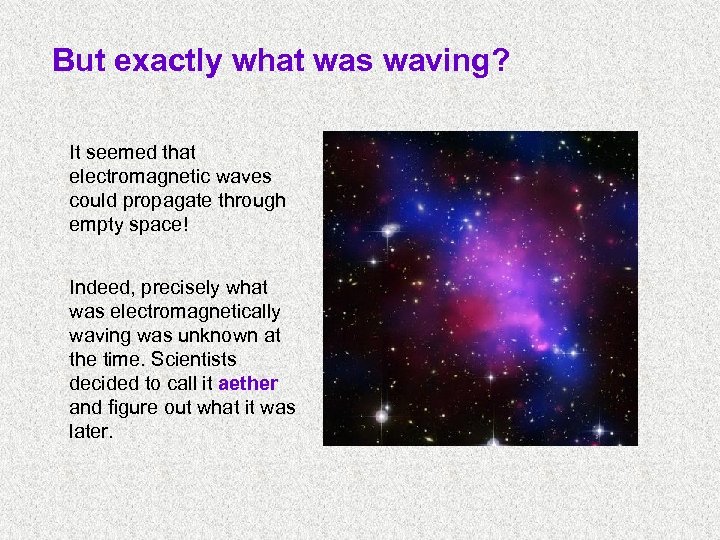 But exactly what was waving? It seemed that electromagnetic waves could propagate through empty space! Indeed, precisely what was electromagnetically waving was unknown at the time. Scientists decided to call it aether and figure out what it was later.
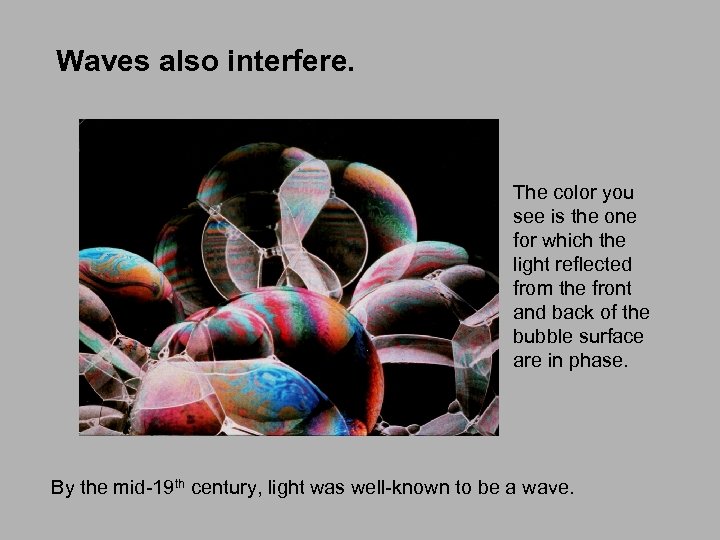 Waves also interfere. The color you see is the one for which the light reflected from the front and back of the bubble surface are in phase. By the mid-19 th century, light was well-known to be a wave.
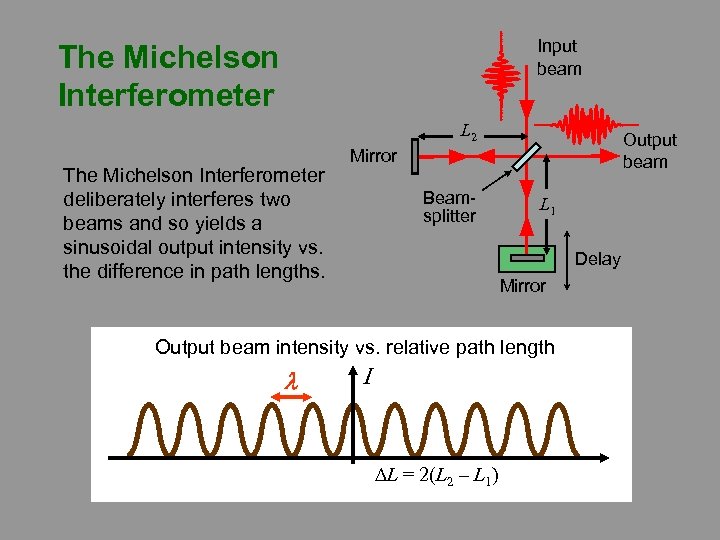 Input beam The Michelson Interferometer L 2 The Michelson Interferometer deliberately interferes two beams and so yields a sinusoidal output intensity vs. the difference in path lengths. Output beam Mirror Beamsplitter L 1 Delay Mirror Output beam intensity vs. relative path length l I DL = 2(L 2 – L 1)
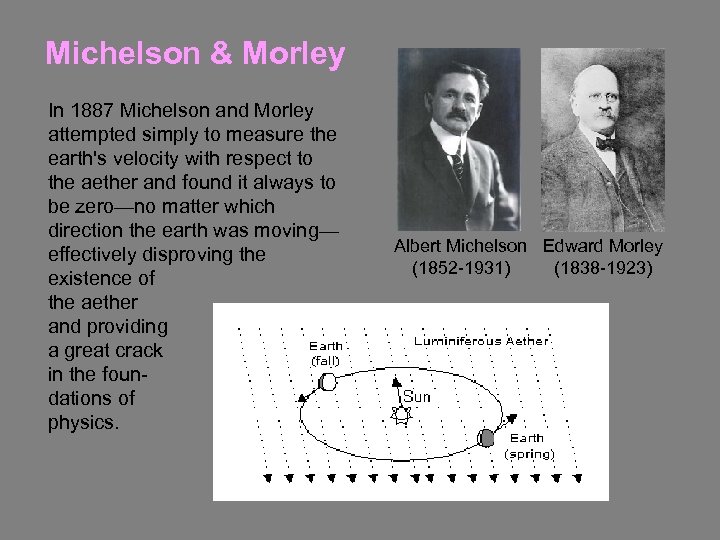 Michelson & Morley In 1887 Michelson and Morley attempted simply to measure the earth's velocity with respect to the aether and found it always to be zero—no matter which direction the earth was moving— effectively disproving the existence of the aether and providing a great crack in the foundations of physics. Albert Michelson Edward Morley (1852 -1931) (1838 -1923)
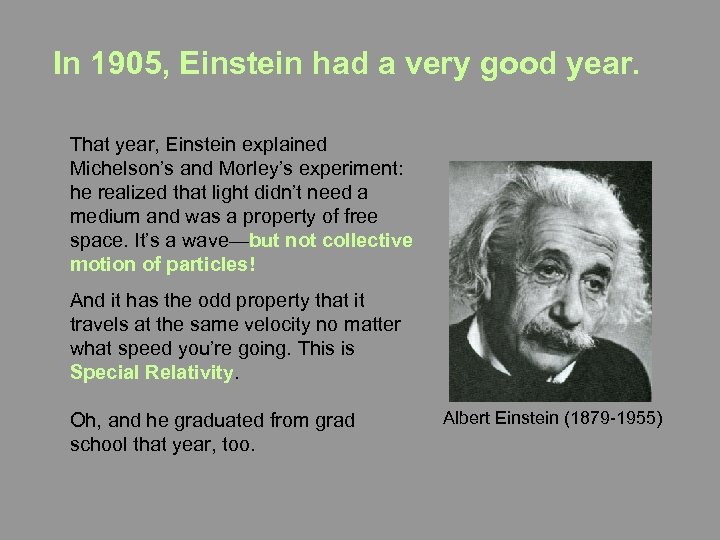 In 1905, Einstein had a very good year. That year, Einstein explained Michelson’s and Morley’s experiment: he realized that light didn’t need a medium and was a property of free space. It’s a wave—but not collective motion of particles! And it has the odd property that it travels at the same velocity no matter what speed you’re going. This is Special Relativity. Oh, and he graduated from grad school that year, too. Albert Einstein (1879 -1955)
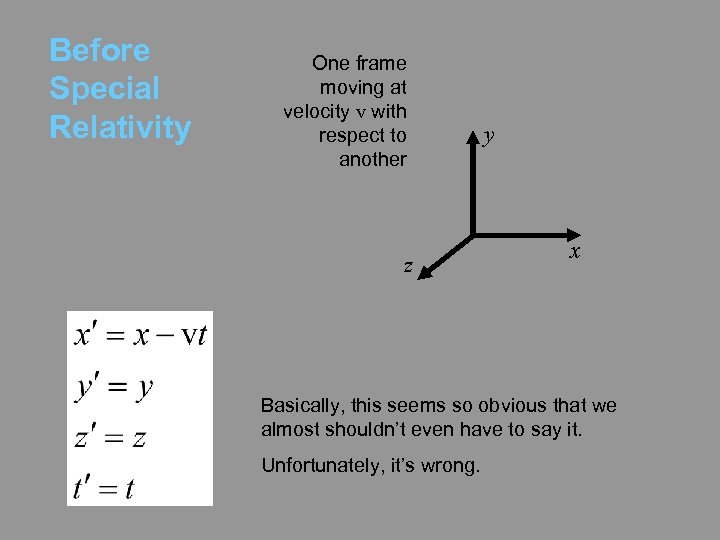 Before Special Relativity One frame moving at velocity v with respect to another z y x Basically, this seems so obvious that we almost shouldn’t even have to say it. Unfortunately, it’s wrong.
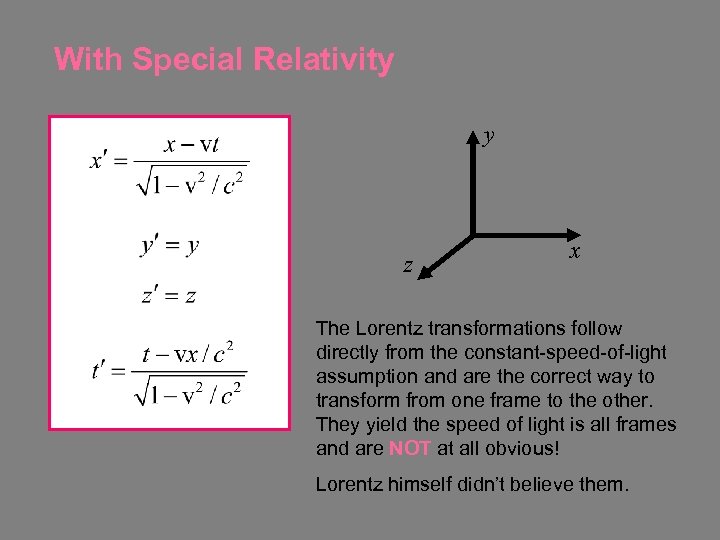 With Special Relativity y z x The Lorentz transformations follow directly from the constant-speed-of-light assumption and are the correct way to transform from one frame to the other. They yield the speed of light is all frames and are NOT at all obvious! Lorentz himself didn’t believe them.
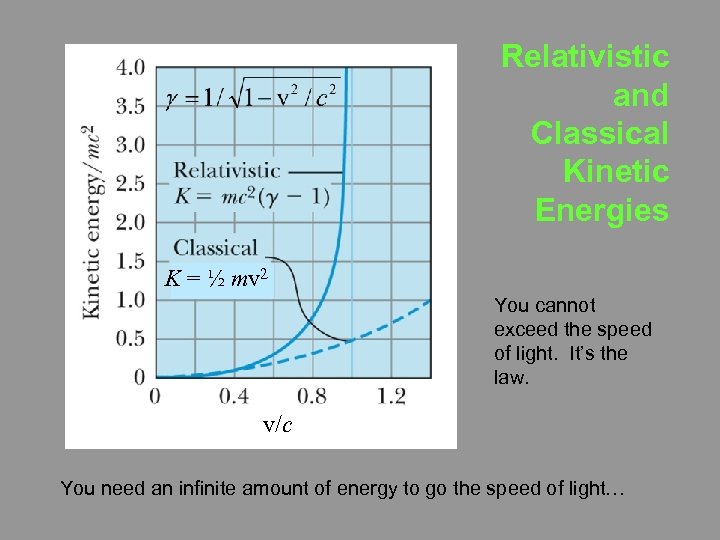 Relativistic and Classical Kinetic Energies K = ½ mv 2 You cannot exceed the speed of light. It’s the law. v/c You need an infinite amount of energy to go the speed of light…
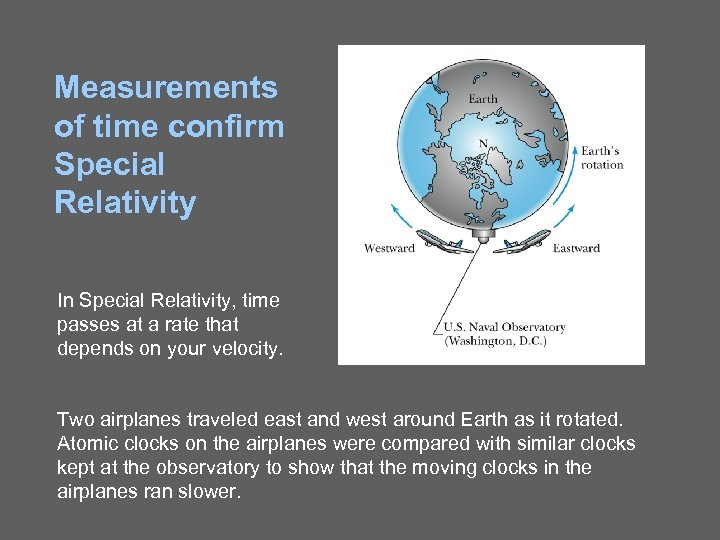 Measurements of time confirm Special Relativity In Special Relativity, time passes at a rate that depends on your velocity. Two airplanes traveled east and west around Earth as it rotated. Atomic clocks on the airplanes were compared with similar clocks kept at the observatory to show that the moving clocks in the airplanes ran slower.
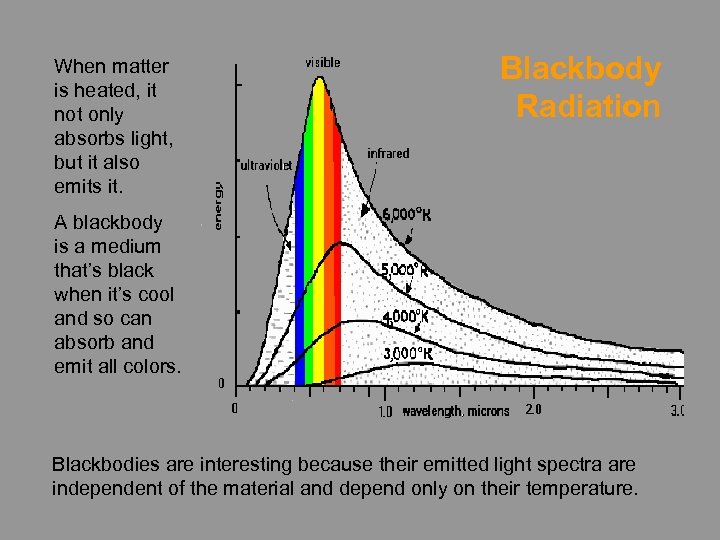 When matter is heated, it not only absorbs light, but it also emits it. Blackbody Radiation A blackbody is a medium that’s black when it’s cool and so can absorb and emit all colors. Blackbodies are interesting because their emitted light spectra are independent of the material and depend only on their temperature.
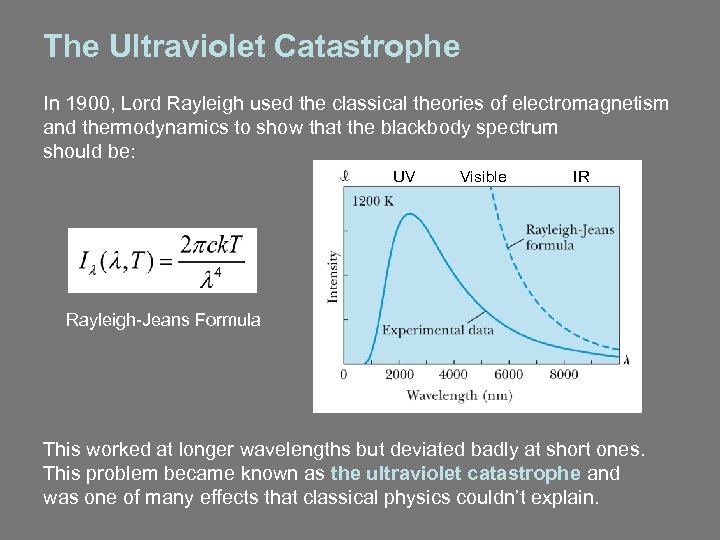 The Ultraviolet Catastrophe In 1900, Lord Rayleigh used the classical theories of electromagnetism and thermodynamics to show that the blackbody spectrum should be: UV Visible IR Rayleigh-Jeans Formula This worked at longer wavelengths but deviated badly at short ones. This problem became known as the ultraviolet catastrophe and was one of many effects that classical physics couldn’t explain.
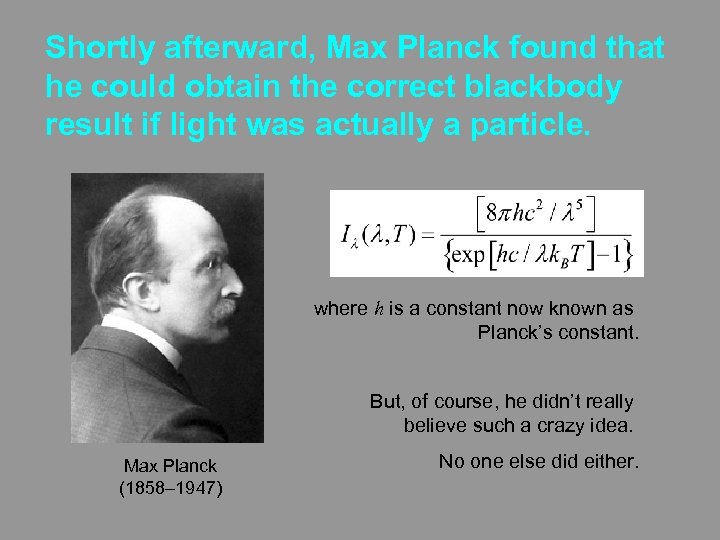 Shortly afterward, Max Planck found that he could obtain the correct blackbody result if light was actually a particle. where h is a constant now known as Planck’s constant. But, of course, he didn’t really believe such a crazy idea. Max Planck (1858– 1947) No one else did either.
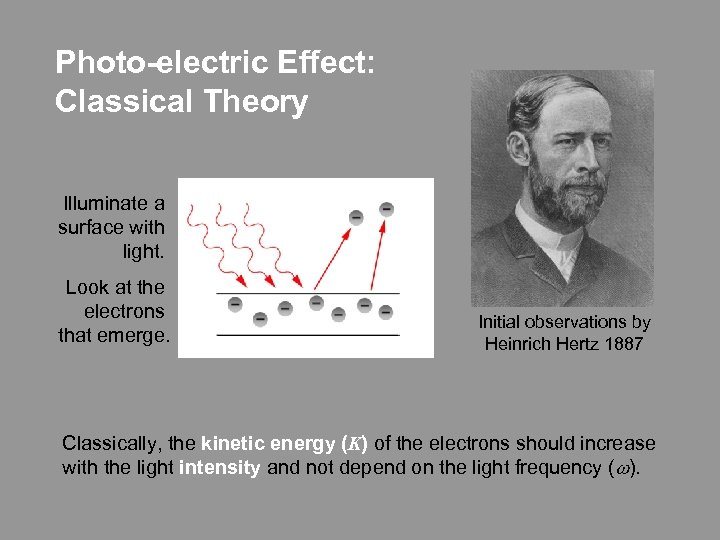 Photo-electric Effect: Classical Theory Illuminate a surface with light. Look at the electrons that emerge. Initial observations by Heinrich Hertz 1887 Classically, the kinetic energy (K) of the electrons should increase with the light intensity and not depend on the light frequency (w).
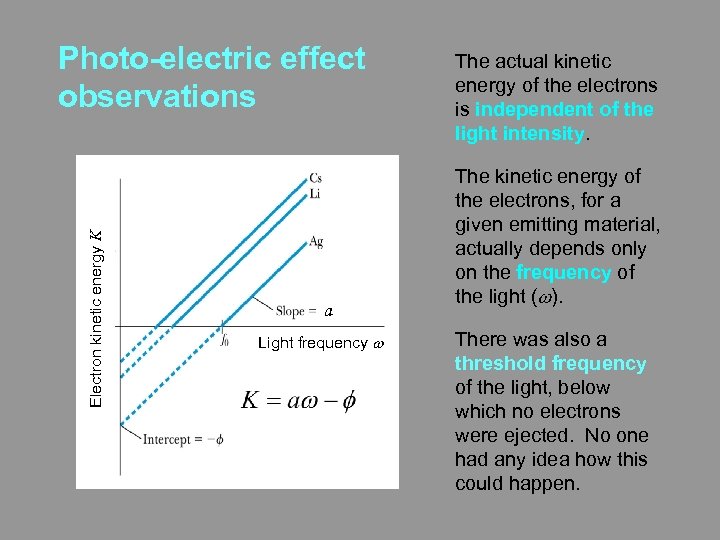 Electron kinetic energy K Photo-electric effect observations a Light frequency w The actual kinetic energy of the electrons is independent of the light intensity. The kinetic energy of the electrons, for a given emitting material, actually depends only on the frequency of the light (w). There was also a threshold frequency of the light, below which no electrons were ejected. No one had any idea how this could happen.
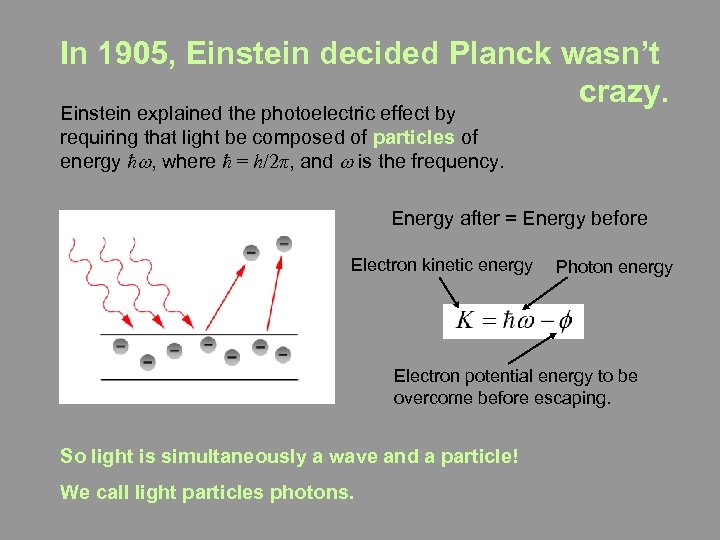 In 1905, Einstein decided Planck wasn’t crazy. Einstein explained the photoelectric effect by requiring that light be composed of particles of energy ħw, where ħ = h/2π, and w is the frequency. Energy after = Energy before Electron kinetic energy Photon energy Electron potential energy to be overcome before escaping. So light is simultaneously a wave and a particle! We call light particles photons.
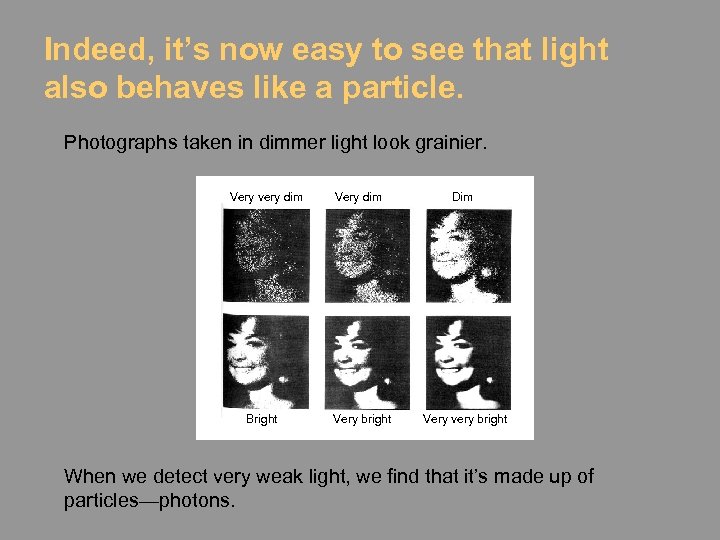 Indeed, it’s now easy to see that light also behaves like a particle. Photographs taken in dimmer light look grainier. Very very dim Bright Very dim Very bright Dim Very very bright When we detect very weak light, we find that it’s made up of particles—photons.
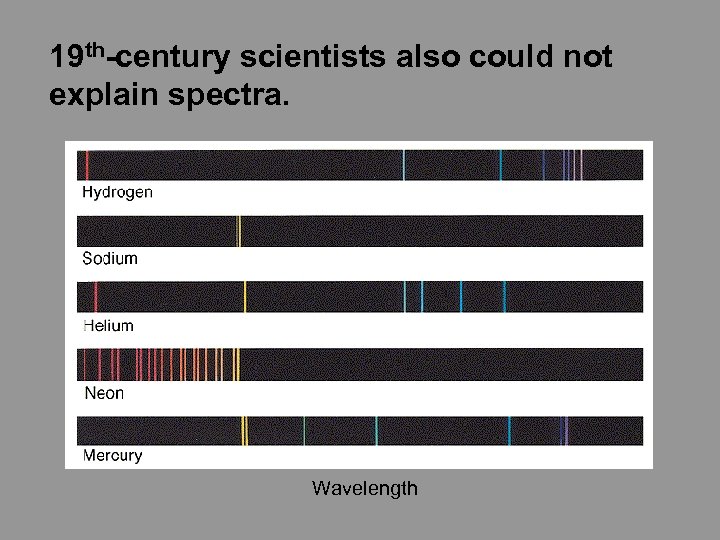 19 th-century scientists also could not explain spectra. Wavelength
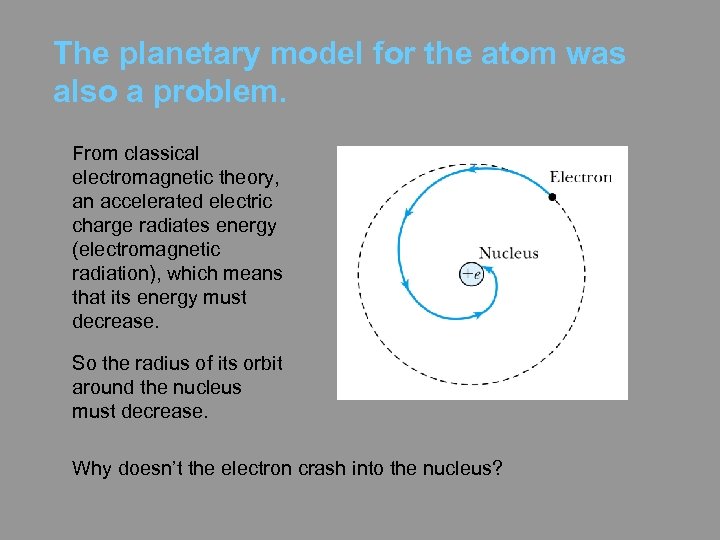 The planetary model for the atom was also a problem. From classical electromagnetic theory, an accelerated electric charge radiates energy (electromagnetic radiation), which means that its energy must decrease. So the radius of its orbit around the nucleus must decrease. Why doesn’t the electron crash into the nucleus?
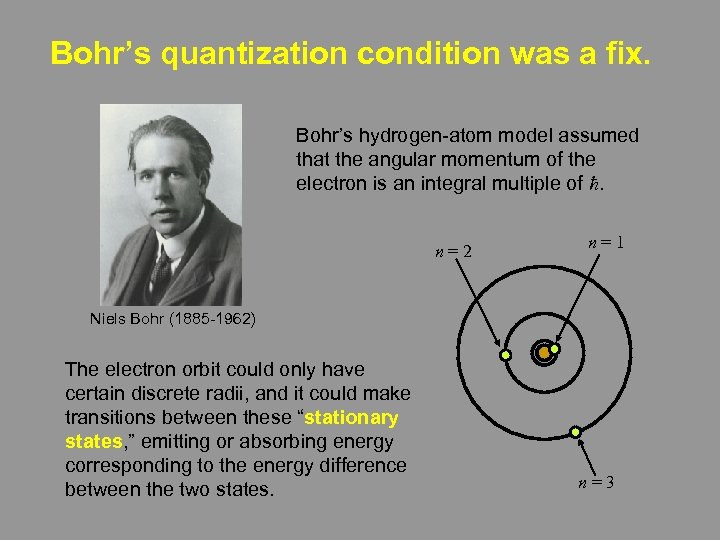 Bohr’s quantization condition was a fix. Bohr’s hydrogen-atom model assumed that the angular momentum of the electron is an integral multiple of ħ. n=2 n=1 Niels Bohr (1885 -1962) The electron orbit could only have certain discrete radii, and it could make transitions between these “stationary states, ” emitting or absorbing energy corresponding to the energy difference between the two states. n=3
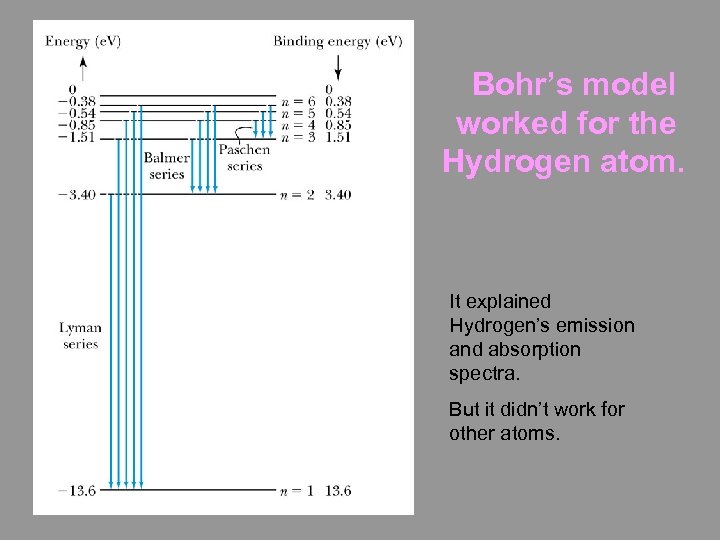 Bohr’s model worked for the Hydrogen atom. It explained Hydrogen’s emission and absorption spectra. But it didn’t work for other atoms.
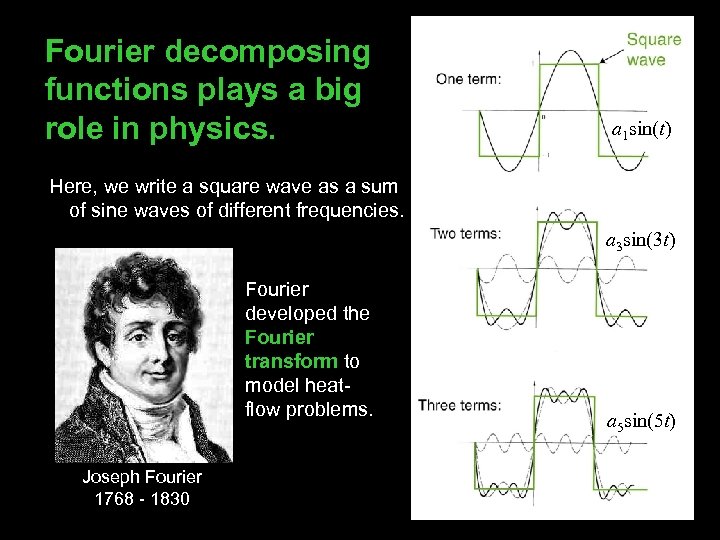 Fourier decomposing functions plays a big role in physics. a 1 sin(t) Here, we write a square wave as a sum of sine waves of different frequencies. a 3 sin(3 t) Fourier developed the Fourier transform to model heatflow problems. Joseph Fourier 1768 - 1830 a 5 sin(5 t)
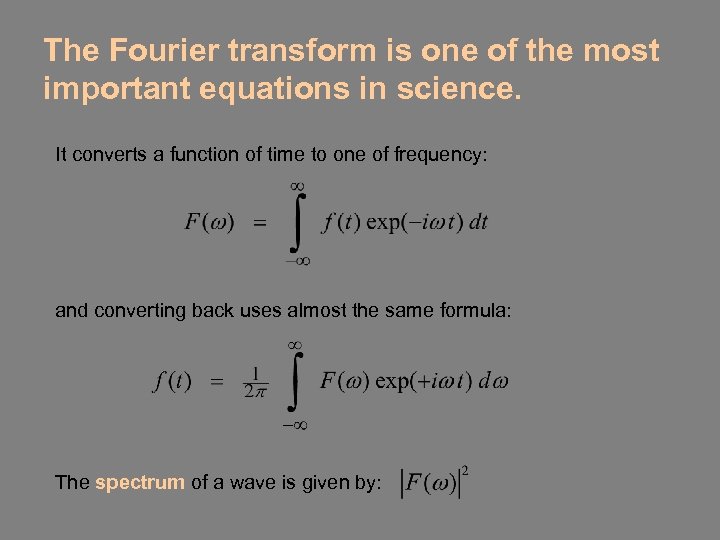 The Fourier transform is one of the most important equations in science. It converts a function of time to one of frequency: and converting back uses almost the same formula: The spectrum of a wave is given by:
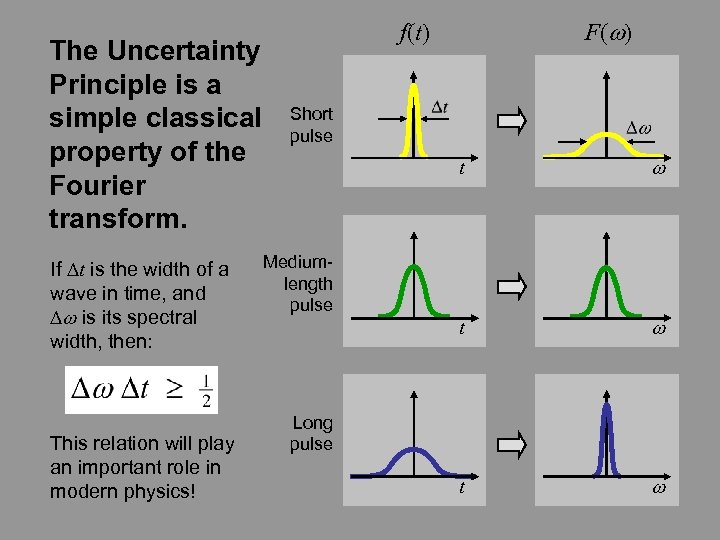 The Uncertainty Principle is a simple classical property of the Fourier transform. If Dt is the width of a wave in time, and Dw is its spectral width, then: This relation will play an important role in modern physics! F(w) f(t) Short pulse t w t w Mediumlength pulse Long pulse
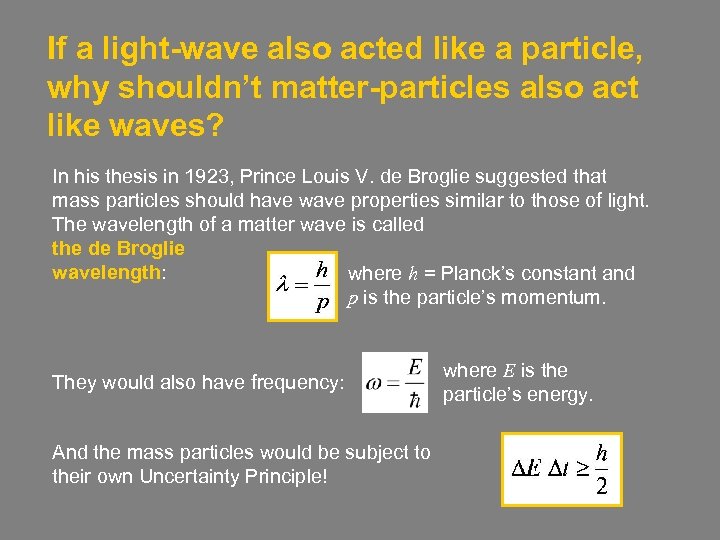 If a light-wave also acted like a particle, why shouldn’t matter-particles also act like waves? In his thesis in 1923, Prince Louis V. de Broglie suggested that mass particles should have wave properties similar to those of light. The wavelength of a matter wave is called the de Broglie wavelength: where h = Planck’s constant and p is the particle’s momentum. They would also have frequency: And the mass particles would be subject to their own Uncertainty Principle! where E is the particle’s energy.
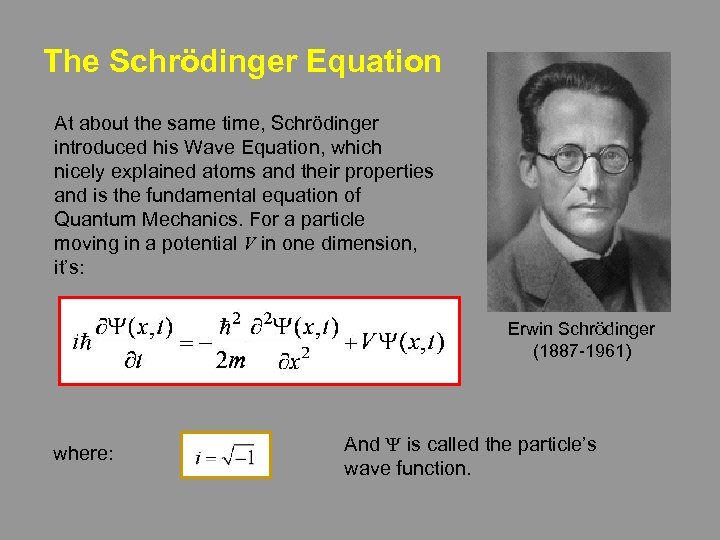 The Schrödinger Equation At about the same time, Schrödinger introduced his Wave Equation, which nicely explained atoms and their properties and is the fundamental equation of Quantum Mechanics. For a particle moving in a potential V in one dimension, it’s: Erwin Schrödinger (1887 -1961) where: And Y is called the particle’s wave function.
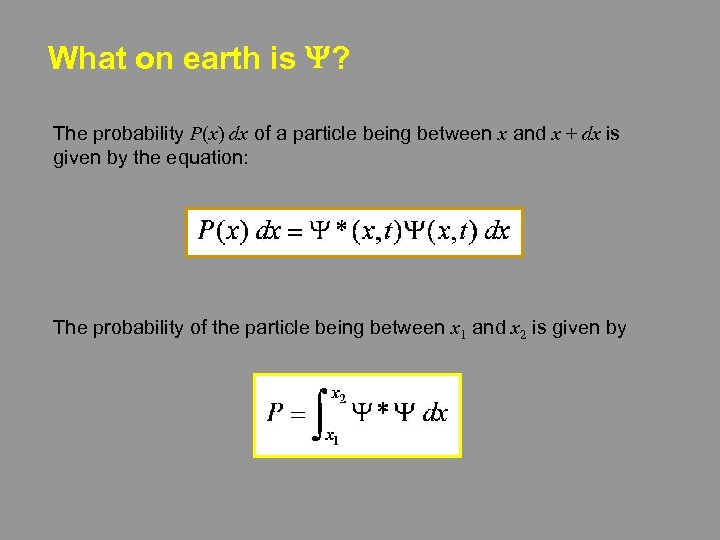 What on earth is Y? The probability P(x) dx of a particle being between x and x + dx is given by the equation: The probability of the particle being between x 1 and x 2 is given by
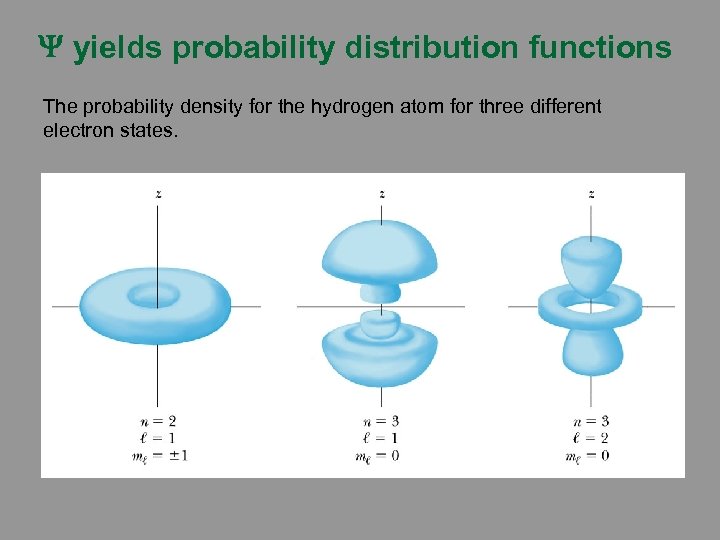 Y yields probability distribution functions The probability density for the hydrogen atom for three different electron states.
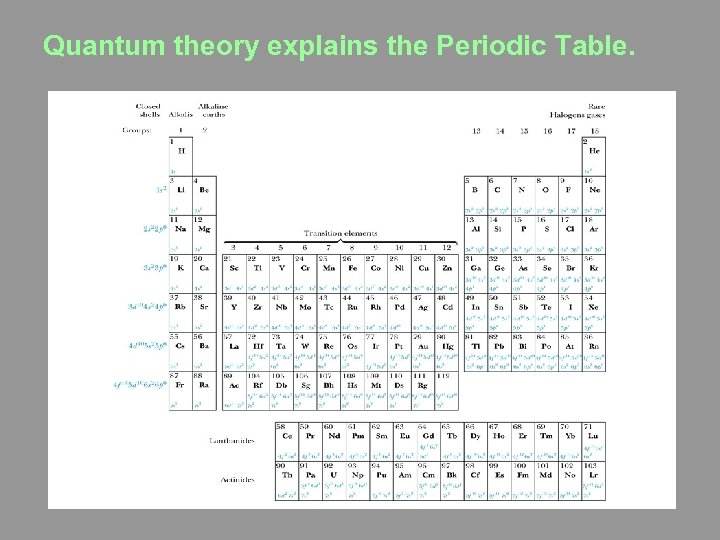 Quantum theory explains the Periodic Table.
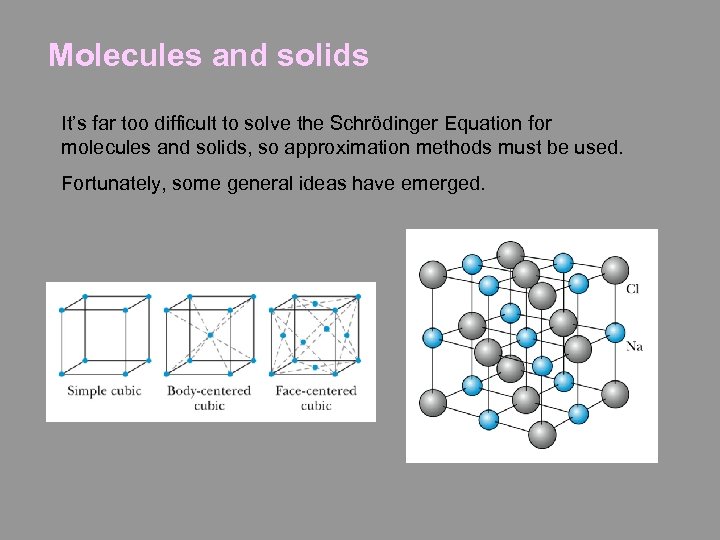 Molecules and solids It’s far too difficult to solve the Schrödinger Equation for molecules and solids, so approximation methods must be used. Fortunately, some general ideas have emerged.
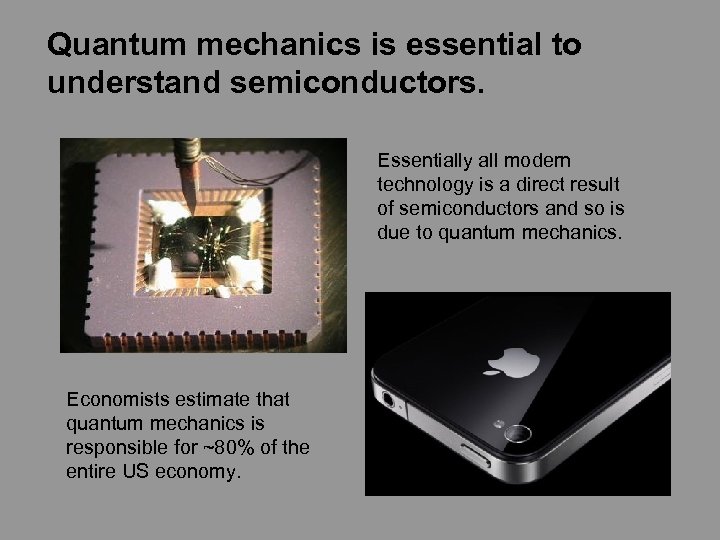 Quantum mechanics is essential to understand semiconductors. Essentially all modern technology is a direct result of semiconductors and so is due to quantum mechanics. Economists estimate that quantum mechanics is responsible for ~80% of the entire US economy.
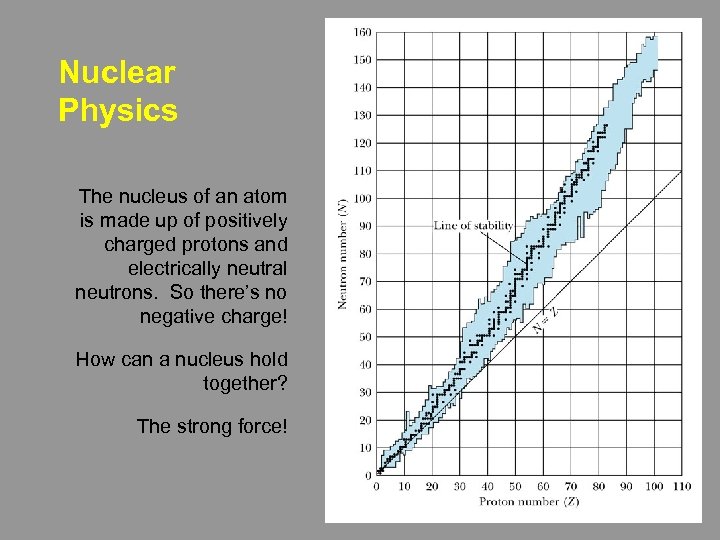 Nuclear Physics The nucleus of an atom is made up of positively charged protons and electrically neutral neutrons. So there’s no negative charge! How can a nucleus hold together? The strong force!
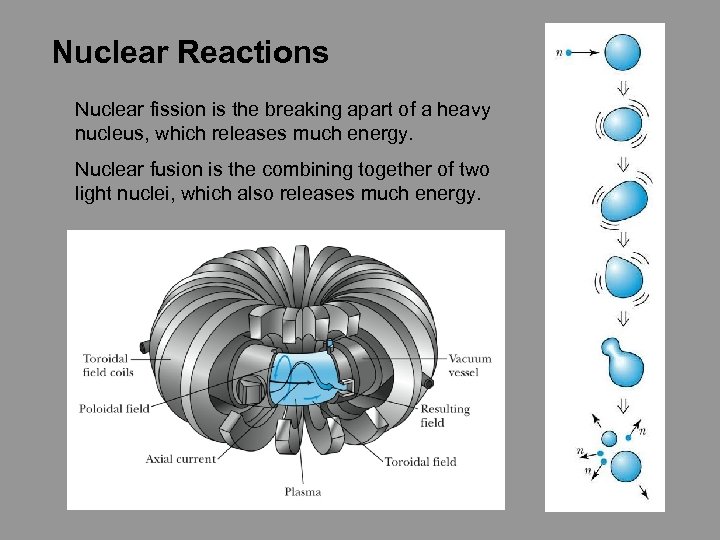 Nuclear Reactions Nuclear fission is the breaking apart of a heavy nucleus, which releases much energy. Nuclear fusion is the combining together of two light nuclei, which also releases much energy.
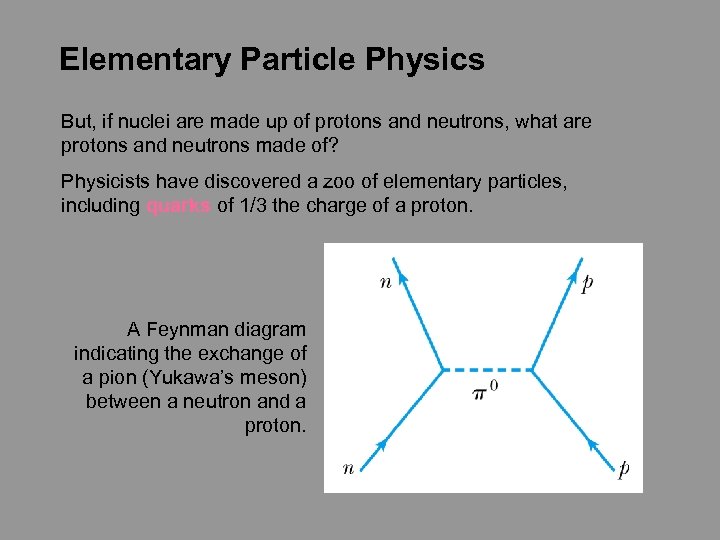 Elementary Particle Physics But, if nuclei are made up of protons and neutrons, what are protons and neutrons made of? Physicists have discovered a zoo of elementary particles, including quarks of 1/3 the charge of a proton. A Feynman diagram indicating the exchange of a pion (Yukawa’s meson) between a neutron and a proton.
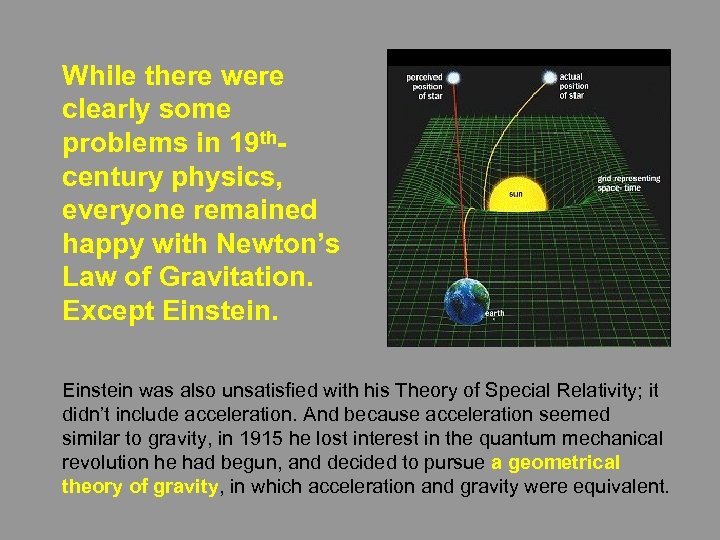 While there were clearly some problems in 19 thcentury physics, everyone remained happy with Newton’s Law of Gravitation. Except Einstein was also unsatisfied with his Theory of Special Relativity; it didn’t include acceleration. And because acceleration seemed similar to gravity, in 1915 he lost interest in the quantum mechanical revolution he had begun, and decided to pursue a geometrical theory of gravity, in which acceleration and gravity were equivalent.
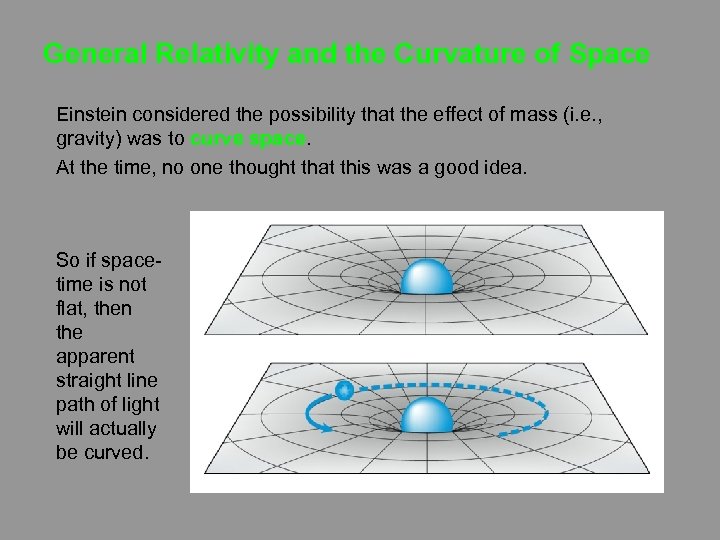 General Relativity and the Curvature of Space Einstein considered the possibility that the effect of mass (i. e. , gravity) was to curve space. At the time, no one thought that this was a good idea. So if spacetime is not flat, then the apparent straight line path of light will actually be curved.
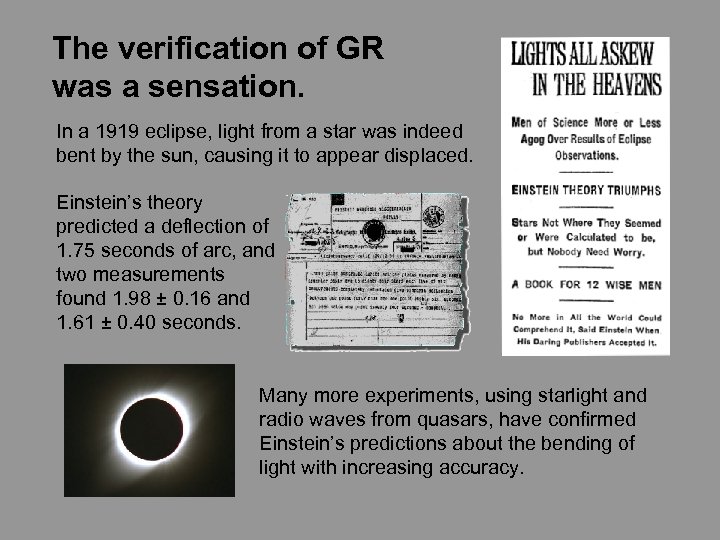 The verification of GR was a sensation. In a 1919 eclipse, light from a star was indeed bent by the sun, causing it to appear displaced. Einstein’s theory predicted a deflection of 1. 75 seconds of arc, and two measurements found 1. 98 ± 0. 16 and 1. 61 ± 0. 40 seconds. Many more experiments, using starlight and radio waves from quasars, have confirmed Einstein’s predictions about the bending of light with increasing accuracy.
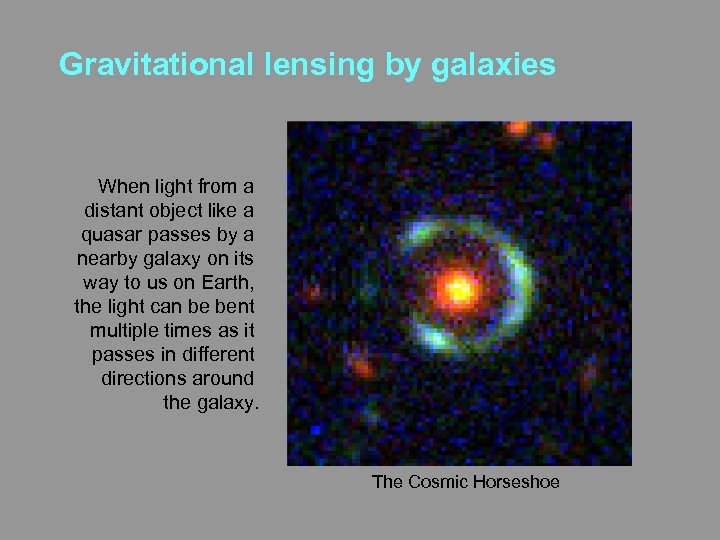 Gravitational lensing by galaxies When light from a distant object like a quasar passes by a nearby galaxy on its way to us on Earth, the light can be bent multiple times as it passes in different directions around the galaxy. The Cosmic Horseshoe
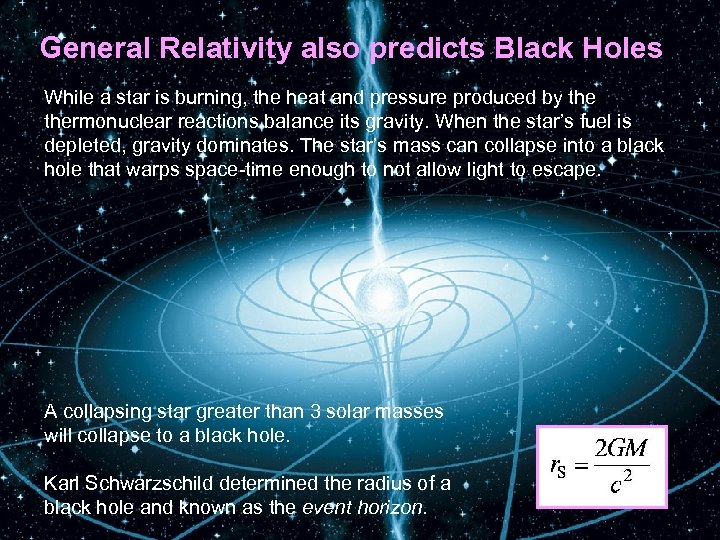 General Relativity also predicts Black Holes While a star is burning, the heat and pressure produced by thermonuclear reactions balance its gravity. When the star’s fuel is depleted, gravity dominates. The star’s mass can collapse into a black hole that warps space-time enough to not allow light to escape. A collapsing star greater than 3 solar masses will collapse to a black hole. Karl Schwarzschild determined the radius of a black hole and known as the event horizon.
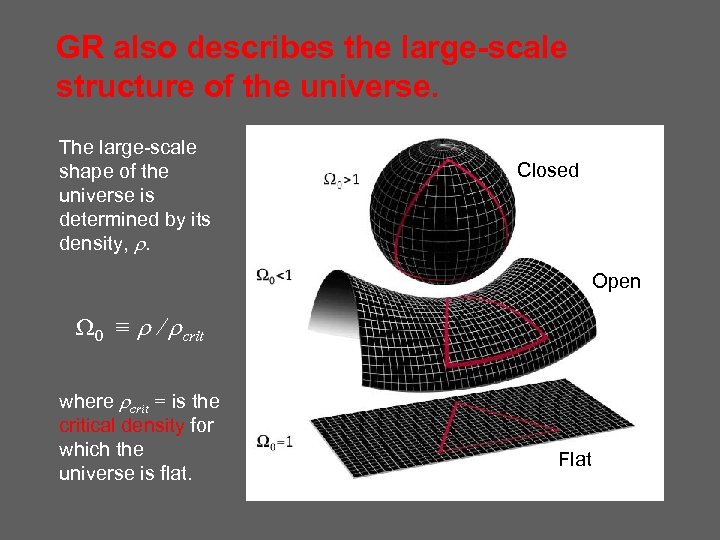 GR also describes the large-scale structure of the universe. The large-scale shape of the universe is determined by its density, r. Closed Open W 0 ≡ r / rcrit where rcrit = is the critical density for which the universe is flat. Flat
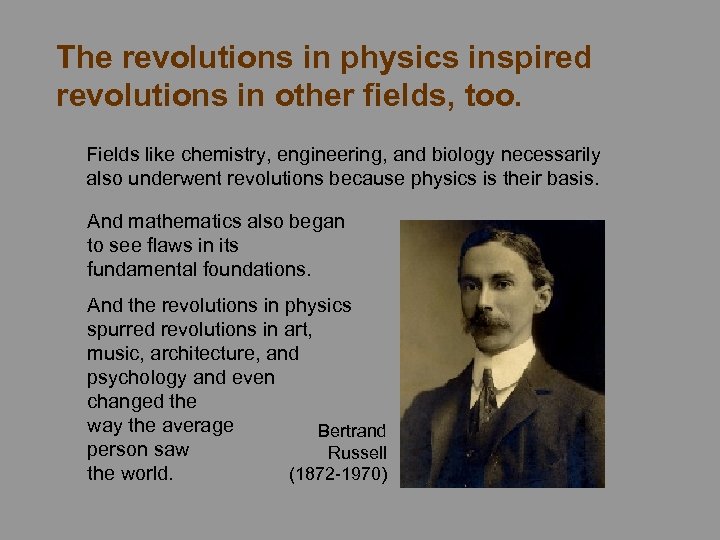 The revolutions in physics inspired revolutions in other fields, too. Fields like chemistry, engineering, and biology necessarily also underwent revolutions because physics is their basis. And mathematics also began to see flaws in its fundamental foundations. And the revolutions in physics spurred revolutions in art, music, architecture, and psychology and even changed the way the average Bertrand person saw Russell the world. (1872 -1970)
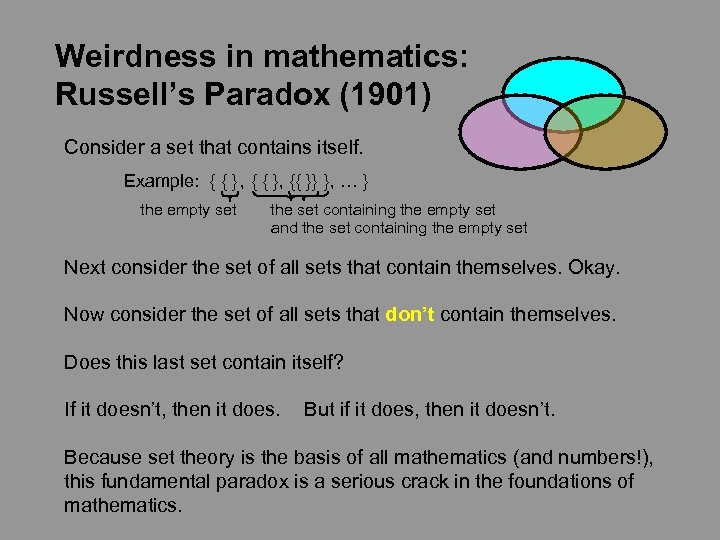 Weirdness in mathematics: Russell’s Paradox (1901) Consider a set that contains itself. {{ }} Example: { , , … } { { }, } the empty set the set containing the empty set and the set containing the empty set Next consider the set of all sets that contain themselves. Okay. Now consider the set of all sets that don’t contain themselves. Does this last set contain itself? If it doesn’t, then it does. But if it does, then it doesn’t. Because set theory is the basis of all mathematics (and numbers!), this fundamental paradox is a serious crack in the foundations of mathematics.
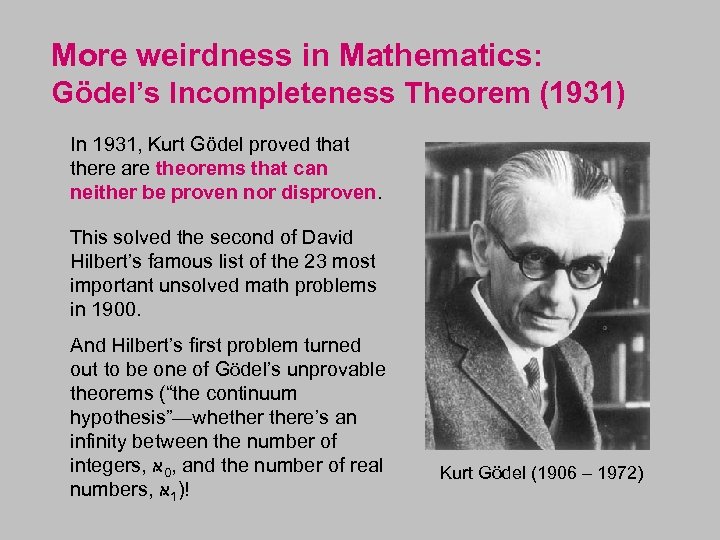 More weirdness in Mathematics: Gödel’s Incompleteness Theorem (1931) In 1931, Kurt Gödel proved that there are theorems that can neither be proven nor disproven. This solved the second of David Hilbert’s famous list of the 23 most important unsolved math problems in 1900. And Hilbert’s first problem turned out to be one of Gödel’s unprovable theorems (“the continuum hypothesis”—whethere’s an infinity between the number of integers, , 0אּ and the number of real numbers, !)1אּ Kurt Gödel (1906 – 1972)
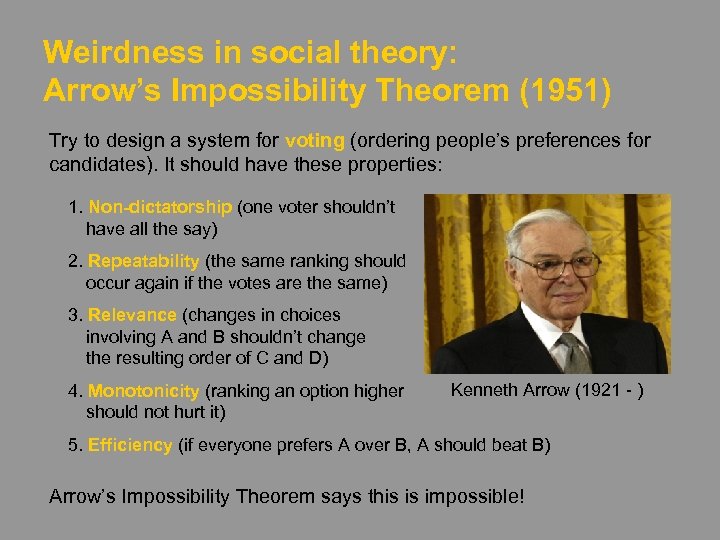 Weirdness in social theory: Arrow’s Impossibility Theorem (1951) Try to design a system for voting (ordering people’s preferences for candidates). It should have these properties: 1. Non-dictatorship (one voter shouldn’t have all the say) 2. Repeatability (the same ranking should occur again if the votes are the same) 3. Relevance (changes in choices involving A and B shouldn’t change the resulting order of C and D) 4. Monotonicity (ranking an option higher should not hurt it) Kenneth Arrow (1921 - ) 5. Efficiency (if everyone prefers A over B, A should beat B) Arrow’s Impossibility Theorem says this is impossible!
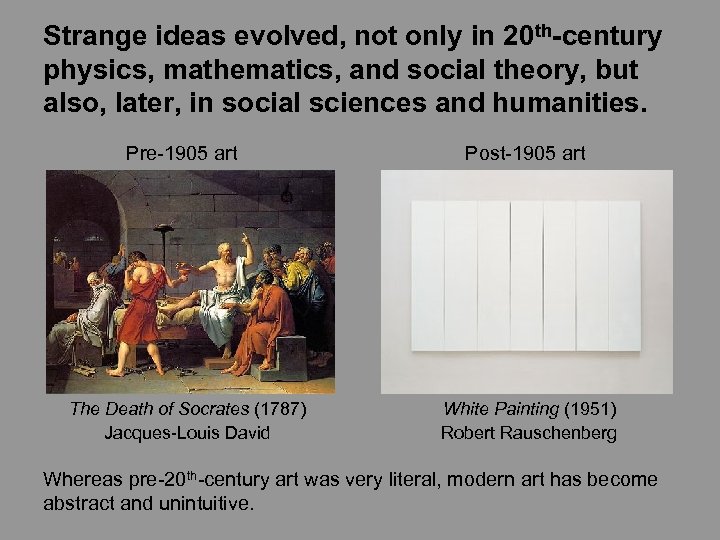 Strange ideas evolved, not only in 20 th-century physics, mathematics, and social theory, but also, later, in social sciences and humanities. Pre-1905 art The Death of Socrates (1787) Jacques-Louis David Post-1905 art White Painting (1951) Robert Rauschenberg Whereas pre-20 th-century art was very literal, modern art has become abstract and unintuitive.
![Modern art is getting weirder and weirder. “Light in [an empty] room turning on](https://present5.com/presentation/93dc0d9865d7c51301306b118b741d6f/image-54.jpg "Modern art is getting weirder and weirder. “Light in [an empty] room turning on") Modern art is getting weirder and weirder. “Light in [an empty] room turning on and off” won the top British art prize (The Turner Prize, £ 20, 000) in 2001. And this is one of the least bizarre winners of this prize. Martin Creed Winner of prize
Modern art is getting weirder and weirder. “Light in [an empty] room turning on and off” won the top British art prize (The Turner Prize, £ 20, 000) in 2001. And this is one of the least bizarre winners of this prize. Martin Creed Winner of prize
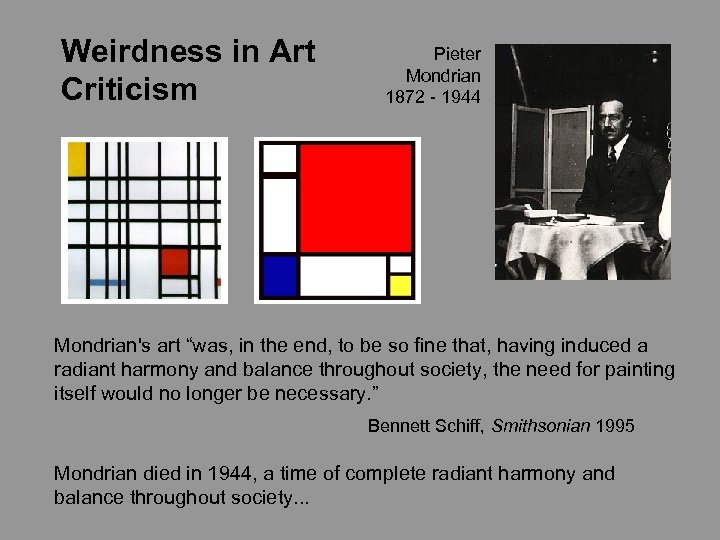 Weirdness in Art Criticism Pieter Mondrian 1872 - 1944 Mondrian's art “was, in the end, to be so fine that, having induced a radiant harmony and balance throughout society, the need for painting itself would no longer be necessary. ” Bennett Schiff, Smithsonian 1995 Mondrian died in 1944, a time of complete radiant harmony and balance throughout society. . .
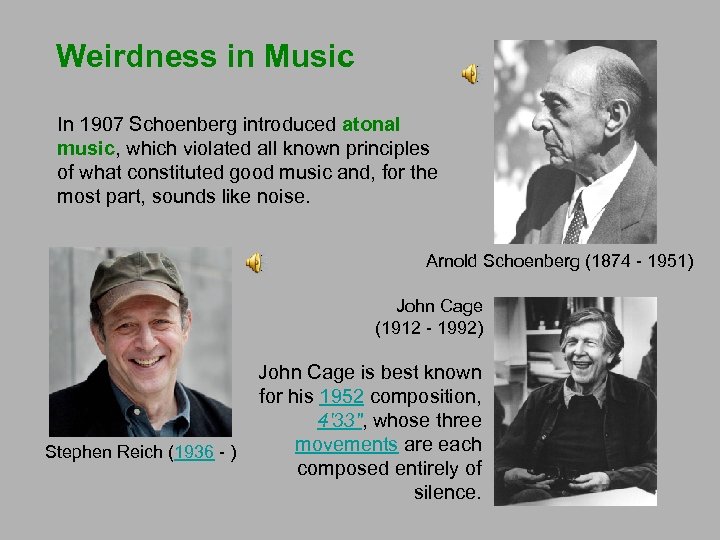 Weirdness in Music In 1907 Schoenberg introduced atonal music, which violated all known principles of what constituted good music and, for the most part, sounds like noise. Arnold Schoenberg (1874 - 1951) John Cage (1912 - 1992) John Cage is best known for his 1952 composition, 4'33", whose three movements are each Stephen Reich (1936 - ) composed entirely of silence.
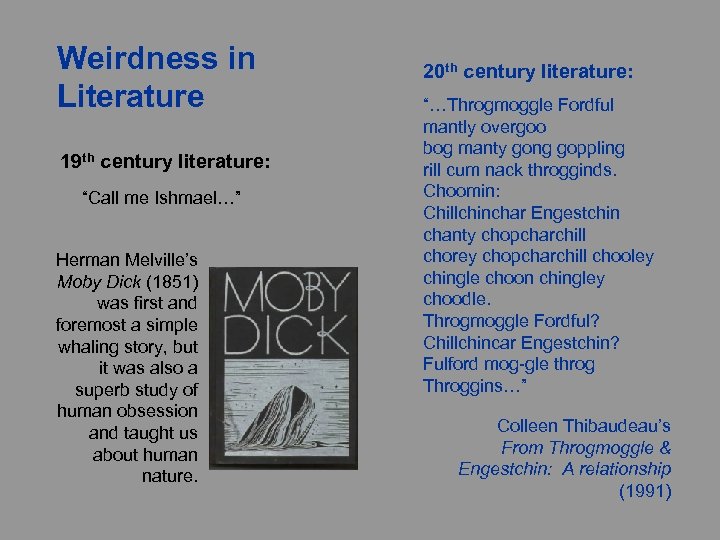 Weirdness in Literature 19 th century literature: “Call me Ishmael…” Herman Melville’s Moby Dick (1851) was first and foremost a simple whaling story, but it was also a superb study of human obsession and taught us about human nature. 20 th century literature: “…Throgmoggle Fordful mantly overgoo bog manty gong goppling rill cum nack throgginds. Choomin: Chillchinchar Engestchin chanty chopcharchill chorey chopcharchill chooley chingle choon chingley choodle. Throgmoggle Fordful? Chillchincar Engestchin? Fulford mog-gle throg Throggins…” Colleen Thibaudeau’s From Throgmoggle & Engestchin: A relationship (1991)
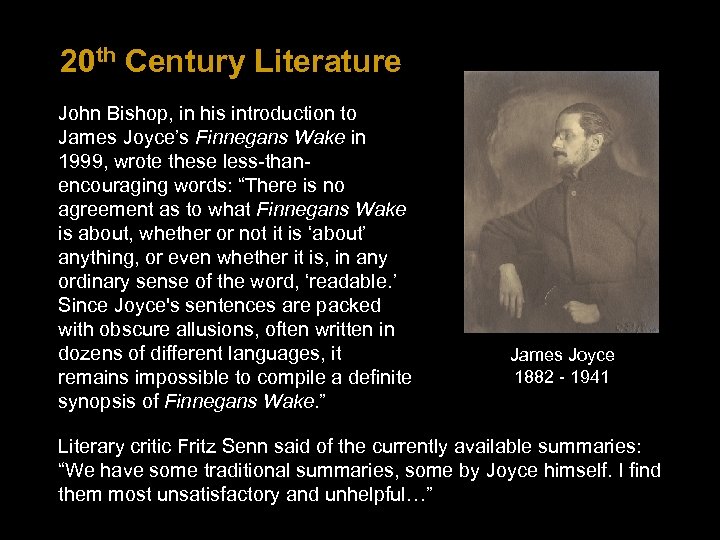 20 th Century Literature John Bishop, in his introduction to James Joyce’s Finnegans Wake in 1999, wrote these less-thanencouraging words: “There is no agreement as to what Finnegans Wake is about, whether or not it is ‘about’ anything, or even whether it is, in any ordinary sense of the word, ‘readable. ’ Since Joyce's sentences are packed with obscure allusions, often written in dozens of different languages, it remains impossible to compile a definite synopsis of Finnegans Wake. ” James Joyce 1882 - 1941 Literary critic Fritz Senn said of the currently available summaries: “We have some traditional summaries, some by Joyce himself. I find them most unsatisfactory and unhelpful…”
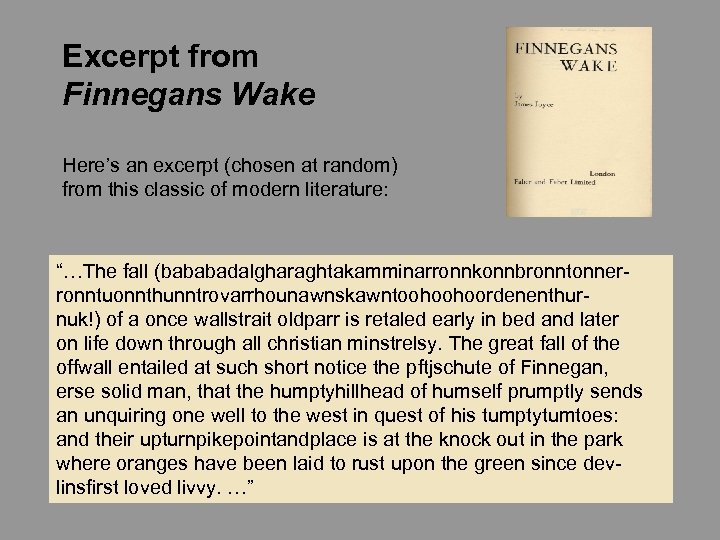 Excerpt from Finnegans Wake Here’s an excerpt (chosen at random) from this classic of modern literature: “…The fall (bababadalgharaghtakamminarronnkonnbronntonnerronntuonnthunntrovarrhounawnskawntoohoohoordenenthurnuk!) of a once wallstrait oldparr is retaled early in bed and later on life down through all christian minstrelsy. The great fall of the offwall entailed at such short notice the pftjschute of Finnegan, erse solid man, that the humptyhillhead of humself prumptly sends an unquiring one well to the west in quest of his tumptytumtoes: and their upturnpikepointandplace is at the knock out in the park where oranges have been laid to rust upon the green since devlinsfirst loved livvy. …”
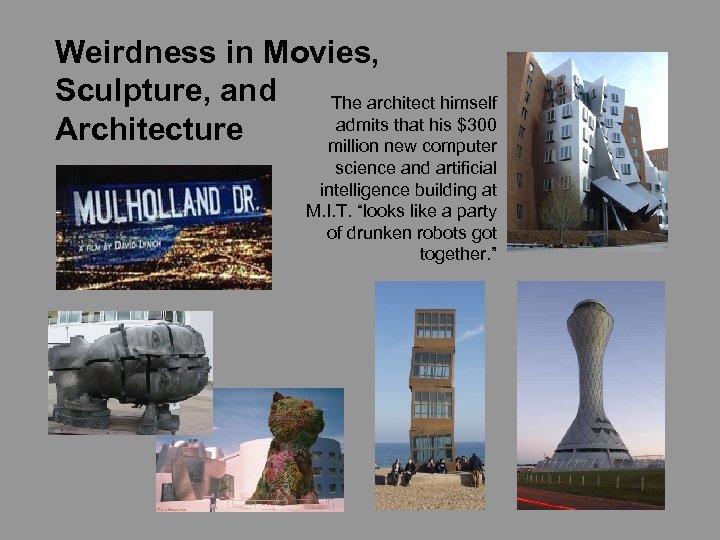 Weirdness in Movies, Sculpture, and The architect himself admits that his $300 Architecture million new computer science and artificial intelligence building at M. I. T. “looks like a party of drunken robots got together. ”
 To read more about weirdness in modern art and architecture… Artists and architects hate these two books…
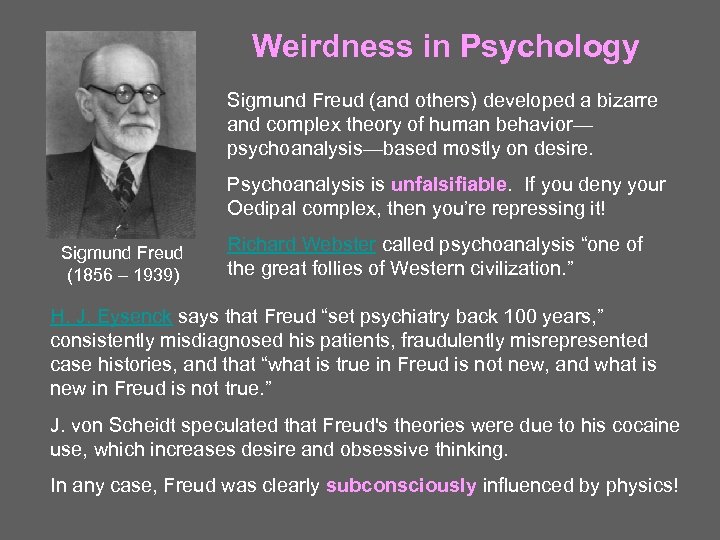 Weirdness in Psychology Sigmund Freud (and others) developed a bizarre and complex theory of human behavior— psychoanalysis—based mostly on desire. Psychoanalysis is unfalsifiable. If you deny your Oedipal complex, then you’re repressing it! Sigmund Freud (1856 – 1939) Richard Webster called psychoanalysis “one of the great follies of Western civilization. ” H. J. Eysenck says that Freud “set psychiatry back 100 years, ” consistently misdiagnosed his patients, fraudulently misrepresented case histories, and that “what is true in Freud is not new, and what is new in Freud is not true. ” J. von Scheidt speculated that Freud's theories were due to his cocaine use, which increases desire and obsessive thinking. In any case, Freud was clearly subconsciously influenced by physics!
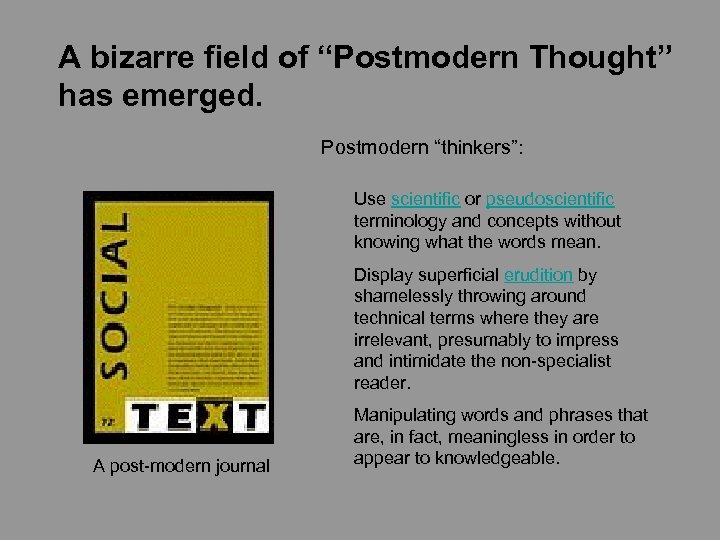 A bizarre field of “Postmodern Thought” has emerged. Postmodern “thinkers”: Use scientific or pseudoscientific terminology and concepts without knowing what the words mean. Display superficial erudition by shamelessly throwing around technical terms where they are irrelevant, presumably to impress and intimidate the non-specialist reader. A post-modern journal Manipulating words and phrases that are, in fact, meaningless in order to appear to knowledgeable.
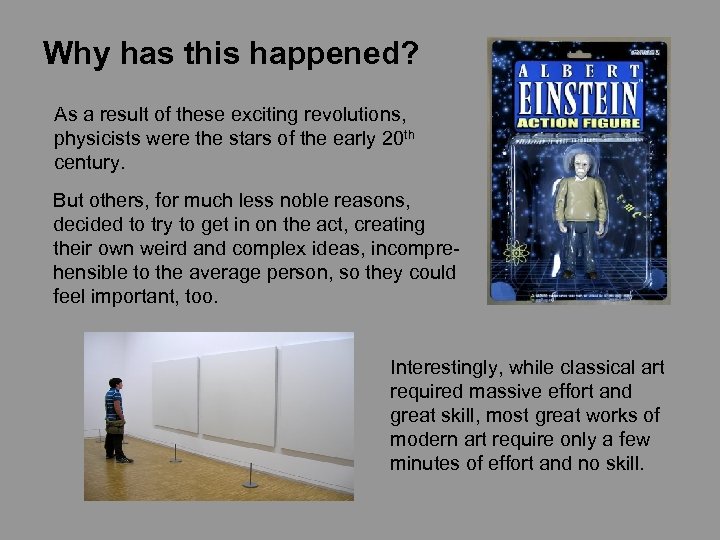 Why has this happened? As a result of these exciting revolutions, physicists were the stars of the early 20 th century. But others, for much less noble reasons, decided to try to get in on the act, creating their own weird and complex ideas, incomprehensible to the average person, so they could feel important, too. Interestingly, while classical art required massive effort and great skill, most great works of modern art require only a few minutes of effort and no skill.
 Genuine vs. Artificial Revolutions The revolutions in physics were the result of new experiments and observations and so were forced upon us by the world around us. That they involved weird ideas that average people couldn’t understand is due to the fact that the universe is, in fact, weird. The “revolutions” in art, architecture, literature, psychology, and music were the result of simple arrogance of the practitioners and their desire to have their own unintuitive ideas that only they could “understand”—what I call Physics Envy. Indeed, Schoenberg himself stated that he wanted to do for music what Einstein did for physics. But these other “revolutions” nicely illustrate the dramatic effects on others of the genuine revolutions that occurred in physics.
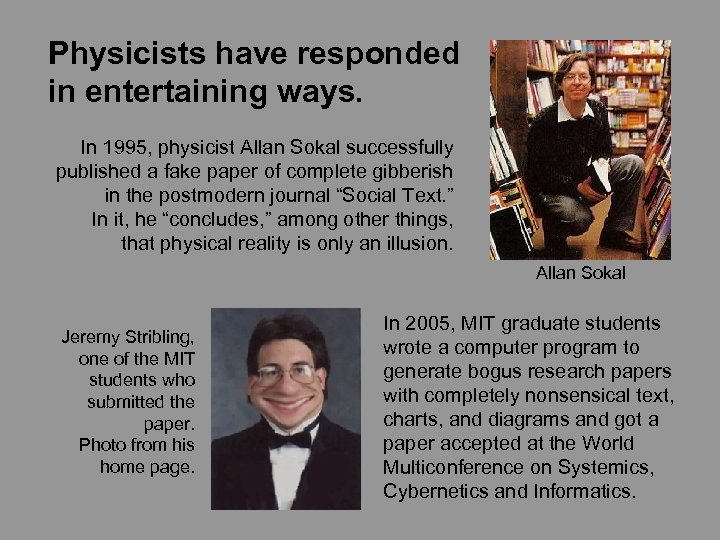 Physicists have responded in entertaining ways. In 1995, physicist Allan Sokal successfully published a fake paper of complete gibberish in the postmodern journal “Social Text. ” In it, he “concludes, ” among other things, that physical reality is only an illusion. Allan Sokal Jeremy Stribling, one of the MIT students who submitted the paper. Photo from his home page. In 2005, MIT graduate students wrote a computer program to generate bogus research papers with completely nonsensical text, charts, and diagrams and got a paper accepted at the World Multiconference on Systemics, Cybernetics and Informatics.