Скачать презентацию MODERN METHODS OF TEACHING ENGLISH MOTIVATION AND TYPES
Modern Methods of Teaching English Motivaton and Types of Learners.pptx
- Количество слайдов: 20
 MODERN METHODS OF TEACHING ENGLISH: MOTIVATION AND TYPES OF LEARNING PRESENTED BY ASSOCIATE PROFESSOR OF THE DEPARTMENT OF FL FOR HUMANITIES A. L. ARTSYSHEVSKA
 • Three major steps of TFL the process of teaching a foreign language is a complex one. It usually involves three major steps: the teaching acts of presenting and explaining new material, providing practice and testing.
 The success of the process of teaching and learning largely depends on the participants – teachers and students – who have their own needs, roles, and responsibilities. It is teachers’ responsibility to identify and address the needs of their students.
 Motivation, as a key factor in the process of learning and teaching, is defined as some kind of internal drive which pushes someone to do things in order to achieve something. Harmer, ( 2001, 51). Ur (1997, 276) presents the following kinds of motivation: extrinsic, integrative, instrumental, global, situational and task motivation.
 Extrinsic Motivation Extrinsic motivation to learn a foreign language is caused by a number of outside factors such as the desire to pass an examination or the possibility of future travel.
 Intrinsic Motivation Intrinsic motivation comes from within the individual who is driven by the enjoyment of the learning process.
 Integrative. Motivation Integrative motivation involves the desire to identify with and integrate into the culture of the language one is studying.
 Instrumental Motivation Instrumental motivation is the wish to learn the language for purposes of study or career promotion.
 Global Motivation Global motivation is defined as the overall orientation of the learner towards the learning of the foreign language.
 Situational Motivation Situational motivation is the motivation caused by the context of learning such as classroom or school environment.
 Task Motivation Task motivation concerns the way the learner approaches the specific task given by the teacher.
 The Major Sources of Motivation The major sources of motivation to learn a foreign language, as pointed out by Harmer (2001, 52), are the society we live in, attitude of parents, older siblings, peers, the teacher and the method used. Harmer (op. cit. , 52) emphasizes the importance of the teacher, who is a major factor in the continuance of students’ motivation, and the method used in the teaching process. According to Ur (1997, 275), the successful learner is the one who is willing to tackle tasks and challenges, has confidence in his/her success, has a need to achieve, to overcome difficulties and succeed in what he/she is doing, is ambitious and finds important to succeed in learning in order to maintain and promote his/her own positive image, is aware of the goals of learning, invests high level of effort in learning, and is not discouraged by setbacks or lack of progress.
 LEARNING STYLES OF STUDENTS Appropriately selected tasks and methods can generate students’ motivation. The appeal of methods is extended if methods are selected according to students’ learning styles. Learning style refers to any individual’s preferred ways of learning. It depends on the student’s personality, including psychological or cognitive character, sociocultural background and educational experience.
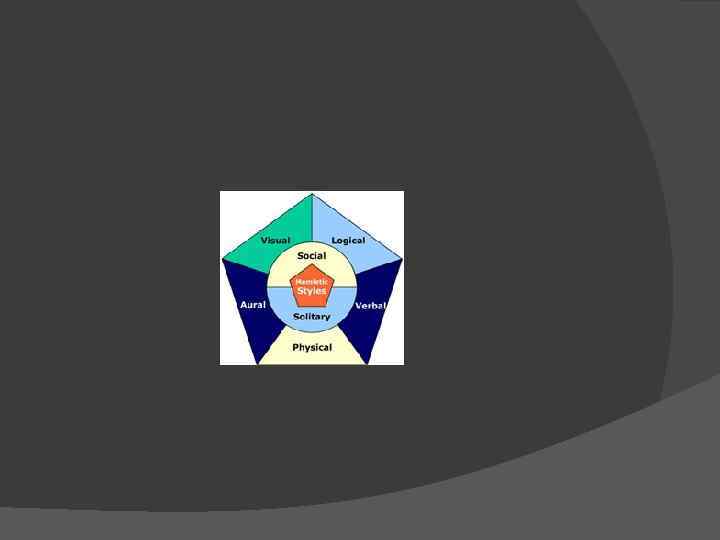
 TYPES OF LEARNERS According to learning styles, all learners can be divided into visual, auditory, kinaesthetic learners logical verbal.
 Visual Learners Visual learners learn better when they can read or see the information. They usually have a strong sense of colour, they follow written directions well and use visualization to remember things, they love to read, remember quickly and easily what is read, and read well from picture clues. However, they process auditory input slowly and are distracted by noise or people talking in the background. They become impatient when extensive listening is required. According to Honey & Mumford (1992), visual learners comprise 65 % of all learners.
 Auditory Learners Auditory learners learn better when the information primarily comes through their ears. Auditory learners (30% of all learners) tend to remember and repeat ideas that are verbally presented. They learn well through lectures and like to talk to others. They enjoy plays, dialogues, dramas and they like to make speeches and presentations. However, they usually cannot keep quiet for a longer time.
 KINAESTHETIC LEARNERS It's likely that you use your body and sense of touch to learn about the world around you. It's likely you like sports and exercise, and other physical activities such as gardening or woodworking. You like to think out issues, ideas and problems while you exercise. You would rather go for a run or walk if something is bothering you, rather than sitting at home.
 LOGICAL LEARNERS Mathematical logical learning style is one of eight types of learning styles, or intelligences, defined in Howard Gardner's theory of Multiple Intelligences. Mathematical Logical learning style refers to a person's ability to reason, solve problems, and learn using numbers, abstract visual information, and analysis of cause and effect relationships. Mathematical logical learners are typically methodical and think in logical or linear order. They may be adept at solving math problems in their heads and are drawn to logic puzzles and games. People with mathematical logical learning styles learn best when taught using visual materials, computers, statistical and analytical programs, and hands on projects. They prefer structured, goal-oriented activities that are based on math reasoning rather than less structured, creative activities with inexact learning goals. Mathematical logical learners would find a statistical study more appealing than analyzing literature or keeping a journal.
 VERBAL LEARNERS Linguistic intelligence or verbal this is where an individual responds best through auditory methods of teaching. Essentially, this is verbal learning, where a student will learn most efficiently from listening to people and taking in information. It means an individual has an ability to solve complex problems, come to conclusions and learn overall using language alone. Hence, those who prefer verbal learning will be particularly talented from an early age when it comes to reading and writing. Verbal learners will be able to express themselves, their problems, and solutions to problems through words. Oftentimes, also, they will have particularly good memories, as verbal learning involves taking in a lot of information in short periods of time and retaining it. Individuals who prefer verbal learning usually also have a fascination with the arts, music and lyrics, legal documents, old-world writings, politics, screenplay and novels. These kinds of learners will also enjoy using language creatively, through fiction and poetry and even through contemporary art in some cases. Linguistic learners appreciate language to be complex and thoroughly interesting, and for any people, one language is not enough. Verbal learners often learn numerous other languages in an effort to increase their knowledge, their wisdom, and their ability to use words to communicate with a larger audience during their lifetime.