


 Скачать презентацию Modern information retrieval Chapter 8 Indexing and
0f120f40957c58526640b6c61d51d91c.ppt
- Количество слайдов: 52
 Modern information retrieval Chapter 8 – Indexing and Searching
 Indexing and Searching TOC • Indexing techniques: – Inverted files – Suffix arrays – Signature files • Technique used to search each type of index • Other searching techniques 2
 Motivation • Just like in traditional RDBMSs searching for data • • • may be costly In a RDB one can take (a lot of) advantage from the well defined structure of (and constraints on) the data Linear scan of the data is not feasible for nontrivial datasets (real life) Indices are not optional in IR (not meaning that they are in RDBMS) 3
 Motivation • Traditional indices, e. g. , B-trees, are not well suited for IR • Main approaches: – Inverted files (or lists) – Suffix arrays – Signature files 4
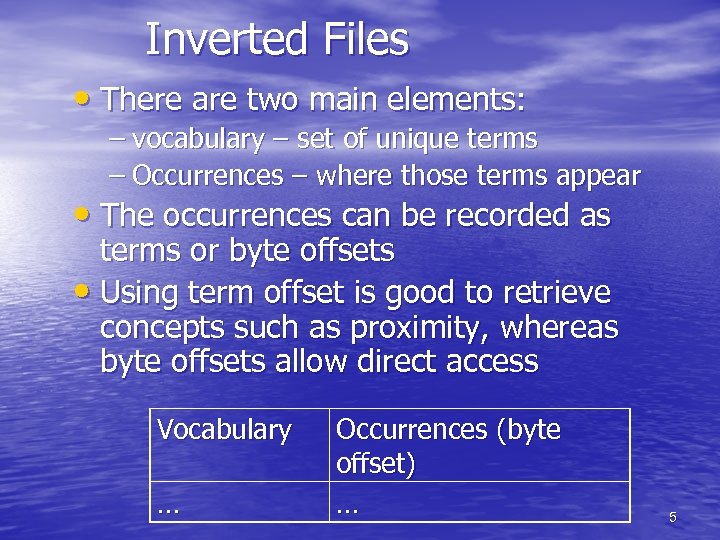 Inverted Files • There are two main elements: – vocabulary – set of unique terms – Occurrences – where those terms appear • The occurrences can be recorded as terms or byte offsets • Using term offset is good to retrieve concepts such as proximity, whereas byte offsets allow direct access Vocabulary … Occurrences (byte offset) … 5
 Inverted Files • The number of indexed terms is often several • • orders of magnitude smaller when compared to the documents size (Mbs vs Gbs) The space consumed by the occurrence list is not trivial. Each time the term appears it must be added to a list in the inverted file That may lead to a quite considerable index overhead 6
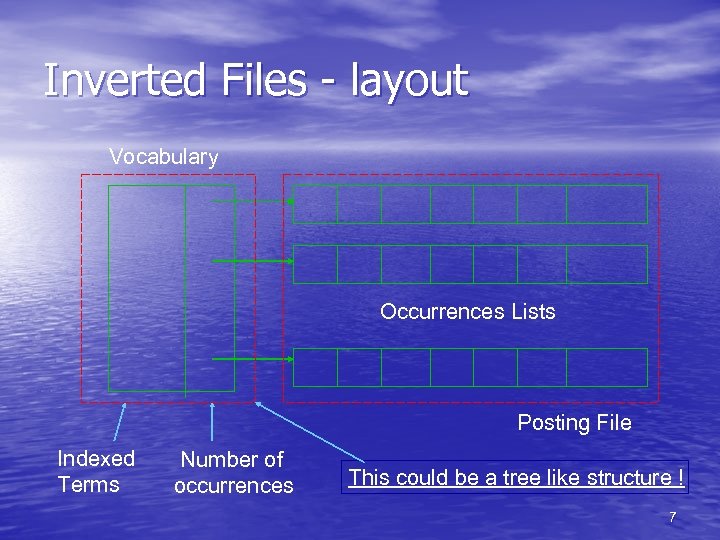 Inverted Files - layout Vocabulary Occurrences Lists Posting File Indexed Terms Number of occurrences This could be a tree like structure ! 7
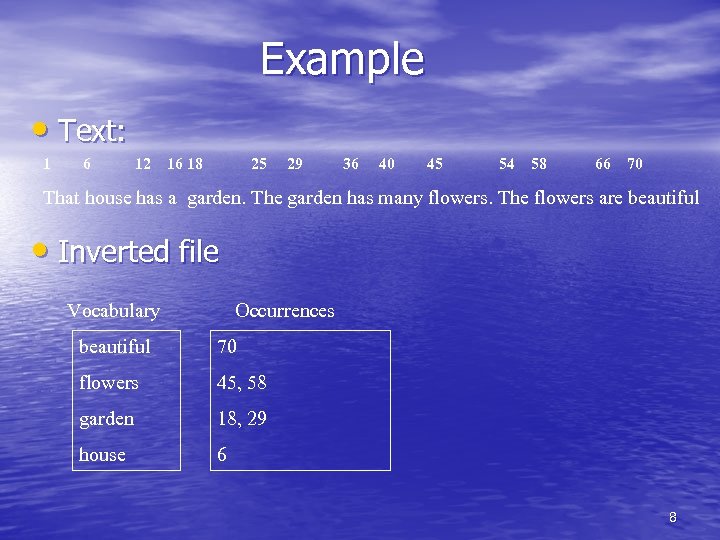 Example • Text: 1 6 12 16 18 25 29 36 40 45 54 58 66 70 That house has a garden. The garden has many flowers. The flowers are beautiful • Inverted file Vocabulary Occurrences beautiful 70 flowers 45, 58 garden 18, 29 house 6 8
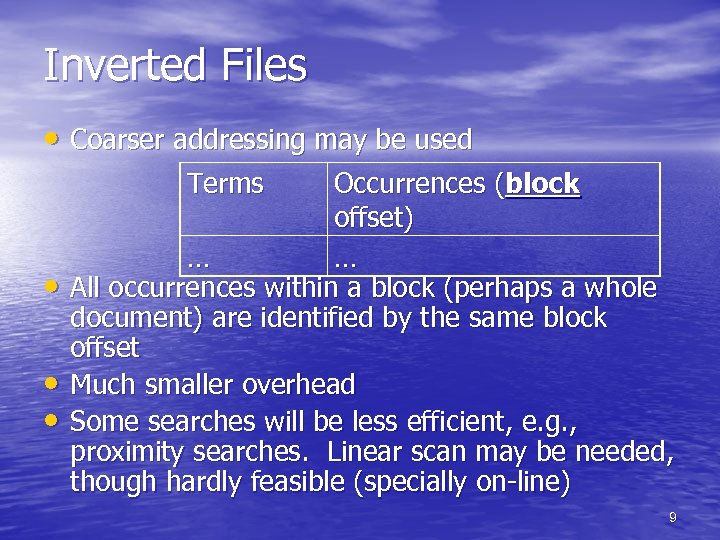 Inverted Files • Coarser addressing may be used Terms • • • Occurrences (block offset) … … All occurrences within a block (perhaps a whole document) are identified by the same block offset Much smaller overhead Some searches will be less efficient, e. g. , proximity searches. Linear scan may be needed, though hardly feasible (specially on-line) 9
 Space Requirements • The space required for the vocabulary is rather • • small. According to Heaps’ law the vocabulary grows as O(n ), where is a constant between 0. 4 and 0. 6 in practice On the other hand, the occurrences demand much more space. Since each word appearing in the text is referenced once in that structure, the extra space is O(n) To reduce space requirements, a technique called block addressing is used 10
 Block Addressing • The text is divided in blocks • The occurrences point to the blocks where the word appears • Advantages: – the number of pointers is smaller than positions – all the occurrences of a word inside a single block are collapsed to one reference • Disadvantages: – online search over the qualifying blocks if exact positions are required 11
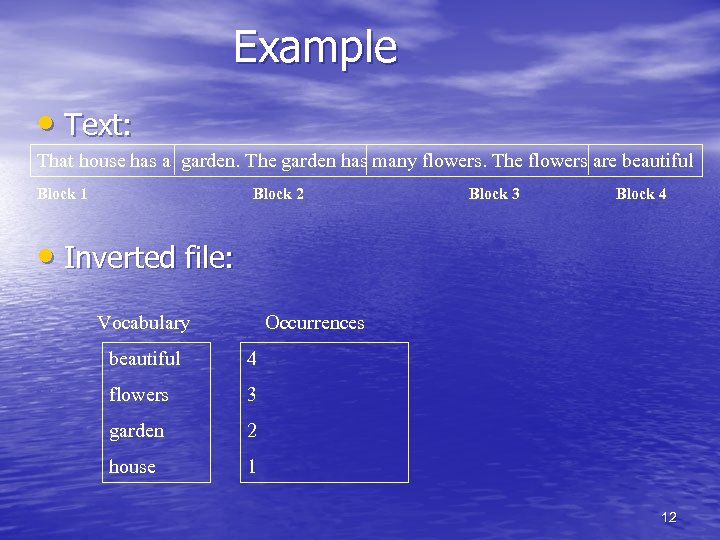 Example • Text: That house has a garden. The garden has many flowers. The flowers are beautiful Block 1 Block 2 Block 3 Block 4 • Inverted file: Vocabulary Occurrences beautiful 4 flowers 3 garden 2 house 1 12
 Inverted Files - construction • Building the index in main memory is not • • feasible (wouldn’t fit, and swapping would be unbearable) Building it entirely in disk is not a good idea either (would take a long time) One idea is to build several partial indices in main memory, one at a time, saving them to disk and then merging all of them to obtain a single index 14
 Inverted Files - construction • The procedure works as follows: – Build and save partial indices l 1, I 2, …, In – Merge Ij and Ij+1 into a single partial index Ij, j+1 • Merging indices mean that their sorted vocabularies are merged, and if a term appears in both indices then the respective lists should be merged (keeping the document order) – Then indices Ij, j+1 and Ij+2, j+3 are merged into partial index Ij, j+3, and so on and so forth until a single index is obtained – Several partial indices can be merged together at once 15
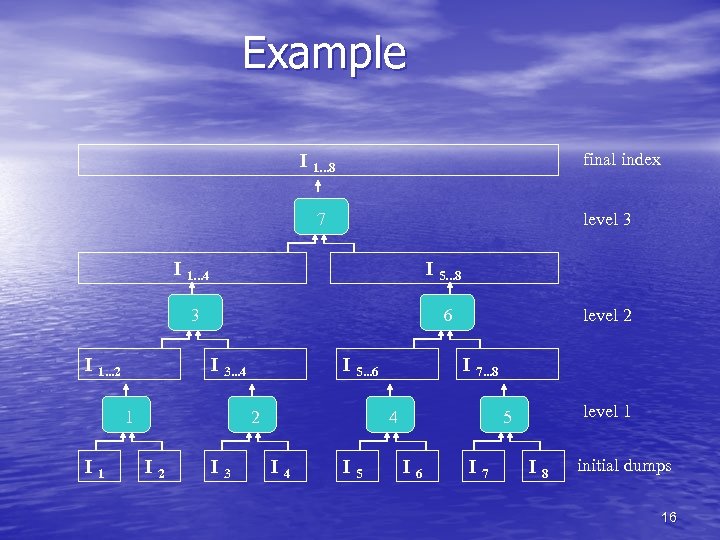 Example final index I 1. . . 8 7 level 3 I 1. . . 4 3 I 1. . . 2 I 5. . . 8 6 I 3. . . 4 1 I 5. . . 6 2 I 3 level 2 I 7. . . 8 4 I 5 level 1 5 I 6 I 7 I 8 initial dumps 16
 Inverted Files - construction • This procedure takes O(n log (n/M)) time plus • • O(n) to build the partial indices – where n is the document size and M is the amount of main memory available Adding a new document is a matter of merging its (partial) index (indices) to the index already built Deletion can be done in O(n) time – scanning over all lists of terms occurring in the deleted document 17
 Searching • The search algorithm on an inverted index follows three steps: – Vocabulary search: the words present in the query are searched in the vocabulary – Retrieval occurrences: the lists of the occurrences of all words found are retrieved – Manipulation of occurrences: the occurrences are processed to solve the query 18
 Searching • Searching task on an inverted file always starts in the vocabulary ( It is better to store the vocabulary in a separate file ) • The structures most used to store the vocabulary are hashing, tries or B-trees • An alternative is simply storing the words in lexicographical order ( cheaper in space and very competitive with O(log v) cost ) 19
 Inverted Files - searching • Searching using an inverted file – Vocabulary search • The terms used in the query (decoupled in the case of phrase or proximity queries) are searched separately – Retrieval of occurrences lists – Filtering answer • If the query was boolean the retrieved lists have to be “booleany” processed as well • If the inverted file used blocking and the query used proximity (for instance) then the actual byte/term offset has to be obtained from the documents 20
 Inverted Files - searching • Processing the lists of occurrences (filtering the • answer set) may be critical For instance, how to process a proximity query (involving two terms) ? – The lists are built in increasing order, so they may be traversed in a synchronous way, and each occurrence is checked for the proximity • What if blocking is used ? – No positional information is kept, so a linear scan of the document is required • The traversal and merging of the obtained lists are sensitive operations 21
 Construction • All the vocabulary is kept in a suitable data structure storing for each word a list of its occurrences • Each word of the text is read and searched in the vocabulary • If it is not found, it is added to the vocabulary with a empty list of occurrences and the new position is added to the end of its list of occurrences 22
 Compression of Inverted Index • I/O to read a occurrence list is reduced if the inverted • • index takes less storage Stop words eliminate about half the size of an inverted index. “the” occurs in 7 percent of English text. Other compression – Occurrence List – Term Dictionary Half of terms occur only once (hapax legomena) so they only have one entry in their Occurrence list Problem is some terms have very long posting lists -- in Excite’s search engine 1997 occurs 7 million times. 23
 Things to Compress • Term name in the term list • Term Frequency in each occurrence list entry • Document Identifier in each occurrence list entry 24
 Data Compression • Applied to occurrence lists – term: (d 1, tf 1), (d 2, tf 2), . . . (dn, tfn) • Documents are ordered, so each di is replaced by the interval difference, namely, di - 1 • Numbers are encoded using fewer bits for smaller, common numbers • Index is reduced to 10 -15% of database size 25
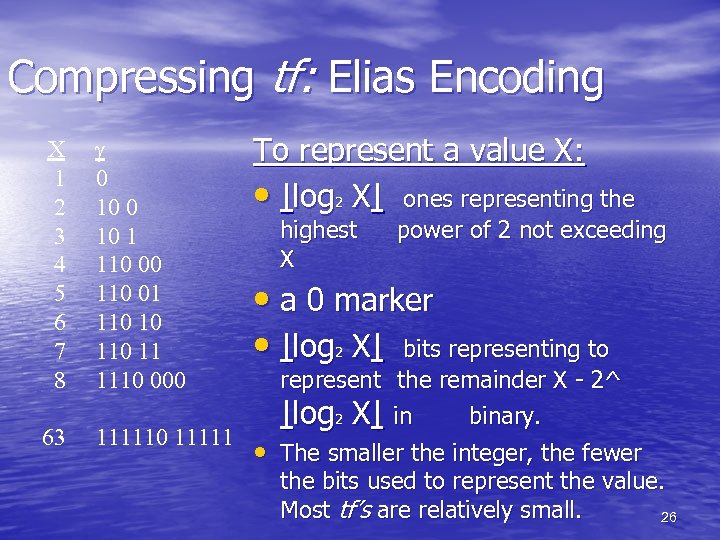 Compressing tf: Elias Encoding X 1 2 3 4 5 6 7 8 0 10 1 110 00 110 01 110 10 11 1110 000 To represent a value X: • |log 2 X| ones representing the 63 111110 11111 • The smaller the integer, the fewer highest X power of 2 not exceeding • a 0 marker • |log X| bits representing to 2 represent the remainder X - 2^ |log 2 X| in binary. the bits used to represent the value. Most tf’s are relatively small. 26
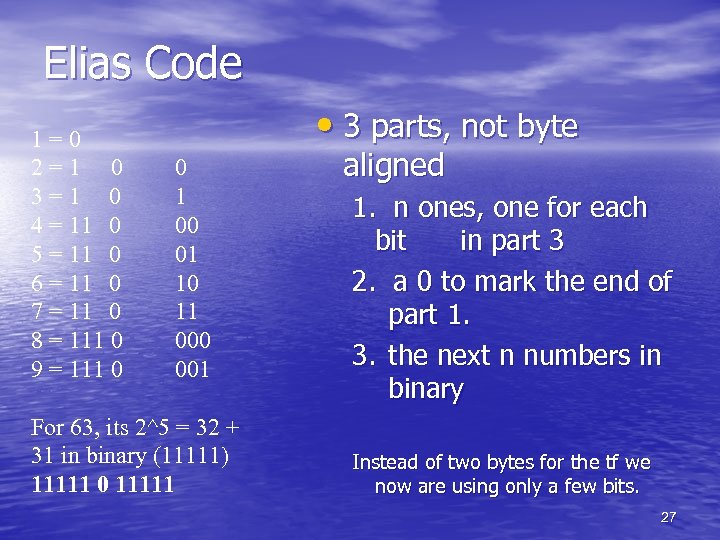 Elias Code 1=0 2=1 0 3=1 0 4 = 11 0 5 = 11 0 6 = 11 0 7 = 11 0 8 = 111 0 9 = 111 0 • 3 parts, not byte 0 1 00 01 10 11 000 001 For 63, its 2^5 = 32 + 31 in binary (11111) 11111 0 11111 aligned 1. n ones, one for each bit in part 3 2. a 0 to mark the end of part 1. 3. the next n numbers in binary Instead of two bytes for the tf we now are using only a few bits. 27
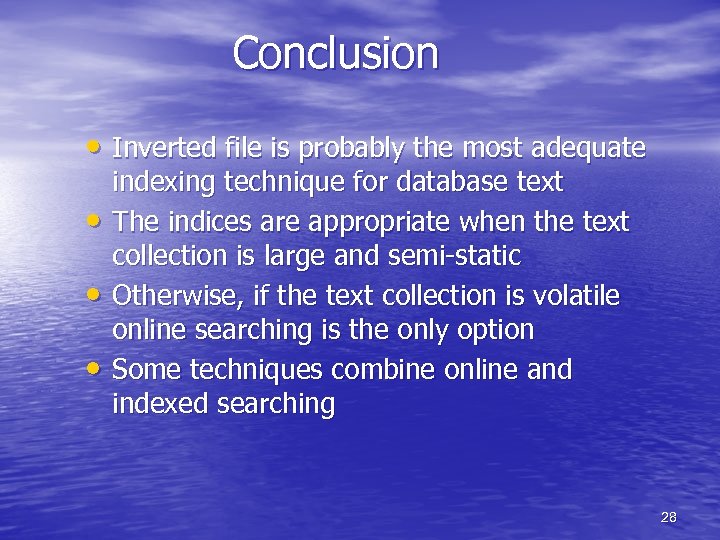 Conclusion • Inverted file is probably the most adequate • • • indexing technique for database text The indices are appropriate when the text collection is large and semi-static Otherwise, if the text collection is volatile online searching is the only option Some techniques combine online and indexed searching 28
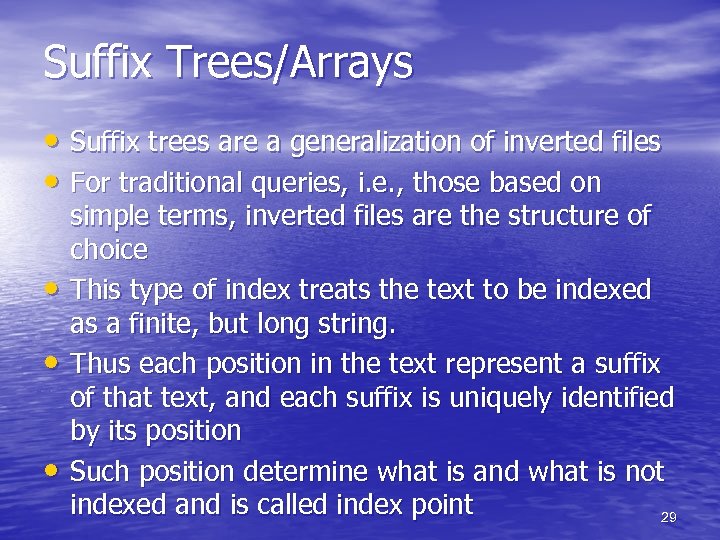 Suffix Trees/Arrays • Suffix trees are a generalization of inverted files • For traditional queries, i. e. , those based on • • • simple terms, inverted files are the structure of choice This type of index treats the text to be indexed as a finite, but long string. Thus each position in the text represent a suffix of that text, and each suffix is uniquely identified by its position Such position determine what is and what is not indexed and is called index point 29
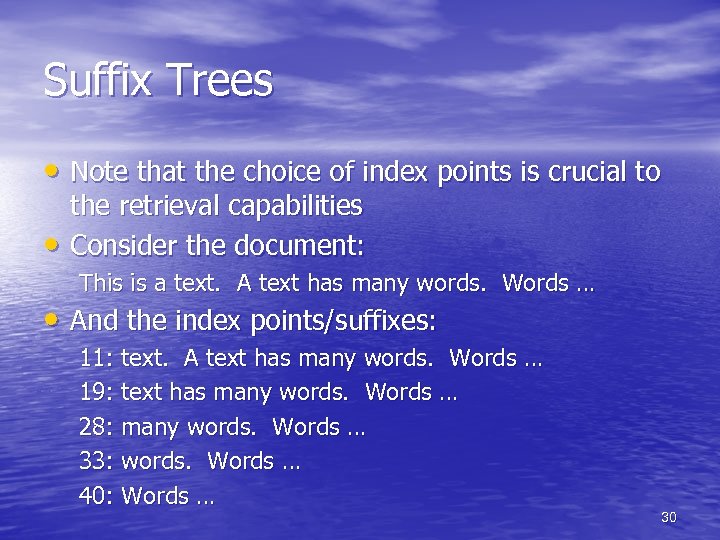 Suffix Trees • Note that the choice of index points is crucial to • the retrieval capabilities Consider the document: This is a text. A text has many words. Words … • And the index points/suffixes: 11: text. A text has many words. Words … 19: text has many words. Words … 28: many words. Words … 33: words. Words … 40: Words … 30
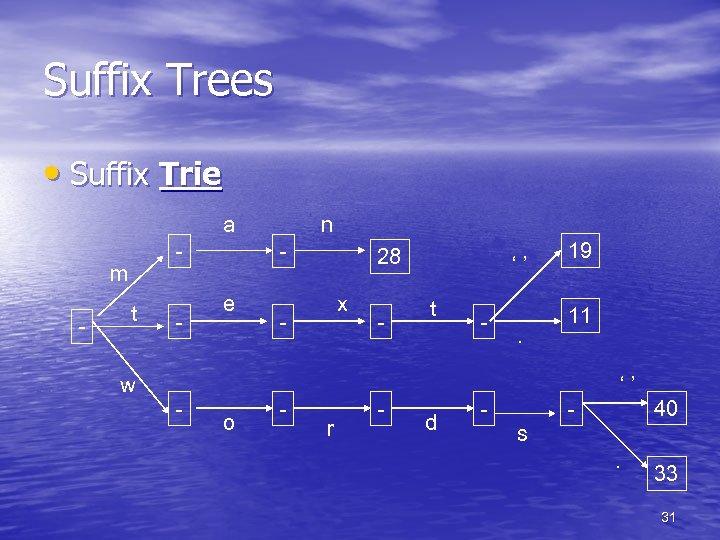 Suffix Trees • Suffix Trie a - m - t w - - n - e o 28 x - - r - - ‘’ t d - . - 19 11 - ‘’ 40 s. 33 31
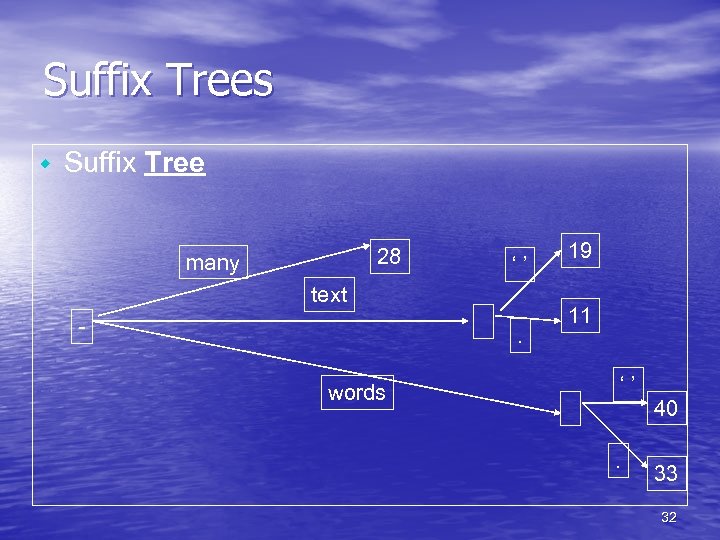 Suffix Trees w Suffix Tree 28 many ‘’ text - . words 19 11 ‘’. 40 33 32
 Suffix Trees • Even though the example showed only terms, one can use suffix trees to index and search phrases • For practical purposes a rather small phrase length (typically much smaller than the text) should be used • Suffix arrays are a better implementation of suffix trees 33
 Suffix Arrays • Careful inspection of the leaves in the suffix tree • • • shows that there is a lexicographical order among the index points An equivalent suffix array would be: [28, 19, 11, 40, 33] for (many, text. , words. } This allows the search to be processed as a binary search, but note that one must use the array and the text at query time The number of I/Os may become a problem 34
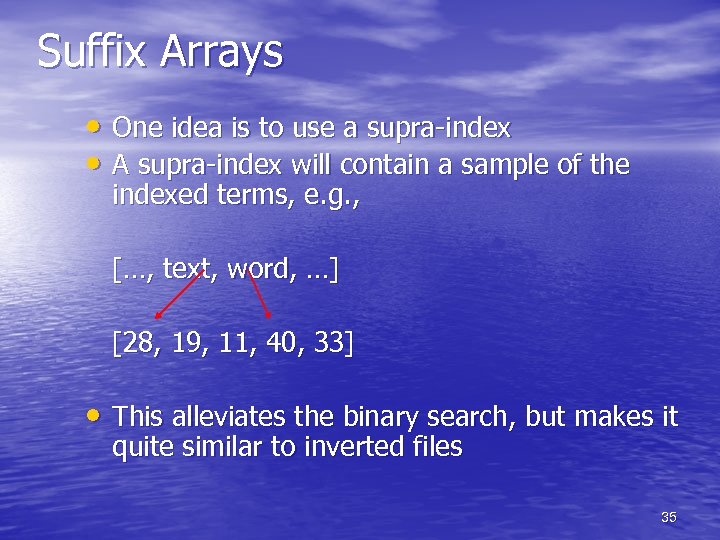 Suffix Arrays • One idea is to use a supra-index • A supra-index will contain a sample of the indexed terms, e. g. , […, text, word, …] [28, 19, 11, 40, 33] • This alleviates the binary search, but makes it quite similar to inverted files 35
 Suffix Arrays • This similarity is true if only single terms are • • • indexed, but suffix trees/arrays aim more than that, they aim mostly at phrase queries However, the array (or tree) is unlikely to fit in main memory, whereas for the inverted files the vocabulary could fit in main memory This requires careful implementation to reduce I/Os Good implementations show reduction of over 50% compared to naive ones 36
 Signature Files • Unlike the case of inverted files where, most of • • the time, there is a tree structure underneath, signature files use hash tables The main idea is to divide the document into blocks of fixed size and each block has assigned to it a signature (also fixed size), which is used to search the document for the queried pattern The block signature is obtained by OR’ing the hashed bitstrings of each term in the block 37
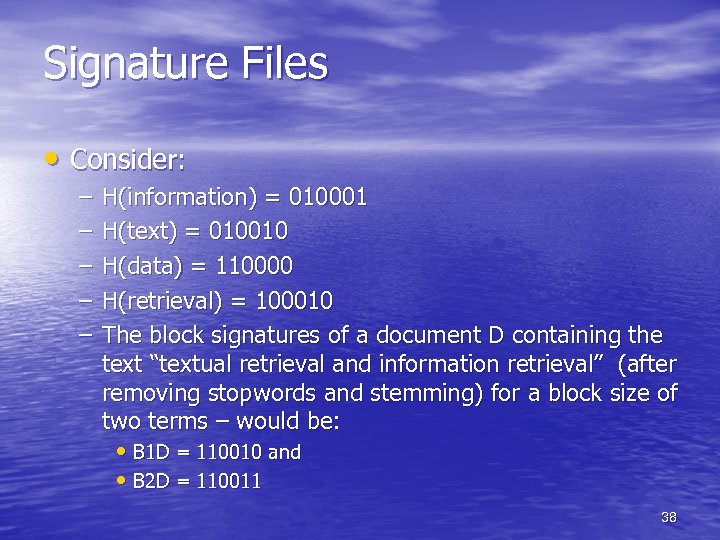 Signature Files • Consider: – – – H(information) = 010001 H(text) = 010010 H(data) = 110000 H(retrieval) = 100010 The block signatures of a document D containing the text “textual retrieval and information retrieval” (after removing stopwords and stemming) for a block size of two terms – would be: • B 1 D = 110010 and • B 2 D = 110011 38
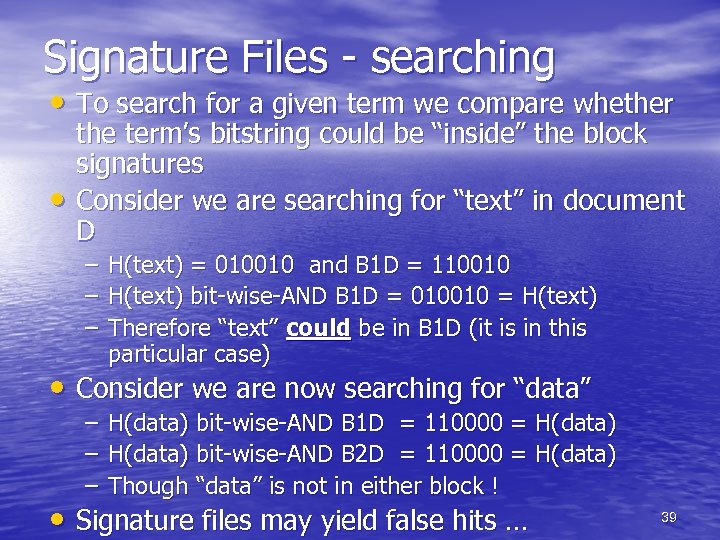 Signature Files - searching • To search for a given term we compare whether • the term’s bitstring could be “inside” the block signatures Consider we are searching for “text” in document D – H(text) = 010010 and B 1 D = 110010 – H(text) bit-wise-AND B 1 D = 010010 = H(text) – Therefore “text” could be in B 1 D (it is in this particular case) • Consider we are now searching for “data” – H(data) bit-wise-AND B 1 D = 110000 = H(data) – H(data) bit-wise-AND B 2 D = 110000 = H(data) – Though “data” is not in either block ! • Signature files may yield false hits … 39
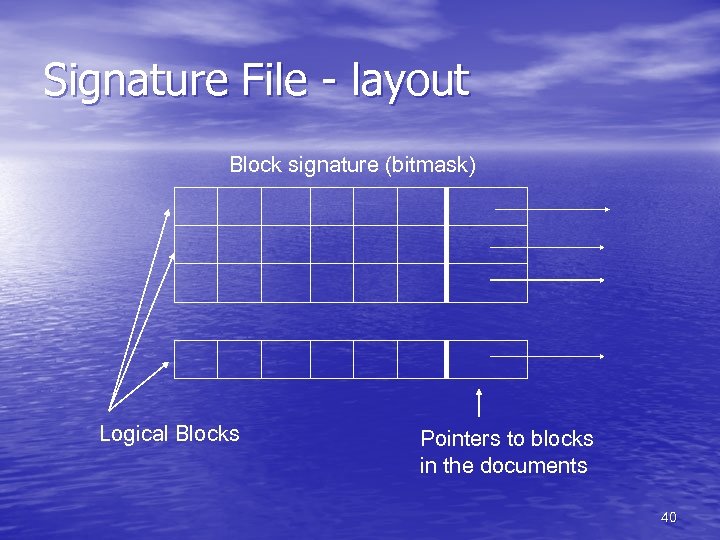 Signature File - layout Block signature (bitmask) Logical Blocks Pointers to blocks in the documents 40
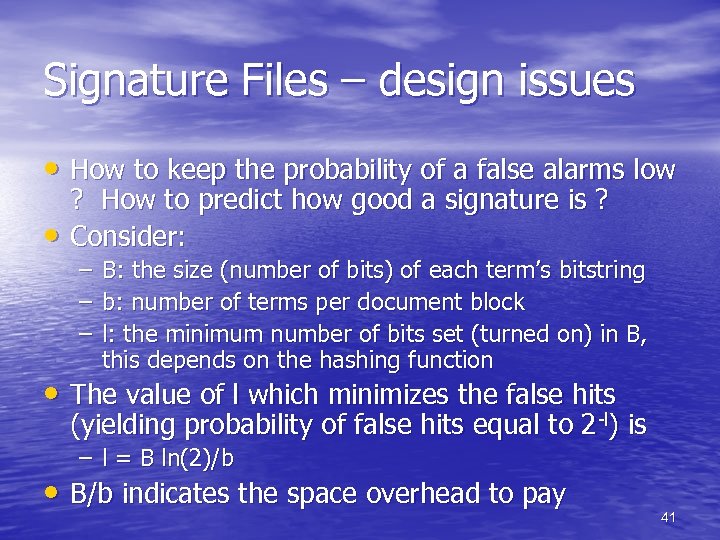 Signature Files – design issues • How to keep the probability of a false alarms low • ? How to predict how good a signature is ? Consider: – B: the size (number of bits) of each term’s bitstring – b: number of terms per document block – l: the minimum number of bits set (turned on) in B, this depends on the hashing function • The value of l which minimizes the false hits (yielding probability of false hits equal to 2 -l) is – l = B ln(2)/b • B/b indicates the space overhead to pay 41
 Signature Files - alternatives • There are many strategies which can be used • with signature files Signature compression – Given that the bitstring is likely to have many 0 s a simple run-length encoding technique can be used – 0001 0010 0001 is encoded as “ 328” (each digit in the code represents the number of 0 s preceding a 1) – The main drawback is that comparing bitstrings require decoding at search time 42
 Signature Files - alternatives • Using the original signature file layout and a • bitstring (queried term signature) all logical blocks are checked as to whether that block could contain that bitstring This may take a long time if the signature file is long (this depends on the block size) • Could we check only at the bits we are interested ? Yes, we can … 43
 Signature Files - alternatives • Original signature file layout: – Each row has a bitmask corresponding to a block – Each column tells whether that bit is set or not • Bit-sliced signature files layout: – Each row correspond to a particular bit in the bitmasks – Each column is the bitmask for the blocks • The signature file is “transposed” 44
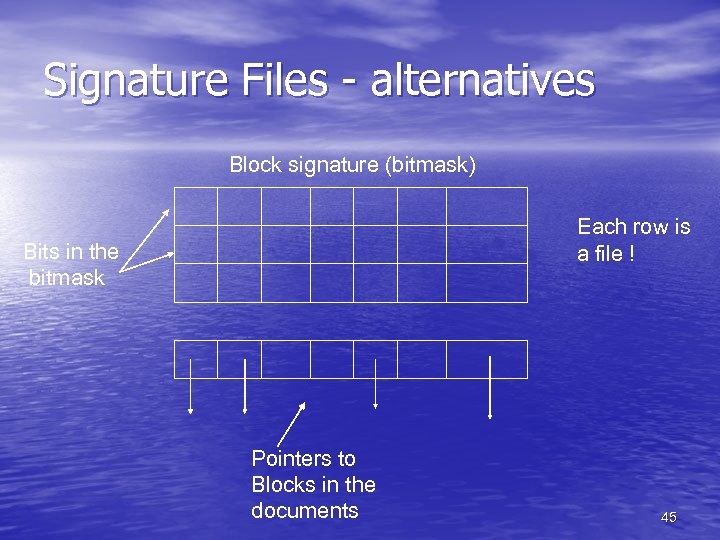 Signature Files - alternatives Block signature (bitmask) Each row is a file ! Bits in the bitmask Pointers to Blocks in the documents 45
 Signature Files - alternatives • Advantages of bit-slicing: • Given a term bitstring one can read only the • • lines (files) corresponding to those set bits and if they are set in a given column, then the whole column may be retrieved. Empty answers are found very fast Insertion is expensive, as all rows must be updated, but in an append-only fashion, this is good for WORM media types 46
 Signature Files - alternatives • It has been proposed that m = 50% (half of the • • • bits to be 1) A typical value of m is 10, that implies 10 accesses for a single term query Some authors have suggested to use a smaller m (thus smaller number of accesses) The trade-off is that to maintain low probability of false-hits, the signature has to be larger, thus the space required for the signature grows larger as well 47
 Searching - Motivation • Thus far, we’ve seen how to pre-process texts • • • (stemming, “stopping” words, compressing, etc) We’ve also seen how to build, process, improve and assess the quality of queries and the returned answer sets In the last classes, we saw how to effectively index the texts Now, how do we search text ? It goes beyond searching the indices, specially in the cases where the indices are not enough to answer queries (e. g. , proximity queries) 48
 Sequential Searching • If no index is used this is the only option, however sometimes (e. g. , when blocking is used) it is necessary even if an index exists • The problem is “simple” – Given a pattern P of length n and a text T of length m (m >> n) find all positions in T where P occurs • There is much more work on this than we can cover, including many theoretical results. Thus we will cover some well known approaches 49
 Brute Force • The name says it all … • Starting from all possible initial positions (i. e. , all • positions) whether the pattern could start at that position It takes O(mn) time in the worst case, but O(n) in the average case – not that bad • The most important thing is that it suggests the use of a sliding window over the text. The idea is to see whether we can see the pattern through the window 50
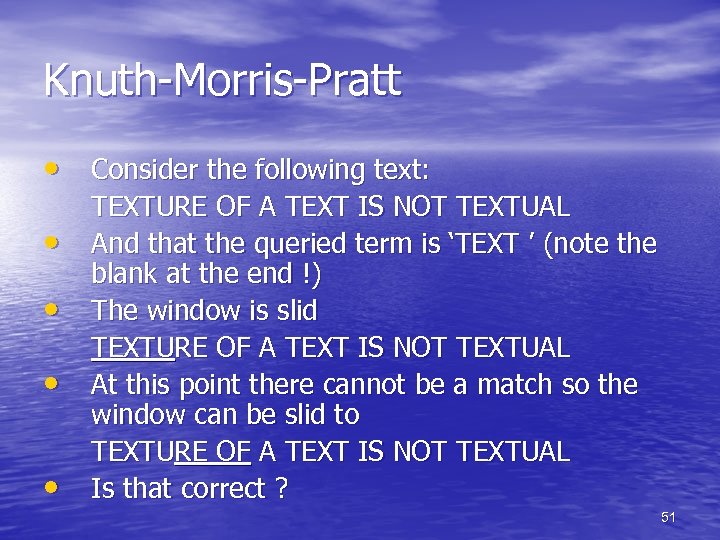 Knuth-Morris-Pratt • Consider the following text: • • TEXTURE OF A TEXT IS NOT TEXTUAL And that the queried term is ‘TEXT ’ (note the blank at the end !) The window is slid TEXTURE OF A TEXT IS NOT TEXTUAL At this point there cannot be a match so the window can be slid to TEXTURE OF A TEXT IS NOT TEXTUAL Is that correct ? 51
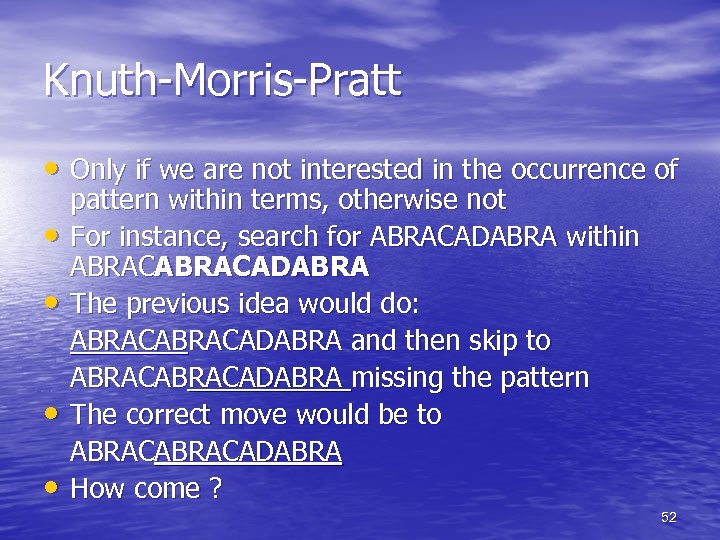 Knuth-Morris-Pratt • Only if we are not interested in the occurrence of • • pattern within terms, otherwise not For instance, search for ABRACADABRA within ABRACADABRA The previous idea would do: ABRACADABRA and then skip to ABRACADABRA missing the pattern The correct move would be to ABRACADABRA How come ? 52
 Knuth-Morris-Pratt • The processing time of this algorithm is O(n), which is linear, thus better than the Brute Force Algorithm • However, in the average case the Brute Force algorithm is O(n) as well • Many, many others algorithms exist … 53