


 Скачать презентацию Modern Correctional Philosophy History n Ancient societies
2b85bd361be3eafdb1d53ead313d0ff6.ppt
- Количество слайдов: 29
 Modern Correctional Philosophy
 History n Ancient societies n n Revenge still used today n Drive-by Shootings _________ n Mafia Assassinations _________
 Responses to Crimes n Retribution n Deterrence n Confinement n Deportation n Sentencing
 Colonial America Corporal Punishment n Public flogging n Branding n Dunking n Placement in stocks n Keel hauling n Walk the plank
 First Long-Term Confinement 1790 in Philadelphia n Walnut Street Jail n n Quakers convinced legislature to set aside one wing of jail for long-term confinement First attempt at reforming Inmate lived alone n Ate alone n Worked alone n Solitary confinement n n To think about offenses and become penitent
 Auburn Prison New York 1816 n Confinement to punish was first adopted n Discipline was enforced by whipping n Prisoners were not allowed to talk Silence used to control prisoners n Ate and worked together in silence n
 Jails and Prisons were separated - 1850 n n Jails to hold persons not yet convicted and some minor sentences Prisons housed convicted felons Person sentenced to prison for punishment n Conditions were harsh n
 1864 n n Taxpayers reluctant to spend money to house and feed inmates Hire out inmates to private companies Some companies built factories on prison grounds and paid inmates a state fee Inmates were leased to private contractors n n n Work amounted to slavery Work and living conditions causes thousands of deaths Many inmates escaped
 1870 n National Prison Association (now American Correctional Association _____________) was founded Adopted the principle of reformation n Prison reform n Community treatment programs started n Ultimate goal return inmates to society as better citizens n
 Components of the Criminal Justice System n Law Enforcement Agencies n Jails n Courts n Corrections n Probation and Parole
 Law Enforcement Agencies n Operate at: Federal n State n County n City n n Responsible for: Prevention of crime n Investigation of crime n Apprehension of criminals n
 Jails n n n Usually operated by Local Law Enforcement House Misdemeanors & Gross Misdemeanors House Accused Awaiting Trial
 Courts n Determine guilt or innocence n Oversee components of the criminal justice system n Jails n Prisons n To ensure confinement practices are lawful
 Corrections n Long Term Confinement n Rehabilitation n House Convicted Felons n House County Safe Keepers n Uncontrollable Jail Inmates
 Parole & Probation n Parole n n To supervise, for a specific amount of time, persons who have been released from serving time in a state facility Probation n To supervise persons who have been released into the community (under certain conditions) who have been found guilty of a crime
 Types of Correctional Facilities and their Roles: n Jails n Prisons n Community-Based Facilities
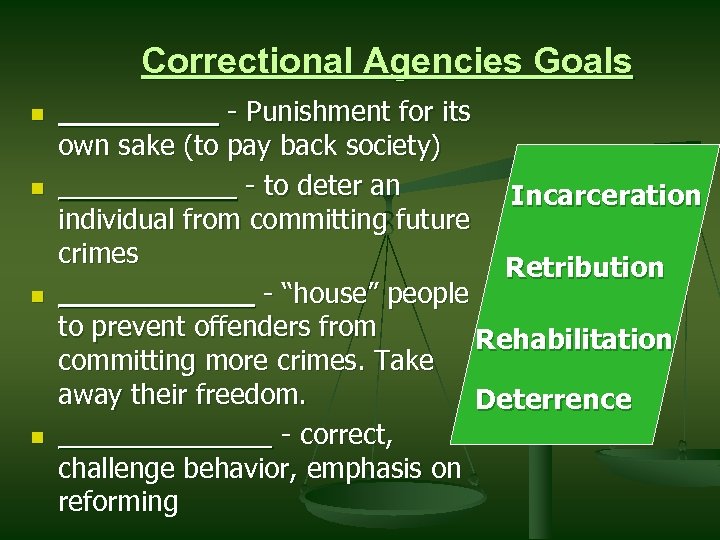 Correctional Agencies Goals n n _____ - Punishment for its own sake (to pay back society) _____ - to deter an Incarceration individual from committing future crimes Retribution ______ - “house” people to prevent offenders from Rehabilitation committing more crimes. Take away their freedom. Deterrence ______ - correct, challenge behavior, emphasis on reforming
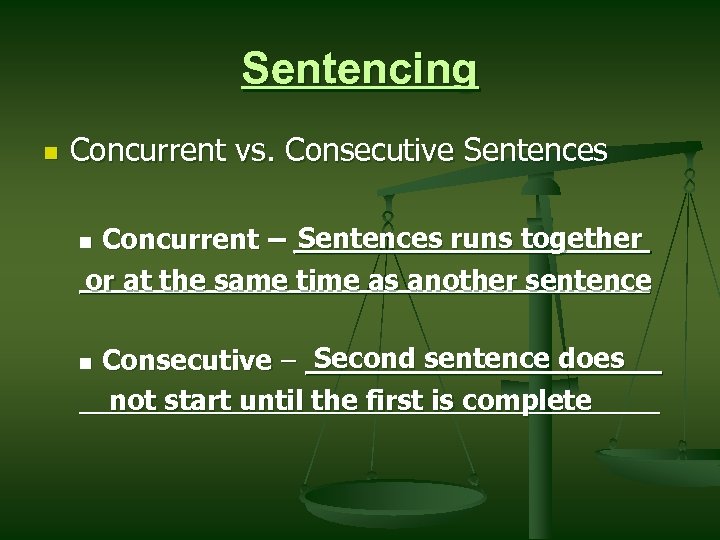 Sentencing n Concurrent vs. Consecutive Sentences runs together Concurrent – __________________________ or at the same time as another sentence n Second sentence does Consecutive – _____________________________ not start until the first is complete n
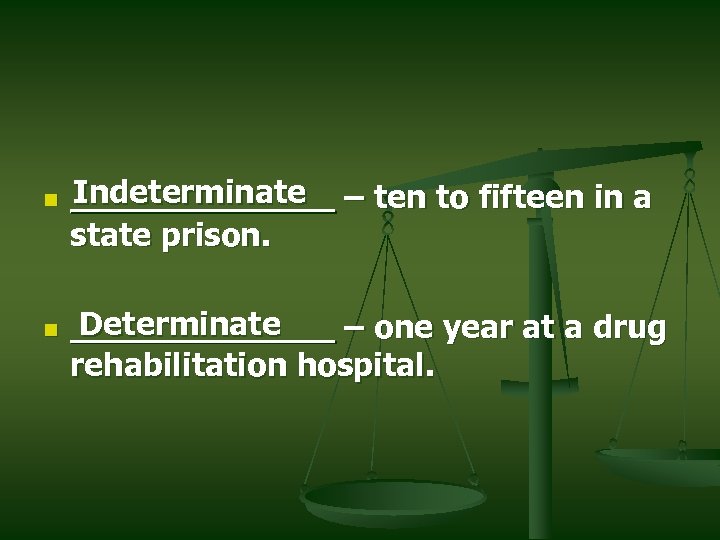 n n Indeterminate _______ – ten to fifteen in a state prison. Determinate _______ – one year at a drug rehabilitation hospital.
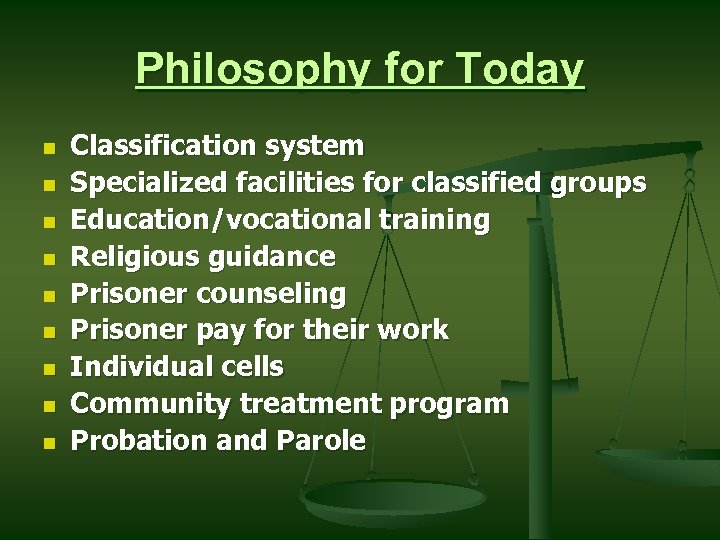 Philosophy for Today n n n n n Classification system Specialized facilities for classified groups Education/vocational training Religious guidance Prisoner counseling Prisoner pay for their work Individual cells Community treatment program Probation and Parole
 n n _____ – is to offer an Probation alternative to confinement while still providing supervision of offenders Parole _____ – is to allow prisoners an early return to society, while keeping home under close supervision
 Jails n Locally Operated n Smaller/House less inmate n Population fluctuates often
 Prison n State/federally Operated Usually house inmate with over 1 year sentence Prisons are usually predominately one custody level Minimum n Medium n Maximum n
 Custody Level Minimum Security 1. ________ Inmate is given much freedom n No guard towers n Minimum supervision n One year or less on sentence n No sex crime, no violent crime n Almost write-up free n
 Custody Level 2. Medium Security ________ § § Two fences with razor wire Guard towers Inmates have yard access Have more supervision (counts, lockup)
 Custody Level 3. Maximum Security ________ § § § Very little free movement Watched almost 24 hours a day Can only go outside the prison under armed escort 2 fences and a lot of razor wire Towers and armed posts all over Life sentence, more than 20 years
 In Addition n _________ Restitution Center n Transitional Housing ___________
 Community Based Facilities n Half-Way House n Drug Rehabilitation n Usually Non-violent Crimes
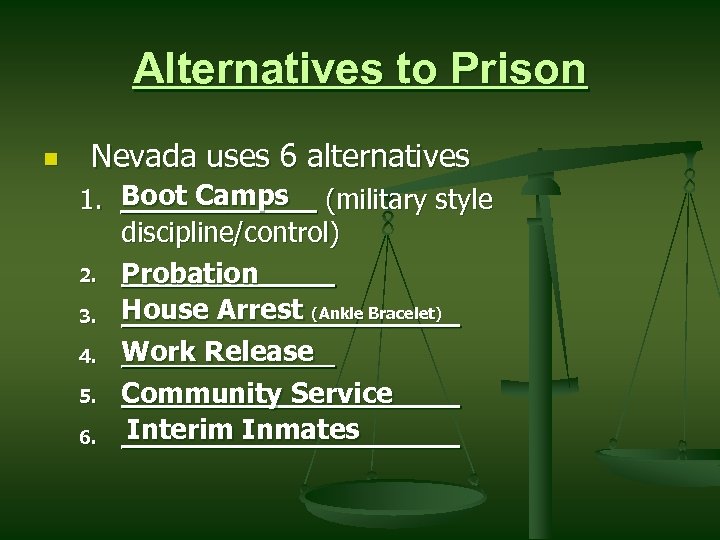 Alternatives to Prison n Nevada uses 6 alternatives Boot Camps 1. ______ (military style discipline/control) 2. Probation ______ 3. House Arrest (Ankle Bracelet) __________ 4. Work Release ______ 5. Community Service __________ Interim Inmates 6. __________