

Modern China. Economical freedom or political oppression «Economic

 Скачать презентацию Modern China. Economical freedom or political oppression «Economic
34796-modern_china.ppt
- Количество слайдов: 15
Modern China. Economical freedom or political oppression
"Economic Survey of China“(2005) "Economic growth about 9.5 percent over 20 years and likely to continue at that pace for some time.“ China "represents one of the most balanced and rapid economic transformations seen in the world economy in the past 50 years” YET state-owned companies "are in dire need of restructuring“ STILL "Further development of the capital markets will help to lower enterprise debt loads, reduce the exposure of the banking sector to commercial risks, and improve market discipline over business behavior"
How miracle works Freedom of enterprise gives freedom of market Lightly controlled open prices Delegation of power Focus on people Co-existence of opposites Cheap labor from rural sector
Paper dragon Growing gap between rich and poor Dependence from West Focus on loss making state-enterprises Little or no technological development Growing demand for higher wages
China in 1980es. Economy 10% annual growth in light industry and agriculture 23% of agricultural output – rural industries 14 SEZ created
Economy. Industry and technology In 1985 light industry occupied 17% of workforce yet its output to national economy was 46% Most enterprises even though state controlled operated by local forces and taxes are paid to province rather then center Rapid growth of townership enterprises
Economy. Industry and technology New technology mainly assimilated Own scientific research had low industry value until mid 80es From 1986 great effort focused on connecting science and industry.
Economical planning During 1980es state role in planning economy was slowly reducing More impact on province and local authorities Dual pricing was introduced in mid 1980es ( much alike as in perestroika’s russia)
Comparision to perestroika Compare economical output? Why do you think its so different? the initial stages of reform were planned so that there were only winners and no losers The market economy was added to the pre-reform central economy rather than replacing it the focus in China involved creation of new systems rather than the replacement of old while allowing for economic reform, the Communist Party of China was intent on maintaining political control.
Social output Poverty reduction – from 54% in mid 1970es to 6% in 2001 Wealth disparity - only 3.5% of the 1.3 billion people in China who earned more than ¥20,000 annually (approximately $2,500), while 50% of the 1.3 billion population earned less than ¥2,000 annually (approximately $250) Inflation due to controlled prices
Politics Unlike USSR PRC strongly maintained censorship and political control Some chinese students was inspired by glasnost and political reforms in Eastern Europe
Protest movements Students argued for speedy reforms pace For more openness toward west, specifically western music For less control from party officials
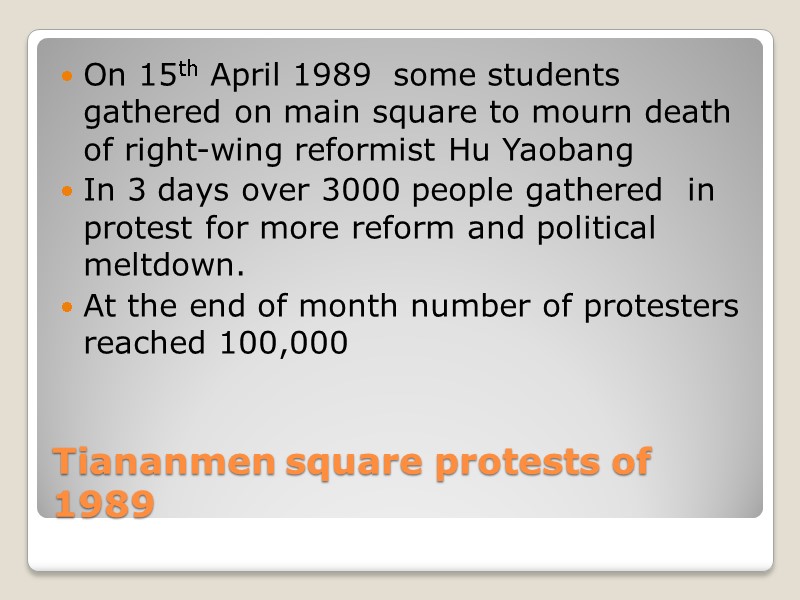
Tiananmen square protests of 1989 On 15th April 1989 some students gathered on main square to mourn death of right-wing reformist Hu Yaobang In 3 days over 3000 people gathered in protest for more reform and political meltdown. At the end of month number of protesters reached 100,000
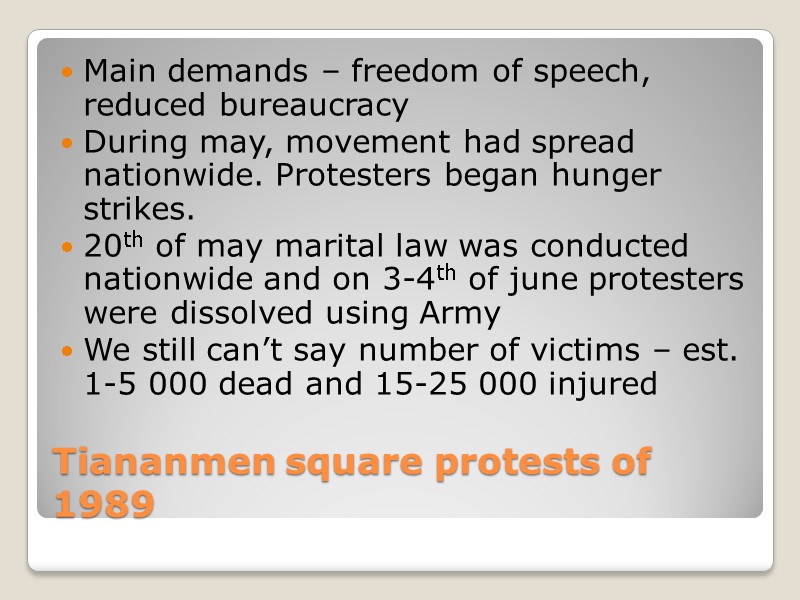
Tiananmen square protests of 1989 Main demands – freedom of speech, reduced bureaucracy During may, movement had spread nationwide. Protesters began hunger strikes. 20th of may marital law was conducted nationwide and on 3-4th of june protesters were dissolved using Army We still can’t say number of victims – est. 1-5 000 dead and 15-25 000 injured
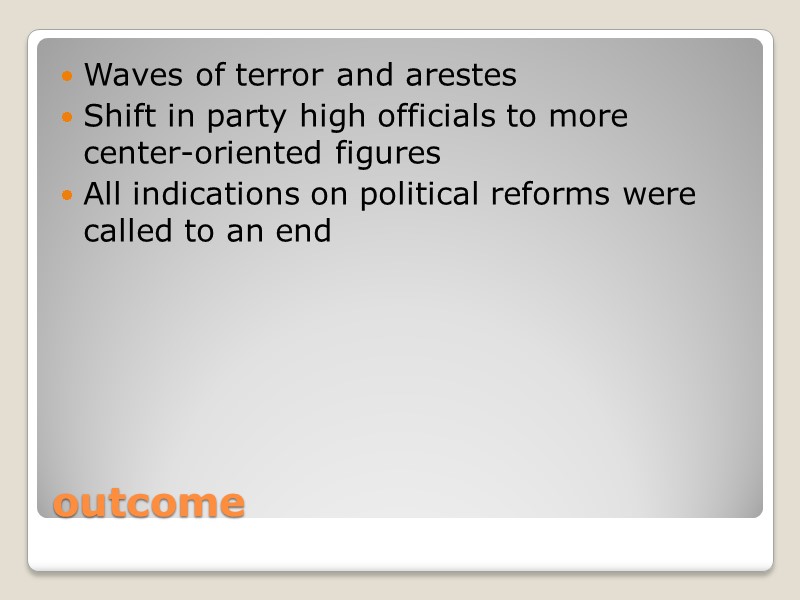
outcome Waves of terror and arestes Shift in party high officials to more center-oriented figures All indications on political reforms were called to an end