 Скачать презентацию MODERN BRITAIN POPULATION POLITICAL SYSTEM PARLIAMENT Population
PowerPoint_MODERN_BRITAIN.PARLIAMENT_AND_GOVERNMENT.ppt
- Количество слайдов: 15



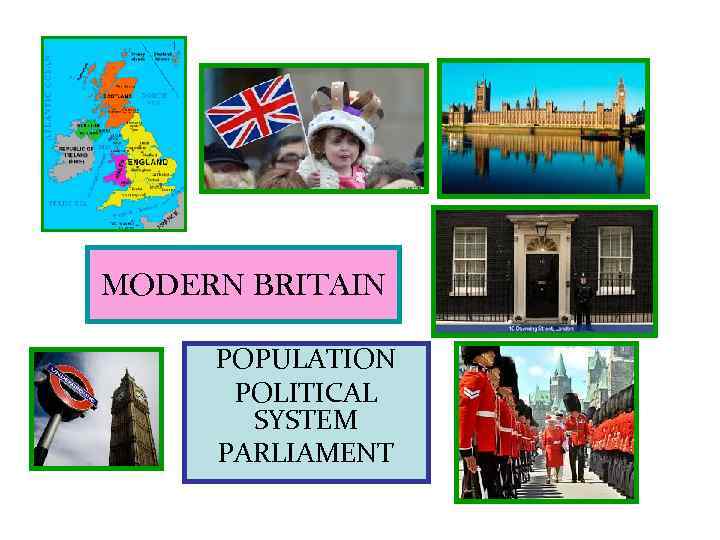
MODERN BRITAIN POPULATION POLITICAL SYSTEM PARLIAMENT
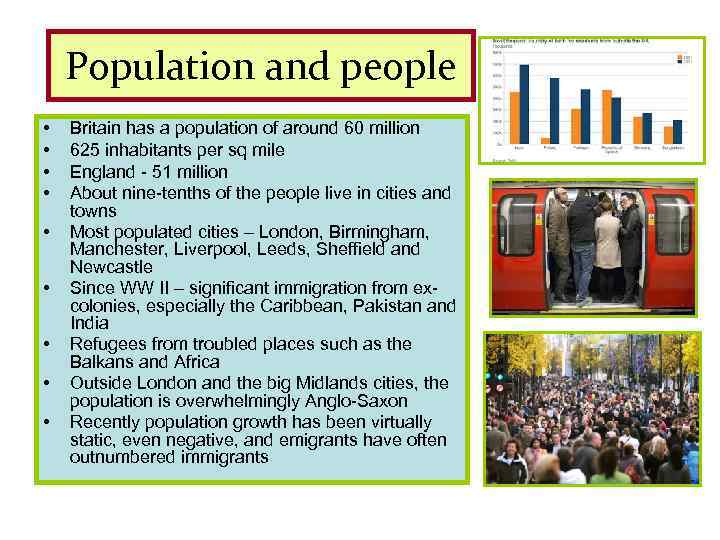
Population and people • • • Britain has a population of around 60 million 625 inhabitants per sq mile England - 51 million About nine-tenths of the people live in cities and towns Most populated cities – London, Birmingham, Manchester, Liverpool, Leeds, Sheffield and Newcastle Since WW II – significant immigration from excolonies, especially the Caribbean, Pakistan and India Refugees from troubled places such as the Balkans and Africa Outside London and the big Midlands cities, the population is overwhelmingly Anglo-Saxon Recently population growth has been virtually static, even negative, and emigrants have often outnumbered immigrants
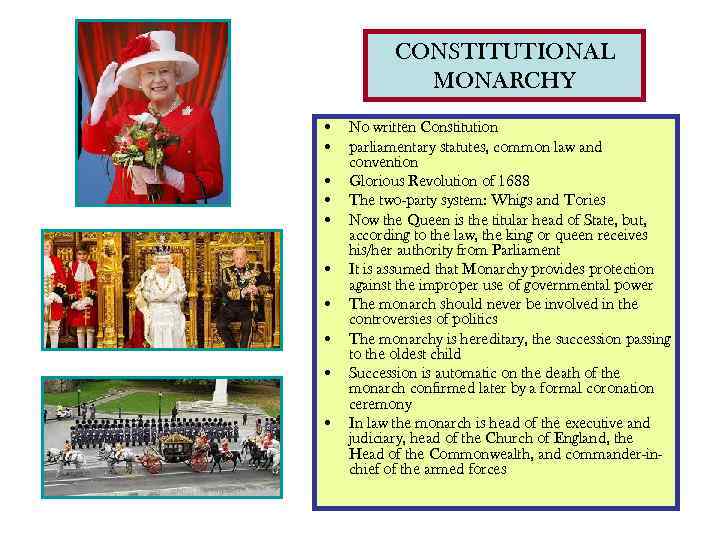
CONSTITUTIONAL MONARCHY • No written Constitution • parliamentary statutes, common law and convention • Glorious Revolution of 1688 • The two-party system: Whigs and Tories • Now the Queen is the titular head of State, but, according to the law, the king or queen receives his/her authority from Parliament • It is assumed that Monarchy provides protection against the improper use of governmental power • The monarch should never be involved in the controversies of politics • The monarchy is hereditary, the succession passing to the oldest child • Succession is automatic on the death of the monarch confirmed later by a formal coronation ceremony • In law the monarch is head of the executive and judiciary, head of the Church of England, the Head of the Commonwealth, and commander-inchief of the armed forces
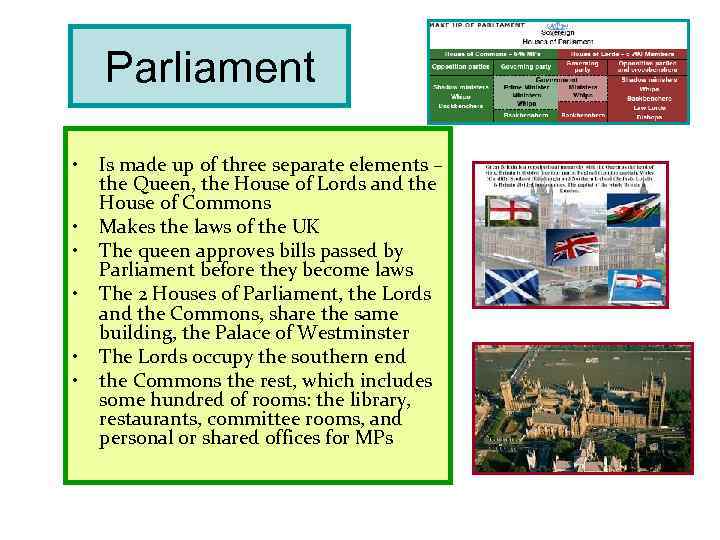
Parliament • • • Is made up of three separate elements – the Queen, the House of Lords and the House of Commons Makes the laws of the UK The queen approves bills passed by Parliament before they become laws The 2 Houses of Parliament, the Lords and the Commons, share the same building, the Palace of Westminster The Lords occupy the southern end the Commons the rest, which includes some hundred of rooms: the library, restaurants, committee rooms, and personal or shared offices for MPs
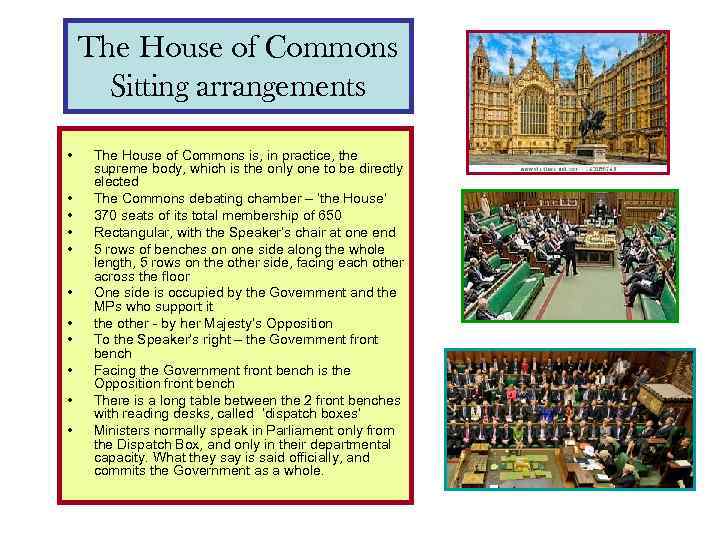
The House of Commons Sitting arrangements • • • The House of Commons is, in practice, the supreme body, which is the only one to be directly elected The Commons debating chamber – ‘the House’ 370 seats of its total membership of 650 Rectangular, with the Speaker’s chair at one end 5 rows of benches on one side along the whole length, 5 rows on the other side, facing each other across the floor One side is occupied by the Government and the MPs who support it the other - by her Majesty’s Opposition To the Speaker’s right – the Government front bench Facing the Government front bench is the Opposition front bench There is a long table between the 2 front benches with reading desks, called ‘dispatch boxes’ Ministers normally speak in Parliament only from the Dispatch Box, and only in their departmental capacity. What they say is said officially, and commits the Government as a whole.
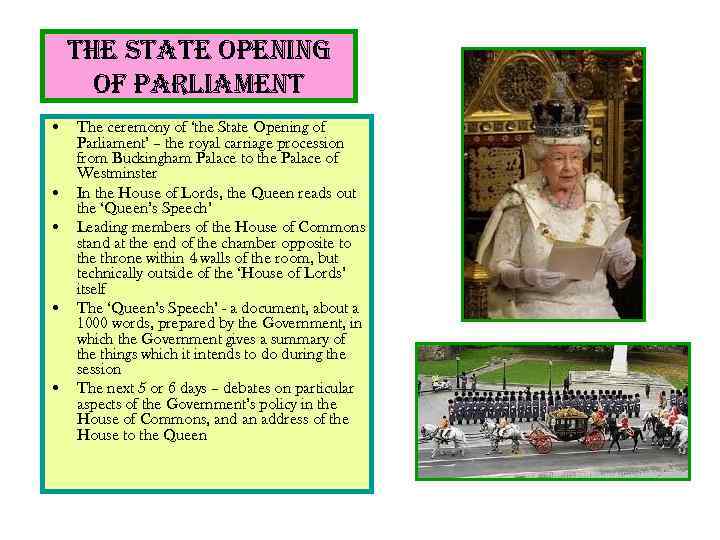
the state opening of parliament • The ceremony of ‘the State Opening of Parliament’ – the royal carriage procession from Buckingham Palace to the Palace of Westminster • In the House of Lords, the Queen reads out the ‘Queen’s Speech’ • Leading members of the House of Commons stand at the end of the chamber opposite to the throne within 4 walls of the room, but technically outside of the ‘House of Lords’ itself • The ‘Queen’s Speech’ - a document, about a 1000 words, prepared by the Government, in which the Government gives a summary of the things which it intends to do during the session • The next 5 or 6 days – debates on particular aspects of the Government’s policy in the House of Commons, and an address of the House to the Queen
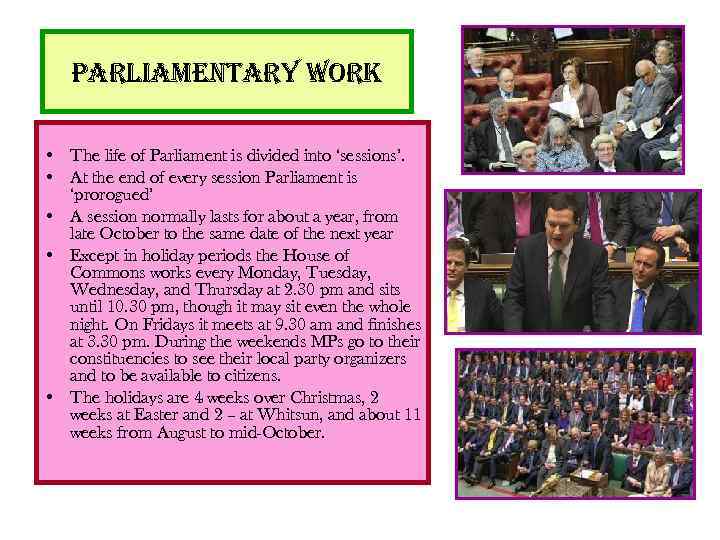
parliamentary work • The life of Parliament is divided into ‘sessions’. • At the end of every session Parliament is ‘prorogued’ • A session normally lasts for about a year, from late October to the same date of the next year • Except in holiday periods the House of Commons works every Monday, Tuesday, Wednesday, and Thursday at 2. 30 pm and sits until 10. 30 pm, though it may sit even the whole night. On Fridays it meets at 9. 30 am and finishes at 3. 30 pm. During the weekends MPs go to their constituencies to see their local party organizers and to be available to citizens. • The holidays are 4 weeks over Christmas, 2 weeks at Easter and 2 – at Whitsun, and about 11 weeks from August to mid-October.
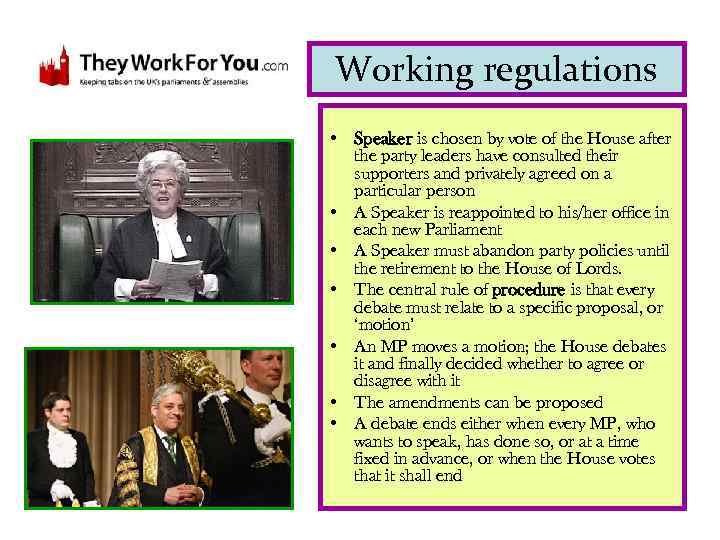
Working regulations • Speaker is chosen by vote of the House after the party leaders have consulted their supporters and privately agreed on a particular person • A Speaker is reappointed to his/her office in each new Parliament • A Speaker must abandon party policies until the retirement to the House of Lords. • The central rule of procedure is that every debate must relate to a specific proposal, or ‘motion’ • An MP moves a motion; the House debates it and finally decided whether to agree or disagree with it • The amendments can be proposed • A debate ends either when every MP, who wants to speak, has done so, or at a time fixed in advance, or when the House votes that it shall end
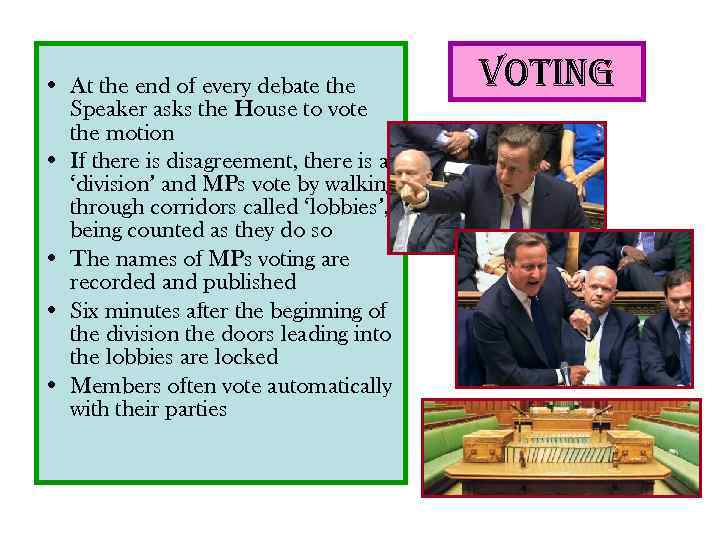
• At the end of every debate the Speaker asks the House to vote the motion • If there is disagreement, there is a ‘division’ and MPs vote by walking through corridors called ‘lobbies’, being counted as they do so • The names of MPs voting are recorded and published • Six minutes after the beginning of the division the doors leading into the lobbies are locked • Members often vote automatically with their parties voting
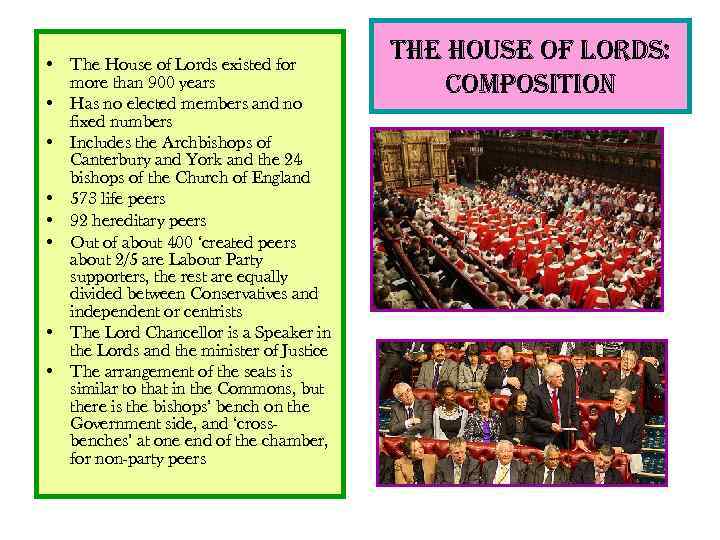
• The House of Lords existed for more than 900 years • Has no elected members and no fixed numbers • Includes the Archbishops of Canterbury and York and the 24 bishops of the Church of England • 573 life peers • 92 hereditary peers • Out of about 400 ‘created peers about 2/5 are Labour Party supporters, the rest are equally divided between Conservatives and independent or centrists • The Lord Chancellor is a Speaker in the Lords and the minister of Justice • The arrangement of the seats is similar to that in the Commons, but there is the bishops’ bench on the Government side, and ‘crossbenches’ at one end of the chamber, for non-party peers the house of lords: composition
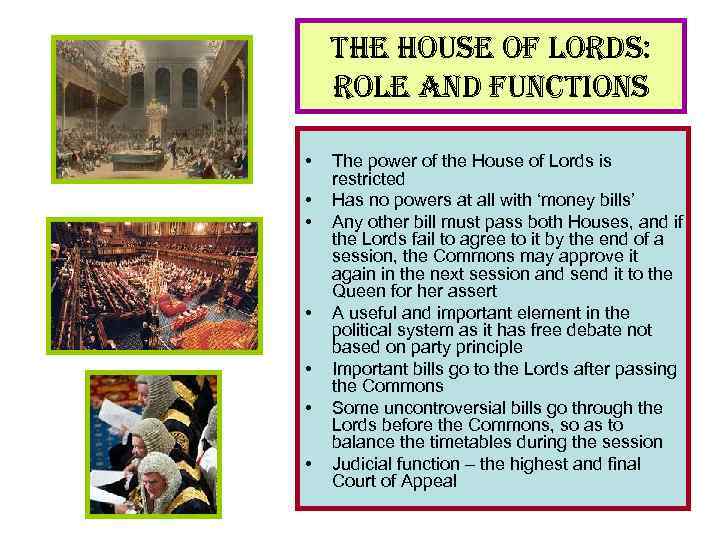
the house of lords: role and functions • • The power of the House of Lords is restricted Has no powers at all with ‘money bills’ Any other bill must pass both Houses, and if the Lords fail to agree to it by the end of a session, the Commons may approve it again in the next session and send it to the Queen for her assert A useful and important element in the political system as it has free debate not based on party principle Important bills go to the Lords after passing the Commons Some uncontroversial bills go through the Lords before the Commons, so as to balance the timetables during the session Judicial function – the highest and final Court of Appeal
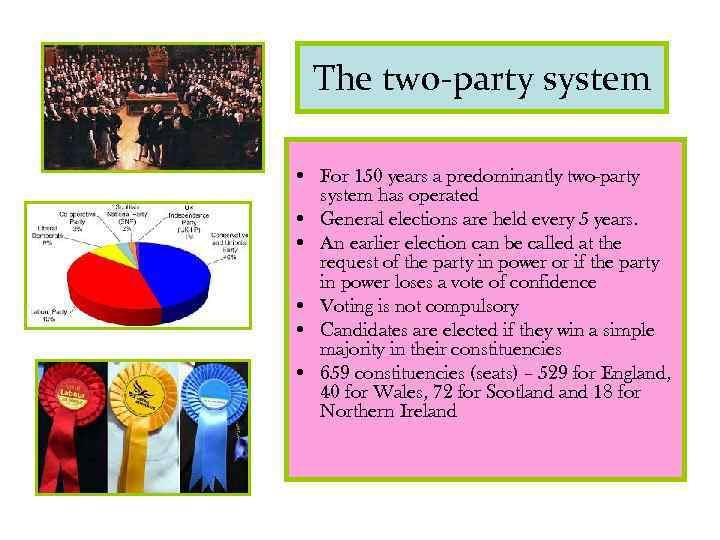
The two-party system • For 150 years a predominantly two-party system has operated • General elections are held every 5 years. • An earlier election can be called at the request of the party in power or if the party in power loses a vote of confidence • Voting is not compulsory • Candidates are elected if they win a simple majority in their constituencies • 659 constituencies (seats) – 529 for England, 40 for Wales, 72 for Scotland 18 for Northern Ireland
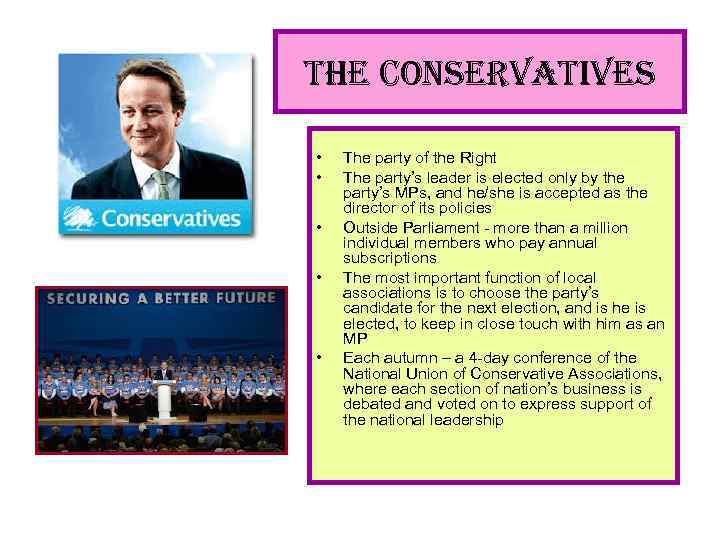
the conservatives • • • The party of the Right The party’s leader is elected only by the party’s MPs, and he/she is accepted as the director of its policies Outside Parliament - more than a million individual members who pay annual subscriptions The most important function of local associations is to choose the party’s candidate for the next election, and is he is elected, to keep in close touch with him as an MP Each autumn – a 4 -day conference of the National Union of Conservative Associations, where each section of nation’s business is debated and voted on to express support of the national leadership
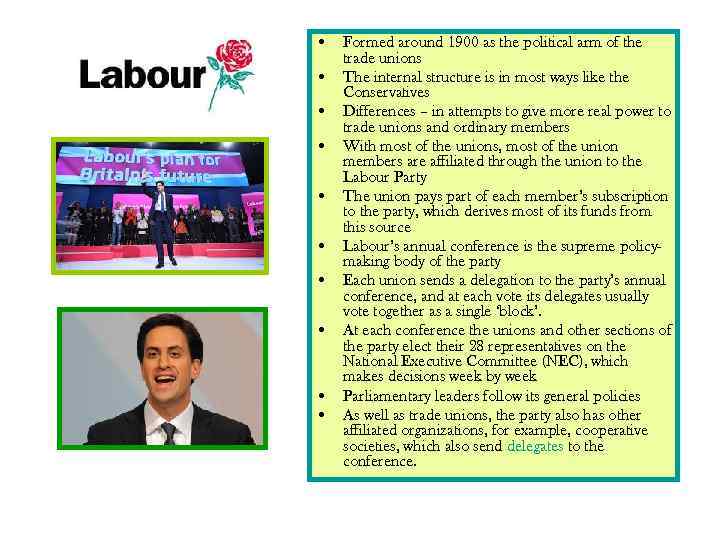
• Formed around 1900 as the political arm of the trade unions • The internal structure is in most ways like the Conservatives • Differences – in attempts to give more real power to trade unions and ordinary members • With most of the unions, most of the union members are affiliated through the union to the Labour Party • The union pays part of each member’s subscription to the party, which derives most of its funds from this source • Labour’s annual conference is the supreme policymaking body of the party • Each union sends a delegation to the party’s annual conference, and at each vote its delegates usually vote together as a single ‘block’. • At each conference the unions and other sections of the party elect their 28 representatives on the National Executive Committee (NEC), which makes decisions week by week • Parliamentary leaders follow its general policies • As well as trade unions, the party also has other affiliated organizations, for example, cooperative societies, which also send delegates to the conference.
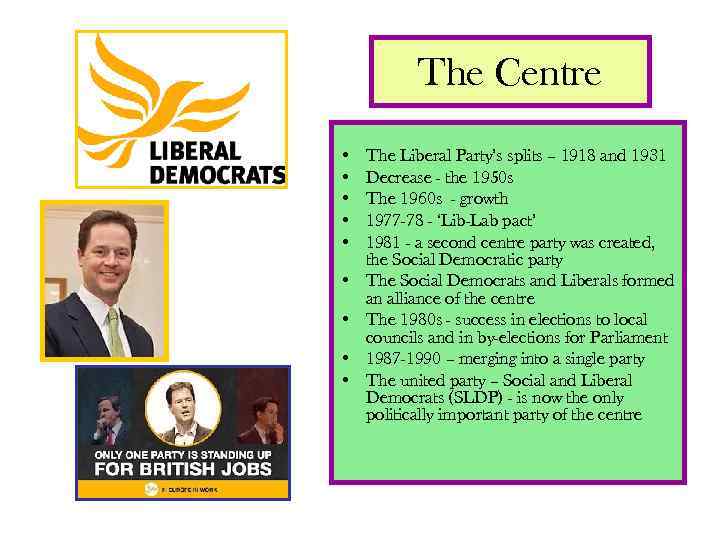
The Centre • • • The Liberal Party’s splits – 1918 and 1931 Decrease - the 1950 s The 1960 s - growth 1977 -78 - ‘Lib-Lab pact’ 1981 - a second centre party was created, the Social Democratic party The Social Democrats and Liberals formed an alliance of the centre The 1980 s - success in elections to local councils and in by-elections for Parliament 1987 -1990 – merging into a single party The united party – Social and Liberal Democrats (SLDP) - is now the only politically important party of the centre
Скачать презентацию MODERN BRITAIN POPULATION POLITICAL SYSTEM PARLIAMENT Population
PowerPoint_MODERN_BRITAIN.PARLIAMENT_AND_GOVERNMENT.ppt