


 Скачать презентацию Modelling Trends and Model Risk Management S van
7bb9101e2906caeca834f1dfc9eaf244.ppt
- Количество слайдов: 15
 Modelling Trends and Model Risk Management S. van Westerop, May 2016
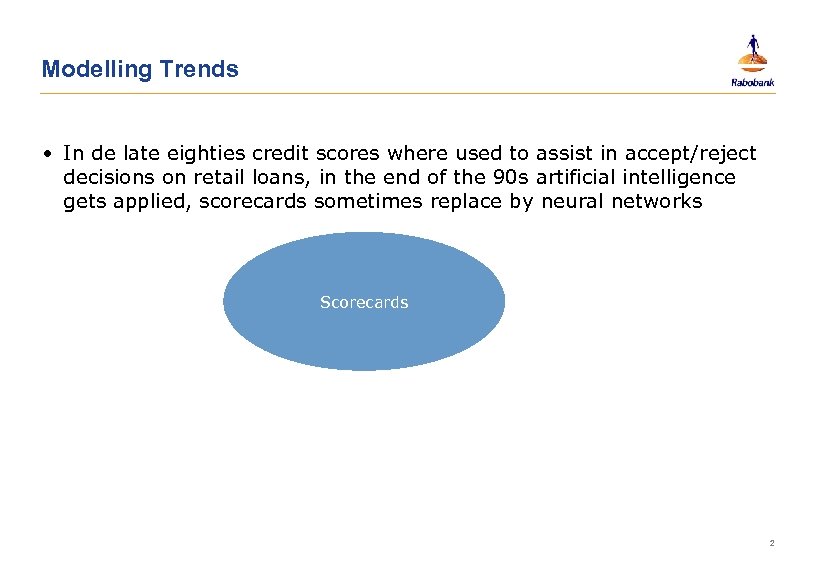 Modelling Trends • In de late eighties credit scores where used to assist in accept/reject decisions on retail loans, in the end of the 90 s artificial intelligence gets applied, scorecards sometimes replace by neural networks Scorecards 2
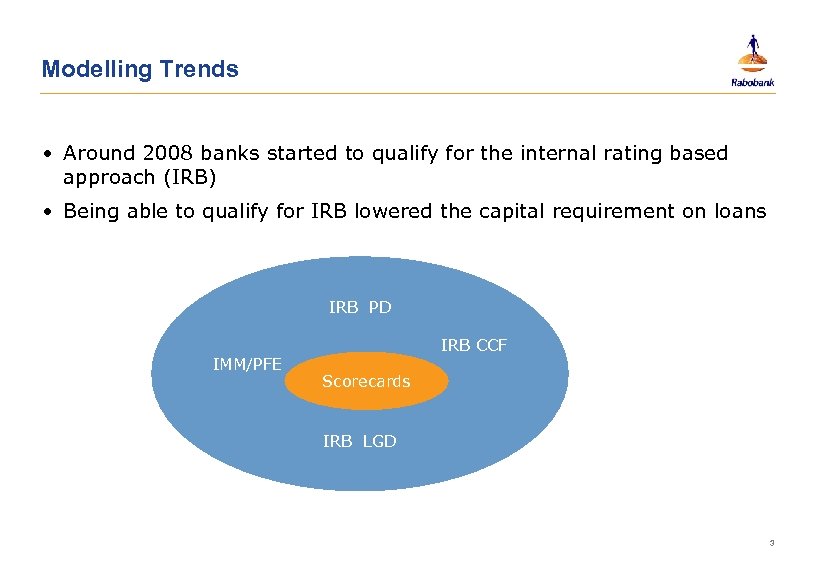 Modelling Trends • Around 2008 banks started to qualify for the internal rating based approach (IRB) • Being able to qualify for IRB lowered the capital requirement on loans IRB PD IMM/PFE IRB CCF Scorecards IRB LGD 3
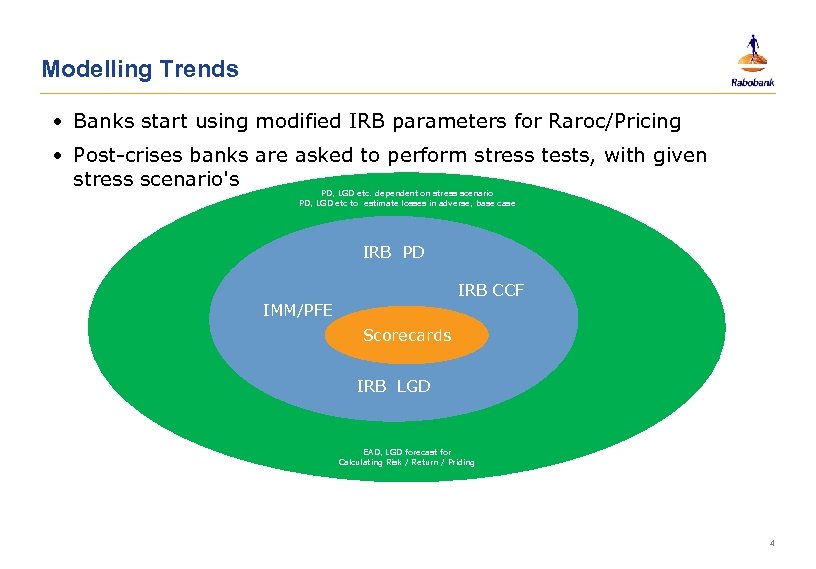 Modelling Trends • Banks start using modified IRB parameters for Raroc/Pricing • Post-crises banks are asked to perform stress tests, with given stress scenario's PD, LGD etc. dependent on stress scenario PD, LGD etc to estimate losses in adverse, base case IRB PD IRB CCF IMM/PFE Scorecards IRB LGD EAD, LGD forecast for Calculating Risk / Return / Priding 4
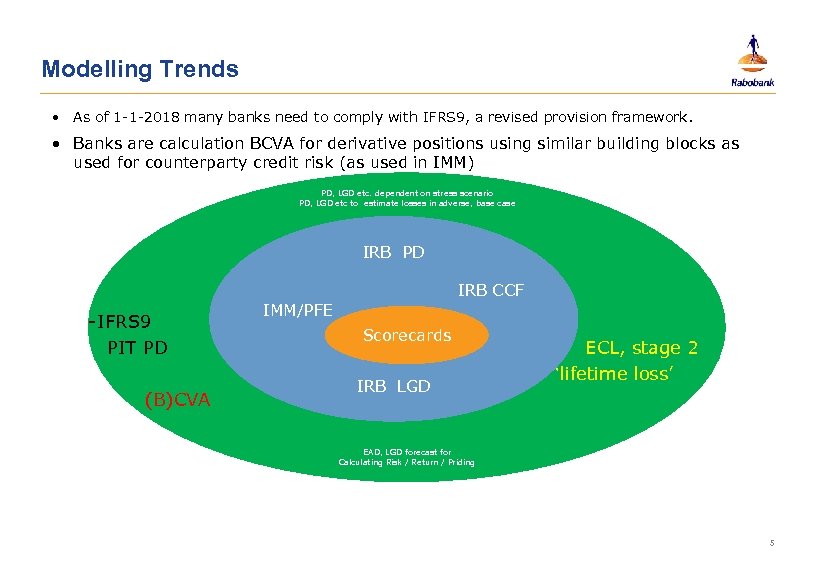 Modelling Trends • As of 1 -1 -2018 many banks need to comply with IFRS 9, a revised provision framework. • Banks are calculation BCVA for derivative positions using similar building blocks as used for counterparty credit risk (as used in IMM) PD, LGD etc. dependent on stress scenario PD, LGD etc to estimate losses in adverse, base case IRB PD - IFRS 9 PIT PD (B)CVA IRB CCF IMM/PFE Scorecards IRB LGD ECL, stage 2 ‘lifetime loss’ EAD, LGD forecast for Calculating Risk / Return / Priding 5
 Modelling Trends - Conclusion • The developments in the last 30 years led to: - A large increase of risk management models in the area of credit risk - These models are used in an increasing scope, initially for underwriting, but evolving into pricing/risk return, stress testing, provisioning - The application of components of the counterparty credit risk models (credit risk on derivatives) is broadening to the field of Credit Valuation Adjustments (CVA) - The models show large similarities, can/should not be the same for compliance reasons and their deviating purposes - This all becomes difficult to maintain: the huge model portfolio needs to be managed! 6
 Model Risk Management • Regulation • Model Risk Management Framework - Framework elements - Policy elements - Formal Definition • Benefits 7
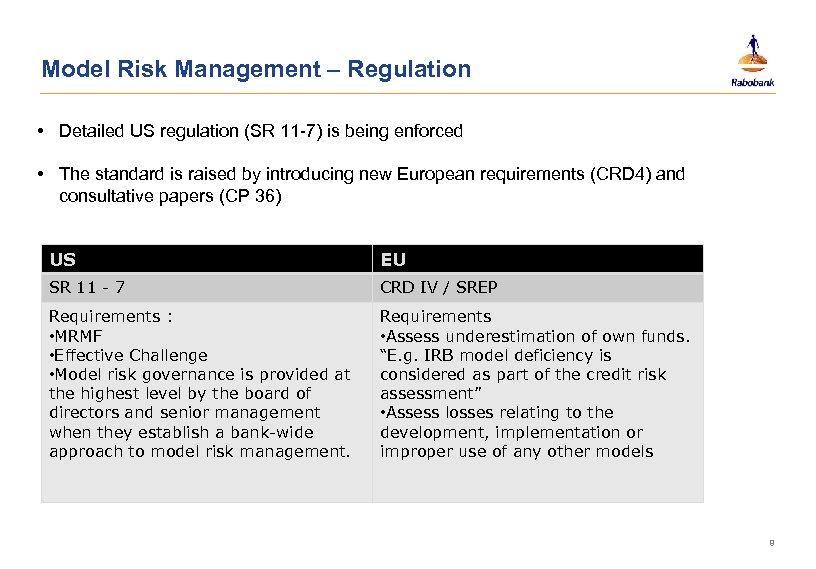 Model Risk Management – Regulation • Detailed US regulation (SR 11 -7) is being enforced • The standard is raised by introducing new European requirements (CRD 4) and consultative papers (CP 36) US EU SR 11 - 7 CRD IV / SREP Requirements : • MRMF • Effective Challenge • Model risk governance is provided at the highest level by the board of directors and senior management when they establish a bank-wide approach to model risk management. Requirements • Assess underestimation of own funds. “E. g. IRB model deficiency is considered as part of the credit risk assessment” • Assess losses relating to the development, implementation or improper use of any other models 8
 Model Risk Management – Model examples • Model examples: - Scorecard for accept/reject decisions in retail finance - Value at Risk model for market risk limits - Loss given default model for capital on performing loans - Residual value model for leasing contracts - Propensity to buy model for marketing - Return on Risk Adjusted Capital for deal selection - Valuation of an interest rate swap 9
 Model Risk Management Framework • Model Risk Management Framework - Governance documents - Model Committees - Group-level systems 8 Model Inventory 8 Model Library - Model Portfolio reporting - Model Chain KPI’s - All entities and departments involved (such as senior management, modelling, validation, users) 10
 MRMF Elements • Definitions - Model Risk - Model Purpose & Model Application - Model Types • Policy Requirements • Roles & Responsibilities - Committee framework - Definition of roles & responsibilities 11
 MRMF elements - Model Definition • Basic Model Definition (SR 11 -7) - A model is a quantitative method, system, or approach that applies statistical, economic, financial, or mathematical theories, techniques, and assumptions to process input data into quantitative estimates. [. . ] - Key: In case a collection of models is built and used for a single and unambiguous purpose, then such a collection should be managed as a single model • Exclusion: Simple computations; End User Computing 12
 MRMF - Elements • Model Risk Assessment Risk = Impact x Uncertainty Impact = Magnitude of loss if model outcome is wrong Uncertainty = How (un)likely does a mistake occur Impact is correlated with size of modelled portfolio or expected new business valume Uncertainty is correlated with complexity of the model of its embedding or implementation 13
 MRMF - Benefits of an MRMF The model risk assessment could steer the intensity of controls such as model validation processes, allocating resources commensurate with model risk. The model inventory makes transparent which models are around and what model risk they induce. It can be used to report to senior management as part of the risk appetite statement. This model inventory date can be used by an architect to steer the evolution of the models and increase their coherence. 14
 Questions? 15