


 Скачать презентацию Modelling the impact of male circumcision on HIV AIDS
acb4e7103c722881c1d8a74d33686c80.ppt
- Количество слайдов: 31
 Modelling the impact of male circumcision on HIV/AIDS in sub-Saharan Africa Brian Williams, SACEMA 14 November 2007
 The purpose of models is not to fit the data but to sharpen the questions Karlin, S. 11 th R. A. Fisher Memorial Lecture, Royal Society, 6 Carlton House Terrace, London. 20 April 1983.
 Question 1 Male circumcision reduces female-to-male transmission by 60%; what is the overall population level effect?
 Question 2 How many men do we need to circumcise now to avert one future case of infection?
 Question 3 How many men do we need to circumcise to avert one future case in a women?
 Question 4 At what age should we circumcise men or boys?
 Question 5 Over what time scale will we see the effects?
 Question 6 How does the age-specific prevalence/incidence of infection vary over time in response to MC?
 Question 7 How do sexual mixing patterns affect the impact of MC?
 Question 8 Sexual network are almost always scale free. How does this affect the impact of MC?
 Question 9 How many (discounted) dollars and lives do we save in the future for each dollar spent now?
 Question 10 What kind of synergies might we expect from other interventions?
 Summary • • • Overall impact Targeting Impact Time scale Effectiveness Cost benefit
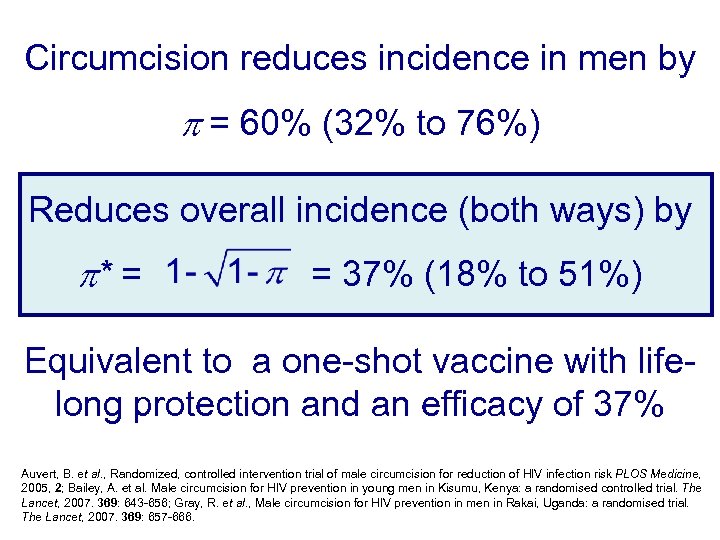 Circumcision reduces incidence in men by p = 60% (32% to 76%) Reduces overall incidence (both ways) by p* = = 37% (18% to 51%) Equivalent to a one-shot vaccine with lifelong protection and an efficacy of 37% Auvert, B. et al. , Randomized, controlled intervention trial of male circumcision for reduction of HIV infection risk PLOS Medicine, 2005, 2; Bailey, A. et al. Male circumcision for HIV prevention in young men in Kisumu, Kenya: a randomised controlled trial. The Lancet, 2007. 369: 643 -656; Gray, R. et al. , Male circumcision for HIV prevention in men in Rakai, Uganda: a randomised trial. The Lancet, 2007. 369: 657 -666.
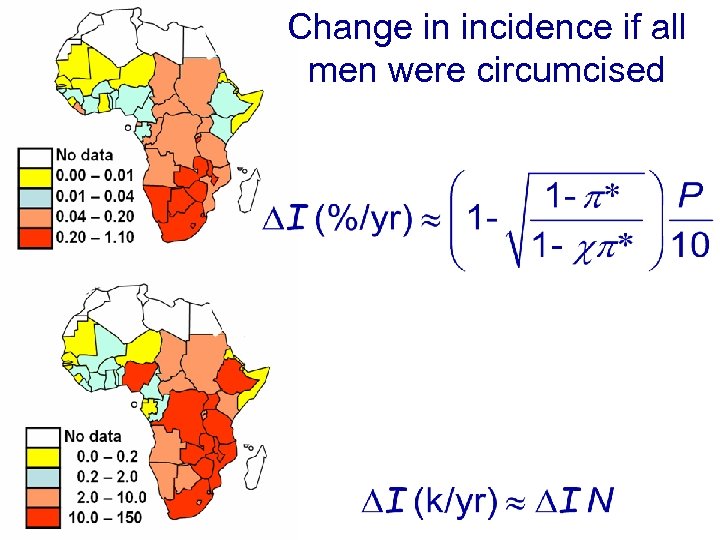 Change in incidence if all men were circumcised
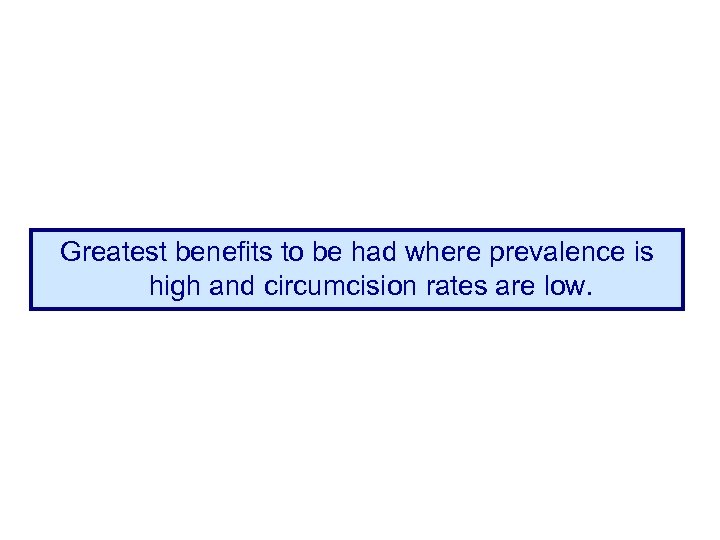 Greatest benefits to be had where prevalence is high and circumcision rates are low.
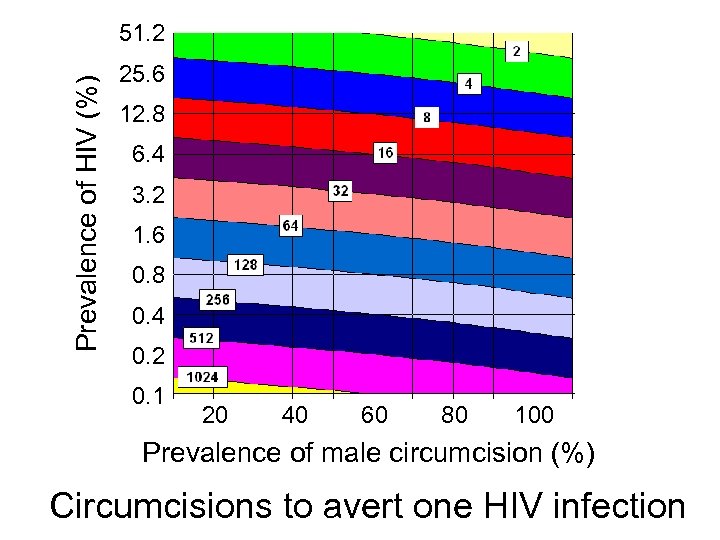 51. 2 25. 6 12. 8 6. 4 3. 2 1. 6 0. 8 0. 4 0. 2 0. 1 0 Prevalence of HIV (%) 51. 2 0. 1 100 20 40 60 80 Prevalence of male circumcision (%) Circumcisions to avert one HIV infection
 Life-time infections averted per circumcision done approximately equal to the prevalence
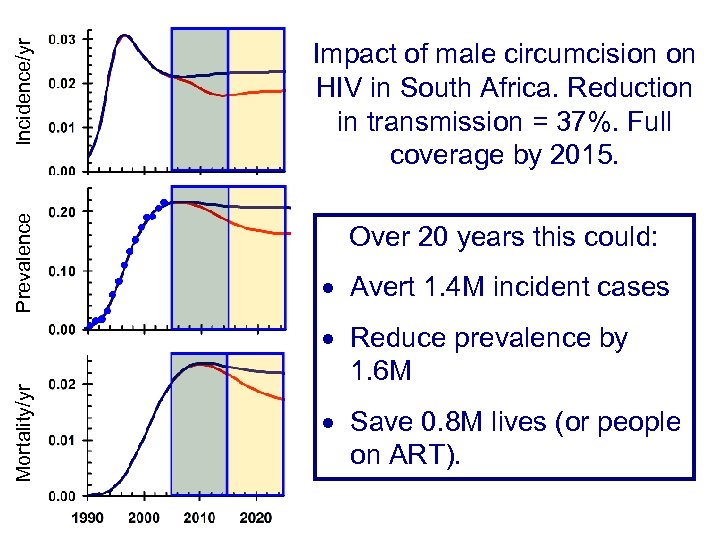 Incidence/yr Prevalence Over 20 years this could: Mortality/yr Impact of male circumcision on HIV in South Africa. Reduction in transmission = 37%. Full coverage by 2015. Avert 1. 4 M incident cases Reduce prevalence by 1. 6 M Save 0. 8 M lives (or people on ART).
 The personal benefit is immediate; the full public health benefit will only be seen over ten years or more.
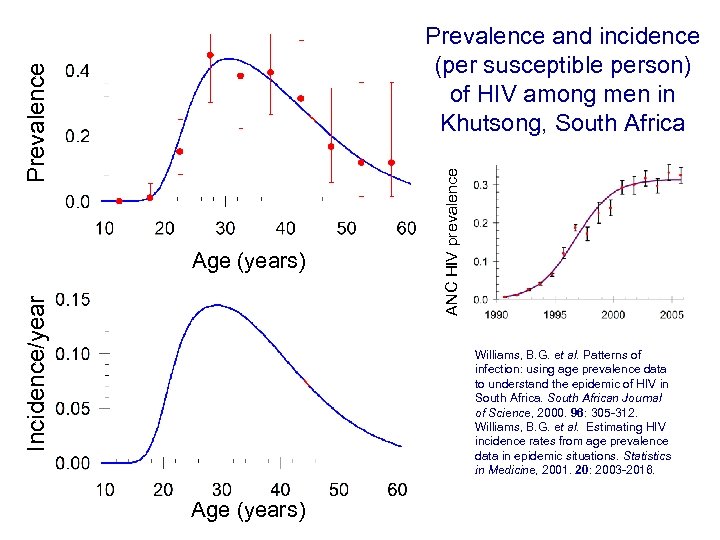 Incidence/year Age (years) ANC HIV prevalence Prevalence and incidence (per susceptible person) of HIV among men in Khutsong, South Africa Williams, B. G. et al. Patterns of infection: using age prevalence data to understand the epidemic of HIV in South African Journal of Science, 2000. 96: 305 -312. Williams, B. G. et al. Estimating HIV incidence rates from age prevalence data in epidemic situations. Statistics in Medicine, 2001. 20: 2003 -2016. Age (years)
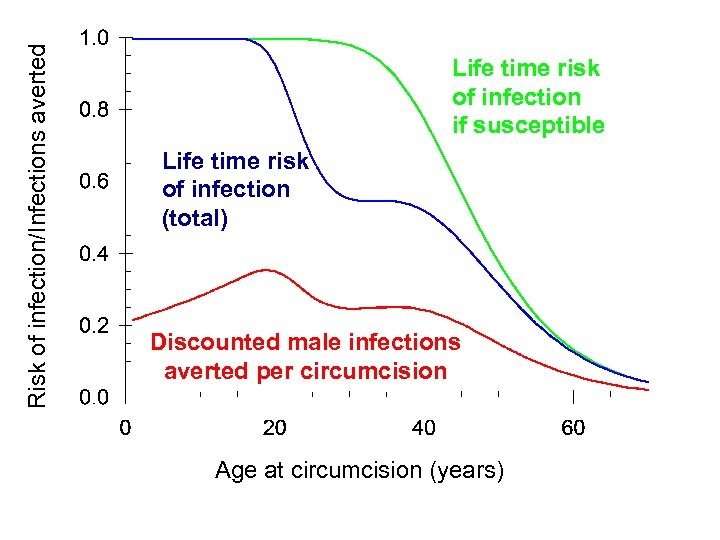 Risk of infection/Infections averted Life time risk of infection if susceptible Life time risk of infection (total) Discounted male infections averted per circumcision Age at circumcision (years)
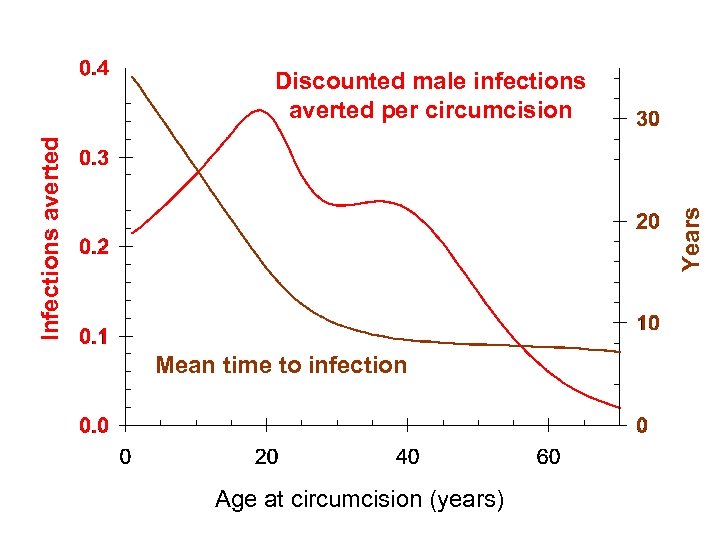 Years Infections averted Discounted male infections averted per circumcision Mean time to infection Age at circumcision (years)
 We need to think about the age at circumcision and the time over which the impact will be seen
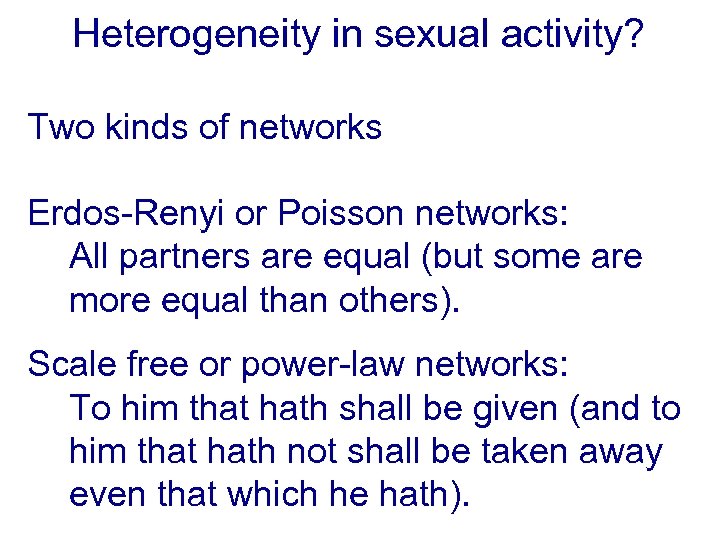 Heterogeneity in sexual activity? Two kinds of networks Erdos-Renyi or Poisson networks: All partners are equal (but some are more equal than others). Scale free or power-law networks: To him that hath shall be given (and to him that hath not shall be taken away even that which he hath).
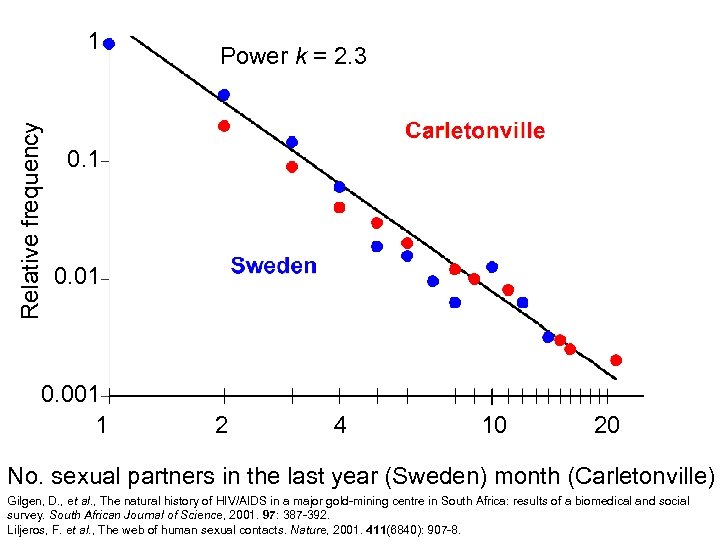 Relative frequency 1 Power k = 2. 3 0. 1 0. 001 1 2 4 10 20 No. sexual partners in the last year (Sweden) month (Carletonville) Gilgen, D. , et al. , The natural history of HIV/AIDS in a major gold-mining centre in South Africa: results of a biomedical and social survey. South African Journal of Science, 2001. 97: 387 -392. Liljeros, F. et al. , The web of human sexual contacts. Nature, 2001. 411(6840): 907 -8.
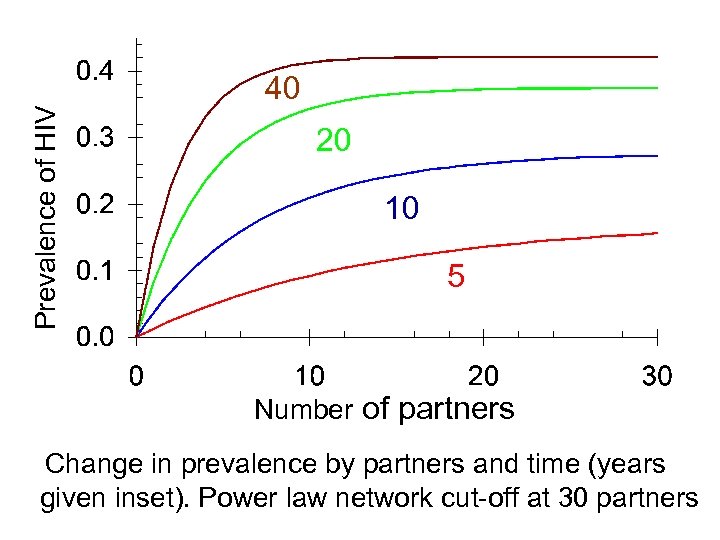 Prevalence of HIV 40 20 10 5 Number of partners Change in prevalence by partners and time (years given inset). Power law network cut-off at 30 partners
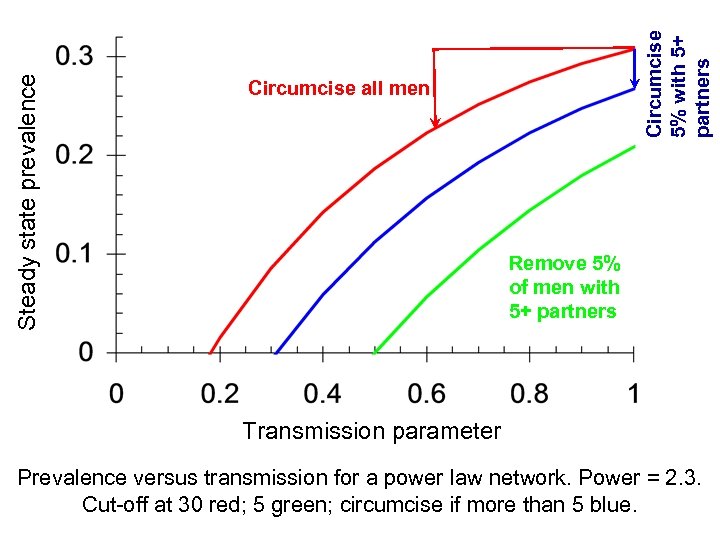 Circumcise 5% with 5+ partners Steady state prevalence Circumcise all men Remove 5% of men with 5+ partners Transmission parameter Prevalence versus transmission for a power law network. Power = 2. 3. Cut-off at 30 red; 5 green; circumcise if more than 5 blue.
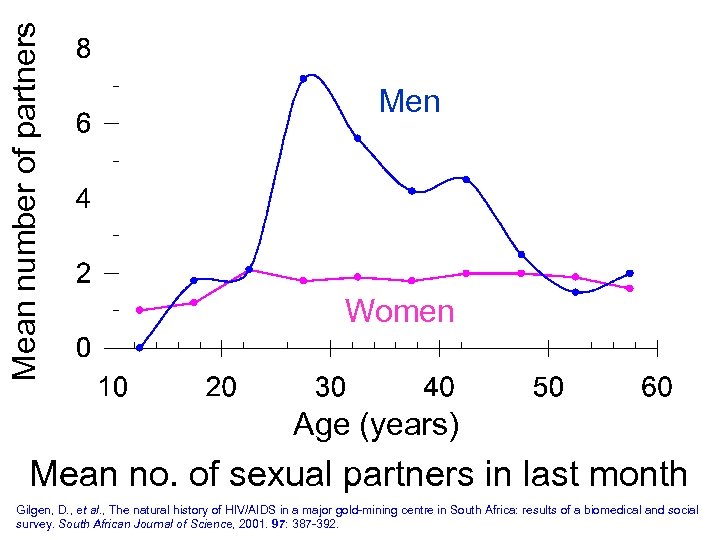 Mean number of partners Men Women Age (years) Mean no. of sexual partners in last month Gilgen, D. , et al. , The natural history of HIV/AIDS in a major gold-mining centre in South Africa: results of a biomedical and social survey. South African Journal of Science, 2001. 97: 387 -392.
 Start with men aged 25 to 35
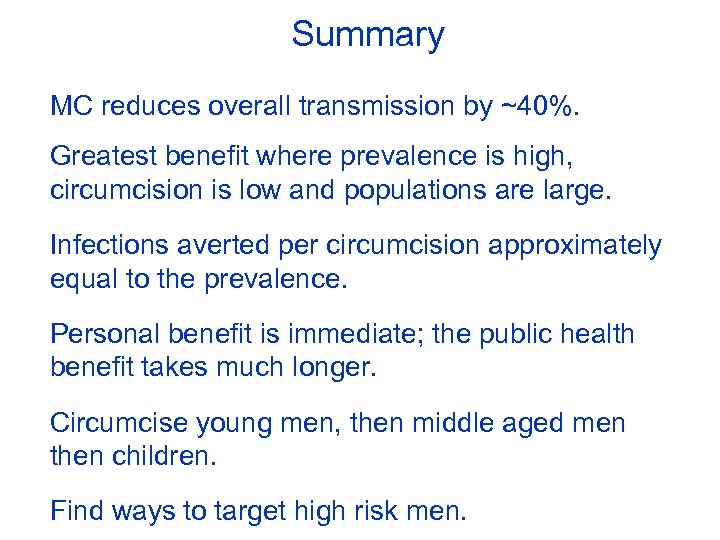 Summary MC reduces overall transmission by ~40%. Greatest benefit where prevalence is high, circumcision is low and populations are large. Infections averted per circumcision approximately equal to the prevalence. Personal benefit is immediate; the public health benefit takes much longer. Circumcise young men, then middle aged men then children. Find ways to target high risk men.