 Скачать презентацию Modelling sustainability in water supply and drainage with
ad640af814681455da03086dfd683299.ppt
- Количество слайдов: 19



Modelling sustainability in water supply and drainage with SIMDEUM® Ilse Pieterse-Quirijns, Claudia Agudelo-Vera, Mirjam Blokker
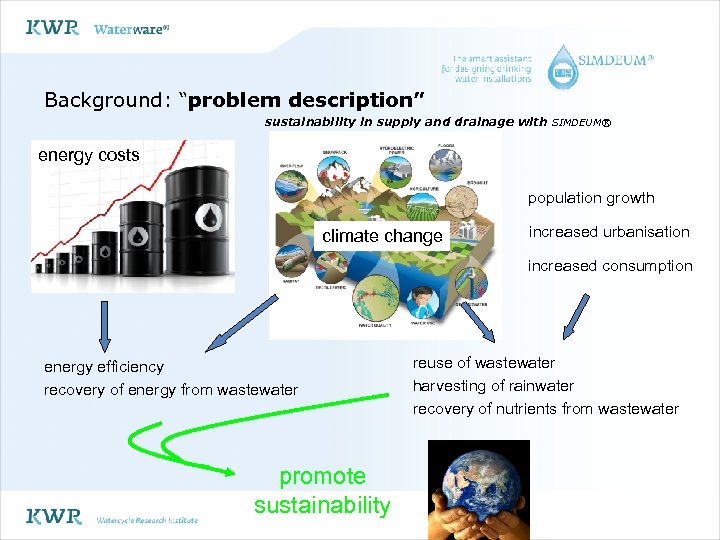
Background: “problem description” sustainability in supply and drainage with SIMDEUM® energy costs population growth climate change increased urbanisation increased consumption energy efficiency recovery of energy from wastewater promote sustainability reuse of wastewater harvesting of rainwater recovery of nutrients from wastewater
Purpose: contribution SIMDEUM® in sustainability in supply and drainage with SIMDEUM® Purpose: Contribution of SIMDEUM® in sustainability in supply and drainage to buildings: Case 1: energy efficient design of water heaters Case 2: grey water recycling and rainwater harvesting system Case 3: recovery of thermal energy and nutrients from wastewater
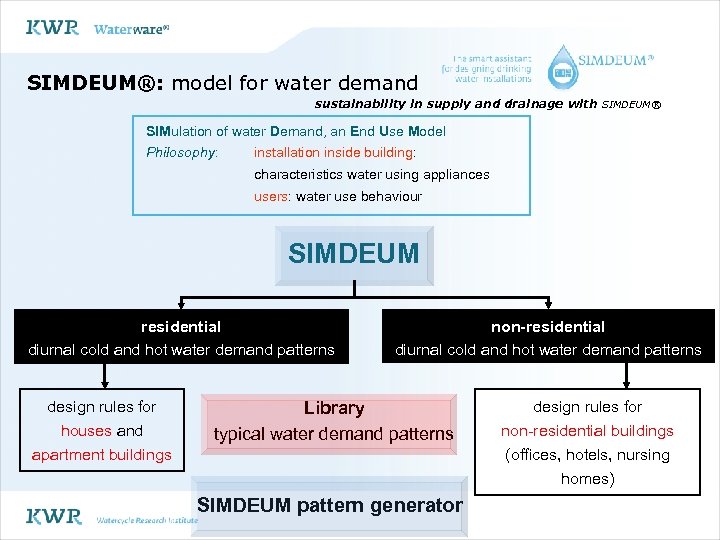
SIMDEUM®: model for water demand sustainability in supply and drainage with SIMDEUM® SIMulation of water Demand, an End Use Model Philosophy: installation inside building: characteristics water using appliances users: water use behaviour SIMDEUM residential diurnal cold and hot water demand patterns design rules for houses and non-residential diurnal cold and hot water demand patterns Library typical water demand patterns apartment buildings design rules for non-residential buildings (offices, hotels, nursing homes) SIMDEUM pattern generator
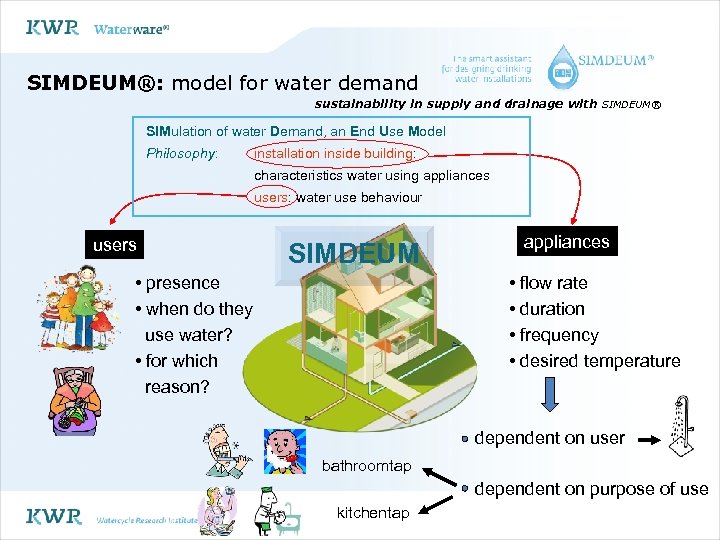
SIMDEUM®: model for water demand sustainability in supply and drainage with SIMDEUM® SIMulation of water Demand, an End Use Model Philosophy: installation inside building: characteristics water using appliances users: water use behaviour users SIMDEUM • presence • when do they use water? • for which reason? appliances • flow rate • duration • frequency • desired temperature dependent on user bathroomtap dependent on purpose of use kitchentap
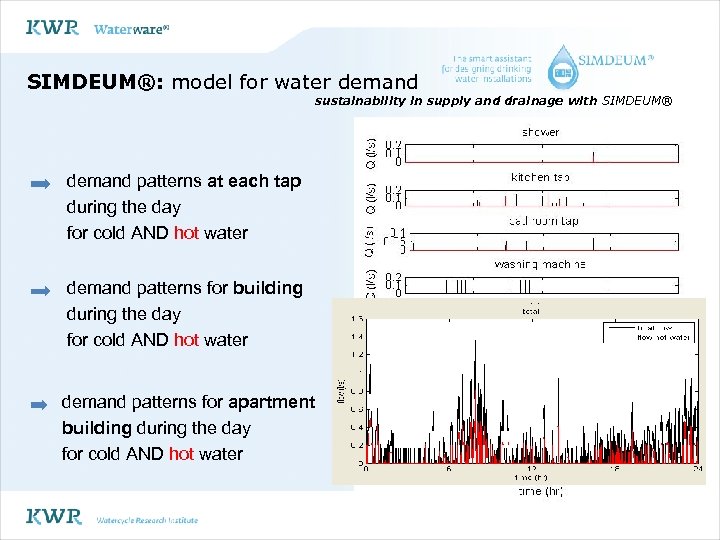
SIMDEUM®: model for water demand sustainability in supply and drainage with SIMDEUM® demand patterns at each tap during the day for cold AND hot water demand patterns for building during the day for cold AND hot water demand patterns for apartment building during the day for cold AND hot water
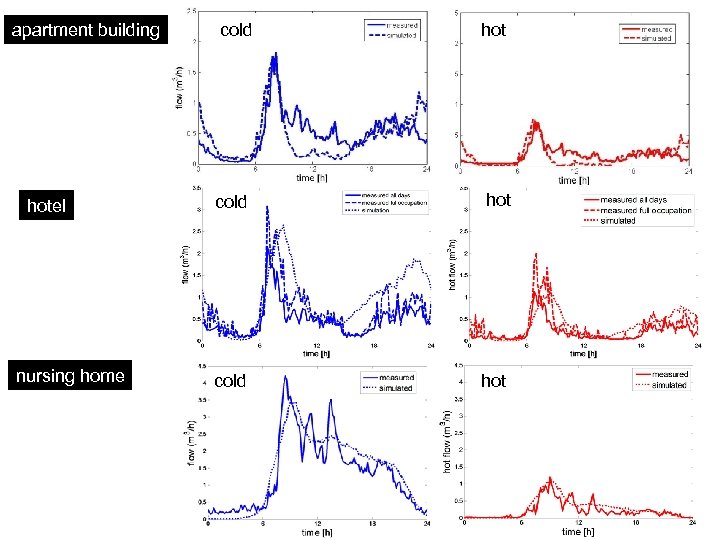
apartment building hotel nursing home cold hot
Case 1 SIMDEUM® in energy efficient design of water heaters
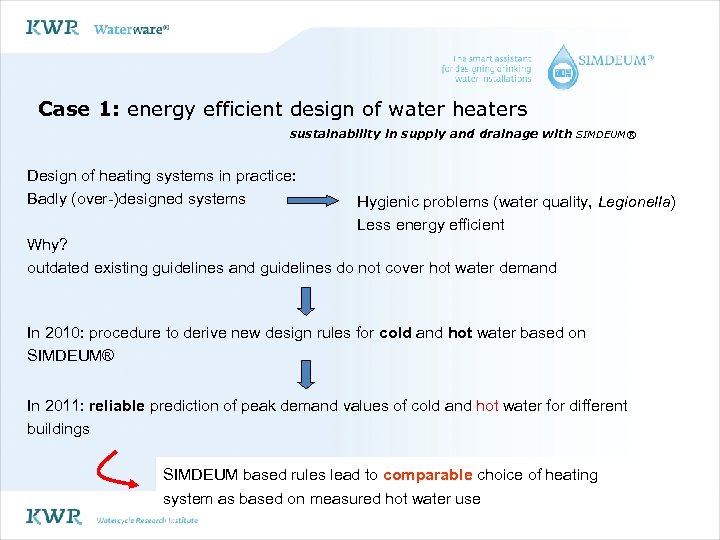
Case 1: energy efficient design of water heaters sustainability in supply and drainage with SIMDEUM® Design of heating systems in practice: Badly (over-)designed systems Hygienic problems (water quality, Legionella) Less energy efficient Why? outdated existing guidelines and guidelines do not cover hot water demand In 2010: procedure to derive new design rules for cold and hot water based on SIMDEUM® In 2011: reliable prediction of peak demand values of cold and hot water for different buildings SIMDEUM based rules lead to comparable choice of heating system as based on measured hot water use
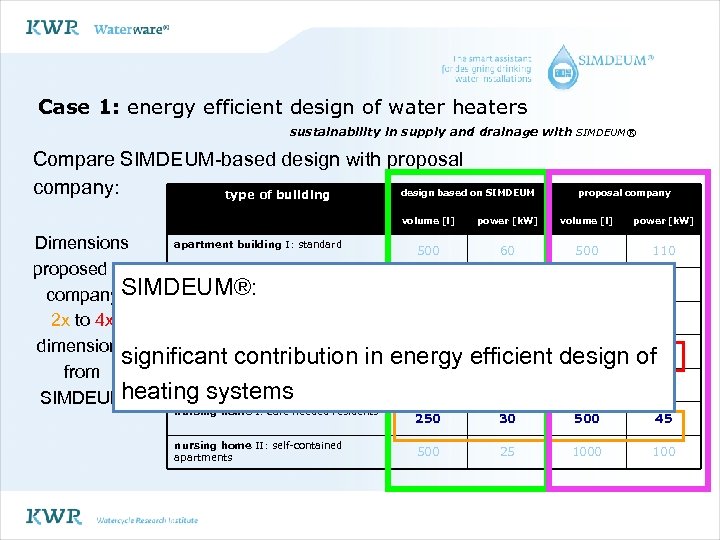
Case 1: energy efficient design of water heaters sustainability in supply and drainage with SIMDEUM® Compare SIMDEUM-based design with proposal company: design based on SIMDEUM type of building proposal company volume [l] apartment building I: standard Dimensions proposed by apartment building II: luxurious) SIMDEUM®: company hotel I (small business) 2 x to 4 x hotel II (large business) dimensions significant contribution from hotel III (tourist) heating systems SIMDEUM volume [l] power [k. W] 500 60 500 110 500 82 1000 80 500 35 1000 200 1000 60 4000 200 in energy efficient design of nursing home I: care needed residents nursing home II: self-contained apartments power [k. W] 250 50 740 100 250 30 500 45 500 25 1000 100
Case 2 SIMDEUM® in grey water recycling and rainwater harvesting system
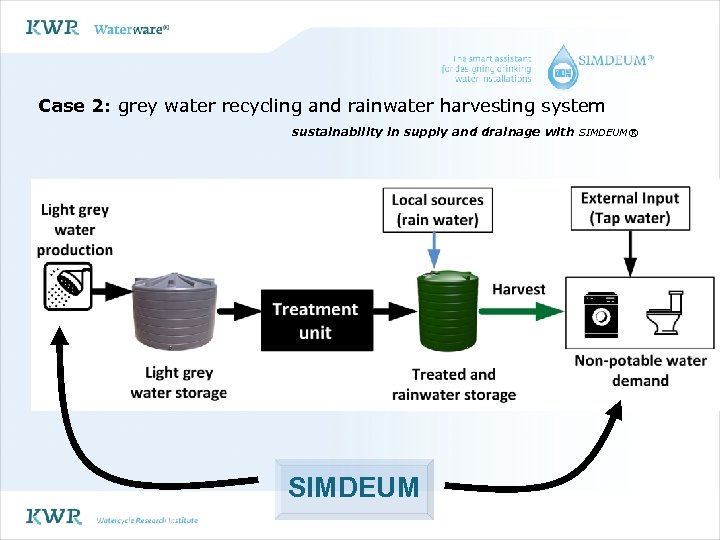
Case 2: grey water recycling and rainwater harvesting system sustainability in supply and drainage with SIMDEUM® SIMDEUM
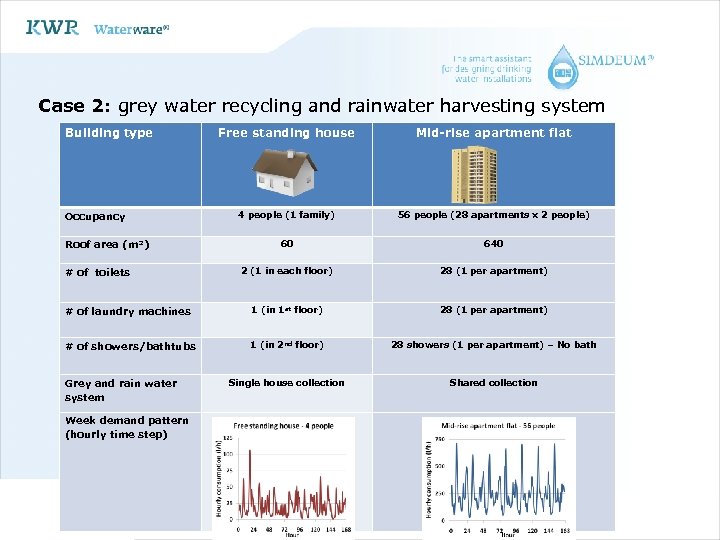
Case 2: grey water recycling and rainwater harvesting system Building type Free standing house Mid-rise apartment flat 4 people (1 family) 56 people (28 apartments x 2 people) 60 640 2 (1 in each floor) 28 (1 per apartment) # of laundry machines 1 (in 1 st floor) 28 (1 per apartment) # of showers/bathtubs 1 (in 2 nd floor) 28 showers (1 per apartment) – No bath Single house collection Shared collection Occupancy Roof area (m²) # of toilets Grey and rain water system Week demand pattern (hourly time step)
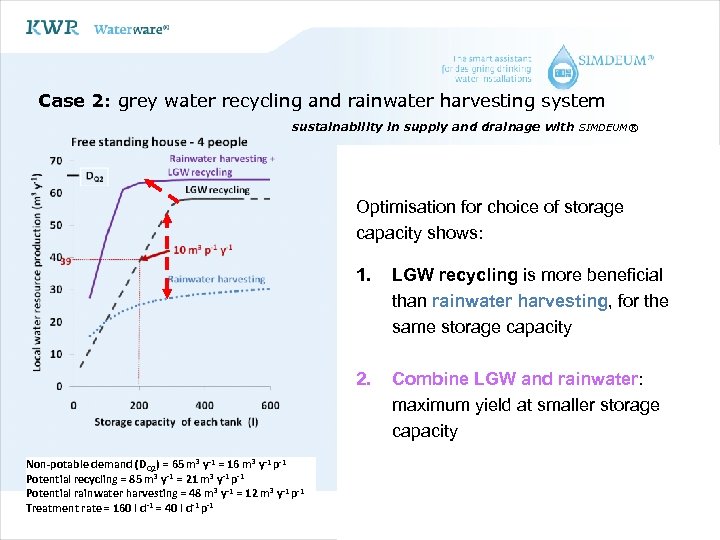
Case 2: grey water recycling and rainwater harvesting system sustainability in supply and drainage with SIMDEUM® Optimisation for choice of storage capacity shows: 1. 2. Non-potable demand (D Q 2) = 65 m³ y-1 = 16 m³ y-1 p-1 Potential recycling = 85 m³ y -1 = 21 m³ y-1 p-1 Potential rainwater harvesting = 48 m³ y -1 = 12 m³ y-1 p-1 Treatment rate = 160 l d-1 = 40 l d -1 p-1 LGW recycling is more beneficial than rainwater harvesting, for the same storage capacity Combine LGW and rainwater: maximum yield at smaller storage capacity Non-potable demand (D Q 2) = 1108 m³ y -1 = 20 m³ y-1 p-1 Potential recycling = 930 m³ y -1 = 17 m³ y-1 p-1 Potential rainwater harvesting = 512 m³ y -1 = 9 m³ y-1 p-1 Treatment rate = 2240 l d -1 = 40 l d -1 p-1
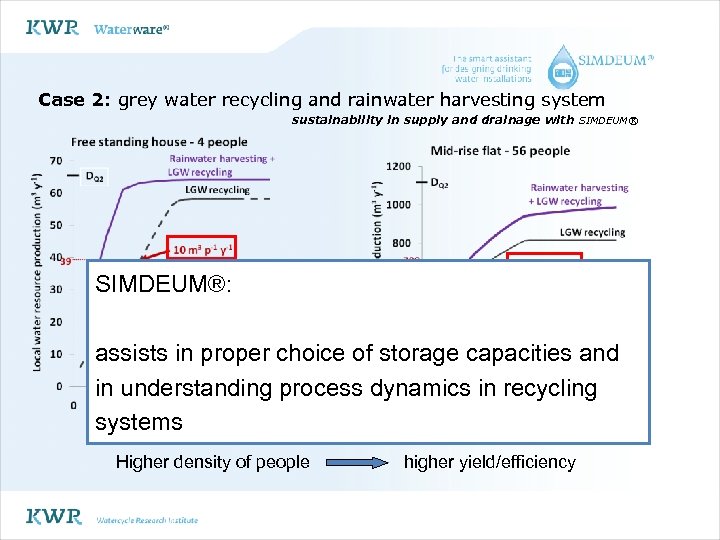
Case 2: grey water recycling and rainwater harvesting system sustainability in supply and drainage with SIMDEUM®: assists in proper choice of storage capacities and in understanding process dynamics in recycling systems Higher density of people higher yield/efficiency
Case 3 SIMDEUM® in recovery of thermal energy and nutrients from wastewater
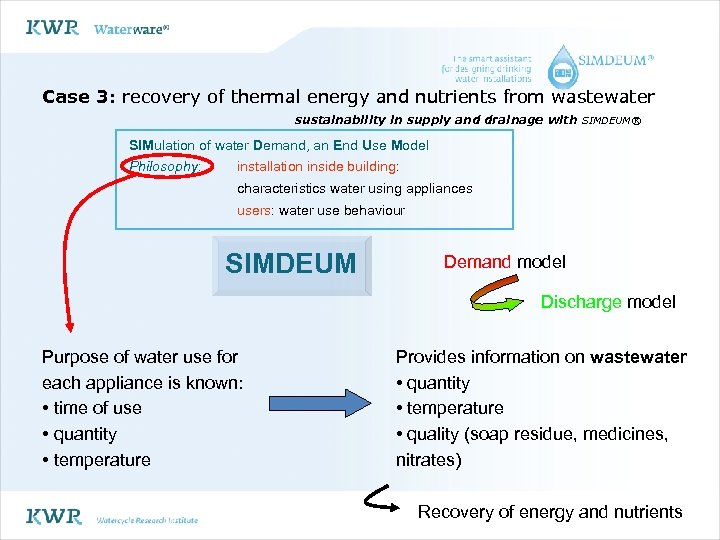
Case 3: recovery of thermal energy and nutrients from wastewater sustainability in supply and drainage with SIMDEUM® SIMulation of water Demand, an End Use Model Philosophy: installation inside building: characteristics water using appliances users: water use behaviour SIMDEUM Demand model Discharge model Purpose of water use for each appliance is known: • time of use • quantity • temperature Provides information on wastewater • quantity • temperature • quality (soap residue, medicines, nitrates) Recovery of energy and nutrients
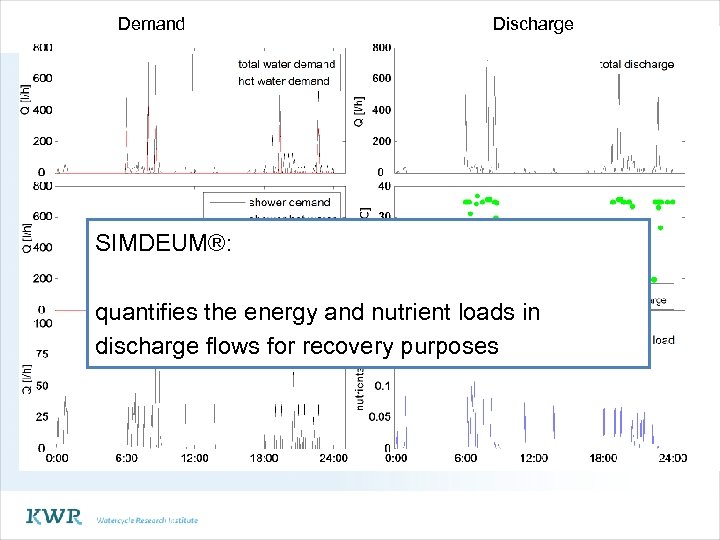
Demand Discharge sustainability in supply and drainage with SIMDEUM® Case 3: recovery of thermal energy and nutrients from wastewater SIMDEUM®: quantifies the energy and nutrient loads in discharge flows for recovery purposes
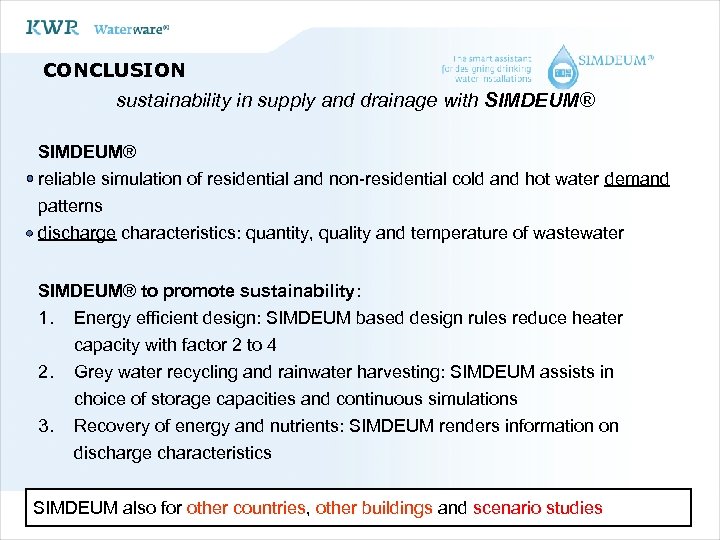
CONCLUSION sustainability in supply and drainage with SIMDEUM® reliable simulation of residential and non-residential cold and hot water demand patterns discharge characteristics: quantity, quality and temperature of wastewater SIMDEUM® to promote sustainability: 1. Energy efficient design: SIMDEUM based design rules reduce heater capacity with factor 2 to 4 2. Grey water recycling and rainwater harvesting: SIMDEUM assists in choice of storage capacities and continuous simulations Recovery of energy and nutrients: SIMDEUM renders information on discharge characteristics 3. SIMDEUM also for other countries, other buildings and scenario studies
Скачать презентацию Modelling sustainability in water supply and drainage with
ad640af814681455da03086dfd683299.ppt