


 Скачать презентацию Modelling of the NSRF 2007 -2013 impact to
b382970caedc168747bd9d4038603342.ppt
- Количество слайдов: 25
 Modelling of the NSRF 2007 -2013 impact to the Slovak economy – possible alternatives Viliam Páleník, Marek Radvanský Institute for Economic Research SAS
 Motivation Significant delay of NSRF funds spending for years 2007 -13 IER SAS as an NSRF evaluator Use of existing methodology Problem of time changes in Structural funds spending on macroeconomic effects 2. 10. 2008, Herľany
 Presentation structure Methodology Model HERMIN for Slovak economy Modelling of the NSRF 2007 -2013 impact to the Slovak economy – possible alternatives 2. 10. 2008, Herľany
 Model HERMIN for Slovak economy
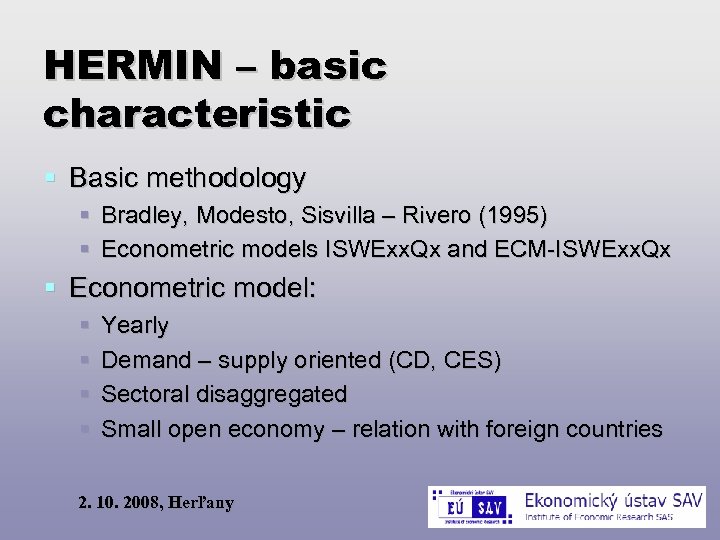 HERMIN – basic characteristic Basic methodology Bradley, Modesto, Sisvilla – Rivero (1995) Econometric models ISWExx. Qx and ECM-ISWExx. Qx Econometric model: Yearly Demand – supply oriented (CD, CES) Sectoral disaggregated Small open economy – relation with foreign countries 2. 10. 2008, Herľany
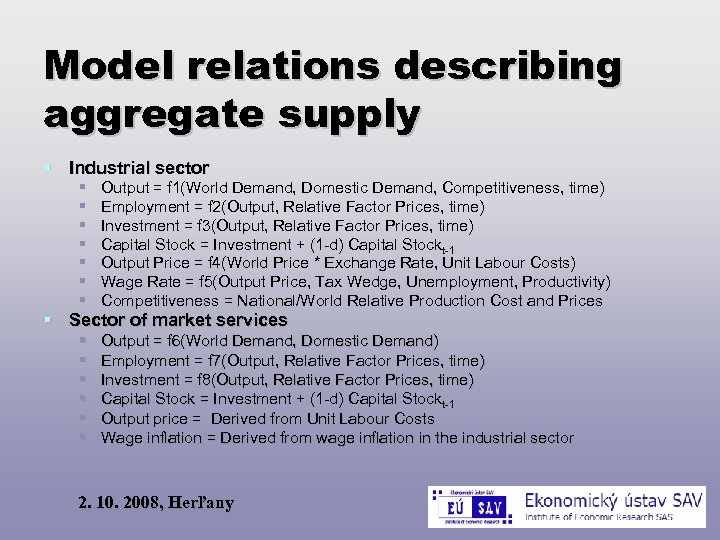 Model relations describing aggregate supply Industrial sector Output = f 1(World Demand, Domestic Demand, Competitiveness, time) Employment = f 2(Output, Relative Factor Prices, time) Investment = f 3(Output, Relative Factor Prices, time) Capital Stock = Investment + (1 -d) Capital Stockt-1 Output Price = f 4(World Price * Exchange Rate, Unit Labour Costs) Wage Rate = f 5(Output Price, Tax Wedge, Unemployment, Productivity) Competitiveness = National/World Relative Production Cost and Prices Sector of market services Output = f 6(World Demand, Domestic Demand) Employment = f 7(Output, Relative Factor Prices, time) f 7( Investment = f 8(Output, Relative Factor Prices, time) Capital Stock = Investment + (1 -d) Capital Stockt-1 Output price = Derived from Unit Labour Costs Wage inflation = Derived from wage inflation in the industrial sector 2. 10. 2008, Herľany
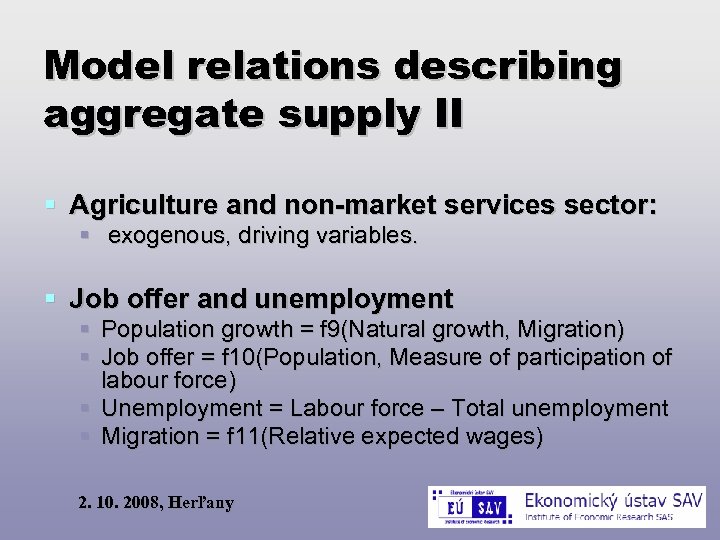 Model relations describing aggregate supply II Agriculture and non-market services sector: exogenous, driving variables. Job offer and unemployment Population growth = f 9(Natural growth, Migration) Job offer = f 10(Population, Measure of participation of labour force) Unemployment = Labour force – Total unemployment Migration = f 11(Relative expected wages) 2. 10. 2008, Herľany
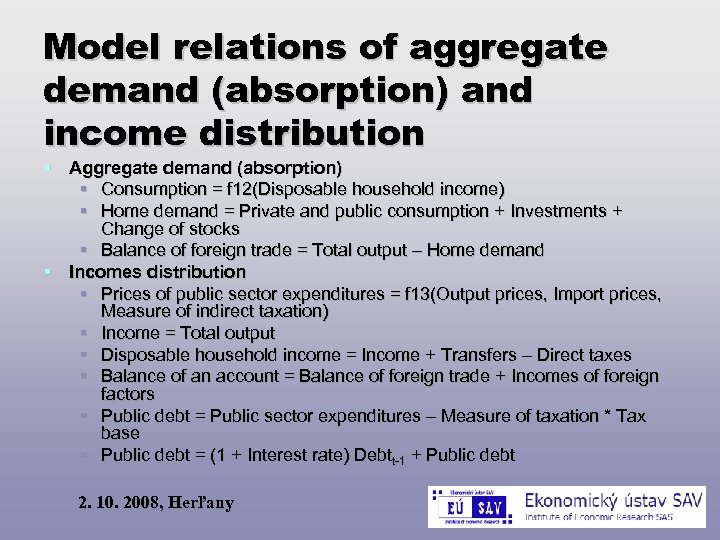 Model relations of aggregate demand (absorption) and income distribution Aggregate demand (absorption) Consumption = f 12(Disposable household income) Home demand = Private and public consumption + Investments + Change of stocks Balance of foreign trade = Total output – Home demand Incomes distribution Prices of public sector expenditures = f 13(Output prices, Import prices, Measure of indirect taxation) Income = Total output Disposable household income = Income + Transfers – Direct taxes Balance of an account = Balance of foreign trade + Incomes of foreign factors Public debt = Public sector expenditures – Measure of taxation * Tax base Public debt = (1 + Interest rate) Debtt-1 + Public debt 2. 10. 2008, Herľany
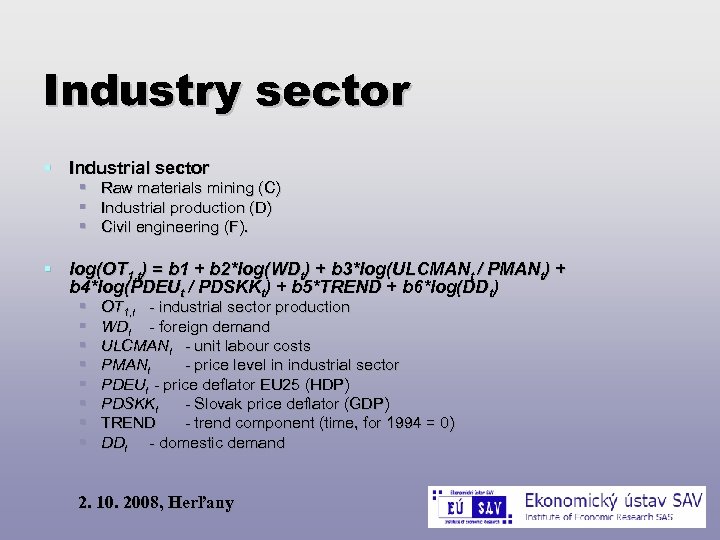 Industry sector Industrial sector Raw materials mining (C) Industrial production (D) Civil engineering (F). log(OT 1, t) = b 1 + b 2*log(WDt) + b 3*log(ULCMANt / PMANt) + b 4*log(PDEUt / PDSKKt) + b 5*TREND + b 6*log(DDt) OT 1, t - industrial sector production WDt - foreign demand ULCMANt - unit labour costs PMANt - price level in industrial sector PDEUt - price deflator EU 25 (HDP) PDSKKt - Slovak price deflator (GDP) TREND - trend component (time, for 1994 = 0) DDt - domestic demand 2. 10. 2008, Herľany
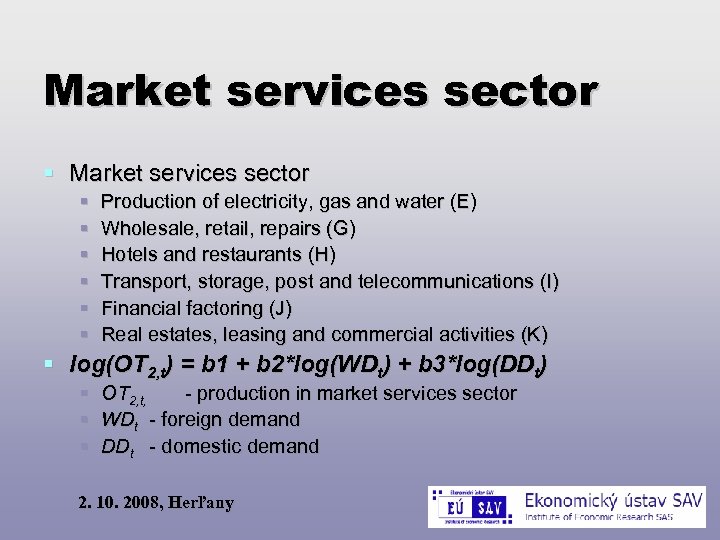 Market services sector Production of electricity, gas and water (E) Wholesale, retail, repairs (G) Hotels and restaurants (H) Transport, storage, post and telecommunications (I) Financial factoring (J) Real estates, leasing and commercial activities (K) log(OT 2, t) = b 1 + b 2*log(WDt) + b 3*log(DDt) OT 2, t, - production in market services sector WDt - foreign demand DDt - domestic demand 2. 10. 2008, Herľany
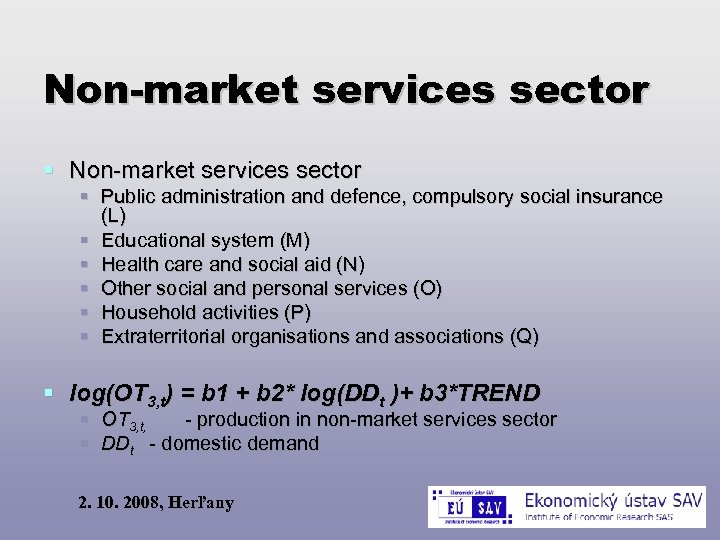 Non-market services sector Public administration and defence, compulsory social insurance (L) Educational system (M) Health care and social aid (N) Other social and personal services (O) Household activities (P) Extraterritorial organisations and associations (Q) log(OT 3, t) = b 1 + b 2* log(DDt )+ b 3*TREND OT 3, t, - production in non-market services sector DDt - domestic demand 2. 10. 2008, Herľany
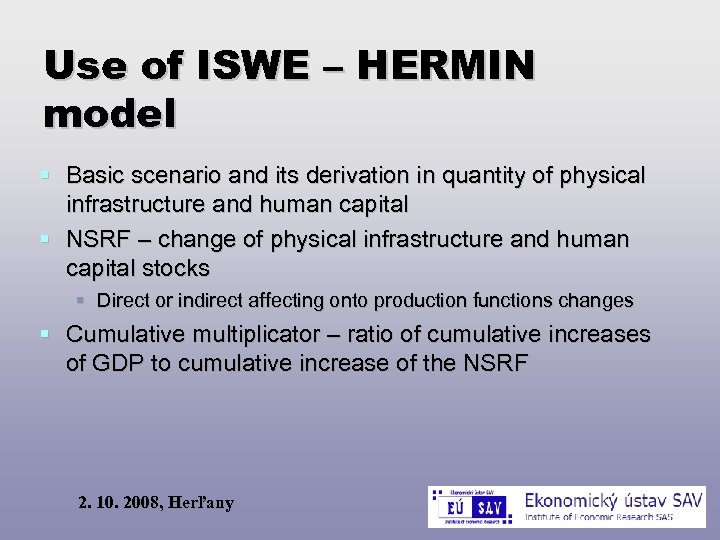 Use of ISWE – HERMIN model Basic scenario and its derivation in quantity of physical infrastructure and human capital NSRF – change of physical infrastructure and human capital stocks Direct or indirect affecting onto production functions changes Cumulative multiplicator – ratio of cumulative increases of GDP to cumulative increase of the NSRF 2. 10. 2008, Herľany
 Modelling of the NSRF 20072013 impact to the Slovak economy – possible alternatives
 Evaluation of alternative NSRF scenarios impact to the Slovak economy Used approaches HERMIN Two scenarios by two alternatives of funds spending NSRF proposal from 3 April 2006 and IER SAS Spending up to 11 bil. Euro Difference in structure made by doubling the costs for science and research in the IER SAS scenario compared to the NSRF from 3 April 2006 Comparison of balanced and significantly delayed funds spending Motivation – determine the impact of EU funds spending delay to effectiveness of their usage 2. 10. 2008, Herľany
 Financial allocations proposal MCRD SR from 3 April 2006 2. 10. 2008, Herľany
 Suggestion of allocation by IER SAS 2. 10. 2008, Herľany
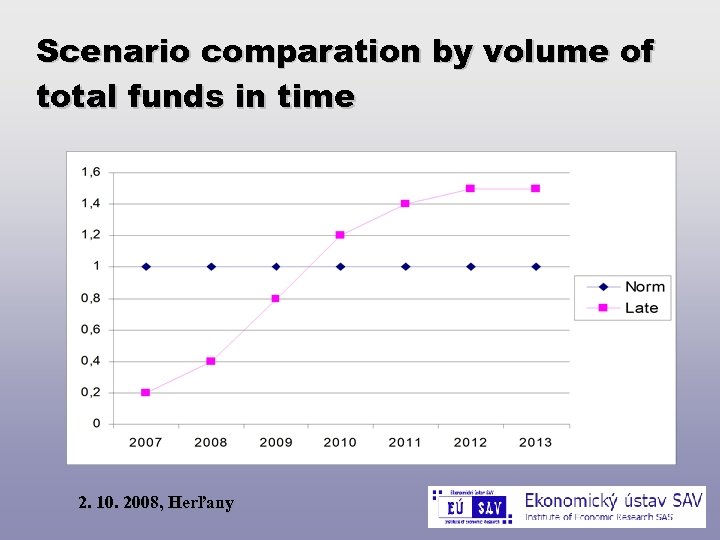 Scenario comparation by volume of total funds in time 2. 10. 2008, Herľany
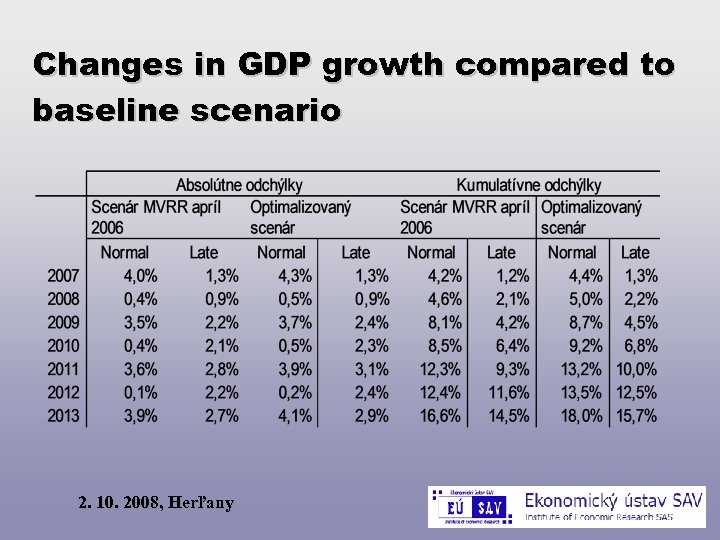 Changes in GDP growth compared to baseline scenario 2. 10. 2008, Herľany
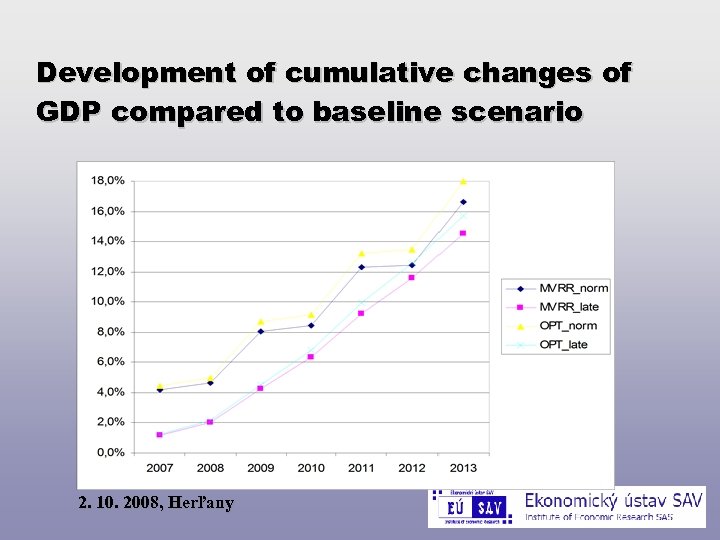 Development of cumulative changes of GDP compared to baseline scenario 2. 10. 2008, Herľany
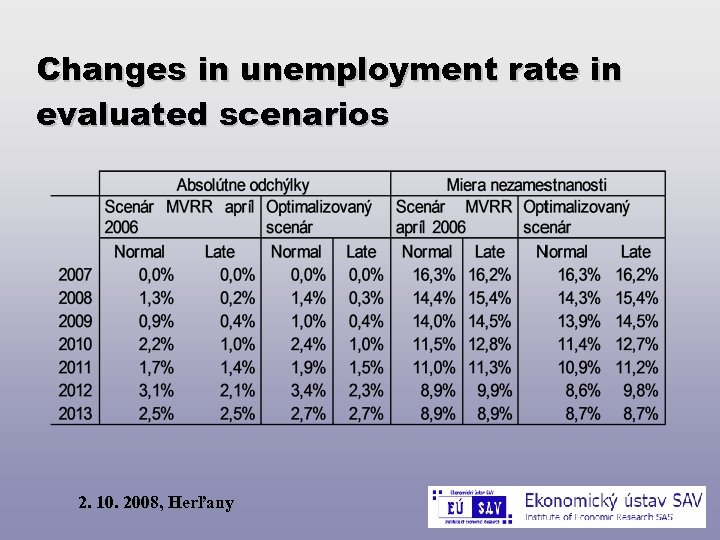 Changes in unemployment rate in evaluated scenarios 2. 10. 2008, Herľany
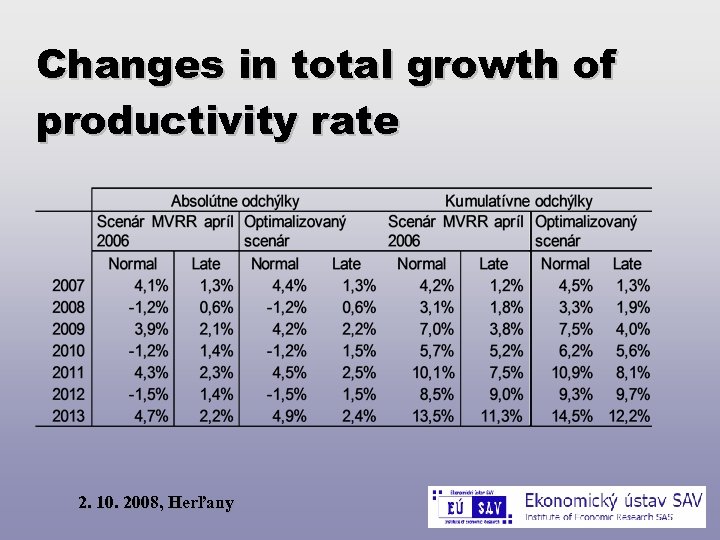 Changes in total growth of productivity rate 2. 10. 2008, Herľany
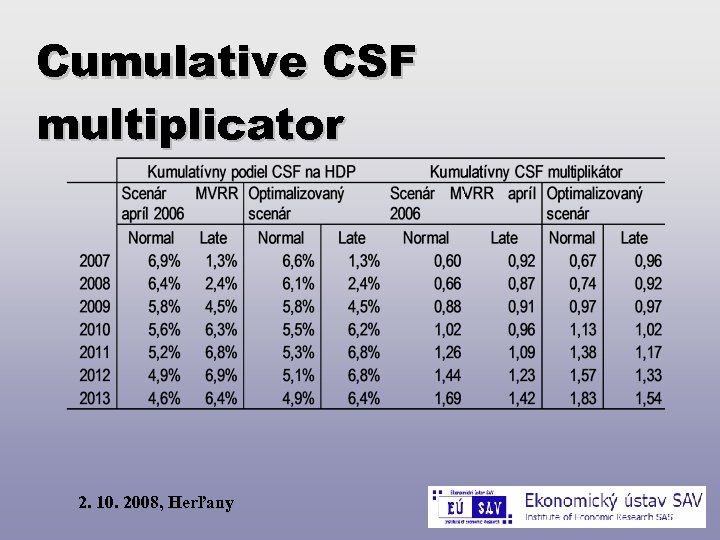 Cumulative CSF multiplicator 2. 10. 2008, Herľany
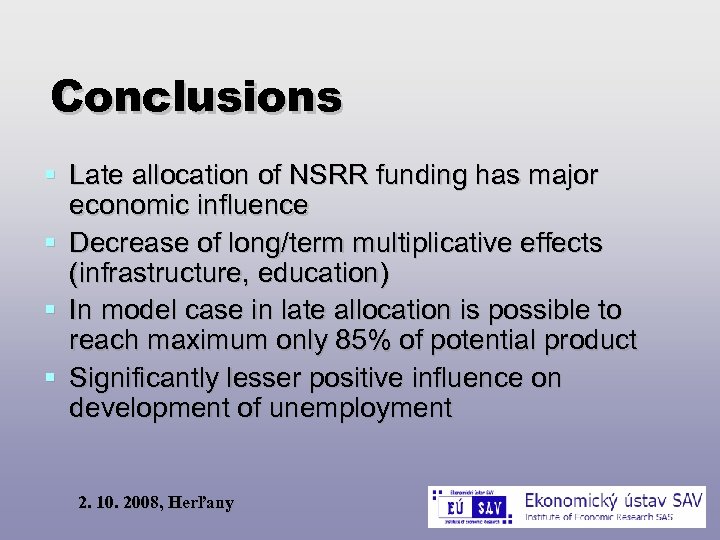 Conclusions Late allocation of NSRR funding has major economic influence Decrease of long/term multiplicative effects (infrastructure, education) In model case in late allocation is possible to reach maximum only 85% of potential product Significantly lesser positive influence on development of unemployment 2. 10. 2008, Herľany
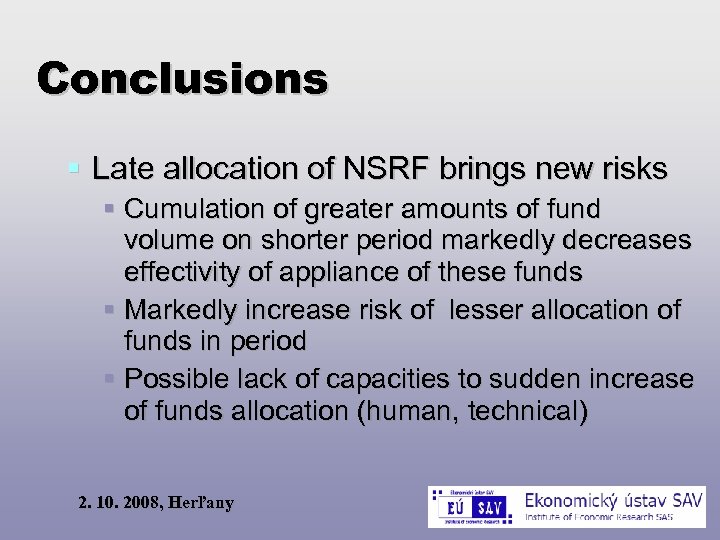 Conclusions Late allocation of NSRF brings new risks Cumulation of greater amounts of fund volume on shorter period markedly decreases effectivity of appliance of these funds Markedly increase risk of lesser allocation of funds in period Possible lack of capacities to sudden increase of funds allocation (human, technical) 2. 10. 2008, Herľany
 Institute for Economic Research Slovak Academy of Sciences www. ekonom. sav. sk Viliam. Palenik@savba. sk Marek. Radvansky@savba. sk 2. 10. 2008, Herľany