


 Скачать презентацию Modelling Ad Hoc Networks Lecture 9 Use
162cda11238e747a101afd361ce2da1c.ppt
- Количество слайдов: 30
 Modelling Ad Hoc Networks Lecture 9
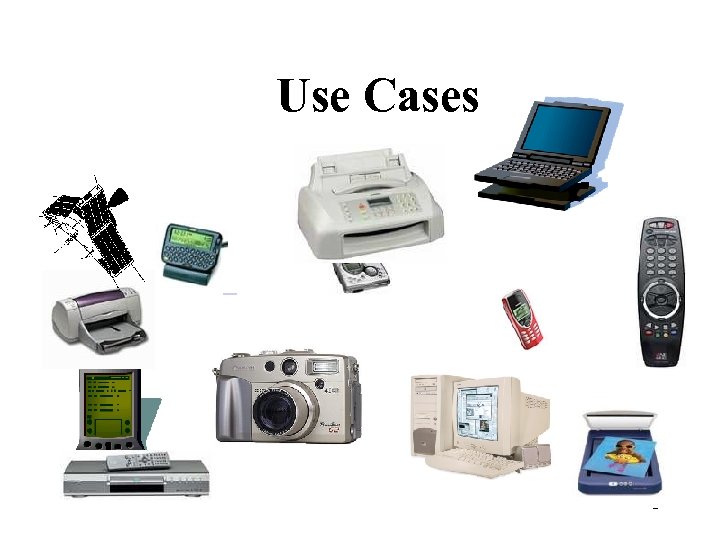 Use Cases 2
 Possibilities • Telephones (cellular, cordless, other) • Cordless multimedia (headsets, speakers, mic. ) • Portable computers (Laptops, desktop, other) • Cordless computer peripherals (keyboard, mouse) • LAN – Local Area Network peripherals (printer, fax) • PDAs - Personal Digital Assistants (palm top/pilot) • Digital cameras 3
 Ad-…what? Ad-hoc network… …a LAN or other small network, …with wireless connections …devices are part of the network only for the duration of a communications session Or …while in close proximity to the network 4
 Ad-hoc Networking Collection of wireless mobile nodes (devices) dynamically forming a temporary network without the use of any existing network infrastructure or centralized administration 5
 Properties • Requires devices to cooperate autonomously • Without user intervention • Rapid self-organizing wireless network • Independent of infrastructure • Heterogeneous & adaptive 6
 Why? Microprocessor embedding trend in: • cellular phones, car stereos, televisions, VCRs, watches, GPS (Global Positioning System) receivers, digital camera. • Ensembles of computational devices for: • environmental monitoring • personal area networks • geophysical measurement 7
 How? Transmission Standards: 1. Piconet 2. Home. RF (Radio Frequency) 3. IEEE 802. 11 Wireless LAN WG (Working Group) 4. Bluetooth SIG (Special Interest Group) • 5. These above use radio waves from licence-exempt ISM (Industrial, Scientific and Medical) frequency band - around 2. 4 GHz Ir. DA (Infra. Red Data Association) • which uses infrared instead of radio waves 8
 Piconet • A general purpose, low-powered, ad-hoc network • It allows two devices near each other to inter-operate • These devices can be either mobile or fixed • The range is said to be reasonably short 9
 Home. RF Uses Shared Wireless Access Protocol (SWAP) system • carries both voice and data traffic • inter-operate with the PSTN (Public Switched Telephone Network) and the Internet • the range covers typical home and yard 10
 IEEE 802. 11 Wireless LAN The principles of Wireless Local Area Network (WLAN) are defined in IEEE 802. 11 standard • It defines two different topologies: ad-hoc network and infrastructure network • This ad-hoc network is able to use only created wireless connection instead of fixed infrastructure 11
 Bluetooth • The code name for an open specification for short-range wireless connectivity • Effortless, instant wireless connections between a wide range of communication devices in a small environment • The BT range restricts the environment to about 10 meters • Used in virtually any mobile device like that can have Bluetooth radios integrated into them 12
 Ir. DA • based on technology similar to the remote control devices • high-speed short range, point-to-point cordless data transfer • in-room cordless peripherals to host-PC • maturity and standardization activities advantage over radio 13
 Challenges Facing Ad Hoc • • • Security scalability load balancing / etiquette between hosts Qo. S CPU/memory overhead effect on devices’ battery life 14
 Issues in Protocol Design • • • Must run in distributed environment must provide loop-free routes must be able to find multiple routes must establish routes quickly must minimize overhead in its communication / reaction to topology change 15
 Some Implementation Choices • • • Flat vs. hierarchical architecture proactive vs. reactive to topology changes table-based, demand-driven, associativity-driven topology change dissemination methods when/how often to exchange topology info assumptions about rate of change of topology and/or quality of connections 16
 Some Ad Hoc Protocols • DARPA (1970 s military packet radio) used with SURAN (SURvivable Adaptive Network; an early ad hoc networking testbed) • • CGSR (hierarchical) TORA (time-based; uses link reversal) DSR AODV 17
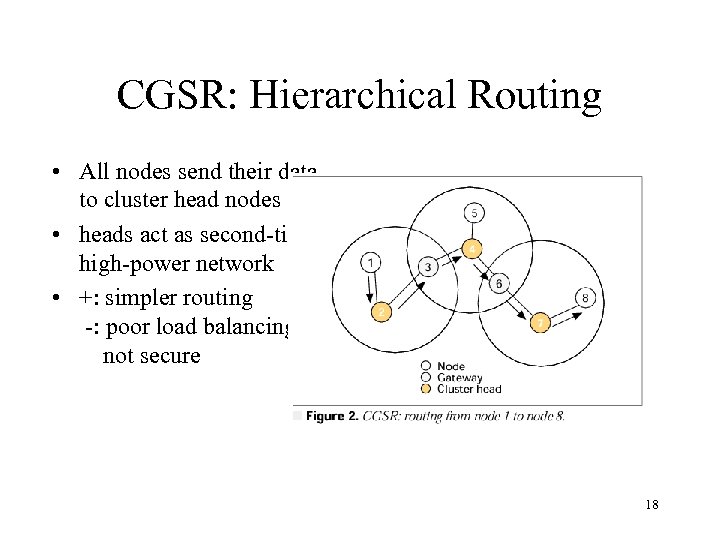 CGSR: Hierarchical Routing • All nodes send their data to cluster head nodes • heads act as second-tier, high-power network • +: simpler routing -: poor load balancing, not secure 18
 In-Depth: AODV (Ad-hoc On-demand Distance Vector routing) • purely on-demand (no routes determined until needed) • each node contains routing table of next-hop information for how to get to every other node 19
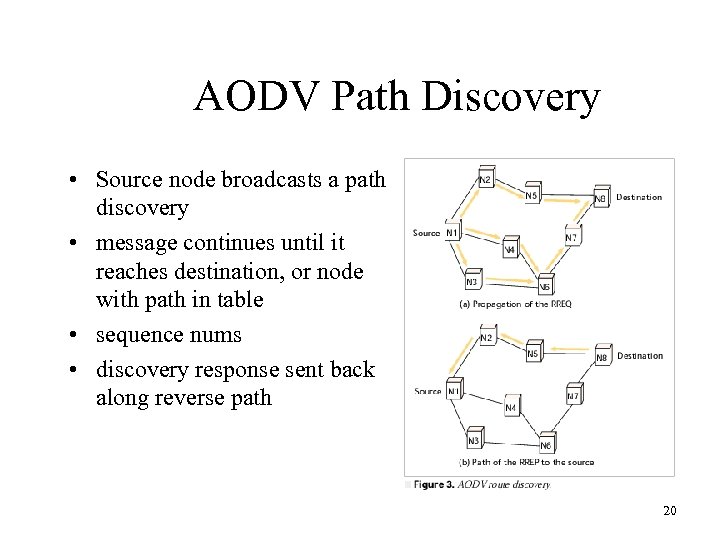 AODV Path Discovery • Source node broadcasts a path discovery • message continues until it reaches destination, or node with path in table • sequence nums • discovery response sent back along reverse path 20
 AODV Path/Connection Maintenance • Nodes ‘ping’ with hello messages to test links • timeouts assumed to be broken links • (only) recent active nodes notified of topology changes--propogated to neighbors 21
 Contrast: DSR (Dynamic Source Routing) • resides in kernel IP layer (based on IPv 6 format) • nodes contain tables of full paths to other nodes • messages: Route Request, Route Reply, Route Error, ACK • Send, Retransmit buffers • passive ACK 22
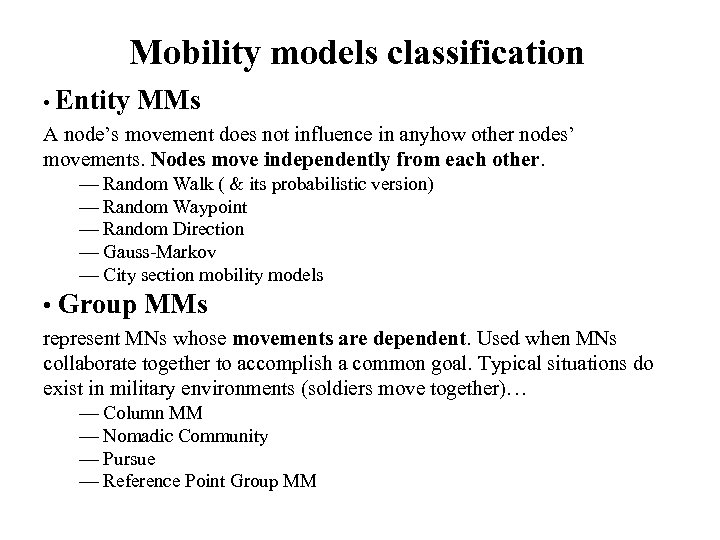 Mobility models classification • Entity MMs A node’s movement does not influence in anyhow other nodes’ movements. Nodes move independently from each other. — Random Walk ( & its probabilistic version) — Random Waypoint — Random Direction — Gauss-Markov — City section mobility models • Group MMs represent MNs whose movements are dependent. Used when MNs collaborate together to accomplish a common goal. Typical situations do exist in military environments (soldiers move together)… — Column MM — Nomadic Community — Pursue — Reference Point Group MM
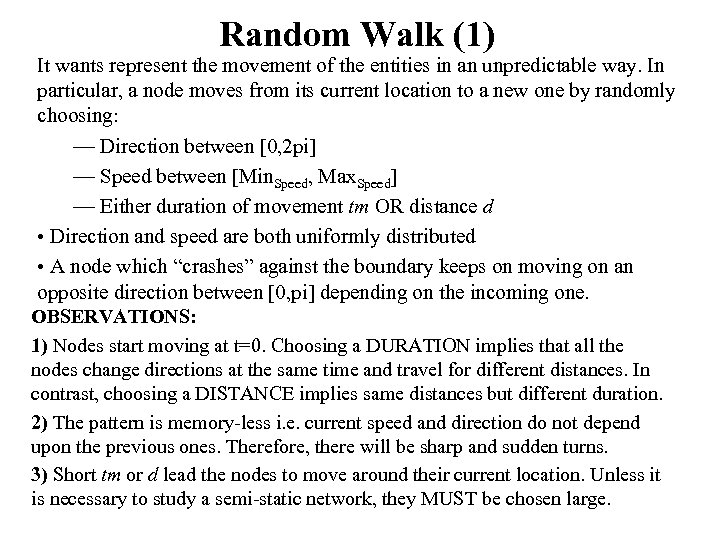 Random Walk (1) It wants represent the movement of the entities in an unpredictable way. In particular, a node moves from its current location to a new one by randomly choosing: — Direction between [0, 2 pi] — Speed between [Min. Speed, Max. Speed] — Either duration of movement tm OR distance d • Direction and speed are both uniformly distributed • A node which “crashes” against the boundary keeps on moving on an opposite direction between [0, pi] depending on the incoming one. OBSERVATIONS: 1) Nodes start moving at t=0. Choosing a DURATION implies that all the nodes change directions at the same time and travel for different distances. In contrast, choosing a DISTANCE implies same distances but different duration. 2) The pattern is memory-less i. e. current speed and direction do not depend upon the previous ones. Therefore, there will be sharp and sudden turns. 3) Short tm or d lead the nodes to move around their current location. Unless it is necessary to study a semi-static network, they MUST be chosen large.
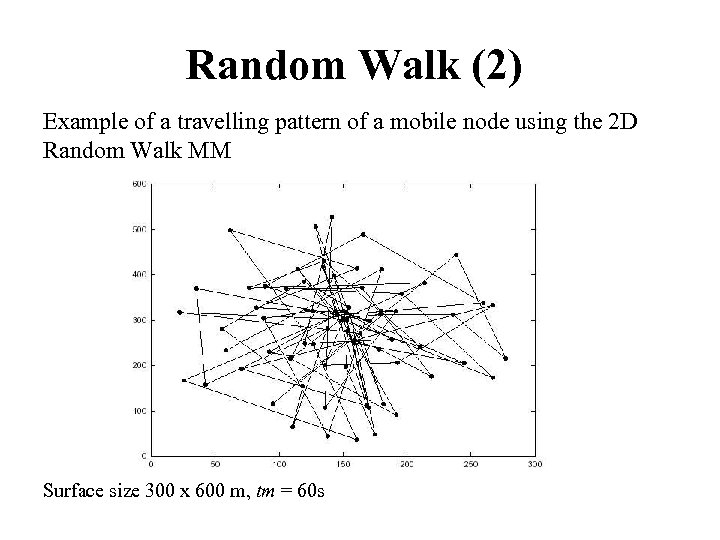 Random Walk (2) Example of a travelling pattern of a mobile node using the 2 D Random Walk MM Surface size 300 x 600 m, tm = 60 s
 Random Waypoint (1) It is a variation of Random Walk. It introduces the concept of pause time. A node randomly chooses (Parameters uniformly distributed): — Pause Time (to wait before resuming the movement) [Pmin, Pmax] — Direction [0, 2 pi] — Speed [Minvel, Maxvel] — Destination point (x, y) to reach. . OBSERVATIONS: 1) the duration of the movement depends on the destination point chosen. 2) nodes do not start roaming all together unless Pmin = Pmax = 0. 3) the pattern becomes a Random Walk when (Pmin = Pmax = 0 ) AND ([Minvel, Maxvel] = [Min. Speed, Max. Speed]) 4) it is the most commonly used MM in ad-hoc network simulation studies (often times is modified). – It needs particular attention to choose the initial locations. Discard the initial part of the simulation OR save the node’s location OR do not place the nodes randomly. – The choice of Pauses and Speeds is relevant. Fast nodes and long pauses produces a more stable network than slow nodes and short pauses. – The most argued issue is that nodes are more likely to be in the central part of the topology rather than close to the bounds.
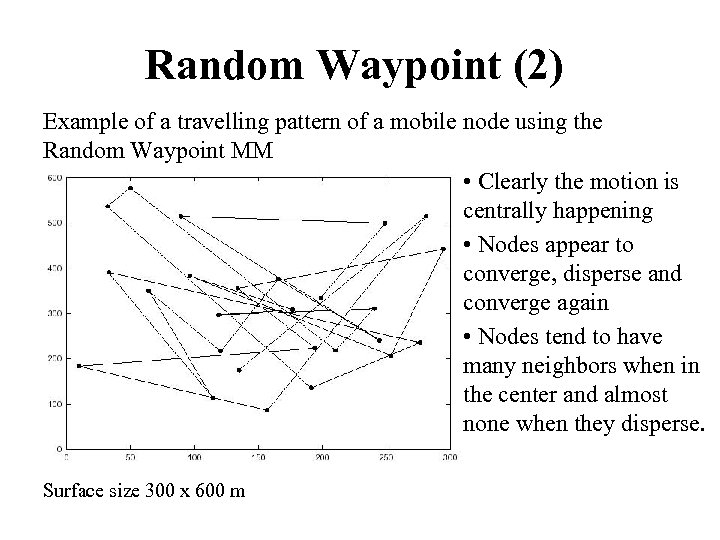 Random Waypoint (2) Example of a travelling pattern of a mobile node using the Random Waypoint MM • Clearly the motion is centrally happening • Nodes appear to converge, disperse and converge again • Nodes tend to have many neighbors when in the center and almost none when they disperse. Surface size 300 x 600 m
 Random Direction (1) Designed to overcame the concentration of the nodes of which R. Waypoint suffers. Nodes start moving by choosing — Direction between [0, 2 pi] — Speed between [Min. Speed, Max. Speed] • Nodes will travel till the bound is reached. On this position they’ll stand for a pause time before leaving to a New-Direction [0, pi]. OBSERVATIONS: 1) Nodes are forced to basically stay away from the center for the most of the time. In fact, they ALL pause somewhere on the perimeter. – Implications: • Average Hop count for Data-packets will be much higher than in R. Waypoint or R Walk. (nodes are on average far from each others) • Higher probability to have Network partition (especially with few MNs).
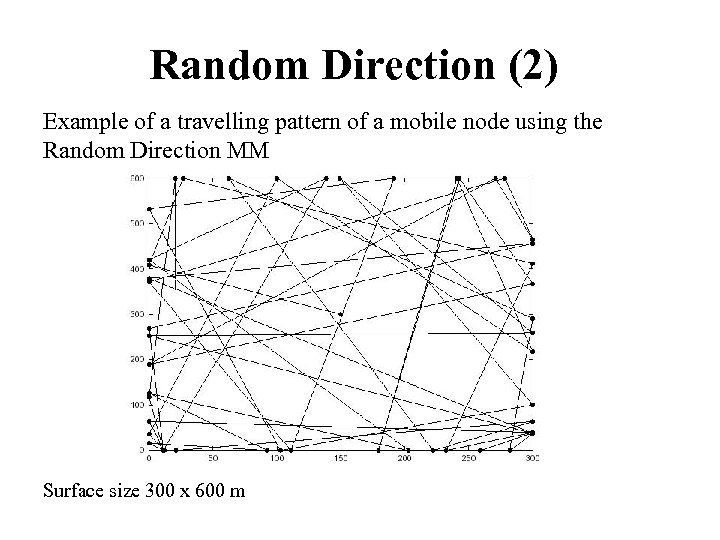 Random Direction (2) Example of a travelling pattern of a mobile node using the Random Direction MM Surface size 300 x 600 m
 Questions 30