Скачать презентацию Modeling of Organizational Performance Rudolf Kulhavý Agenda
bd87ecb5fb9b39055cc41816ca5f5f33.ppt
- Количество слайдов: 69
 Modeling of Organizational Performance Rudolf Kulhavý
 Agenda 1. The Challenge of Management 2. Addressing Complexity a. System Dynamics b. Variety Engineering c. Viable System Model d. Pattern Theory 3. Practical Issues
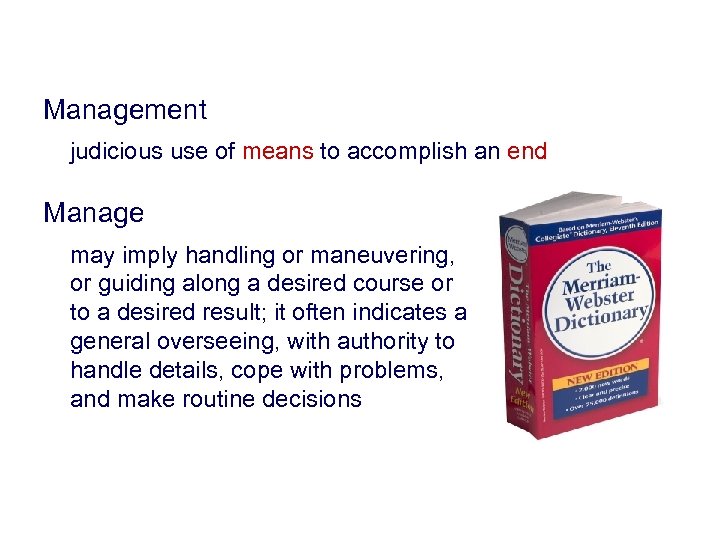 Management judicious use of means to accomplish an end Manage may imply handling or maneuvering, or guiding along a desired course or to a desired result; it often indicates a general overseeing, with authority to handle details, cope with problems, and make routine decisions
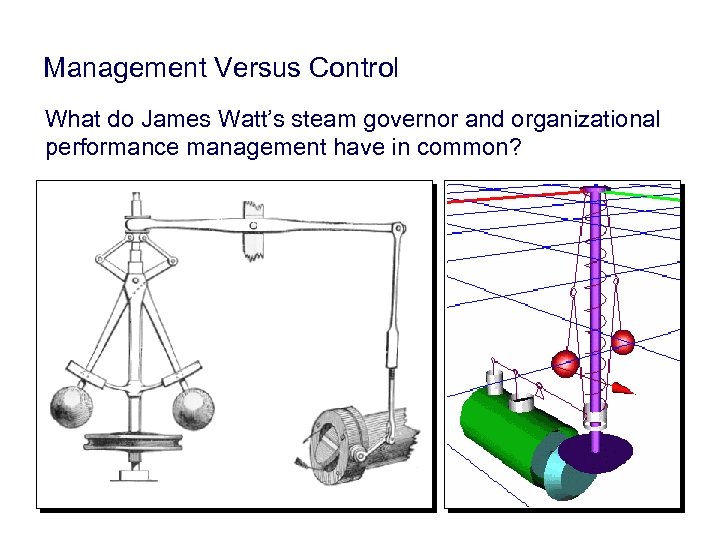 Management Versus Control What do James Watt’s steam governor and organizational performance management have in common?
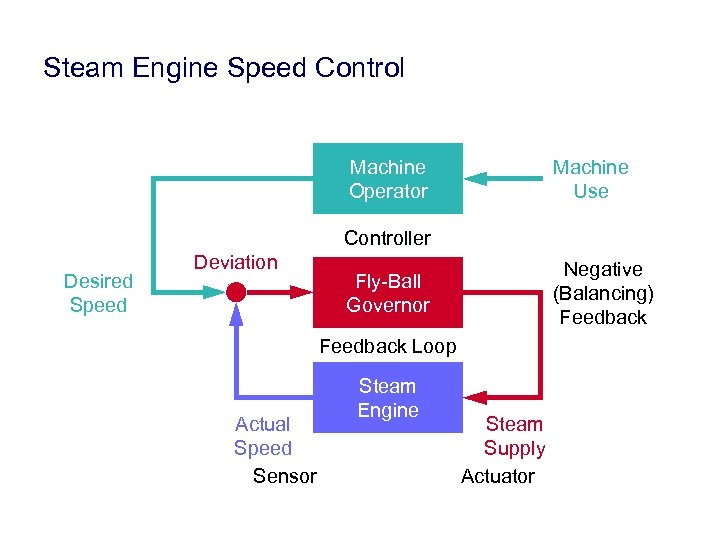 Steam Engine Speed Control Machine Use Machine Operator Controller Desired Speed Deviation Negative (Balancing) Feedback Fly-Ball Governor Feedback Loop Actual Speed Sensor Steam Engine Steam Supply Actuator
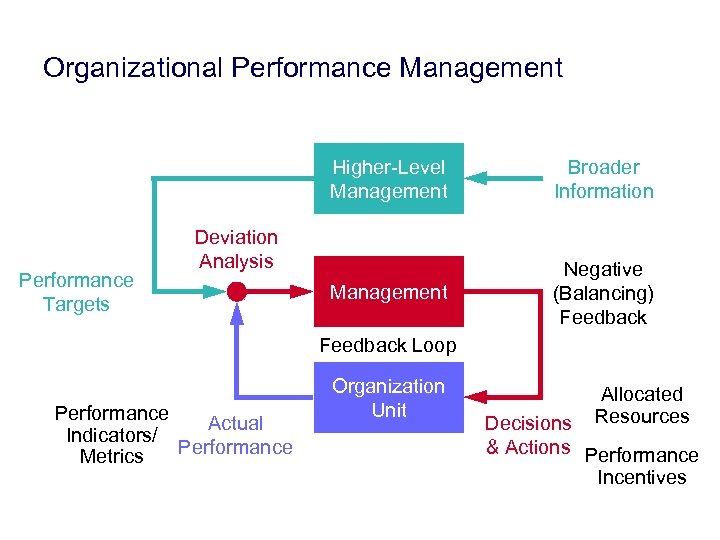 Organizational Performance Management Higher-Level Management Performance Targets Broader Information Management Negative (Balancing) Feedback Deviation Analysis Feedback Loop Performance Actual Indicators/ Performance Metrics Organization Unit Allocated Resources Decisions & Actions Performance Incentives
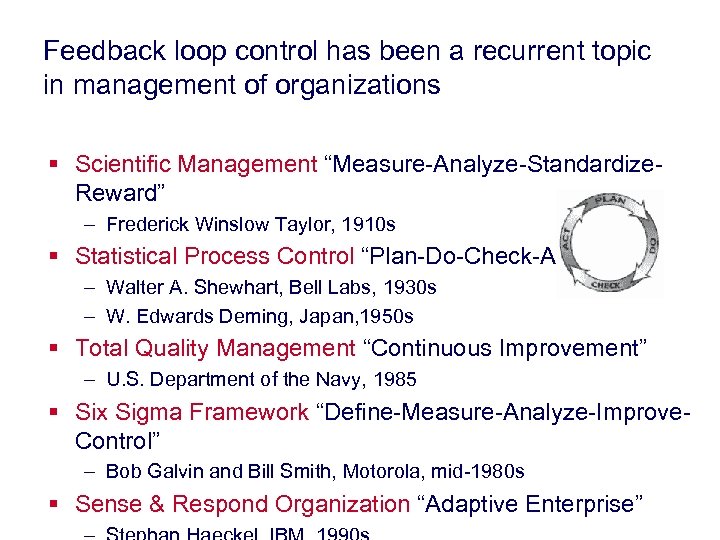 Feedback loop control has been a recurrent topic in management of organizations § Scientific Management “Measure-Analyze-Standardize. Reward” – Frederick Winslow Taylor, 1910 s § Statistical Process Control “Plan-Do-Check-Act” – Walter A. Shewhart, Bell Labs, 1930 s – W. Edwards Deming, Japan, 1950 s § Total Quality Management “Continuous Improvement” – U. S. Department of the Navy, 1985 § Six Sigma Framework “Define-Measure-Analyze-Improve. Control” – Bob Galvin and Bill Smith, Motorola, mid-1980 s § Sense & Respond Organization “Adaptive Enterprise”
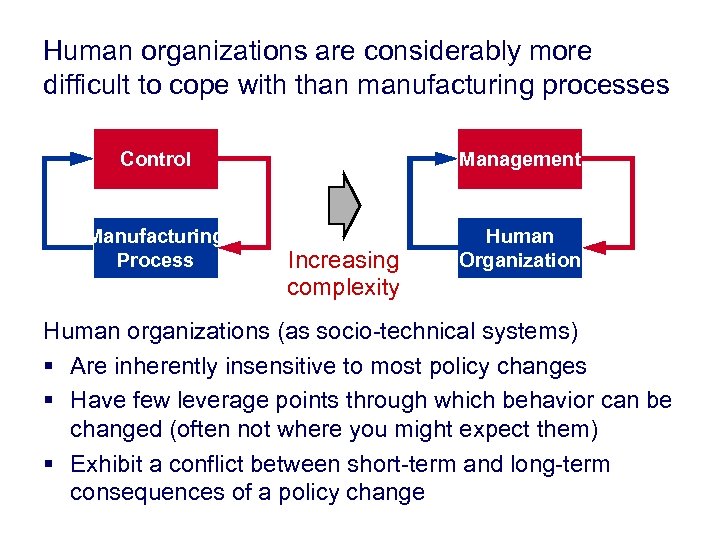 Human organizations are considerably more difficult to cope with than manufacturing processes Control Management Manufacturing Process Human Organization Increasing complexity Human organizations (as socio-technical systems) § Are inherently insensitive to most policy changes § Have few leverage points through which behavior can be changed (often not where you might expect them) § Exhibit a conflict between short-term and long-term consequences of a policy change
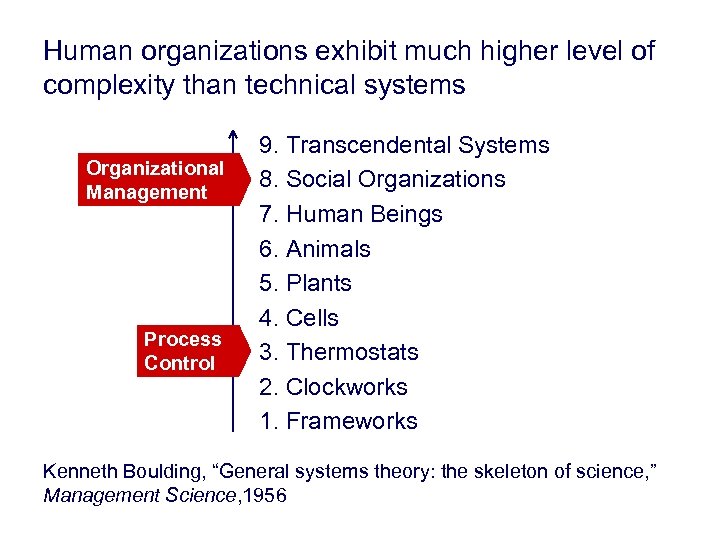 Human organizations exhibit much higher level of complexity than technical systems Organizational Management Process Control 9. Transcendental Systems 8. Social Organizations 7. Human Beings 6. Animals 5. Plants 4. Cells 3. Thermostats 2. Clockworks 1. Frameworks Kenneth Boulding, “General systems theory: the skeleton of science, ” Management Science, 1956
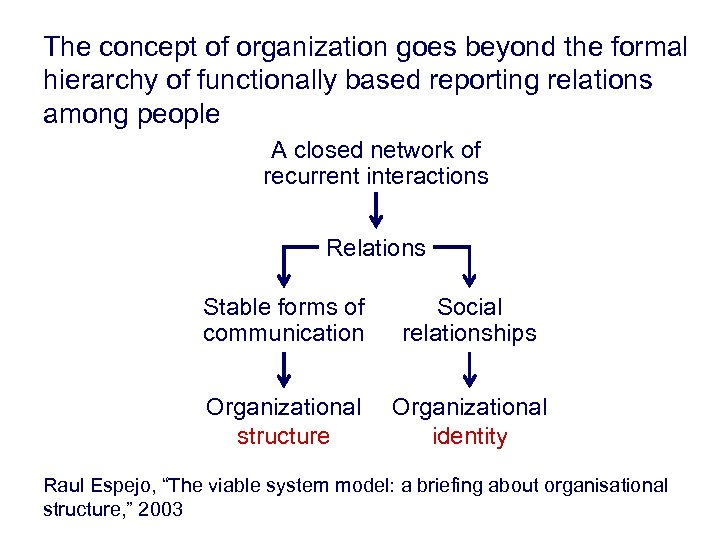 The concept of organization goes beyond the formal hierarchy of functionally based reporting relations among people A closed network of recurrent interactions Relations Stable forms of communication Social relationships Organizational structure Organizational identity Raul Espejo, “The viable system model: a briefing about organisational structure, ” 2003
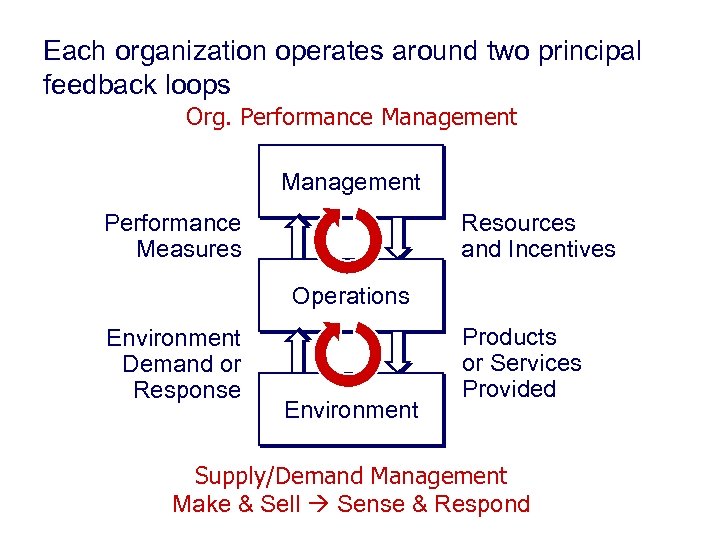 Each organization operates around two principal feedback loops Org. Performance Management Performance Measures Resources and Incentives Operations Environment Demand or Response Environment Products or Services Provided Supply/Demand Management Make & Sell Sense & Respond
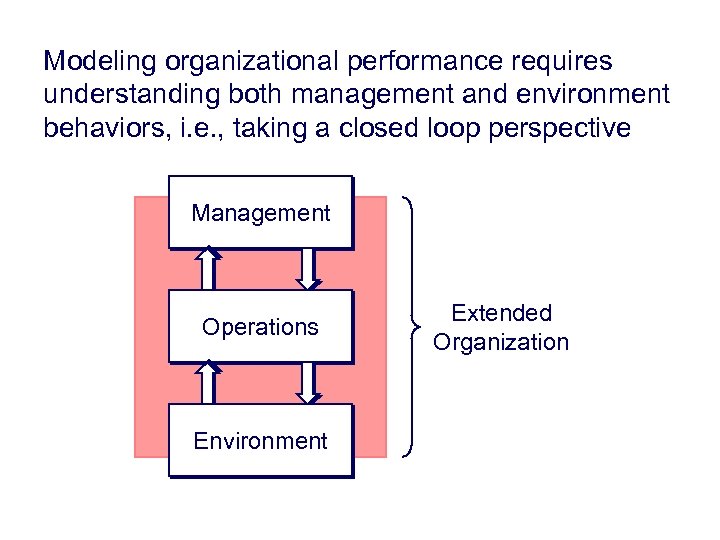 Modeling organizational performance requires understanding both management and environment behaviors, i. e. , taking a closed loop perspective Management Operations Environment Extended Organization
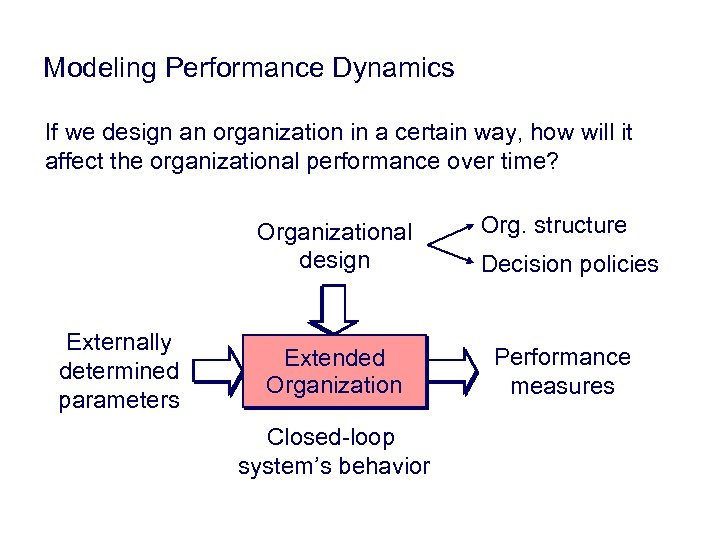 Modeling Performance Dynamics If we design an organization in a certain way, how will it affect the organizational performance over time? Organizational design Externally determined parameters Extended Organization Closed-loop system’s behavior Org. structure Decision policies Performance measures
 The complexity of an extended organization makes its modeling an extremely challenging task § Variety – Much higher than typical for technical systems – No obvious/natural mapping of variety § Dynamics – Inherently nonlinear – Typically of high order § Uncertainty – Both stochastic behavior and model uncertainty – Both performance evolution and structural jumps
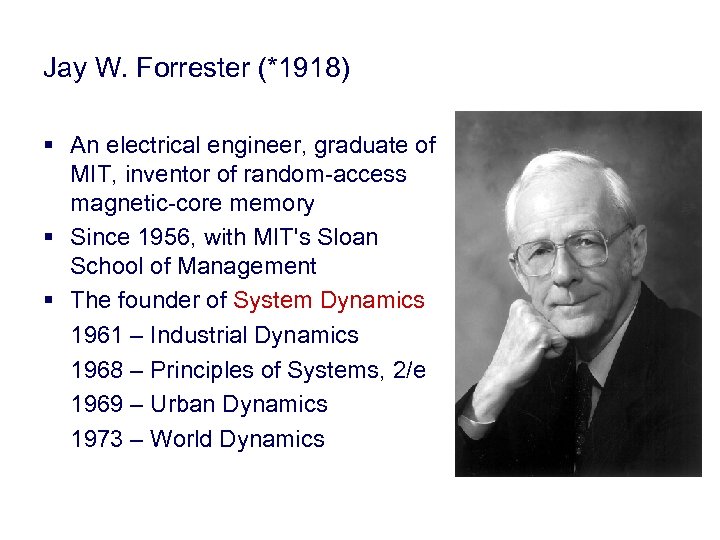 Jay W. Forrester (*1918) § An electrical engineer, graduate of MIT, inventor of random-access magnetic-core memory § Since 1956, with MIT's Sloan School of Management § The founder of System Dynamics 1961 – Industrial Dynamics 1968 – Principles of Systems, 2/e 1969 – Urban Dynamics 1973 – World Dynamics
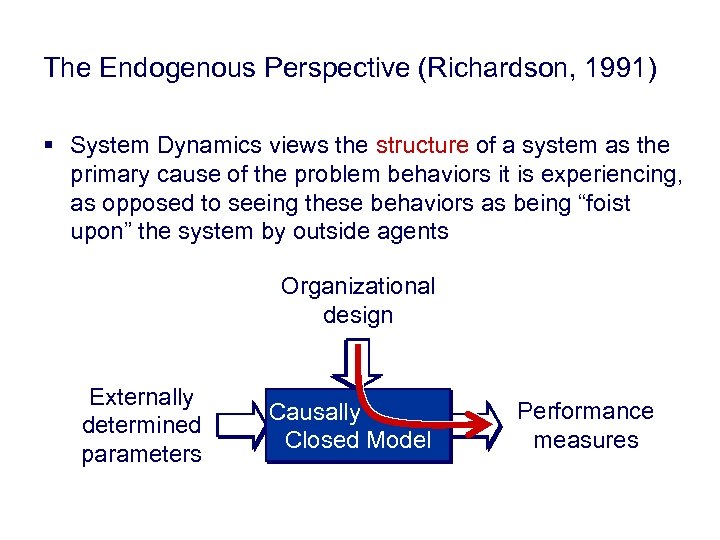
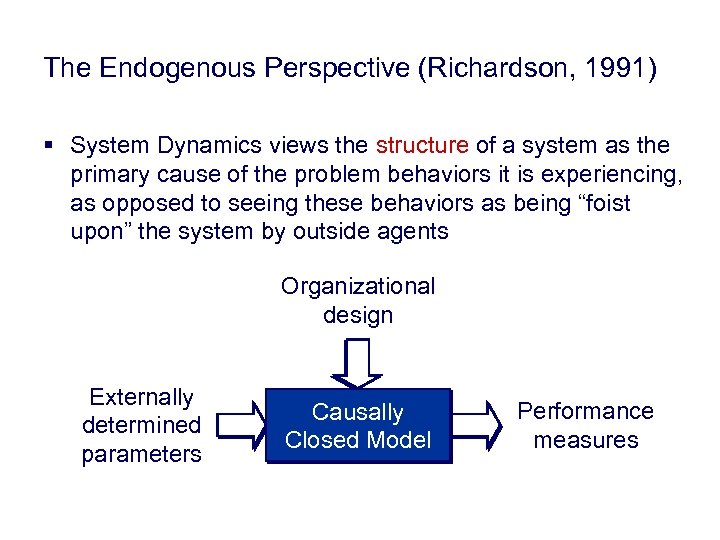 The Endogenous Perspective (Richardson, 1991) § System Dynamics views the structure of a system as the primary cause of the problem behaviors it is experiencing, as opposed to seeing these behaviors as being “foist upon” the system by outside agents Organizational design Externally determined parameters Causally Closed Model Performance measures
 The Endogenous Perspective (Richardson, 1991) § System Dynamics views the structure of a system as the primary cause of the problem behaviors it is experiencing, as opposed to seeing these behaviors as being “foist upon” the system by outside agents Organizational design Externally determined parameters Causally Closed Model Performance measures
 More often than we realize, systems cause their own crises, not external forces or individuals' mistakes. Peter Senge The Fifth Discipline, 1994
 System Dynamics § Represents the real-world processes in terms of – stocks (e. g. of material, knowledge, people, money), – flows between these stocks, and – information that determines the values of the flows. § These stocks, flows, and feedback relationships map out the actual structure of a system – including any physical flows, non-measured or non-measurable variables that are important to the problem being addressed, and actual (as opposed to idealized) human decision making structures § Abstracts from single events and entities and takes an aggregate view concentrating on policies.
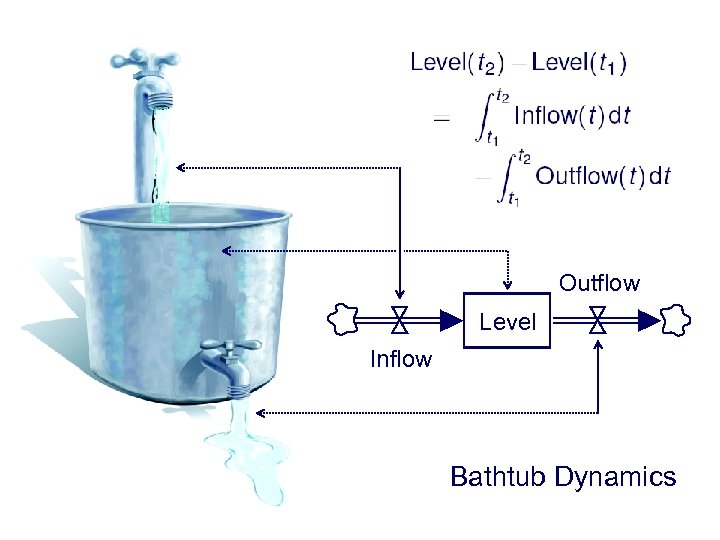 Outflow Level Inflow Bathtub Dynamics
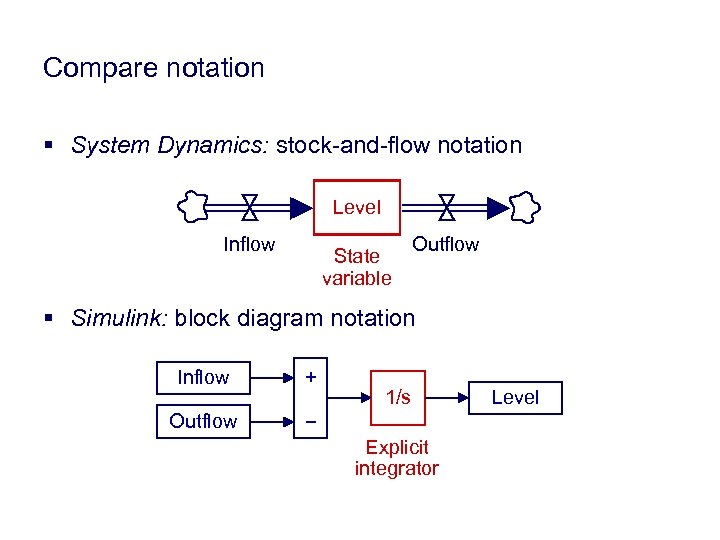 Compare notation § System Dynamics: stock-and-flow notation Level Inflow State variable Outflow § Simulink: block diagram notation Inflow + Outflow − 1/s Explicit integrator Level
 System Dynamics: An old thing? § System dynamics modeling is problem-oriented: problems are modeled, not systems § Any information that is thought to be relevant to the modeling problem at hand (process, business, equipment, human factors) can be formally incorporated into a system dynamics model § This holistic, “big picture” perspective of system is what distinguishes system dynamics from control theory, which has, in its majority, followed rather a reductionist and quantitative route (applying “hard” thinking as opposed to “soft” one)
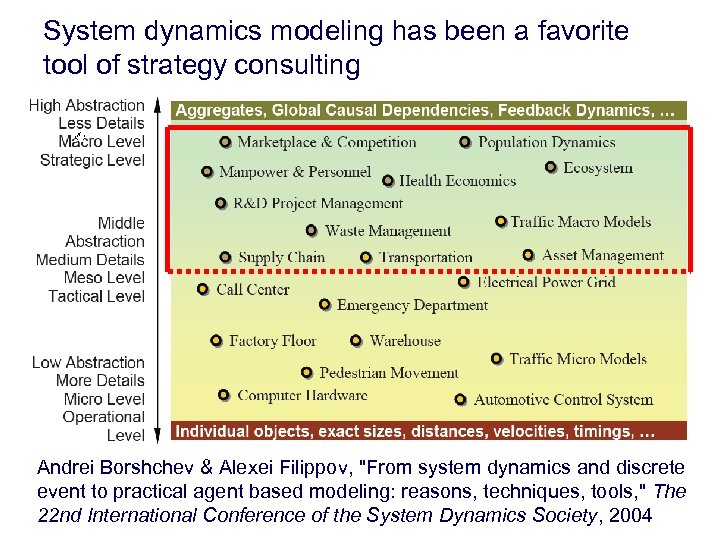 System dynamics modeling has been a favorite tool of strategy consulting Andrei Borshchev & Alexei Filippov, "From system dynamics and discrete event to practical agent based modeling: reasons, techniques, tools, " The 22 nd International Conference of the System Dynamics Society, 2004
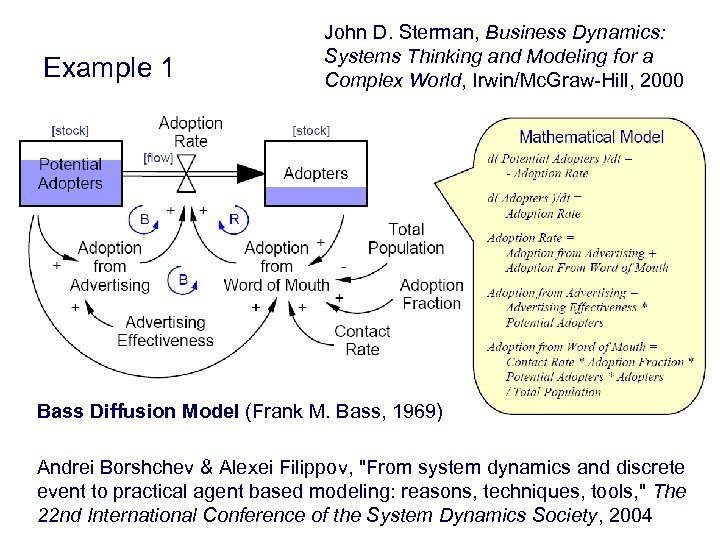 Example 1 John D. Sterman, Business Dynamics: Systems Thinking and Modeling for a Complex World, Irwin/Mc. Graw-Hill, 2000 Bass Diffusion Model (Frank M. Bass, 1969) Andrei Borshchev & Alexei Filippov, "From system dynamics and discrete event to practical agent based modeling: reasons, techniques, tools, " The 22 nd International Conference of the System Dynamics Society, 2004
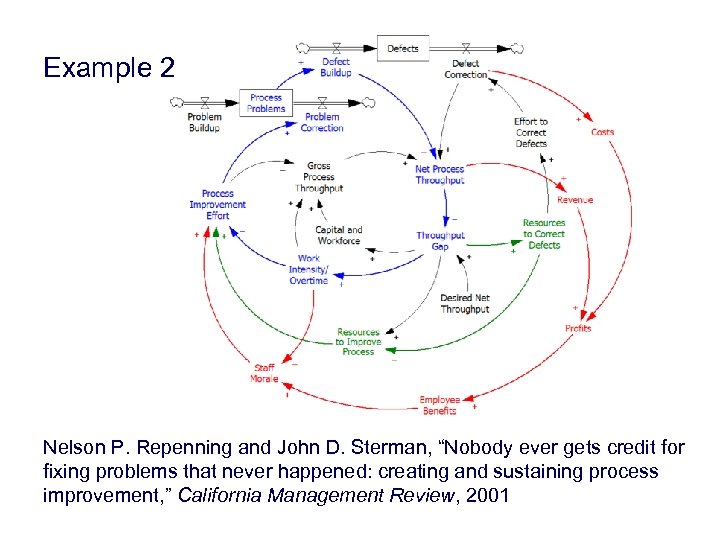 Example 2 Nelson P. Repenning and John D. Sterman, “Nobody ever gets credit for fixing problems that never happened: creating and sustaining process improvement, ” California Management Review, 2001
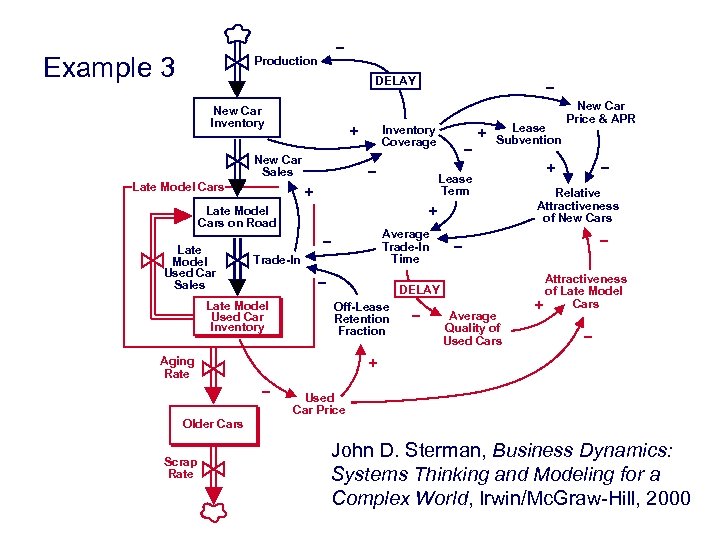 Example 3 − Production DELAY New Car Inventory + New Car Sales Late Model Cars Inventory Coverage − Lease Subvention + Average Trade-In Time − Trade-In − Late Model Used Car Inventory − + Lease Term + Late Model Cars on Road Late Model Used Car Sales − Aging Rate − − + Relative Attractiveness of New Cars − − DELAY Off-Lease Retention Fraction New Car Price & APR Average Quality of Used Cars Attractiveness of Late Model Cars + − Used Car Price Older Cars Scrap Rate John D. Sterman, Business Dynamics: Systems Thinking and Modeling for a Complex World, Irwin/Mc. Graw-Hill, 2000
 Asset-Driven Model of Performance § Organizational performance depends on resources and capabilities that the organization owns or has access to Assets = Resources + Capabilities § An asset is a resource controlled by the enterprise as a result of past events and from which future economic benefits are expected to flow to the enterprise International Accounting Standards Board (IASB)
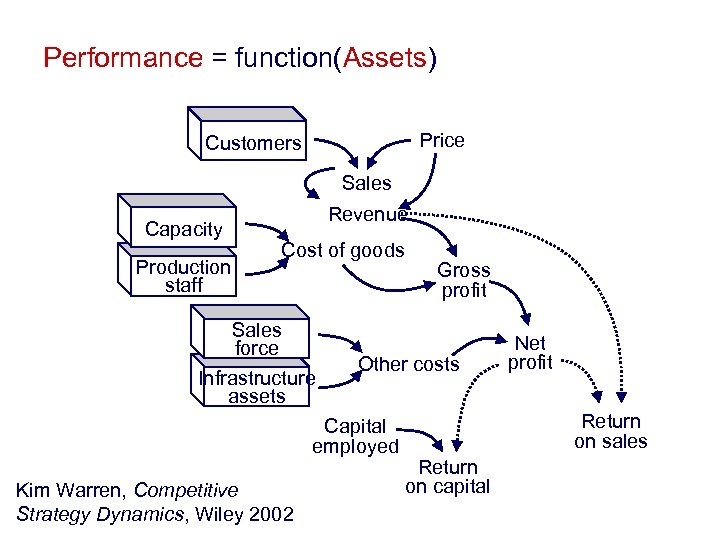 Performance = function(Assets) Price Customers Sales Capacity Production staff Revenue Cost of goods Sales force Infrastructure assets Other costs Capital employed Kim Warren, Competitive Strategy Dynamics, Wiley 2002 Gross profit Net profit Return on sales Return on capital
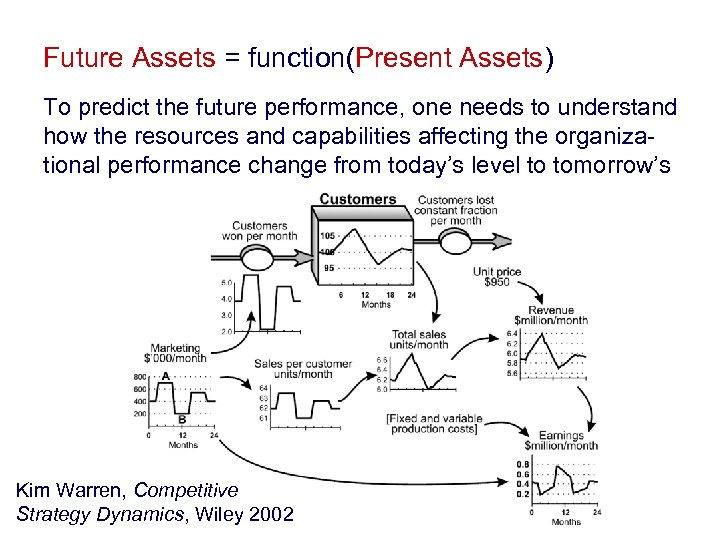 Future Assets = function(Present Assets) To predict the future performance, one needs to understand how the resources and capabilities affecting the organizational performance change from today’s level to tomorrow’s Kim Warren, Competitive Strategy Dynamics, Wiley 2002
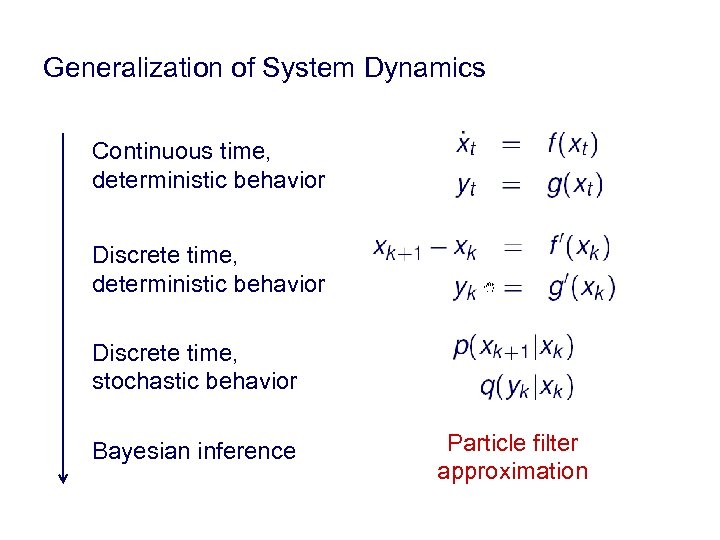 Generalization of System Dynamics Continuous time, deterministic behavior Discrete time, stochastic behavior Bayesian inference Particle filter approximation
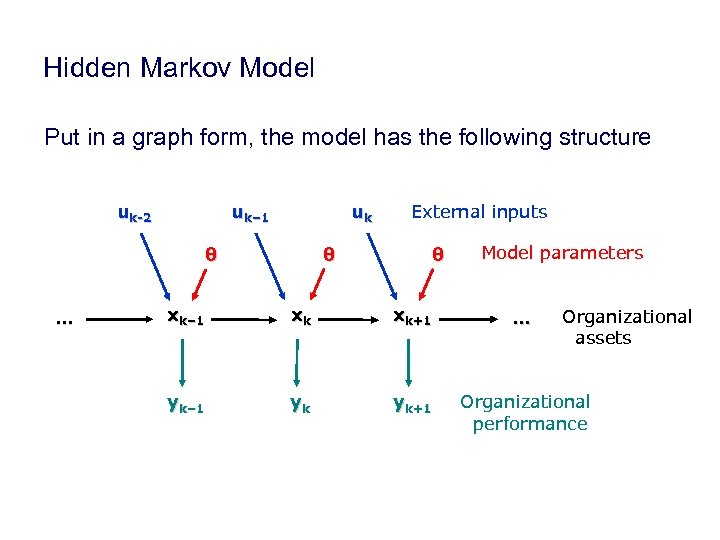 Hidden Markov Model Put in a graph form, the model has the following structure uk-2 uk uk– 1 θ θ θ … External inputs Model parameters xk– 1 xk xk+1 … yk– 1 yk yk+1 Organizational performance Organizational assets
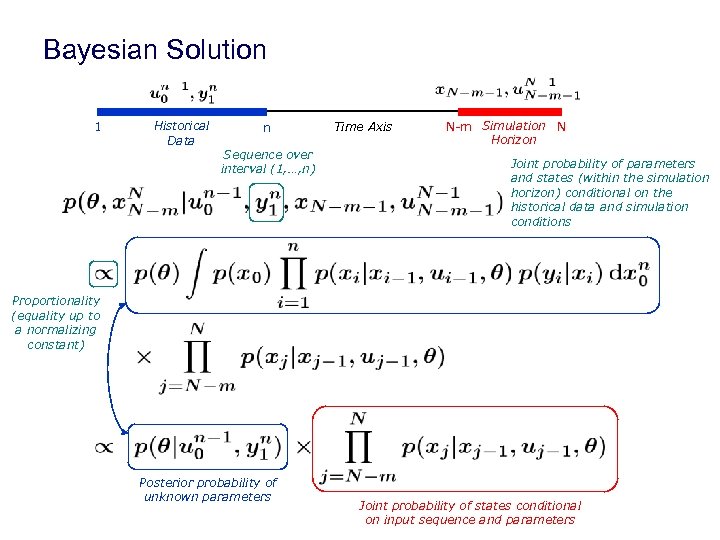 Bayesian Solution 1 Historical Data n Sequence over interval (1, …, n) Time Axis N-m Simulation N Horizon Joint probability of parameters and states (within the simulation horizon) conditional on the historical data and simulation conditions Proportionality (equality up to a normalizing constant) Posterior probability of unknown parameters Joint probability of states conditional on input sequence and parameters
 How should one define the performance measures and underlying assets (resources and capabilities)?
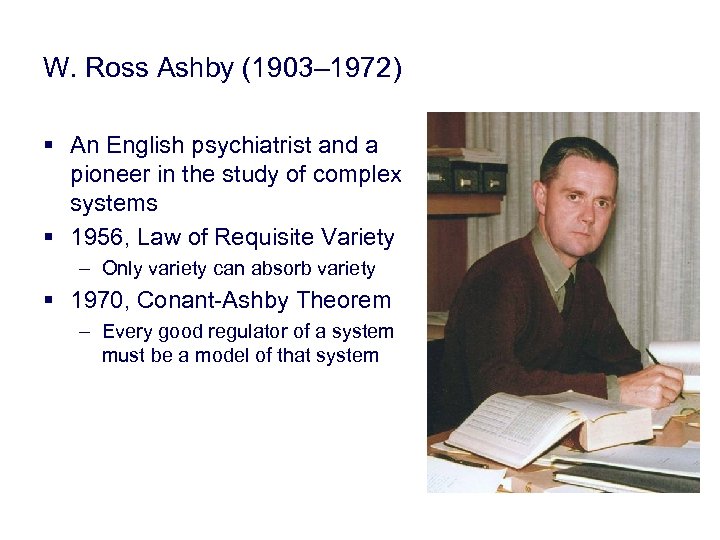 W. Ross Ashby (1903– 1972) § An English psychiatrist and a pioneer in the study of complex systems § 1956, Law of Requisite Variety – Only variety can absorb variety § 1970, Conant-Ashby Theorem – Every good regulator of a system must be a model of that system
 Variety (Ashby, 1956) a measure of complexity, determined by the number of states that the system (environment, operations, or management) can take on
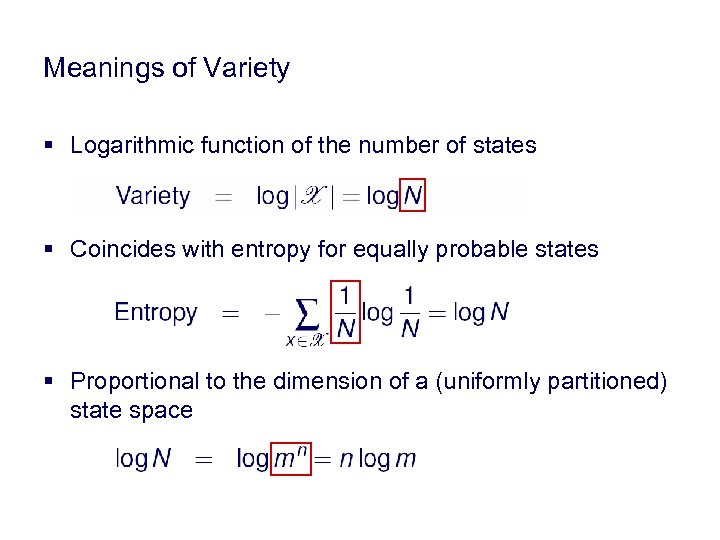 Meanings of Variety § Logarithmic function of the number of states § Coincides with entropy for equally probable states § Proportional to the dimension of a (uniformly partitioned) state space
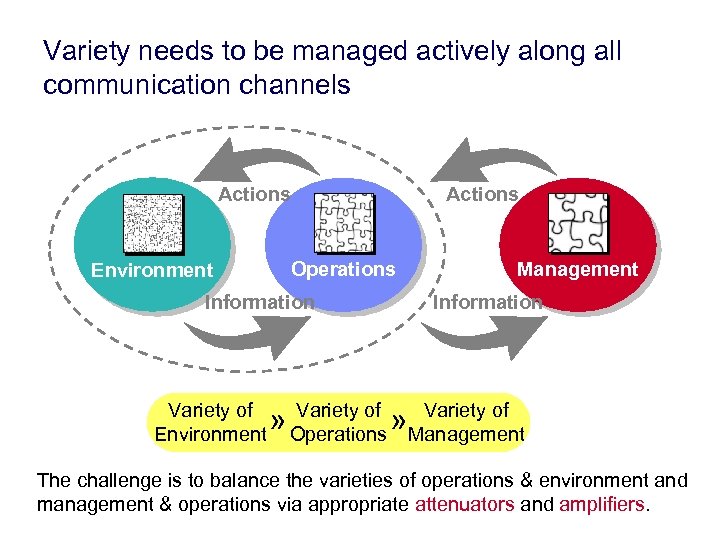 Variety needs to be managed actively along all communication channels Actions Environment Operations Information Variety of Environment Actions Management Information Variety of » Operations » Management The challenge is to balance the varieties of operations & environment and management & operations via appropriate attenuators and amplifiers.
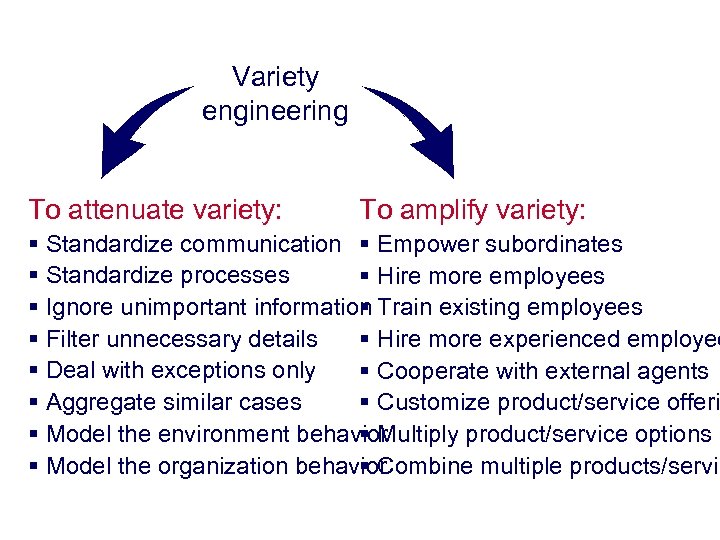 Variety engineering To attenuate variety: To amplify variety: § Standardize communication § Empower subordinates § Standardize processes § Hire more employees § Ignore unimportant information Train existing employees § § Filter unnecessary details § Hire more experienced employee § Deal with exceptions only § Cooperate with external agents § Aggregate similar cases § Customize product/service offerin § Model the environment behavior § Multiply product/service options § Model the organization behavior § Combine multiple products/servic
 What should the structure of a viable organization look like? viable = capable of maintaining separate existence in a dynamic and uncertain environment
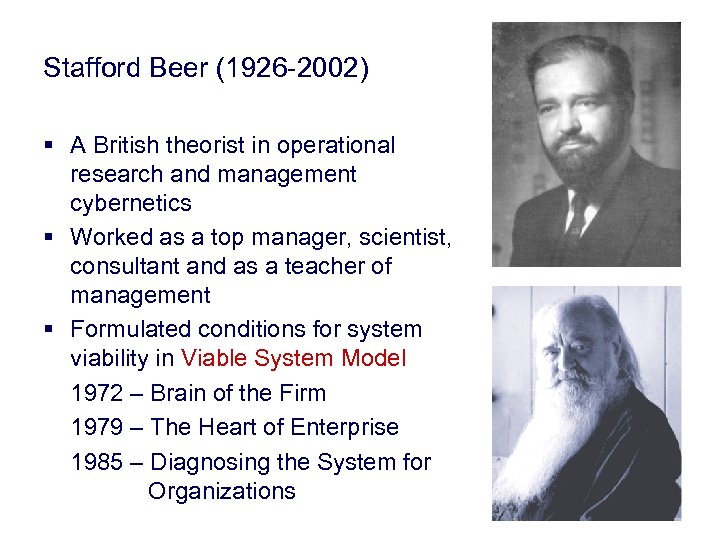 Stafford Beer (1926 -2002) § A British theorist in operational research and management cybernetics § Worked as a top manager, scientist, consultant and as a teacher of management § Formulated conditions for system viability in Viable System Model 1972 – Brain of the Firm 1979 – The Heart of Enterprise 1985 – Diagnosing the System for Organizations
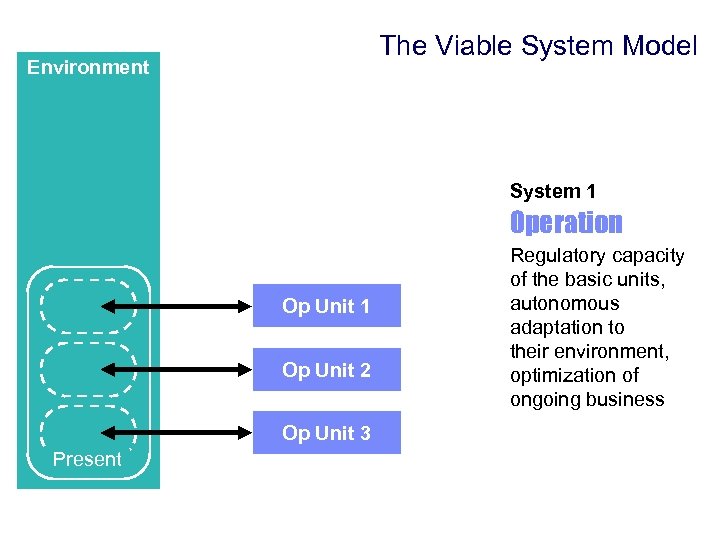 The Viable System Model Environment System 1 Operation Op Unit 1 Op Unit 2 Op Unit 3 Present Regulatory capacity of the basic units, autonomous adaptation to their environment, optimization of ongoing business
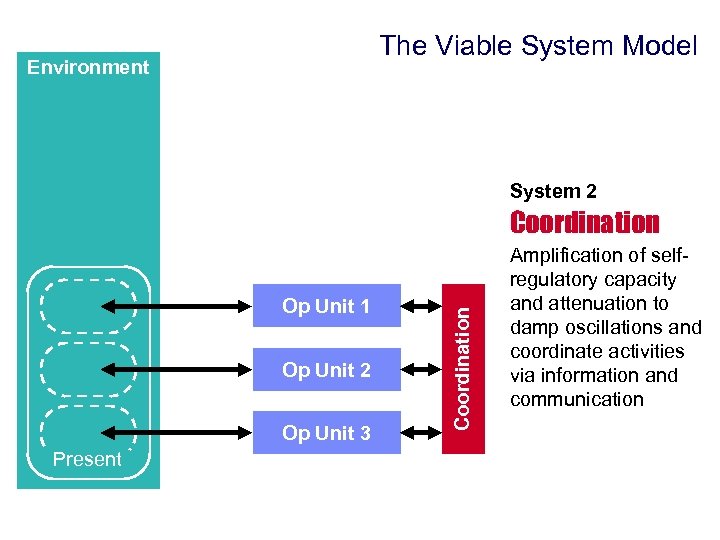 The Viable System Model Environment System 2 Op Unit 1 Op Unit 2 Op Unit 3 Present Coordination Amplification of selfregulatory capacity and attenuation to damp oscillations and coordinate activities via information and communication
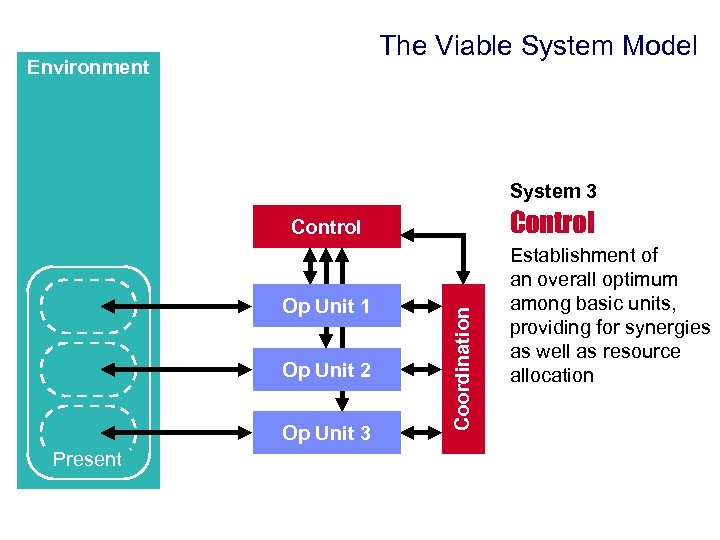 The Viable System Model Environment System 3 Control Op Unit 1 Op Unit 2 Op Unit 3 Present Coordination Control Establishment of an overall optimum among basic units, providing for synergies as well as resource allocation
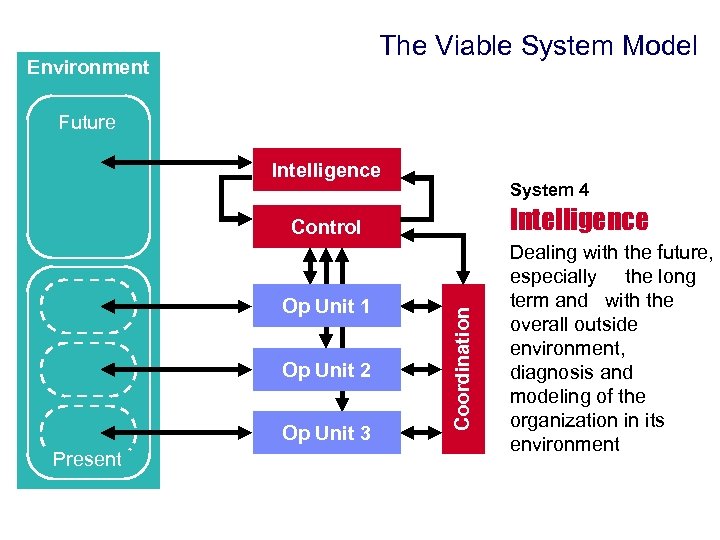 The Viable System Model Environment Future Intelligence System 4 Intelligence Op Unit 1 Op Unit 2 Op Unit 3 Present Coordination Control Dealing with the future, especially the long term and with the overall outside environment, diagnosis and modeling of the organization in its environment
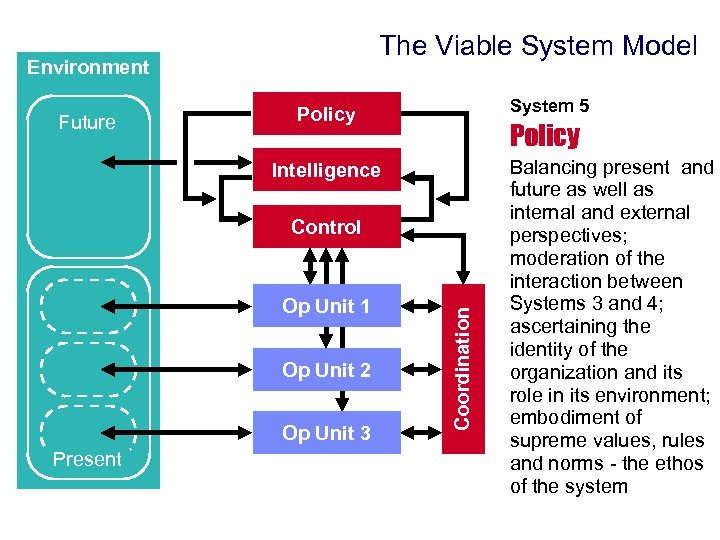 The Viable System Model Environment Future System 5 Policy Intelligence Op Unit 1 Op Unit 2 Op Unit 3 Present Coordination Control Balancing present and future as well as internal and external perspectives; moderation of the interaction between Systems 3 and 4; ascertaining the identity of the organization and its role in its environment; embodiment of supreme values, rules and norms - the ethos of the system
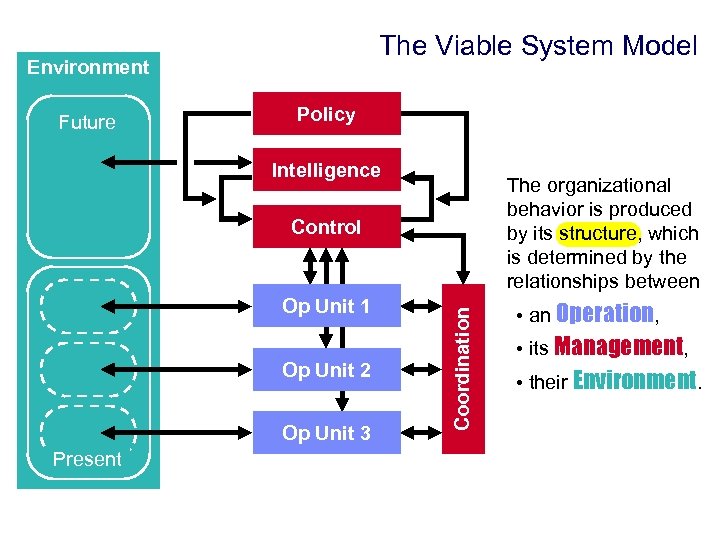 The Viable System Model Environment Future Policy Intelligence The organizational behavior is produced by its structure, which is determined by the relationships between Op Unit 1 Op Unit 2 Op Unit 3 Present Coordination Control Operation, § its Management, § their Environment. § an
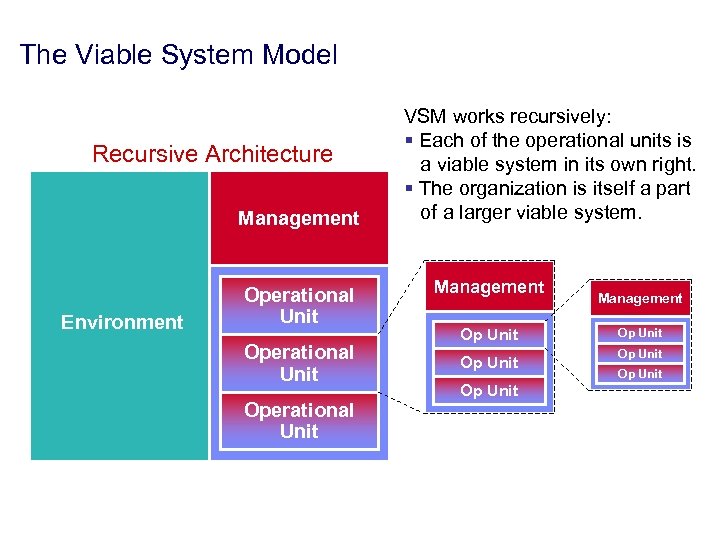 The Viable System Model Recursive Architecture Management Environment Operational Unit Operational Operations Unit Operational Unit VSM works recursively: § Each of the operational units is a viable system in its own right. § The organization is itself a part of a larger viable system. Management Op Unit Operations Op Unit
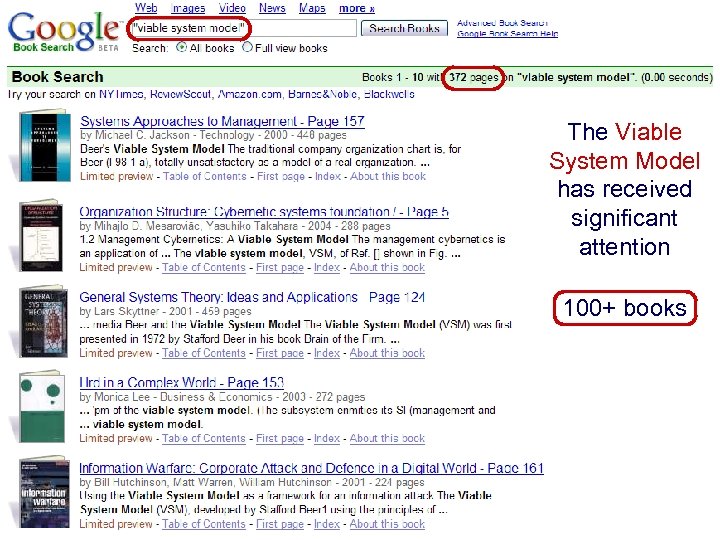 The Viable System Model has received significant attention 100+ books
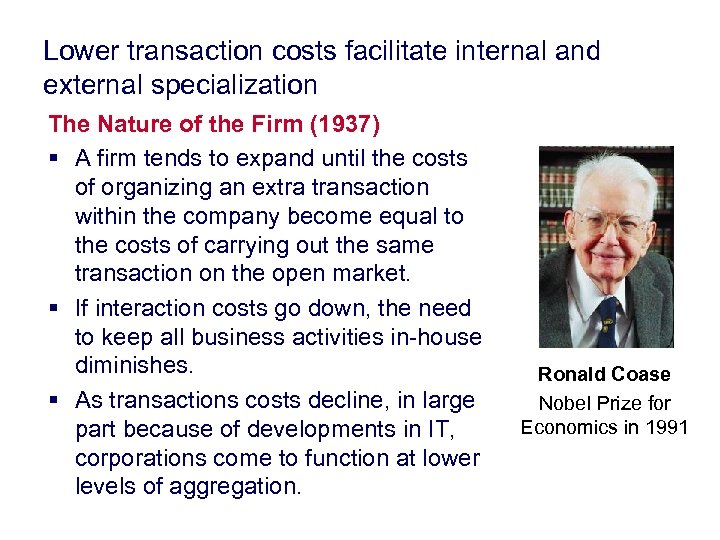 Lower transaction costs facilitate internal and external specialization The Nature of the Firm (1937) § A firm tends to expand until the costs of organizing an extra transaction within the company become equal to the costs of carrying out the same transaction on the open market. § If interaction costs go down, the need to keep all business activities in-house diminishes. § As transactions costs decline, in large part because of developments in IT, corporations come to function at lower levels of aggregation. Ronald Coase Nobel Prize for Economics in 1991
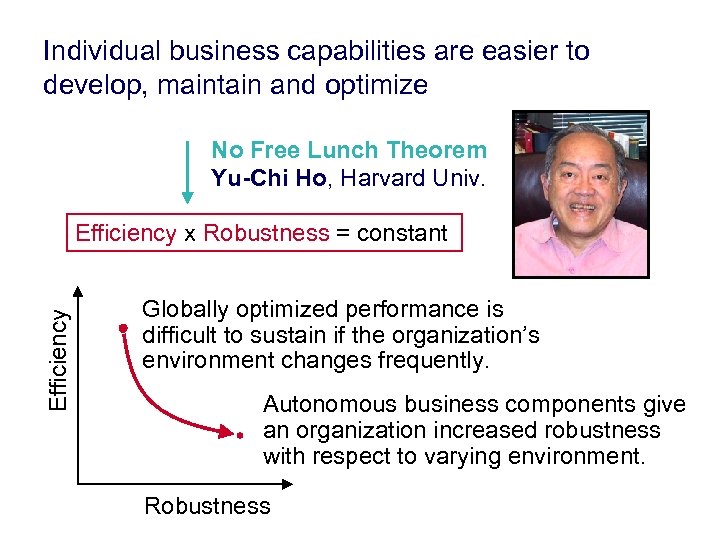 Individual business capabilities are easier to develop, maintain and optimize No Free Lunch Theorem Yu-Chi Ho, Harvard Univ. Efficiency x Robustness = constant Globally optimized performance is difficult to sustain if the organization’s environment changes frequently. Autonomous business components give an organization increased robustness with respect to varying environment. Robustness
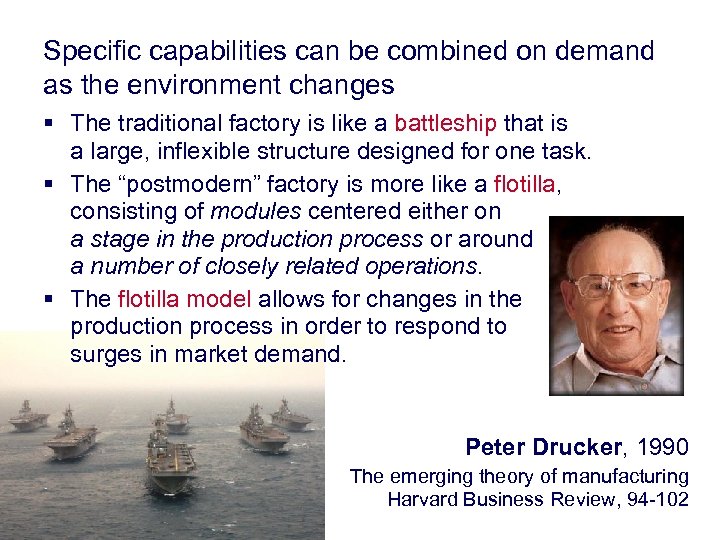 Specific capabilities can be combined on demand as the environment changes § The traditional factory is like a battleship that is a large, inflexible structure designed for one task. § The “postmodern” factory is more like a flotilla, consisting of modules centered either on a stage in the production process or around a number of closely related operations. § The flotilla model allows for changes in the production process in order to respond to surges in market demand. Peter Drucker, 1990 The emerging theory of manufacturing Harvard Business Review, 94 -102
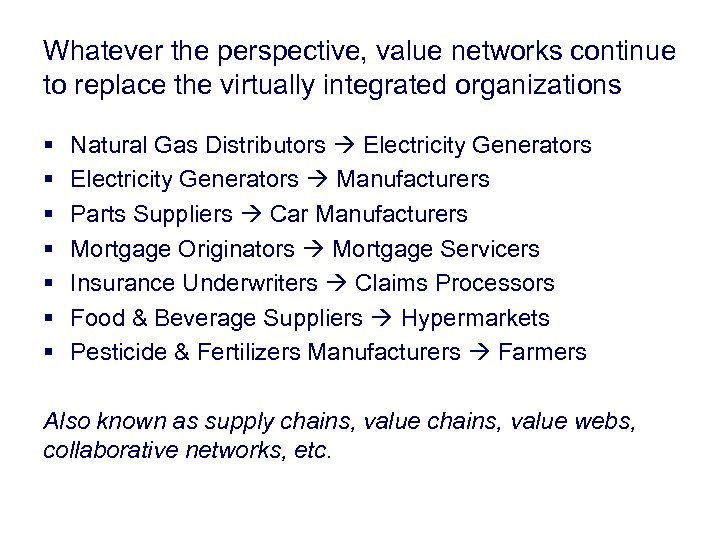 Whatever the perspective, value networks continue to replace the virtually integrated organizations § § § § Natural Gas Distributors Electricity Generators Manufacturers Parts Suppliers Car Manufacturers Mortgage Originators Mortgage Servicers Insurance Underwriters Claims Processors Food & Beverage Suppliers Hypermarkets Pesticide & Fertilizers Manufacturers Farmers Also known as supply chains, value webs, collaborative networks, etc.
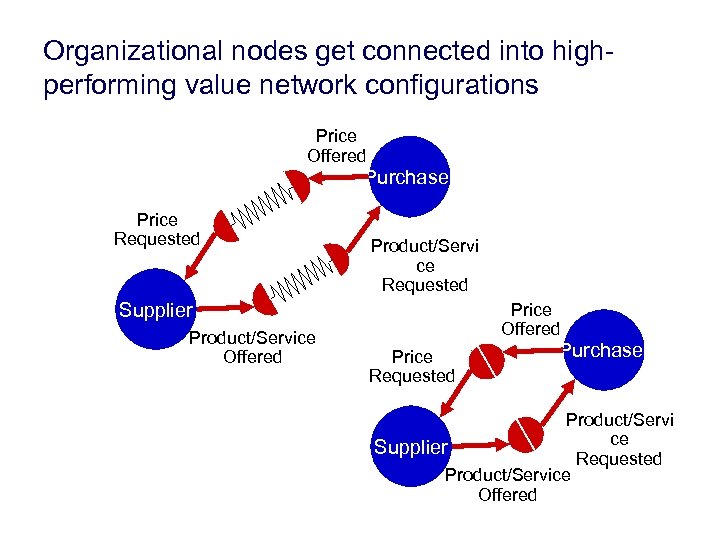 Organizational nodes get connected into highperforming value network configurations Price Offered Purchaser Price Requested Product/Servi ce Requested Supplier Product/Service Offered Price Requested Purchaser Product/Servi ce Supplier Requested Product/Service Offered
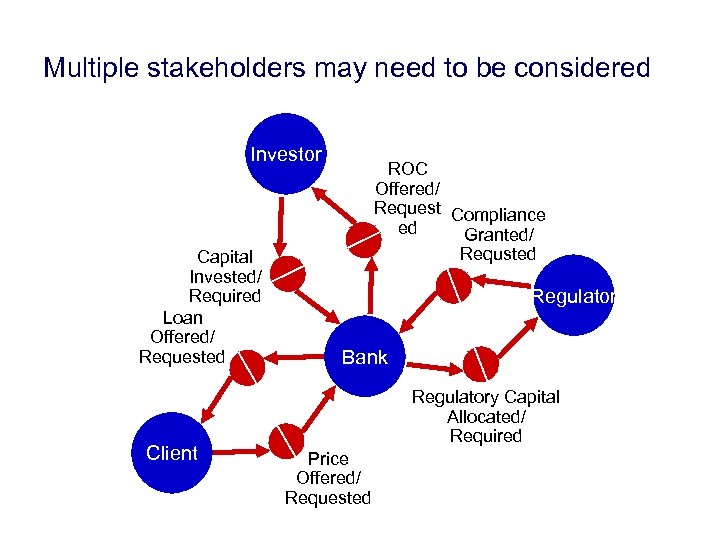 Multiple stakeholders may need to be considered Investor Capital Invested/ Required Loan Offered/ Requested Client ROC Offered/ Request Compliance ed Granted/ Requsted Regulator Bank Regulatory Capital Allocated/ Required Price Offered/ Requested
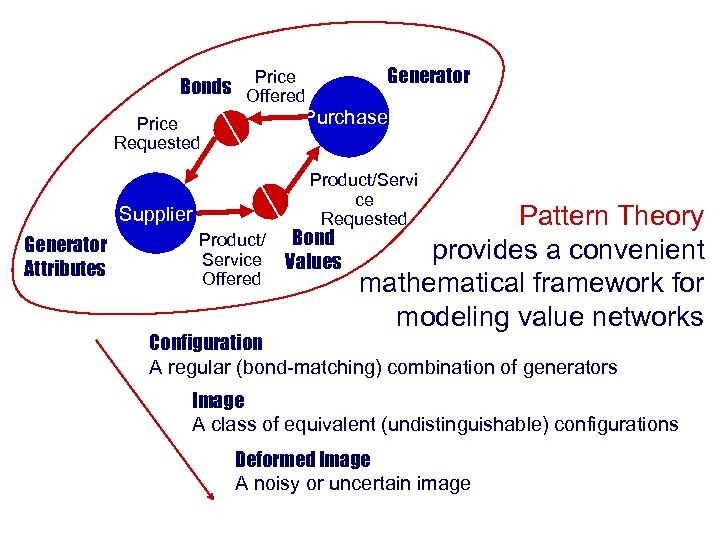 Price Generator Bonds Offered Purchaser Price Requested Product/Servi ce Requested Supplier Generator Attributes Product/ Service Offered Bond Values Pattern Theory provides a convenient mathematical framework for modeling value networks Configuration A regular (bond-matching) combination of generators Image A class of equivalent (undistinguishable) configurations Deformed Image A noisy or uncertain image
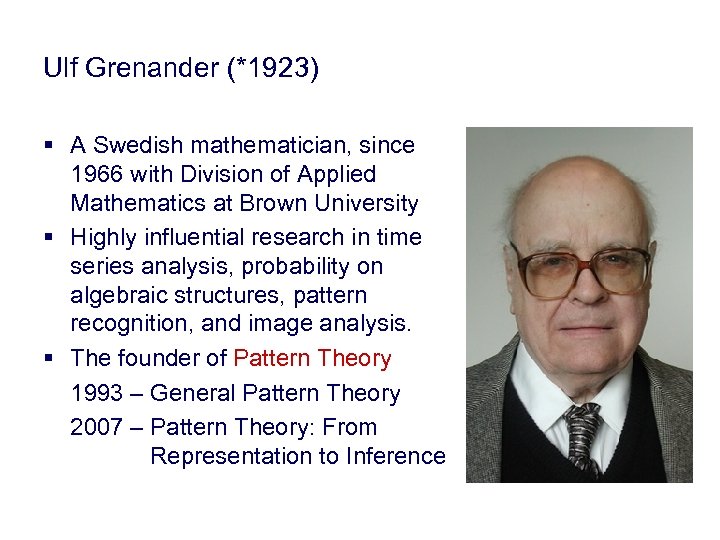 Ulf Grenander (*1923) § A Swedish mathematician, since 1966 with Division of Applied Mathematics at Brown University § Highly influential research in time series analysis, probability on algebraic structures, pattern recognition, and image analysis. § The founder of Pattern Theory 1993 – General Pattern Theory 2007 – Pattern Theory: From Representation to Inference
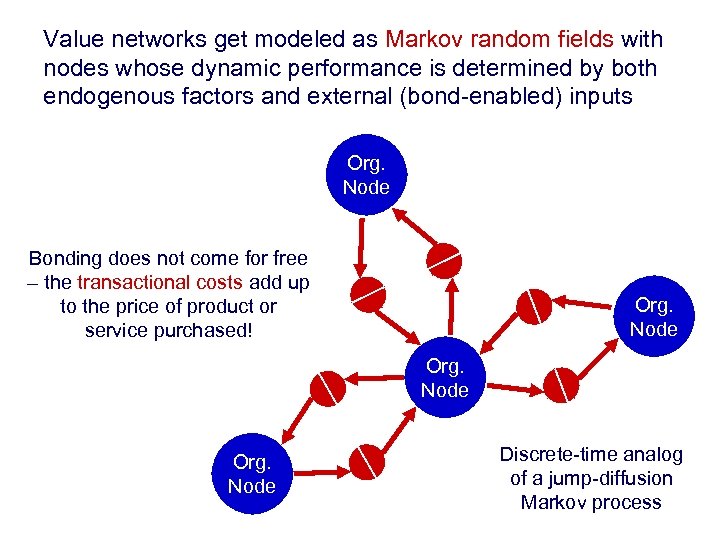 Value networks get modeled as Markov random fields with nodes whose dynamic performance is determined by both endogenous factors and external (bond-enabled) inputs Org. Node Bonding does not come for free – the transactional costs add up to the price of product or service purchased! Org. Node Discrete-time analog of a jump-diffusion Markov process
 Problems of Interest § Optimum configuration of a value network (from the process orchestrator’s viewpoint) § Optimum selection of suppliers and purchasers (from the node-level organization’s viewpoint) § Optimum design of organizational structure (which organizational competencies should be maintained and which should be outsourced) § Optimum positioning within existing value networks (which organizational competencies would deserve to be insourced) § Optimum organizational performance development (how to increase the bonding potential of the organization within existing or future value networks)
 Two Primary Challenges § The tedious modeling phase – The approach outlined models specific problems rather than underlying systems – There are many problems of potential interest … – How can one proceed effectively, without starting anew in each problem § Way to market – There are established ways how advanced process control can reach the market – The situation with organizational management is different
 Way to Market § The chasm of Two Cultures (C. P. Snow) – The application of mathematical models in management is still viewed with distrust, as an academic and impractical endeavor § The preference for one-size-fits-all predictive models – An opportunity for rich, elegant and widely applicable theory – A sufficient demand to justify the software development costs § The difficulty of turning dynamic simulation modeling into a practical tool – Educating managers in dynamic modeling? – Developing reusable model archetypes? – Facilitating the modeling process with software?
 Many Related Disciplines § § § § § Cybernetics, Organizational Cybernetics Systems Theory, Control Theory Nonlinear Dynamics, Chaos Theory Operations Research, Systems Analysis Decision Theory, Decision Analysis, Decision Support Statistics, Econometrics Macroeconomics, Microeconomics Organizational Behavior, Management Science Business Intelligence, Business Performance Management Yet, no established name for control of human organizations!
![[Feynman’s] driving curiosity was apparent when, in his last media interview, he told The](https://present5.com/presentation/bd87ecb5fb9b39055cc41816ca5f5f33/image-68.jpg "[Feynman’s] driving curiosity was apparent when, in his last media interview, he told The") [Feynman’s] driving curiosity was apparent when, in his last media interview, he told The Boston Globe last year that his work on the Shuttle commission had so aroused his interest in the complexities of managing a large organization like NASA that if he were starting his life over, he might be tempted to study management rather than physics. From the obituary of Richard P. Feynman in the Boston Globe, 16 February 1988
[Feynman’s] driving curiosity was apparent when, in his last media interview, he told The Boston Globe last year that his work on the Shuttle commission had so aroused his interest in the complexities of managing a large organization like NASA that if he were starting his life over, he might be tempted to study management rather than physics. From the obituary of Richard P. Feynman in the Boston Globe, 16 February 1988