


 Скачать презентацию Modeling Hydrological Processes Ed Maurer PRISM Science Retreat
490b3f2a53ca3bf1081be7b12158c65a.ppt
- Количество слайдов: 18
 Modeling Hydrological Processes Ed Maurer PRISM Science Retreat Friday, September 27, 2002
 Acknowledgments
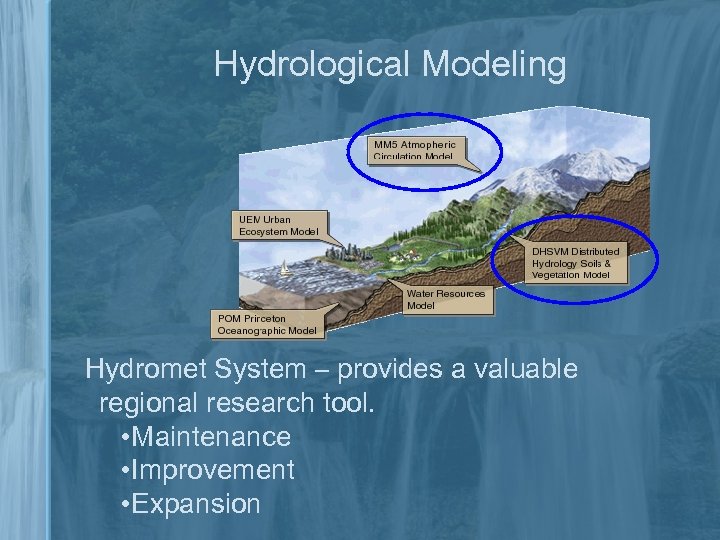 Hydrological Modeling Hydromet System – provides a valuable regional research tool. • Maintenance • Improvement • Expansion
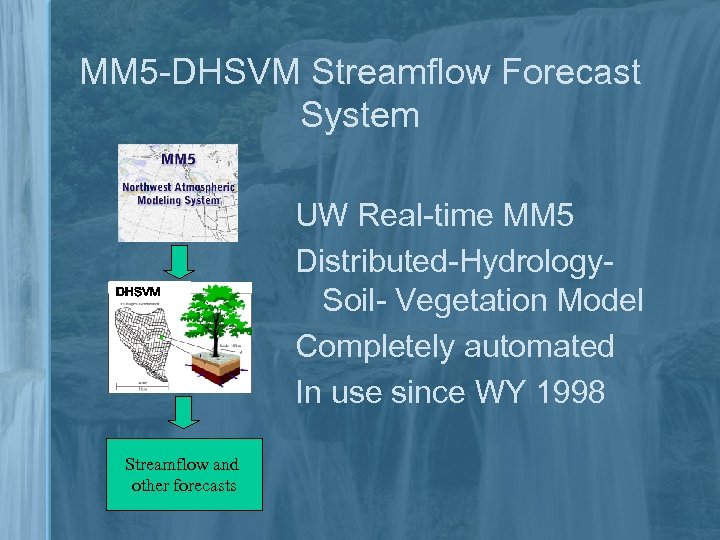 MM 5 -DHSVM Streamflow Forecast System DHSVM Streamflow and other forecasts UW Real-time MM 5 Distributed-Hydrology. Soil- Vegetation Model Completely automated In use since WY 1998
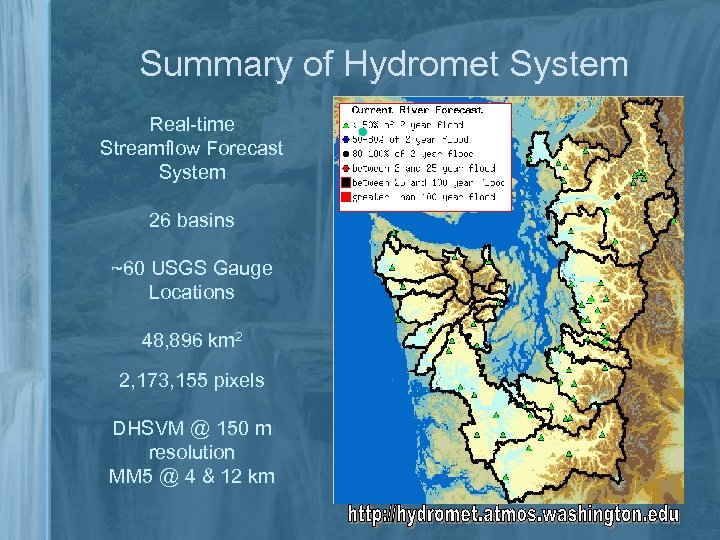 Summary of Hydromet System Real-time Streamflow Forecast System 26 basins ~60 USGS Gauge Locations 48, 896 km 2 2, 173, 155 pixels DHSVM @ 150 m resolution MM 5 @ 4 & 12 km
 Some Recent Publications • Westrick, K. J. , P. Storck, and C. F. Mass, Description and Evaluation of a Hydrometeorological Forecast System for Mountainous Watersheds, Weather and Forecasting 17: 250262, 2002. • Mass, C. F. , D. Ovens, K. Westrick, and B. A. Colle, Does Increasing Horizontal Resolution Produce More Skillful Forecasts? . Bull. Amer. Meteorol. Soc. 83: 407 -430, 2002. • Westrick, K. J. and C. F. Mass, An Evaluation of a High. Resolution Hydrometeorological Modeling System for Prediction of a Cool-Season Flood Event in a Coastal Mountainous Watershed, J. Hydrometeorology 2: 161 -180, 2001.
 Maintenance of System As models evolve and data formats change, the system must adapt • Data format for streamflow observations • Extending forecasts to 48 hours as with 4 km MM 5
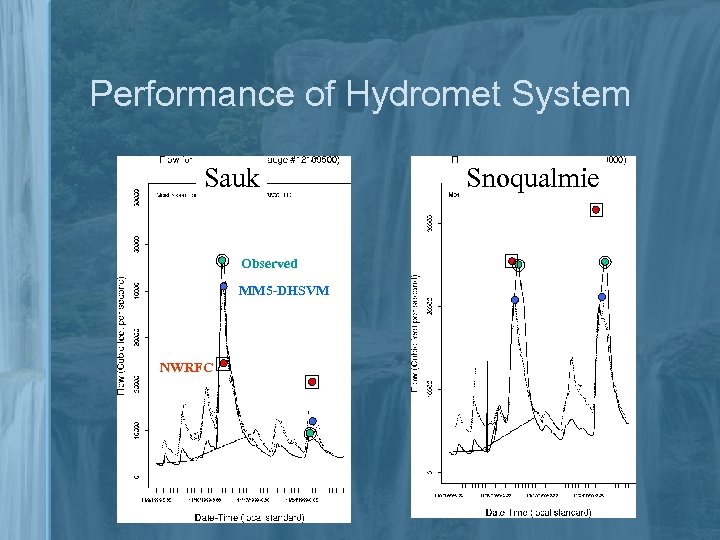 Performance of Hydromet System Sauk Observed MM 5 -DHSVM NWRFC Snoqualmie
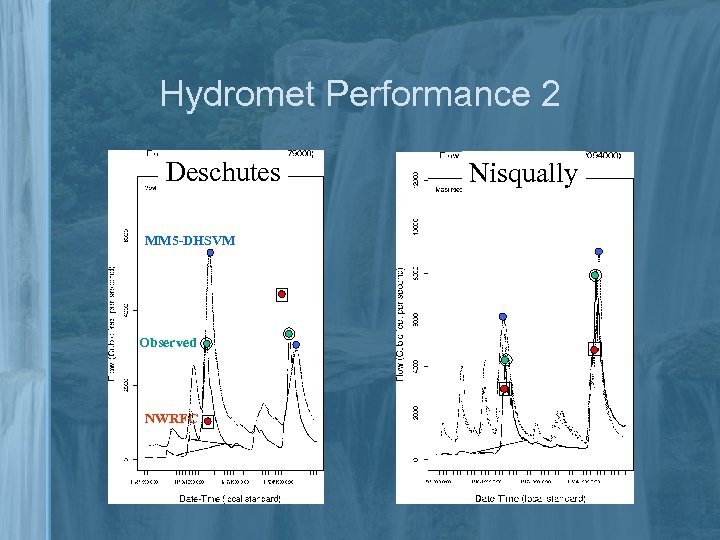 Hydromet Performance 2 Deschutes MM 5 -DHSVM Observed NWRFC Nisqually
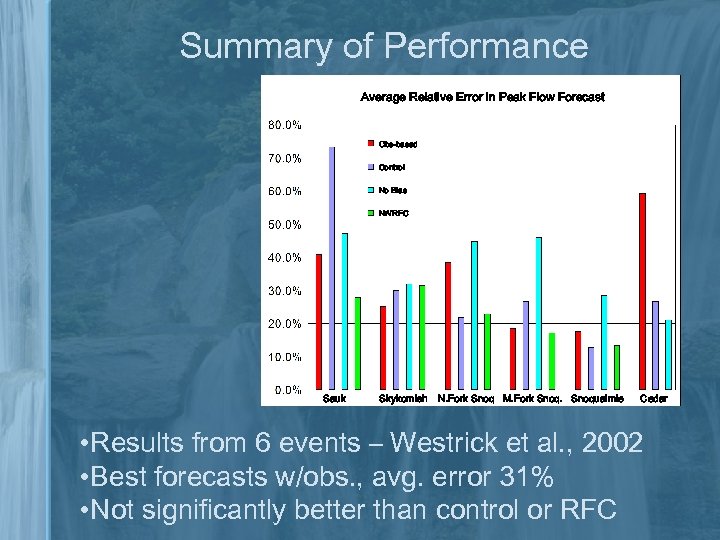 Summary of Performance Average Relative Error in Peak Flow Forecast Obs-based Control No Bias NWRFC Sauk Skykomish N. Fork Snoq M. Fork Snoqualmie Cedar • Results from 6 events – Westrick et al. , 2002 • Best forecasts w/obs. , avg. error 31% • Not significantly better than control or RFC
 Opportunity for Improving Hydromet Forecasts One key finding from Westrick et al. , 2002: Precipitation uncertainties in observed data due to: • Instrument error • Areal representativeness of point obs. • Interpolation method These errors can be nearly as large as uncertainty in meteorological forecast.
 Lack of Observations • To improve forecasts, we must identify the relative magnitudes of the errors. • Precipitation observations at a spatial resolution sufficient to determine “reality” do not exist in domain • IMPROVE – 2 study provides a valuable context for examining the orographic precipitation for several events, and provides a basis for intercomparing the errors
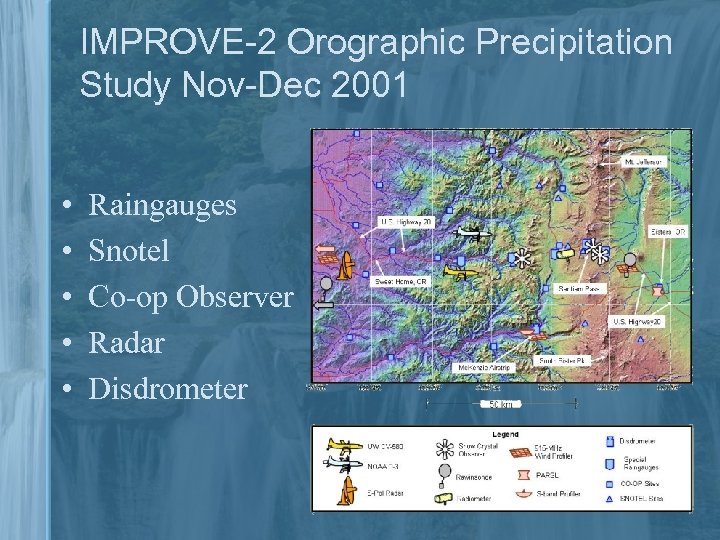 IMPROVE-2 Orographic Precipitation Study Nov-Dec 2001 • • • Raingauges Snotel Co-op Observer Radar Disdrometer
 Expansion of Forecasting Tools • DHSVM produces more than just streamflow • Soil moistures, slopes in model provide additional forecasting capabilities • Investigate landslide hazard forecasting
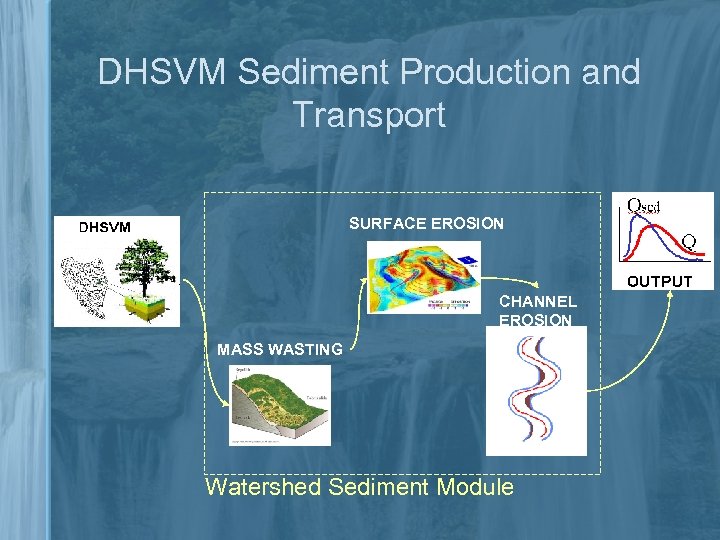 DHSVM Sediment Production and Transport SURFACE EROSION CHANNEL EROSION MASS WASTING Watershed Sediment Module
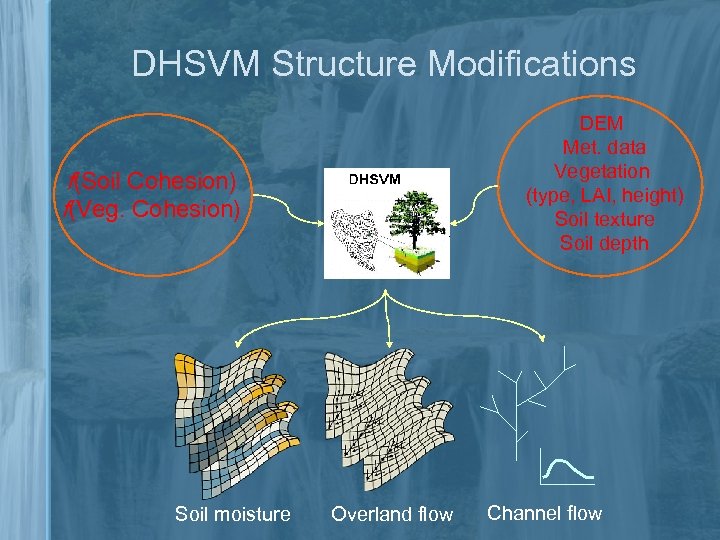 DHSVM Structure Modifications DEM Met. data Vegetation (type, LAI, height) Soil texture Soil depth f(Soil Cohesion) f(Veg. Cohesion) Soil moisture Overland flow Channel flow
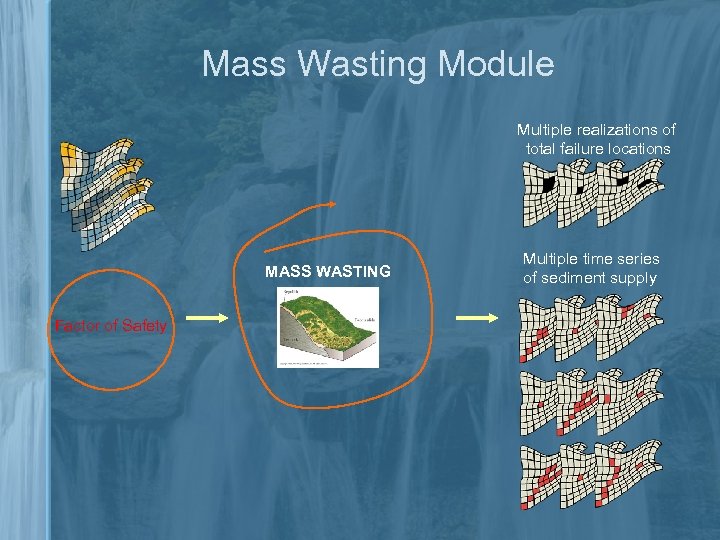 Mass Wasting Module Multiple realizations of total failure locations MASS WASTING Factor of Safety Multiple time series of sediment supply
 Summary • Many Opportunities to Build on the Past Successes • Coordination with Others in the PRISM Community is an Essential Component