


 Скачать презентацию Model Independent Visual Servoing CMPUT 610 Literature Reading
3657bde53ddd6c4ad8764167a7f6c0e8.ppt
- Количество слайдов: 23
 Model Independent Visual Servoing CMPUT 610 Literature Reading Presentation Zhen Deng
 Introduction Summaries and Comparisons of Traditional Visual Servoing and Model independent Visual Servoing emphasizing on the latter. w Works are mostly from Jenelle A. Piepmeier’s thesis and Alexandra Hauck’s thesis w
 Visual Servo w Visual servo control has the potential to provide a low-cost, low-maintenance automation solution for unstructured industries and environments. w Robotics has thrived in ordered domains, it has found challenges in environments that are not well defined.
 Traditional Visual Servoing w Precise knowledge of the robot kinematics, the camera model, or the geometric relationship between the camera and the robot systems is assumed. w Need to know the exact position of the endeffector and the target in the Cartesian Space. w Require lots of calculation.
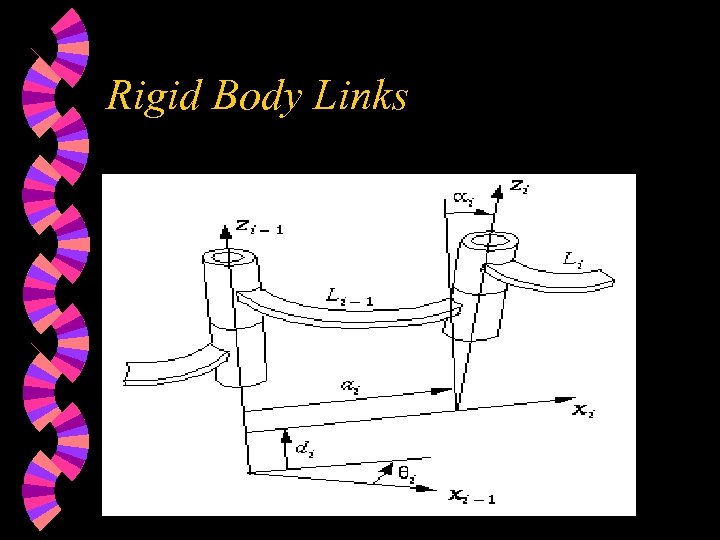 Rigid Body Links
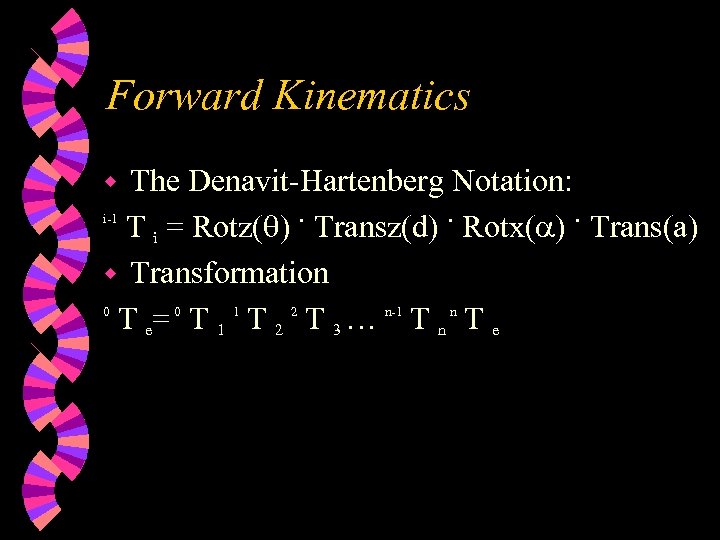 Forward Kinematics The Denavit-Hartenberg Notation: . Transz(d). Rotx(a). Trans(a) i-1 T i = Rotz(q) w Transformation 0 0 1 2 n-1 n T e= T 1 T 2 T 3 … T n T e w
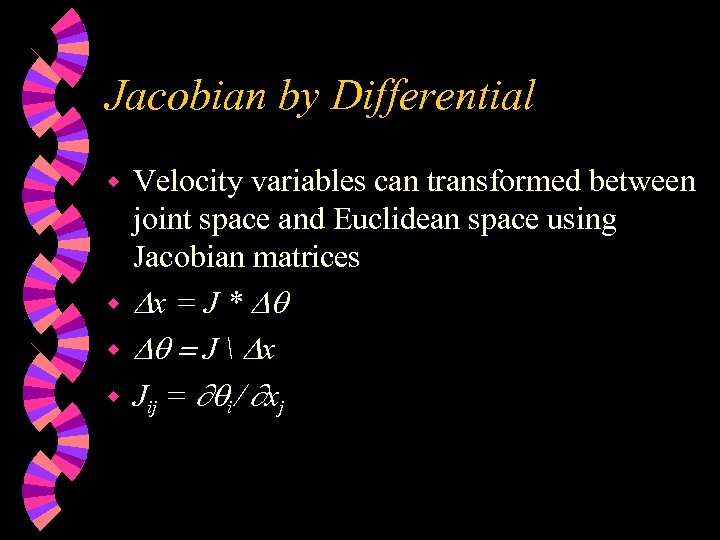 Jacobian by Differential Velocity variables can transformed between joint space and Euclidean space using Jacobian matrices w Dx = J * Dq w Dq = J Dx w Jij = ¶qi/ ¶xj w
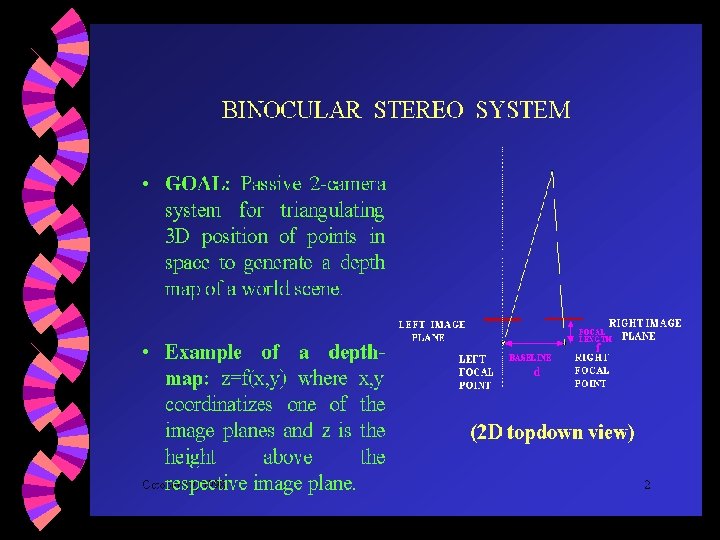 Calibrated Camera Model
 Model Independent Visual Servoing An image-based Visual Servoing method. w Could be further classified as dynamic lookand-move according to the classification scheme developed by Sanderson and Weiss. w Estimate the Jacobian on-line and does not require calibrated models of either of the camera configuration or the robot kinematics. w
 History Martin Jagersand formulates the visual Servoing problem as a nonlinear least squares problem solved by a quasi-Newton method using Broyden Jacobian estimation. w Base on Martin’s work, Jenelle P adds a frame to solve the problem of grasping a moving target. w me ? … w
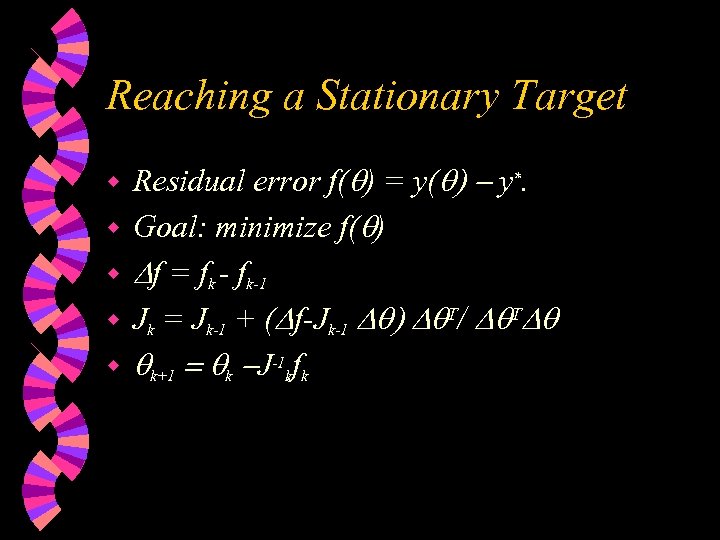 Reaching a Stationary Target w w w Residual error f(q) = y(q) - y*. Goal: minimize f(q) Df = fk - fk-1 Jk = Jk-1 + (Df-Jk-1 Dq) Dq. T/ Dq. TDq qk+1 = qk -J-1 kfk
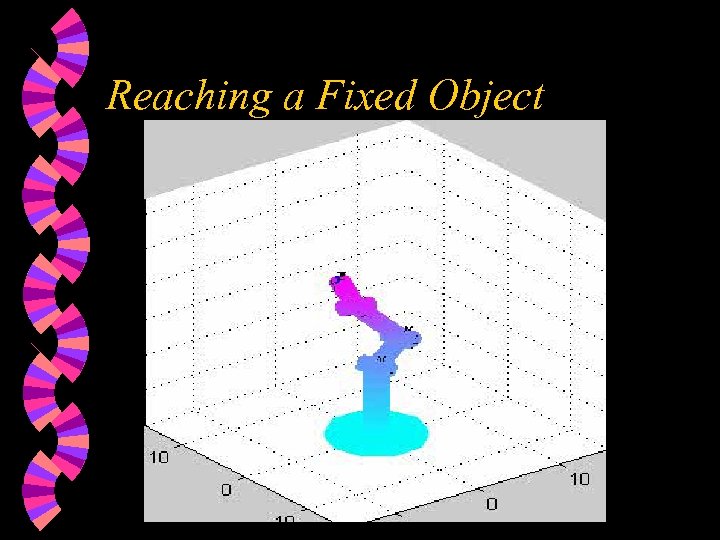 Reaching a Fixed Object
 Tracking the moving object Interaction with a moving object, e. g. catching or hitting it, is perhaps the most difficult task for a hand-eye system. w Most successful systems presented in paper uses precisely calibrated, stationary stereo camera systems and image-processing hardware together with a simplified visual environment. w
 Peter K. Allen’s Work Allen et al. Developed a system that could grasp a toy train moving in a plain. The train’s position is estimated from(hardwaresupported) measurements of optic flow with a stationary, calibrated stereo system. w Using a non-linear filtering and prediction, the robot tracks the train and finally grasps it. w
 “Ball player” Andersson’s ping-pong player is one of the earliest “ball playing” robot. w Nakai et al developed a robotic volleyball player. w
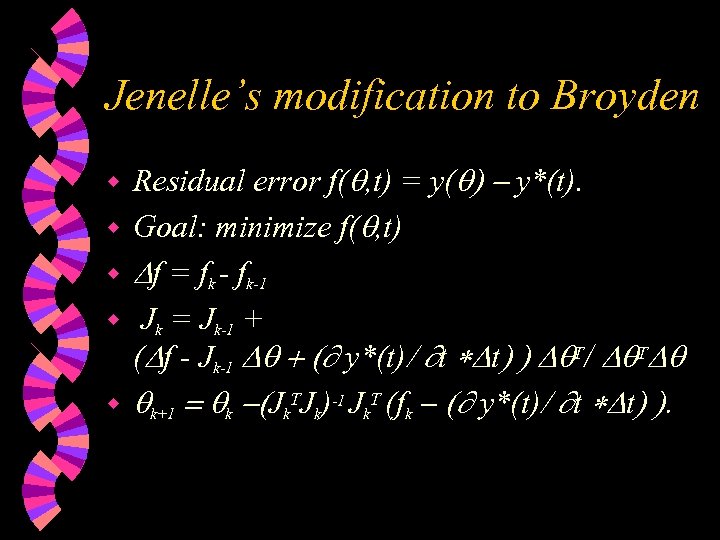 Jenelle’s modification to Broyden w w w Residual error f(q, t) = y(q) - y*(t). Goal: minimize f(q, t) Df = fk - fk-1 Jk = Jk-1 + (Df - Jk-1 Dq + (¶ y*(t)/ ¶t *Dt) ) Dq. T/ Dq. TDq qk+1 = qk -(Jk. TJk)-1 Jk. T (fk - (¶ y*(t)/ ¶t *Dt) ).
 Convergence The residual error converges as the iterations increasing. w While the static method does not. w The mathematics proof of this result could be found in Jenelle’s paper. w
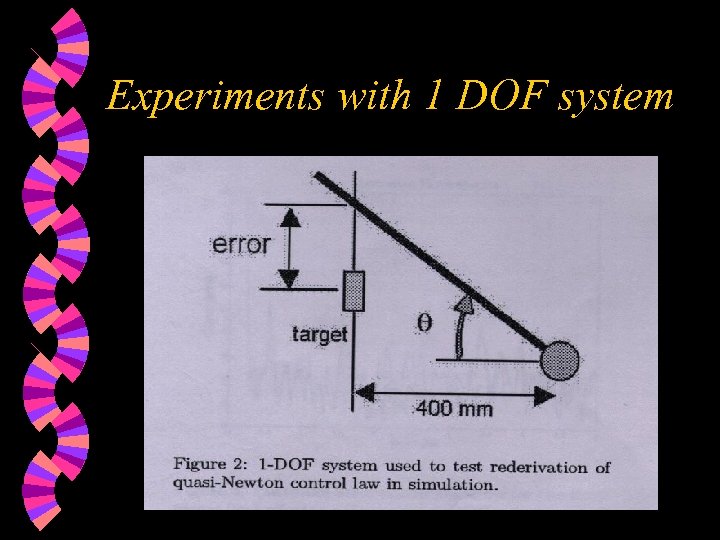 Experiments with 1 DOF system
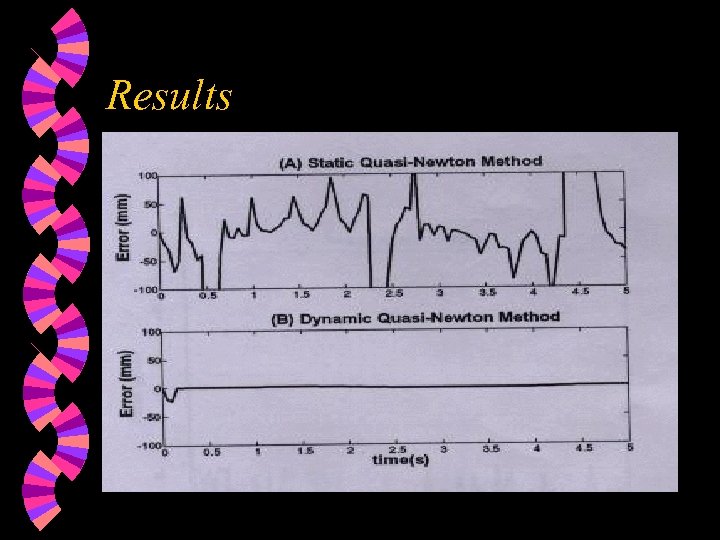 Results
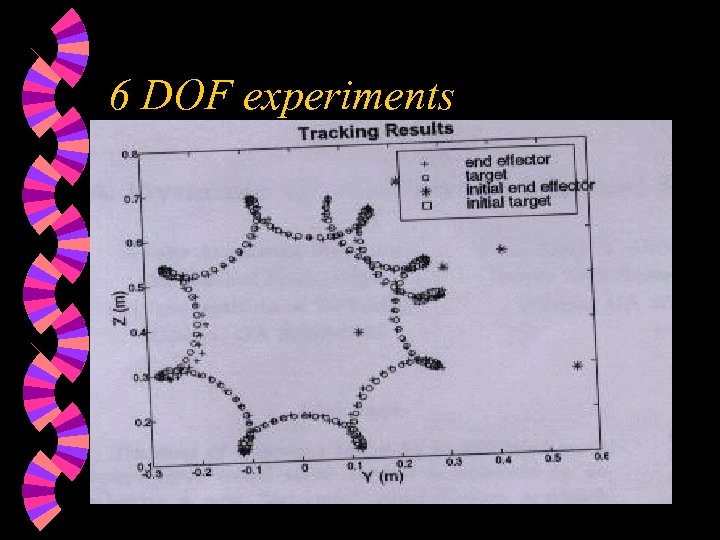 6 DOF experiments
 Future work ? Analysis between the two distinct ways of computing the Jacobian Matrix. w Solving the tracking problem without the knowledge of target motion. w More robust … ? w
 Literature Links http: //mime 1. gtri. gatech. edu/imb/projects/m ivs/vsweb 2. html w A Dynamic Quasi-Newton Method for Uncalibrated Visual Servoing by Jenelle al w Automated Tracking and Grasping of a Moving Object with a Robotic Hand-Eye System. By Peter K. Allen w
 Summary w Model Independent approach is proved to be more robust and more efficient.