 Скачать презентацию Model-driven Test Generation Oleg Sokolsky September 22 2004
381cc6bedc0fe427a4f963cb6860f777.ppt
- Количество слайдов: 51



Model-driven Test Generation Oleg Sokolsky September 22, 2004
Outline and scope • Classification of model-driven testing • Conformance testing for communication protocols • Coverage-based testing – Coverage criteria – Coverage-based test generation • Can we do more? (open questions)
Testing classification • By component level – Unit testing – Integration testing – System testing • By abstraction level – Black box – White box – Grey box ? ? ?
Testing classification • By purpose – Functional testing – Performance testing – Robustness testing – Stress testing • Who performs testing? – Developers – In-house QA – Third-party
Functional testing • An implementation can exhibit a variety of behaviors • For each behavior, we can tell whether it is correct or not • A test can be applied to the implementation and accept or reject one or more behaviors – The test fails if a behavior is rejected • A test suite is a finite collection of tests – Testing fails if any test in the suite fails
Formal methods in testing • “Testing can never demonstrate the absence of errors, only their presence. ” Edsger W. Dijkstra • How can formal methods help? • Add rigor! – Reliably identify what should to be tested – Provide basis for test generation – Provide basis for test execution
Model-driven testing • Rely on a model of the system – Different interpretations of a model • Model is a requirement – Black-box conformance testing – QA or third party • Model is a design artifact – Grey-box unit/system testing – QA or developers
Conformance testing • A specification prescribes legal behaviors • Does the implementation conform to the specification? – Need the notion of conformance • Not interested in: – How the system is implemented? – What went wrong if an error is found? – What else the system can do?
Test hypothesis • How do we relate beasts of different species? – Implementation is a physical object – Specification is a formal object • Assume there is a formal model that is faithful to implementation – We do not know it! • Define conformance between the model and the specification – Generate tests to demonstrate conformance
Conformance testing with LTS • Requirement is specified as a labeled transition system • Implementation is modeled as an input-output transition system • Conformance relation is given by ioco – [Tretmans 96] – Built upon earlier work on testing preorders
Historical reference • Process equivalences: – Trace equivalence/preorder is too coarse – Bisimulation/simulation is too fine • Middle ground: – – Failures equivalence in CSP may- and must-testing by Hennessy Testing preorder by de Nicola They are all the same! • Right notion but hard to compute
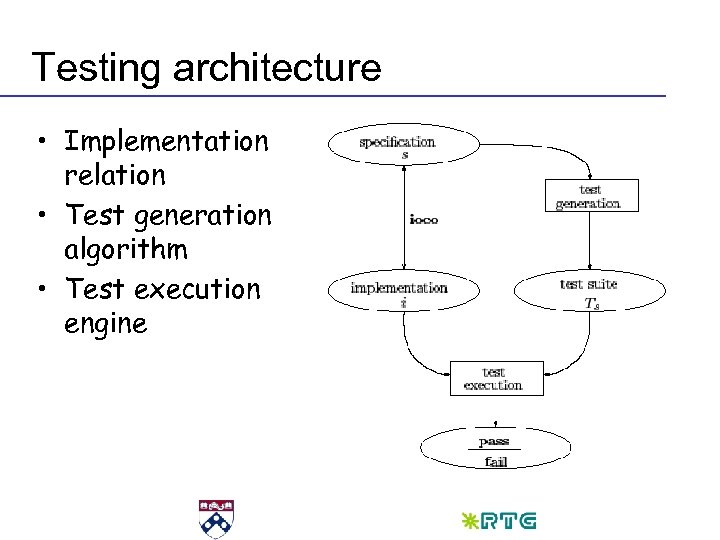
Testing architecture • Implementation relation • Test generation algorithm • Test execution engine
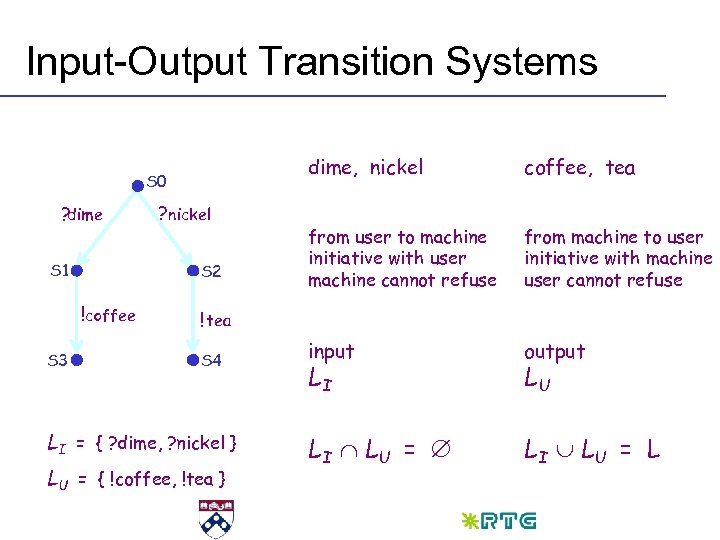
Input-Output Transition Systems dime, nickel S 0 ? dime S 1 S 2 !coffee S 3 ? nickel coffee, tea from user to machine initiative with user machine cannot refuse from machine to user initiative with machine user cannot refuse input output LI LU = L ! tea S 4 LI = { ? dime, ? nickel } LU = { !coffee, !tea } LI LU
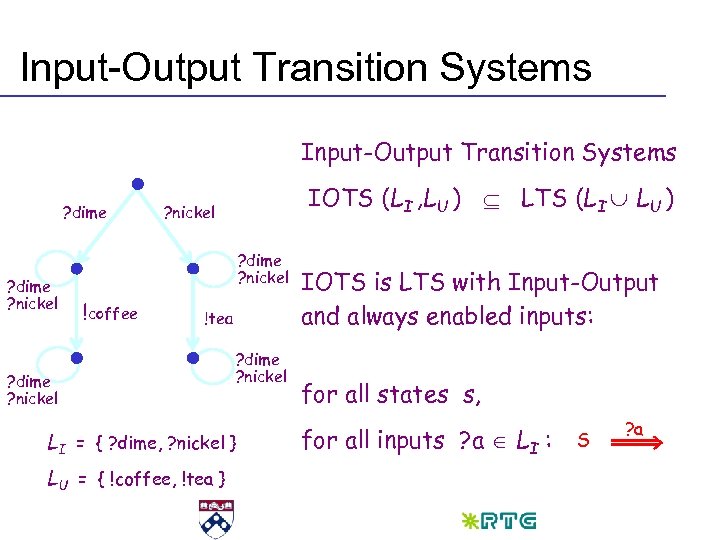
Input-Output Transition Systems ? dime ? nickel IOTS (LI , LU ) LTS (LI LU ) ? nickel ? dime ? nickel !coffee !tea ? dime ? nickel LI = { ? dime, ? nickel } LU = { !coffee, !tea } IOTS is LTS with Input-Output and always enabled inputs: for all states s, for all inputs ? a LI : S ? a
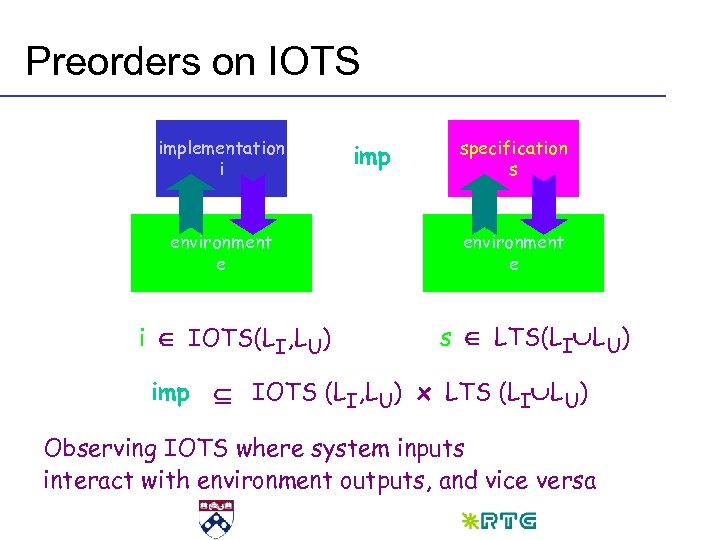
Preorders on IOTS implementation i environment e i IOTS(LI, LU) imp specification s environment e s LTS(LI LU) IOTS (LI, LU) x LTS (LI LU) Observing IOTS where system inputs interact with environment outputs, and vice versa
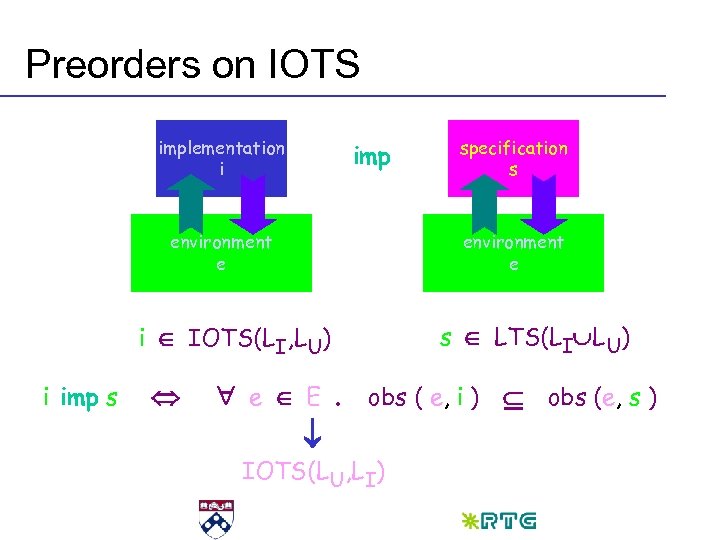
Preorders on IOTS implementation i imp environment e i IOTS(LI, LU) i imp s specification s s LTS(LI LU) e E. obs ( e, i ) obs (e, s ) IOTS(LU, LI)
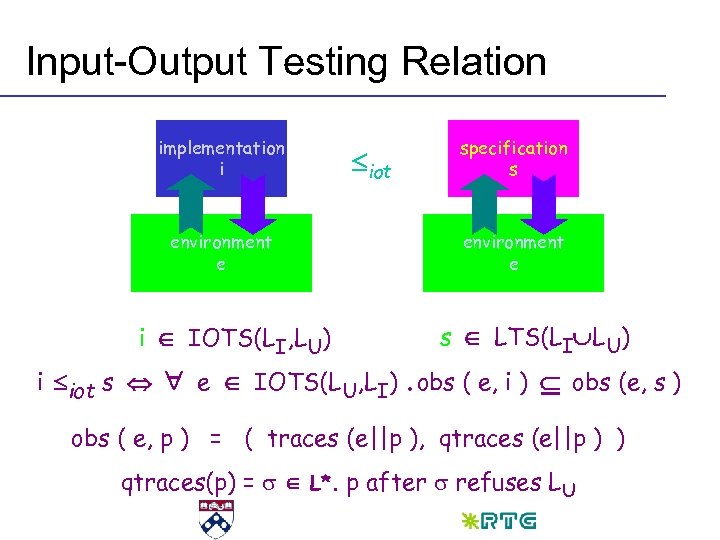
Input-Output Testing Relation implementation i environment e iot specification s environment e s LTS(LI LU) i IOTS(LI, LU) i iot s e IOTS(LU, LI). obs ( e, i ) obs (e, s ) obs ( e, p ) = ( traces (e||p ), qtraces (e||p ) ) qtraces(p) = L*. p after refuses LU
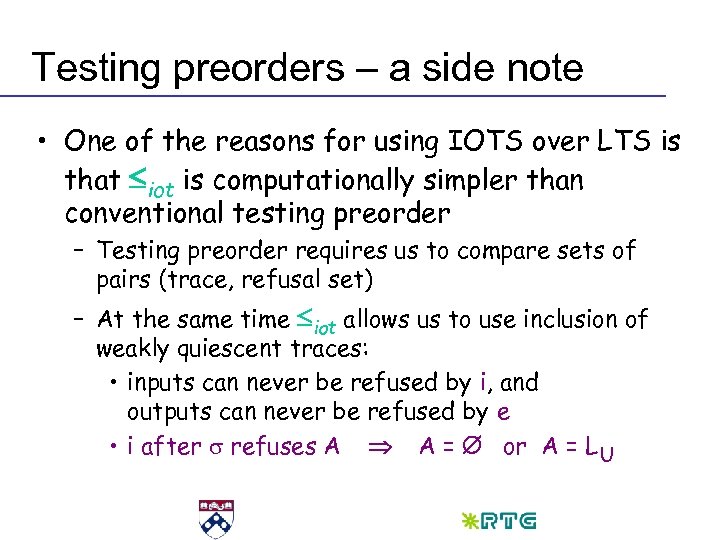
Testing preorders – a side note • One of the reasons for using IOTS over LTS is that iot is computationally simpler than conventional testing preorder – Testing preorder requires us to compare sets of pairs (trace, refusal set) – At the same time iot allows us to use inclusion of weakly quiescent traces: • inputs can never be refused by i, and outputs can never be refused by e • i after refuses A A = or A = LU
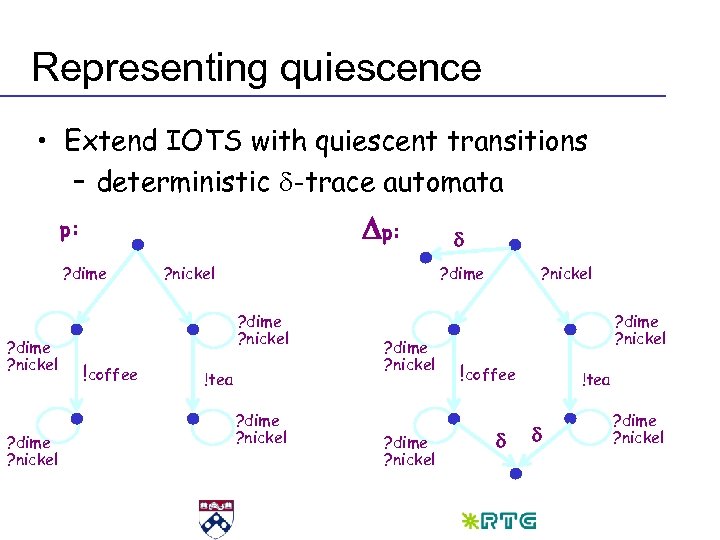
Representing quiescence • Extend IOTS with quiescent transitions – deterministic d-trace automata Dp: p: ? dime ? nickel ? dime ? nickel ? dime ? nickel !coffee d !tea d ? dime ? nickel
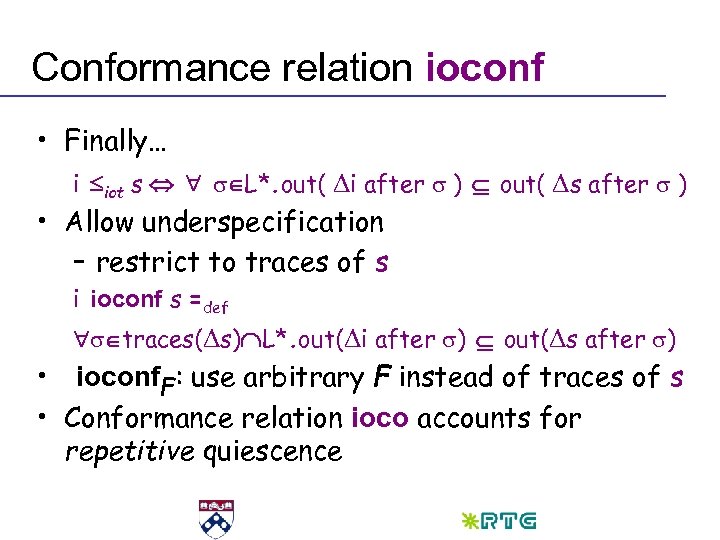
Conformance relation ioconf • Finally… i iot s L*. out( Di after ) out( Ds after ) • Allow underspecification – restrict to traces of s i ioconf s =def traces(Ds) L*. out(Di after ) out(Ds after ) • ioconf. F: use arbitrary F instead of traces of s • Conformance relation ioco accounts for repetitive quiescence
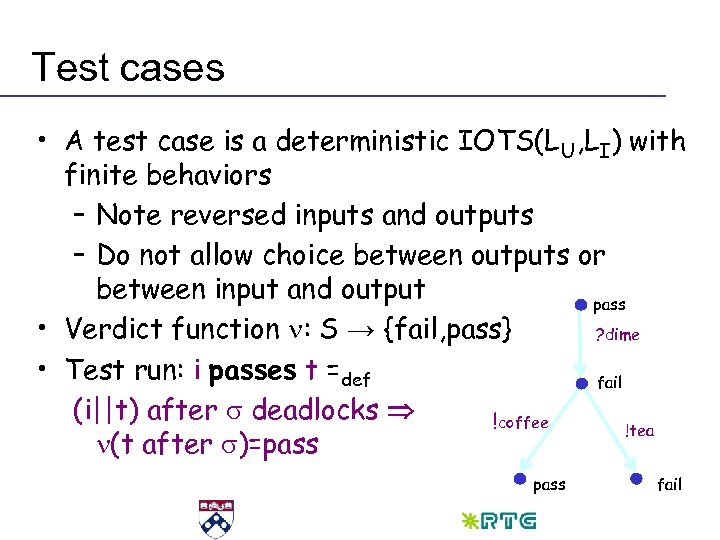
Test cases • A test case is a deterministic IOTS(LU, LI) with finite behaviors – Note reversed inputs and outputs – Do not allow choice between outputs or between input and output pass • Verdict function n: S → {fail, pass} ? dime • Test run: i passes t =def fail (i||t) after deadlocks !coffee !tea n(t after )=pass fail
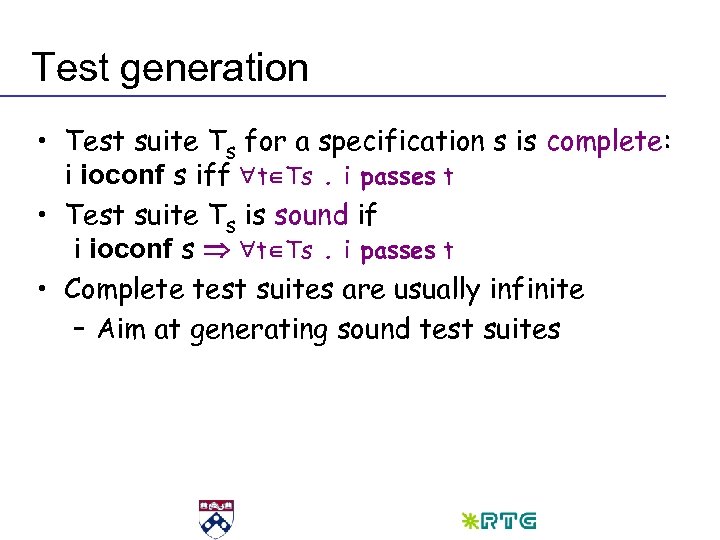
Test generation • Test suite Ts for a specification s is complete: i ioconf s iff t Ts. i passes t • Test suite Ts is sound if i ioconf s t Ts. i passes t • Complete test suites are usually infinite – Aim at generating sound test suites
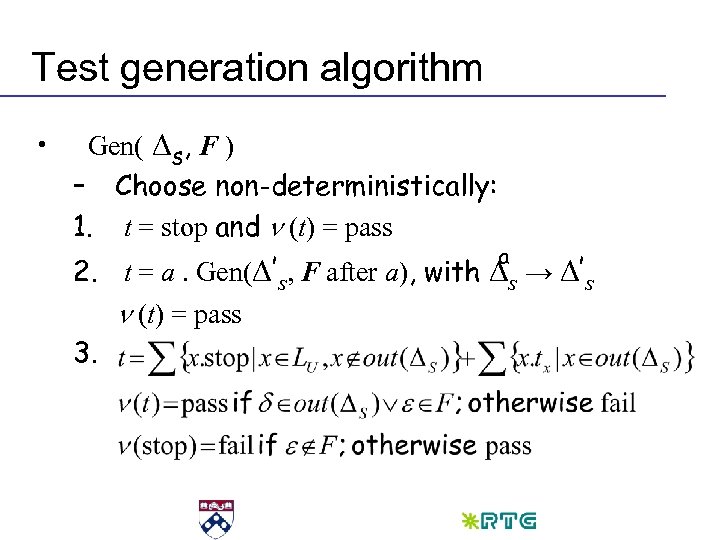
Test generation algorithm • Gen( Ds, F ) – Choose non-deterministically: 1. t = stop and n (t) = pass a 2. t = a. Gen(D’s, F after a), with Ds → D’s n (t) = pass 3.
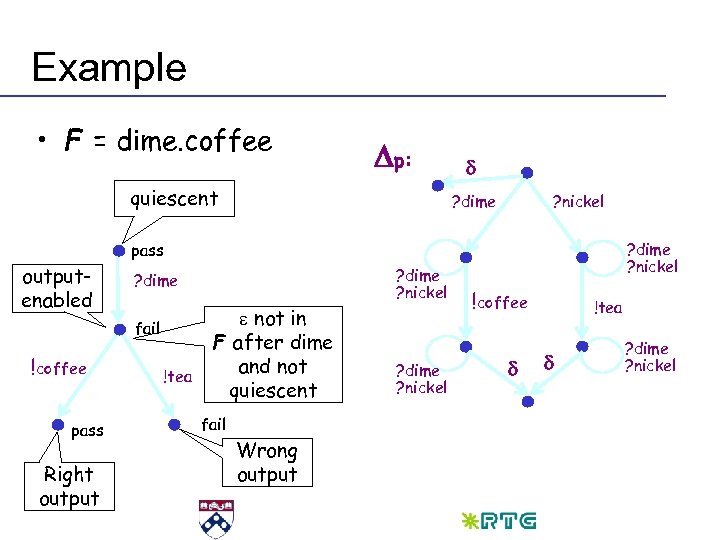
Example • F = dime. coffee Dp: quiescent d ? dime ? nickel pass outputenabled fail !coffee pass Right output ? dime ? nickel ? dime !tea e not in F after dime and not quiescent fail Wrong output ? dime ? nickel !coffee d !tea d ? dime ? nickel
Test purposes • Where does F come from? • Test purposes: – Requirements, use cases – Automata, message sequence charts • Test purposes represent “interesting” or “significant” behaviors – Define “interesting” or “significant”… • Can we come up with test purposes automatically?
Summary: conformance testing • Advantages: – Very rigorous formal foundation – Size of the test suite is controlled by use cases • Disadvantages: – How much have we learned about the system that passed the test suite? – Does not guarantee coverage
Coverage-based testing • Traditional: – Tests are derived from the implementation structure (code) • Model-driven: – Cover the model instead of code – Model should be much closer to the implementation in structure • Relies on coverage criteria
![Coverage criteria and tests • [Hong. Lee. Sokolsky. Ural 02] • Control flow: –](https://present5.com/presentation/381cc6bedc0fe427a4f963cb6860f777/image-28.jpg "Coverage criteria and tests • [Hong. Lee. Sokolsky. Ural 02] • Control flow: –")
Coverage criteria and tests • [Hong. Lee. Sokolsky. Ural 02] • Control flow: – all-states – all-transitions • Data flow: – – all-defs all-uses all-inputs all-outputs • Test is a linear sequence of inputs and outputs
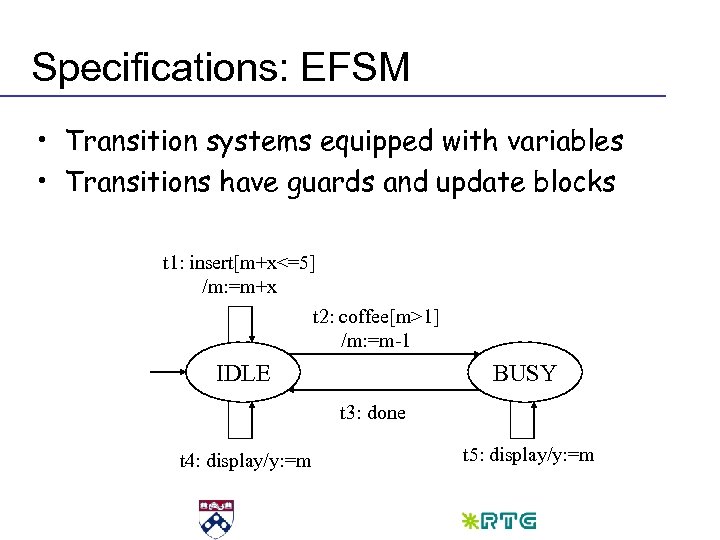
Specifications: EFSM • Transition systems equipped with variables • Transitions have guards and update blocks t 1: insert[m+x<=5] /m: =m+x t 2: coffee[m>1] /m: =m-1 IDLE BUSY t 3: done t 4: display/y: =m t 5: display/y: =m
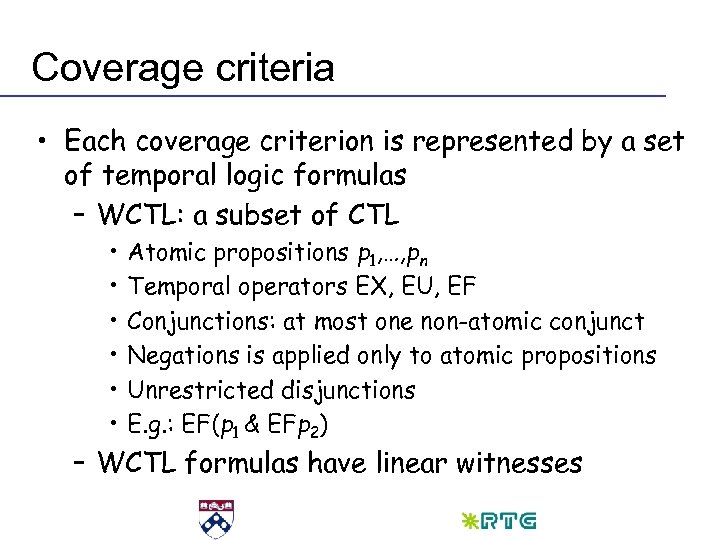
Coverage criteria • Each coverage criterion is represented by a set of temporal logic formulas – WCTL: a subset of CTL • • • Atomic propositions p 1, …, pn Temporal operators EX, EU, EF Conjunctions: at most one non-atomic conjunct Negations is applied only to atomic propositions Unrestricted disjunctions E. g. : EF(p 1 & EFp 2) – WCTL formulas have linear witnesses
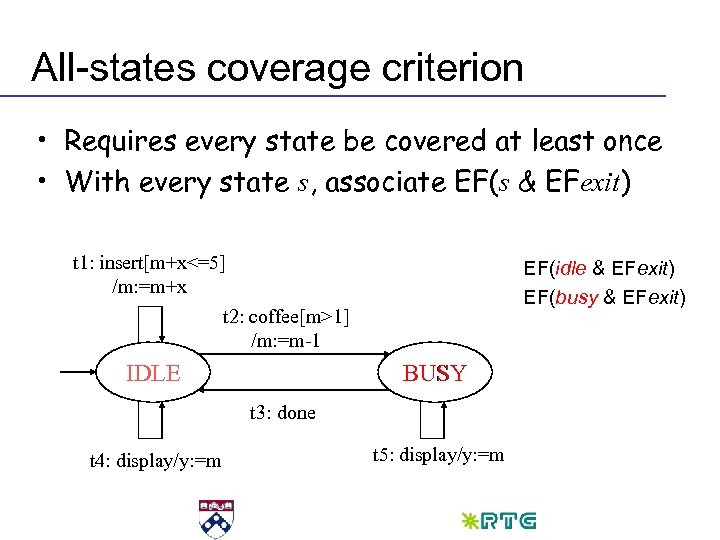
All-states coverage criterion • Requires every state be covered at least once • With every state s, associate EF(s & EFexit) t 1: insert[m+x<=5] /m: =m+x EF(idle & EFexit) EF(busy & EFexit) t 2: coffee[m>1] /m: =m-1 IDLE BUSY t 3: done t 4: display/y: =m t 5: display/y: =m
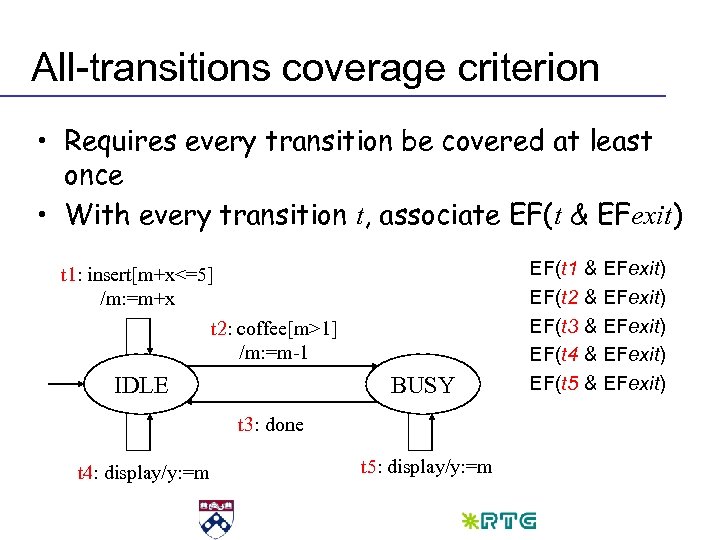
All-transitions coverage criterion • Requires every transition be covered at least once • With every transition t, associate EF(t & EFexit) t 1: insert[m+x<=5] /m: =m+x t 2: coffee[m>1] /m: =m-1 IDLE BUSY t 3: done t 4: display/y: =m t 5: display/y: =m EF(t 1 & EFexit) EF(t 2 & EFexit) EF(t 3 & EFexit) EF(t 4 & EFexit) EF(t 5 & EFexit)
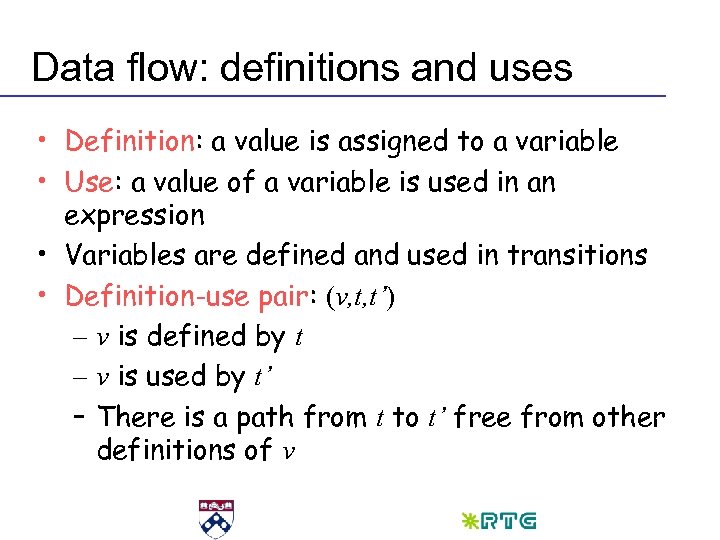
Data flow: definitions and uses • Definition: a value is assigned to a variable • Use: a value of a variable is used in an expression • Variables are defined and used in transitions • Definition-use pair: (v, t, t’) – v is defined by t – v is used by t’ – There is a path from t to t’ free from other definitions of v
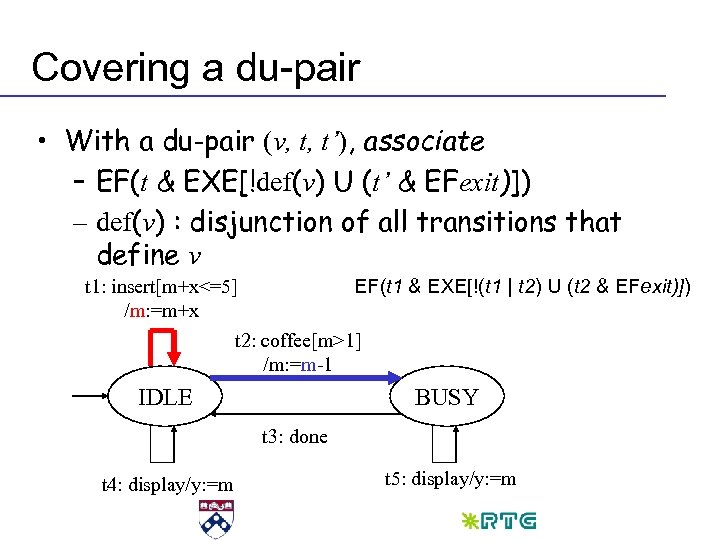
Covering a du-pair • With a du-pair (v, t, t’), associate – EF(t & EXE[!def(v) U (t’ & EFexit)]) – def(v) : disjunction of all transitions that define v t 1: insert[m+x<=5] EF(t 1 & EXE[!(t 1 | t 2) U (t 2 & EFexit)]) /m: =m+x t 2: coffee[m>1] /m: =m-1 IDLE BUSY t 3: done t 4: display/y: =m t 5: display/y: =m
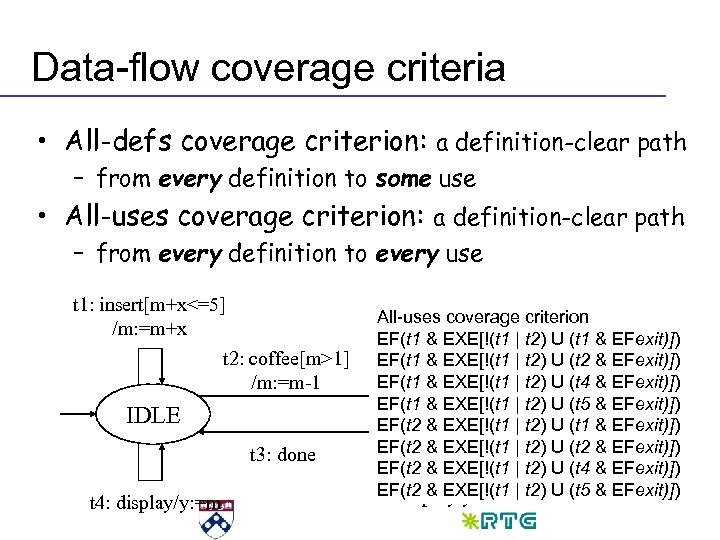
Data-flow coverage criteria • All-defs coverage criterion: a definition-clear path – from every definition to some use • All-uses coverage criterion: a definition-clear path – from every definition to every use t 1: insert[m+x<=5] /m: =m+x t 2: coffee[m>1] /m: =m-1 IDLE t 3: done t 4: display/y: =m All-uses coverage criterion EF(t 1 & EXE[!(t 1 | t 2) U (t 1 & EFexit)]) EF(t 1 & EXE[!(t 1 | t 2) U (t 2 & EFexit)]) EF(t 1 & EXE[!(t 1 | t 2) U (t 4 & EFexit)]) EF(t 1 & EXE[!(t 1 | t 2) U (t 5 & EFexit)]) BUSY EF(t 2 & EXE[!(t 1 | t 2) U (t 1 & EFexit)]) EF(t 2 & EXE[!(t 1 | t 2) U (t 2 & EFexit)]) EF(t 2 & EXE[!(t 1 | t 2) U (t 4 & EFexit)]) EF(t 2 & EXE[!(t 1 t 5: display/y: =m | t 2) U (t 5 & EFexit)])
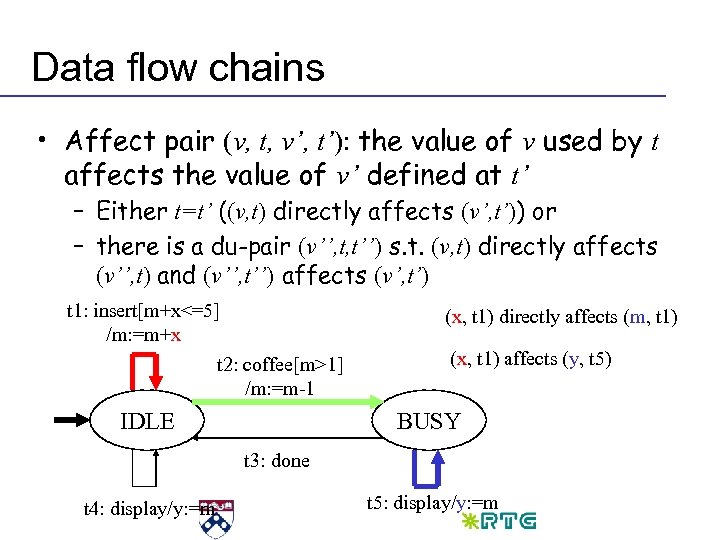
Data flow chains • Affect pair (v, t, v’, t’): the value of v used by t affects the value of v’ defined at t’ – Either t=t’ ((v, t) directly affects (v’, t’)) or – there is a du-pair (v’’, t, t’’) s. t. (v, t) directly affects (v’’, t) and (v’’, t’’) affects (v’, t’) t 1: insert[m+x<=5] /m: =m+x t 2: coffee[m>1] /m: =m-1 IDLE (x, t 1) directly affects (m, t 1) (x, t 1) affects (y, t 5) BUSY t 3: done t 4: display/y: =m t 5: display/y: =m
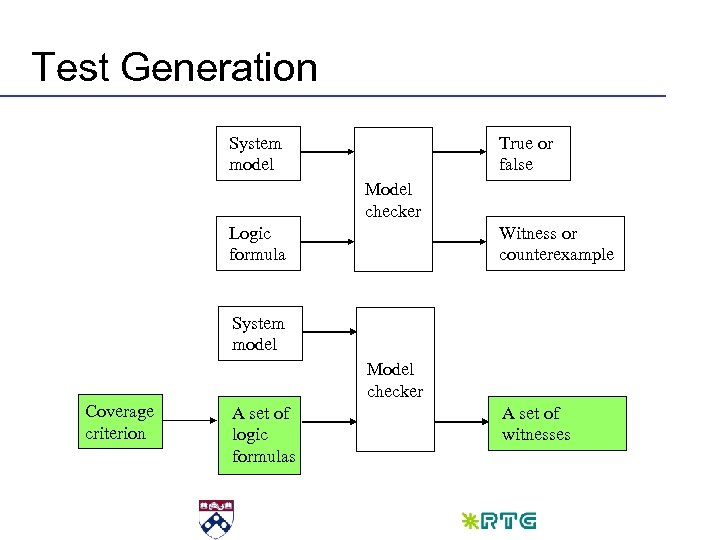
Test Generation System model True or false Model checker Logic formula Witness or counterexample System model Model checker Coverage criterion A set of logic formulas A set of witnesses
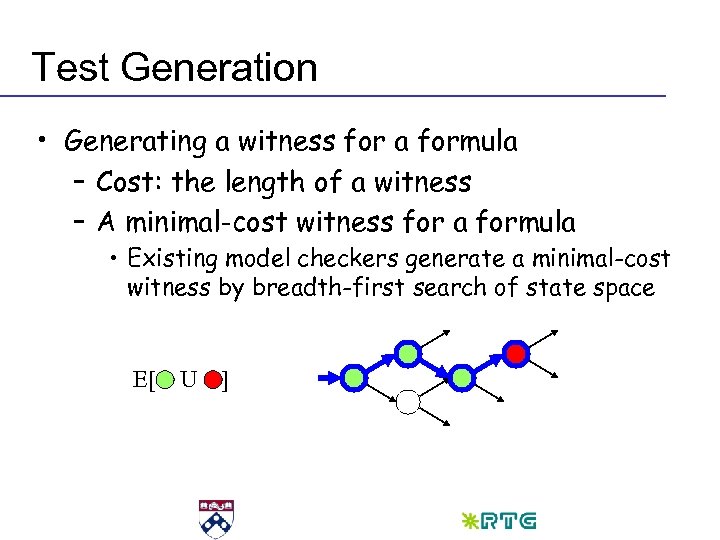
Test Generation • Generating a witness for a formula – Cost: the length of a witness – A minimal-cost witness for a formula • Existing model checkers generate a minimal-cost witness by breadth-first search of state space E[ U ]
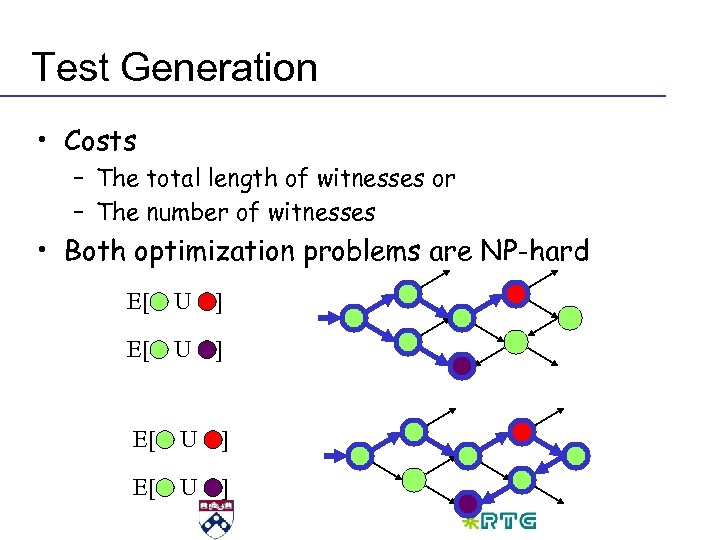
Test Generation • Costs – The total length of witnesses or – The number of witnesses • Both optimization problems are NP-hard E[ U ]
Coverage for distributed systems • What if our system is a collection of components? • Possible solutions: – Generate tests for each components • Clearly unsatisfactory; does not test integration – Generate tests from the product of component models • Too many redundant tests • Non-determinism is another problem
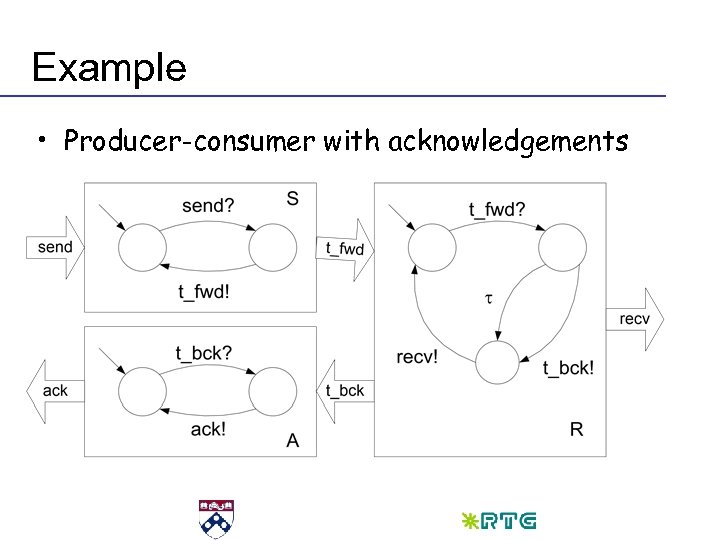
Example • Producer-consumer with acknowledgements
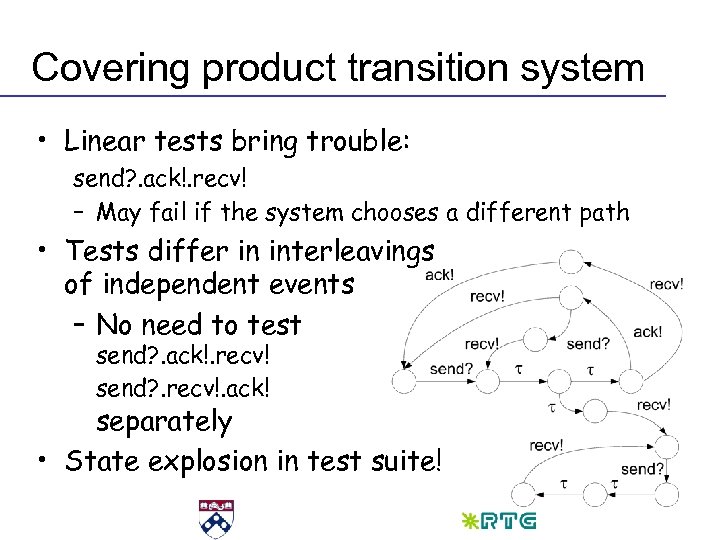
Covering product transition system • Linear tests bring trouble: send? . ack!. recv! – May fail if the system chooses a different path • Tests differ in interleavings of independent events – No need to test send? . ack!. recv! send? . recv!. ack! separately • State explosion in test suite!
Partial orders for test generation • Use event structures instead of transition systems [Heninger 97] • Test generation covers the event structure • Allows natural generation of distributed testers
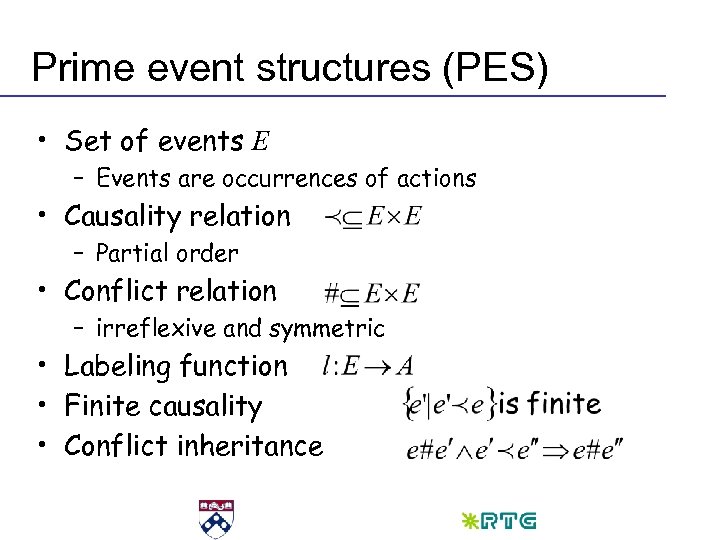
Prime event structures (PES) • Set of events E – Events are occurrences of actions • Causality relation – Partial order • Conflict relation – irreflexive and symmetric • Labeling function • Finite causality • Conflict inheritance
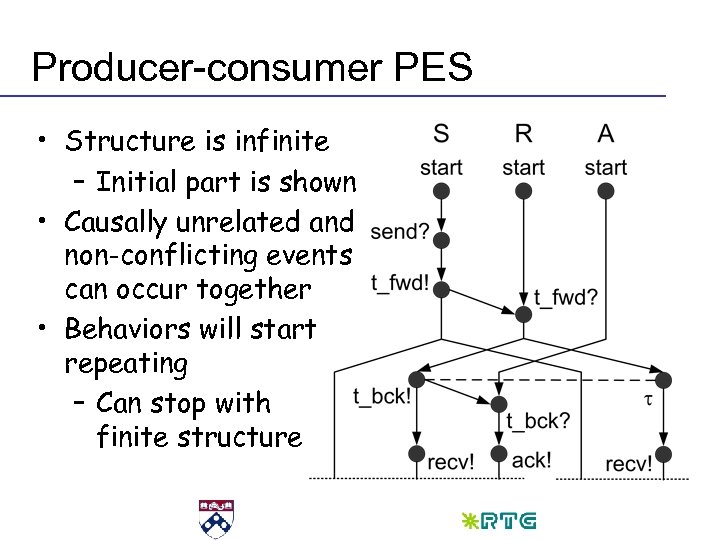
Producer-consumer PES • Structure is infinite – Initial part is shown • Causally unrelated and non-conflicting events can occur together • Behaviors will start repeating – Can stop with finite structure
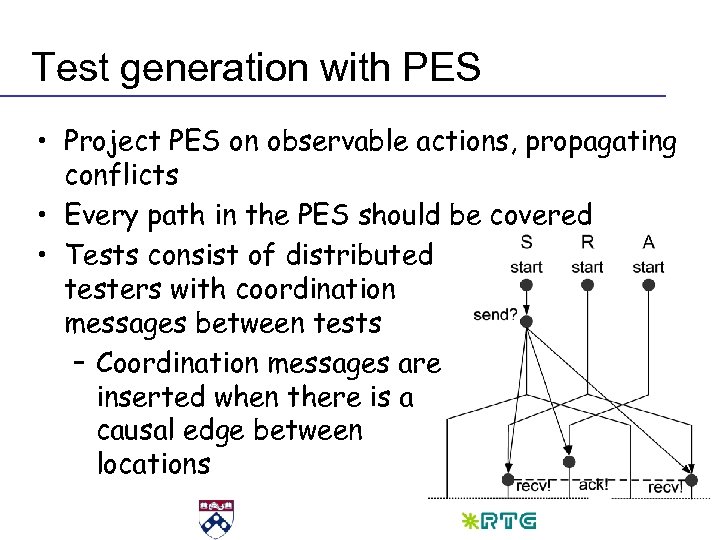
Test generation with PES • Project PES on observable actions, propagating conflicts • Every path in the PES should be covered • Tests consist of distributed testers with coordination messages between tests – Coordination messages are inserted when there is a causal edge between locations
Summary: coverage-based testing • Advantages: – Exercise the specification to the desired degree – Does not rely on test purpose selection • Disadvantages: – Large and unstructured test suites – If the specification is an overapproximation, tests may be infeasible
![Generation of test purposes • Recent work: [Henninger. Lu. Ural-03] • Construct PES •](https://present5.com/presentation/381cc6bedc0fe427a4f963cb6860f777/image-48.jpg "Generation of test purposes • Recent work: [Henninger. Lu. Ural-03] • Construct PES •")
Generation of test purposes • Recent work: [Henninger. Lu. Ural-03] • Construct PES • Generate MSC (message sequence charts) to cover PES • Use MSC as test purposes in ioco-based test generation
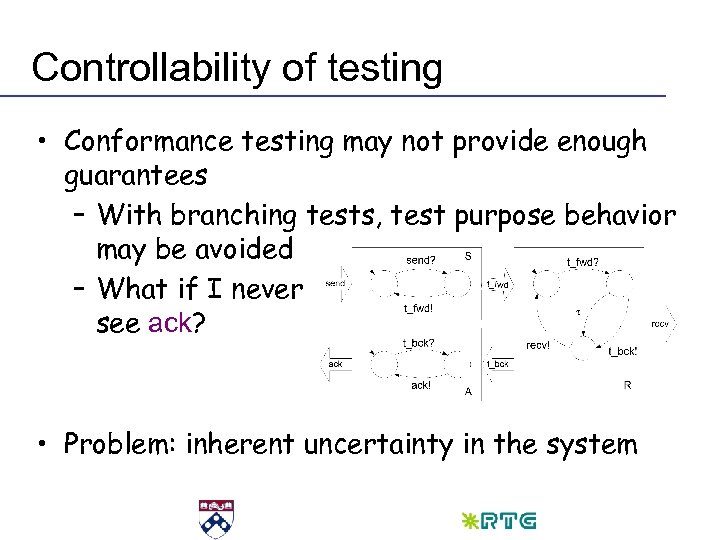
Controllability of testing • Conformance testing may not provide enough guarantees – With branching tests, test purpose behavior may be avoided – What if I never see ack? • Problem: inherent uncertainty in the system
How to contain uncertainty? • Avoidance (no need to increase control) – During testing, compute confidence measure • E. g. , accumulate coverage – Stop at the desired confidence level • Prevention (add more control) – Use instrumentation to resolve uncertainty – What to instrument? • Use model for guidance • Anyone needs a project to work on?
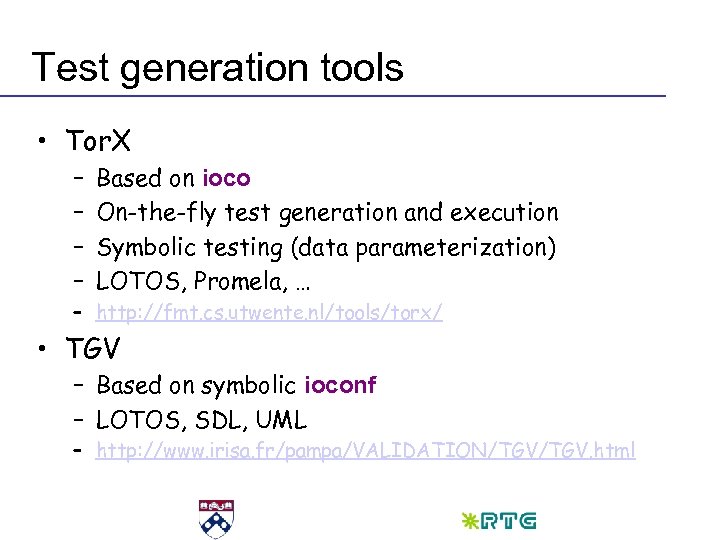
Test generation tools • Tor. X – – Based on ioco On-the-fly test generation and execution Symbolic testing (data parameterization) LOTOS, Promela, … – http: //fmt. cs. utwente. nl/tools/torx/ • TGV – Based on symbolic ioconf – LOTOS, SDL, UML – http: //www. irisa. fr/pampa/VALIDATION/TGV. html
Скачать презентацию Model-driven Test Generation Oleg Sokolsky September 22 2004
381cc6bedc0fe427a4f963cb6860f777.ppt