 Скачать презентацию Model Driven Engineering for Distributed Real-time Embedded
b29dfb215b4304d427ad30a73f24b2d5.ppt
- Количество слайдов: 45



Model Driven Engineering for Distributed Real-time & Embedded Systems or “Why I’d Rather Write Code That Writes Code Than Write Code” Dr. Douglas C. Schmidt d. schmidt@vanderbilt. edu www. dre. vanderbilt. edu/~schmidt Institute for Software Integrated Systems Vanderbilt University Nashville, Tennessee
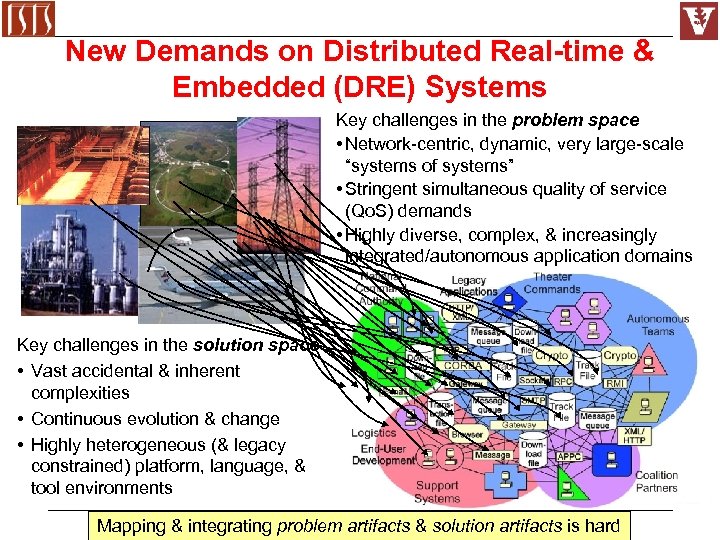
New Demands on Distributed Real-time & Embedded (DRE) Systems Key challenges in the problem space • Network-centric, dynamic, very large-scale “systems of systems” • Stringent simultaneous quality of service (Qo. S) demands • Highly diverse, complex, & increasingly integrated/autonomous application domains Key challenges in the solution space • Vast accidental & inherent complexities • Continuous evolution & change • Highly heterogeneous (& legacy constrained) platform, language, & tool environments Mapping & integrating problem artifacts & solution artifacts is hard
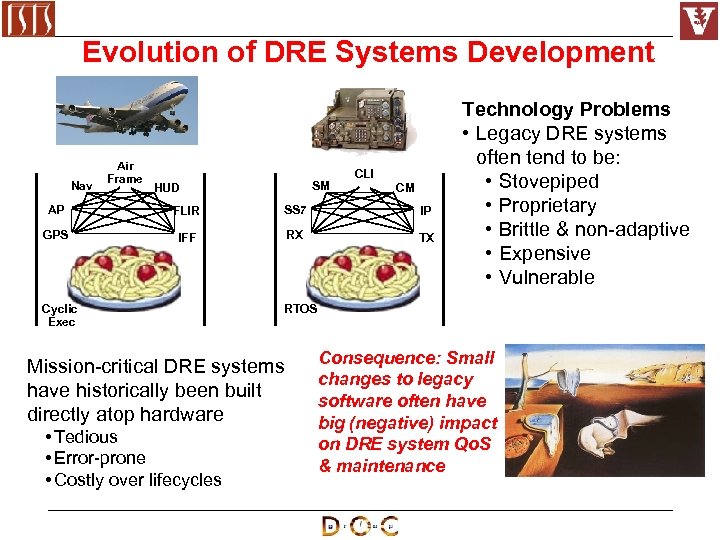
Evolution of DRE Systems Development Nav Air Frame SM HUD CLI CM AP FLIR SS 7 IP GPS IFF RX TX Cyclic Exec RTOS Mission-critical DRE systems have historically been built directly atop hardware • Tedious • Error-prone • Costly over lifecycles Technology Problems • Legacy DRE systems often tend to be: • Stovepiped • Proprietary • Brittle & non-adaptive • Expensive • Vulnerable Consequence: Small changes to legacy software often have big (negative) impact on DRE system Qo. S & maintenance
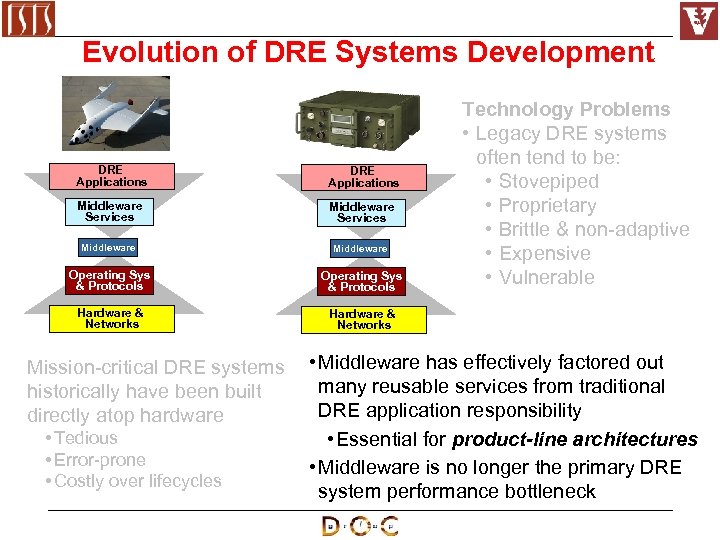
Evolution of DRE Systems Development DRE Applications Middleware Services Middleware Operating Sys & Protocols Hardware & Networks Technology Problems • Legacy DRE systems often tend to be: • Stovepiped • Proprietary • Brittle & non-adaptive • Expensive • Vulnerable Hardware & Networks Mission-critical DRE systems historically have been built directly atop hardware • Tedious • Error-prone • Costly over lifecycles • Middleware has effectively factored out many reusable services from traditional DRE application responsibility • Essential for product-line architectures • Middleware is no longer the primary DRE system performance bottleneck
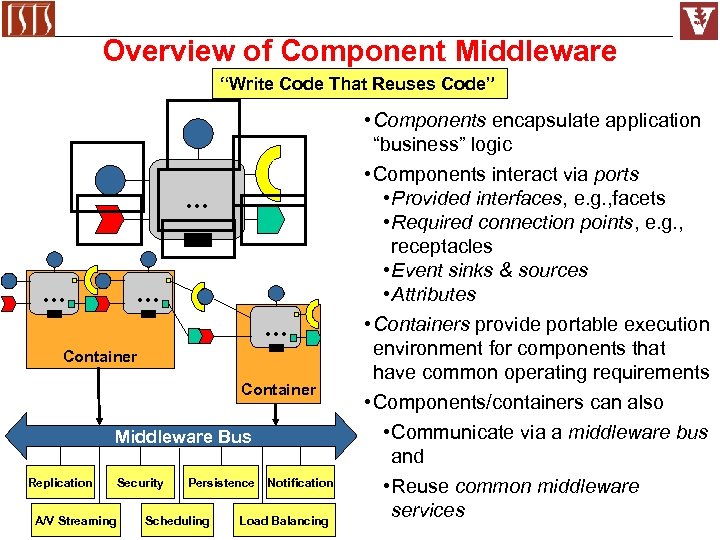
Overview of Component Middleware “Write Code That Reuses Code” … … Container Middleware Bus Replication A/V Streaming Security Persistence Scheduling Notification Load Balancing • Components encapsulate application “business” logic • Components interact via ports • Provided interfaces, e. g. , facets • Required connection points, e. g. , receptacles • Event sinks & sources • Attributes • Containers provide portable execution environment for components that have common operating requirements • Components/containers can also • Communicate via a middleware bus and • Reuse common middleware services
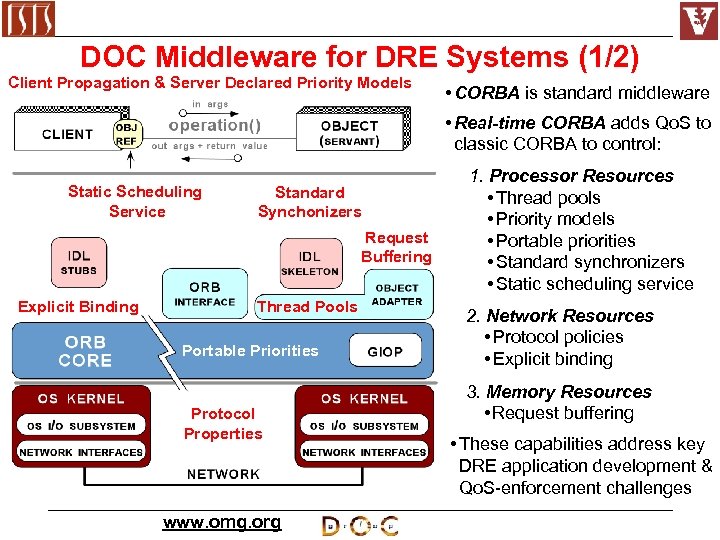
DOC Middleware for DRE Systems (1/2) Client Propagation & Server Declared Priority Models • CORBA is standard middleware • Real-time CORBA adds Qo. S to classic CORBA to control: Static Scheduling Service Standard Synchonizers Request Buffering Explicit Binding Thread Pools Portable Priorities Protocol Properties www. omg. org 1. Processor Resources • Thread pools • Priority models • Portable priorities • Standard synchronizers • Static scheduling service 2. Network Resources • Protocol policies • Explicit binding 3. Memory Resources • Request buffering • These capabilities address key DRE application development & Qo. S-enforcement challenges
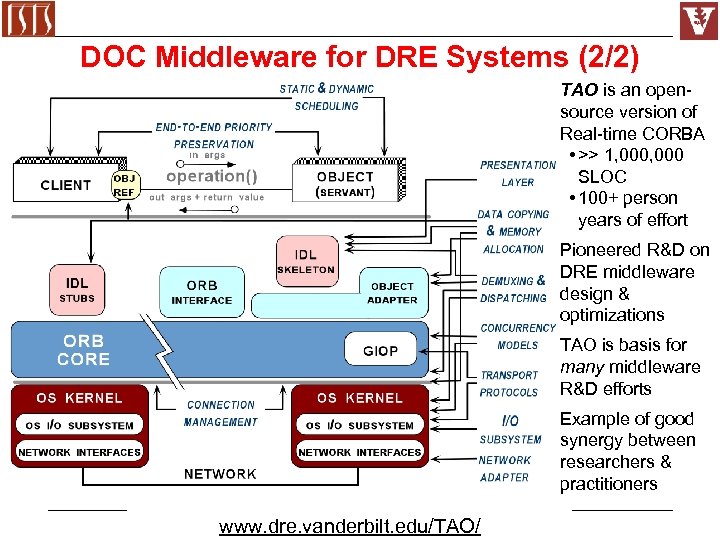
DOC Middleware for DRE Systems (2/2) • TAO is an opensource version of Real-time CORBA • >> 1, 000 SLOC • 100+ person years of effort • Pioneered R&D on DRE middleware design & optimizations • TAO is basis for many middleware R&D efforts • Example of good synergy between researchers & practitioners www. dre. vanderbilt. edu/TAO/
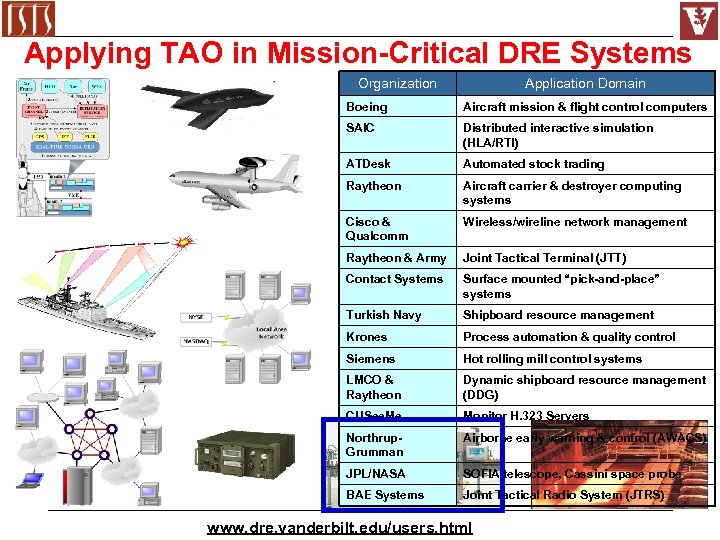
Applying TAO in Mission-Critical DRE Systems Organization Application Domain Boeing Aircraft mission & flight control computers SAIC Distributed interactive simulation (HLA/RTI) ATDesk Automated stock trading Raytheon Aircraft carrier & destroyer computing systems Cisco & Qualcomm Wireless/wireline network management Raytheon & Army Joint Tactical Terminal (JTT) Contact Systems Surface mounted “pick-and-place” systems Turkish Navy Shipboard resource management Krones Process automation & quality control Siemens Hot rolling mill control systems LMCO & Raytheon Dynamic shipboard resource management (DDG) CUSee. Me Monitor H. 323 Servers Northrup. Grumman Airborne early warning & control (AWACS) JPL/NASA SOFIA telescope, Cassini space probe BAE Systems Joint Tactical Radio System (JTRS) www. dre. vanderbilt. edu/users. html
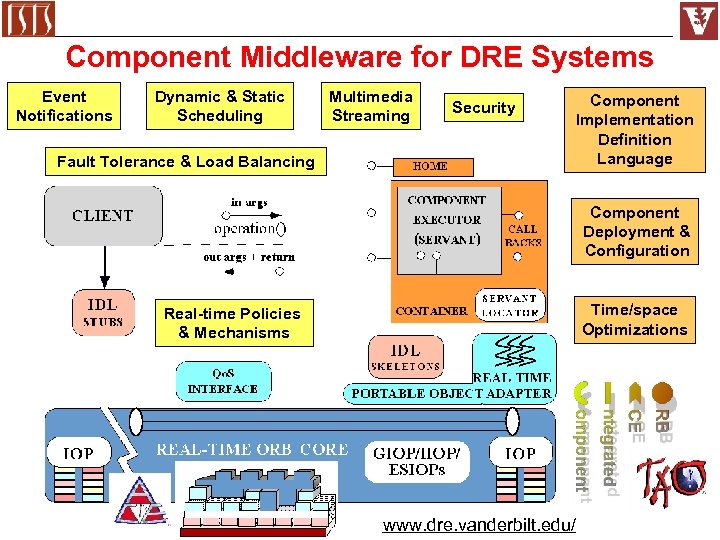
Component Middleware for DRE Systems Event Notifications Dynamic & Static Scheduling Multimedia Streaming Security Fault Tolerance & Load Balancing Component Implementation Definition Language Component Deployment & Configuration Time/space Optimizations Real-time Policies & Mechanisms www. dre. vanderbilt. edu/
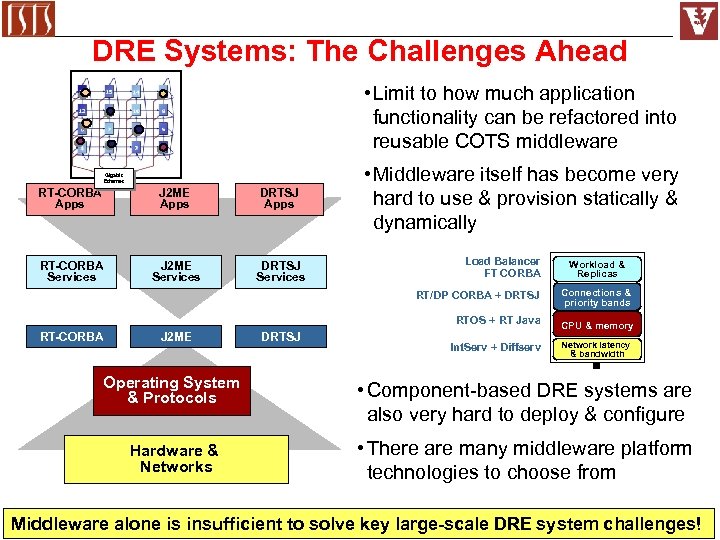
DRE Systems: The Challenges Ahead • Limit to how much application functionality can be refactored into reusable COTS middleware Gigabit Ethernet RT-CORBA Apps J 2 ME DRTSJ Apps Middleware J 2 ME Services DRTSJ Services DRE Applications Apps RT-CORBA Services • Middleware itself has become very hard to use & provision statically & dynamically Load Balancer FT CORBA Workload & Replicas RT/DP CORBA + DRTSJ RT-CORBA Middleware J 2 ME RTOS + RT Java DRTSJ Connections & priority bands CPU & memory Int. Serv + Diffserv Network latency & bandwidth Operating System & Protocols • Component-based DRE systems are also very hard to deploy & configure Hardware & Networks • There are many middleware platform technologies to choose from Middleware alone is insufficient to solve key large-scale DRE system challenges!
DRE Systems: The Challenges Ahead Gigabit Ethernet RT-CORBA Apps J 2 ME DRTSJ Apps Middleware J 2 ME Services DRTSJ Services DRE Applications Apps RT-CORBA Services RT-CORBA Middleware J 2 ME DRTSJ Operating System & Protocols Hardware & Networks It’s enough to make you scream!
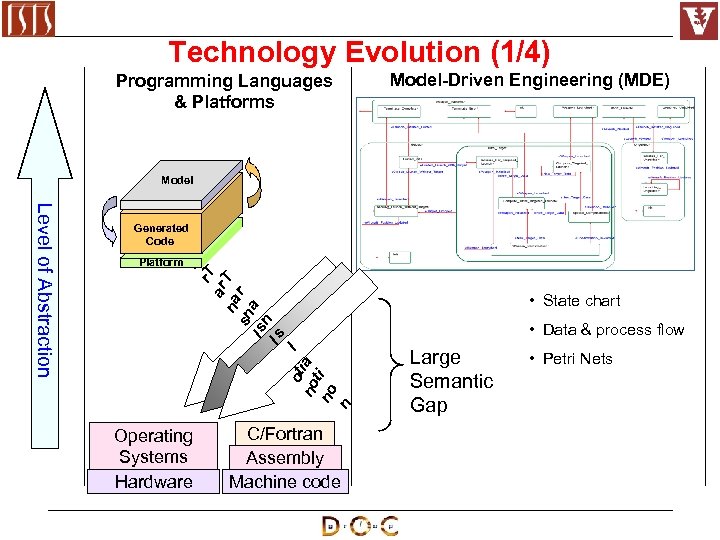
Technology Evolution (1/4) Model-Driven Engineering (MDE) Programming Languages & Platforms Model Level of Abstraction Generated Model Code Platform T T r r. T a ar n na s sn l ls a al ti tia o oti n no Operating Systems Hardware C/Fortran Assembly Machine code • State chart • Data & process flow n Large Semantic Gap • Petri Nets
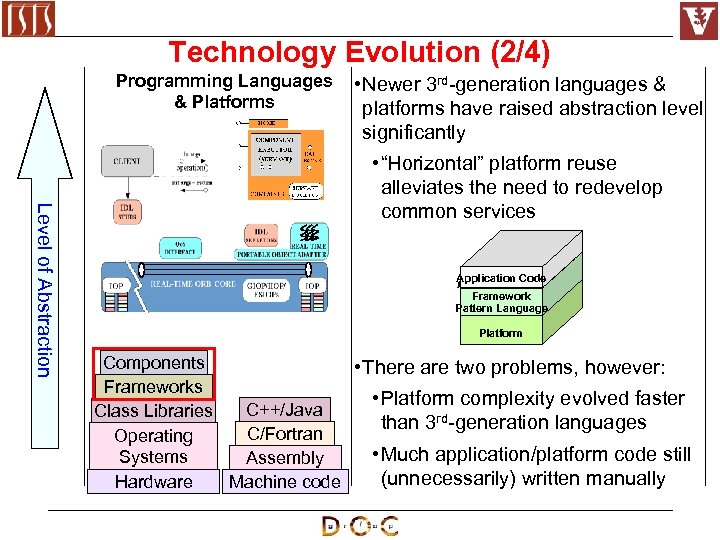
Technology Evolution (2/4) Programming Languages & Platforms • Newer 3 rd-generation languages & platforms have raised abstraction level significantly Level of Abstraction • “Horizontal” platform reuse alleviates the need to redevelop common services Model Application Code Application. Code Generated Code Framework Domain Specific Pattern Language Framework Platform Frameworks Components • There are two problems, however: Frameworks • Platform complexity evolved faster C++/Java Class Libraries than 3 rd-generation languages C/Fortran Operating • Much application/platform code still Systems Assembly (unnecessarily) written manually Machine code Hardware
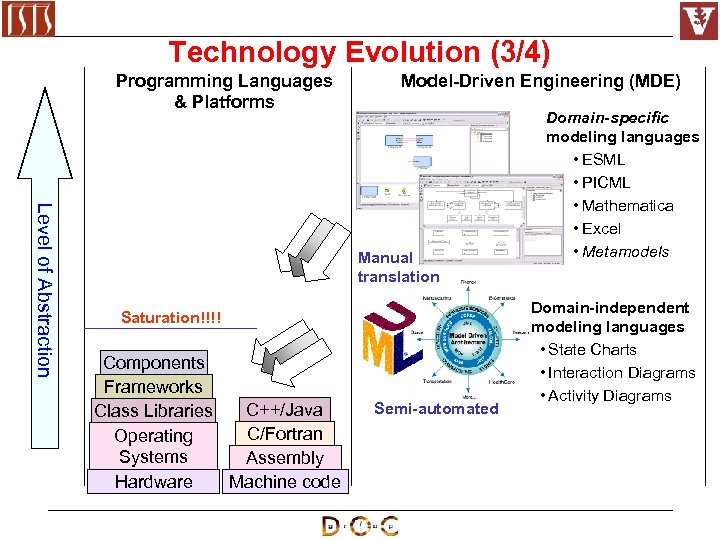
Technology Evolution (3/4) Programming Languages & Platforms Model-Driven Engineering (MDE) Level of Abstraction Manual translation Saturation!!!! Components Frameworks C++/Java Class Libraries C/Fortran Operating Systems Assembly Machine code Hardware Semi-automated Domain-specific modeling languages • ESML • PICML • Mathematica • Excel • Metamodels Domain-independent modeling languages • State Charts • Interaction Diagrams • Activity Diagrams
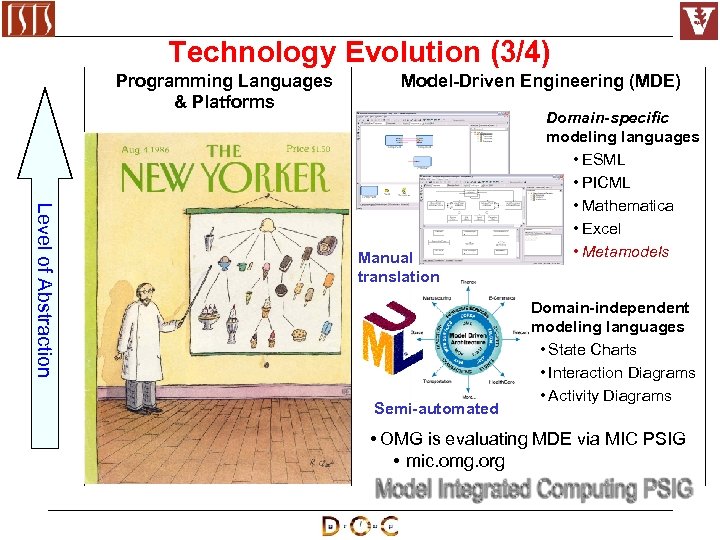
Technology Evolution (3/4) Programming Languages & Platforms Model-Driven Engineering (MDE) Level of Abstraction Manual translation Semi-automated Domain-specific modeling languages • ESML • PICML • Mathematica • Excel • Metamodels Domain-independent modeling languages • State Charts • Interaction Diagrams • Activity Diagrams • OMG is evaluating MDE via MIC PSIG • mic. omg. org
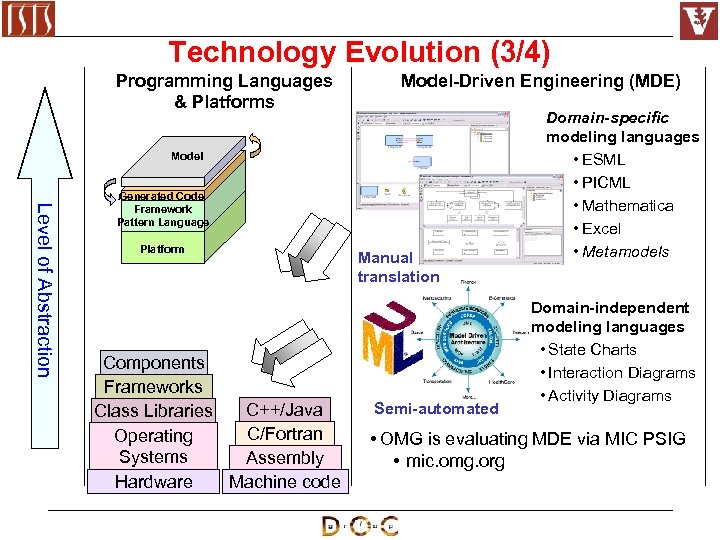
Technology Evolution (3/4) Programming Languages & Platforms Model-Driven Engineering (MDE) Model Level of Abstraction Application. Code Generated Code Framework Domain Specific Pattern Language Framework Platform Frameworks Components Frameworks C++/Java Class Libraries C/Fortran Operating Systems Assembly Machine code Hardware Manual translation Semi-automated Domain-specific modeling languages • ESML • PICML • Mathematica • Excel • Metamodels Domain-independent modeling languages • State Charts • Interaction Diagrams • Activity Diagrams • OMG is evaluating MDE via MIC PSIG • mic. omg. org
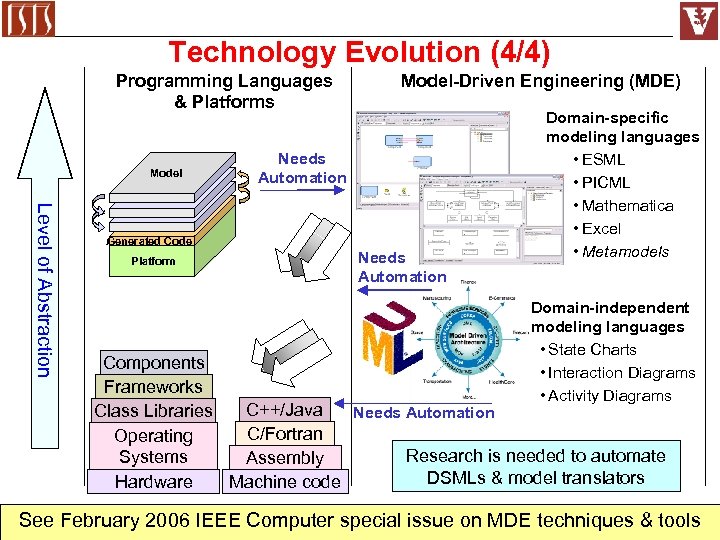
Technology Evolution (4/4) Programming Languages & Platforms Model Level of Abstraction Application. Code Generated Code Platform Frameworks Model-Driven Engineering (MDE) Needs Automation Domain-specific modeling languages • ESML • PICML • Mathematica • Excel • Metamodels Domain-independent modeling languages • State Charts • Interaction Diagrams • Activity Diagrams Components Frameworks C++/Java Class Libraries Needs Automation C/Fortran Operating Research is needed to automate Systems Assembly DSMLs & model translators Machine code Hardware See February 2006 IEEE Computer special issue on MDE techniques & tools
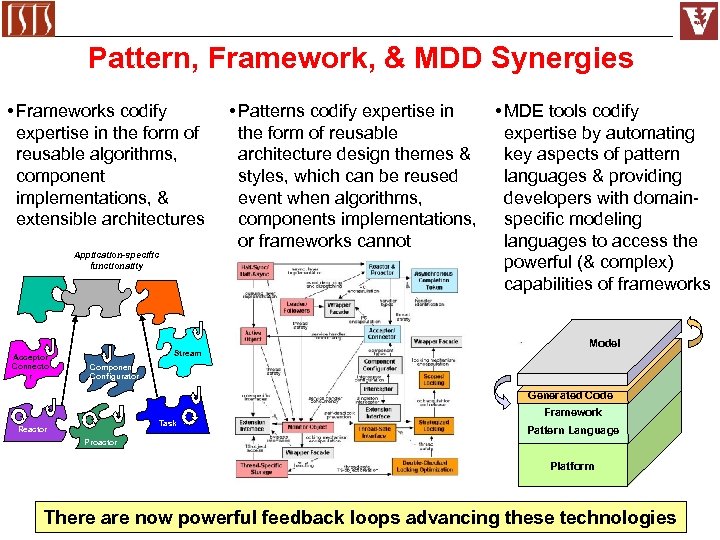
Pattern, Framework, & MDD Synergies • Frameworks codify expertise in the form of reusable algorithms, component implementations, & extensible architectures Application-specific functionality Acceptor Connecto r Stream • Patterns codify expertise in • MDE tools codify the form of reusable expertise by automating architecture design themes & key aspects of pattern styles, which can be reused languages & providing event when algorithms, developers with domaincomponents implementations, specific modeling or frameworks cannot languages to access the powerful (& complex) capabilities of frameworks Model Component Configurator Generated Code Application Code Task Reactor Framework Domain Specific Pattern Language Framework Proactor Platform Frameworks There are now powerful feedback loops advancing these technologies
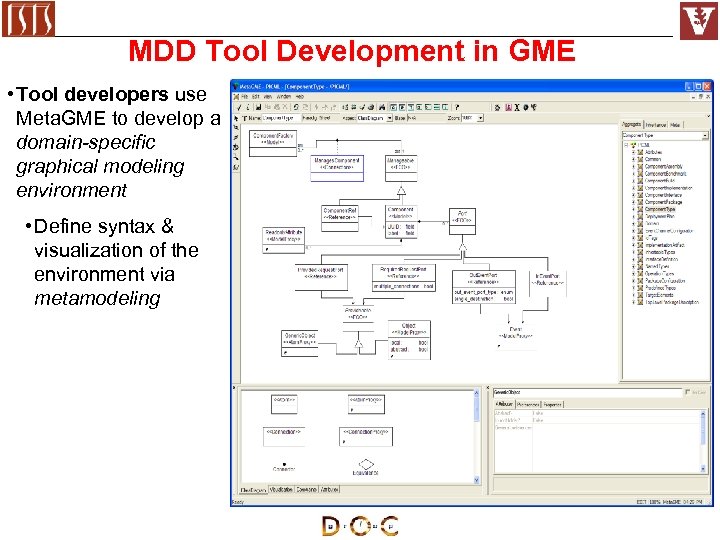
MDD Tool Development in GME • Tool developers use Meta. GME to develop a domain-specific graphical modeling environment • Define syntax & visualization of the environment via metamodeling
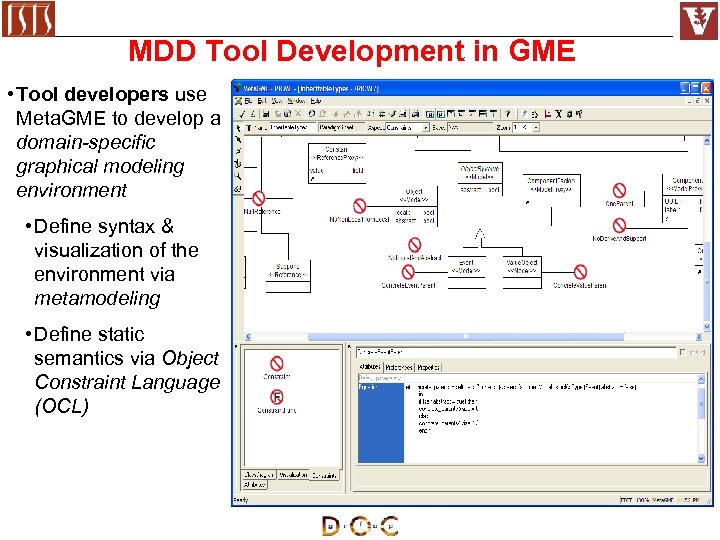
MDD Tool Development in GME • Tool developers use Meta. GME to develop a domain-specific graphical modeling environment • Define syntax & visualization of the environment via metamodeling • Define static semantics via Object Constraint Language (OCL)
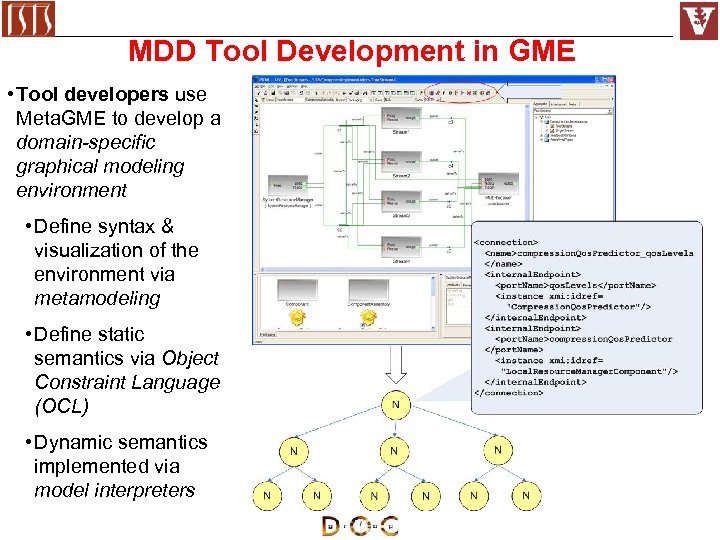
MDD Tool Development in GME • Tool developers use Meta. GME to develop a domain-specific graphical modeling environment • Define syntax & visualization of the environment via metamodeling • Define static semantics via Object Constraint Language (OCL) • Dynamic semantics implemented via model interpreters
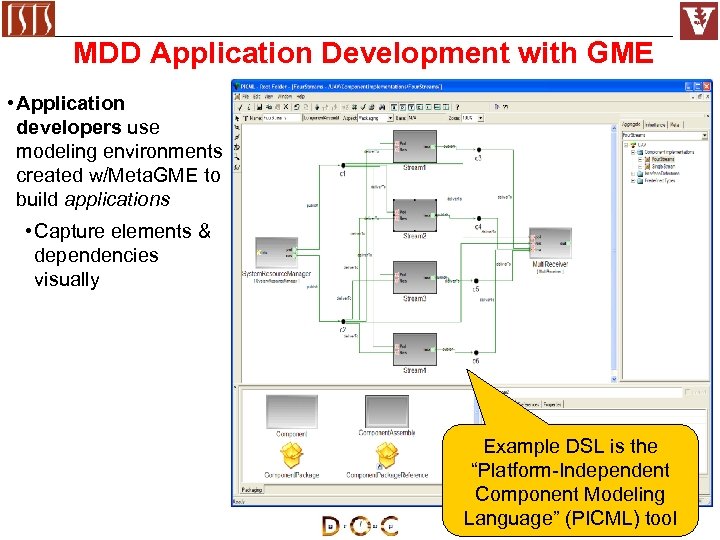
MDD Application Development with GME • Application developers use modeling environments created w/Meta. GME to build applications • Capture elements & dependencies visually Example DSL is the “Platform-Independent Component Modeling Language” (PICML) tool
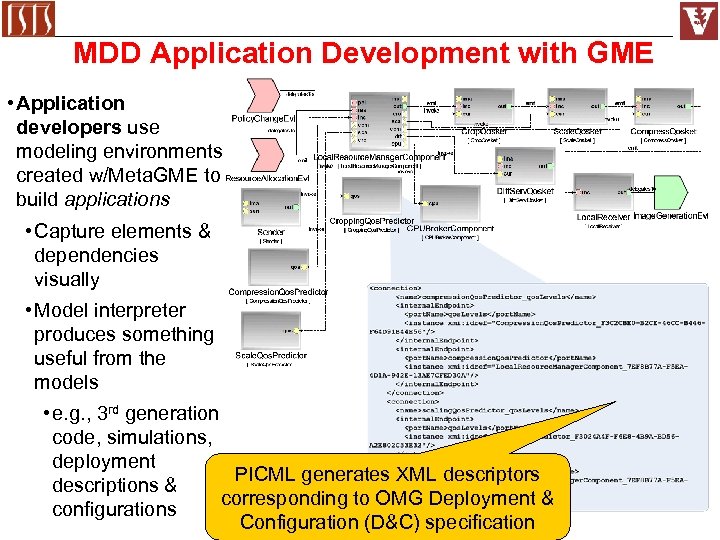
MDD Application Development with GME • Application developers use modeling environments created w/Meta. GME to build applications • Capture elements & dependencies visually • Model interpreter produces something useful from the models • e. g. , 3 rd generation code, simulations, deployment PICML generates XML descriptors descriptions & corresponding to OMG Deployment & configurations Configuration (D&C) specification
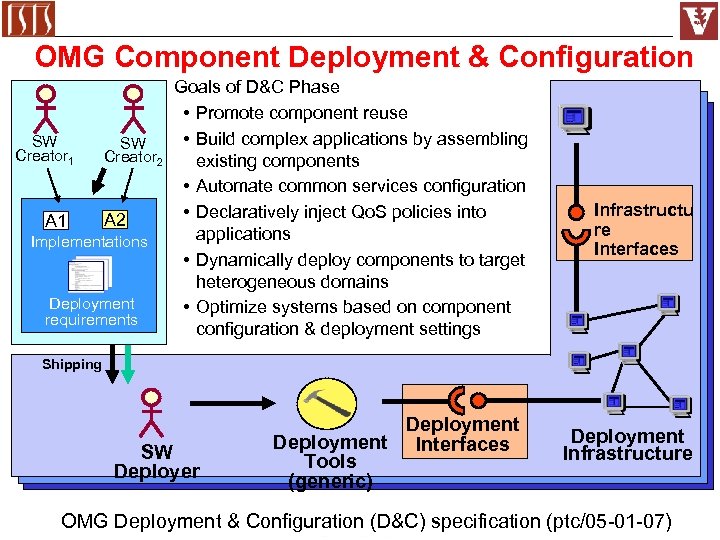
OMG Component Deployment & Configuration Goals of D&C Phase • Promote component reuse • Build complex applications by assembling SW SW Creator 1 Creator 2 existing components • Automate common services configuration • Declaratively inject Qo. S policies into A 2 A 1 applications Implementations • Dynamically deploy components to target heterogeneous domains Deployment • Optimize systems based on component requirements configuration & deployment settings Infrastructu re Interfaces Shipping SW Deployer Deployment Interfaces Tools (generic) Deployment Infrastructure OMG Deployment & Configuration (D&C) specification (ptc/05 -01 -07)
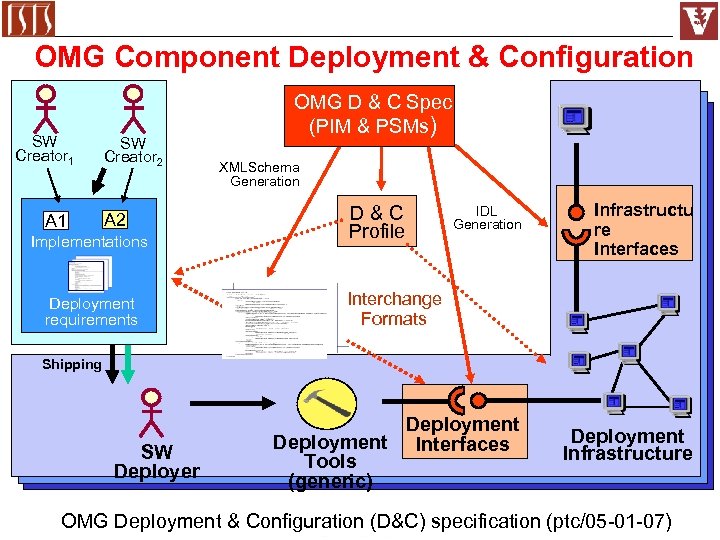
OMG Component Deployment & Configuration SW Creator 1 A 1 SW Creator 2 A 2 Implementations Deployment requirements OMG D & C Spec (PIM & PSMs) XMLSchema Generation D&C Profile IDL Generation Infrastructu re Interfaces Interchange Formats Shipping SW Deployer Deployment Interfaces Tools (generic) Deployment Infrastructure OMG Deployment & Configuration (D&C) specification (ptc/05 -01 -07)
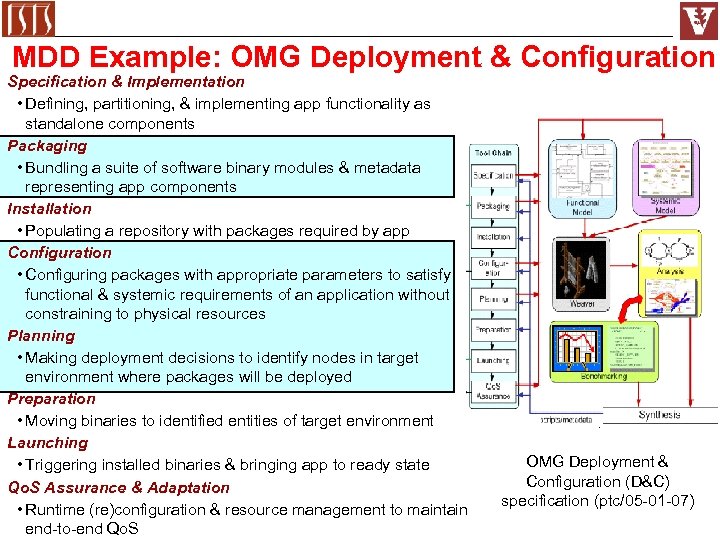
MDD Example: OMG Deployment & Configuration Specification & Implementation • Defining, partitioning, & implementing app functionality as standalone components Packaging • Bundling a suite of software binary modules & metadata representing app components Installation • Populating a repository with packages required by app Configuration • Configuring packages with appropriate parameters to satisfy functional & systemic requirements of an application without constraining to physical resources Planning • Making deployment decisions to identify nodes in target environment where packages will be deployed Preparation • Moving binaries to identified entities of target environment Launching • Triggering installed binaries & bringing app to ready state Qo. S Assurance & Adaptation • Runtime (re)configuration & resource management to maintain end-to-end Qo. S OMG Deployment & Configuration (D&C) specification (ptc/05 -01 -07)
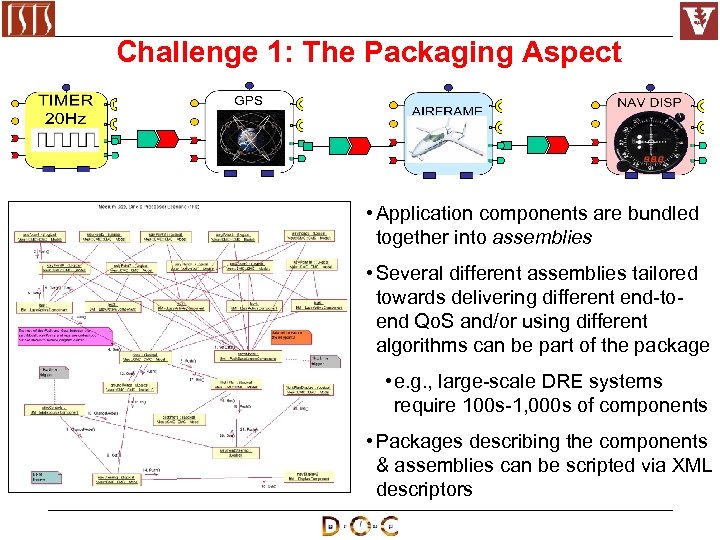
Challenge 1: The Packaging Aspect • Application components are bundled together into assemblies • Several different assemblies tailored towards delivering different end-toend Qo. S and/or using different algorithms can be part of the package • e. g. , large-scale DRE systems require 100 s-1, 000 s of components • Packages describing the components & assemblies can be scripted via XML descriptors
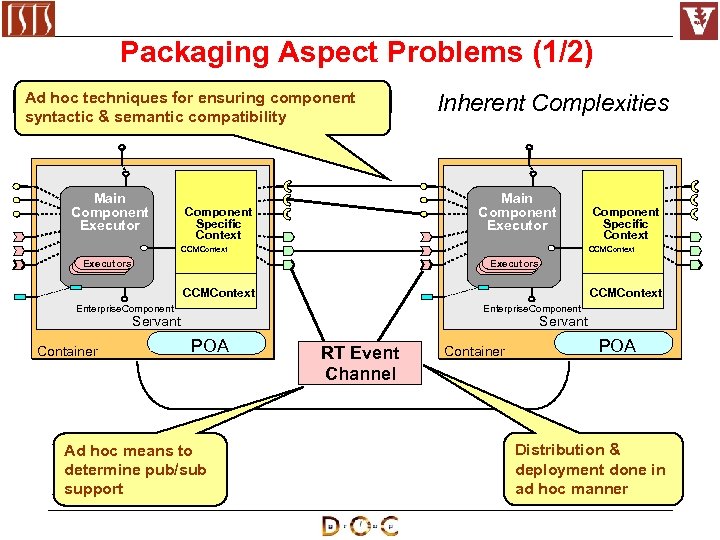
Packaging Aspect Problems (1/2) Ad hoc techniques for ensuring component syntactic & semantic compatibility Main Component Executor Inherent Complexities Main Component Executor Component Specific Context CCMContext Executors Executors CCMContext Enterprise. Component Servant Container Component Specific Context Servant POA Ad hoc means to determine pub/sub support RT Event Channel Container POA Distribution & deployment done in ad hoc manner
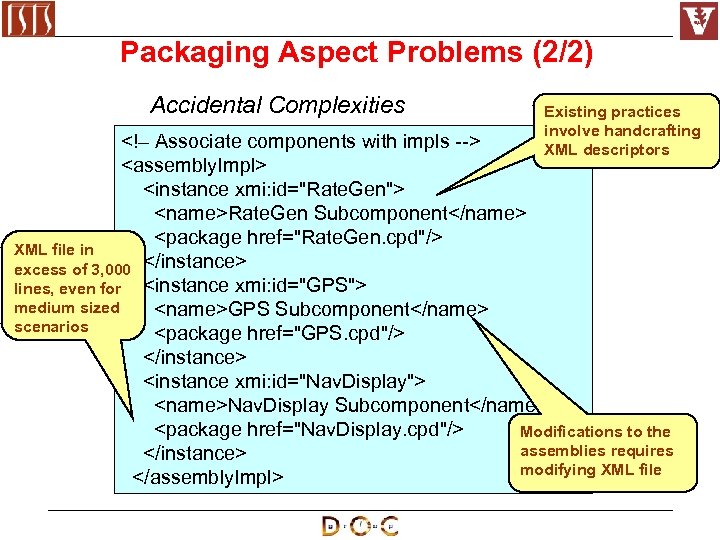
Packaging Aspect Problems (2/2) Accidental Complexities Existing practices involve handcrafting XML descriptors <!– Associate components with impls --> <assembly. Impl> <instance xmi: id="Rate. Gen"> <name>Rate. Gen Subcomponent</name> <package href="Rate. Gen. cpd"/> XML file in excess of 3, 000 </instance> lines, even for <instance xmi: id="GPS"> medium sized <name>GPS Subcomponent</name> scenarios <package href="GPS. cpd"/> </instance> <instance xmi: id="Nav. Display"> <name>Nav. Display Subcomponent</name> <package href="Nav. Display. cpd"/> Modifications to the assemblies requires </instance> modifying XML file </assembly. Impl>
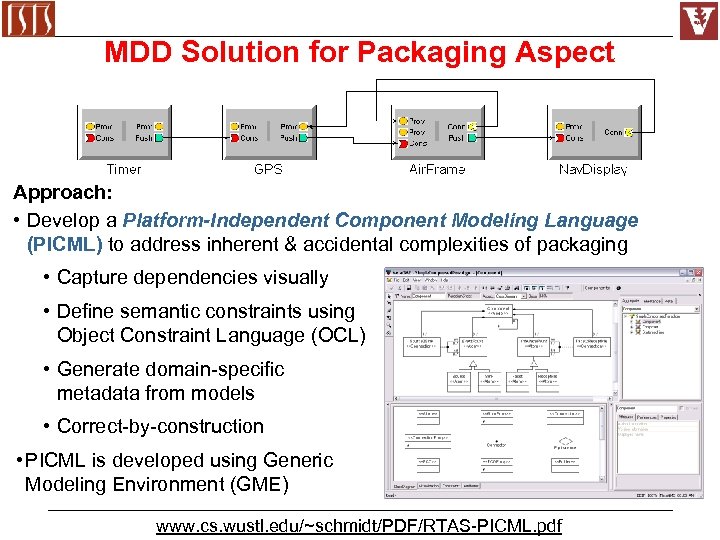
MDD Solution for Packaging Aspect Approach: • Develop a Platform-Independent Component Modeling Language (PICML) to address inherent & accidental complexities of packaging • Capture dependencies visually • Define semantic constraints using Object Constraint Language (OCL) • Generate domain-specific metadata from models • Correct-by-construction • PICML is developed using Generic Modeling Environment (GME) www. cs. wustl. edu/~schmidt/PDF/RTAS-PICML. pdf
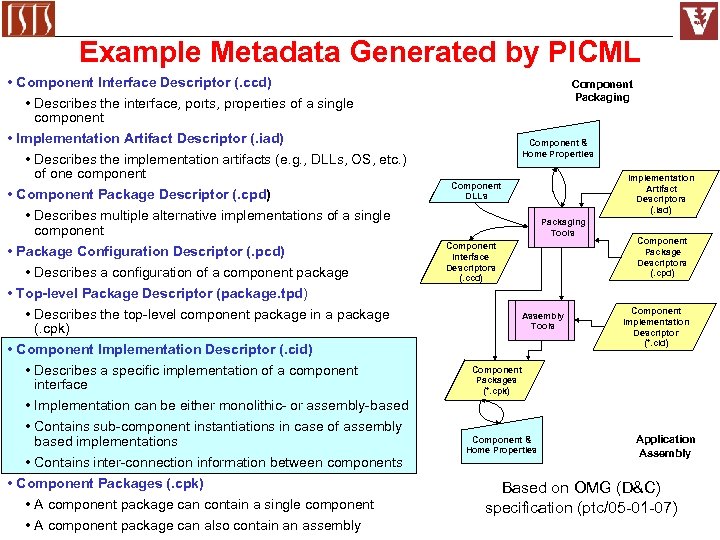
Example Metadata Generated by PICML • Component Interface Descriptor (. ccd) • Describes the interface, ports, properties of a single component • Implementation Artifact Descriptor (. iad) • Describes the implementation artifacts (e. g. , DLLs, OS, etc. ) of one component • Component Package Descriptor (. cpd) • Describes multiple alternative implementations of a single component • Package Configuration Descriptor (. pcd) • Describes a configuration of a component package • Top-level Package Descriptor (package. tpd) • Describes the top-level component package in a package (. cpk) • Component Implementation Descriptor (. cid) • Describes a specific implementation of a component interface • Implementation can be either monolithic- or assembly-based • Contains sub-component instantiations in case of assembly based implementations • Contains inter-connection information between components • Component Packages (. cpk) • A component package can contain a single component • A component package can also contain an assembly Component Packaging Component & Home Properties Implementation Artifact Descriptors (. iad) Component DLLs Packaging Tools Component Interface Descriptors (. ccd) Assembly Tools Component Package Descriptors (. cpd) Component Implementation Descriptor (*. cid) Component Packages (*. cpk) Component & Home Properties Application Assembly Based on OMG (D&C) specification (ptc/05 -01 -07)
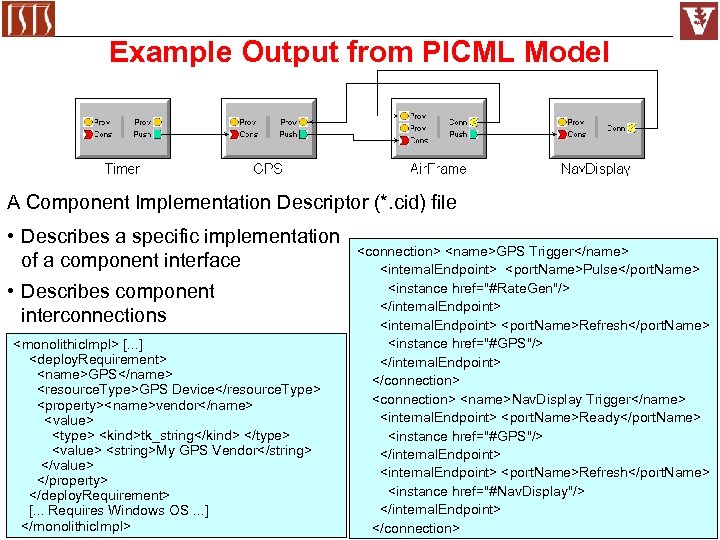
Example Output from PICML Model A Component Implementation Descriptor (*. cid) file • Describes a specific implementation of a component interface • Describes component interconnections <monolithic. Impl> [. . . ] <deploy. Requirement> <name>GPS</name> <resource. Type>GPS Device</resource. Type> <property><name>vendor</name> <value> <type> <kind>tk_string</kind> </type> <value> <string>My GPS Vendor</string> </value> </property> </deploy. Requirement> [. . . Requires Windows OS. . . ] </monolithic. Impl> <connection> <name>GPS Trigger</name> <internal. Endpoint> <port. Name>Pulse</port. Name> <instance href="#Rate. Gen"/> </internal. Endpoint> <port. Name>Refresh</port. Name> <instance href="#GPS"/> </internal. Endpoint> </connection> <name>Nav. Display Trigger</name> <internal. Endpoint> <port. Name>Ready</port. Name> <instance href="#GPS"/> </internal. Endpoint> <port. Name>Refresh</port. Name> <instance href="#Nav. Display"/> </internal. Endpoint> </connection>
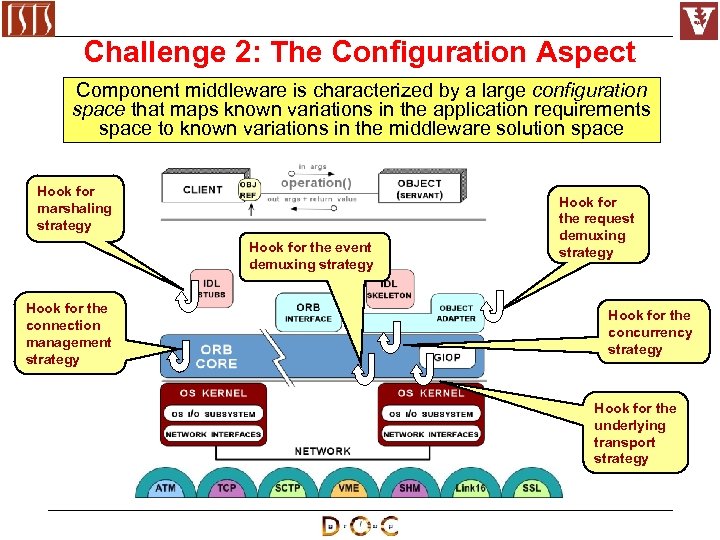
Challenge 2: The Configuration Aspect Component middleware is characterized by a large configuration space that maps known variations in the application requirements space to known variations in the middleware solution space Hook for marshaling strategy Hook for the event demuxing strategy Hook for the connection management strategy Hook for the request demuxing strategy Hook for the concurrency strategy Hook for the underlying transport strategy
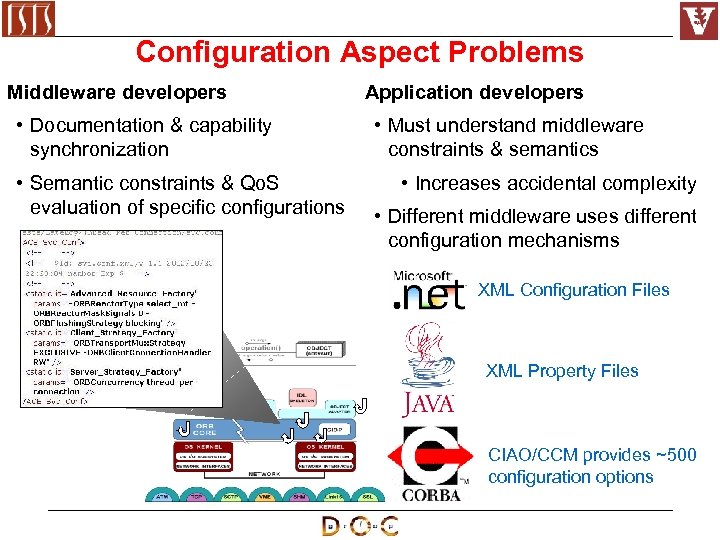
Configuration Aspect Problems Middleware developers • Documentation & capability synchronization • Semantic constraints & Qo. S evaluation of specific configurations Application developers • Must understand middleware constraints & semantics • Increases accidental complexity • Different middleware uses different configuration mechanisms XML Configuration Files XML Property Files CIAO/CCM provides ~500 configuration options
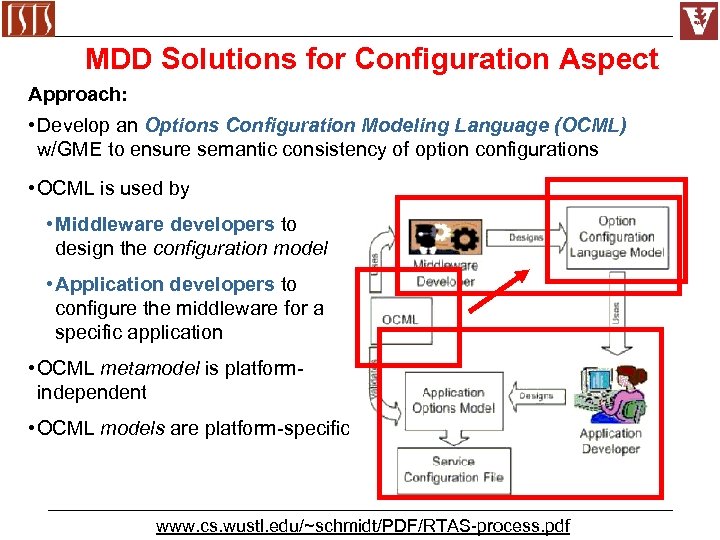
MDD Solutions for Configuration Aspect Approach: • Develop an Options Configuration Modeling Language (OCML) w/GME to ensure semantic consistency of option configurations • OCML is used by • Middleware developers to design the configuration model • Application developers to configure the middleware for a specific application • OCML metamodel is platformindependent • OCML models are platform-specific www. cs. wustl. edu/~schmidt/PDF/RTAS-process. pdf
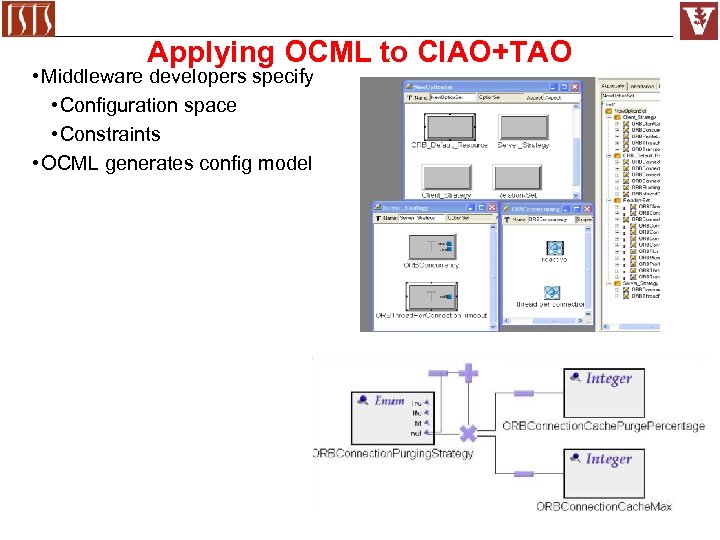
Applying OCML to CIAO+TAO • Middleware developers specify • Configuration space • Constraints • OCML generates config model
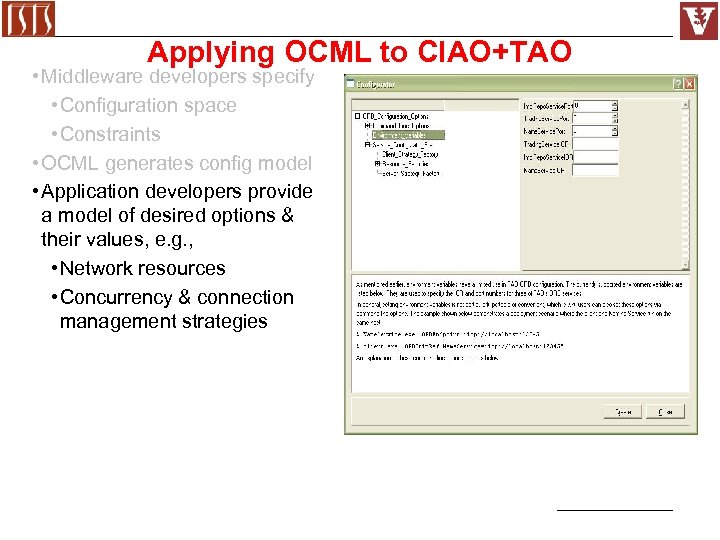
Applying OCML to CIAO+TAO • Middleware developers specify • Configuration space • Constraints • OCML generates config model • Application developers provide a model of desired options & their values, e. g. , • Network resources • Concurrency & connection management strategies
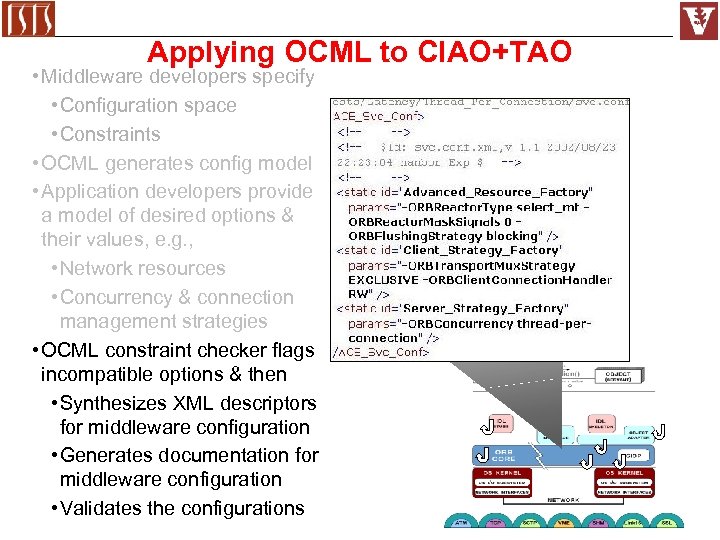
Applying OCML to CIAO+TAO • Middleware developers specify • Configuration space • Constraints • OCML generates config model • Application developers provide a model of desired options & their values, e. g. , • Network resources • Concurrency & connection management strategies • OCML constraint checker flags incompatible options & then • Synthesizes XML descriptors for middleware configuration • Generates documentation for middleware configuration • Validates the configurations
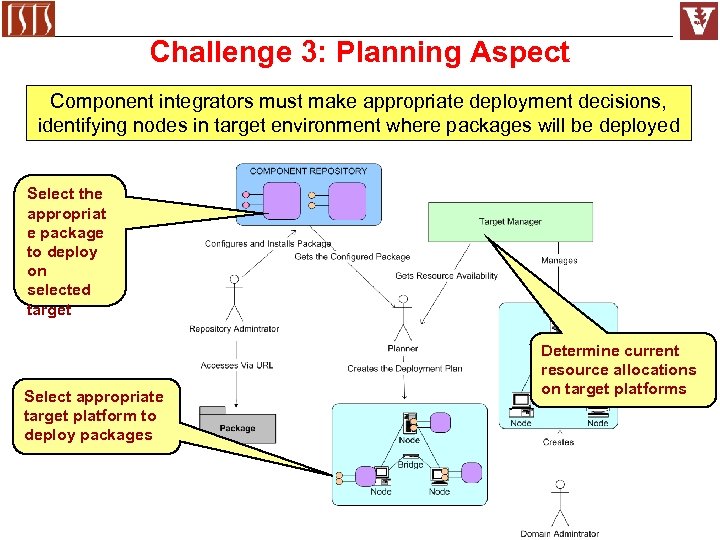
Challenge 3: Planning Aspect Component integrators must make appropriate deployment decisions, identifying nodes in target environment where packages will be deployed Select the appropriat e package to deploy on selected target Select appropriate target platform to deploy packages Determine current resource allocations on target platforms
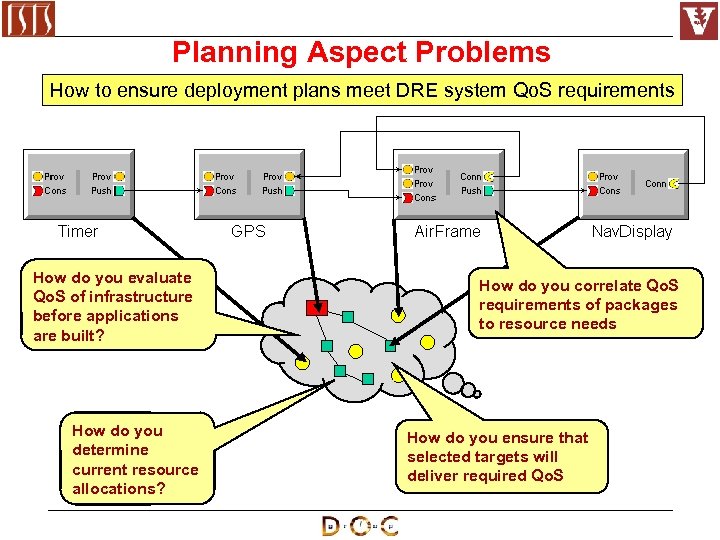
Planning Aspect Problems How to ensure deployment plans meet DRE system Qo. S requirements How do you evaluate Qo. S of infrastructure before applications are built? How do you determine current resource allocations? How do you correlate Qo. S requirements of packages to resource needs How do you ensure that selected targets will deliver required Qo. S
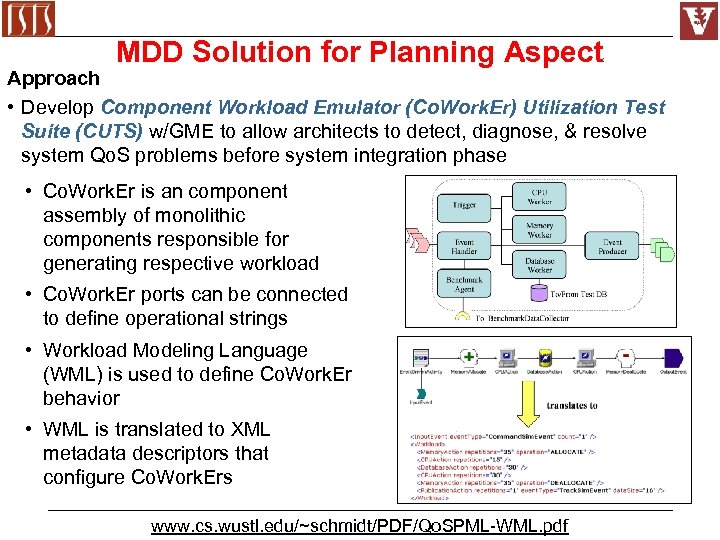
MDD Solution for Planning Aspect Approach • Develop Component Workload Emulator (Co. Work. Er) Utilization Test Suite (CUTS) w/GME to allow architects to detect, diagnose, & resolve system Qo. S problems before system integration phase • Co. Work. Er is an component assembly of monolithic components responsible for generating respective workload • Co. Work. Er ports can be connected to define operational strings • Workload Modeling Language (WML) is used to define Co. Work. Er behavior • WML is translated to XML metadata descriptors that configure Co. Work. Ers www. cs. wustl. edu/~schmidt/PDF/Qo. SPML-WML. pdf
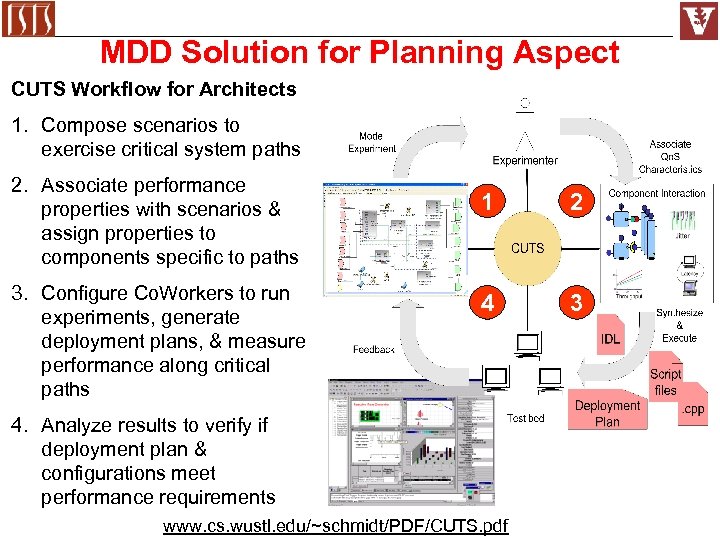
MDD Solution for Planning Aspect CUTS Workflow for Architects 1. Compose scenarios to exercise critical system paths 2. Associate performance properties with scenarios & assign properties to components specific to paths 3. Configure Co. Workers to run experiments, generate deployment plans, & measure performance along critical paths 1 2 4 3 4. Analyze results to verify if deployment plan & configurations meet performance requirements www. cs. wustl. edu/~schmidt/PDF/CUTS. pdf
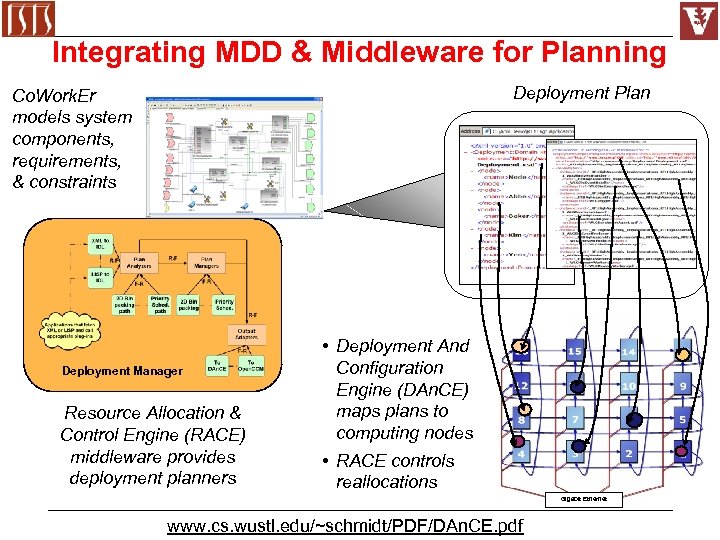
Integrating MDD & Middleware for Planning Deployment Plan Co. Work. Er models system components, requirements, & constraints Deployment Manager Resource Allocation & Control Engine (RACE) middleware provides deployment planners • Deployment And Configuration Engine (DAn. CE) maps plans to computing nodes • RACE controls reallocations Gigabit Ethernet www. cs. wustl. edu/~schmidt/PDF/DAn. CE. pdf
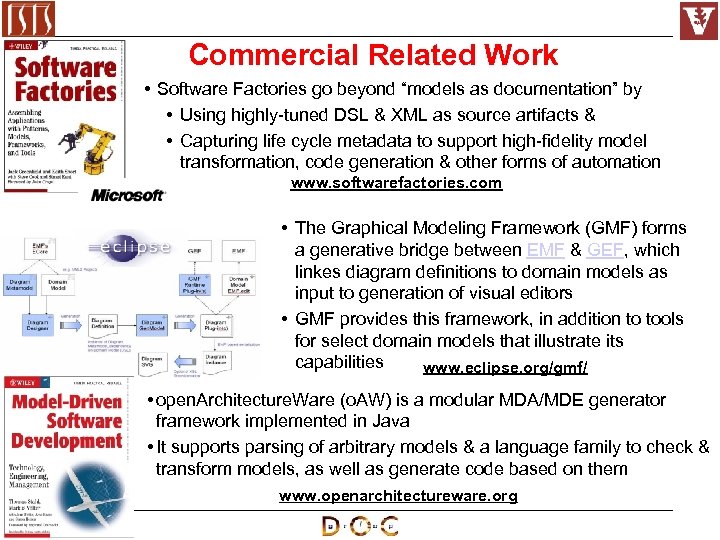
Commercial Related Work • Software Factories go beyond “models as documentation” by • Using highly-tuned DSL & XML as source artifacts & • Capturing life cycle metadata to support high-fidelity model transformation, code generation & other forms of automation www. softwarefactories. com • The Graphical Modeling Framework (GMF) forms a generative bridge between EMF & GEF, which linkes diagram definitions to domain models as input to generation of visual editors • GMF provides this framework, in addition to tools for select domain models that illustrate its capabilities www. eclipse. org/gmf/ • open. Architecture. Ware (o. AW) is a modular MDA/MDE generator framework implemented in Java • It supports parsing of arbitrary models & a language family to check & transform models, as well as generate code based on them www. openarchitectureware. org
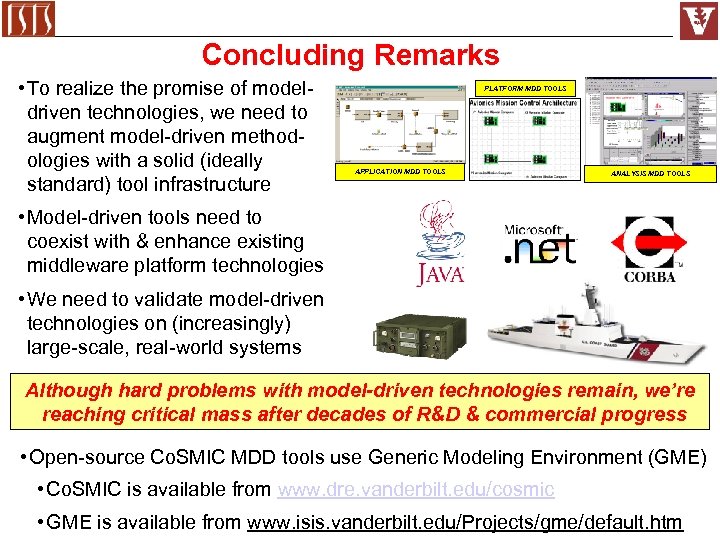
Concluding Remarks • To realize the promise of modeldriven technologies, we need to augment model-driven methodologies with a solid (ideally standard) tool infrastructure PLATFORM MDD TOOLS APPLICATION MDD TOOLS ANALYSIS MDD TOOLS • Model-driven tools need to coexist with & enhance existing middleware platform technologies • We need to validate model-driven technologies on (increasingly) large-scale, real-world systems Although hard problems with model-driven technologies remain, we’re reaching critical mass after decades of R&D & commercial progress • Open-source Co. SMIC MDD tools use Generic Modeling Environment (GME) • Co. SMIC is available from www. dre. vanderbilt. edu/cosmic • GME is available from www. isis. vanderbilt. edu/Projects/gme/default. htm
Скачать презентацию Model Driven Engineering for Distributed Real-time Embedded
b29dfb215b4304d427ad30a73f24b2d5.ppt