


 Скачать презентацию Model Core Curriculum for Iowa High Schools Literacy
b51cb00a0704bd3e08df9f896125e992.ppt
- Количество слайдов: 89
 Model Core Curriculum for Iowa High Schools Literacy, Mathematics, and Science Model Core Curriculum April 25, 2007 Mississippi Bend AEA 9 Excellence in Teaching and Learning
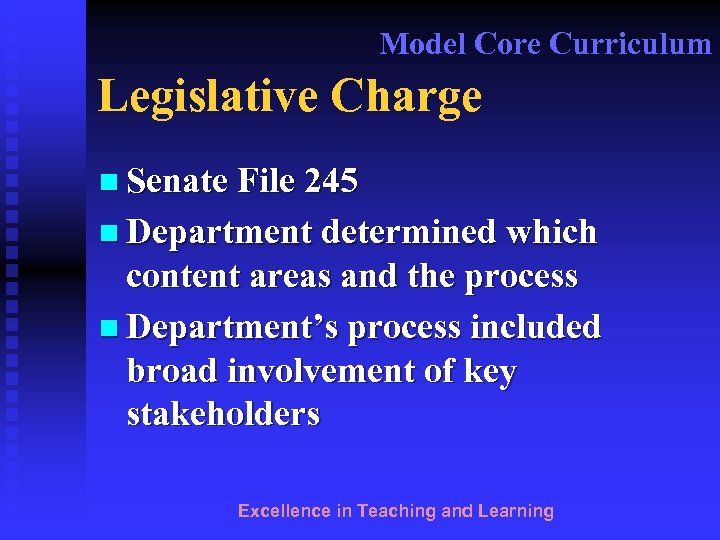 Model Core Curriculum Legislative Charge n Senate File 245 n Department determined which content areas and the process n Department’s process included broad involvement of key stakeholders Excellence in Teaching and Learning
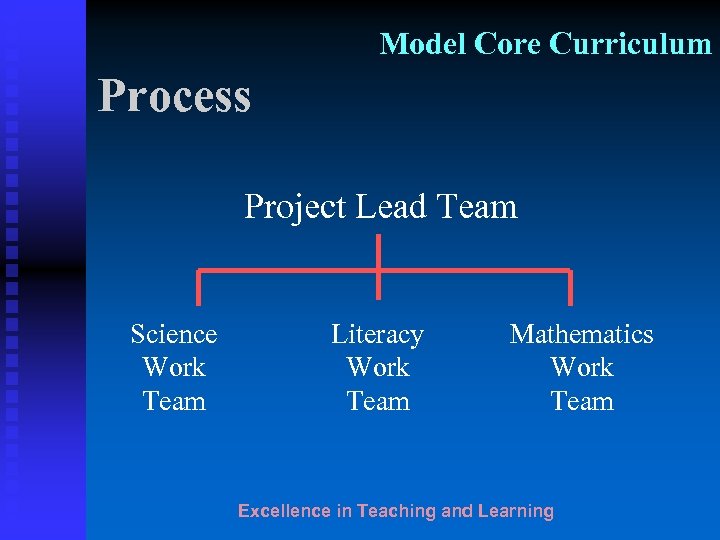 Model Core Curriculum Process Project Lead Team Science Work Team Literacy Work Team Mathematics Work Team Excellence in Teaching and Learning
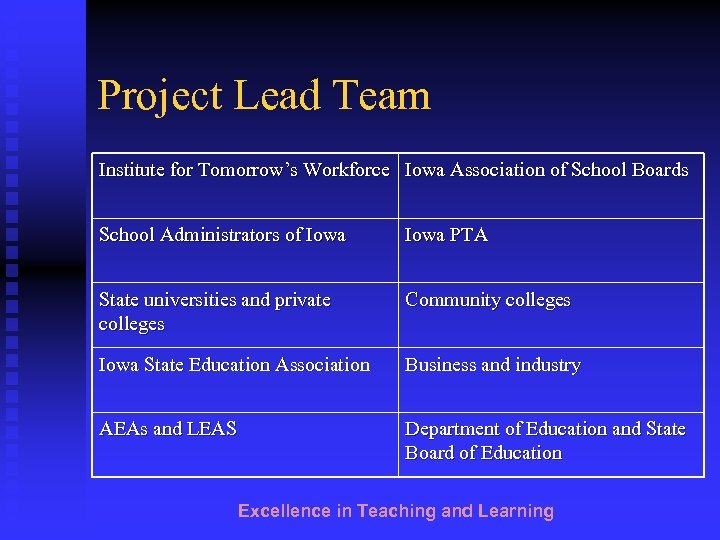 Project Lead Team Institute for Tomorrow’s Workforce Iowa Association of School Boards School Administrators of Iowa PTA State universities and private colleges Community colleges Iowa State Education Association Business and industry AEAs and LEAS Department of Education and State Board of Education Excellence in Teaching and Learning
 Work Teams n n n Chaired by a DE consultant and an expert in the field Teachers and curriculum directors University and community college representatives AEA consultants Connections to state PD initiatives in math and science Excellence in Teaching and Learning
 What It Is A tool to stimulate discussion n A comprehensive set of recommendations based on national documents, research, local documents, assessments, and best thinking in the fields n Excellence in Teaching and Learning
 What It Isn’t n Not mandatory state standards Excellence in Teaching and Learning
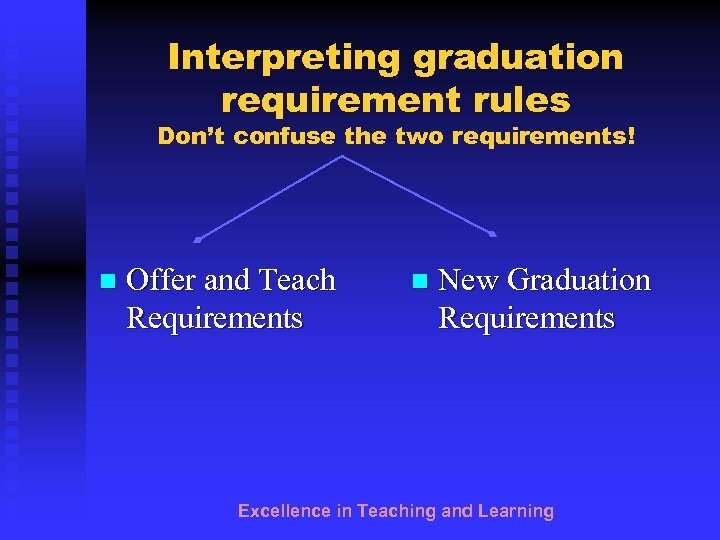 Interpreting graduation requirement rules Don’t confuse the two requirements! n Offer and Teach Requirements n New Graduation Requirements Excellence in Teaching and Learning
 Intended Use … Excellence in Teaching and Learning
 Conduct a gap analysis How does local coursework match the Model Core? n Where do we exceed the Model Core recommendations? n Where do we fall short of the Model Core recommendations? n Excellence in Teaching and Learning
 What does this mean to you? May mean that you alter courses and your local curriculum n May mean that you alter pedagogy n Excellence in Teaching and Learning
 Mathematics Model Core Curriculum for Iowa High Schools Excellence in Teaching and Learning
 Mathematics Model Core Curriculum Essential Characteristics n Essential Skills n Essential Content n Excellence in Teaching and Learning
 Need in Math Education n n Poor performance on international and national tests Losing our competitive edge in STEM (Science, Technology, and Mathematics) Curriculum that is “a mile wide and inch deep” Students not prepared mathematically to keep all their options open for college and the world of work Business & industry demand workers who can solve problems, work in teams, and are able to apply learning to new and changing situations Excellence in Teaching and Learning
 Mathematics Work Team AEA mathematics consultants n College, community college, and university faculty n High school mathematics teachers n Department of Education mathematics consultant n Every Student Counts developers n Excellence in Teaching and Learning
 Based on Resources … n n n n NAEP 2005 Mathematics Framework NCTM’s Principles and Standards for School Mathematics Teaching through Problem Solving, NCTM College Board Recommendations (draft) Achieve End-of HS benchmarks (updated) Achieve Course Standards (draft) NCTM Focal Points K-8 (draft) ASSM/NCTM summary of state standards Excellence in Teaching and Learning
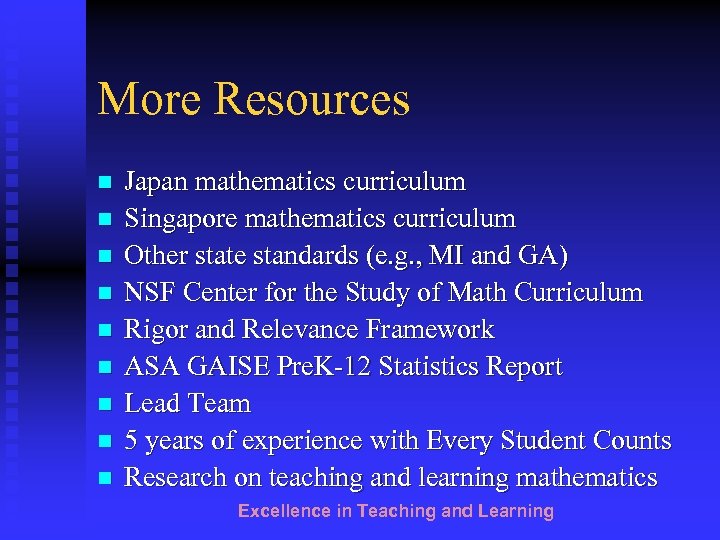 More Resources n n n n n Japan mathematics curriculum Singapore mathematics curriculum Other state standards (e. g. , MI and GA) NSF Center for the Study of Math Curriculum Rigor and Relevance Framework ASA GAISE Pre. K-12 Statistics Report Lead Team 5 years of experience with Every Student Counts Research on teaching and learning mathematics Excellence in Teaching and Learning
 Mathematics Model Core Curriculum Essential Characteristics n Essential Skills n Essential Content n Excellence in Teaching and Learning
 Characteristics, Skills, Content Characteristics Curriculum features that frame the essential skills and content Essential Skills and Content The recommendations Excellence in Teaching and Learning
 Essential Characteristics A world-class mathematics curriculum should be built around and focused on these essential characteristics … Excellence in Teaching and Learning
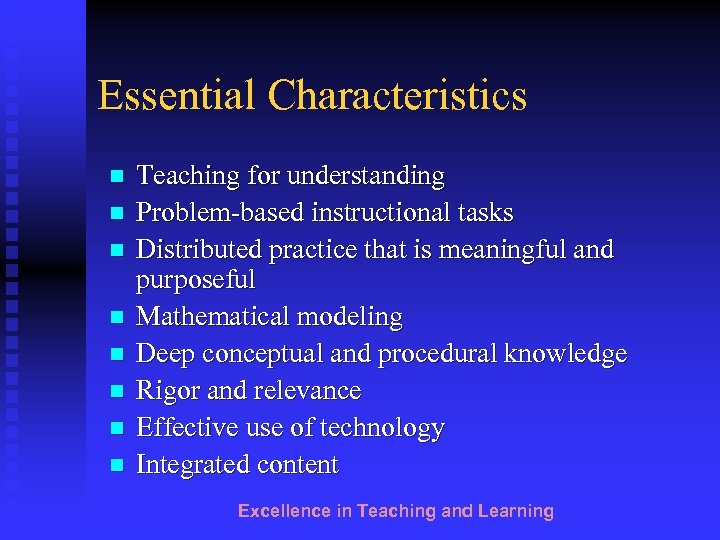 Essential Characteristics n n n n Teaching for understanding Problem-based instructional tasks Distributed practice that is meaningful and purposeful Mathematical modeling Deep conceptual and procedural knowledge Rigor and relevance Effective use of technology Integrated content Excellence in Teaching and Learning
 Teaching for Understanding First and foremost, teaching mathematics for understanding is the basis of the world-class core curriculum in mathematics that all Iowa students deserve. We must shift from a teaching paradigm of “memorize and practice” to one of “understand apply. ” Excellence in Teaching and Learning
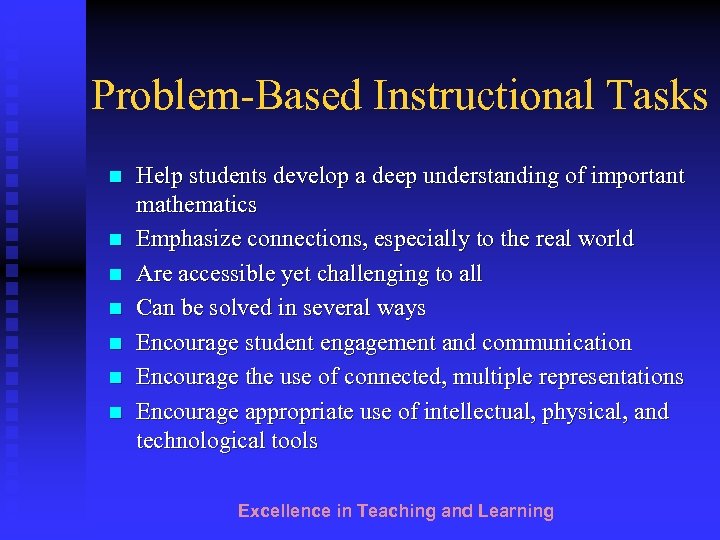 Problem-Based Instructional Tasks n n n n Help students develop a deep understanding of important mathematics Emphasize connections, especially to the real world Are accessible yet challenging to all Can be solved in several ways Encourage student engagement and communication Encourage the use of connected, multiple representations Encourage appropriate use of intellectual, physical, and technological tools Excellence in Teaching and Learning
 What kind of knowledge? Conceptual knowledge? n Procedural knowledge? n Factual knowledge? n Usable knowledge? n Skills? Yes. All of the above. Deep knowledge. n Excellence in Teaching and Learning
 Mathematical Modeling Excellence in Teaching and Learning
 Effective Use of Technology n n Research: Appropriate use of technology supports effective mathematics teaching and enhances mathematics learning. Context within which to use technology: First, identify the important mathematics. Next, think about powerful pedagogy. Then determine how/if technology can be used as an effective teaching and learning tool. Excellence in Teaching and Learning
 Integrated Content Connections • Connections to other disciplines —> interdisciplinary • Connections within mathematics —> integrated courses • Virtually every country in the world except the US has integrated courses • National high school math standards currently being developed include an option for integrated courses (Achieve, College Board) • ITED is developing integrated end-of-course tests Excellence in Teaching and Learning
 Essential Characteristics n n n n Teaching for understanding Problem-based instructional tasks Distributed practice that is meaningful and purposeful Mathematical modeling Deep conceptual and procedural knowledge Rigor and relevance Effective use of technology Integrated content Excellence in Teaching and Learning
 Essential Skills n Students need powerful skills to be successful in the globally competitive workforce of the 21 st century. n Business and industry demand workers who can solve problems, work in teams, and are able to apply learning to new and changing situations, especially as workers change jobs and careers many times in their lifetimes. n Thus, students must acquire powerful, flexible, and widely-applicable math skills. Excellence in Teaching and Learning
 Essential Skills Problem solving n Communication n Reasoning and proof n Connections – Ability to recognize, make, and apply connections n Representations – Ability to construct and apply multiple connected representations n Excellence in Teaching and Learning
 Essential Content Recommended content that all students should study by the end of high school n Core content needed by all students to keep all their options open for college and the world of work n Legacy content and future content n Excellence in Teaching and Learning
 Essential Content Algebra n Geometry n Statistics and Probability n Quantitative Literacy (Note: Discrete mathematics topics are integrated throughout the above strands) n Excellence in Teaching and Learning
 Essential Topics • • Serve to identify important mathematics Provide a focus for curriculum design and instruction Are not a laundry list of objectives Are not “a mile wide and an inch deep” Lay the foundation for future learning of math Are consistent with professional recommendations for mathematics education Are consistent with professional experience in curriculum development and instruction Excellence in Teaching and Learning
![More research support for Essential Topics (Pellegrino, 2006) “… curriculum and instruction [should] be](https://present5.com/presentation/b51cb00a0704bd3e08df9f896125e992/image-34.jpg "More research support for Essential Topics (Pellegrino, 2006) “… curriculum and instruction [should] be") More research support for Essential Topics (Pellegrino, 2006) “… curriculum and instruction [should] be focused on the conceptual organization of knowledge and the teasing out of ‘big ideas’ in a discipline from the earliest stages of learning onward rather than an undue emphasis on rote knowledge of facts and procedures. ” (p. 5) Excellence in Teaching and Learning
More research support for Essential Topics (Pellegrino, 2006) “… curriculum and instruction [should] be focused on the conceptual organization of knowledge and the teasing out of ‘big ideas’ in a discipline from the earliest stages of learning onward rather than an undue emphasis on rote knowledge of facts and procedures. ” (p. 5) Excellence in Teaching and Learning
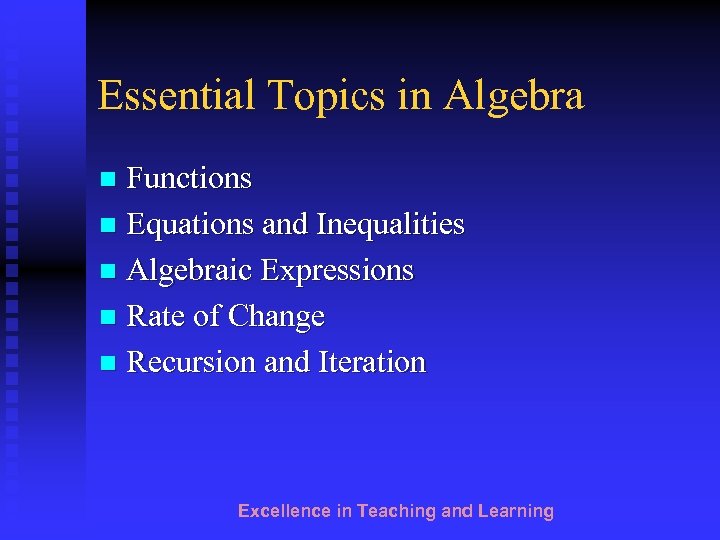 Essential Topics in Algebra Functions n Equations and Inequalities n Algebraic Expressions n Rate of Change n Recursion and Iteration n Excellence in Teaching and Learning
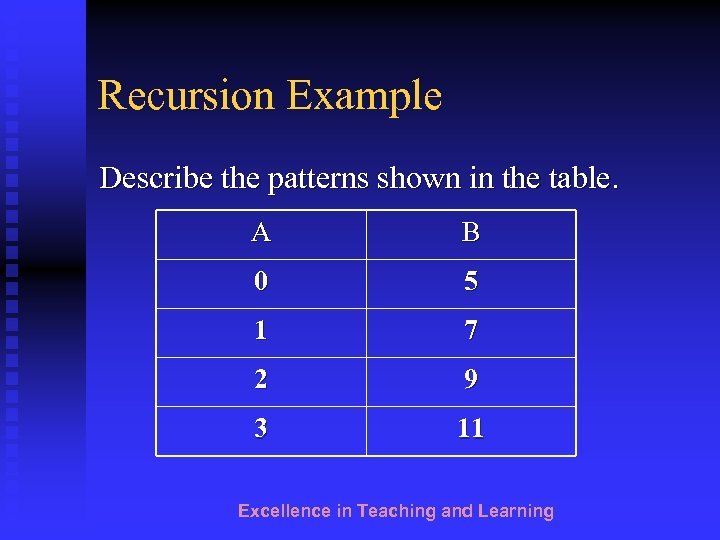 Recursion Example Describe the patterns shown in the table. A B 0 5 1 7 2 9 3 11 Excellence in Teaching and Learning
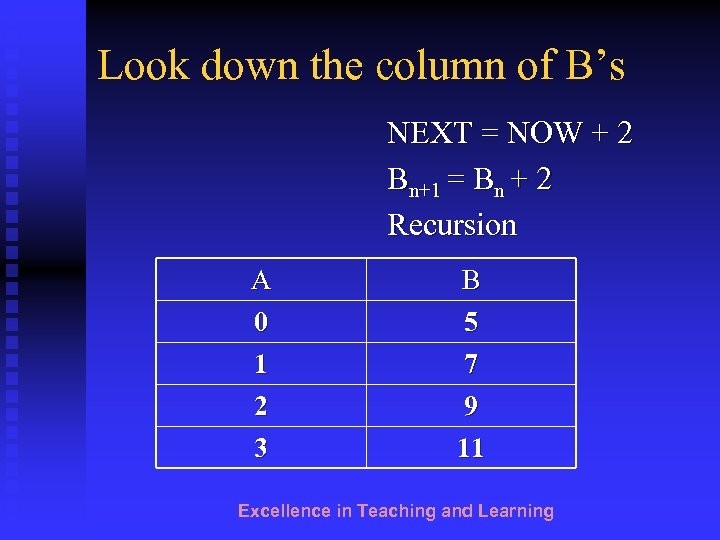 Look down the column of B’s NEXT = NOW + 2 Bn+1 = Bn + 2 Recursion A 0 1 B 5 7 2 3 9 11 Excellence in Teaching and Learning
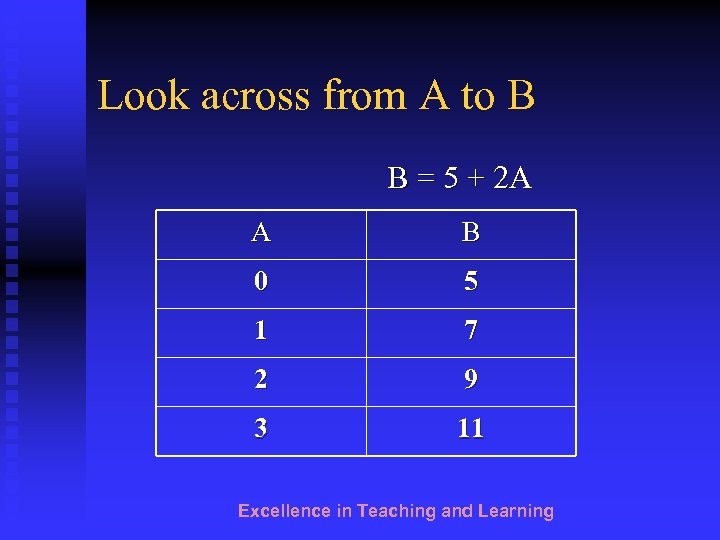 Look across from A to B B = 5 + 2 A A B 0 5 1 7 2 9 3 11 Excellence in Teaching and Learning
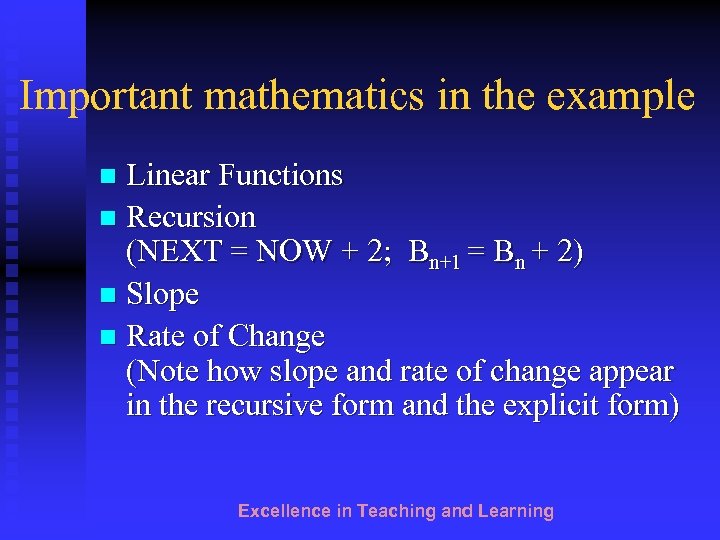 Important mathematics in the example Linear Functions n Recursion (NEXT = NOW + 2; Bn+1 = Bn + 2) n Slope n Rate of Change (Note how slope and rate of change appear in the recursive form and the explicit form) n Excellence in Teaching and Learning
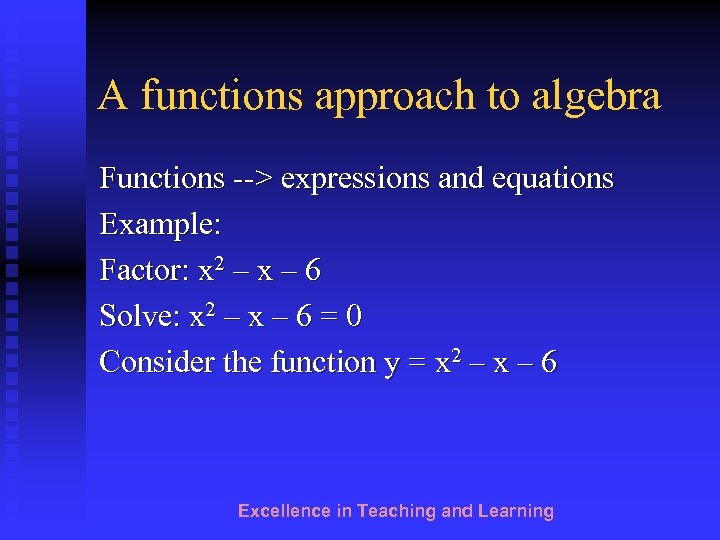 A functions approach to algebra Functions --> expressions and equations Example: Factor: x 2 – x – 6 Solve: x 2 – x – 6 = 0 Consider the function y = x 2 – x – 6 Excellence in Teaching and Learning
![Solve: [mystery quadratic] = 0 Here’s a graph of y = [mystery quadratic] Excellence](https://present5.com/presentation/b51cb00a0704bd3e08df9f896125e992/image-41.jpg "Solve: [mystery quadratic] = 0 Here’s a graph of y = [mystery quadratic] Excellence") Solve: [mystery quadratic] = 0 Here’s a graph of y = [mystery quadratic] Excellence in Teaching and Learning
Solve: [mystery quadratic] = 0 Here’s a graph of y = [mystery quadratic] Excellence in Teaching and Learning
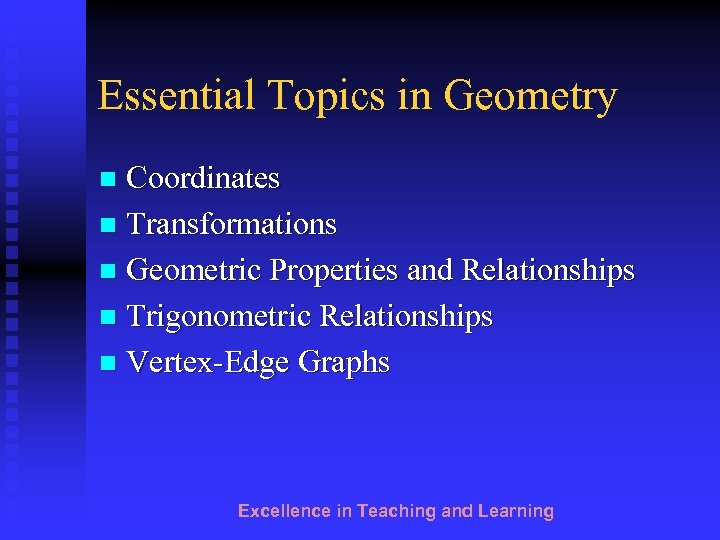 Essential Topics in Geometry Coordinates n Transformations n Geometric Properties and Relationships n Trigonometric Relationships n Vertex-Edge Graphs n Excellence in Teaching and Learning
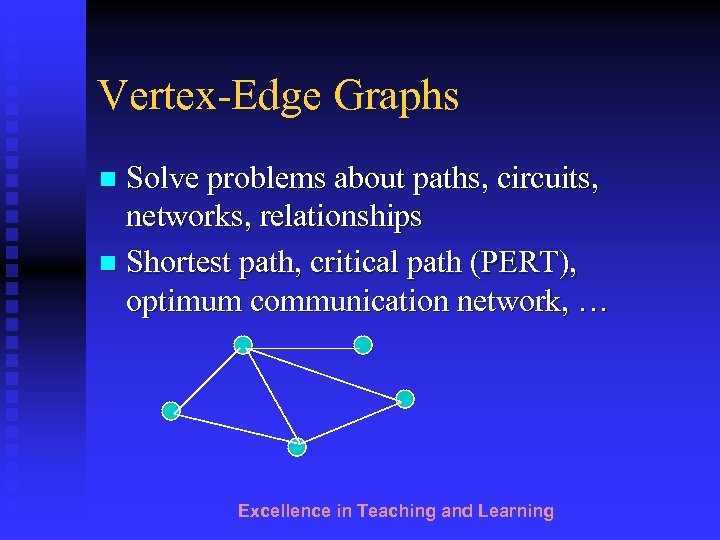 Vertex-Edge Graphs Solve problems about paths, circuits, networks, relationships n Shortest path, critical path (PERT), optimum communication network, … n Excellence in Teaching and Learning
 Essential Topics in Statistics & Probability Descriptive Statistics n Inferential Statistics n Probability n Excellence in Teaching and Learning
 Essential Topics in Quantitative Literacy Number Operations and Properties n Democratic Decision Making n Information Processing n Systematic Counting n Excellence in Teaching and Learning
 Democratic Decision Making Some mathematics related to decision making in a democratic society n Voting, apportioning seats in congress, fair division n Not a lot, but important n Could be taught in a social studies class n Excellence in Teaching and Learning
 Information Processing n n n Some mathematics related to information processing and information technology Logic and set theory used in Internet searches (“google it”) Number theory used in secure e-commerce (safely using your credit card online) Number theory used in ZIP codes, UPC codes, and ISBN numbers Efficient file compression (mp 3, zip, …) Not a lot, but important Excellence in Teaching and Learning
 Broad and Deep NOT mile-wide and inch-deep n Issues: u Time u Topics and Subtopics u Overlap n Excellence in Teaching and Learning
 Mathematics Model Core Curriculum Essential Characteristics n Essential Skills n Essential Content n Excellence in Teaching and Learning
 Key Differences from Existing Teaching and learning mathematics through problem solving n Connections integrated n Legacy content and future content n Excellence in Teaching and Learning
 Math Model Core Curriculum Mathematics Model Core Curriculum document online (and download): http: //www. iowamodelcore. org/ Excellence in Teaching and Learning
 LITERACY Model Core Curriculum Excellence in Teaching and Learning
 st Century Skills for the 21 n 5 years ago— u What did literacy learning look like? Excellence in Teaching and Learning
 st Century Skills for the 21 n 5 years from now— 2011 u What will students need to know and be able to do? Excellence in Teaching and Learning
 Literacy n n n Includes reading, writing, speaking, listening, and viewing Literacy synonymous with learning Students apply fundamentally same language concepts in increasingly more complex ways as they mature Excellence in Teaching and Learning
 Literacy is social n Emphasizes the application of skills across the curriculum n Literacy development essential for postsecondary success n Excellence in Teaching and Learning
 Literacy n Sources consulted u u u u IRA/NCTE Standards New Standards Performance Standards NAEP Frameworks in reading and writing Reading Next Adolescent Literacy: Reading for the 21 st Century Other state curriculum strands, local standards and benchmarks Research and best practice information Excellence in Teaching and Learning
 Reading 1. 2. 3. Independently reads a significant number of books and text each year. This reading should include both fiction and nonfiction in a variety of genres. Reads for a variety of purposes and across content areas. Uses a variety of skills and strategies to comprehend complex nonfiction and informational text. Excellence in Teaching and Learning
 Reading 4. 5. 6. Uses a variety of skills and strategies to comprehend and interpret complex literature Reads with fluency silently and aloud to support comprehension. Uses a variety of strategies to understand unfamiliar vocabulary found in narrative text, technical reading, and literary text Excellence in Teaching and Learning
 Writing 1. 2. 3. 4. Uses an effective writing process Uses knowledge of purpose, audience, format, and medium in developing written communication Applies writing skills and strategies to effectively communicate in a variety of genres with various audiences Uses writing as a tool for learning Excellence in Teaching and Learning
 Writing 5. 6. 7. 8. Engages in the information literacy process: accesses, evaluates, and communicates information and ideas Is able to write on demand Adheres to conventions generally established in spelling, punctuation, grammar, usage, syntax, and style Incorporates technology as a tool to enhance writing Excellence in Teaching and Learning
 Speaking 1. 2. 3. 4. 5. Considers audience and variables in the speaking situation Produces a coherent message Participate in a variety of communication situations Uses appropriate content and conventions for purpose, audience, occasion, and context Demonstrates control of delivery skills Excellence in Teaching and Learning
 Speaking 6. 7. 8. Participates appropriately in one-on-one situations and group settings Recognizes the role of evaluation in oral communication Recognizes the role of response in oral communication Excellence in Teaching and Learning
 Listening 1. 2. 3. Listens for information and understanding Listens for interpretation, analysis, and evaluation Listens to establish, maintain, and enhance relationships Excellence in Teaching and Learning
 Viewing 1. 2. 3. Analyzes the effects of visual media on society and culture Uses a range of strategies to interpret visual media Applies a variety of criteria to evaluate media Excellence in Teaching and Learning
 Of the ideas just shared with you, what do you feel will have the greatest impact in helping bridge the gap between the classroom of 2002 and that of 2012? Excellence in Teaching and Learning
 FOR MORE INFO. . . Rita Martens at 515/281 -3145 or rita. martens@iowa. gov Excellence in Teaching and Learning
 Science Model Core Curriculum for Iowa High Schools Sioux Center April 29, 2007 Excellence in Teaching and Learning
 Science Model Core Curriculum Inquiry n Life Science n Earth and Space Science n Physical Science n Excellence in Teaching and Learning
 Teaching for Understanding Scientific understanding lives in the application of meaningful science content to solve problems, understand interactions and investigate the natural world. Excellence in Teaching and Learning
 Listing of Key Concepts n n n Your core curriculum will not have every one of these concepts. A student who take a rich science core and a moderate number of science electives will see these essentials. If you have content that is NOT in the MCC it should prompt important questions. Excellence in Teaching and Learning
 Inquiry is both a standard set and woven throughout the document. "Inquiry is a set of interrelated processes by which scientists and students pose questions about the natural world and investigate phenomena; in doing so, students acquire knowledge and develop a rich understanding of concepts, principles, models, and theories. " —National Research Council. National Science Education Standards. Washington, DC: National Academy Press, 1996. n Excellence in Teaching and Learning
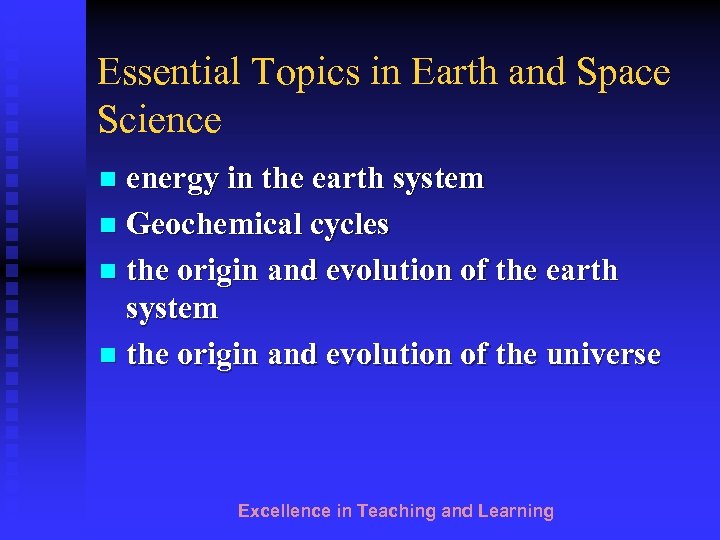 Essential Topics in Earth and Space Science energy in the earth system n Geochemical cycles n the origin and evolution of the earth system n the origin and evolution of the universe n Excellence in Teaching and Learning
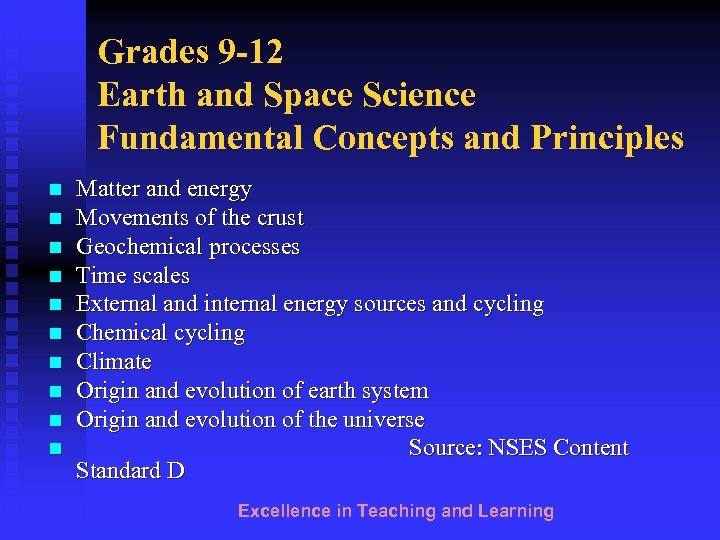 Grades 9 -12 Earth and Space Science Fundamental Concepts and Principles n n n n n Matter and energy Movements of the crust Geochemical processes Time scales External and internal energy sources and cycling Chemical cycling Climate Origin and evolution of earth system Origin and evolution of the universe Source: NSES Content Standard D Excellence in Teaching and Learning
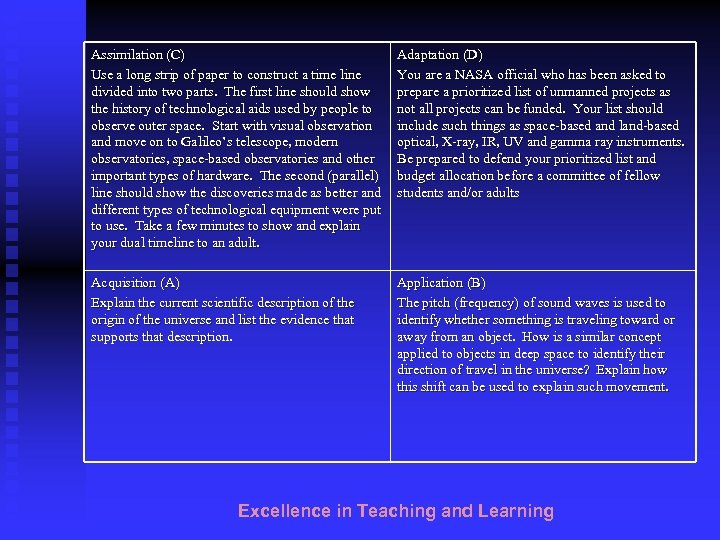 Assimilation (C) Use a long strip of paper to construct a time line divided into two parts. The first line should show the history of technological aids used by people to observe outer space. Start with visual observation and move on to Galileo’s telescope, modern observatories, space-based observatories and other important types of hardware. The second (parallel) line should show the discoveries made as better and different types of technological equipment were put to use. Take a few minutes to show and explain your dual timeline to an adult. Adaptation (D) You are a NASA official who has been asked to prepare a prioritized list of unmanned projects as not all projects can be funded. Your list should include such things as space-based and land-based optical, X-ray, IR, UV and gamma ray instruments. Be prepared to defend your prioritized list and budget allocation before a committee of fellow students and/or adults Acquisition (A) Explain the current scientific description of the origin of the universe and list the evidence that supports that description. Application (B) The pitch (frequency) of sound waves is used to identify whether something is traveling toward or away from an object. How is a similar concept applied to objects in deep space to identify their direction of travel in the universe? Explain how this shift can be used to explain such movement. Excellence in Teaching and Learning
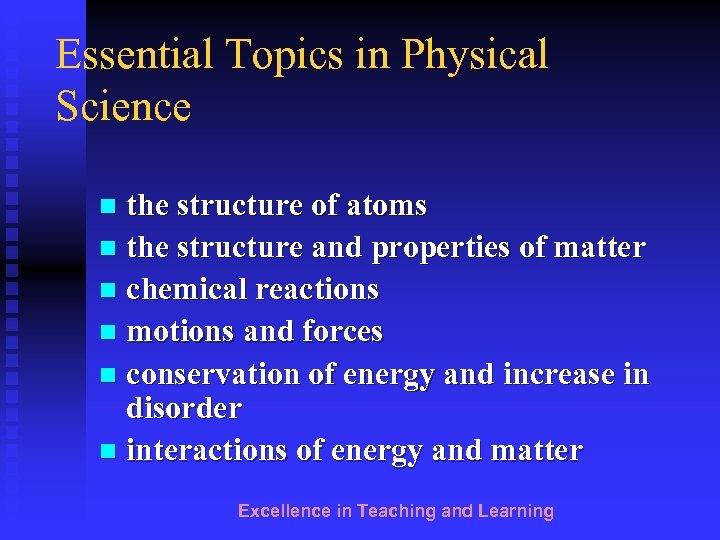 Essential Topics in Physical Science the structure of atoms n the structure and properties of matter n chemical reactions n motions and forces n conservation of energy and increase in disorder n interactions of energy and matter n Excellence in Teaching and Learning
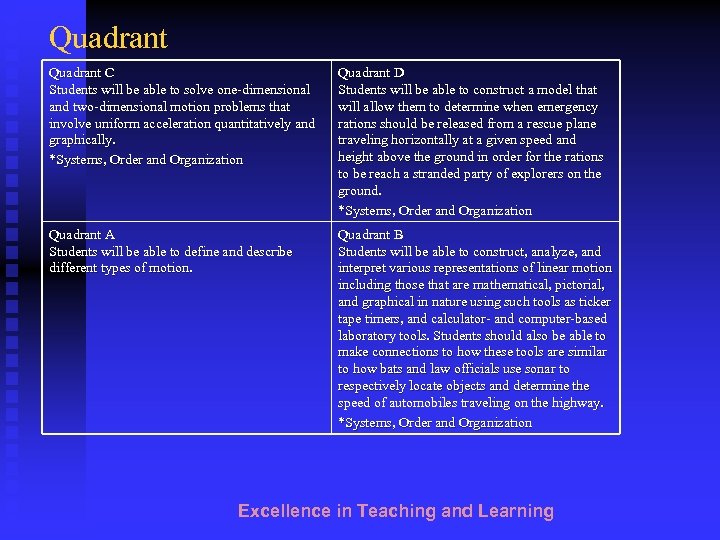 Quadrant C Students will be able to solve one-dimensional and two-dimensional motion problems that involve uniform acceleration quantitatively and graphically. *Systems, Order and Organization Quadrant D Students will be able to construct a model that will allow them to determine when emergency rations should be released from a rescue plane traveling horizontally at a given speed and height above the ground in order for the rations to be reach a stranded party of explorers on the ground. *Systems, Order and Organization Quadrant A Students will be able to define and describe different types of motion. Quadrant B Students will be able to construct, analyze, and interpret various representations of linear motion including those that are mathematical, pictorial, and graphical in nature using such tools as ticker tape timers, and calculator- and computer-based laboratory tools. Students should also be able to make connections to how these tools are similar to how bats and law officials use sonar to respectively locate objects and determine the speed of automobiles traveling on the highway. *Systems, Order and Organization Excellence in Teaching and Learning
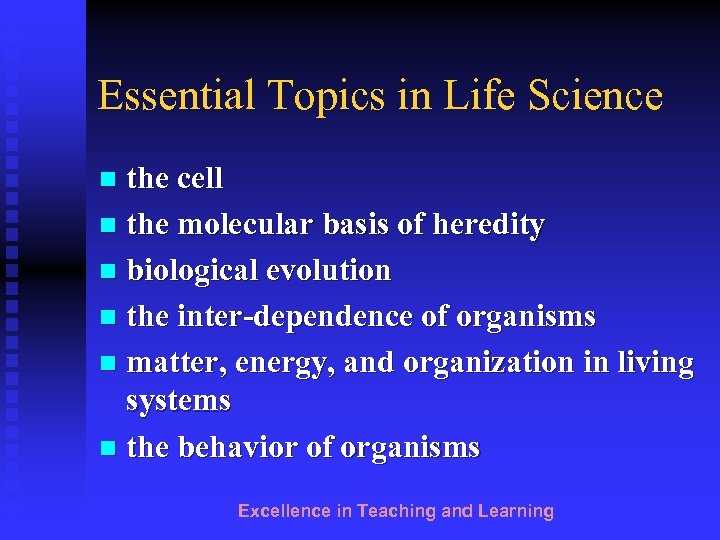 Essential Topics in Life Science the cell n the molecular basis of heredity n biological evolution n the inter-dependence of organisms n matter, energy, and organization in living systems n the behavior of organisms n Excellence in Teaching and Learning
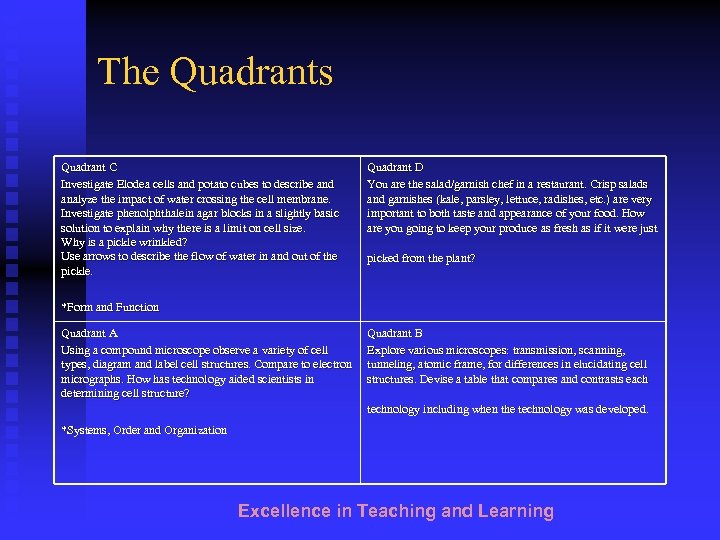 The Quadrants Quadrant C Investigate Elodea cells and potato cubes to describe and analyze the impact of water crossing the cell membrane. Investigate phenolphthalein agar blocks in a slightly basic solution to explain why there is a limit on cell size. Why is a pickle wrinkled? Use arrows to describe the flow of water in and out of the pickle. Quadrant D You are the salad/garnish chef in a restaurant. Crisp salads and garnishes (kale, parsley, lettuce, radishes, etc. ) are very important to both taste and appearance of your food. How are you going to keep your produce as fresh as if it were just picked from the plant? *Form and Function Quadrant A Using a compound microscope observe a variety of cell types, diagram and label cell structures. Compare to electron micrographs. How has technology aided scientists in determining cell structure? Quadrant B Explore various microscopes: transmission, scanning, tunneling, atomic frame, for differences in elucidating cell structures. Devise a table that compares and contrasts each technology including when the technology was developed. *Systems, Order and Organization Excellence in Teaching and Learning
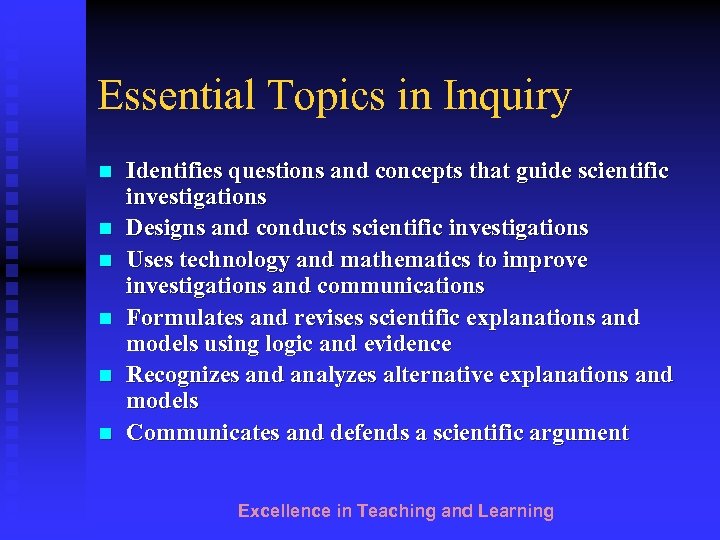 Essential Topics in Inquiry n n n Identifies questions and concepts that guide scientific investigations Designs and conducts scientific investigations Uses technology and mathematics to improve investigations and communications Formulates and revises scientific explanations and models using logic and evidence Recognizes and analyzes alternative explanations and models Communicates and defends a scientific argument Excellence in Teaching and Learning
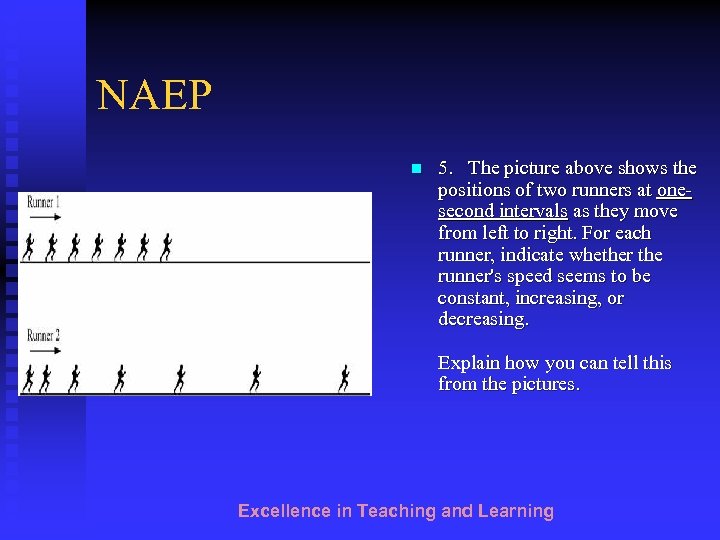 NAEP n 5. The picture above shows the positions of two runners at onesecond intervals as they move from left to right. For each runner, indicate whether the runner's speed seems to be constant, increasing, or decreasing. Explain how you can tell this from the pictures. Excellence in Teaching and Learning
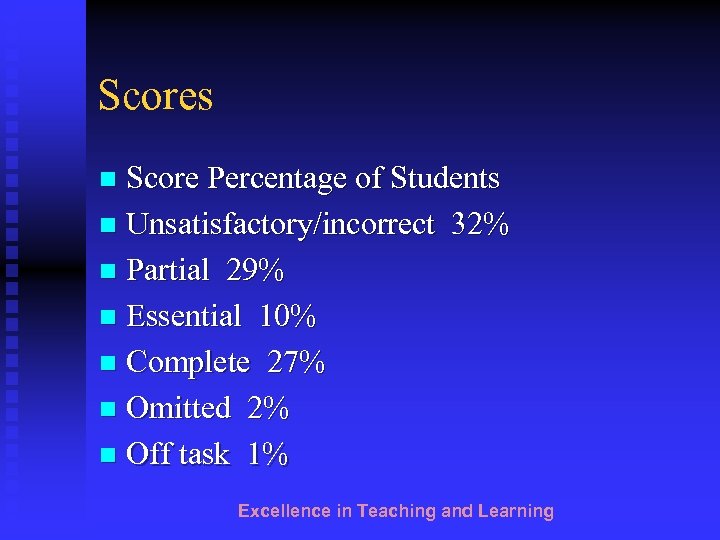 Scores Score Percentage of Students n Unsatisfactory/incorrect 32% n Partial 29% n Essential 10% n Complete 27% n Omitted 2% n Off task 1% n Excellence in Teaching and Learning
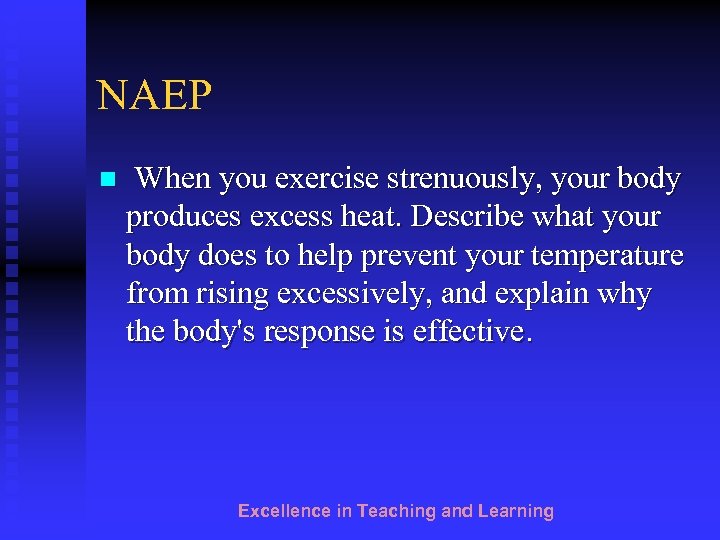 NAEP n When you exercise strenuously, your body produces excess heat. Describe what your body does to help prevent your temperature from rising excessively, and explain why the body's response is effective. Excellence in Teaching and Learning
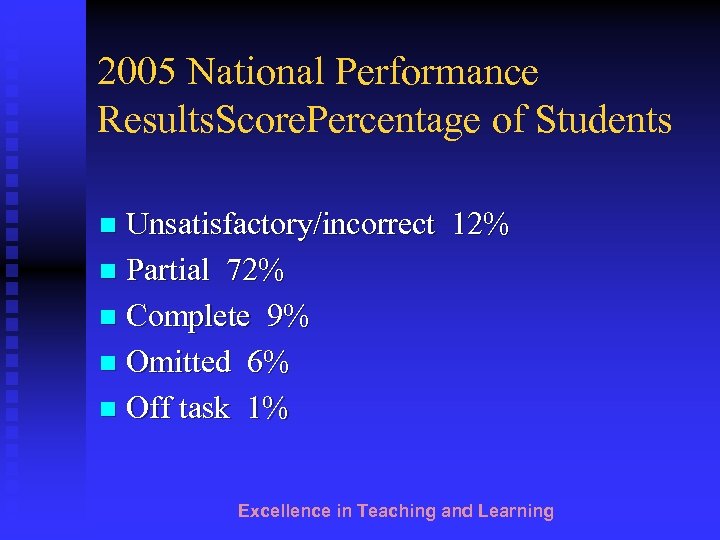 2005 National Performance Results. Score. Percentage of Students Unsatisfactory/incorrect 12% n Partial 72% n Complete 9% n Omitted 6% n Off task 1% n Excellence in Teaching and Learning
 n Oil is spilled onto the water from an oceangoing tanker. Investigators want to know whether wave motion will help disperse the oil. Design an experiment that they can carry out in a laboratory to find out whether wave motion will help disperse the oil. Describe the equipment they should use and the procedure they should follow. Excellence in Teaching and Learning
 n The table below gives additional information about the planets: their periods of revolution about the Sun and rotation about their axes. n Suppose that a new planet (Planet P) is discovered and it has a period of revolution of 500 Earth days. What, if anything, could you predict about the mean distance of Planet P from the Sun based on the graph in question 7? Explain why you could or could not make this prediction. Excellence in Teaching and Learning
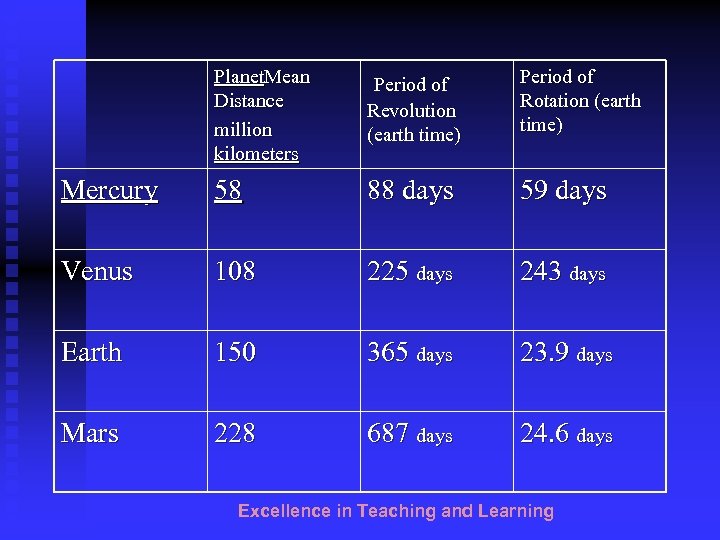 Planet. Mean Distance million kilometers Period of Revolution (earth time) Period of Rotation (earth time) Mercury 58 88 days 59 days Venus 108 225 days 243 days Earth 150 365 days 23. 9 days Mars 228 687 days 24. 6 days Excellence in Teaching and Learning
 What does this mean to you? May mean that you alter courses and your local curriculum n May mean that you alter pedagogy n Excellence in Teaching and Learning
 More information online… • Science Model Core Curriculum document online: http: //www. iowamodelcore. org/ • DE Model Core Curriculum Web site: http: //www. iowa. gov/educate/content/view/ 674/714/ Excellence in Teaching and Learning