


 Скачать презентацию MODEL CHECKING WITH SPIN MODELING AND VERIFICATION WITH
03c287a5a6d6a5377912fe0eceb9798c.ppt
- Количество слайдов: 33
 MODEL CHECKING WITH SPIN MODELING AND VERIFICATION WITH SPIN ANDREA ORLANDINI – ISTC (CNR)
 Overview Model Checking PROMELA Model and Language SPIN Model Checker Example(s) and Demo
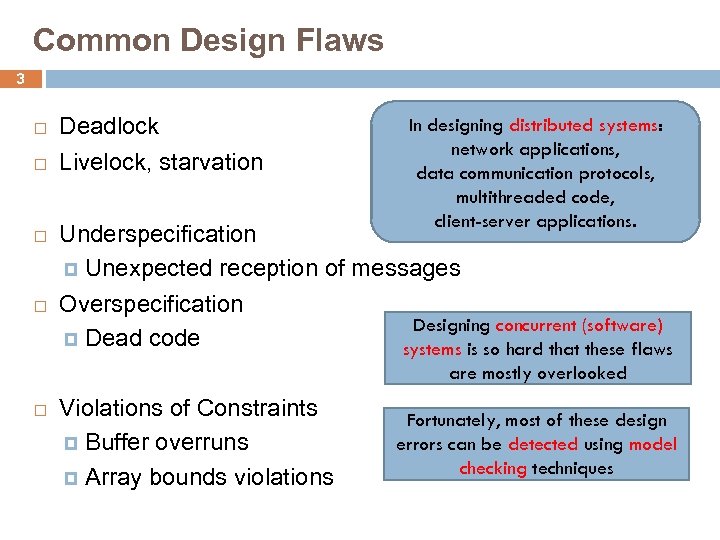 Common Design Flaws 3 Deadlock Livelock, starvation In designing distributed systems: network applications, data communication protocols, multithreaded code, client-server applications. Underspecification Unexpected reception of messages Overspecification Designing concurrent (software) Dead code systems is so hard that these flaws are mostly overlooked Violations of Constraints Buffer overruns Array bounds violations Fortunately, most of these design errors can be detected using model checking techniques
![What is model checking? 4 [Clarke & Emerson 1981]: “Model checking is an automated](https://present5.com/presentation/03c287a5a6d6a5377912fe0eceb9798c/image-4.jpg "What is model checking? 4 [Clarke & Emerson 1981]: “Model checking is an automated") What is model checking? 4 [Clarke & Emerson 1981]: “Model checking is an automated technique that, given a finite-state model of a system and a logical property, systematically checks whether this property holds for (a given initial state in) that model. ” Model checking tools automatically. Sifakis whether Clarke, Emerson, and verify holds, where M is a (finite-state) model of a system and Receive property F is stated in ACM Turing Award 2007 some formal notation. Problem: state space explosion! SPIN [Holzmann 1991] is one of the most powerful model checkers. (based on [Vardi & Wolper 1986]
What is model checking? 4 [Clarke & Emerson 1981]: “Model checking is an automated technique that, given a finite-state model of a system and a logical property, systematically checks whether this property holds for (a given initial state in) that model. ” Model checking tools automatically. Sifakis whether Clarke, Emerson, and verify holds, where M is a (finite-state) model of a system and Receive property F is stated in ACM Turing Award 2007 some formal notation. Problem: state space explosion! SPIN [Holzmann 1991] is one of the most powerful model checkers. (based on [Vardi & Wolper 1986]
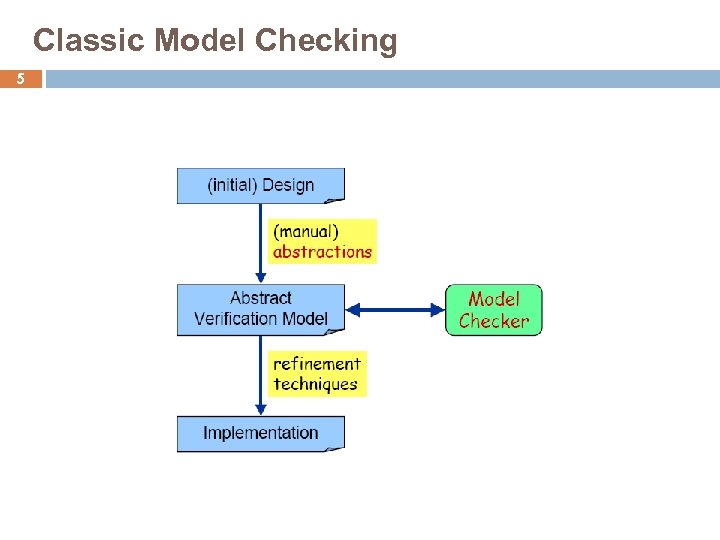 Classic Model Checking 5
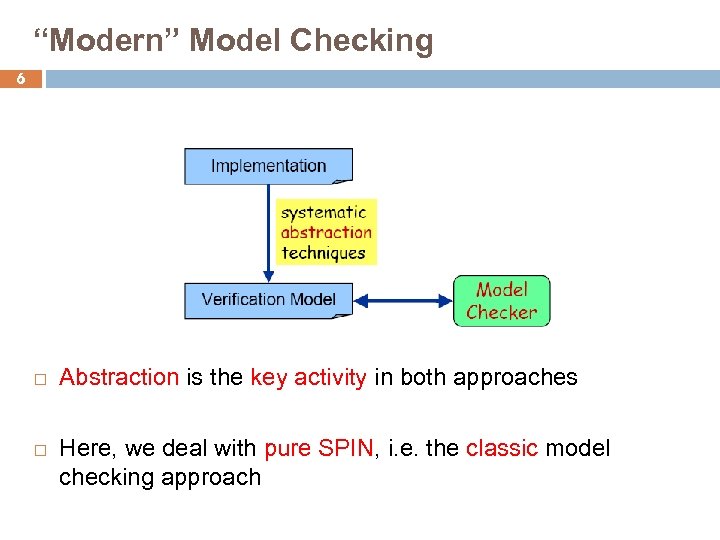 “Modern” Model Checking 6 Abstraction is the key activity in both approaches Here, we deal with pure SPIN, i. e. the classic model checking approach
 Verification vs Debugging 7 Two (extreme) approaches with respect to the application of model checkers. verification approach: tries to assure the correctness of a detailed model M of the system under validation. debugging approach: tries to find errors in a model M. Model checking is most effective in combination with the debugging approach. Automatic verification is not about proving correctness, but about finding bugs much earlier in the development of a system. (there are exceptions: BIP approach [Henzinger and Sifakis])
 Spin and Promela SPIN = Simple Promela Interpreter Promela = Process Meta Language The modeling language of SPIN So it is not a language to build an application! Strong features : Powerful constructs to synchronize concurrent processes Cutting edge model checking technology Simulation to support analysis (of the models)
 System, process, and action. 9 A system in SPIN consists of a set of interacting and concurrent processes. Each process is sequential, but possibly non-deterministic. Each process is built from atomic actions (transition). Concurrent execution is modeled by interleaving. Fairness can be impossed.
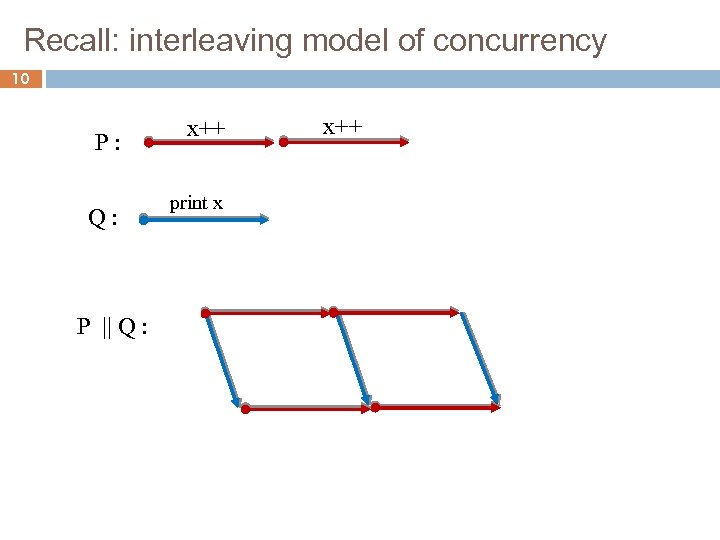 Recall: interleaving model of concurrency 10 P: Q: P || Q : x++ print x x++
![Promela model consists of: Type declarations Channel declarations Variable declarations Process declarations [init process]](https://present5.com/presentation/03c287a5a6d6a5377912fe0eceb9798c/image-11.jpg "Promela model consists of: Type declarations Channel declarations Variable declarations Process declarations [init process]") Promela model consists of: Type declarations Channel declarations Variable declarations Process declarations [init process] A Promela model corresponds with a (usually very large, but) finite transition system, so No unbounded data No unbounded channels No unbounded processes No unbounded process creation
Promela model consists of: Type declarations Channel declarations Variable declarations Process declarations [init process] A Promela model corresponds with a (usually very large, but) finite transition system, so No unbounded data No unbounded channels No unbounded processes No unbounded process creation
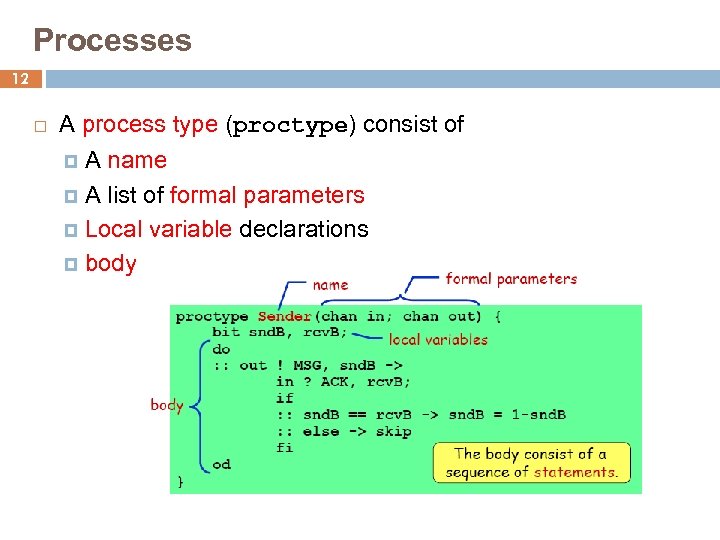 Processes 12 A process type (proctype) consist of A name A list of formal parameters Local variable declarations body
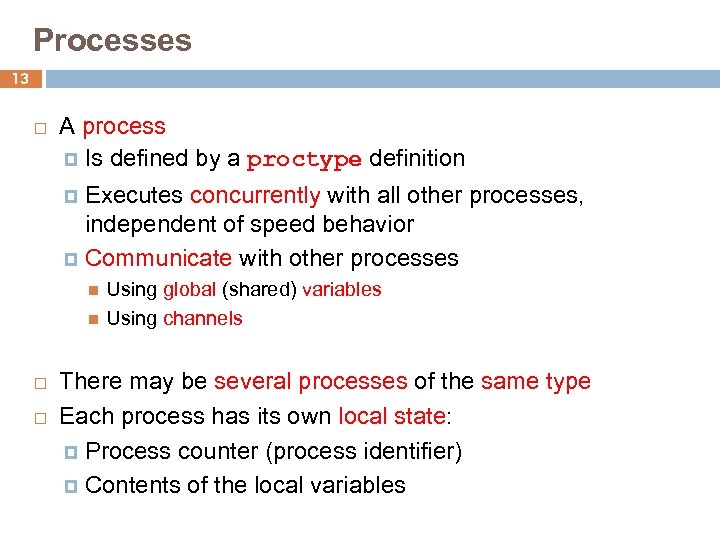 Processes 13 A process Is defined by a proctype definition Executes concurrently with all other processes, independent of speed behavior Communicate with other processes Using global (shared) variables Using channels There may be several processes of the same type Each process has its own local state: Process counter (process identifier) Contents of the local variables
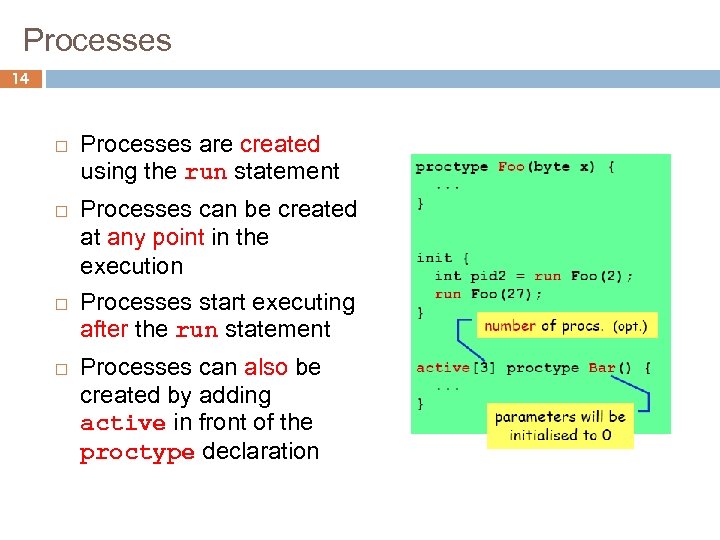 Processes 14 Processes are created using the run statement Processes can be created at any point in the execution Processes start executing after the run statement Processes can also be created by adding active in front of the proctype declaration
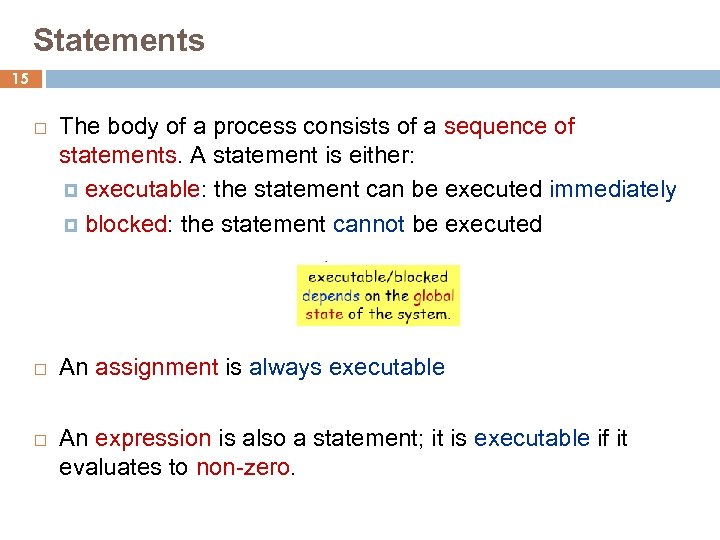 Statements 15 The body of a process consists of a sequence of statements. A statement is either: executable: the statement can be executed immediately blocked: the statement cannot be executed An assignment is always executable An expression is also a statement; it is executable if it evaluates to non-zero.
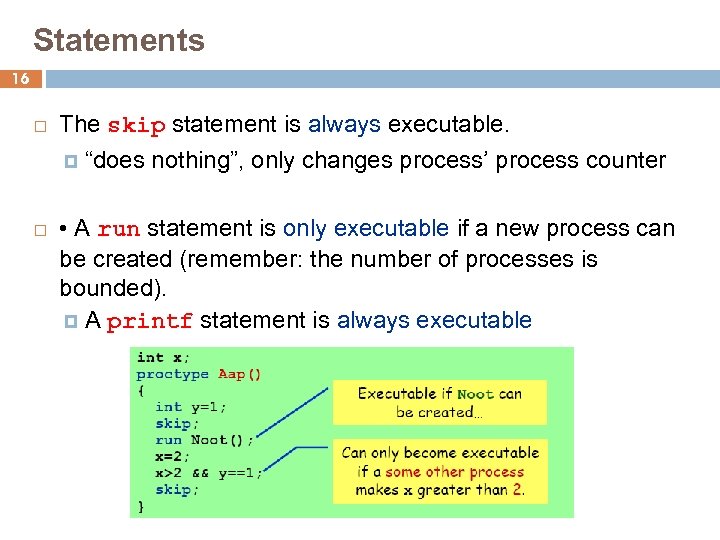 Statements 16 The skip statement is always executable. “does nothing”, only changes process’ process counter • A run statement is only executable if a new process can be created (remember: the number of processes is bounded). A printf statement is always executable
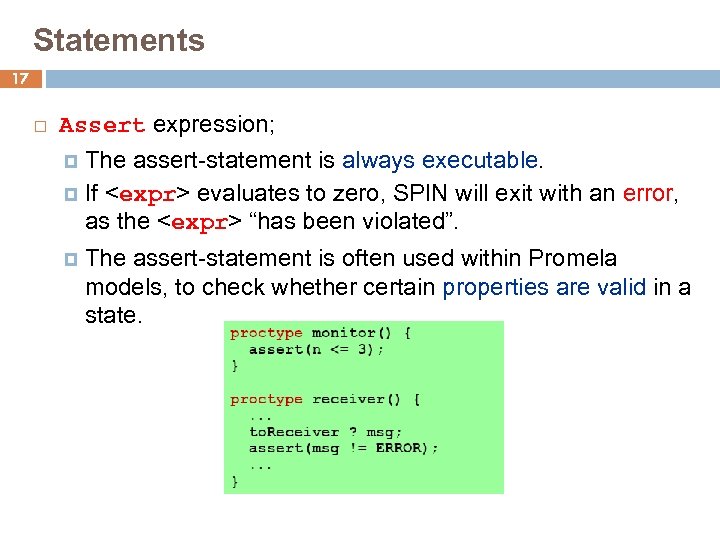 Statements 17 Assert expression; The assert-statement is always executable. If
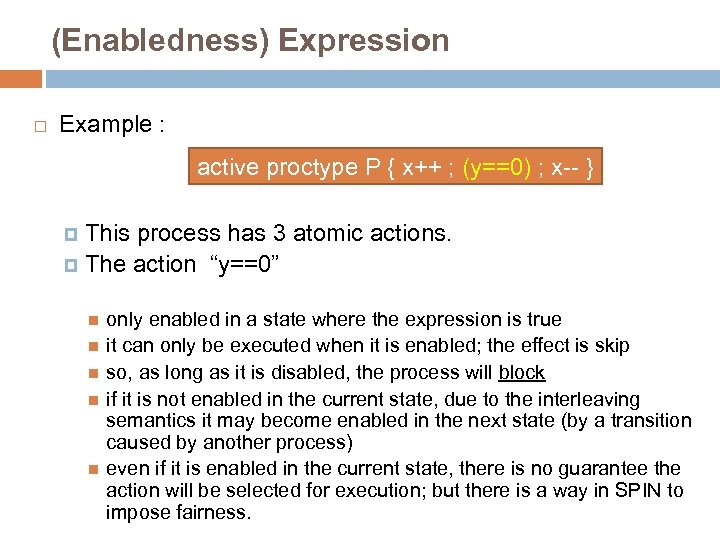 (Enabledness) Expression Example : active proctype P { x++ ; (y==0) ; x-- } This process has 3 atomic actions. The action “y==0” only enabled in a state where the expression is true it can only be executed when it is enabled; the effect is skip so, as long as it is disabled, the process will block if it is not enabled in the current state, due to the interleaving semantics it may become enabled in the next state (by a transition caused by another process) even if it is enabled in the current state, there is no guarantee the action will be selected for execution; but there is a way in SPIN to impose fairness.
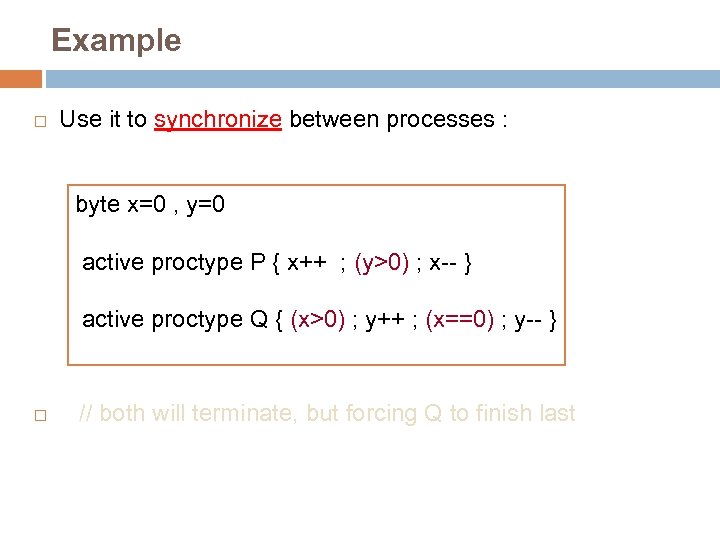 Example Use it to synchronize between processes : byte x=0 , y=0 active proctype P { x++ ; (y>0) ; x-- } active proctype Q { (x>0) ; y++ ; (x==0) ; y-- } // both will terminate, but forcing Q to finish last
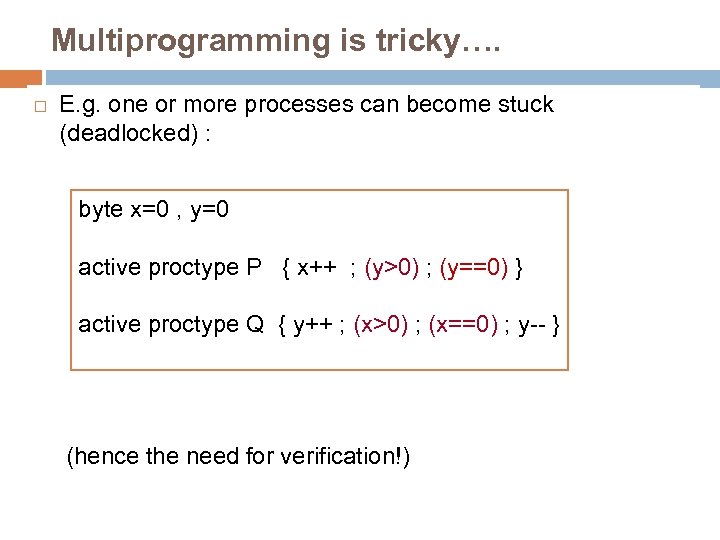 Multiprogramming is tricky…. E. g. one or more processes can become stuck (deadlocked) : byte x=0 , y=0 active proctype P { x++ ; (y>0) ; (y==0) } active proctype Q { y++ ; (x>0) ; (x==0) ; y-- } (hence the need for verification!)
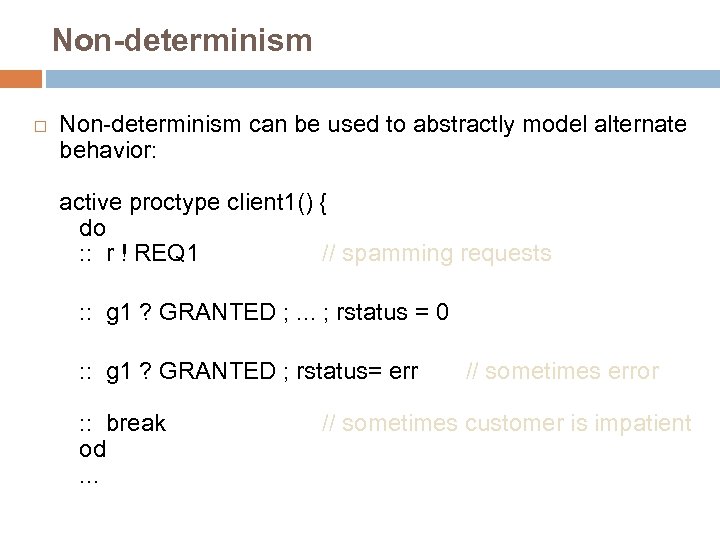 Non-determinism can be used to abstractly model alternate behavior: active proctype client 1() { do : : r ! REQ 1 // spamming requests : : g 1 ? GRANTED ; . . . ; rstatus = 0 : : g 1 ? GRANTED ; rstatus= err : : break od. . . // sometimes error // sometimes customer is impatient
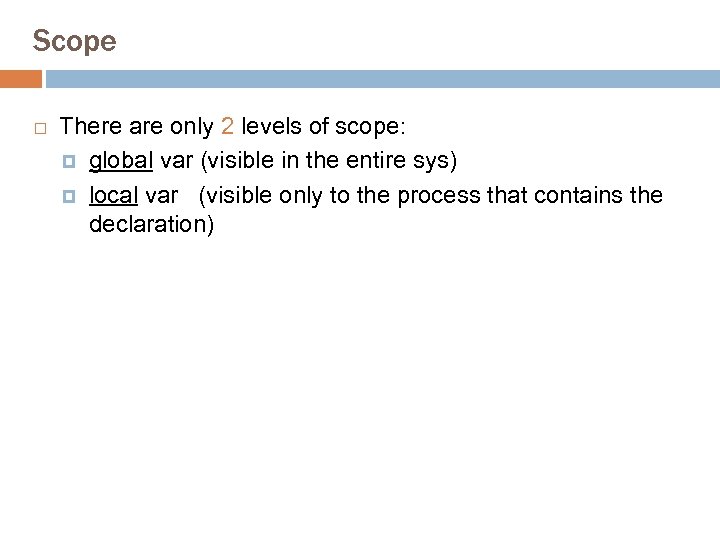 Scope There are only 2 levels of scope: global var (visible in the entire sys) local var (visible only to the process that contains the declaration)
![Channels chan c chan d chan e[2] [0] of {bit}; [2] of {mtype, bit,](https://present5.com/presentation/03c287a5a6d6a5377912fe0eceb9798c/image-23.jpg "Channels chan c chan d chan e[2] [0] of {bit}; [2] of {mtype, bit,") Channels chan c chan d chan e[2] [0] of {bit}; [2] of {mtype, bit, byte}; [1] of {mtype, record}; for exchanging messages between processes finite sized and asynchronously, unless you set it to size 0 synchronous channel Syntax : c!0 c? x = = = sending over channel c; blocking if c is full receives from c, transfer it to x; blocking if c is empty There are some more exotic channel operations : checking empty/full, testing head-value, copying instead of receiving, sorted send, random receive. . . check out the Manual
Channels chan c chan d chan e[2] [0] of {bit}; [2] of {mtype, bit, byte}; [1] of {mtype, record}; for exchanging messages between processes finite sized and asynchronously, unless you set it to size 0 synchronous channel Syntax : c!0 c? x = = = sending over channel c; blocking if c is full receives from c, transfer it to x; blocking if c is empty There are some more exotic channel operations : checking empty/full, testing head-value, copying instead of receiving, sorted send, random receive. . . check out the Manual
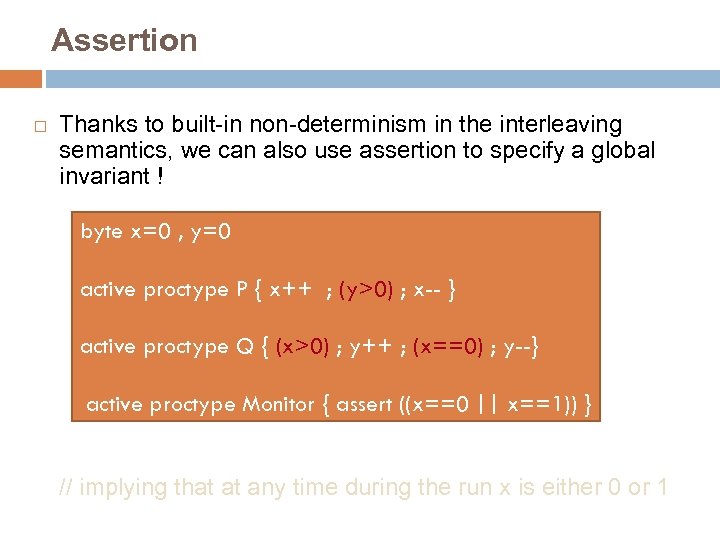 Assertion Thanks to built-in non-determinism in the interleaving semantics, we can also use assertion to specify a global invariant ! byte x=0 , y=0 active proctype P { x++ ; (y>0) ; x-- } active proctype Q { (x>0) ; y++ ; (x==0) ; y--} active proctype Monitor { assert ((x==0 || x==1)) } // implying that at any time during the run x is either 0 or 1
 End state 25 When a process P fails to reach its terminal (end) state: Then it was locked error. Maybe this P is not supposed to reach end-state suppress end-state checking with SPIN option. The terminal state is by default just the textual end of of P’s code. You can specify additional terminal states by using endlabel: Of the form “end*”
 State 26 Each (global) state of a system is a “product” of the states of its processes. E. g. Suppose we have: One global var byte x Process P with byte y Process Q with byte z Each system state should describe: all these variables Program counter of each process Other SPIN predefined vars Represent each global state as a tuple … this tuple can be quite big.
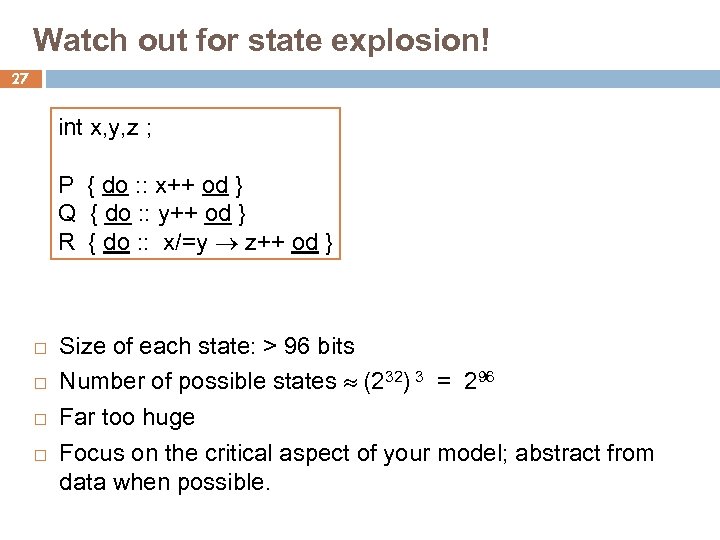 Watch out for state explosion! 27 int x, y, z ; P { do : : x++ od } Q { do : : y++ od } R { do : : x/=y z++ od } Size of each state: > 96 bits Number of possible states (232) 3 = 296 Far too huge Focus on the critical aspect of your model; abstract from data when possible.
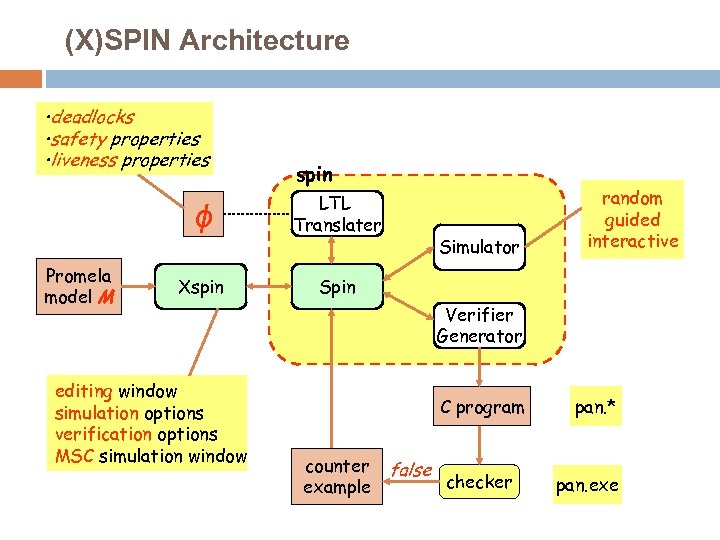 (X)SPIN Architecture • deadlocks • safety properties • liveness properties spin ϕ Promela model M LTL Translater Xspin random guided interactive Spin editing window simulation options verification options MSC simulation window Simulator Verifier Generator C program counter false checker example pan. * pan. exe
 The stack 29 To save space SPIN does not keep a stack of states (large!), but rather a stack of action-IDs (small!) Though this requires computing action-undo when backtracking
![Verifier’s output assertion violated !((crit[0]&&crit[1])) (at depth 5). . . Warning: Search not completed](https://present5.com/presentation/03c287a5a6d6a5377912fe0eceb9798c/image-30.jpg "Verifier’s output assertion violated !((crit[0]&&crit[1])) (at depth 5). . . Warning: Search not completed") Verifier’s output assertion violated !((crit[0]&&crit[1])) (at depth 5). . . Warning: Search not completed Full statespace search for: . . . never-claim assertion violations invalid endstates - (not selected) + + State-vector 20 byte, depth reached 7, errors: 1 24 states, stored 17 states, matched 41 transitions (= stored+matched) 0 atomic steps hash conflicts: 0 (resolved) (max size 2^19 states) 2. 542 // computation depth memory usage (Mbyte) // max. stack depth // states stored in hash table // states found re-revisited
Verifier’s output assertion violated !((crit[0]&&crit[1])) (at depth 5). . . Warning: Search not completed Full statespace search for: . . . never-claim assertion violations invalid endstates - (not selected) + + State-vector 20 byte, depth reached 7, errors: 1 24 states, stored 17 states, matched 41 transitions (= stored+matched) 0 atomic steps hash conflicts: 0 (resolved) (max size 2^19 states) 2. 542 // computation depth memory usage (Mbyte) // max. stack depth // states stored in hash table // states found re-revisited
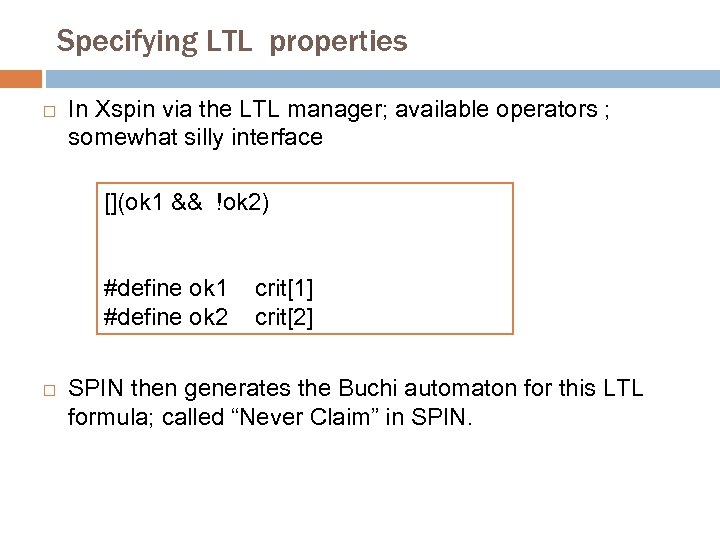 Specifying LTL properties In Xspin via the LTL manager; available operators ; somewhat silly interface [](ok 1 && !ok 2) #define ok 1 #define ok 2 crit[1] crit[2] SPIN then generates the Buchi automaton for this LTL formula; called “Never Claim” in SPIN.
![Example of a Never Claim (the Buchi of []<>p Here is the never-claim of](https://present5.com/presentation/03c287a5a6d6a5377912fe0eceb9798c/image-32.jpg "Example of a Never Claim (the Buchi of []<>p Here is the never-claim of") Example of a Never Claim (the Buchi of []<>p Here is the never-claim of []<>p = <>[] p) This is automatically generated by SPIN never { do : : p ; break : : skip od ; accept : do : : !p ; skip od } Error if accept is reachable in the lock-step execution, and from there a cyclic run can be found.
Example of a Never Claim (the Buchi of []<>p Here is the never-claim of []<>p = <>[] p) This is automatically generated by SPIN never { do : : p ; break : : skip od ; accept : do : : !p ; skip od } Error if accept is reachable in the lock-step execution, and from there a cyclic run can be found.
 Demo Time 33 Just to have a rough idea of how SPIN works!!!