


 Скачать презентацию Model Checking I What are LTL and CTL
d7cfeb38ff728a78f26d0e8b88de4bcd.ppt
- Количество слайдов: 53
 Model Checking I What are LTL and CTL?
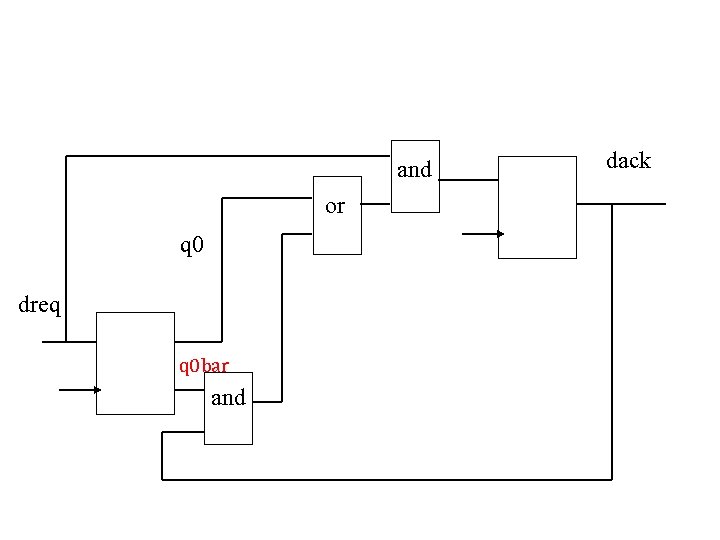 and or q 0 dreq q 0 bar and dack
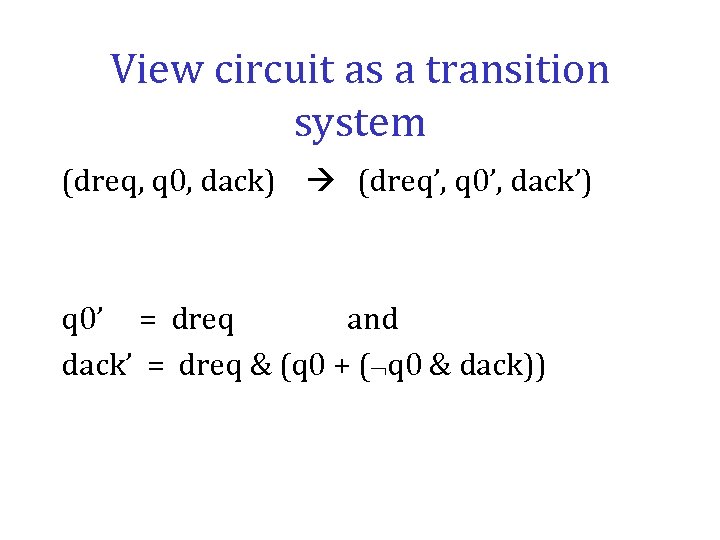 View circuit as a transition system (dreq, q 0, dack) (dreq’, q 0’, dack’) q 0’ = dreq and dack’ = dreq & (q 0 + ( q 0 & dack))
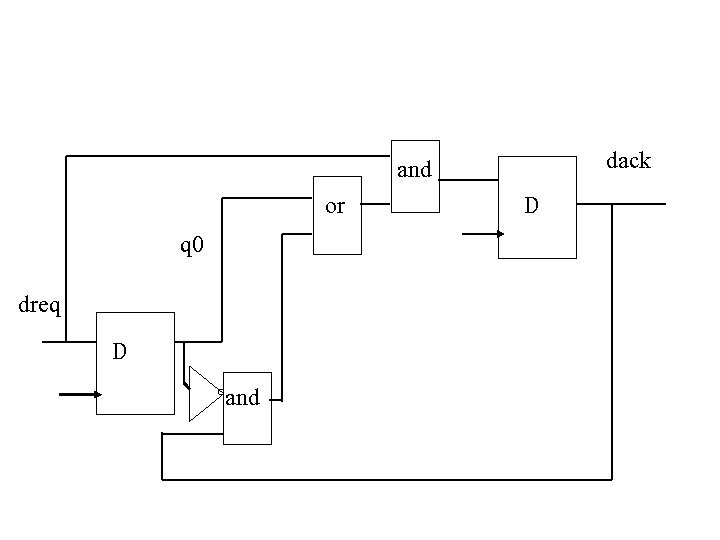 dack and or q 0 dreq D and D
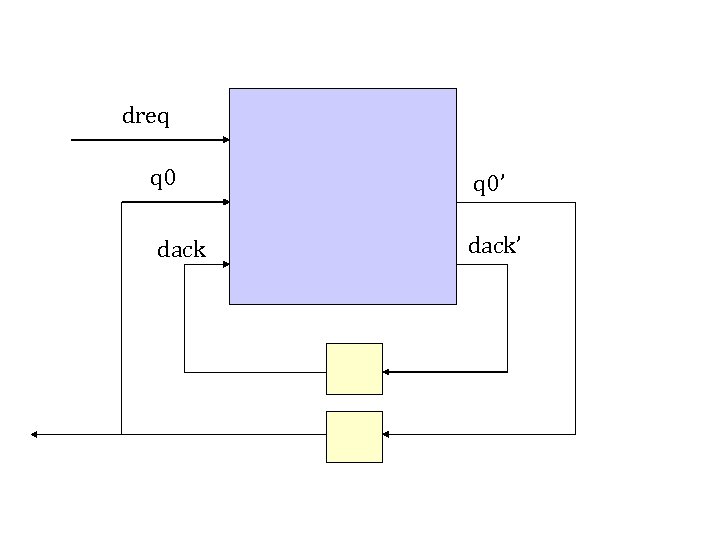 dreq q 0 dack q 0’ dack’
 Idea Transition system + special temporal logic + automatic checking algorithm
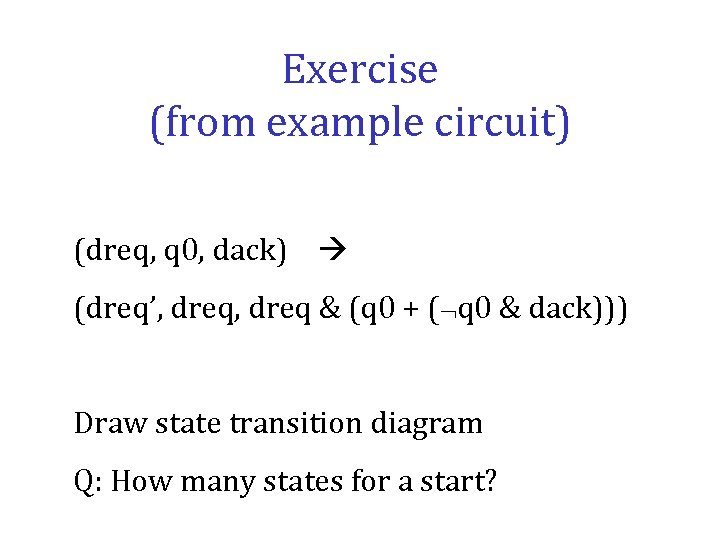 Exercise (from example circuit) (dreq, q 0, dack) (dreq’, dreq & (q 0 + ( q 0 & dack))) Draw state transition diagram Q: How many states for a start?
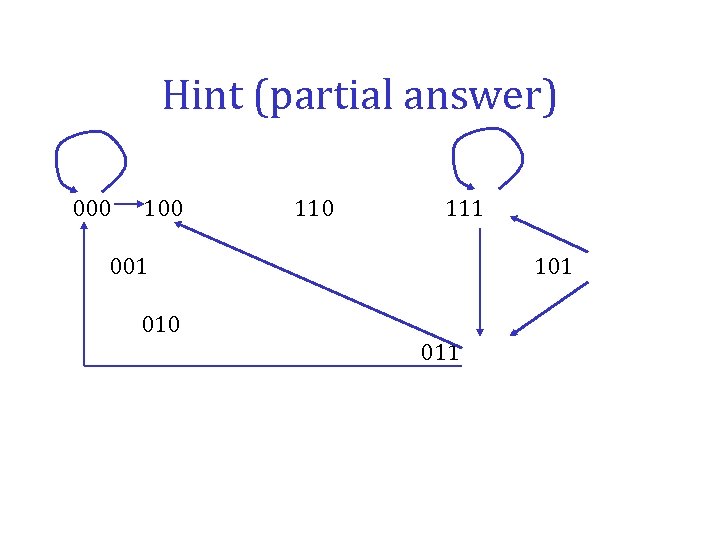 Hint (partial answer) 000 110 111 001 101 010 011
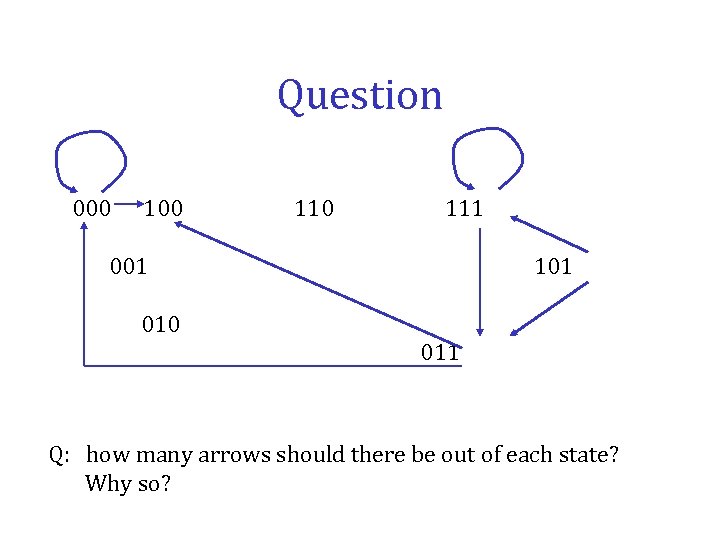 Question 000 110 111 001 101 010 011 Q: how many arrows should there be out of each state? Why so?
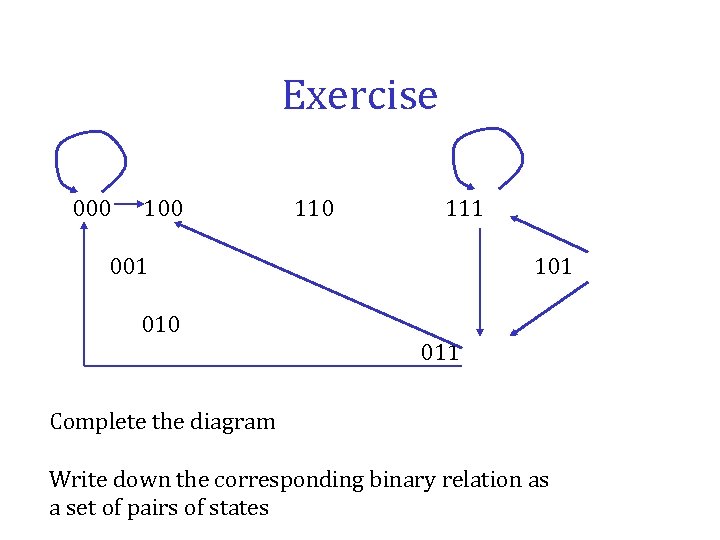 Exercise 000 110 111 001 101 010 011 Complete the diagram Write down the corresponding binary relation as a set of pairs of states
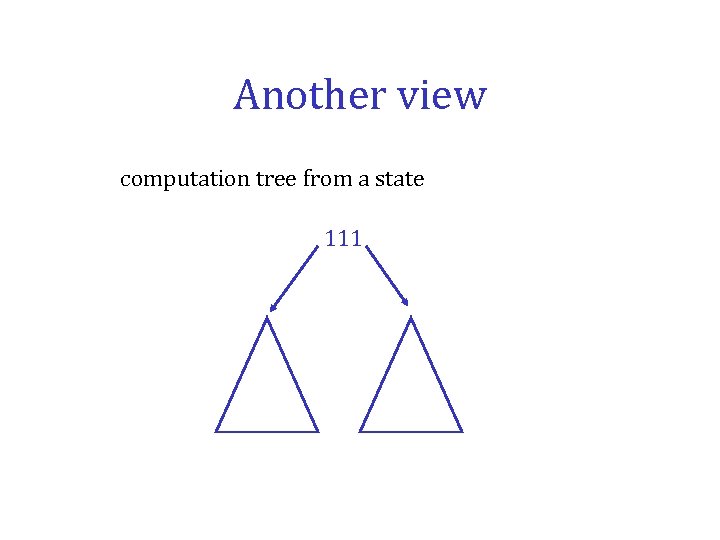 Another view computation tree from a state 111
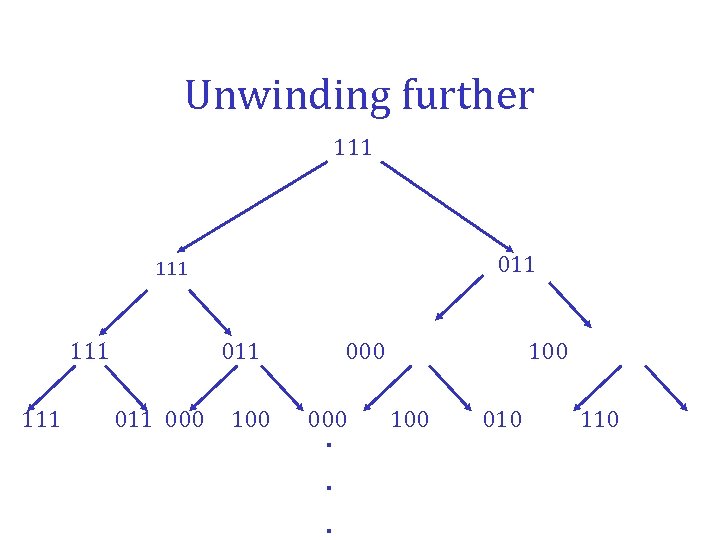 Unwinding further 111 011 111 111 011 000 100 000 . . . 100 010 110
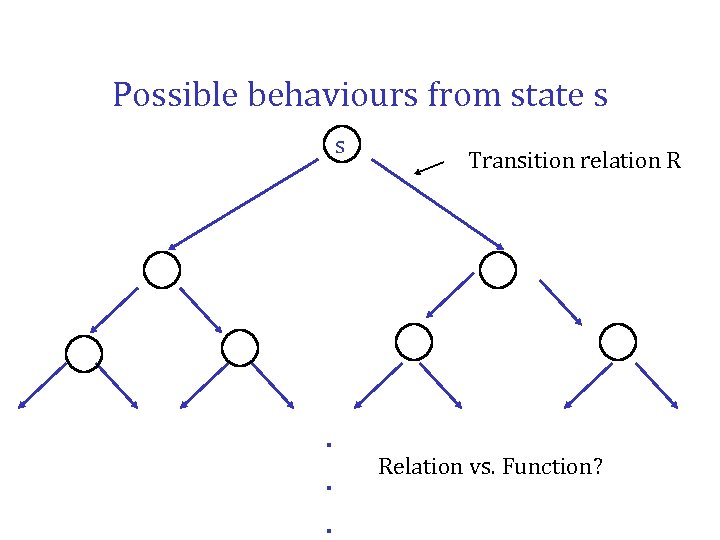 Possible behaviours from state s s . . . Transition relation R Relation vs. Function?
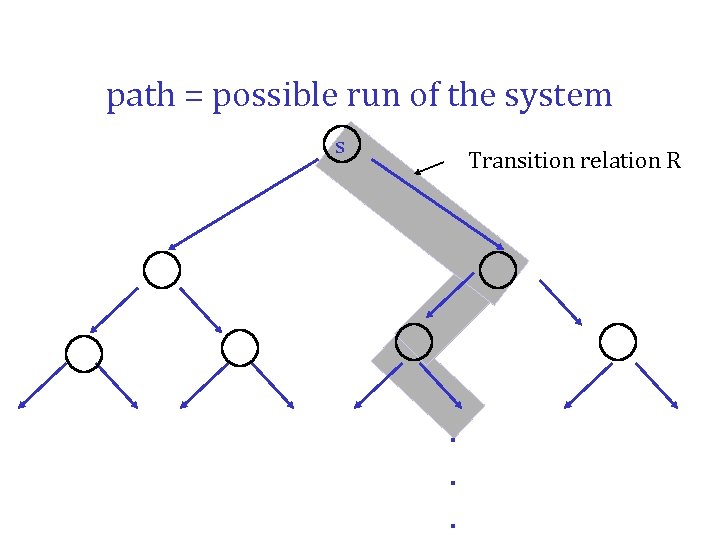 path = possible run of the system s Transition relation R . . .
 Points to note Transition system models circuit behaviour We chose the tick of the transition system to be the same as one clock cycle. Gates have zero delay – a very standard choice for synchronous circuits Could have had a finer degree of modelling of time (with delays in gates). Choices here determine what properties can be analysed Model checker starts with transition system. It doesn’t matter where it came from
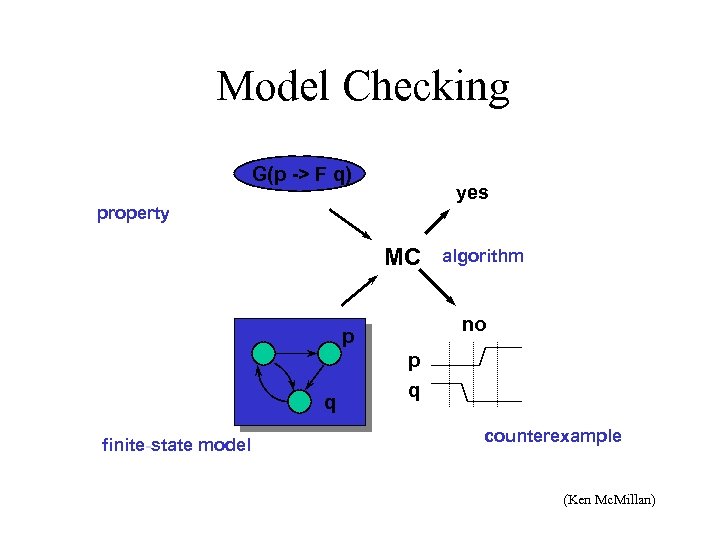 Model Checking G(p -> F q) yes property MC no p q finite-state model algorithm p q counterexample (Ken Mc. Millan)
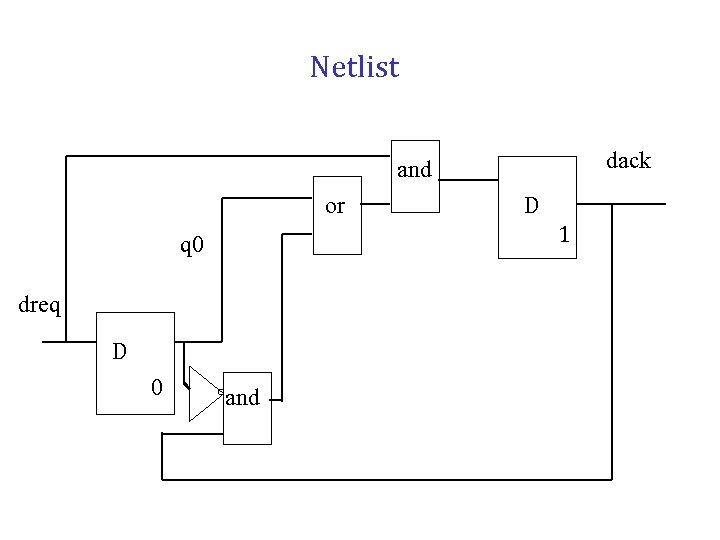 Netlist dack and or 1 q 0 dreq D 0 D and
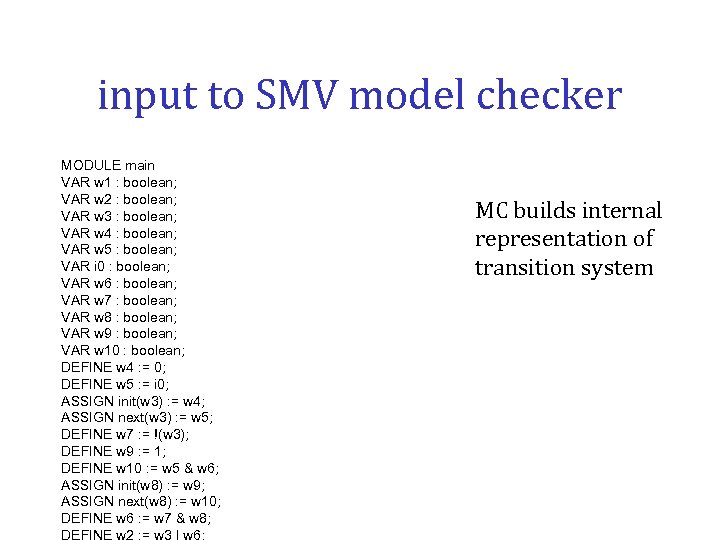 input to SMV model checker MODULE main VAR w 1 : boolean; VAR w 2 : boolean; VAR w 3 : boolean; VAR w 4 : boolean; VAR w 5 : boolean; VAR i 0 : boolean; VAR w 6 : boolean; VAR w 7 : boolean; VAR w 8 : boolean; VAR w 9 : boolean; VAR w 10 : boolean; DEFINE w 4 : = 0; DEFINE w 5 : = i 0; ASSIGN init(w 3) : = w 4; ASSIGN next(w 3) : = w 5; DEFINE w 7 : = !(w 3); DEFINE w 9 : = 1; DEFINE w 10 : = w 5 & w 6; ASSIGN init(w 8) : = w 9; ASSIGN next(w 8) : = w 10; DEFINE w 6 : = w 7 & w 8; MC builds internal representation of transition system
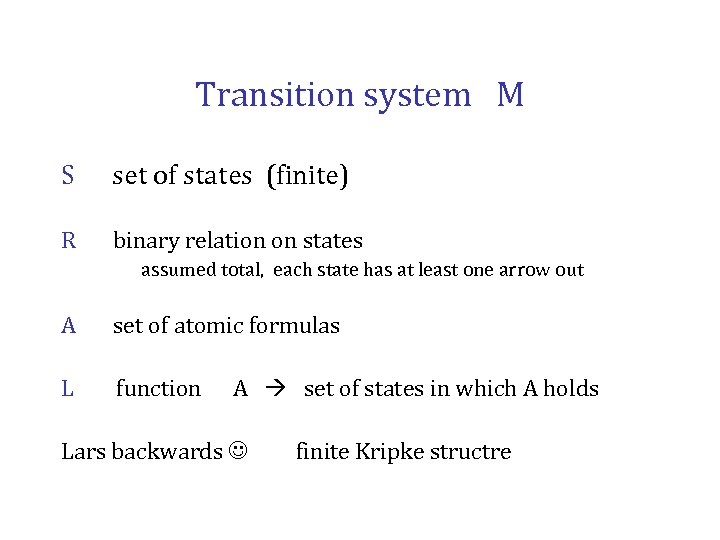 Transition system M S set of states (finite) R binary relation on states assumed total, each state has at least one arrow out A set of atomic formulas L function A set of states in which A holds Lars backwards finite Kripke structre
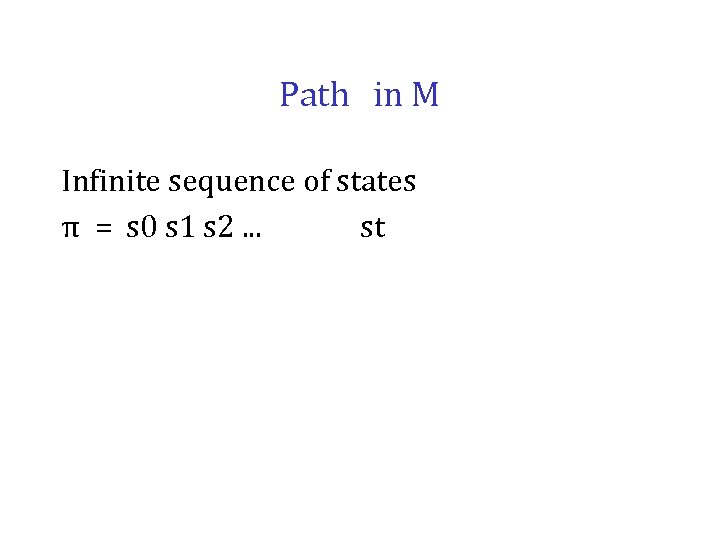 Path in M Infinite sequence of states π = s 0 s 1 s 2. . . st
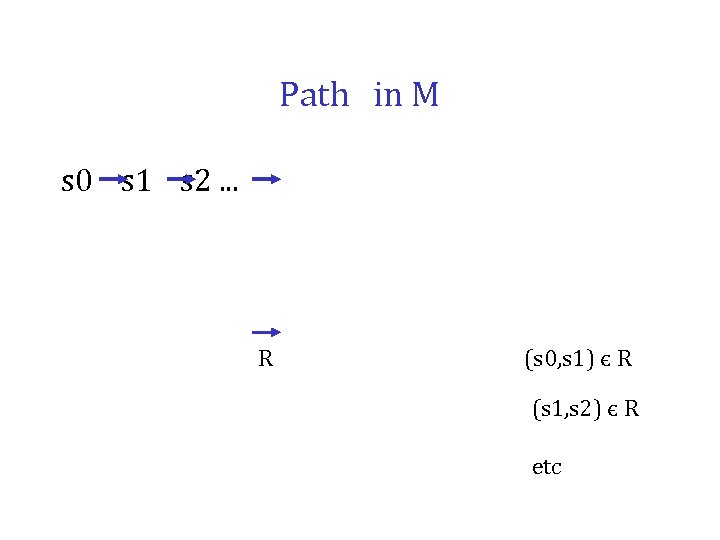 Path in M s 0 s 1 s 2. . . R (s 0, s 1) є R (s 1, s 2) є R etc
 Read Another look at LTL model checking Clarke, Grumberg and Hamaguchi See course page
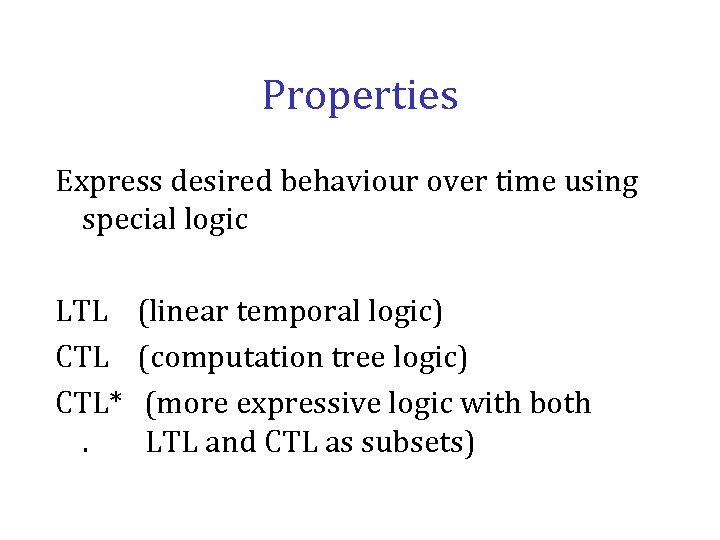 Properties Express desired behaviour over time using special logic LTL CTL*. (linear temporal logic) (computation tree logic) (more expressive logic with both LTL and CTL as subsets)
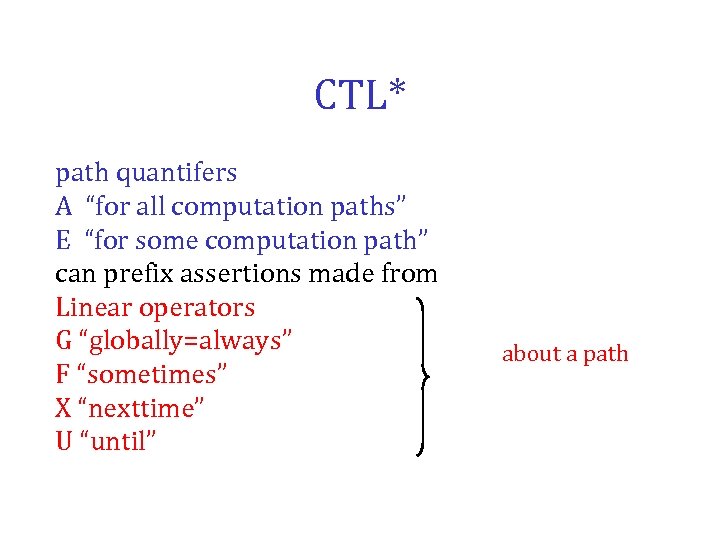 CTL* path quantifers A “for all computation paths” E “for some computation path” can prefix assertions made from Linear operators G “globally=always” F “sometimes” X “nexttime” U “until” about a path
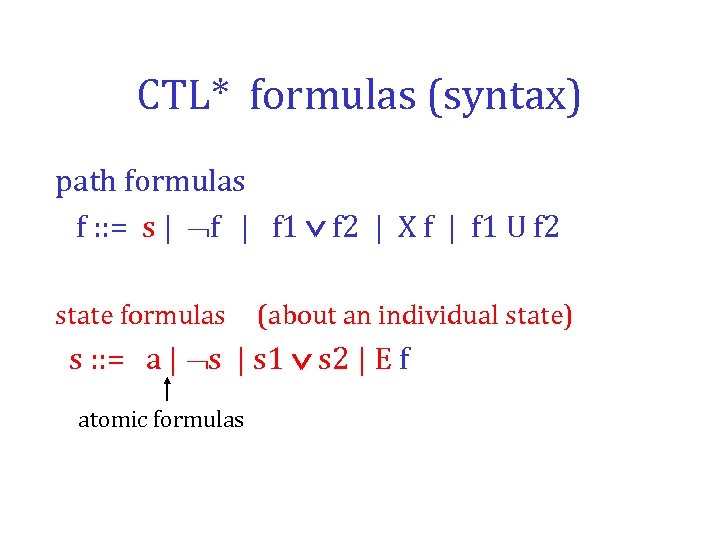 CTL* formulas (syntax) path formulas f : : = s | f 1 f 2 | X f | f 1 U f 2 state formulas (about an individual state) s : : = a | s 1 s 2 | E f atomic formulas
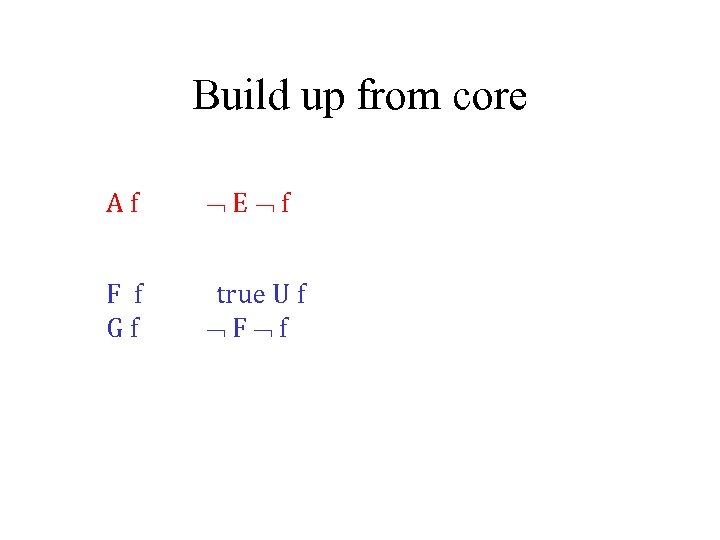 Build up from core Af E f F f Gf true U f F f
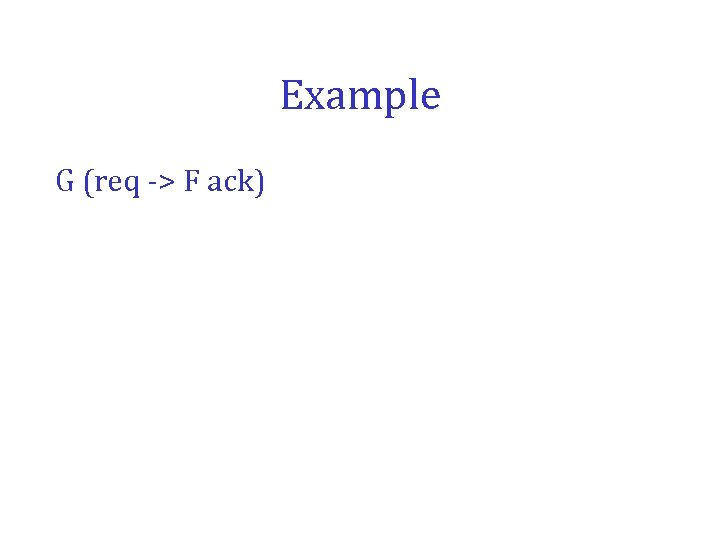 Example G (req -> F ack)
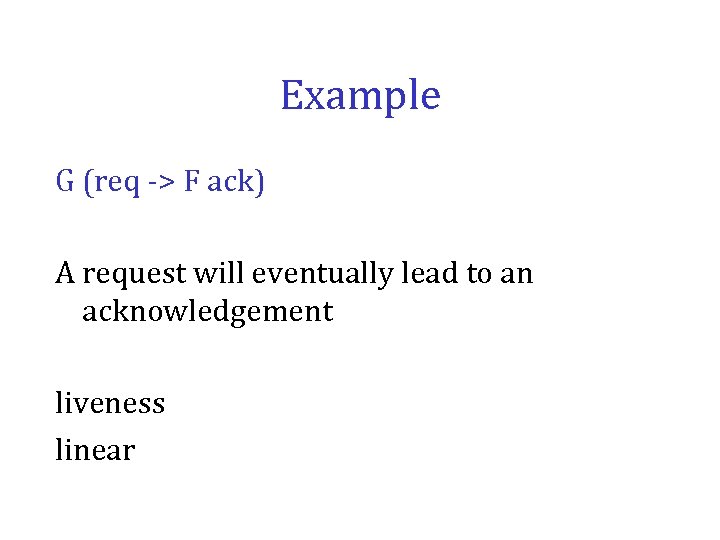 Example G (req -> F ack) A request will eventually lead to an acknowledgement liveness linear
 Example (Gordon) It is possible to get to a state where Started holds but Ready does not
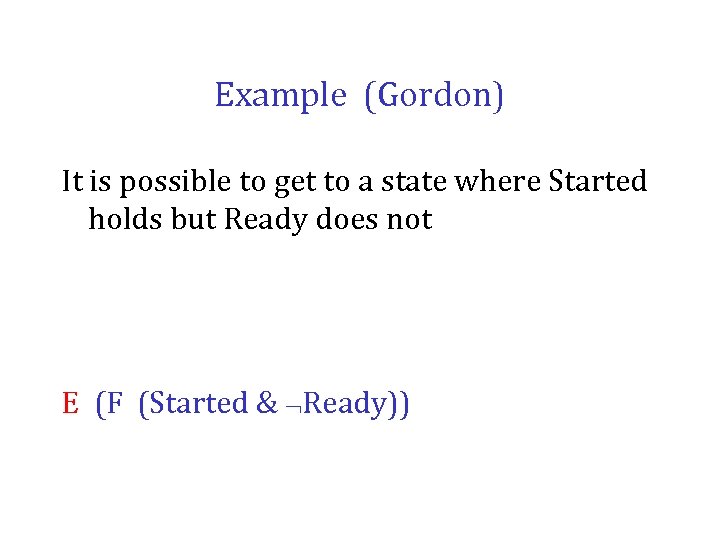 Example (Gordon) It is possible to get to a state where Started holds but Ready does not E (F (Started & Ready))
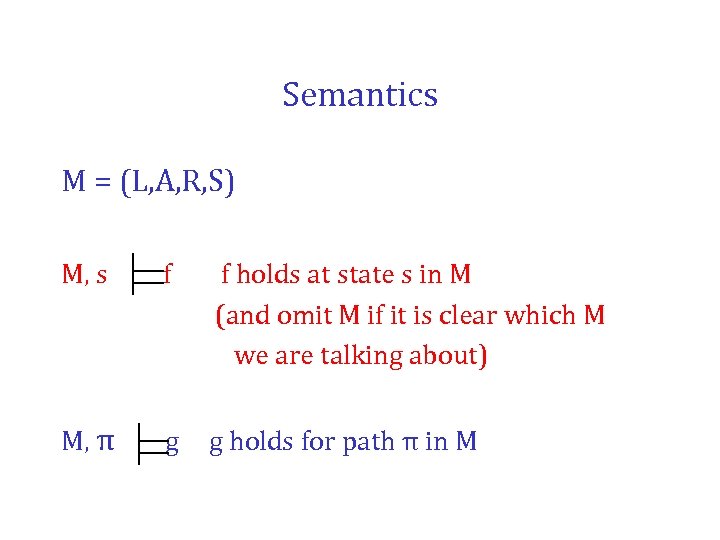 Semantics M = (L, A, R, S) M, s f f holds at state s in M (and omit M if it is clear which M we are talking about) M, π g g holds for path π in M
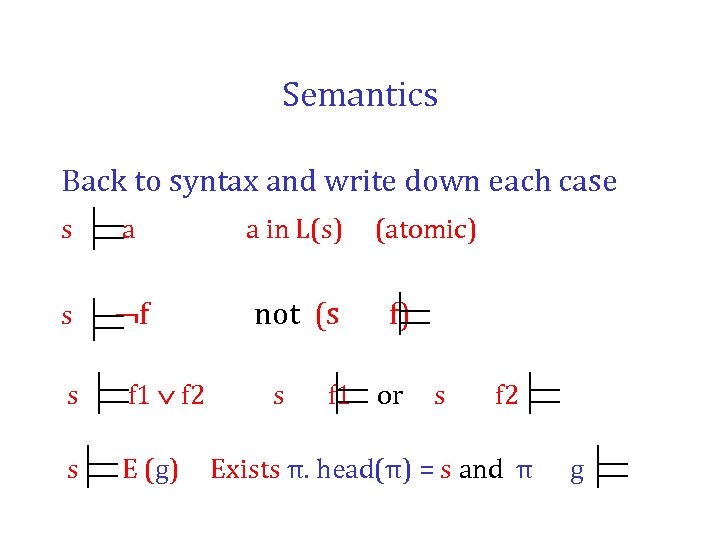 Semantics Back to syntax and write down each case s a a in L(s) s f not (s s f 1 f 2 s E (g) s (atomic) f) f 1 or s f 2 Exists π. head(π) = s and π g
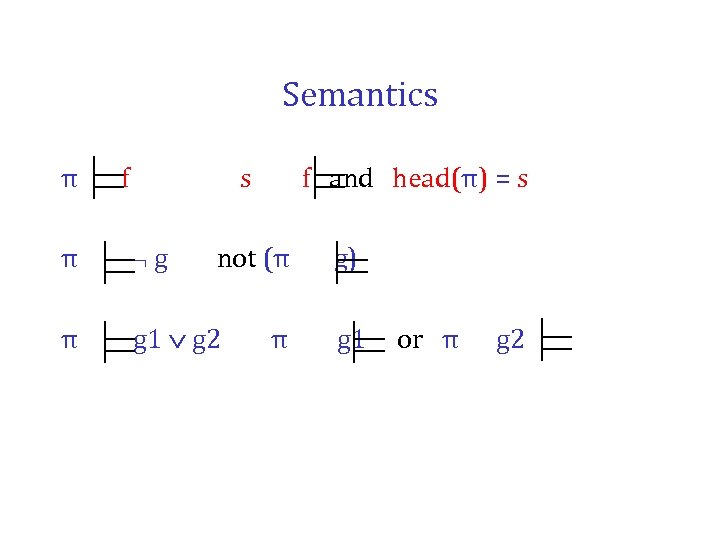 Semantics π f s π g π g 1 g 2 f and head(π) = s not (π π g) g 1 or π g 2
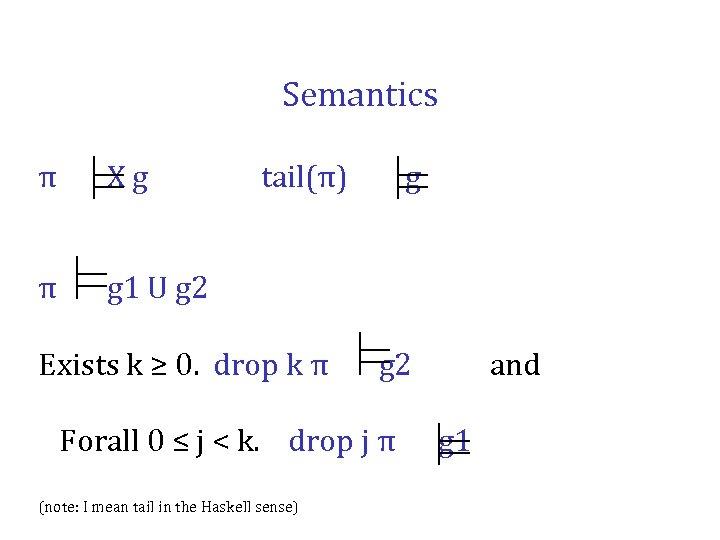 Semantics π Xg π tail(π) g 1 U g 2 Exists k ≥ 0. drop k π g g 2 Forall 0 ≤ j < k. drop j π (note: I mean tail in the Haskell sense) and g 1
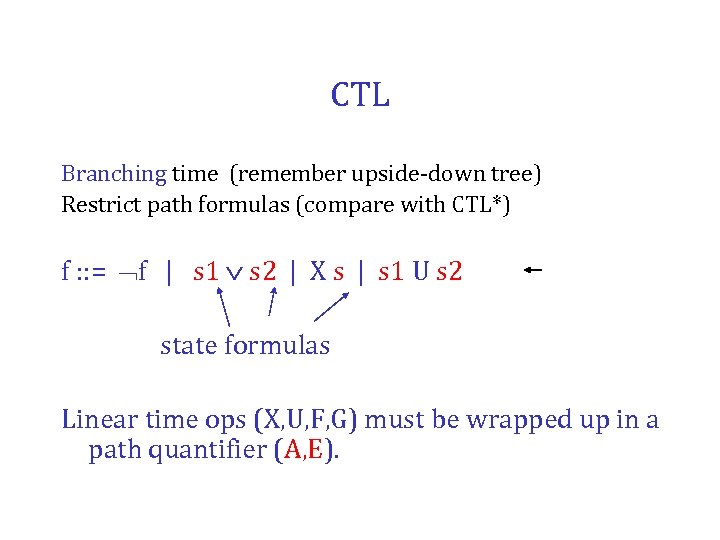 CTL Branching time (remember upside-down tree) Restrict path formulas (compare with CTL*) f : : = f | s 1 s 2 | X s | s 1 U s 2 state formulas Linear time ops (X, U, F, G) must be wrapped up in a path quantifier (A, E).
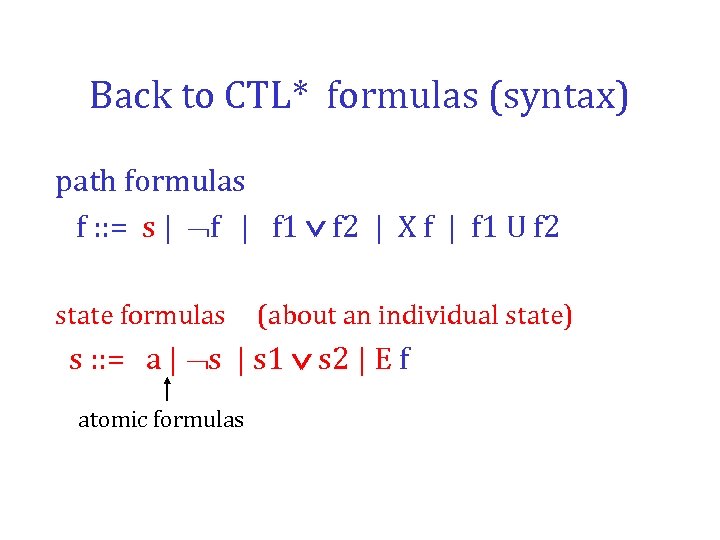 Back to CTL* formulas (syntax) path formulas f : : = s | f 1 f 2 | X f | f 1 U f 2 state formulas (about an individual state) s : : = a | s 1 s 2 | E f atomic formulas
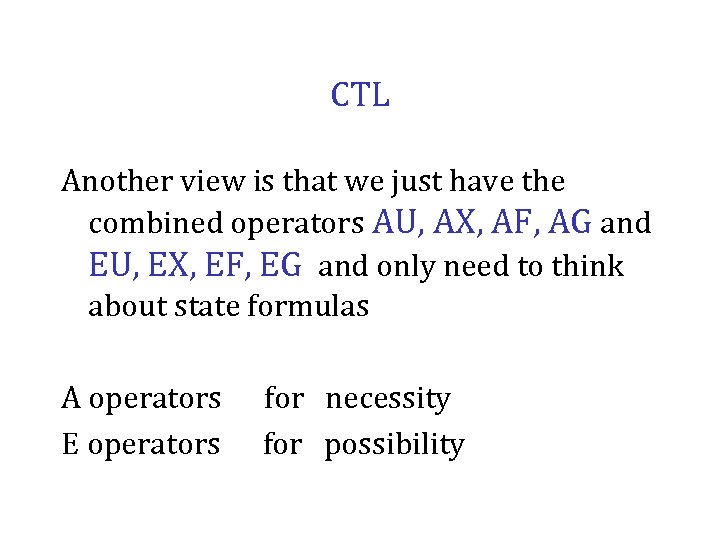 CTL Another view is that we just have the combined operators AU, AX, AF, AG and EU, EX, EF, EG and only need to think about state formulas A operators E operators for necessity for possibility
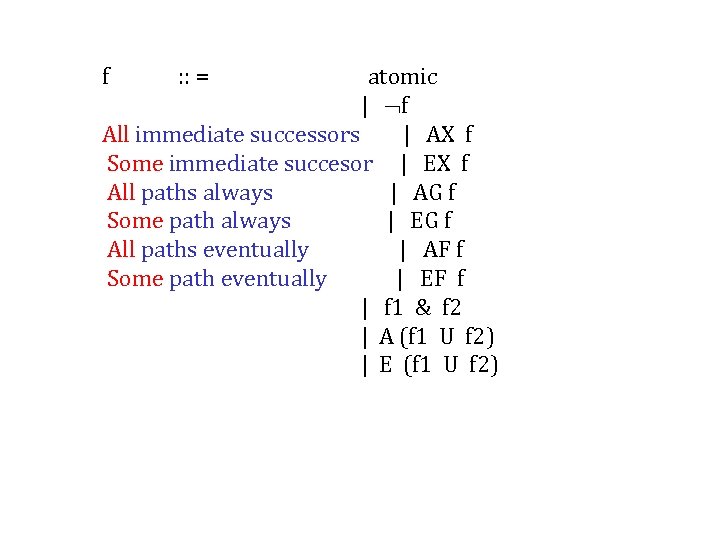 f : : = atomic | f All immediate successors | AX f Some immediate succesor | EX f All paths always | AG f Some path always | EG f All paths eventually | AF f Some path eventually | EF f | f 1 & f 2 | A (f 1 U f 2) | E (f 1 U f 2)
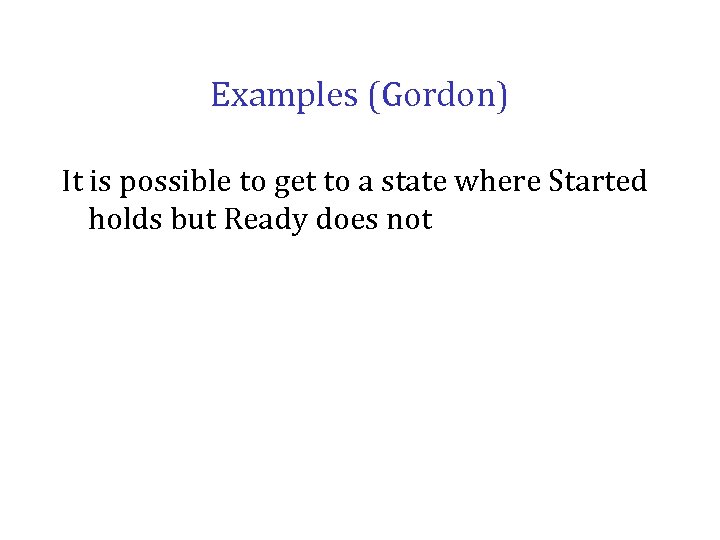 Examples (Gordon) It is possible to get to a state where Started holds but Ready does not
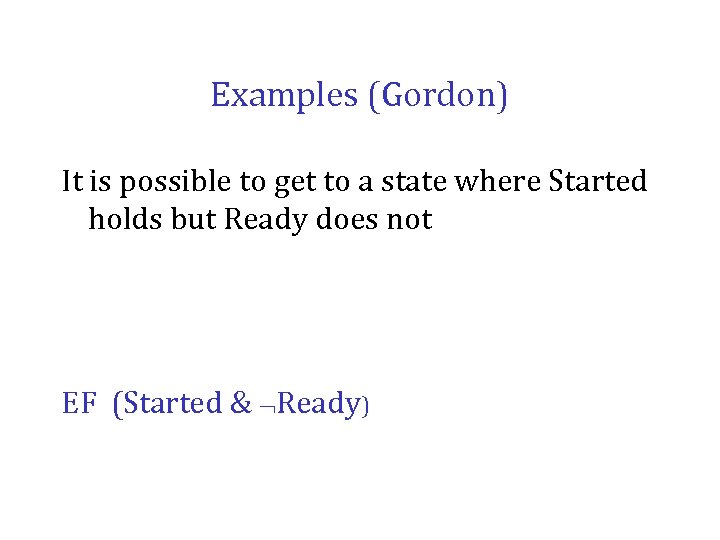 Examples (Gordon) It is possible to get to a state where Started holds but Ready does not EF (Started & Ready)
 Examples (Gordon) If a request Req occurs, then it will eventually be acknowledged by Ack
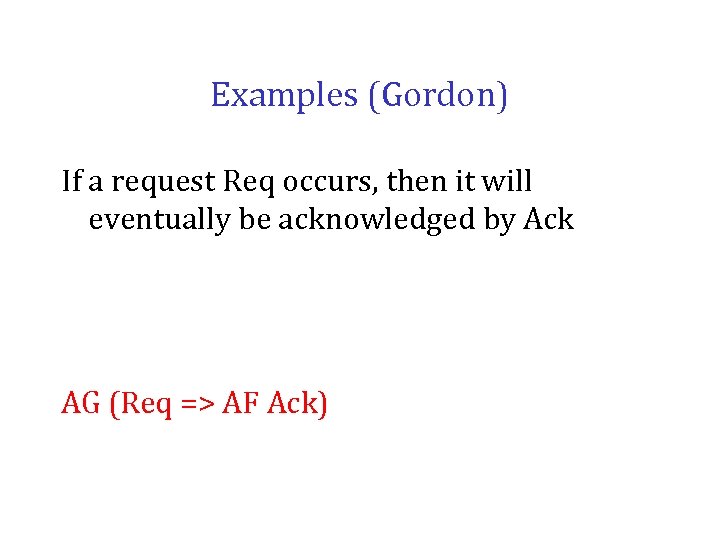 Examples (Gordon) If a request Req occurs, then it will eventually be acknowledged by Ack AG (Req => AF Ack)
 Examples (Gordon) If a request Req occurs, then it continues to hold, until it is eventually acknowledged
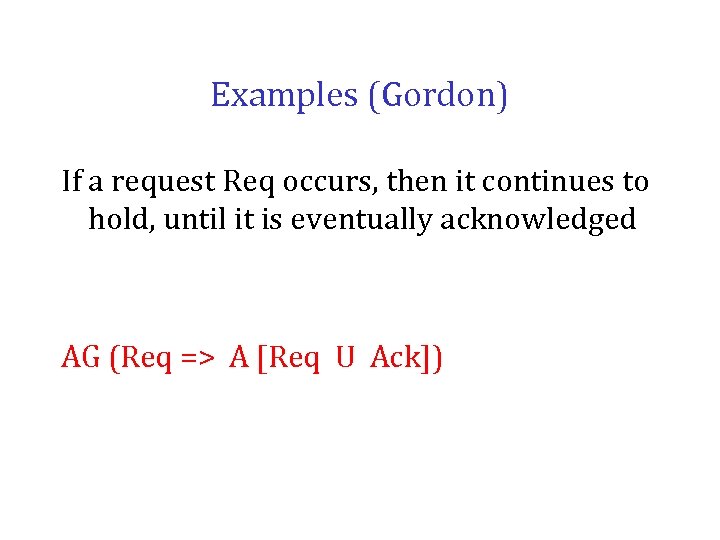 Examples (Gordon) If a request Req occurs, then it continues to hold, until it is eventually acknowledged AG (Req => A [Req U Ack])
 Exercise Draw computation trees illustrating AX f and EX f
 Exercise Draw computation trees illustrating AG, EG, AF and EF (See nice pictures from Pistore and Roveri)
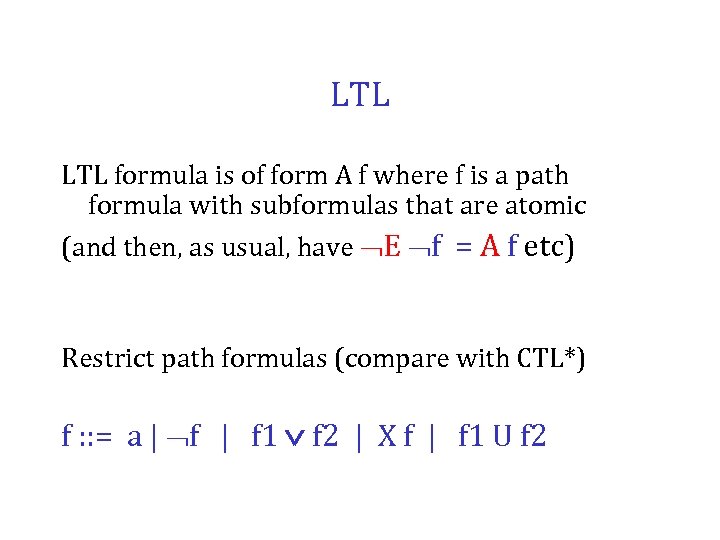 LTL formula is of form A f where f is a path formula with subformulas that are atomic (and then, as usual, have E f = A f etc) Restrict path formulas (compare with CTL*) f : : = a | f 1 f 2 | X f | f 1 U f 2
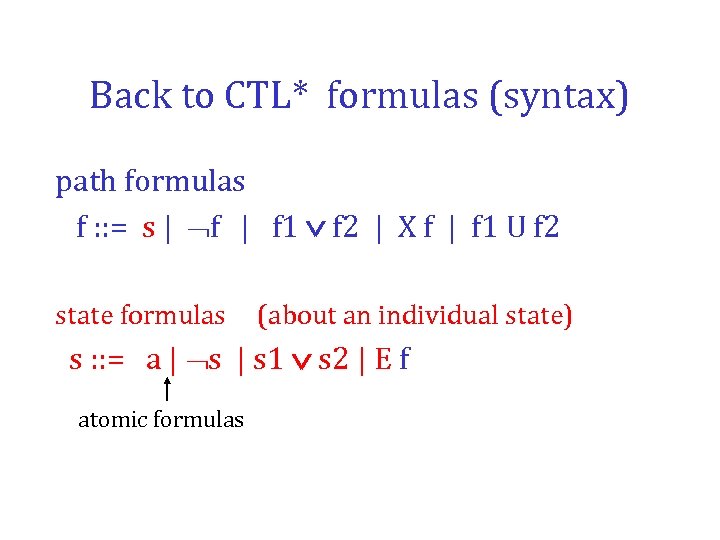 Back to CTL* formulas (syntax) path formulas f : : = s | f 1 f 2 | X f | f 1 U f 2 state formulas (about an individual state) s : : = a | s 1 s 2 | E f atomic formulas
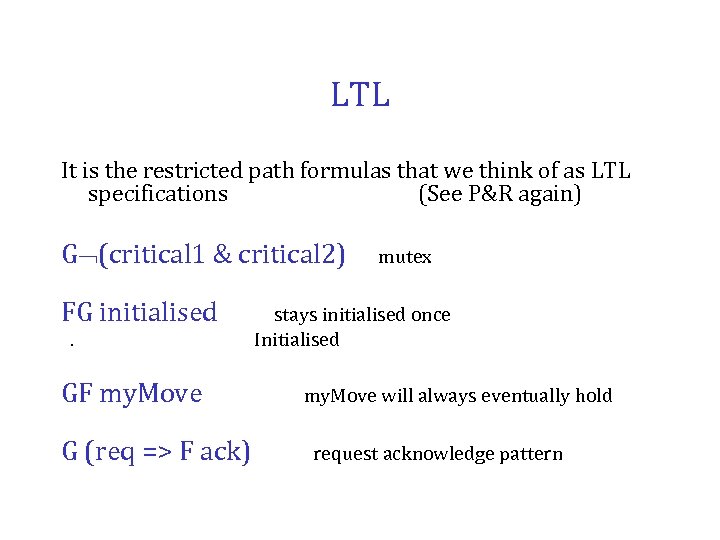 LTL It is the restricted path formulas that we think of as LTL specifications (See P&R again) G (critical 1 & critical 2) FG initialised. GF my. Move G (req => F ack) mutex stays initialised once Initialised my. Move will always eventually hold request acknowledge pattern
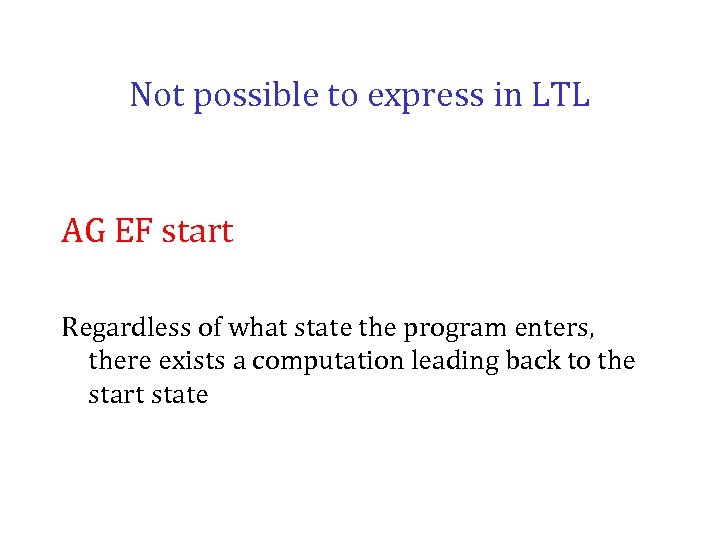 Not possible to express in LTL AG EF start Regardless of what state the program enters, there exists a computation leading back to the start state
 Exercise Find something that can be expressed in LTL but not CTL
 Further reading The ”Another look at LTL model checking paper” Ed Clarke’s course on Bug Catching: Automated Program Verification and Testing complete with moving bug on the home page! Covers model checking relevant to hardware too. http: //www-2. cs. cmu. edu/~emc/15 -398/
 Next lecture How to model check LTL and CTL formulas