


 Скачать презентацию Model Checking CTL model checking algorithms Many slides
36cdf4ac9db78c71d0bc3d0ff8c0febc.ppt
- Количество слайдов: 46
 Model Checking CTL model checking algorithms Many slides from Tevfik Bultan
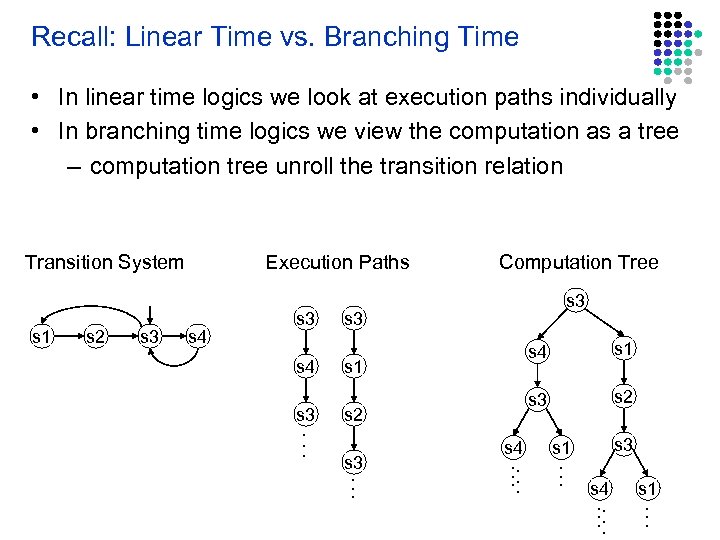 Recall: Linear Time vs. Branching Time • In linear time logics we look at execution paths individually • In branching time logics we view the computation as a tree – computation tree unroll the transition relation Transition System s 1 s 2 s 3 Execution Paths s 4 s 3. . . Computation Tree s 3 s 4 s 3 s 1 s 2 s 3. . . s 4. . . s 1 s 2 s 3 s 1. . . s 4. . . s 1. . .
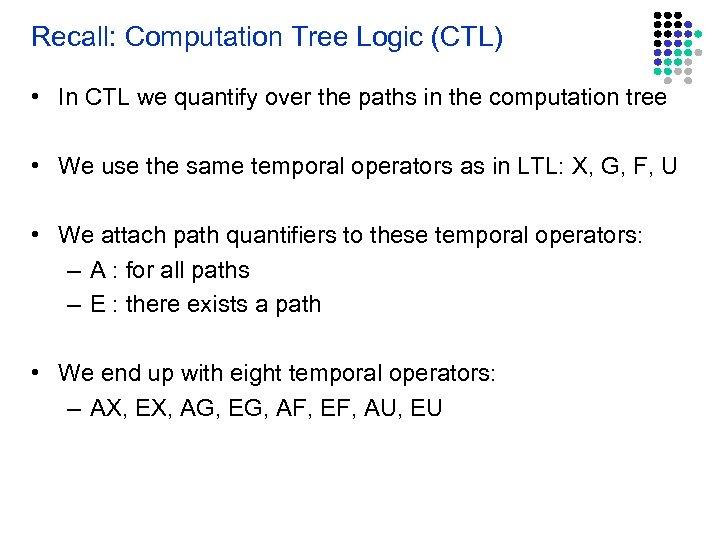 Recall: Computation Tree Logic (CTL) • In CTL we quantify over the paths in the computation tree • We use the same temporal operators as in LTL: X, G, F, U • We attach path quantifiers to these temporal operators: – A : for all paths – E : there exists a path • We end up with eight temporal operators: – AX, EX, AG, EG, AF, EF, AU, EU
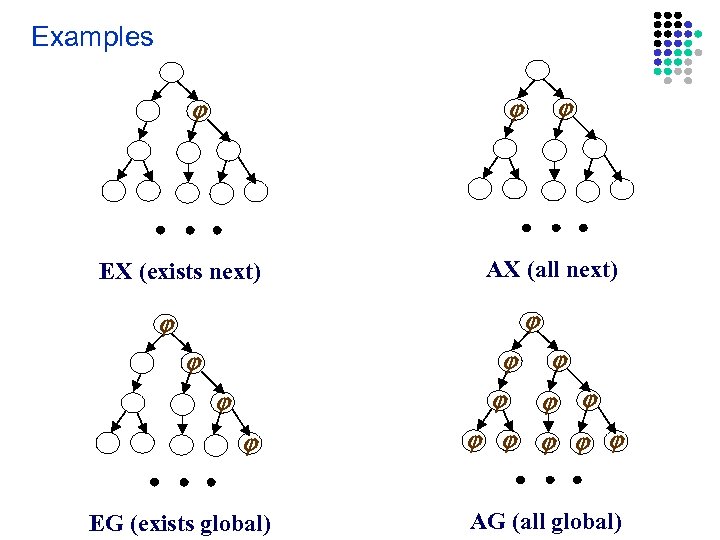 Examples EX (exists next) AX (all next) EG (exists global) AG (all global)
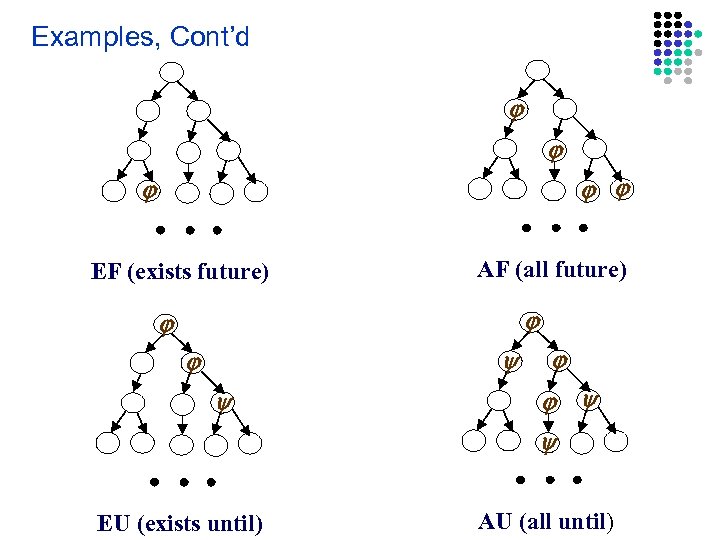 Examples, Cont’d EF (exists future) AF (all future) EU (exists until) AU (all until)
![Automated Verification of Finite State Systems [Clarke and Emerson 81], [Queille and Sifakis 82]](https://present5.com/presentation/36cdf4ac9db78c71d0bc3d0ff8c0febc/image-6.jpg "Automated Verification of Finite State Systems [Clarke and Emerson 81], [Queille and Sifakis 82]") Automated Verification of Finite State Systems [Clarke and Emerson 81], [Queille and Sifakis 82] • CTL Model checking problem: Given a transition system T = (S, I, R), and a CTL formula f, does the transition system satisfy the property? CTL model checking problem can be solved in O(|f| (|S|+|R|)) Note that the complexity is linear in the size of the transition system – But, the size of the transition system is exponential in the number of variables and concurrent components – this is called the state space explosion problem
Automated Verification of Finite State Systems [Clarke and Emerson 81], [Queille and Sifakis 82] • CTL Model checking problem: Given a transition system T = (S, I, R), and a CTL formula f, does the transition system satisfy the property? CTL model checking problem can be solved in O(|f| (|S|+|R|)) Note that the complexity is linear in the size of the transition system – But, the size of the transition system is exponential in the number of variables and concurrent components – this is called the state space explosion problem
 CTL Model Checking Algorithm • Translate the formula to a formula which uses the basis – EX p, EG p, p EU q • Key idea: Start from the innermost (non-atomic) subformulas and label the states in the transition system with the subformulas that hold in that state – Initially states are labeled with atomic properties • Each (temporal or boolean) operator has to be processed once – Graph traversal algorithms are used to find the labeling for each operator • Computation of each subformula takes O(|S|+|R|)
 CTL Model Checking Algorithm • EX p is easy to do in O(|S|+|R|) – All the nodes which have a next state labeled with p should be labeled with EX p • p EU q: Find the states which are the source of a path where p U q holds – Equivalently, find the nodes which reach a node that is labeled with q by a path where each node is labeled with p – Label such nodes with p EU q – It is a reachability problem which can be solved in O(|S|+|R|)
 CTL Model Checking Algorithm • EG p: Find paths where each node is labeled with p and label nodes in such paths with EG p – First remove all the states which do not satisfy p from the transition graph – Compute the strongly connected components of the remaining graph and then find the nodes which can reach the strongly connected components (both of which can be done in O(|S|+|R|) – Label the nodes in the strongly connected components and that can reach the strongly connected components with EG p
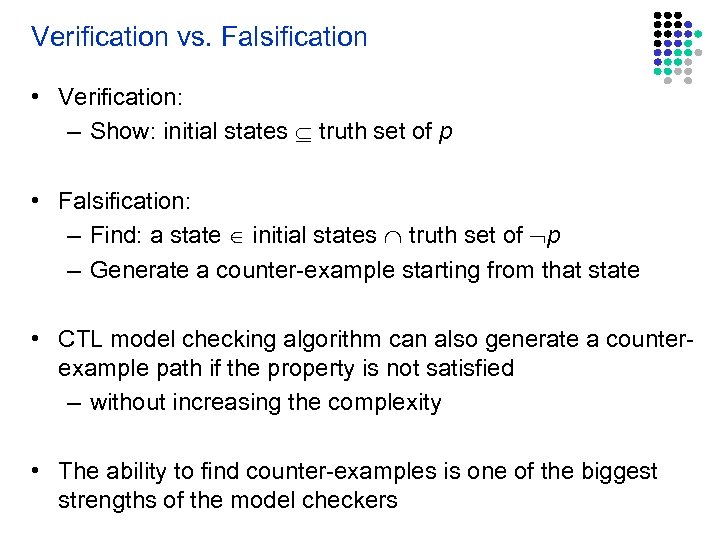 Verification vs. Falsification • Verification: – Show: initial states truth set of p • Falsification: – Find: a state initial states truth set of p – Generate a counter-example starting from that state • CTL model checking algorithm can also generate a counterexample path if the property is not satisfied – without increasing the complexity • The ability to find counter-examples is one of the biggest strengths of the model checkers
 Problems with the previous algorithm It is named to explicit state model checking • All the states and labels associated to the states must be recorded – needs a lot of memory – exponential explosion - the set of states in the transition graph is exponential to the number of variables and concurrent processes in the initial system
![Temporal Properties Fixpoints [Emerson and Clarke 80] Here are some interesting CTL equivalences: AG](https://present5.com/presentation/36cdf4ac9db78c71d0bc3d0ff8c0febc/image-12.jpg "Temporal Properties Fixpoints [Emerson and Clarke 80] Here are some interesting CTL equivalences: AG") Temporal Properties Fixpoints [Emerson and Clarke 80] Here are some interesting CTL equivalences: AG p = p AX AG p EG p = p EX EG p AF p = p AX AF p EF p = p EX EF p p AU q = q (p AX (p AU q)) p EU q = q (p EX (p EU q)) Note that we wrote the CTL temporal operators in terms of themselves and EX and AX operators - unfolding the property
Temporal Properties Fixpoints [Emerson and Clarke 80] Here are some interesting CTL equivalences: AG p = p AX AG p EG p = p EX EG p AF p = p AX AF p EF p = p EX EF p p AU q = q (p AX (p AU q)) p EU q = q (p EX (p EU q)) Note that we wrote the CTL temporal operators in terms of themselves and EX and AX operators - unfolding the property
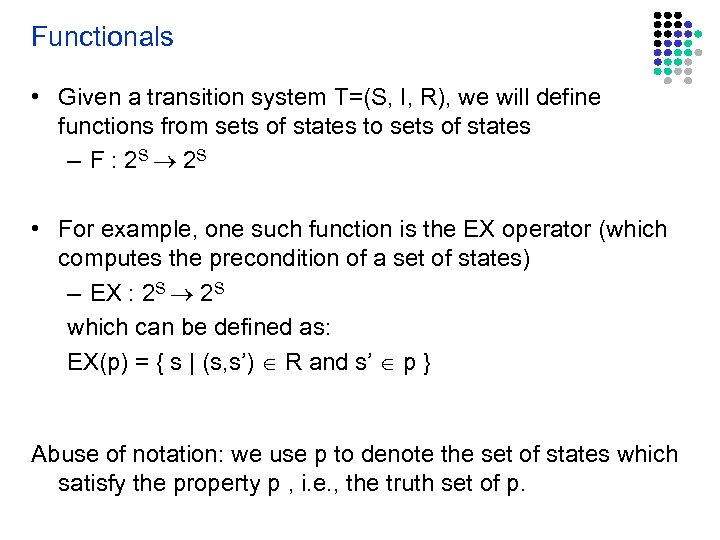 Functionals • Given a transition system T=(S, I, R), we will define functions from sets of states to sets of states – F : 2 S 2 S • For example, one such function is the EX operator (which computes the precondition of a set of states) – EX : 2 S which can be defined as: EX(p) = { s | (s, s’) R and s’ p } Abuse of notation: we use p to denote the set of states which satisfy the property p , i. e. , the truth set of p.
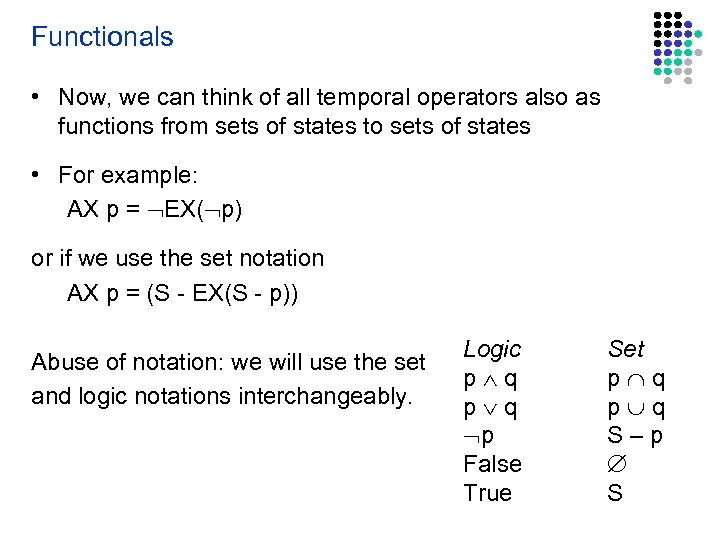 Functionals • Now, we can think of all temporal operators also as functions from sets of states to sets of states • For example: AX p = EX( p) or if we use the set notation AX p = (S - EX(S - p)) Abuse of notation: we will use the set and logic notations interchangeably. Logic p q p False True Set p q S–p S
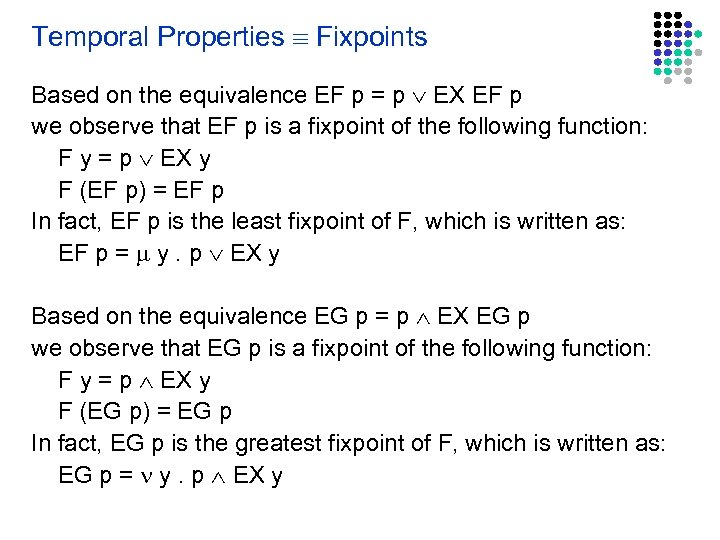 Temporal Properties Fixpoints Based on the equivalence EF p = p EX EF p we observe that EF p is a fixpoint of the following function: F y = p EX y F (EF p) = EF p In fact, EF p is the least fixpoint of F, which is written as: EF p = y. p EX y Based on the equivalence EG p = p EX EG p we observe that EG p is a fixpoint of the following function: F y = p EX y F (EG p) = EG p In fact, EG p is the greatest fixpoint of F, which is written as: EG p = y. p EX y
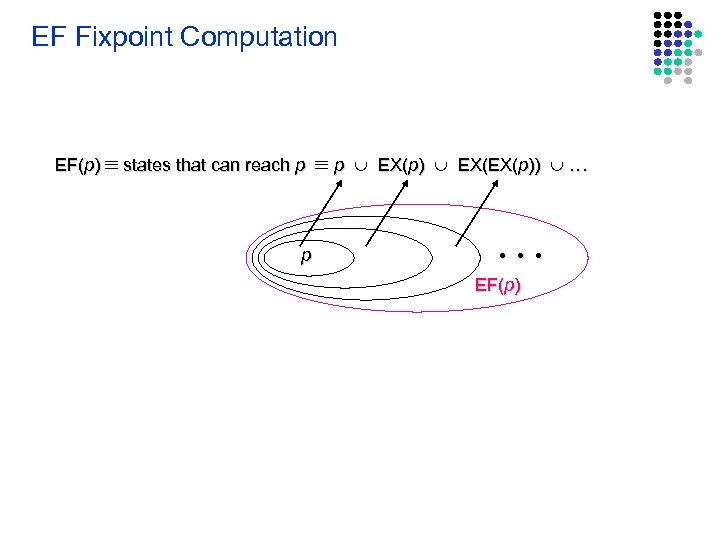 EF Fixpoint Computation EF(p) states that can reach p p p EX(p) EX(EX(p)) . . . • • • EF(p)
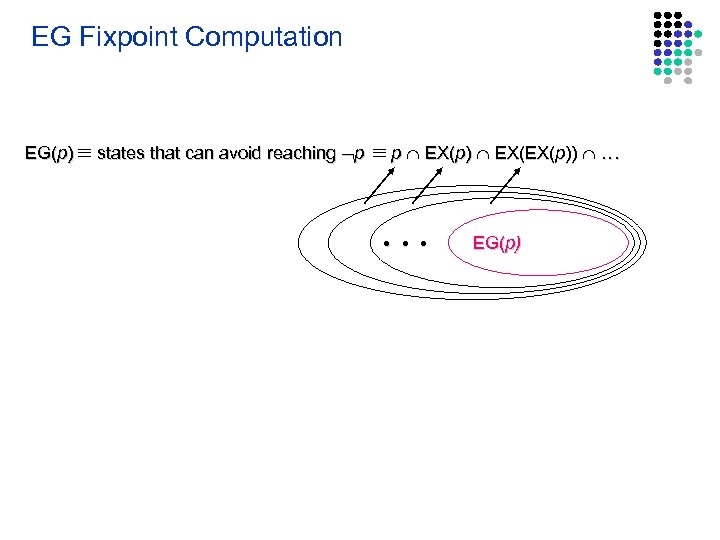 EG Fixpoint Computation EG(p) states that can avoid reaching p p EX(p) EX(EX(p)) . . . • • • EG(p)
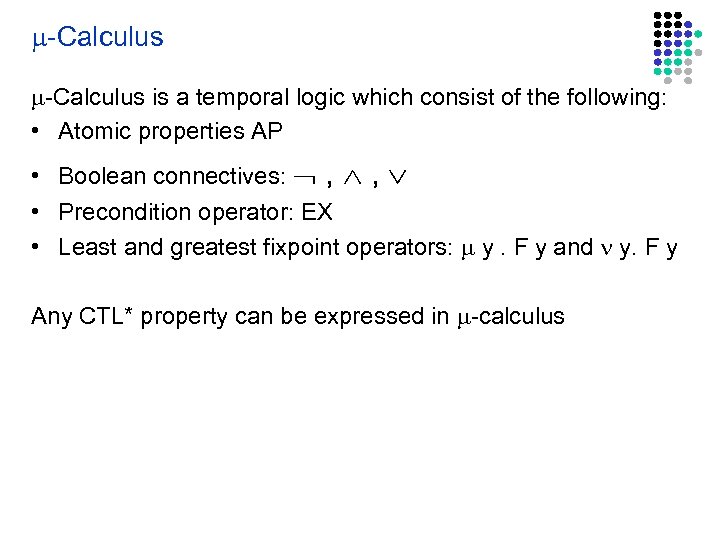 -Calculus is a temporal logic which consist of the following: • Atomic properties AP • Boolean connectives: , , • Precondition operator: EX • Least and greatest fixpoint operators: y. F y and y. F y Any CTL* property can be expressed in -calculus
![Symbolic Model Checking [Mc. Millan et al. LICS 90] • Represent sets of states](https://present5.com/presentation/36cdf4ac9db78c71d0bc3d0ff8c0febc/image-19.jpg "Symbolic Model Checking [Mc. Millan et al. LICS 90] • Represent sets of states") Symbolic Model Checking [Mc. Millan et al. LICS 90] • Represent sets of states and the transition relation as Boolean logic formulas • Fixpoint computation becomes formula manipulation – pre-condition (EX) computation: Existential variable elimination – conjunction (intersection), disjunction (union) and negation (set difference), and equivalence check • Use an efficient data structure for boolean logic formulas – Binary Decision Diagrams (BDDs)
Symbolic Model Checking [Mc. Millan et al. LICS 90] • Represent sets of states and the transition relation as Boolean logic formulas • Fixpoint computation becomes formula manipulation – pre-condition (EX) computation: Existential variable elimination – conjunction (intersection), disjunction (union) and negation (set difference), and equivalence check • Use an efficient data structure for boolean logic formulas – Binary Decision Diagrams (BDDs)
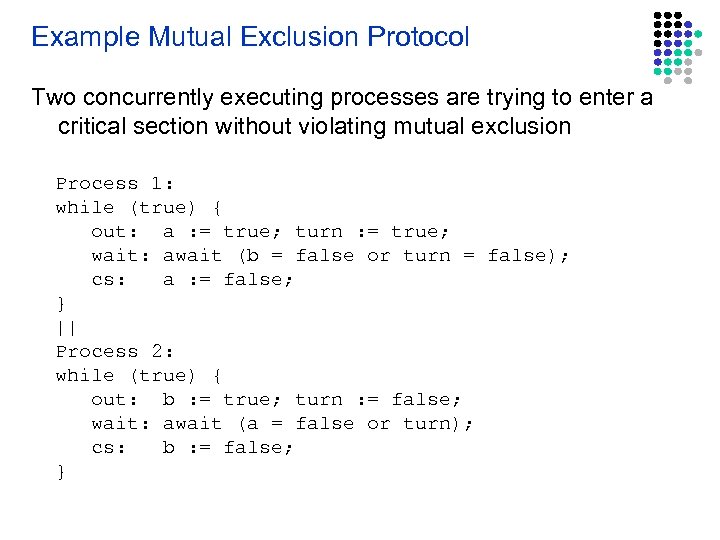 Example Mutual Exclusion Protocol Two concurrently executing processes are trying to enter a critical section without violating mutual exclusion Process 1: while (true) { out: a : = true; turn : = true; wait: await (b = false or turn = false); cs: a : = false; } || Process 2: while (true) { out: b : = true; turn : = false; wait: await (a = false or turn); cs: b : = false; }
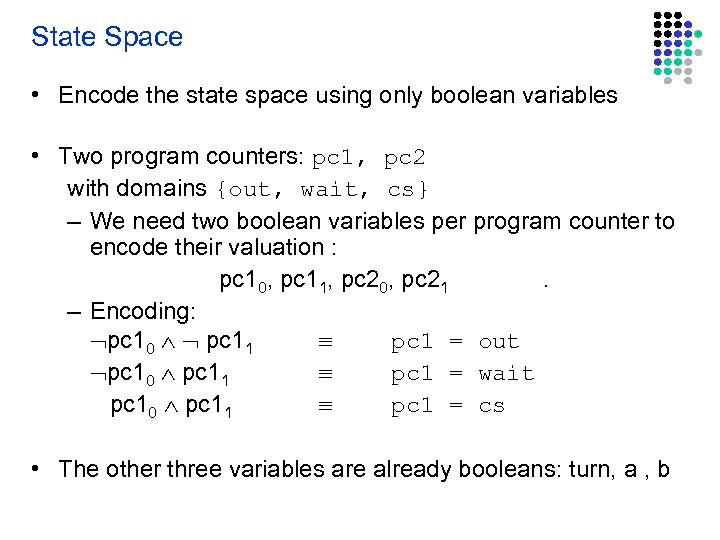 State Space • Encode the state space using only boolean variables • Two program counters: pc 1, pc 2 with domains {out, wait, cs} – We need two boolean variables per program counter to encode their valuation : pc 10, pc 11, pc 20, pc 21. – Encoding: pc 10 pc 11 pc 1 = out pc 10 pc 11 pc 1 = wait pc 10 pc 11 pc 1 = cs • The other three variables are already booleans: turn, a , b
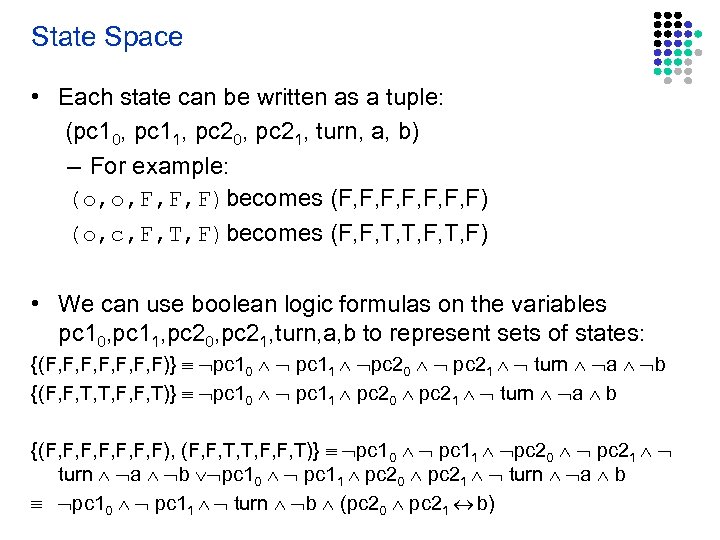 State Space • Each state can be written as a tuple: (pc 10, pc 11, pc 20, pc 21, turn, a, b) – For example: (o, o, F, F, F)becomes (F, F, F, F) (o, c, F, T, F)becomes (F, F, T, T, F) • We can use boolean logic formulas on the variables pc 10, pc 11, pc 20, pc 21, turn, a, b to represent sets of states: {(F, F, F, F)} pc 10 pc 11 pc 20 pc 21 turn a b {(F, F, T, T, F, F, T)} pc 10 pc 11 pc 20 pc 21 turn a b {(F, F, F, F), (F, F, T, T, F, F, T)} pc 10 pc 11 pc 20 pc 21 turn a b pc 10 pc 11 pc 20 pc 21 turn a b pc 10 pc 11 turn b (pc 20 pc 21 b)
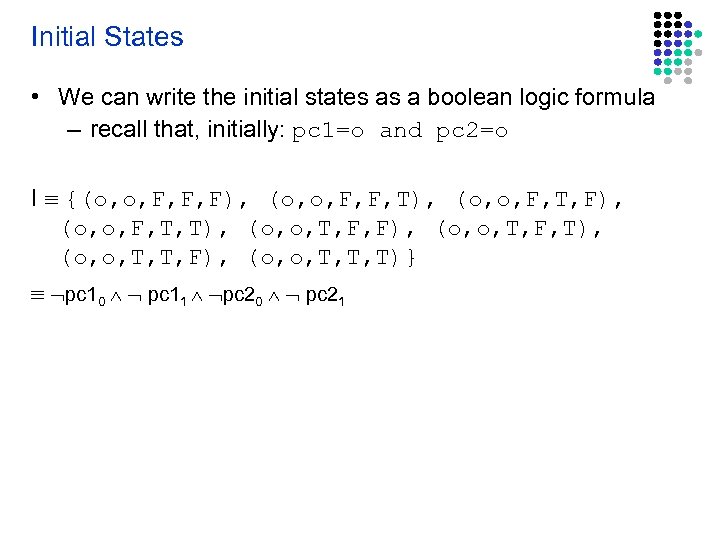 Initial States • We can write the initial states as a boolean logic formula – recall that, initially: pc 1=o and pc 2=o I {(o, o, F, F, F), (o, o, F, F, T), (o, o, F, T, F), (o, o, F, T, T), (o, o, T, F, F), (o, o, T, F, T), (o, o, T, T, F), (o, o, T, T, T)} pc 10 pc 11 pc 20 pc 21
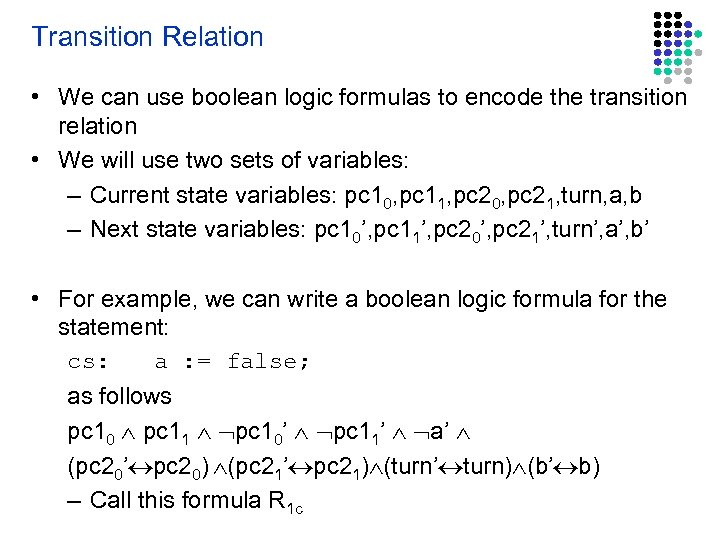 Transition Relation • We can use boolean logic formulas to encode the transition relation • We will use two sets of variables: – Current state variables: pc 10, pc 11, pc 20, pc 21, turn, a, b – Next state variables: pc 10’, pc 11’, pc 20’, pc 21’, turn’, a’, b’ • For example, we can write a boolean logic formula for the statement: cs: a : = false; as follows pc 10 pc 11 pc 10’ pc 11’ a’ (pc 20’ pc 20) (pc 21’ pc 21) (turn’ turn) (b’ b) – Call this formula R 1 c
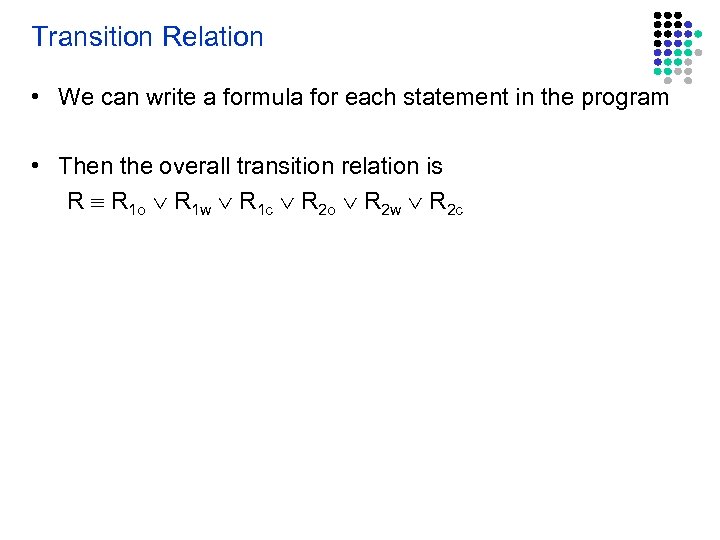 Transition Relation • We can write a formula for each statement in the program • Then the overall transition relation is R R 1 o R 1 w R 1 c R 2 o R 2 w R 2 c
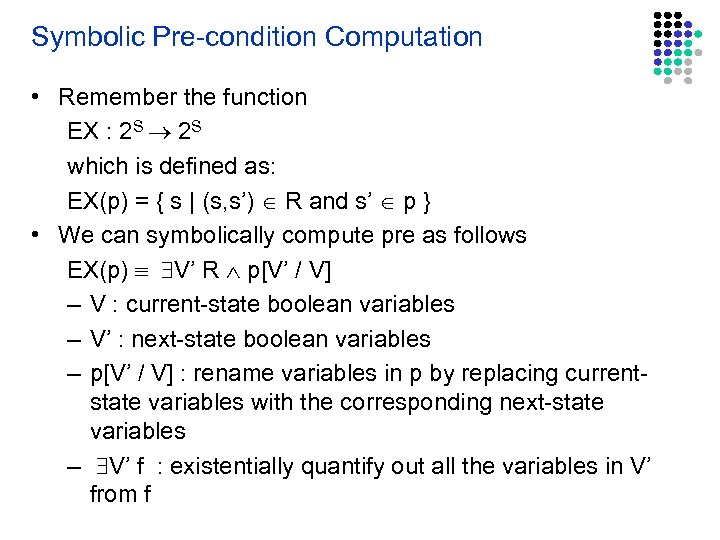 Symbolic Pre-condition Computation • Remember the function EX : 2 S which is defined as: EX(p) = { s | (s, s’) R and s’ p } • We can symbolically compute pre as follows EX(p) V’ R p[V’ / V] – V : current-state boolean variables – V’ : next-state boolean variables – p[V’ / V] : rename variables in p by replacing currentstate variables with the corresponding next-state variables – V’ f : existentially quantify out all the variables in V’ from f
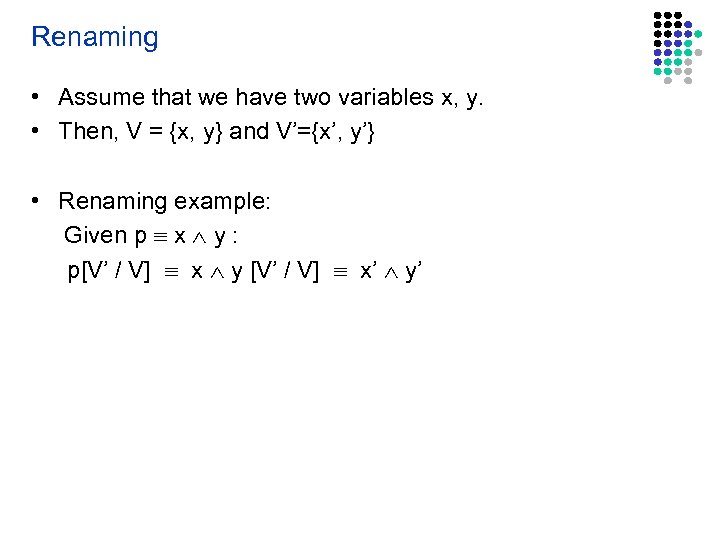 Renaming • Assume that we have two variables x, y. • Then, V = {x, y} and V’={x’, y’} • Renaming example: Given p x y : p[V’ / V] x y [V’ / V] x’ y’
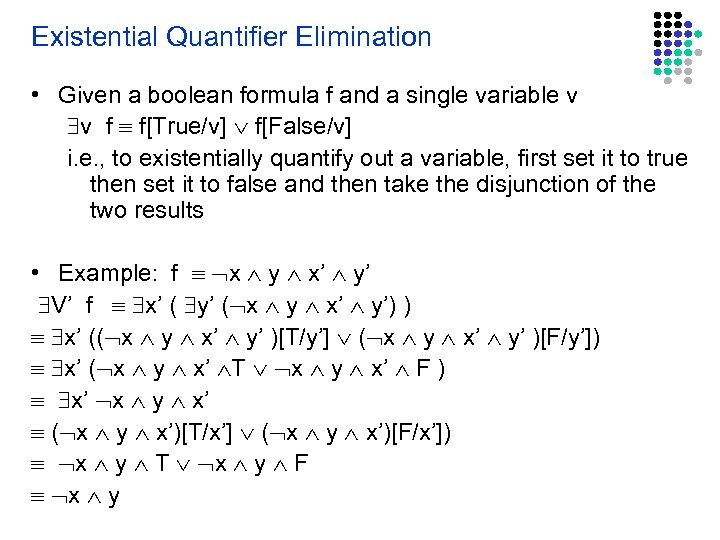 Existential Quantifier Elimination • Given a boolean formula f and a single variable v v f f[True/v] f[False/v] i. e. , to existentially quantify out a variable, first set it to true then set it to false and then take the disjunction of the two results • Example: f x y x’ y’ V’ f x’ ( y’ ( x y x’ y’) ) x’ (( x y x’ y’ )[T/y’] ( x y x’ y’ )[F/y’]) x’ ( x y x’ T x y x’ F ) x’ x y x’ ( x y x’)[T/x’] ( x y x’)[F/x’]) x y T x y F x y
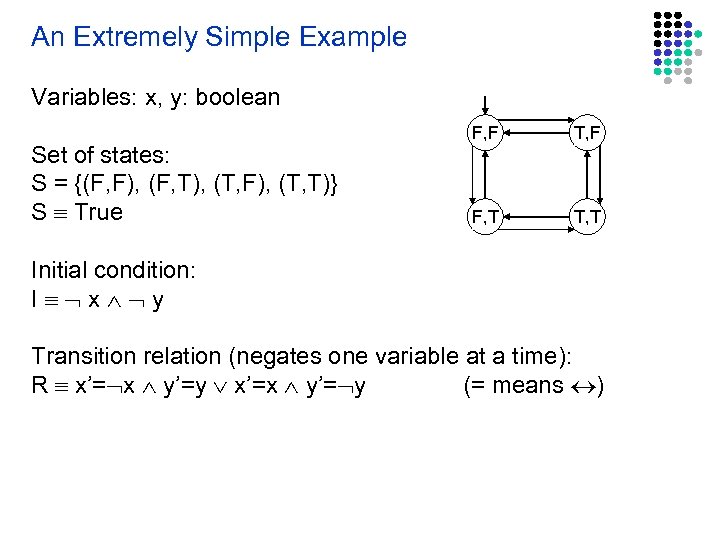 An Extremely Simple Example Variables: x, y: boolean Set of states: S = {(F, F), (F, T), (T, F), (T, T)} S True F, F T, F F, T T, T Initial condition: I x y Transition relation (negates one variable at a time): R x’= x y’=y x’=x y’= y (= means )
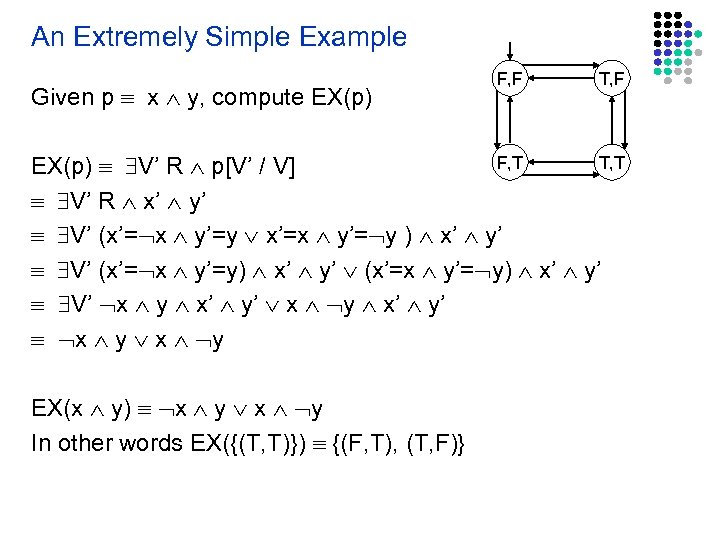 An Extremely Simple Example Given p x y, compute EX(p) F, F T, F F, T T, T EX(p) V’ R p[V’ / V] V’ R x’ y’ V’ (x’= x y’=y x’=x y’= y ) x’ y’ V’ (x’= x y’=y) x’ y’ (x’=x y’= y) x’ y’ V’ x y x’ y’ x y EX(x y) x y In other words EX({(T, T)}) {(F, T), (T, F)}
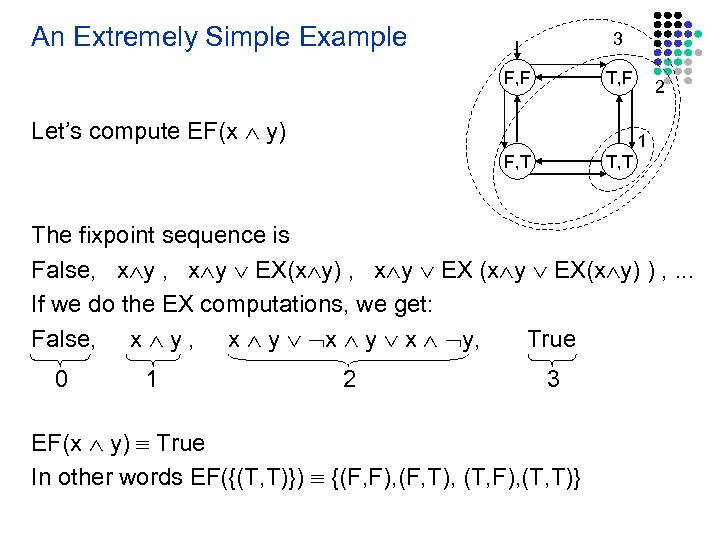 An Extremely Simple Example 3 F, F T, F Let’s compute EF(x y) 2 1 F, T The fixpoint sequence is False, x y EX(x y) , x y EX (x y EX(x y) ) , . . . If we do the EX computations, we get: False, x y x y, True 0 1 2 3 EF(x y) True In other words EF({(T, T)}) {(F, F), (F, T), (T, F), (T, T)}
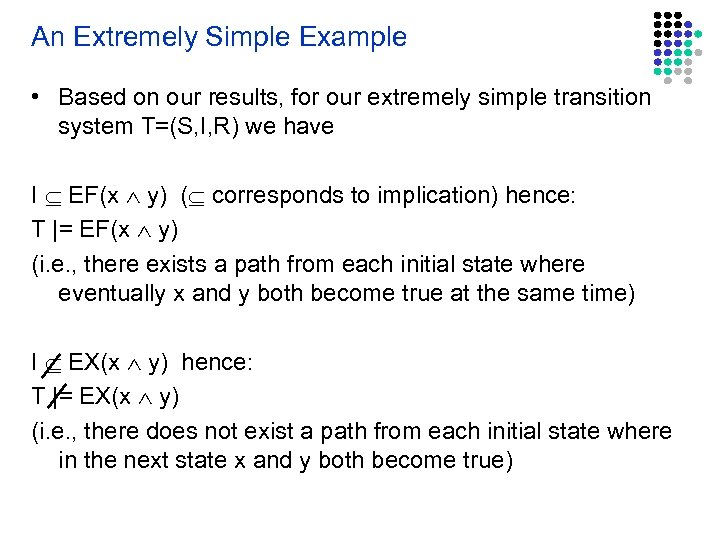 An Extremely Simple Example • Based on our results, for our extremely simple transition system T=(S, I, R) we have I EF(x y) ( corresponds to implication) hence: T |= EF(x y) (i. e. , there exists a path from each initial state where eventually x and y both become true at the same time) I EX(x y) hence: T |= EX(x y) (i. e. , there does not exist a path from each initial state where in the next state x and y both become true)
 An Extremely Simple Example • Let’s try one more property AF(x y) • To check this property we first convert it to a formula which uses only the temporal operators in our basis: AF(x y) EG( (x y)) If we can find an initial state which satisfies EG( (x y)), then we know that the transition system T, does not satisfy the property AF(x y)
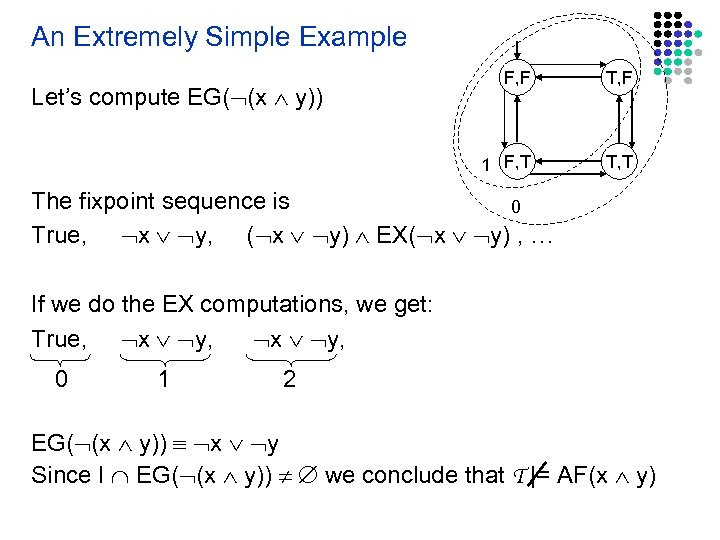 An Extremely Simple Example T, F 1 F, T Let’s compute EG( (x y)) F, F T, T The fixpoint sequence is 0 True, x y, ( x y) EX( x y) , … If we do the EX computations, we get: True, x y, 0 1 2 EG( (x y)) x y Since I EG( (x y)) we conclude that T |= AF(x y)
 Symbolic CTL Model Checking Algorithm • Translate the formula to a formula which uses the basis – EX p, EG p, p EU q • Atomic formulas can be interpreted directly on the state representation • For EX p compute the precondition using existential variable elimination as we discussed • For EG and EU compute the fixpoints iteratively
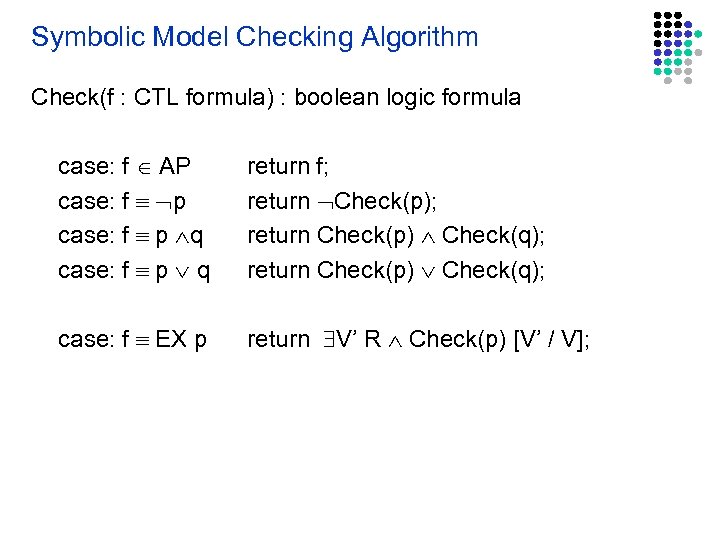 Symbolic Model Checking Algorithm Check(f : CTL formula) : boolean logic formula case: f AP case: f p q case: f p q return f; return Check(p) Check(q); case: f EX p return V’ R Check(p) [V’ / V];
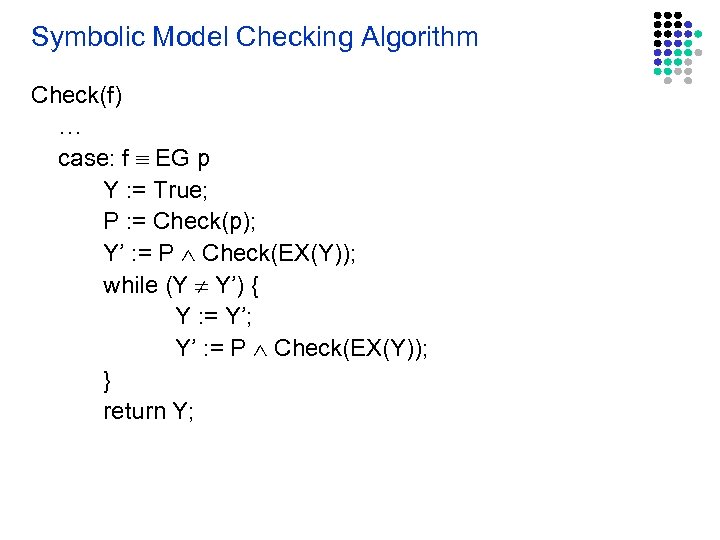 Symbolic Model Checking Algorithm Check(f) … case: f EG p Y : = True; P : = Check(p); Y’ : = P Check(EX(Y)); while (Y Y’) { Y : = Y’; Y’ : = P Check(EX(Y)); } return Y;
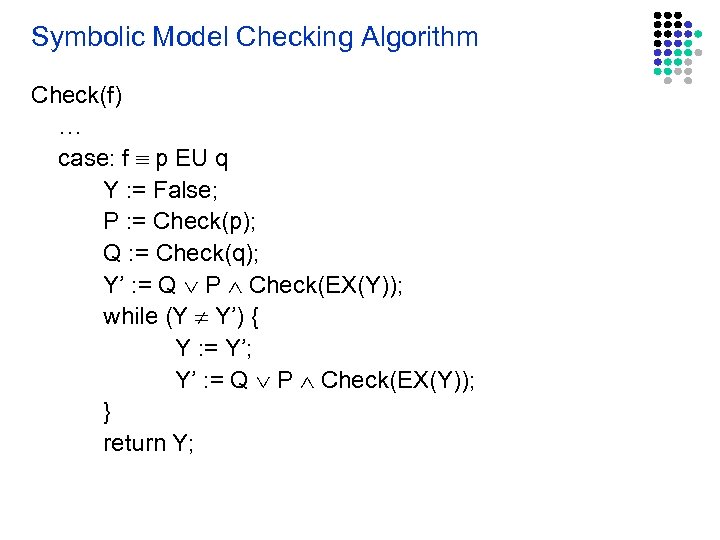 Symbolic Model Checking Algorithm Check(f) … case: f p EU q Y : = False; P : = Check(p); Q : = Check(q); Y’ : = Q P Check(EX(Y)); while (Y Y’) { Y : = Y’; Y’ : = Q P Check(EX(Y)); } return Y;
 Binary Decision Diagrams (BDDs) • Ordered Binary Decision Diagrams (BDDs) – An efficient data structure for boolean formula manipulation – There are BDD packages available: (for example CUDD from Colorado University) • BDD data structure can be used to implement the symbolic model checking algorithm discussed above • BDDs are a canonical representation for boolean logic formulas – given two boolean logic formulas F and G, if F and G are equivalent their BDD representations will be identical
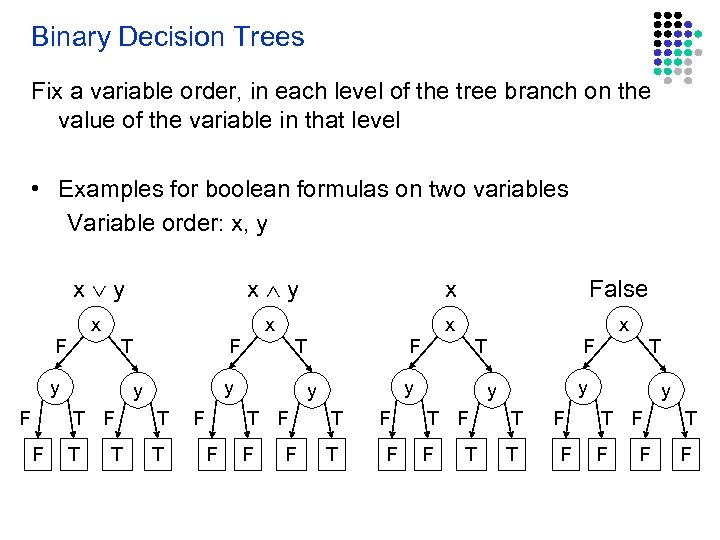 Binary Decision Trees Fix a variable order, in each level of the tree branch on the value of the variable in that level • Examples for boolean formulas on two variables Variable order: x, y x y x False x x F T y F F y y T F F T T T F F y y T F F T F T F F F y y T F T T T F F y T F F F
 BDDs • Repeatedly apply the following transformations to a binary decision tree: – Remove duplicate terminals – Remove duplicate non-terminals – Remove redundant tests • These transformations transform the tree to a directed acyclic graph
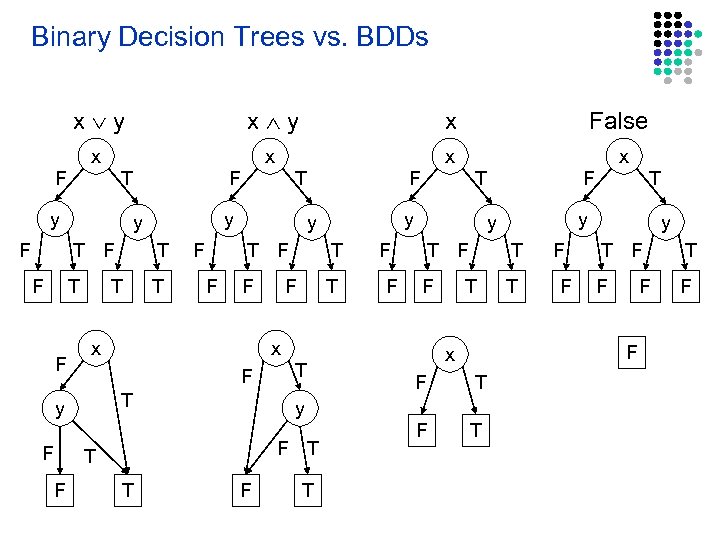 Binary Decision Trees vs. BDDs x y x False x x F T y F F y y T F F T F F T T y T F x T F y x y T F F F y y T F T T F F y T F F F F x F T T
 Good News About BDDs • Given BDDs for two boolean logic formulas F and G – The BDDs for F G and F G are of size |F| |G| (and can be computed in that time) – The BDD for F is of size |F| (and can be computed in that time) – F ? G can be checked in constant time – Satisfiability of F can be checked in constant time • But, this does not mean that you cane solve SAT in constant time
 Bad News About BDDs • The size of a BDD can be exponential in the number of boolean variables • The sizes of the BDDs are very sensitive to the variable ordering. Bad variable ordering can cause exponential increase in the size of the BDD • There are functions which have BDDs that are exponential for any variable ordering (for example binary multiplication) • Pre condition computation requires existential variable elimination – Existential variable elimination cause an exponential blow-up in the size of the BDD
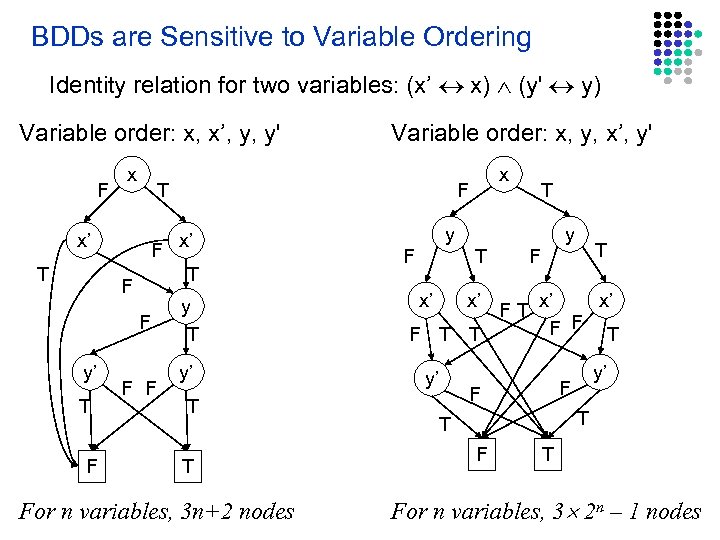 BDDs are Sensitive to Variable Ordering Identity relation for two variables: (x’ x) (y' y) Variable order: x, x’, y, y' F x x’ T F T T F F F x’ T F y’ Variable order: x, y, x’, y' y T y’ T T For n variables, 3 n+2 nodes y F T T y F T x’ x’ F F T T y’ y’ F F T T For n variables, 3 2 n – 1 nodes
 What About LTL and CTL* Model Checking? • The complexity of the model checking problem for LTL and CTL* are: – (|S|+|R|) 2 O(|f|) where |f| is the number of logic connectives in f • Typically the size of the formula is much smaller than the size of the transition system – So the exponential complexity in the size of the formula is not very significant in practice • LTL properties are more intuitive and easier to write correctly – XF p and FX p are equivalent in LTL – AXAF p and AFAX p are not equivalent in LTL