 Скачать презентацию Model-Based Development and Validation of Multirobot Cooperative System
b4673f2476f6752f1382329ca40e251c.ppt
- Количество слайдов: 25



Model-Based Development and Validation of Multirobot Cooperative System Jüri Vain Dept. of Computer Science Tallinn University of Technology Doctoral course ’Advanced topics in Embedded Systems’. Lyngby'08
Goals of the course To give “work in progress” style introduction in the field of collaborative robotics. p To attract interest to some fast evolving and rich problem domains inspired by nature, e. g. p n n p “swarm intelligence” “human adaptive robotics”. Real life examples on how to apply FMs to handle problems of collaborative robotics. Doctoral course ’Advanced topics in Embedded Systems’. Lyngby'08
Structure p Modules: n n introduction theoretical background, applications hands-on exercises Doctoral course ’Advanced topics in Embedded Systems’. Lyngby'08
Syllabus p p Monday morning: (9: 00 – 12. 30) n 9: 00 – 9: 45 Introduction n 10: 00 – 11: 30 Hands-on exercises I: Uppaal model construction n 11: 45 – 12: 30 Theoretical background I: XTA semantics, model learning Lunch 12. 30 – 13. 30 Monday afternoon: (13: 30 – 16: 30) n 13. 30 – 14: 15 Applications I: Human Addaptive Scrub Nurse Robot n 14. 30 – 15. 15 Theoretical background II: model checking n 15. 30 – 16: 15 Hands-on exercises II: model checking Tuesday morning: (9: 00 – 12. 30) n 9: 00 – 9: 45 Theoretical background III: Model based testing n 10: 00 – 10: 45 Applications II: reactive planning tester n 11: 00 – 12: 30 Hands-on exercises III (model refinement) Doctoral course ’Advanced topics in Embedded Systems’. Lyngby'08
Lecture #L 1 : Introduction Lecture Plan p From single robot to multi-robot systems (MRS) n Single-robot systems p p n Multi-robot systems and swarms p p p n Examples Advantages/Disadvantages Lessons from nature What makes the MRS special? How can a swarm function: 3 -tier architecture Formal Methods for Multi-robot Cooperative System p p Why formal methods? Problems and methods Doctoral course ’Advanced topics in Embedded Systems’. Lyngby'08
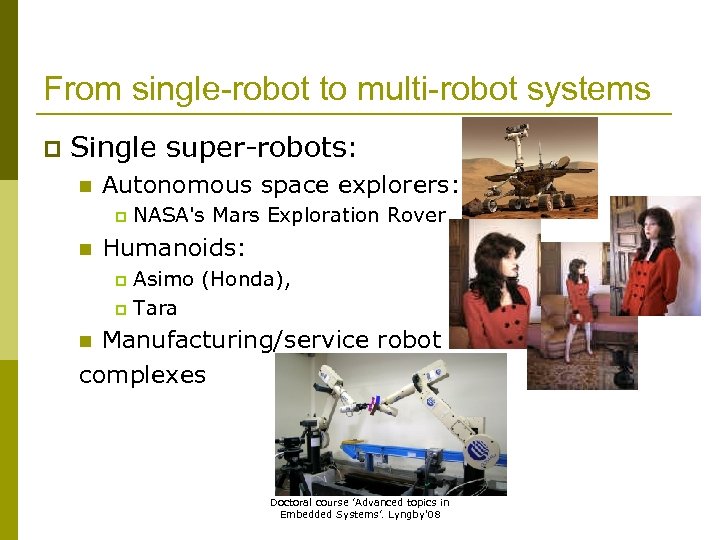
From single-robot to multi-robot systems p Single super-robots: n Autonomous space explorers: p n NASA's Mars Exploration Rover Humanoids: Asimo (Honda), p Tara p Manufacturing/service robot complexes n Doctoral course ’Advanced topics in Embedded Systems’. Lyngby'08
Traditional single-robot systems p Advantages: n n n p Able to mimic human/pets’ behaviour, e. g. , home assitant Tara, cyberdog Aibo Capable of operating autonomously for long time (Mars Rover) High performance in well-defined tasks, . e. g car composing Disadvantages: n n Advanced robots are expensive Inefficient in teamwork and spatially distributed activities p n A group of super-robots is not neccessarily a supergroup Sensibility to HW/SW failures – whole mission can fail if the robot fails Doctoral course ’Advanced topics in Embedded Systems’. Lyngby'08
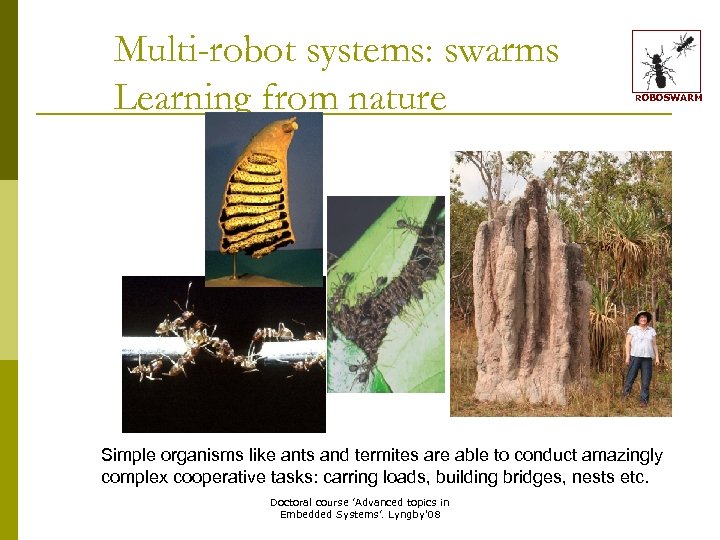
Multi-robot systems: swarms Learning from nature ROBOSWARM Simple organisms like ants and termites are able to conduct amazingly complex cooperative tasks: carring loads, building bridges, nests etc. Doctoral course ’Advanced topics in Embedded Systems’. Lyngby'08
Swarm intelligence (SI) p ROBOSWARM SI systems are typically made up of a population of simple agents n Agents interact locally with one another and p through their environment (stigmery). p n n n the agents follow very simple rules, there is no centralized control structure dictating how individual agents should behave, local interactions between agents lead to the emergence of complex global behavior. Doctoral course ’Advanced topics in Embedded Systems’. Lyngby'08
Examples of swarm intelligence ant colonies, p bird flocking, p animal herding, p bacterial growth, p fish schooling p etc p Doctoral course ’Advanced topics in Embedded Systems’. Lyngby'08 ROBOSWARM
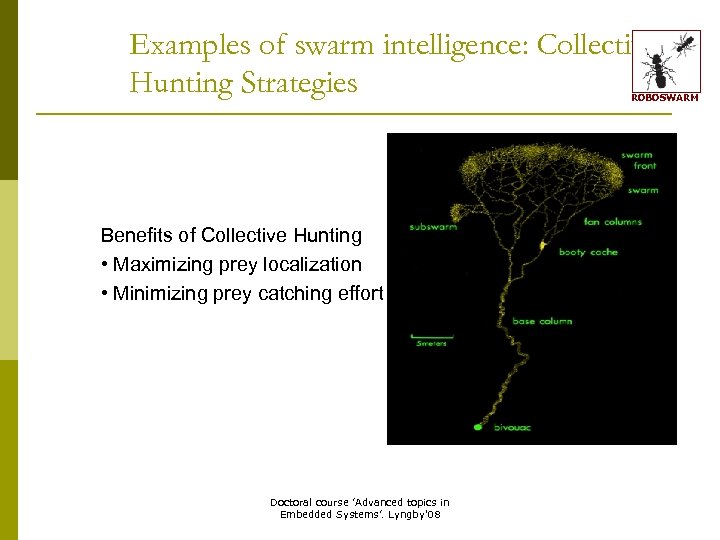
Examples of swarm intelligence: Collective Hunting Strategies ROBOSWARM Benefits of Collective Hunting • Maximizing prey localization • Minimizing prey catching effort Doctoral course ’Advanced topics in Embedded Systems’. Lyngby'08
What makes a swarm/collective intelligent? p Coordination n p distributed control individual autonomy self-organization Communication n n p ROBOSWARM direct (peer-to-peer) local communication indirect communication through signs in the environment (stigmergy) Robustness n n n redundancy balance exploitation/exploration individual simplicity Doctoral course ’Advanced topics in Embedded Systems’. Lyngby'08
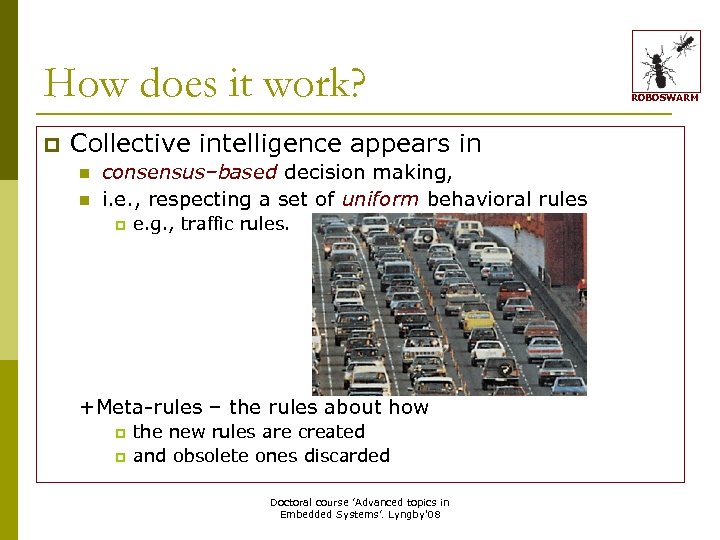
How does it work? p Collective intelligence appears in n n consensus–based decision making, i. e. , respecting a set of uniform behavioral rules p e. g. , traffic rules. +Meta-rules – the rules about how p p the new rules are created and obsolete ones discarded Doctoral course ’Advanced topics in Embedded Systems’. Lyngby'08 ROBOSWARM
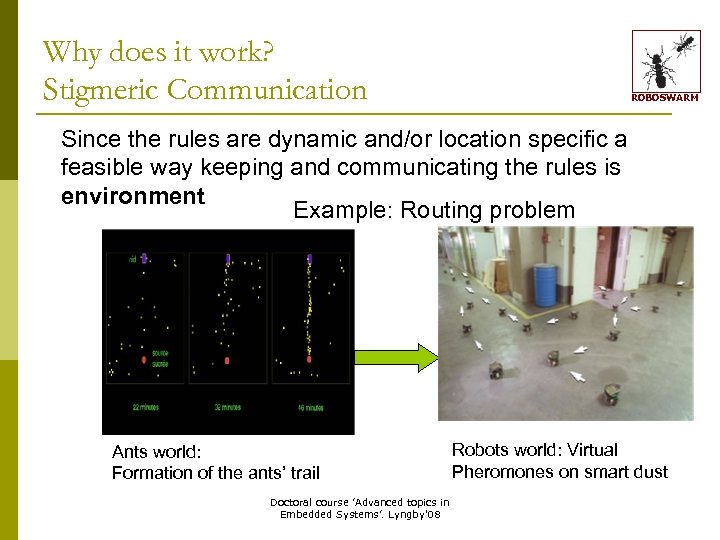
Why does it work? Stigmeric Communication ROBOSWARM Since the rules are dynamic and/or location specific a feasible way keeping and communicating the rules is environment Example: Routing problem Ants world: Formation of the ants’ trail Doctoral course ’Advanced topics in Embedded Systems’. Lyngby'08 Robots world: Virtual Pheromones on smart dust
Cooperative intelligence: summary ROBOSWARM Stochastic individual behavior & p repetitive, context sensitive amplification of (local)information || / Efficient Collective Decisions p Doctoral course ’Advanced topics in Embedded Systems’. Lyngby'08
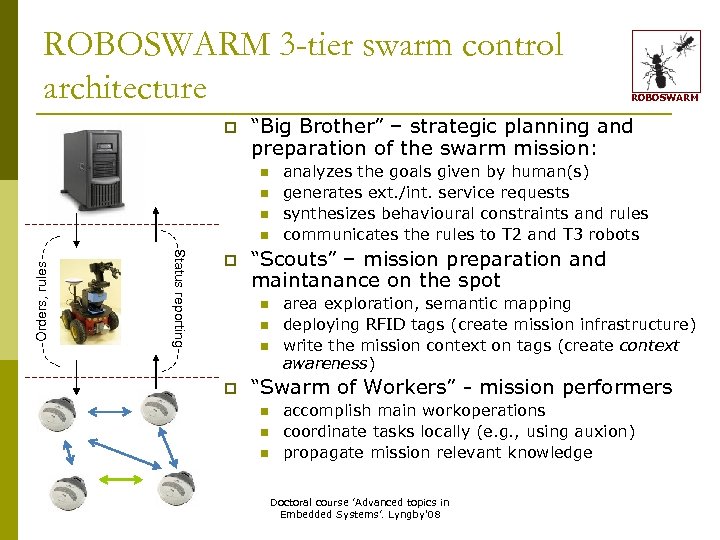
ROBOSWARM 3 -tier swarm control architecture p “Big Brother” – strategic planning and preparation of the swarm mission: n n n Status reporting Orders, rules n p analyzes the goals given by human(s) generates ext. /int. service requests synthesizes behavioural constraints and rules communicates the rules to T 2 and T 3 robots “Scouts” – mission preparation and maintanance on the spot n n n p ROBOSWARM area exploration, semantic mapping deploying RFID tags (create mission infrastructure) write the mission context on tags (create context awareness) “Swarm of Workers” - mission performers n n n accomplish main workoperations coordinate tasks locally (e. g. , using auxion) propagate mission relevant knowledge Doctoral course ’Advanced topics in Embedded Systems’. Lyngby'08
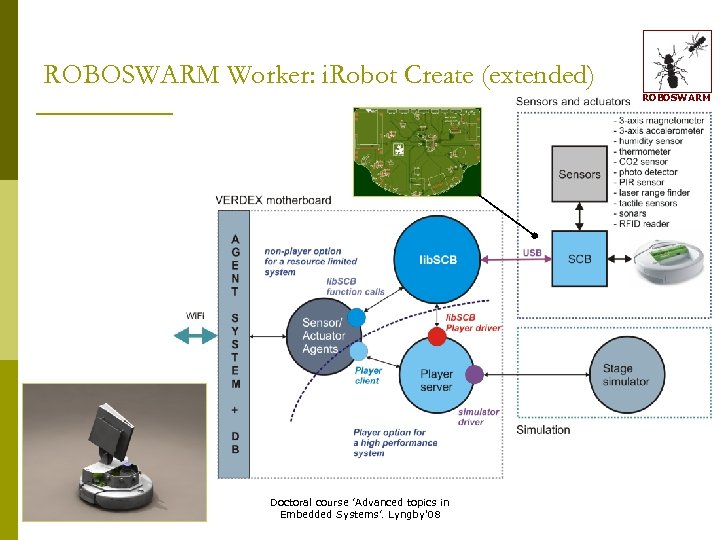
ROBOSWARM Worker: i. Robot Create (extended) ROBOSWARM Doctoral course ’Advanced topics in Embedded Systems’. Lyngby'08
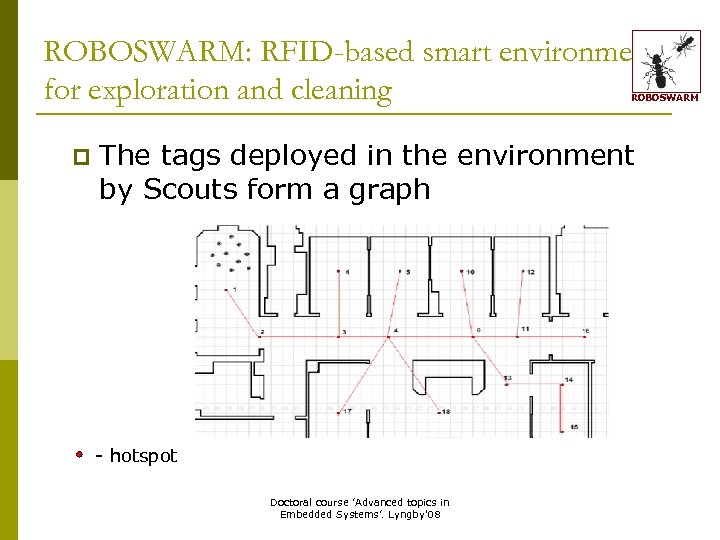
ROBOSWARM: RFID-based smart environment for exploration and cleaning ROBOSWARM p The tags deployed in the environment by Scouts form a graph - hotspot Doctoral course ’Advanced topics in Embedded Systems’. Lyngby'08
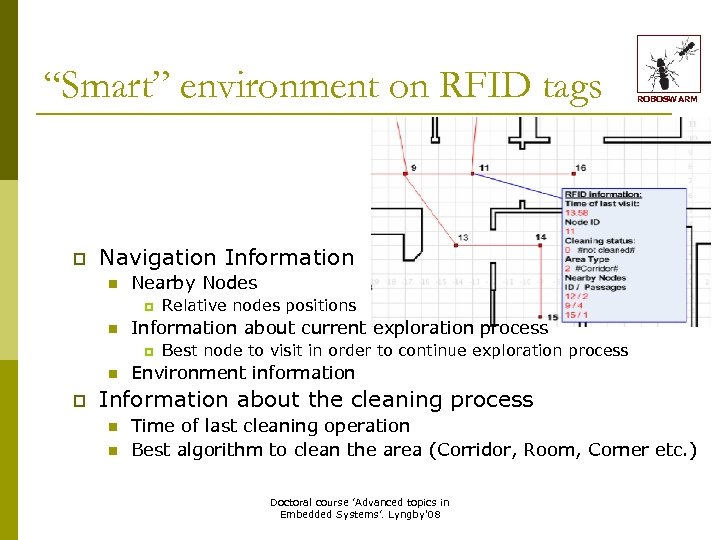
“Smart” environment on RFID tags p Navigation Information n Nearby Nodes p n n Relative nodes positions Information about current exploration process p p ROBOSWARM Best node to visit in order to continue exploration process Environment information Information about the cleaning process n n Time of last cleaning operation Best algorithm to clean the area (Corridor, Room, Corner etc. ) Doctoral course ’Advanced topics in Embedded Systems’. Lyngby'08
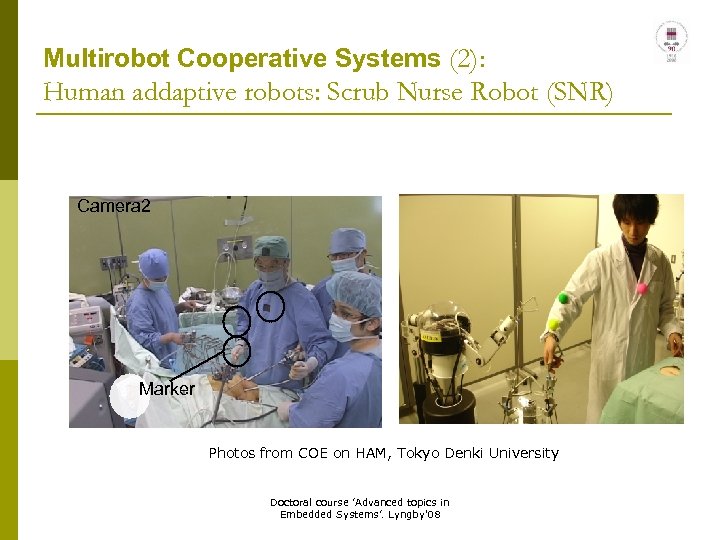
Multirobot Cooperative Systems (2): Human addaptive robots: Scrub Nurse Robot (SNR) Camera 2 Marker Photos from COE on HAM, Tokyo Denki University Doctoral course ’Advanced topics in Embedded Systems’. Lyngby'08
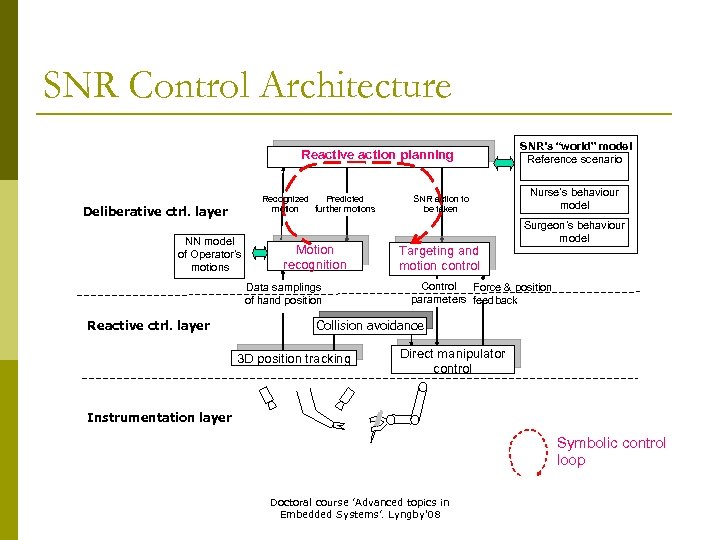
SNR Control Architecture Reactive action planning Recognized Predicted motion further motions Deliberative ctrl. layer NN model of Operator’s motions Motion recognition Data samplings of hand position Reactive ctrl. layer SNR action to be taken Targeting and motion control SNR’s “world” model Reference scenario Nurse’s behaviour model Surgeon’s behaviour model Control Force & position parameters feedback Collision avoidance 3 D position tracking Direct manipulator control Instrumentation layer Symbolic control loop Doctoral course ’Advanced topics in Embedded Systems’. Lyngby'08
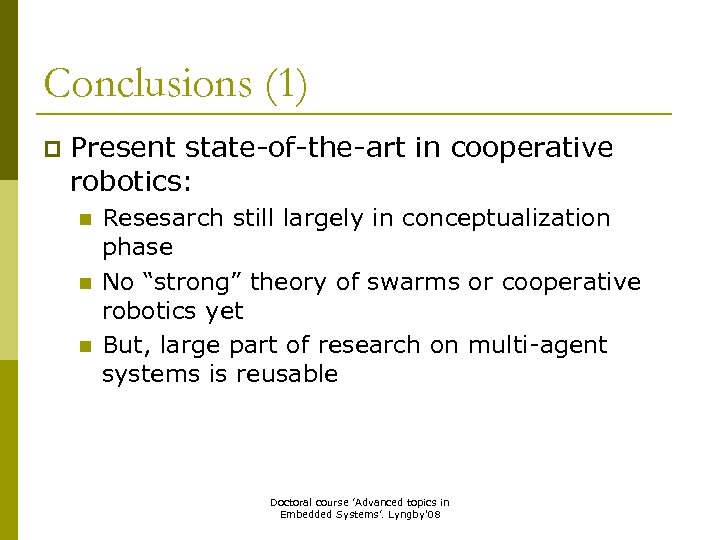
Conclusions (1) p Present state-of-the-art in cooperative robotics: n n n Resesarch still largely in conceptualization phase No “strong” theory of swarms or cooperative robotics yet But, large part of research on multi-agent systems is reusable Doctoral course ’Advanced topics in Embedded Systems’. Lyngby'08
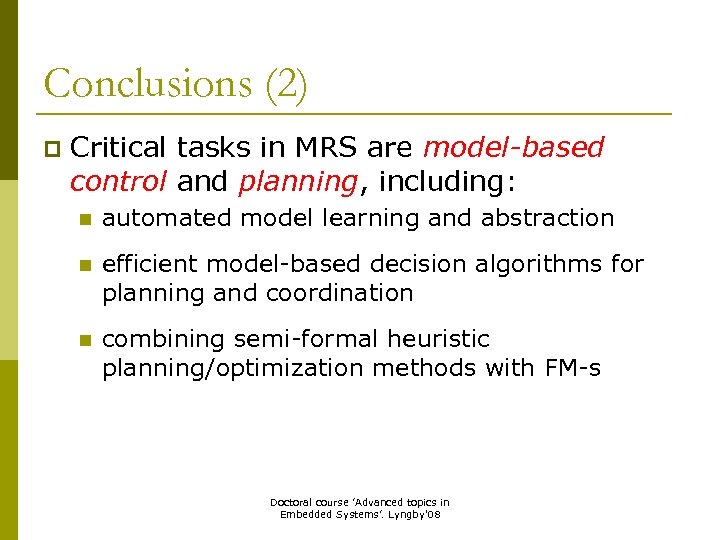
Conclusions (2) p Critical tasks in MRS are model-based control and planning, including: n automated model learning and abstraction n efficient model-based decision algorithms for planning and coordination n combining semi-formal heuristic planning/optimization methods with FM-s Doctoral course ’Advanced topics in Embedded Systems’. Lyngby'08
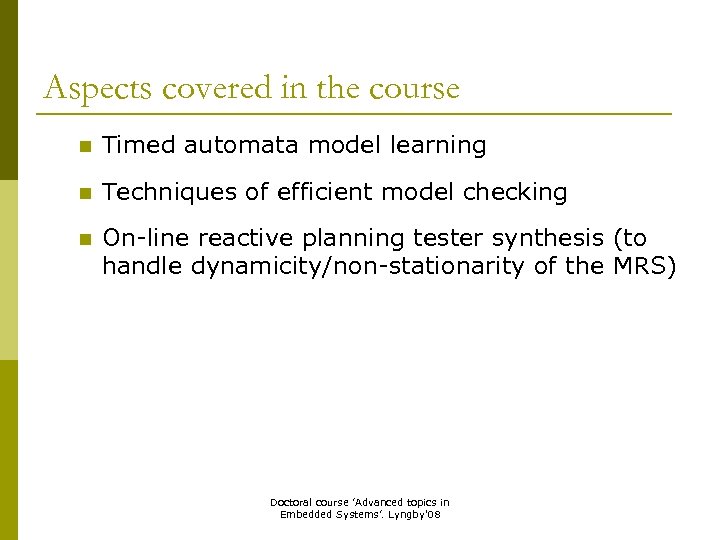
Aspects covered in the course n Timed automata model learning n Techniques of efficient model checking n On-line reactive planning tester synthesis (to handle dynamicity/non-stationarity of the MRS) Doctoral course ’Advanced topics in Embedded Systems’. Lyngby'08
Questions? Doctoral course ’Advanced topics in Embedded Systems’. Lyngby'08
Скачать презентацию Model-Based Development and Validation of Multirobot Cooperative System
b4673f2476f6752f1382329ca40e251c.ppt