 Скачать презентацию Model Antrian By Render ect Outline
5618fd88ea4436d408793dbc0d48e6a3.ppt
- Количество слайдов: 37




Model Antrian By : Render, ect
Outline ¨ Characteristics of a Waiting-Line System. ¨ Arrival characteristics. ¨ Waiting-Line characteristics. ¨ Service facility characteristics. ¨ Waiting Line (Queuing) Models. ¨ M/M/1: One server. ¨ M/M/2: Two servers. ¨ M/M/S: S servers. ¨ Cost comparisons.
Waiting Lines ¨ First studied by A. K. Erlang in 1913. ¨ Analyzed telephone facilities. ¨ Body of knowledge called queuing theory. ¨ Queue is another name for waiting line. ¨ Decision problem: ¨ Balance cost of providing good service with cost of customers waiting.
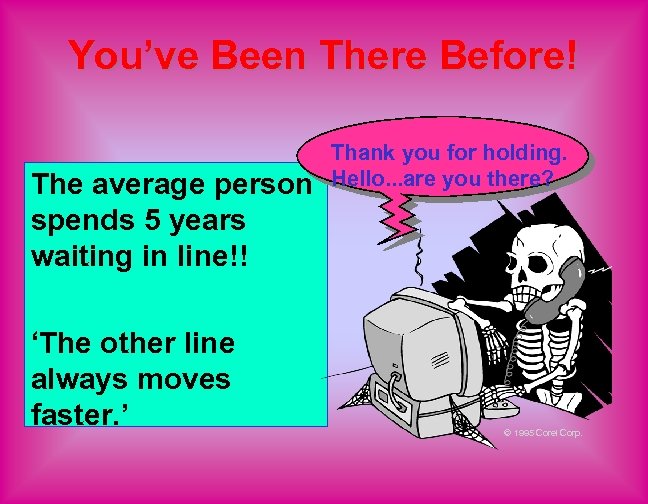
You’ve Been There Before! The average person spends 5 years waiting in line!! ‘The other line always moves faster. ’ Thank you for holding. Hello. . . are you there? © 1995 Corel Corp.
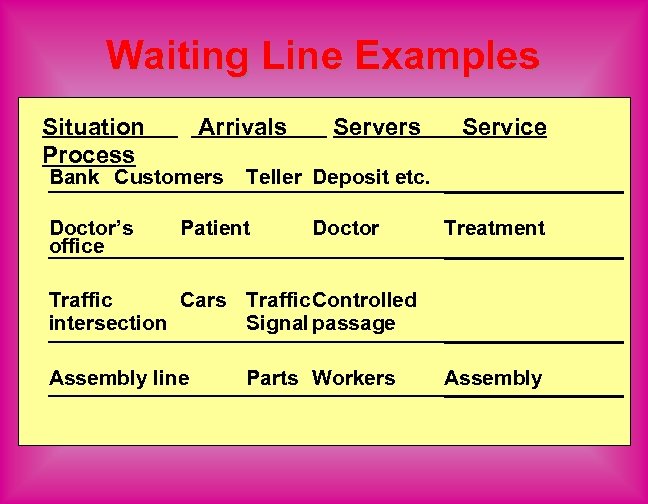
Waiting Line Examples Situation Process Arrivals Bank Customers Doctor’s office Servers Service Teller Deposit etc. Patient Doctor Treatment Traffic Cars Traffic. Controlled intersection Signal passage Assembly line Parts Workers Assembly
Waiting Line Components ¨ Arrivals: Customers (people, machines, calls, etc. ) that demand service. ¨ Service System: Includes waiting line and servers. ¨ Waiting Line (Queue): Arrivals waiting for a free server. ¨ Servers: People or machines that provide service to the arrivals.
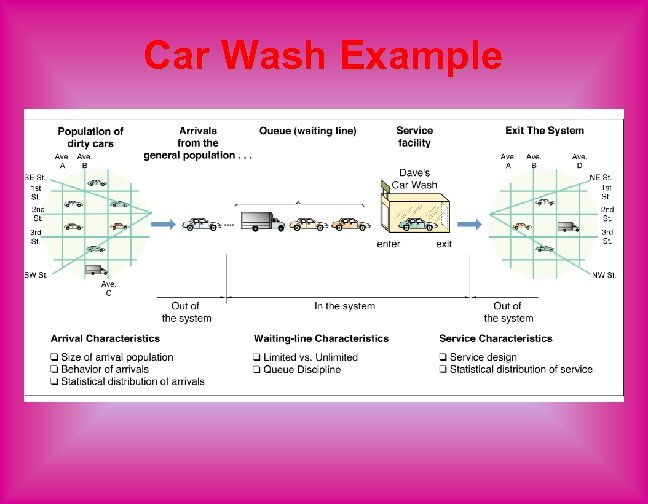
Car Wash Example
Key Tradeoff ¨ Higher service level (more servers, faster servers) Þ Higher costs to provide service. Þ Lower cost for customers waiting in line (less waiting time).
Waiting Line Terminology ¨ Queue: Waiting line. ¨ Arrival: 1 person, machine, part, etc. that arrives and demands service. ¨ Queue discipline: Rules for determining the order that arrivals receive service. ¨ Channels: Parallel servers. ¨ Phases: Sequential stages in service.
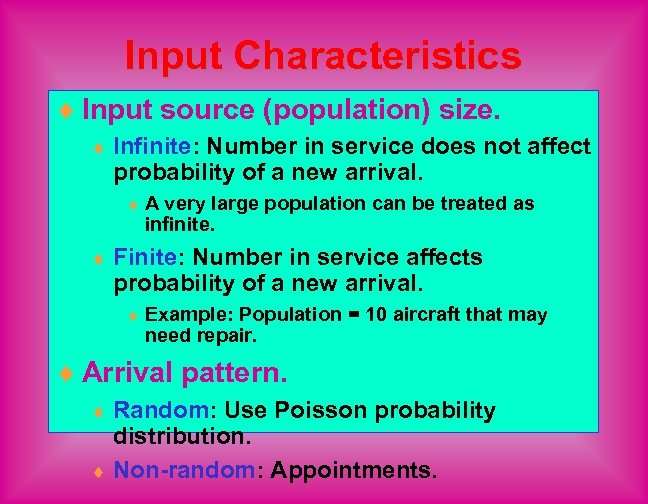
Input Characteristics ¨ Input source (population) size. ¨ Infinite: Number in service does not affect probability of a new arrival. ¨ ¨ A very large population can be treated as infinite. Finite: Number in service affects probability of a new arrival. ¨ Example: Population = 10 aircraft that may need repair. ¨ Arrival pattern. Random: Use Poisson probability distribution. ¨ Non-random: Appointments. ¨
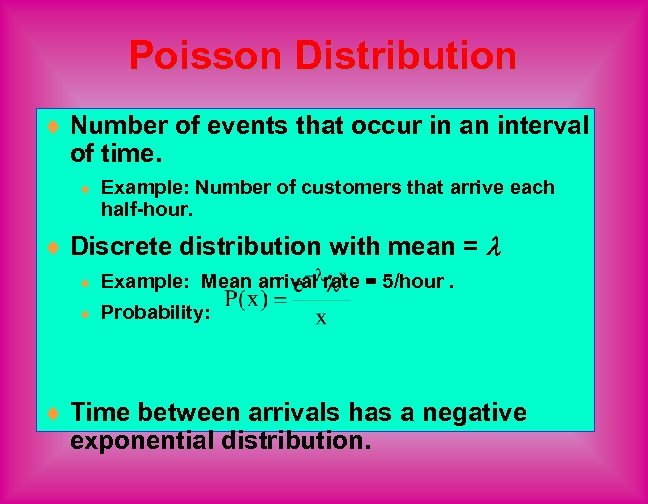
Poisson Distribution ¨ Number of events that occur in an interval of time. ¨ Example: Number of customers that arrive each half-hour. ¨ Discrete distribution with mean = ¨ Example: Mean arrival rate = 5/hour. ¨ Probability: ¨ Time between arrivals has a negative exponential distribution.
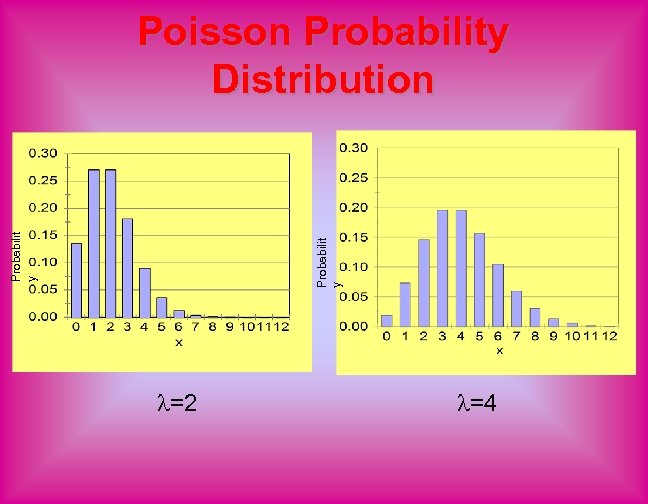
Probabilit y Poisson Probability Distribution =2 =4
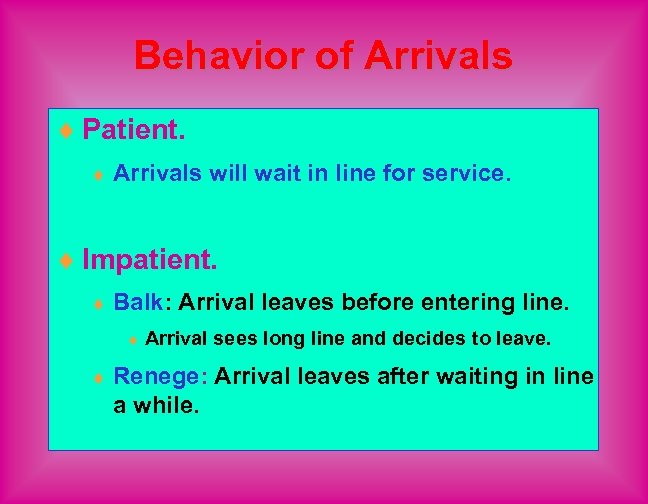
Behavior of Arrivals ¨ Patient. ¨ Arrivals will wait in line for service. ¨ Impatient. ¨ Balk: Arrival leaves before entering line. ¨ ¨ Arrival sees long line and decides to leave. Renege: Arrival leaves after waiting in line a while.
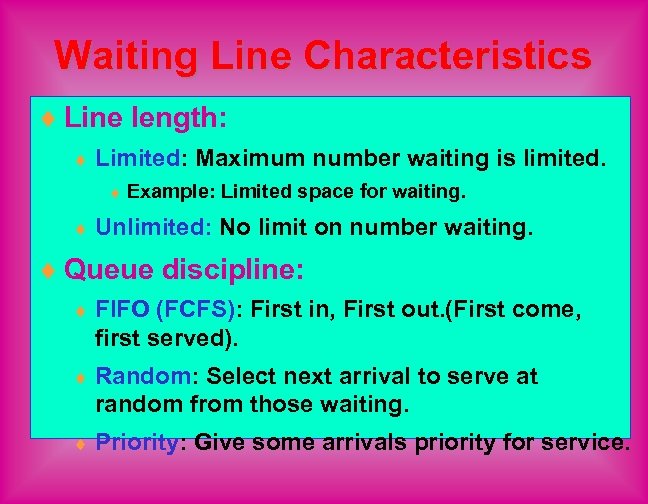
Waiting Line Characteristics ¨ Line length: ¨ Limited: Maximum number waiting is limited. ¨ ¨ Example: Limited space for waiting. Unlimited: No limit on number waiting. ¨ Queue discipline: ¨ FIFO (FCFS): First in, First out. (First come, first served). ¨ Random: Select next arrival to serve at random from those waiting. ¨ Priority: Give some arrivals priority for service.
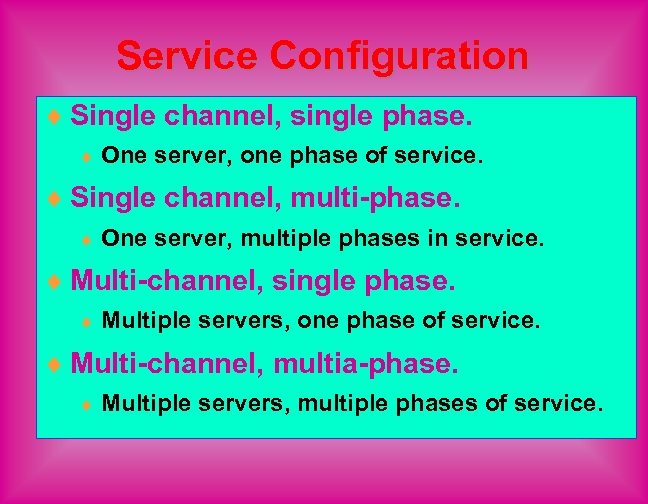
Service Configuration ¨ Single channel, single phase. ¨ One server, one phase of service. ¨ Single channel, multi-phase. ¨ One server, multiple phases in service. ¨ Multi-channel, single phase. ¨ Multiple servers, one phase of service. ¨ Multi-channel, multia-phase. ¨ Multiple servers, multiple phases of service.
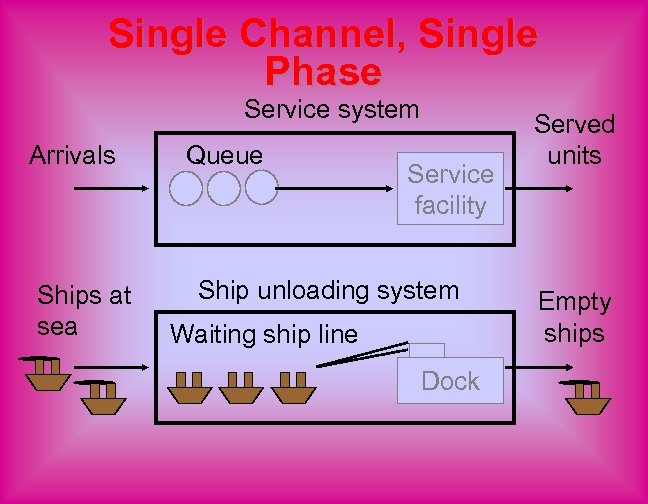
Single Channel, Single Phase Service system Arrivals Ships at sea Queue Service facility Ship unloading system Waiting ship line Dock Served units Empty ships
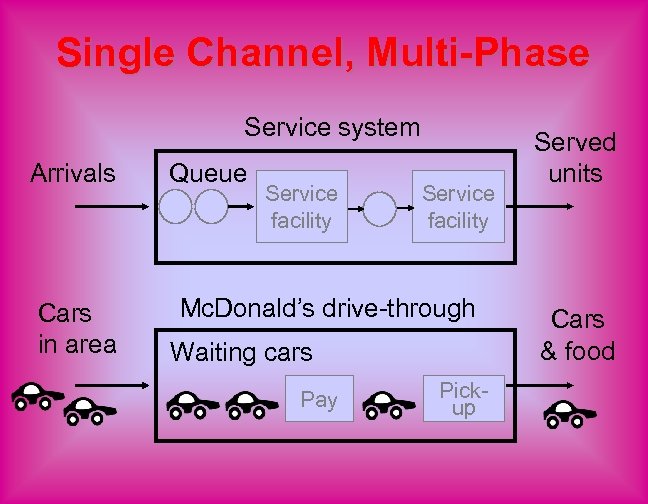
Single Channel, Multi-Phase Service system Arrivals Cars in area Queue Service facility Mc. Donald’s drive-through Waiting cars Pay Pickup Served units Cars & food
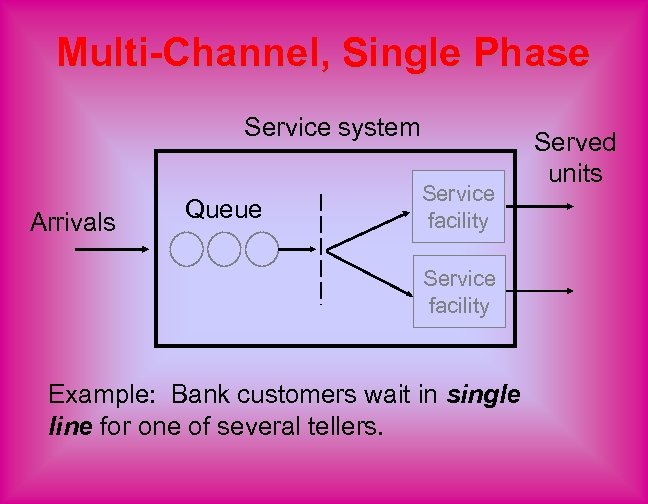
Multi-Channel, Single Phase Service system Arrivals Queue Service facility Example: Bank customers wait in single line for one of several tellers. Served units
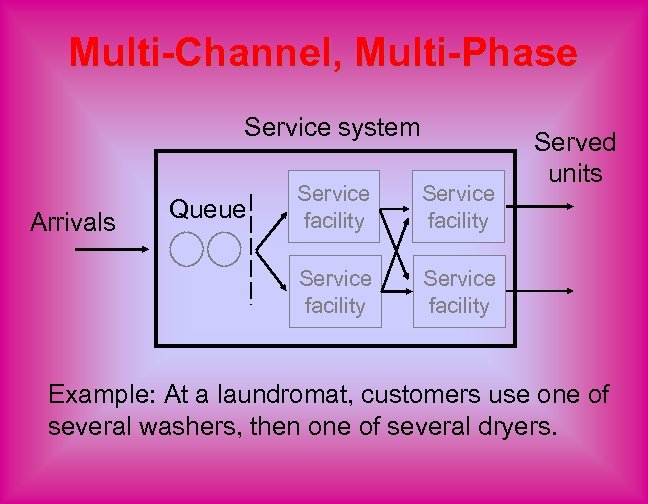
Multi-Channel, Multi-Phase Service system Queue Service facility Arrivals Service facility Served units Service facility Example: At a laundromat, customers use one of several washers, then one of several dryers.
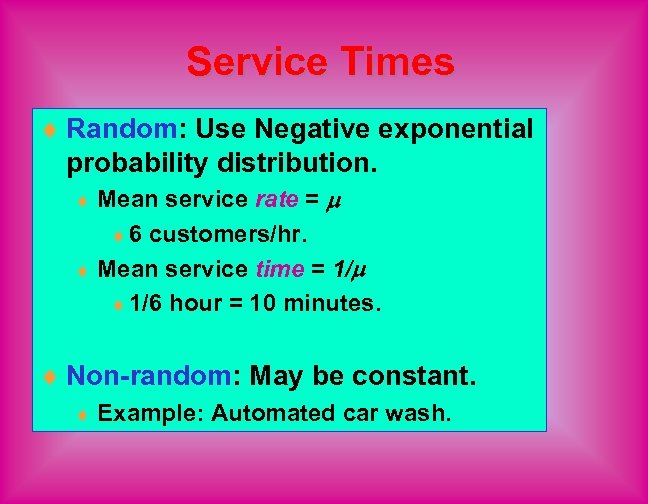
Service Times ¨ Random: Use Negative exponential probability distribution. Mean service rate = ¨ 6 customers/hr. ¨ Mean service time = 1/ ¨ 1/6 hour = 10 minutes. ¨ ¨ Non-random: May be constant. ¨ Example: Automated car wash.
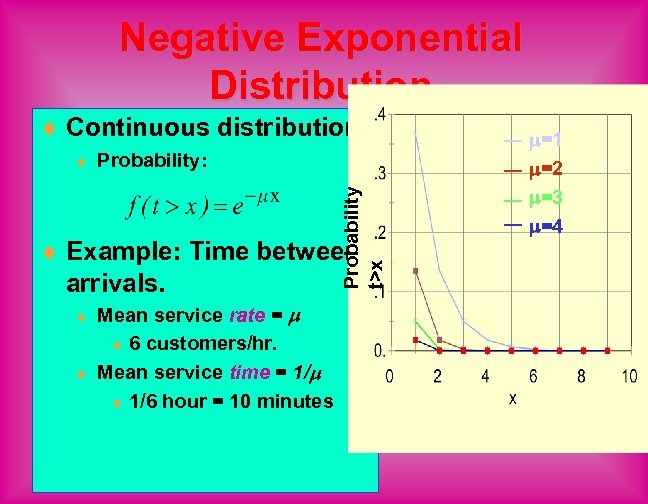
Negative Exponential Distribution ¨ Continuous distribution. Probability: Probability t>x ¨ ¨ Example: Time between arrivals. Mean service rate = ¨ 6 customers/hr. ¨ Mean service time = 1/ ¨ 1/6 hour = 10 minutes ¨ =1 =2 =3 =4
Assumptions in the Basic Model ¨ Customer population is homogeneous and infinite. ¨ Queue capacity is infinite. ¨ Customers are well behaved (no balking or reneging). ¨ Arrivals are served FCFS (FIFO). ¨ Poisson arrivals. ¨ The time between arrivals follows a negative exponential distribution ¨ Service times are described by the negative exponential distribution.
Steady State Assumptions ¨ Mean arrival rate , mean service rate , and the number of servers are constant. ¨ The service rate is greater than the arrival rate. ¨ These conditions have existed for a long time.
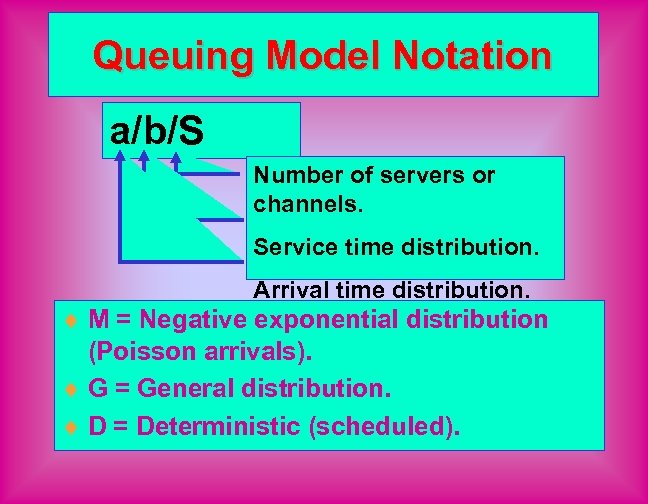
Queuing Model Notation a/b/S Number of servers or channels. Service time distribution. Arrival time distribution. ¨ M = Negative exponential distribution (Poisson arrivals). ¨ G = General distribution. ¨ D = Deterministic (scheduled).
Types of Queuing Models ¨ Simple (M/M/1). ¨ Example: Information booth at mall. ¨ Multi-channel (M/M/S). ¨ Example: Airline ticket counter. ¨ Constant Service (M/D/1). ¨ Example: Automated car wash. ¨ Limited Population. ¨ Example: Department with only 7 drills that may break down and require service.
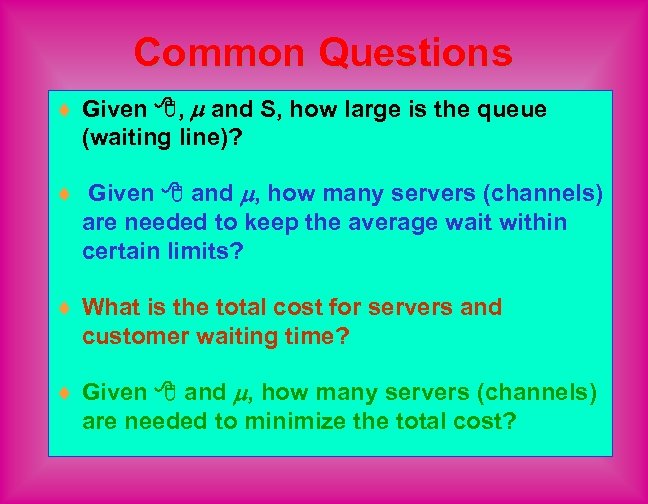
Common Questions ¨ Given , and S, how large is the queue (waiting line)? ¨ Given and , how many servers (channels) are needed to keep the average wait within certain limits? ¨ What is the total cost for servers and customer waiting time? ¨ Given and , how many servers (channels) are needed to minimize the total cost?
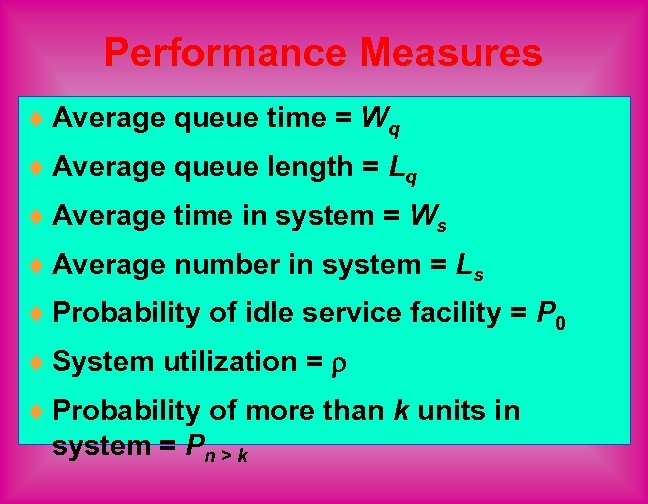
Performance Measures ¨ Average queue time = Wq ¨ Average queue length = Lq ¨ Average time in system = Ws ¨ Average number in system = Ls ¨ Probability of idle service facility = P 0 ¨ System utilization = ¨ Probability of more than k units in system = Pn > k
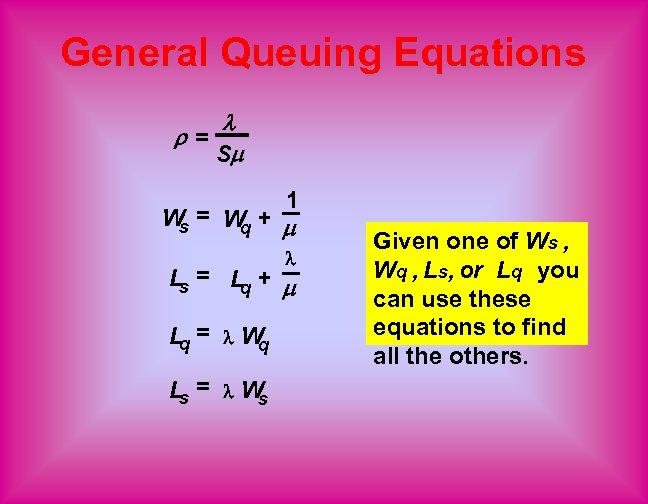
General Queuing Equations = S 1 = W + W s q Ls = Lq + Lq = W q Ls = W s Given one of Ws , Wq , Ls, or Lq you can use these equations to find all the others.
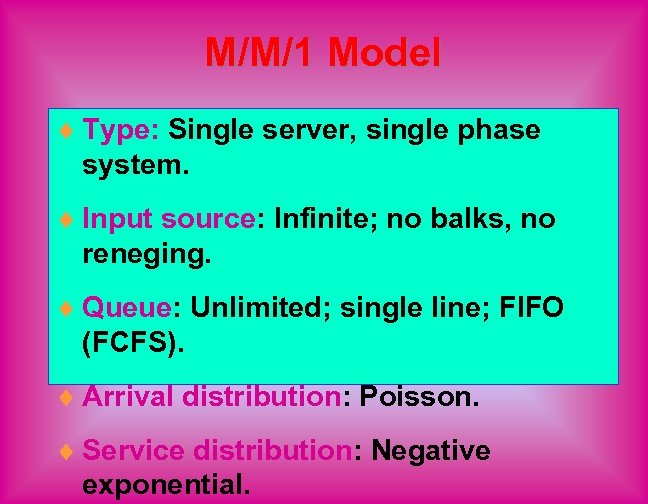
M/M/1 Model ¨ Type: Single server, single phase system. ¨ Input source: Infinite; no balks, no reneging. ¨ Queue: Unlimited; single line; FIFO (FCFS). ¨ Arrival distribution: Poisson. ¨ Service distribution: Negative exponential.
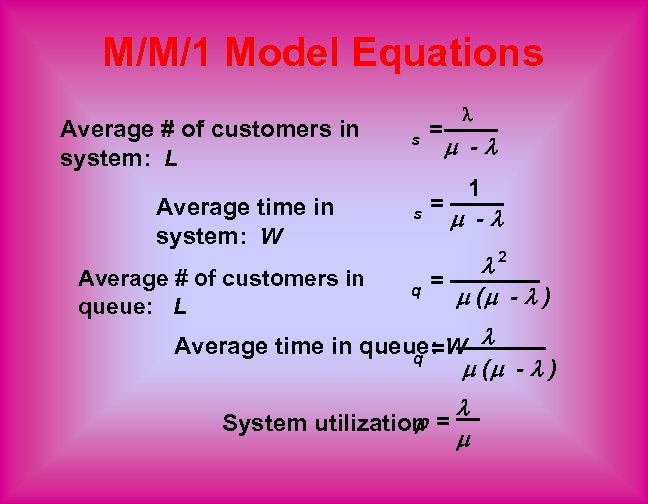
M/M/1 Model Equations Average # of customers in system: L Average time in system: W Average # of customers in queue: L s = - 1 - 2 q = ( - ) Average time in queue: W q = ( - ) System utilization =
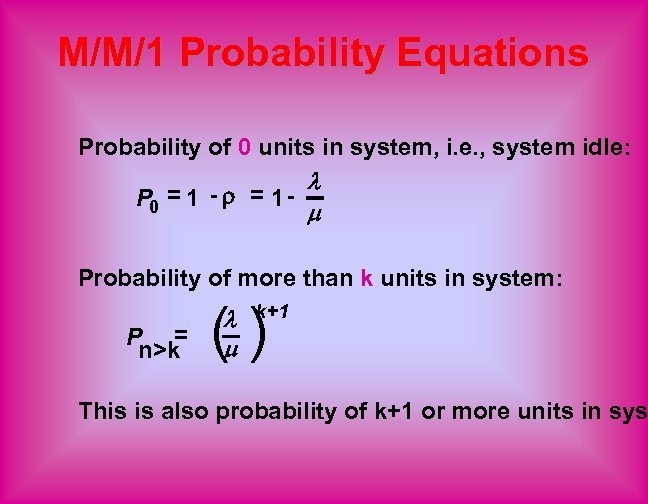
M/M/1 Probability Equations Probability of 0 units in system, i. e. , system idle: P 0 = 1 - Probability of more than k units in system: P = n>k () k+1 This is also probability of k+1 or more units in sys
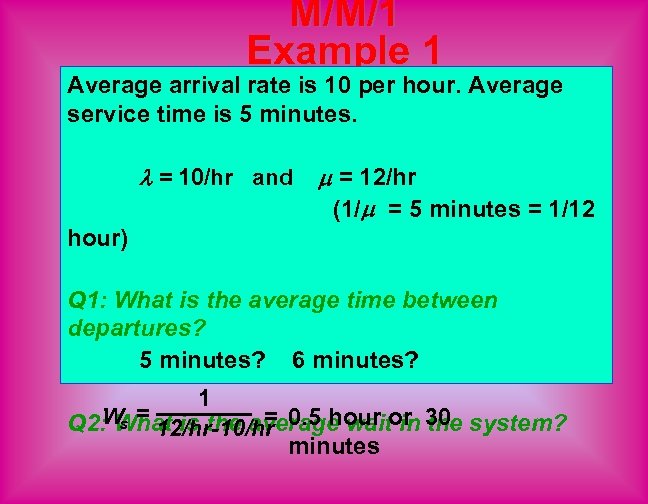
M/M/1 Example 1 Average arrival rate is 10 per hour. Average service time is 5 minutes. = 10/hr and = 12/hr (1/ = 5 minutes = 1/12 hour) Q 1: What is the average time between departures? 5 minutes? 6 minutes? 1 W = = s Q 2: What is the average waitor 30 system? 12/hr-10/hr 0. 5 hour in the minutes
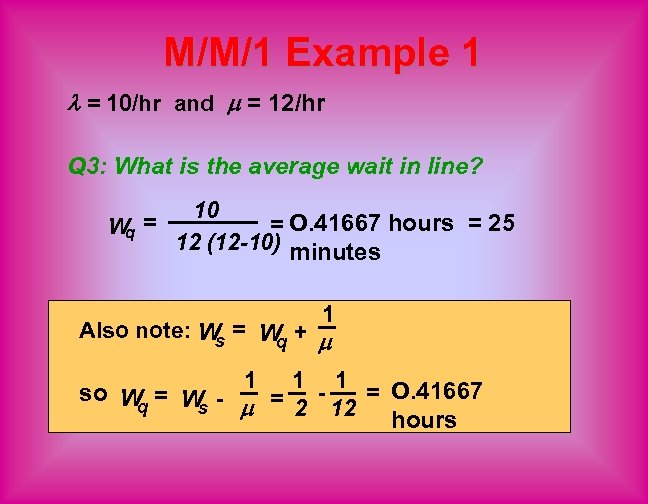
M/M/1 Example 1 = 10/hr and = 12/hr Q 3: What is the average wait in line? W = q 10 = O. 41667 hours = 25 12 (12 -10) minutes 1 Also note: W = W + s q 1 1 1 so W = 2 - 12 = O. 41667 q s hours
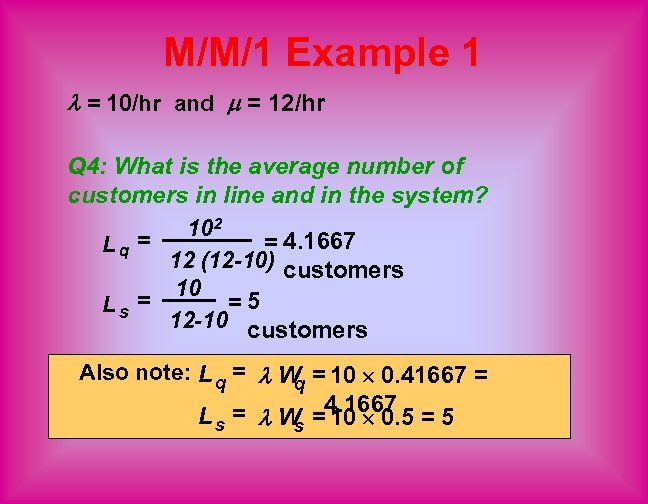
M/M/1 Example 1 = 10/hr and = 12/hr Q 4: What is the average number of customers in line and in the system? 102 = 4. 1667 Lq = 12 (12 -10) customers 10 = =5 Ls 12 -10 customers Also note: L q = W = 10 0. 41667 = q 4. 1667 L s = W = 10 0. 5 = 5 s
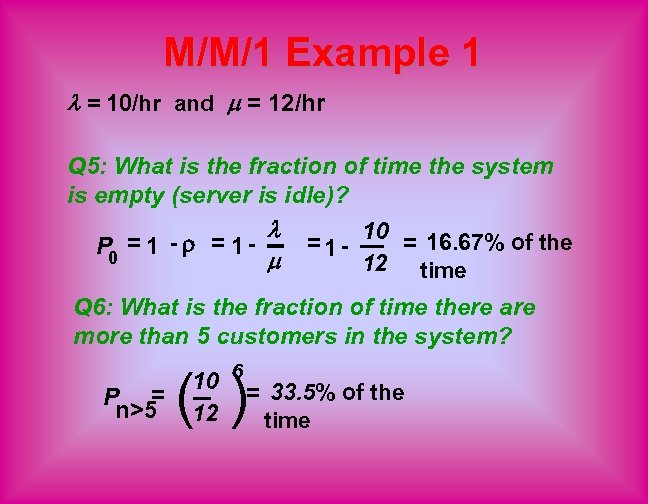
M/M/1 Example 1 = 10/hr and = 12/hr Q 5: What is the fraction of time the system is empty (server is idle)? P 0 = 1 - 10 = 16. 67% of the 12 time Q 6: What is the fraction of time there are more than 5 customers in the system? P = n>5 10 6 = 33. 5% of the 12 time ( )
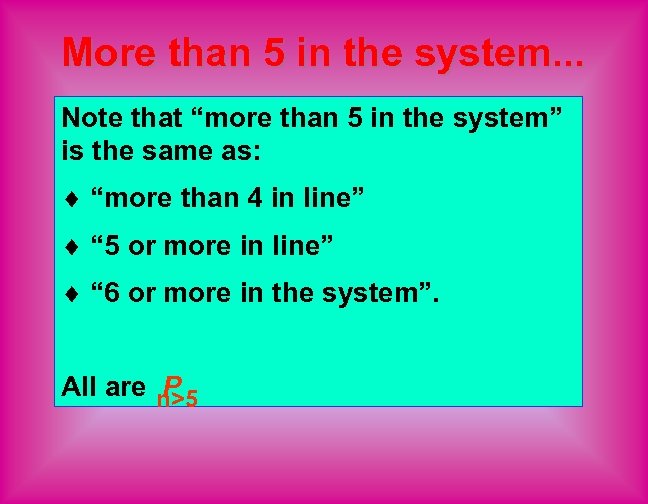
More than 5 in the system. . . Note that “more than 5 in the system” is the same as: ¨ “more than 4 in line” ¨ “ 5 or more in line” ¨ “ 6 or more in the system”. All are n>5 P
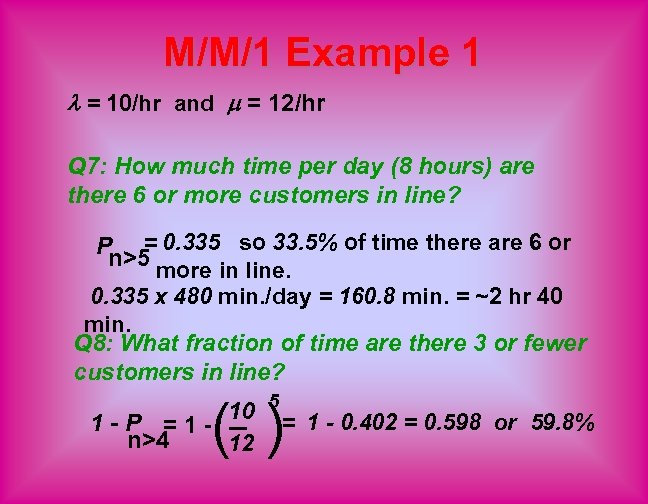
M/M/1 Example 1 = 10/hr and = 12/hr Q 7: How much time per day (8 hours) are there 6 or more customers in line? P = 0. 335 so 33. 5% of time there are 6 or n>5 more in line. 0. 335 x 480 min. /day = 160. 8 min. = ~2 hr 40 min. Q 8: What fraction of time are there 3 or fewer customers in line? 10 5 = 1 - 0. 402 = 0. 598 or 59. 8% 1 -P =1 n>4 12 ( )
Скачать презентацию Model Antrian By Render ect Outline
5618fd88ea4436d408793dbc0d48e6a3.ppt