 Скачать презентацию Mode Selection based on Effective CINR Document Number
824279c1b13c314bc239564a7d6723f7.ppt
- Количество слайдов: 16



Mode Selection based on Effective CINR. Document Number: IEEE S 80216 m-08/661 Date Submitted: 2008 -07 -03 Source: Michael Erlihson, Doron Ezri Runcom Technologies Moshe Levi St. 11, Rishon Le. Zion 75658, Israel Venue: IEEE C 802. 16 m-08/024 - Call for Comments and Contributions on Project 802. 16 m System Description Document (SDD) Target topic: “Link adaptation”. Base Contribution: none. Abstract: We propose a new explicit technique for efficient MIMO mode selection. Purpose: Discussion and approval by TGm for the 802. 16 m SDD Notice: This document does not represent the agreed views of the IEEE 802. 16 Working Group or any of its subgroups. It represents only the views of the participants listed in the “Source(s)” field above. It is offered as a basis for discussion. It is not binding on the contributor(s), who reserve(s) the right to add, amend or withdraw material contained herein. Release: The contributor grants a free, irrevocable license to the IEEE to incorporate material contained in this contribution, and any modifications thereof, in the creation of an IEEE Standards publication; to copyright in the IEEE’s name any IEEE Standards publication even though it may include portions of this contribution; and at the IEEE’s sole discretion to permit others to reproduce in whole or in part the resulting IEEE Standards publication. The contributor also acknowledges and accepts that this contribution may be made public by IEEE 802. 16. Patent Policy: The contributor is familiar with the IEEE-SA Patent Policy and Procedures: <http: //standards. ieee. org/guides/bylaws/sect 6 -7. html#6> and <http: //standards. ieee. org/guides/opman/sect 6. html#6. 3>. Further information is located at <http: //standards. ieee. org/board/pat-material. html> and <http: //standards. ieee. org/board/pat >.
Motivation n n In the 16 e, MIMO mode selection is implementation specific. This means that it is difficult for BS vendors to rely on it for link adaptation. Many BS vendors rather rely on PCINR which is better defined (but does not fully reflect the link condition). Therefore mode selection should be well defined in the 16 m.
Scope n n We introduce a new mode selection technique, which provides an efficient and accurate means for selecting the optimal MIMO mode and MCS in various channel conditions. This method is based on the effective CINR concept applied to the per-tone MIMO PCINR.
Preliminaries - ECINR n n It is known that average PCINR provides a loose link error prediction for fading channels. To overcome this difficulty, the PCINR may be replaced with the effective CINR (ECINR), which is defined as the AWGNequivalent CINR that results in the same error rate.
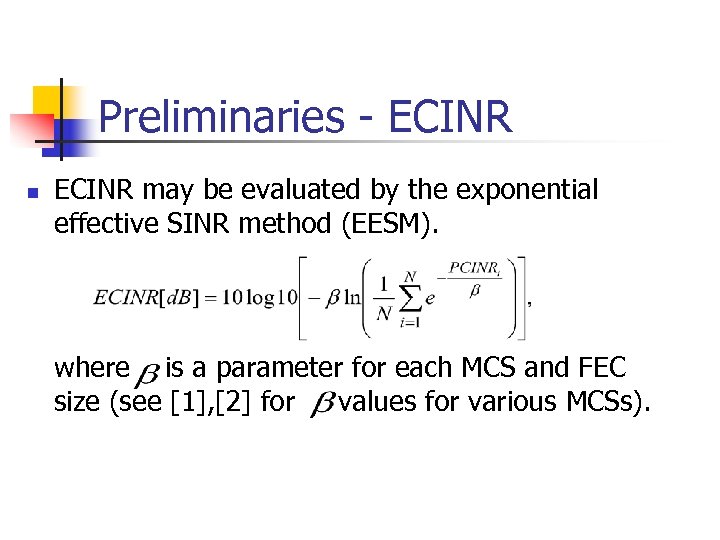
Preliminaries - ECINR n ECINR may be evaluated by the exponential effective SINR method (EESM). where is a parameter for each MCS and FEC size (see [1], [2] for values for various MCSs).
Preliminaries – MIMO PCINR § § The per-tone MIMO PCINR is well defined in the 802. 16 e for most MIMO modes. Some of the 16 e PCINR formulas are given in the next slide.
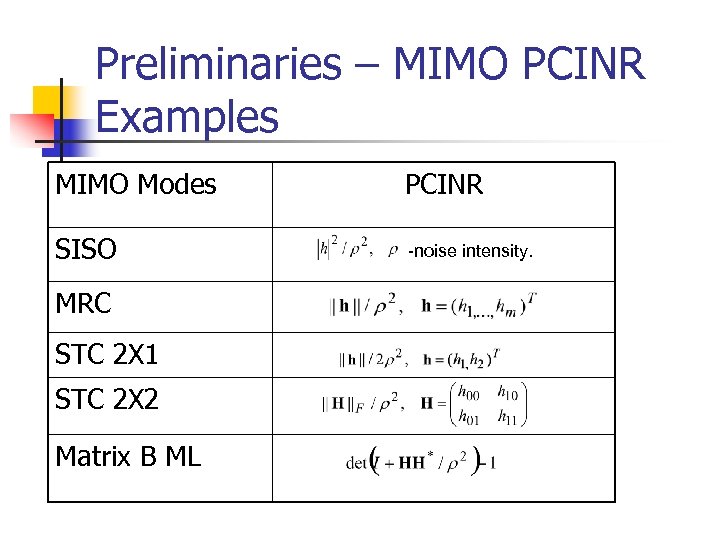
Preliminaries – MIMO PCINR Examples MIMO Modes PCINR SISO -noise intensity. MRC STC 2 X 1 STC 2 X 2 Matrix B ML
Main Concept n n Fusion between ECINR and Effective MIMO channel Decide on the MIMO mode and MCS with maximal throughput subject to Qo. S.
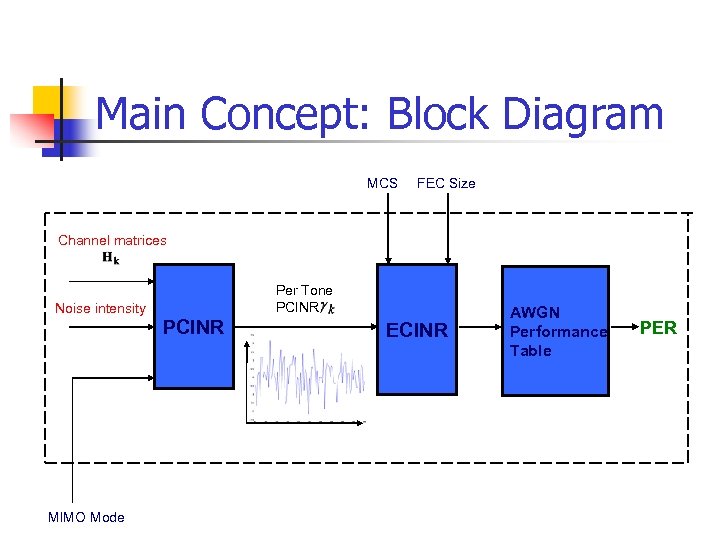
Main Concept: Block Diagram MCS FEC Size Channel matrices Per Tone PCINR Noise intensity PCINR MIMO Mode ECINR AWGN Performance Table PER
Further Simplifications n Check Only Relevant Modes § § Create a list of available MIMO modes based on system capabilities (Mobility will be discussed in the sequel). In case only part of the channel matrix is available, modes that require more information for the computation of the PCINR should not be considered (e. g. MIMO PCINR cannot be based on the channel estimate resulting for single antenna transmission).
Further Simplifications n Modes hierarchy § § Some modes are always superior to others (e. g. MRC is always better than SISO) Thus, when superior modes are available the inferior modes shouldn’t be considered. Thus an offline database of modes hierarchy may be constructed. This database doesn’t include any information regarding modulation-coding schemes.

Optimality Criterion § Based on the resulting PER values, choose the optimal MIMO mode and MCS combination with highest throughput subject to some predefined Qo. S.
Accounting for Mobility § § § Some MIMO modes, as closed-loop schemes, are not suitable for employment in high mobility scenarios. Thus, such schemes should not be considered when the velocity is above some threshold. This issue (and the way channel variations are assessed) requires further study.
Conclusions n n n Will provide similar baseline for different vendors Calculation of the ECINR is based on PCINR which is already incorporated in the system Will enhance system performance and is simple to implement * This approach as been recently presented in [1] and showed excellent performance.
Proposed changes n n We propose that the specified technique of mode selection based on ECINR calculation will be used by the 16 m MS. We propose to include a section pertaining to MIMO mode selection in the SDD.
![: References [1] Dachuan Yao, Alfonso Camargo, and Andreas Czylwik, Adaptive MIMO Transmission Scheme](https://present5.com/presentation/824279c1b13c314bc239564a7d6723f7/image-16.jpg ": References [1] Dachuan Yao, Alfonso Camargo, and Andreas Czylwik, Adaptive MIMO Transmission Scheme")
: References [1] Dachuan Yao, Alfonso Camargo, and Andreas Czylwik, Adaptive MIMO Transmission Scheme for BICM-OFDM Wireless Systems, COST 2100, TD(08)509, 2008. [2] Ericsson, “Effective-SNR Mapping for Modeling Frame Error Rates in Multiple-state Channels, ” 3 GPP 2 -C 30 -20030429 -010, Nov. , 2003.
Скачать презентацию Mode Selection based on Effective CINR Document Number
824279c1b13c314bc239564a7d6723f7.ppt