 Скачать презентацию MODAL VERBS FOR REQUESTS Виконала студентка 21 -А
Modal Verbs.pptx
- Количество слайдов: 10



MODAL VERBS FOR REQUESTS Виконала студентка 21 -А групи Сало Христина
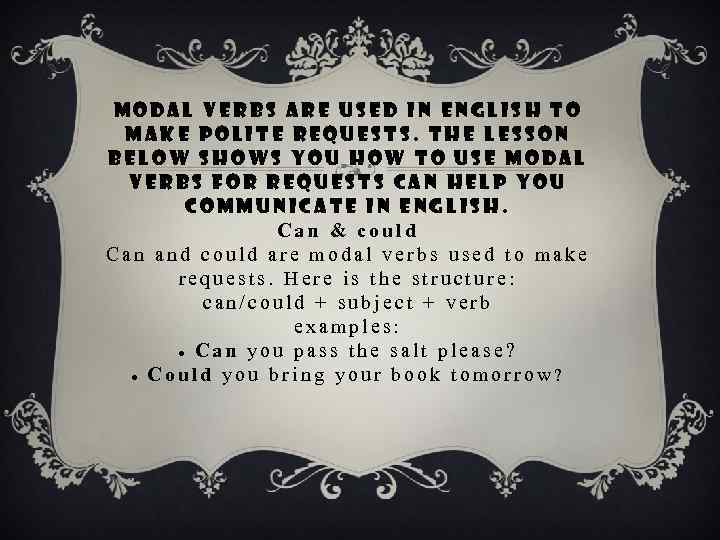
Modal verbs are used in English to make polite requests. The lesson below shows you how to use modal verbs for requests can help you communicate in English. Can & could Can and could are modal verbs used to make requests. Here is the structure: can/could + subject + verb examples: ● Can you pass the salt please? ● Could you bring your book tomorrow?
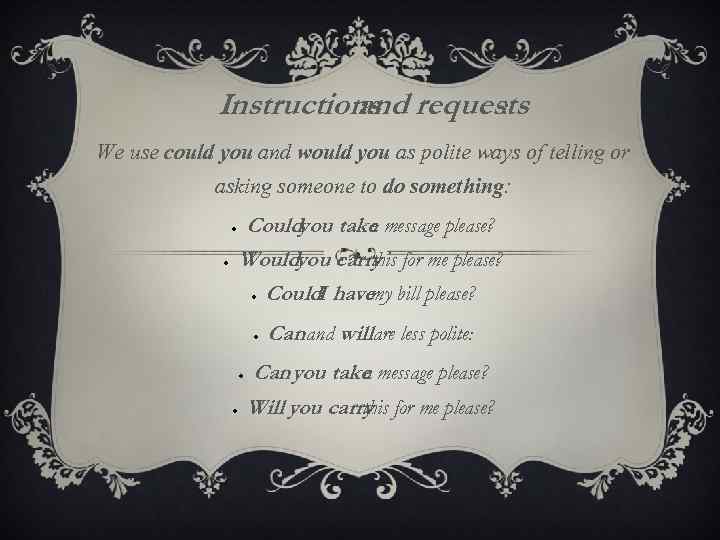
Instructions requests and : We use could you and would you as polite ways of telling or asking someone to do something: ● ● Couldyou take message please? a Wouldyou carry for me please? this ● Could have I my bill please? ● ● ● Can and willare less polite: Can you take message please? a Will you carry for me please? this
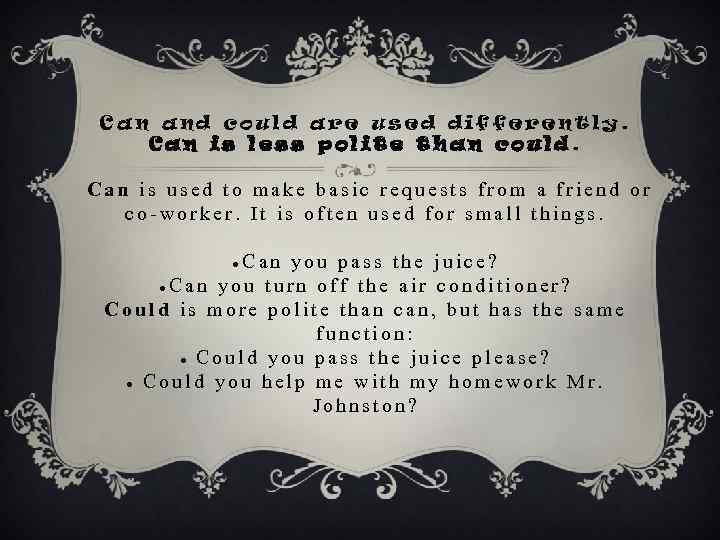
Can and could are used differently. Can is less polite than could. Can is used to make basic requests from a friend or co-worker. It is often used for small things. Can you pass the juice? ●Can you turn off the air conditioner? Could is more polite than can, but has the same function: ● Could you pass the juice please? ● Could you help me with my homework Mr. Johnston? ●
Would is used to make polite requests in English. The structure is as follows: Would you mind + Verb + ING Examples: ●Would you mind closing the door? ● Would you mind turning down the radio? You can also say “do you mind”, but “would you mind” is more polite: ● Do you mind turning off the music? ● Would you mind turning off the music?
would can also be used to make polite requests with the verb “like”. ●I would like another drink please. ● I would like some help with my math homework please. This is the same as using the verb “want”. However, would is more polite. ● I want a drink. ● I would like a drink. These types of requests are more common when ordering something. Take a look at these examples: ● I would like rice with my chicken. ● I would like another coke please.
REQUESTS WITH “TO HAVE” WHEN YOU NEED OR WANT SOMETHING, YOU CAN USE THE MODAL VERBS “CAN”, “COULD” OR “MAY” FOLLOWED BY THE VERB “TO HAVE”. REMEMBER THAT WE USE “CAN” IN INFORMAL SITUATIONS, SUCH AS WITH FRIENDS AND FAMILY. “COULD” AND “MAY” ARE USED IN MORE FORMAL SITUATIONS, WITH YOUR BOSS OR DURING A MEETING. EXAMPLES: “CAN I HAVE SOME MORE CHICKEN, MOM? ” “CAN I HAVE TWO COKE’S AND A BURGER, PLEASE? ” “COULD I HAVE SOME MORE COFFEE? ” “COULD I HAVE THE WINE, PLEASE? ” “MAY I HAVE THE BILL, PLEASE? ”
The modal verbs MAY, COULD, WILL, WOULD are used in making polite requests in speech and writing, in communication with strangers and with people you know. CAN in requests is considered to be less polite than the other modals in this group. CAN is generally used in informal requests, mostly in conversation with friends and family. Note the use of the pronouns "I, you". In requests, MAY is used in the form "May I"; WILL and WOULD are used in the forms "Will you" and "Would you"; COULD and CAN are used in both variants. May I speak to Tom Lee, please? May I borrow your pen, please? Could I speak to Tom Lee, please? Could you lend me thirty dollars till Wednesday, please? Can I borrow your pen, please? Can you tell me where the bank is, please? Will you please be quiet? Would you please ask her to call me? Note: The modal verb MIGHT may be used in making polite requests in the same way as MAY, but it is rarely used in this function.
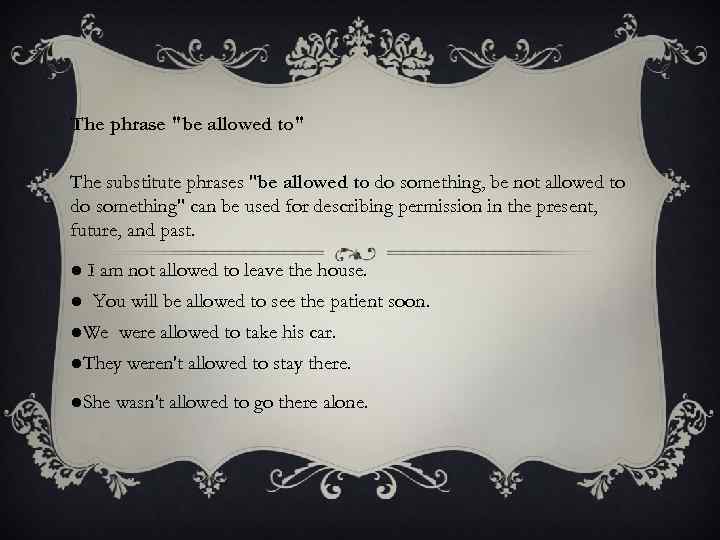
The phrase "be allowed to" The substitute phrases "be allowed to do something, be not allowed to do something" can be used for describing permission in the present, future, and past. ● I am not allowed to leave the house. ● You will be allowed to see the patient soon. ●We were allowed to take his car. ●They weren't allowed to stay there. ●She wasn't allowed to go there alone.

THE END!
Скачать презентацию MODAL VERBS FOR REQUESTS Виконала студентка 21 -А
Modal Verbs.pptx