 Скачать презентацию Modal Doubling in Hong Kong Hokkien Yin Ling
096a312aa41c5b62d2040c993d355139.ppt
- Количество слайдов: 39



Modal Doubling in Hong Kong Hokkien Yin Ling Cheung Ph. D. Candidate in Linguistics Purdue University August 31, 2007 1
The Goal • To find out how modal doubling in Hong Kong Hokkien is represented. 2
Outline 1. 2. 3. 4. 5. 6. Introduction: location and language family Basic word order Properties of Modal Doubling in Hokkien Potential Analyses for Serial Verb Constructions in Hong Kong Hokkien Larsonian Structure to Account for Resultative Serial Verb Construction Conclusion 3
1. 2. 3. 4. Introduction: location and language family Basic word order Properties of Modal Doubling in Hokkien Potential Analyses for Serial Verb Constructions in Hong Kong Hokkien 5. Larsonian Structure to Account for Resultative Serial Verb Construction 6. Conclusion 4
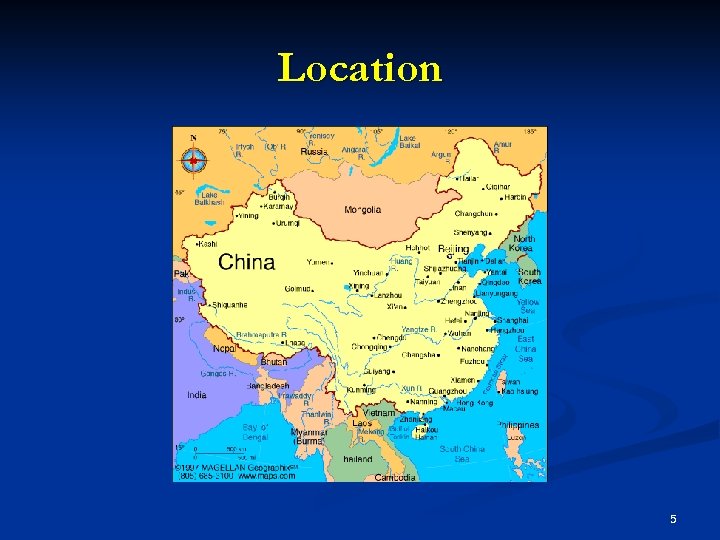
Location 5
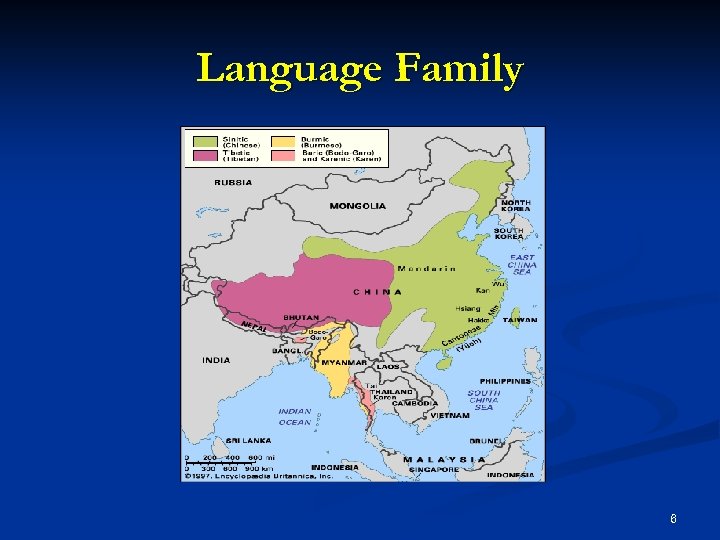
Language Family 6
1. Introduction: location and language family 2. Basic word order 3. Properties of Modal Doubling in Hokkien 4. Potential Analyses for Serial Verb Constructions in Hong Kong Hokkien 5. Larsonian Structure to Account for Resultative Serial Verb Construction 6. Conclusion 7
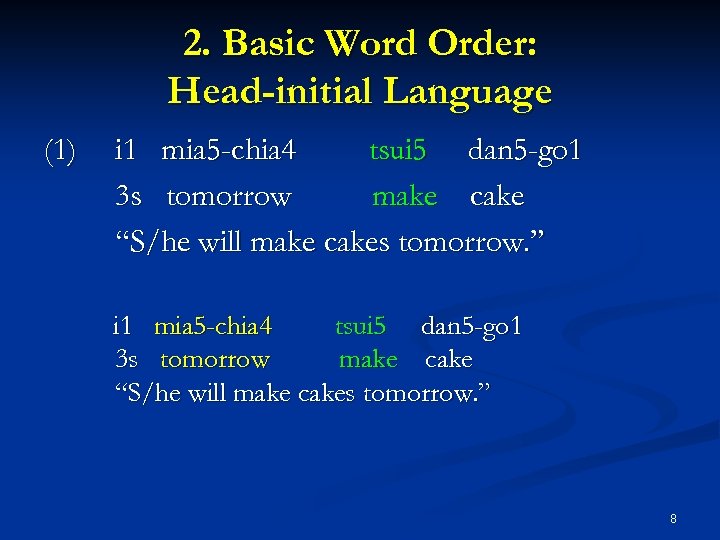
2. Basic Word Order: Head-initial Language (1) i 1 mia 5 -chia 4 tsui 5 dan 5 -go 1 3 s tomorrow make cake “S/he will make cakes tomorrow. ” 8
1. Introduction: location and language family 2. Basic word order 3. Properties of Modal Doubling in Hokkien 4. Potential Analyses for Serial Verb Constructions in Hong Kong Hokkien 5. Larsonian Structure to Account for Resultative Serial Verb Construction 6. Conclusion 9
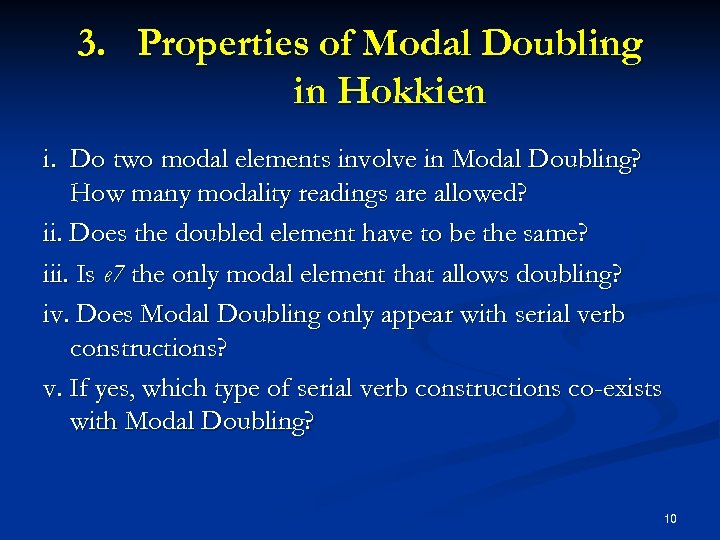
3. Properties of Modal Doubling in Hokkien i. Do two modal elements involve in Modal Doubling? How many modality readings are allowed? ii. Does the doubled element have to be the same? iii. Is e 7 the only modal element that allows doubling? iv. Does Modal Doubling only appear with serial verb constructions? v. If yes, which type of serial verb constructions co-exists with Modal Doubling? 10
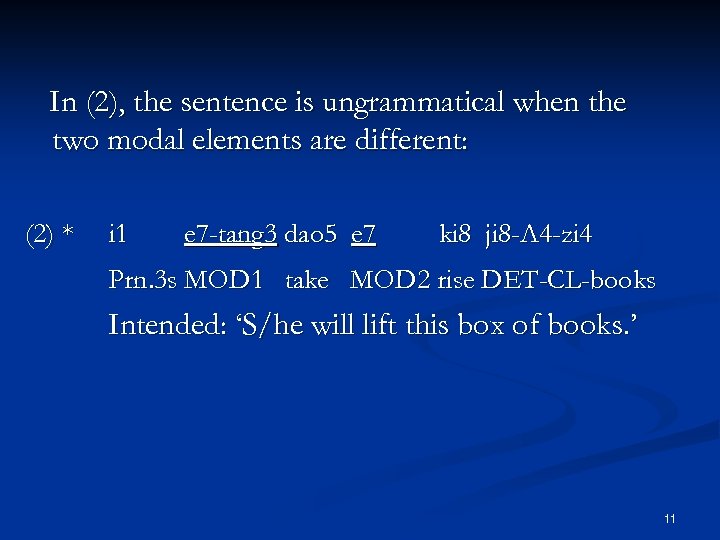
In (2), the sentence is ungrammatical when the two modal elements are different: (2) * i 1 e 7 -tang 3 dao 5 e 7 ki 8 ji 8 -Λ 4 -zi 4 Prn. 3 s MOD 1 take MOD 2 rise DET-CL-books Intended: ‘S/he will lift this box of books. ’ 11
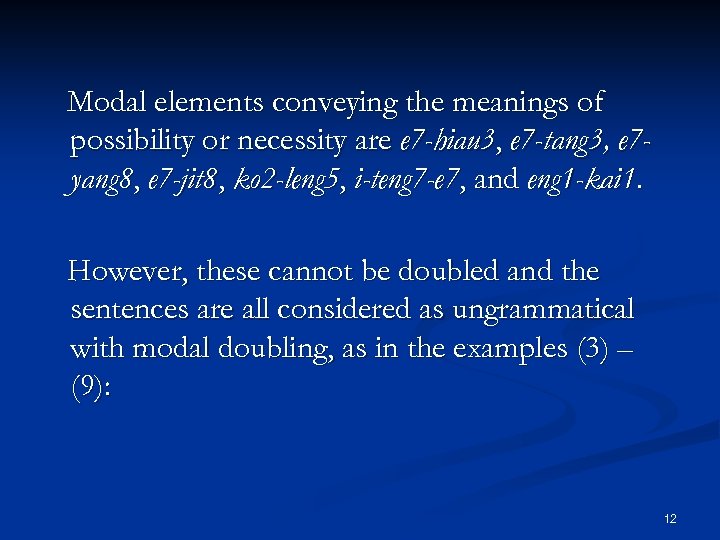
Modal elements conveying the meanings of possibility or necessity are e 7 -hiau 3, e 7 -tang 3, e 7 yang 8, e 7 -jit 8, ko 2 -leng 5, i-teng 7 -e 7, and eng 1 -kai 1. However, these cannot be doubled and the sentences are all considered as ungrammatical with modal doubling, as in the examples (3) – (9): 12
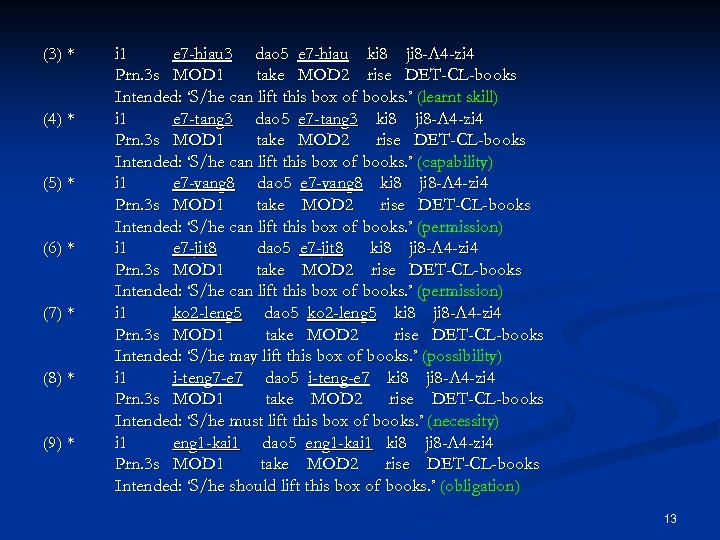
(3) * (4) * (5) * (6) * (7) * (8) * (9) * i 1 e 7 -hiau 3 dao 5 e 7 -hiau ki 8 ji 8 -Λ 4 -zi 4 Prn. 3 s MOD 1 take MOD 2 rise DET-CL-books Intended: ‘S/he can lift this box of books. ’ (learnt skill) i 1 e 7 -tang 3 dao 5 e 7 -tang 3 ki 8 ji 8 -Λ 4 -zi 4 Prn. 3 s MOD 1 take MOD 2 rise DET-CL-books Intended: ‘S/he can lift this box of books. ’ (capability) i 1 e 7 -yang 8 dao 5 e 7 -yang 8 ki 8 ji 8 -Λ 4 -zi 4 Prn. 3 s MOD 1 take MOD 2 rise DET-CL-books Intended: ‘S/he can lift this box of books. ’ (permission) i 1 e 7 -jit 8 dao 5 e 7 -jit 8 ki 8 ji 8 -Λ 4 -zi 4 Prn. 3 s MOD 1 take MOD 2 rise DET-CL-books Intended: ‘S/he can lift this box of books. ’ (permission) i 1 ko 2 -leng 5 dao 5 ko 2 -leng 5 ki 8 ji 8 -Λ 4 -zi 4 Prn. 3 s MOD 1 take MOD 2 rise DET-CL-books Intended: ‘S/he may lift this box of books. ’ (possibility) i 1 i-teng 7 -e 7 dao 5 i-teng-e 7 ki 8 ji 8 -Λ 4 -zi 4 Prn. 3 s MOD 1 take MOD 2 rise DET-CL-books Intended: ‘S/he must lift this box of books. ’ (necessity) i 1 eng 1 -kai 1 dao 5 eng 1 -kai 1 ki 8 ji 8 -Λ 4 -zi 4 Prn. 3 s MOD 1 take MOD 2 rise DET-CL-books Intended: ‘S/he should lift this box of books. ’ (obligation) 13
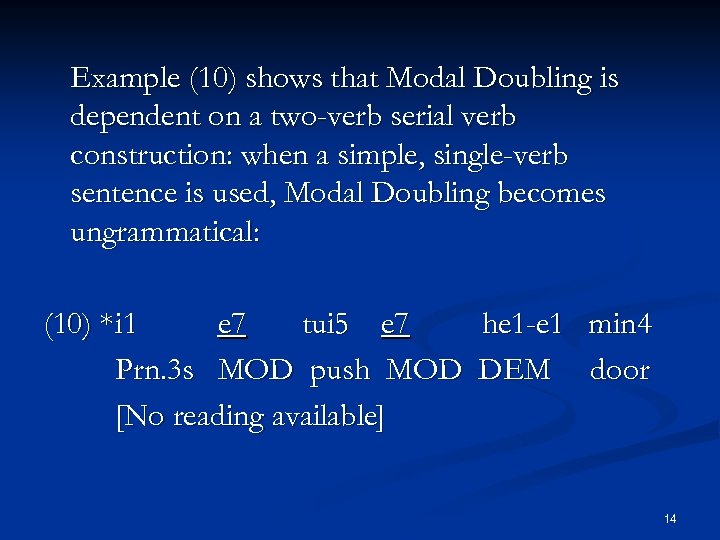
Example (10) shows that Modal Doubling is dependent on a two-verb serial verb construction: when a simple, single-verb sentence is used, Modal Doubling becomes ungrammatical: (10) * i 1 e 7 tui 5 e 7 he 1 -e 1 min 4 Prn. 3 s MOD push MOD DEM door [No reading available] 14
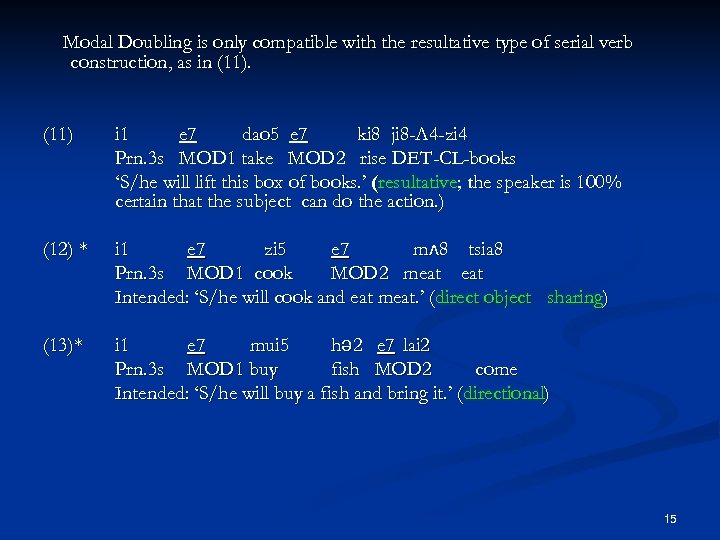
Modal Doubling is only compatible with the resultative type of serial verb construction, as in (11) i 1 e 7 dao 5 e 7 ki 8 ji 8 -Λ 4 -zi 4 Prn. 3 s MOD 1 take MOD 2 rise DET-CL-books ‘S/he will lift this box of books. ’ (resultative; the speaker is 100% certain that the subject can do the action. ) (12) * i 1 e 7 zi 5 e 7 mʌ8 tsia 8 Prn. 3 s MOD 1 cook MOD 2 meat Intended: ‘S/he will cook and eat meat. ’ (direct object sharing) (13)* i 1 e 7 mui 5 hə 2 e 7 lai 2 Prn. 3 s MOD 1 buy fish MOD 2 come Intended: ‘S/he will buy a fish and bring it. ’ (directional) 15
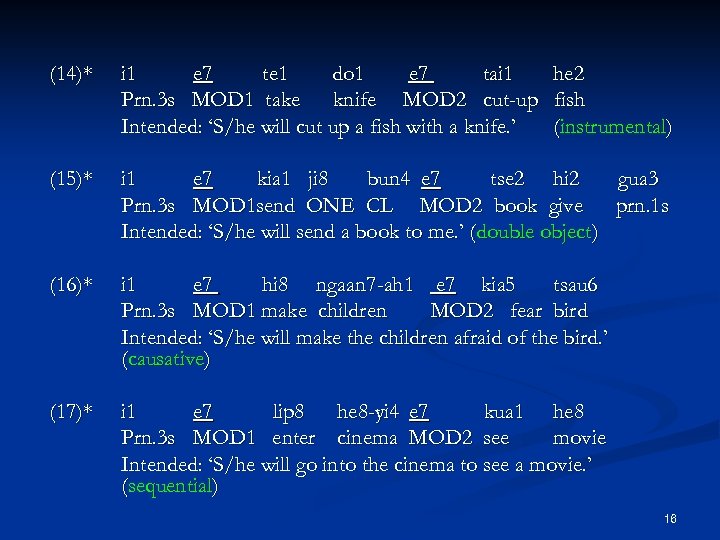
(14)* i 1 e 7 te 1 do 1 e 7 tai 1 Prn. 3 s MOD 1 take knife MOD 2 cut-up Intended: ‘S/he will cut up a fish with a knife. ’ he 2 fish (instrumental) (15)* i 1 e 7 kia 1 ji 8 bun 4 e 7 tse 2 hi 2 gua 3 Prn. 3 s MOD 1 send ONE CL MOD 2 book give prn. 1 s Intended: ‘S/he will send a book to me. ’ (double object) (16)* i 1 e 7 hi 8 ngaan 7 -ah 1 e 7 kia 5 tsau 6 Prn. 3 s MOD 1 make children MOD 2 fear bird Intended: ‘S/he will make the children afraid of the bird. ’ (causative) (17)* i 1 e 7 lip 8 he 8 -yi 4 e 7 kua 1 he 8 Prn. 3 s MOD 1 enter cinema MOD 2 see movie Intended: ‘S/he will go into the cinema to see a movie. ’ (sequential) 16
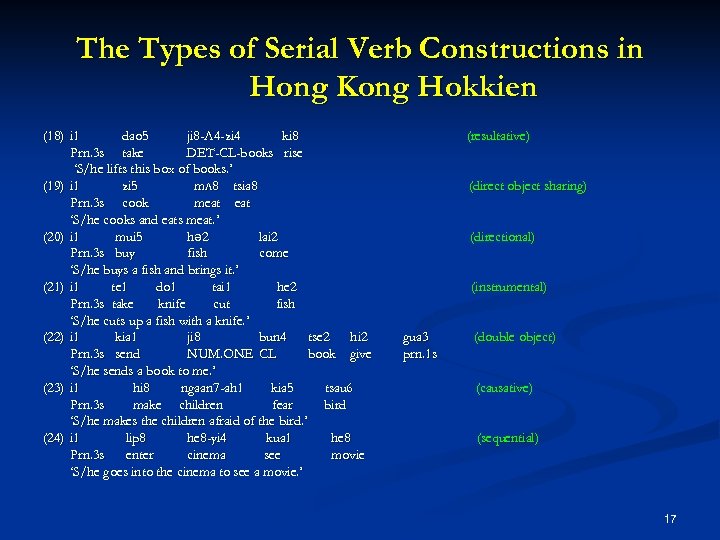
The Types of Serial Verb Constructions in Hong Kong Hokkien (18) i 1 dao 5 ji 8 -Λ 4 -zi 4 ki 8 Prn. 3 s take DET-CL-books rise ‘S/he lifts this box of books. ’ (19) i 1 zi 5 mʌ8 tsia 8 Prn. 3 s cook meat ‘S/he cooks and eats meat. ’ (20) i 1 mui 5 h ə 2 lai 2 Prn. 3 s buy fish come ‘S/he buys a fish and brings it. ’ (21) i 1 te 1 do 1 tai 1 he 2 Prn. 3 s take knife cut fish ‘S/he cuts up a fish with a knife. ’ (22) i 1 kia 1 ji 8 bun 4 tse 2 hi 2 Prn. 3 s send NUM. ONE CL book give ‘S/he sends a book to me. ’ (23) i 1 hi 8 ngaan 7 -ah 1 kia 5 tsau 6 Prn. 3 s make children fear bird ‘S/he makes the children afraid of the bird. ’ (24) i 1 lip 8 he 8 -yi 4 kua 1 he 8 Prn. 3 s enter cinema see movie ‘S/he goes into the cinema to see a movie. ’ (resultative) (direct object sharing) (directional) (instrumental) gua 3 prn. 1 s (double object) (causative) (sequential) 17
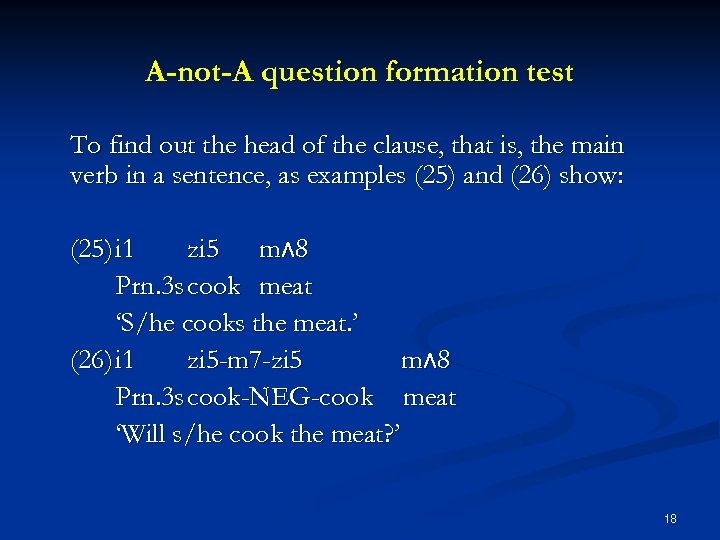
A-not-A question formation test To find out the head of the clause, that is, the main verb in a sentence, as examples (25) and (26) show: (25) i 1 zi 5 mʌ8 Prn. 3 s cook meat ‘S/he cooks the meat. ’ (26) i 1 zi 5 -m 7 -zi 5 mʌ8 Prn. 3 s cook-NEG-cook meat ‘Will s/he cook the meat? ’ 18
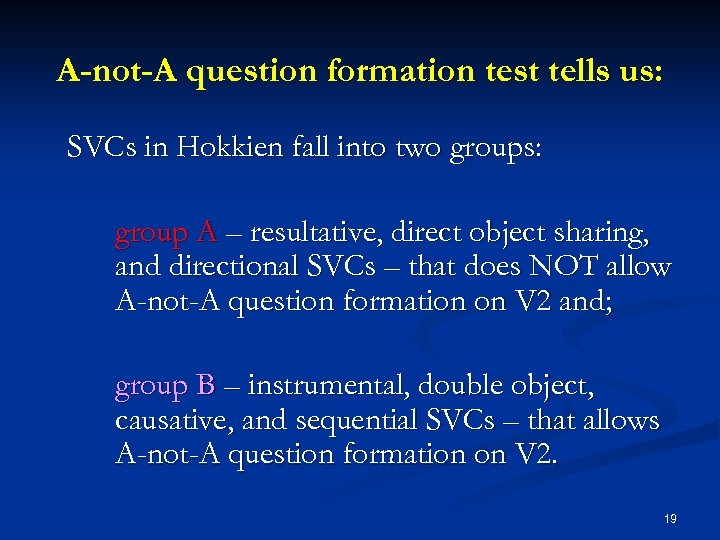
A-not-A question formation test tells us: SVCs in Hokkien fall into two groups: group A – resultative, direct object sharing, and directional SVCs – that does NOT allow A-not-A question formation on V 2 and; group B – instrumental, double object, causative, and sequential SVCs – that allows A-not-A question formation on V 2. 19
1. Introduction: location and language family 2. Basic word order 3. Properties of Modal Doubling in Hokkien 4. Potential Analyses for Serial Verb Constructions in Hong Kong Hokkien 5. Larsonian Structure to Account for Resultative Serial Verb Construction 6. Conclusion 20
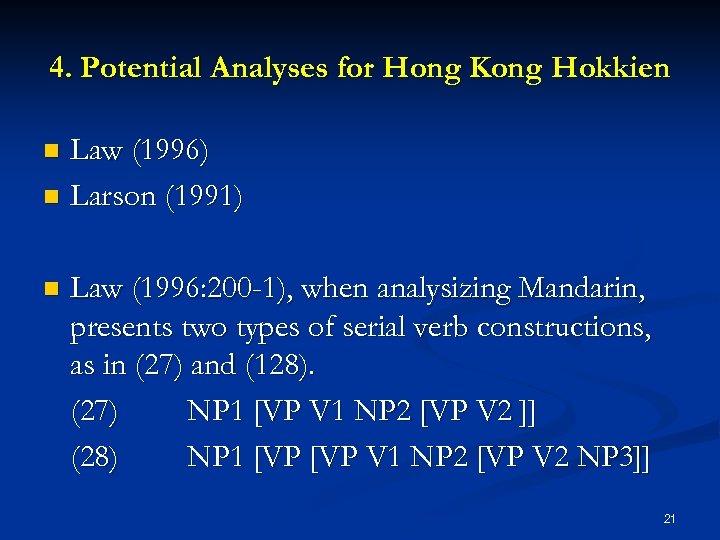
4. Potential Analyses for Hong Kong Hokkien Law (1996) n Larson (1991) n n Law (1996: 200 -1), when analysizing Mandarin, presents two types of serial verb constructions, as in (27) and (128). (27) NP 1 [VP V 1 NP 2 [VP V 2 ]] (28) NP 1 [VP V 1 NP 2 [VP V 2 NP 3]] 21
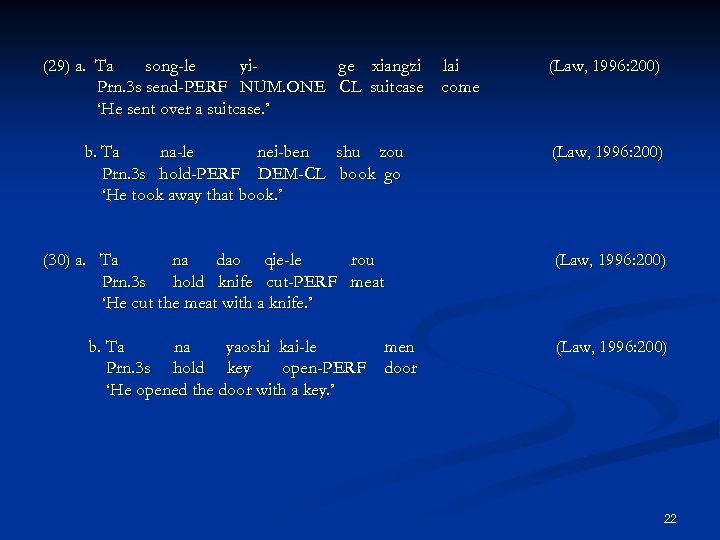
(29) a. Ta song-le yige xiangzi lai Prn. 3 s send-PERF NUM. ONE CL suitcase come ‘He sent over a suitcase. ’ b. Ta na-le nei-ben shu zou Prn. 3 s hold-PERF DEM-CL book go ‘He took away that book. ’ (30) a. Ta na dao qie-le rou Prn. 3 s hold knife cut-PERF meat ‘He cut the meat with a knife. ’ b. Ta na yaoshi kai-le men Prn. 3 s hold key open-PERF door ‘He opened the door with a key. ’ (Law, 1996: 200) 22
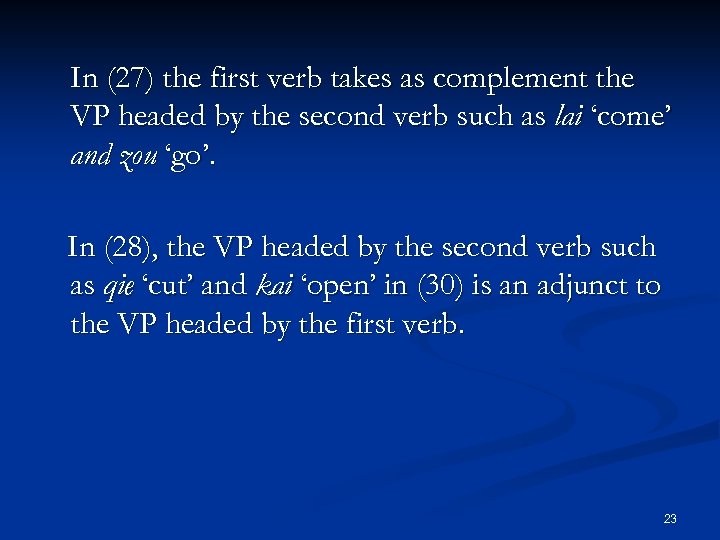
In (27) the first verb takes as complement the VP headed by the second verb such as lai ‘come’ and zou ‘go’. In (28), the VP headed by the second verb such as qie ‘cut’ and kai ‘open’ in (30) is an adjunct to the VP headed by the first verb. 23
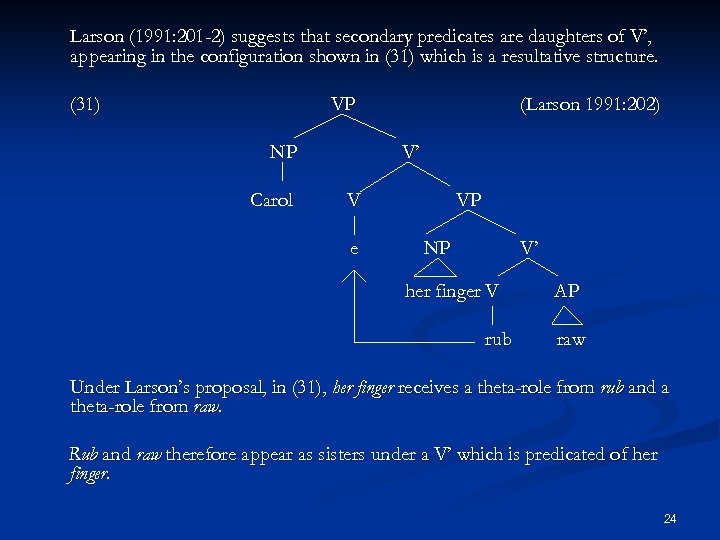
Larson (1991: 201 -2) suggests that secondary predicates are daughters of V’, appearing in the configuration shown in (31) which is a resultative structure. (31) VP NP Carol (Larson 1991: 202) V’ V e VP NP V’ her finger V rub AP raw Under Larson’s proposal, in (31), her finger receives a theta-role from rub and a theta-role from raw. Rub and raw therefore appear as sisters under a V’ which is predicated of her finger. 24
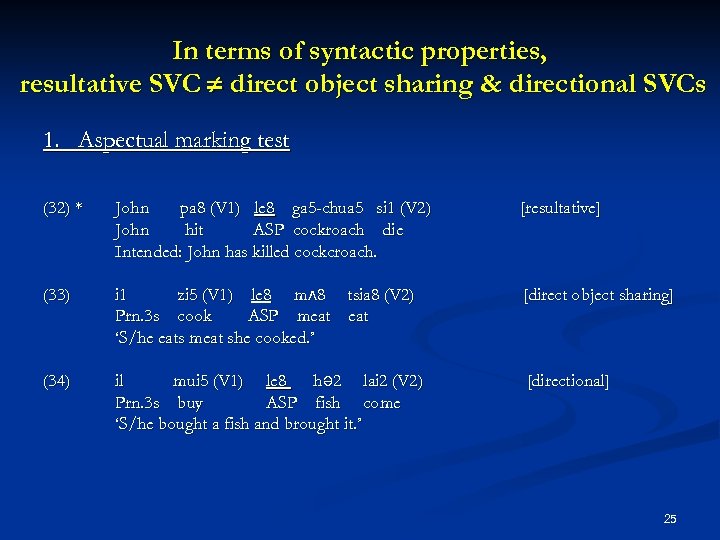
In terms of syntactic properties, resultative SVC direct object sharing & directional SVCs 1. Aspectual marking test (32) * John pa 8 (V 1) le 8 ga 5 -chua 5 si 1 (V 2) John hit ASP cockroach die Intended: John has killed cockcroach. [resultative] (33) i 1 zi 5 (V 1) le 8 mʌ8 tsia 8 (V 2) Prn. 3 s cook ASP meat ‘S/he eats meat she cooked. ’ [direct object sharing] (34) il mui 5 (V 1) le 8 hə 2 lai 2 (V 2) Prn. 3 s buy ASP fish come ‘S/he bought a fish and brought it. ’ [directional] 25
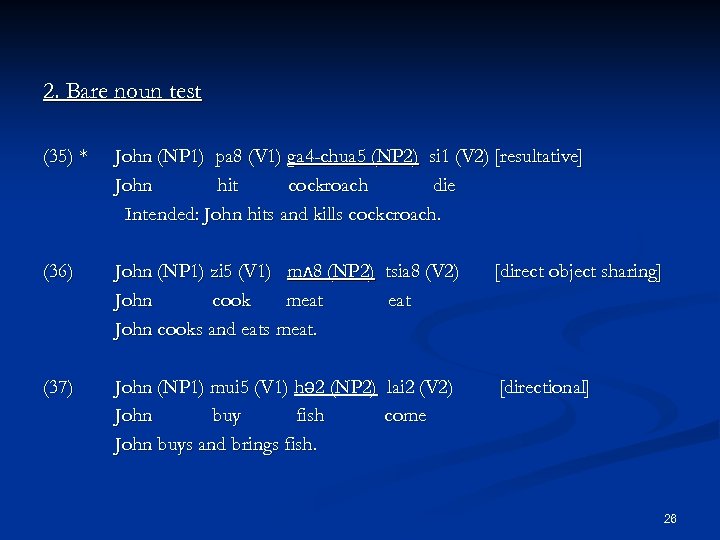
2. Bare noun test (35) * John (NP 1) pa 8 (V 1) ga 4 -chua 5 (NP 2) si 1 (V 2) [resultative] John hit cockroach die Intended: John hits and kills cockcroach. (36) John (NP 1) zi 5 (V 1) mʌ8 (NP 2) tsia 8 (V 2) John cook meat John cooks and eats meat. [direct object sharing] (37) John (NP 1) mui 5 (V 1) hə 2 (NP 2) lai 2 (V 2) John buy fish come John buys and brings fish. [directional] 26
1. Introduction: location and language family 2. Basic word order 3. Properties of Modal Doubling in Hokkien 4. Potential Analyses for Serial Verb Constructions in Hong Kong Hokkien 5. Larsonian Structure to Account for Resultative Serial Verb Construction 6. Conclusion 27
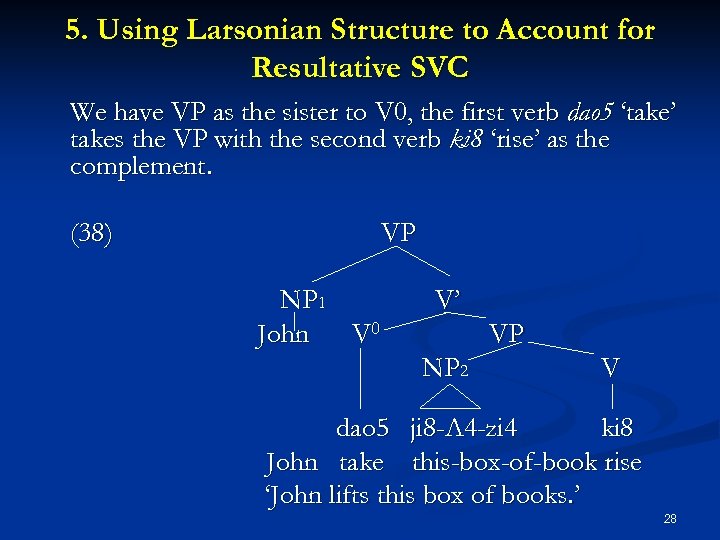
5. Using Larsonian Structure to Account for Resultative SVC We have VP as the sister to V 0, the first verb dao 5 ‘take’ takes the VP with the second verb ki 8 ‘rise’ as the complement. (38) VP NP 1 John V 0 V’ VP NP 2 V dao 5 ji 8 -Λ 4 -zi 4 ki 8 John take this-box-of-book rise ‘John lifts this box of books. ’ 28
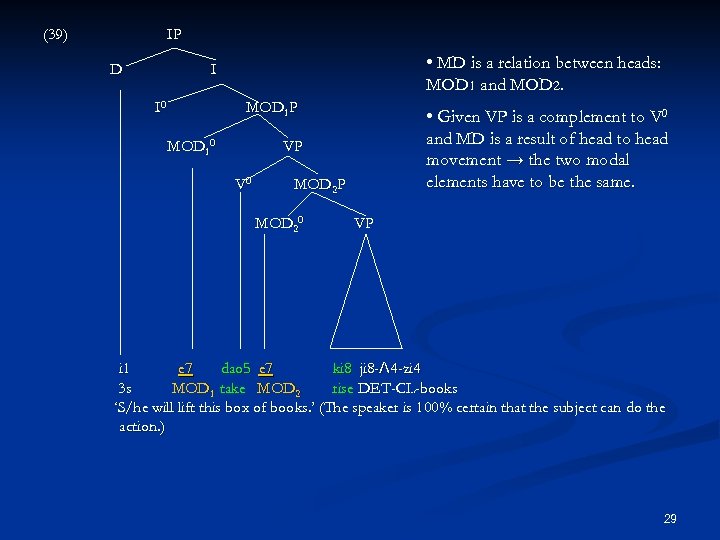
(39) IP D • MD is a relation between heads: MOD 1 and MOD 2. I I 0 MOD 1 P MOD 10 • Given VP is a complement to V 0 and MD is a result of head to head movement → the two modal elements have to be the same. VP V 0 MOD 2 P MOD 20 VP i 1 e 7 dao 5 e 7 ki 8 ji 8 -Λ 4 -zi 4 3 s MOD 1 take MOD 2 rise DET-CL-books ‘S/he will lift this box of books. ’ (The speaker is 100% certain that the subject can do the action. ) 29
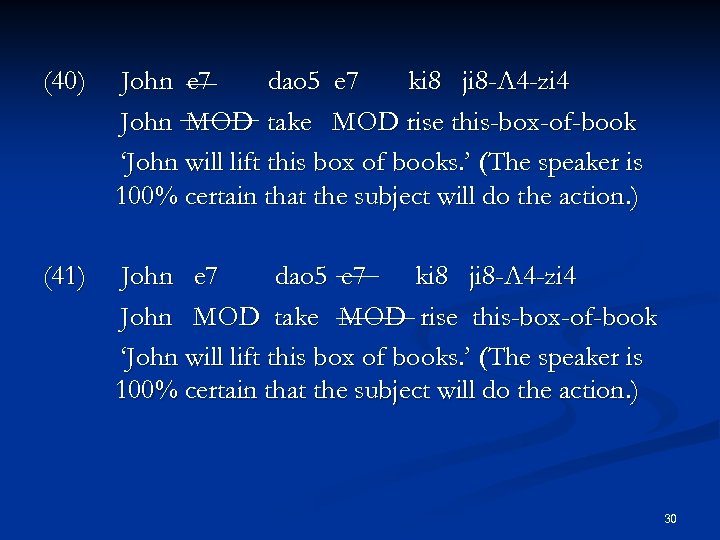
(40) John e 7 dao 5 e 7 ki 8 ji 8 -Λ 4 -zi 4 John MOD take MOD rise this-box-of-book ‘John will lift this box of books. ’ (The speaker is 100% certain that the subject will do the action. ) (41) John e 7 dao 5 e 7 ki 8 ji 8 -Λ 4 -zi 4 John MOD take MOD rise this-box-of-book ‘John will lift this box of books. ’ (The speaker is 100% certain that the subject will do the action. ) 30
1. Introduction: location and language family 2. Basic word order 3. Properties of Modal Doubling in Hokkien 4. Potential Analyses for Serial Verb Constructions in Hong Kong Hokkien 5. Larsonian Structure to Account for Resultative Serial Verb Construction 6. Conclusion 31
6. Conclusion n I have identified Modal Doubling in Hong Kong Hokkien → only restricted to resultative SVC. 32
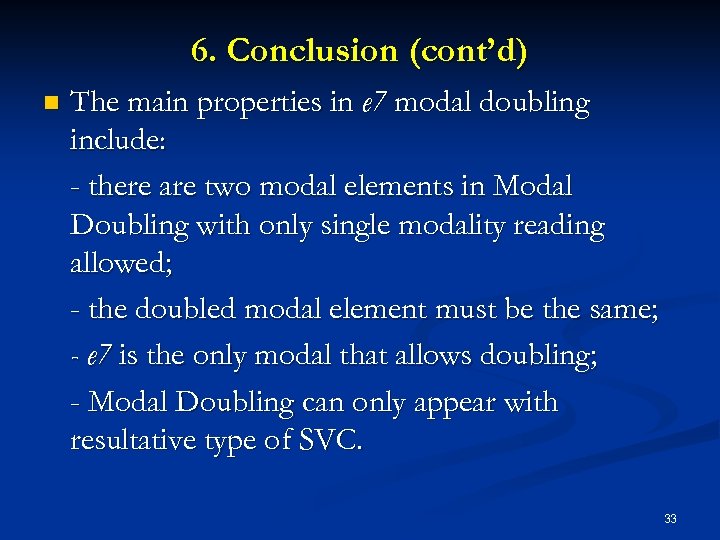
6. Conclusion (cont’d) n The main properties in e 7 modal doubling include: - there are two modal elements in Modal Doubling with only single modality reading allowed; - the doubled modal element must be the same; - e 7 is the only modal that allows doubling; - Modal Doubling can only appear with resultative type of SVC. 33
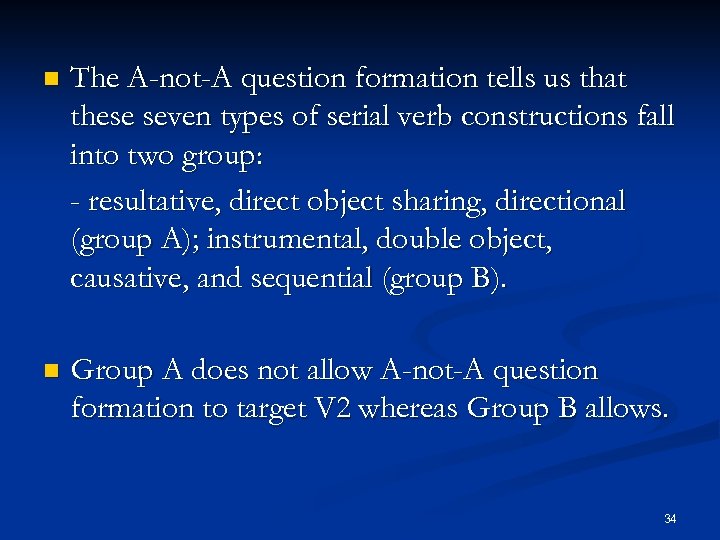
n The A-not-A question formation tells us that these seven types of serial verb constructions fall into two group: - resultative, direct object sharing, directional (group A); instrumental, double object, causative, and sequential (group B). n Group A does not allow A-not-A question formation to target V 2 whereas Group B allows. 34
n Law’s (1996) structures can account for group A type of constructions and also to explain the constructions in group B. 35
n I have proposed a Larsonian structure to explain resultative SVC, but not direct object sharing and directional SVCs because resultative fits into Larson’s proposal with VP as a sister to V 0. 36
n In direct object sharing and directional SVCs, instead of having VP as a sister to V 0, NP 2 as a sister to V 0. This means that direct object sharing and directional SVCs fail to fit into the Larsonian structure. 37
n The Larsonian structure for resultative SVC allows for a structural position for both modal heads, in that way accounting for modal doubling with resultative SVC in Hokkien. 38
Modal Doubling in Hong Kong Hokkien Yin Ling Cheung Ph. D. Candidate in Linguistics Purdue University August 31, 2007 39
Скачать презентацию Modal Doubling in Hong Kong Hokkien Yin Ling
096a312aa41c5b62d2040c993d355139.ppt