 Скачать презентацию Mobile Communications Unit-3 Mobile Network layer Motivation
861cfdf5ef30cf05fa92390d043d9385.ppt
- Количество слайдов: 87



Mobile Communications Unit-3: Mobile Network layer • Motivation • Data transfer , Encapsulation • Security, IPv 6, Problems • Micro mobility support • DHCP • Ad-hoc networks, Routing protocols
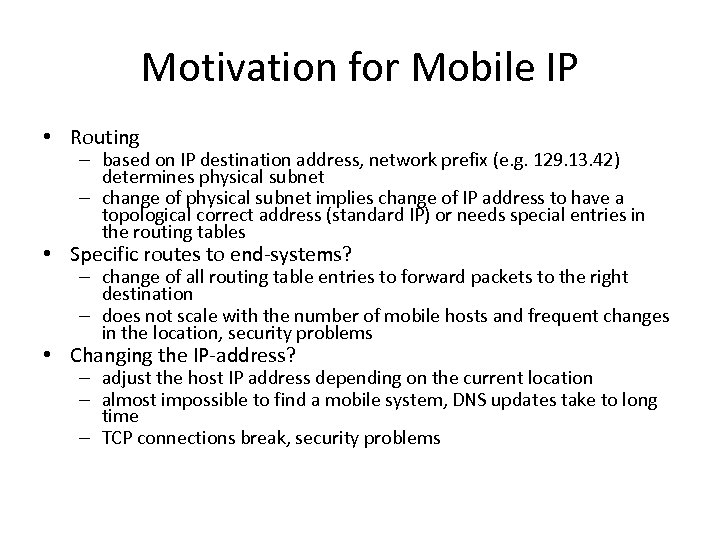
Motivation for Mobile IP • Routing – based on IP destination address, network prefix (e. g. 129. 13. 42) determines physical subnet – change of physical subnet implies change of IP address to have a topological correct address (standard IP) or needs special entries in the routing tables • Specific routes to end-systems? – change of all routing table entries to forward packets to the right destination – does not scale with the number of mobile hosts and frequent changes in the location, security problems • Changing the IP-address? – adjust the host IP address depending on the current location – almost impossible to find a mobile system, DNS updates take to long time – TCP connections break, security problems
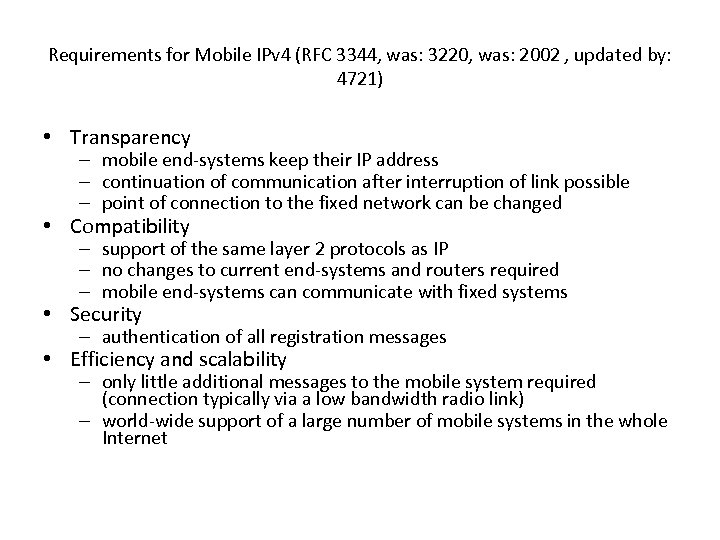
Requirements for Mobile IPv 4 (RFC 3344, was: 3220, was: 2002 , updated by: 4721) • Transparency – mobile end-systems keep their IP address – continuation of communication after interruption of link possible – point of connection to the fixed network can be changed • Compatibility – support of the same layer 2 protocols as IP – no changes to current end-systems and routers required – mobile end-systems can communicate with fixed systems • Security – authentication of all registration messages • Efficiency and scalability – only little additional messages to the mobile system required (connection typically via a low bandwidth radio link) – world-wide support of a large number of mobile systems in the whole Internet
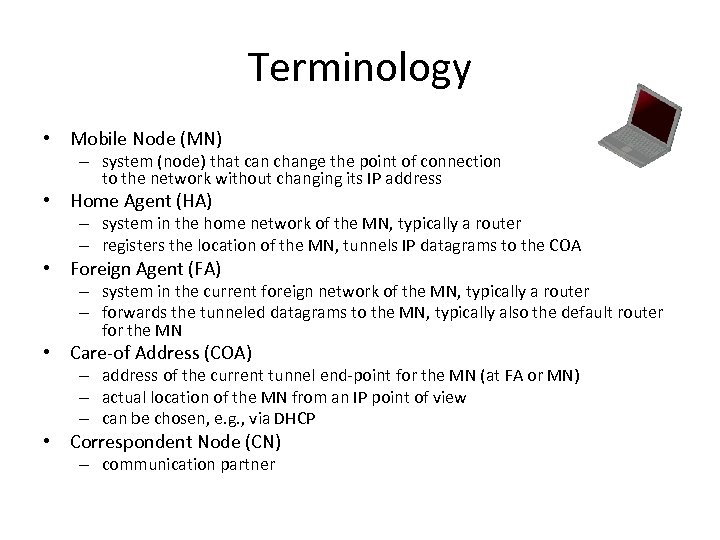
Terminology • Mobile Node (MN) – system (node) that can change the point of connection to the network without changing its IP address • Home Agent (HA) – system in the home network of the MN, typically a router – registers the location of the MN, tunnels IP datagrams to the COA • Foreign Agent (FA) – system in the current foreign network of the MN, typically a router – forwards the tunneled datagrams to the MN, typically also the default router for the MN • Care-of Address (COA) – address of the current tunnel end-point for the MN (at FA or MN) – actual location of the MN from an IP point of view – can be chosen, e. g. , via DHCP • Correspondent Node (CN) – communication partner
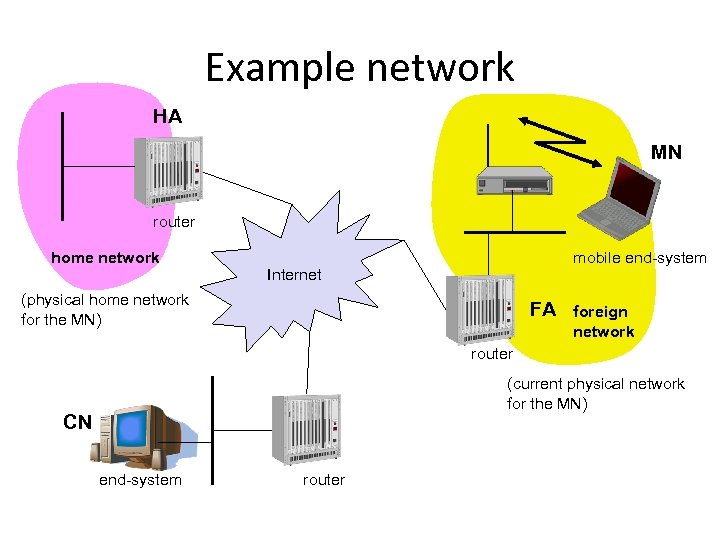
Example network HA MN router home network mobile end-system Internet (physical home network for the MN) FA foreign network router (current physical network for the MN) CN end-system router
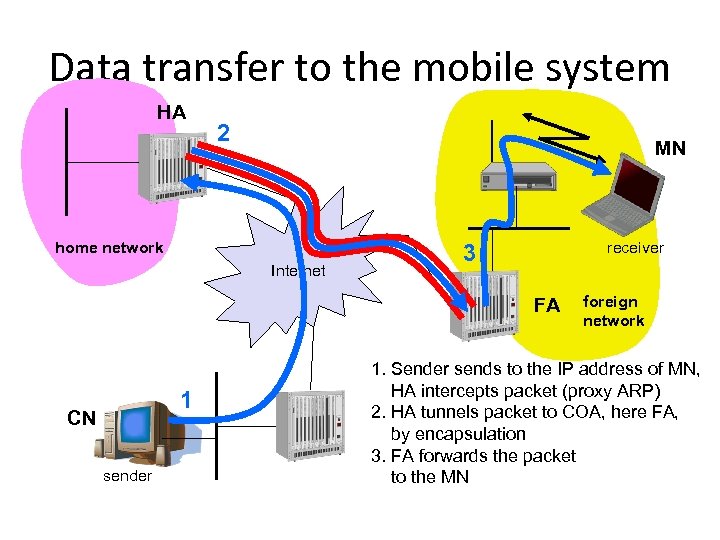
Data transfer to the mobile system HA 2 MN home network Internet receiver 3 FA 1 CN sender foreign network 1. Sender sends to the IP address of MN, HA intercepts packet (proxy ARP) 2. HA tunnels packet to COA, here FA, by encapsulation 3. FA forwards the packet to the MN
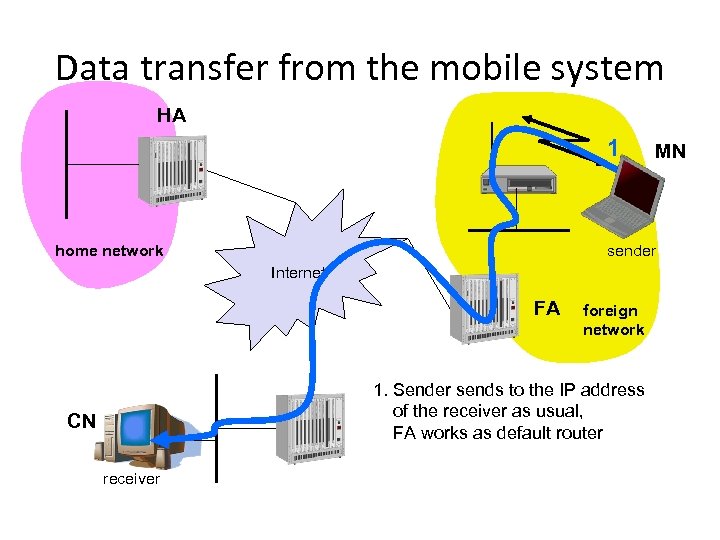
Data transfer from the mobile system HA 1 home network sender Internet FA foreign network 1. Sender sends to the IP address of the receiver as usual, FA works as default router CN receiver MN
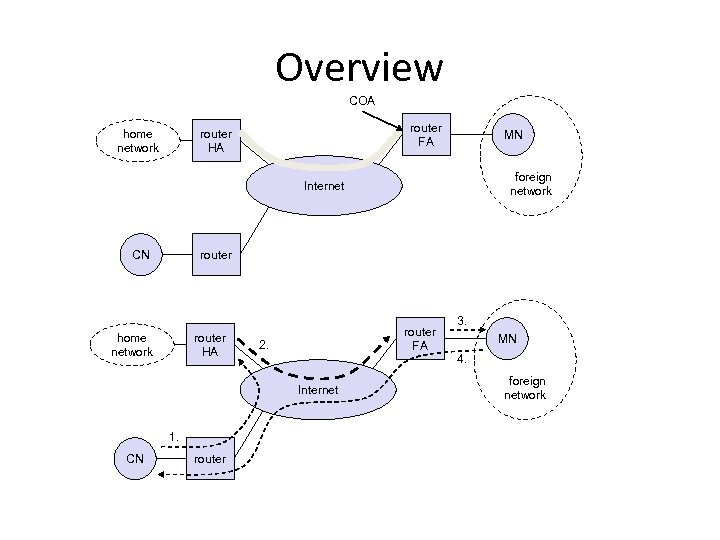
Overview COA router FA router HA home network MN foreign network Internet router CN home network router HA router FA 2. Internet 1. CN router 3. MN 4. foreign network
Network integration • Agent Advertisement – HA and FA periodically send advertisement messages into their physical subnets – MN listens to these messages and detects, if it is in the home or a foreign network (standard case for home network) – MN reads a COA from the FA advertisement messages • Registration (always limited lifetime!) – MN signals COA to the HA via the FA, HA acknowledges via FA to MN – these actions have to be secured by authentication • Advertisement – HA advertises the IP address of the MN (as for fixed systems), i. e. standard routing information – routers adjust their entries, these are stable for a longer time (HA responsible for a MN over a longer period of time) – packets to the MN are sent to the HA, – independent of changes in COA/FA
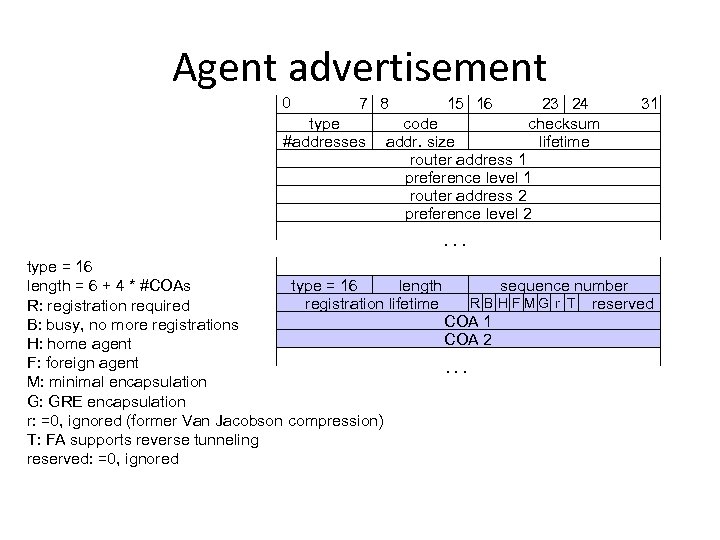
Agent advertisement 0 7 8 type #addresses 15 16 23 24 checksum lifetime 31 code addr. size router address 1 preference level 1 router address 2 preference level 2. . . type = 16 length sequence number length = 6 + 4 * #COAs R B H F M G r T reserved registration lifetime R: registration required COA 1 B: busy, no more registrations COA 2 H: home agent F: foreign agent. . . M: minimal encapsulation G: GRE encapsulation r: =0, ignored (former Van Jacobson compression) T: FA supports reverse tunneling reserved: =0, ignored
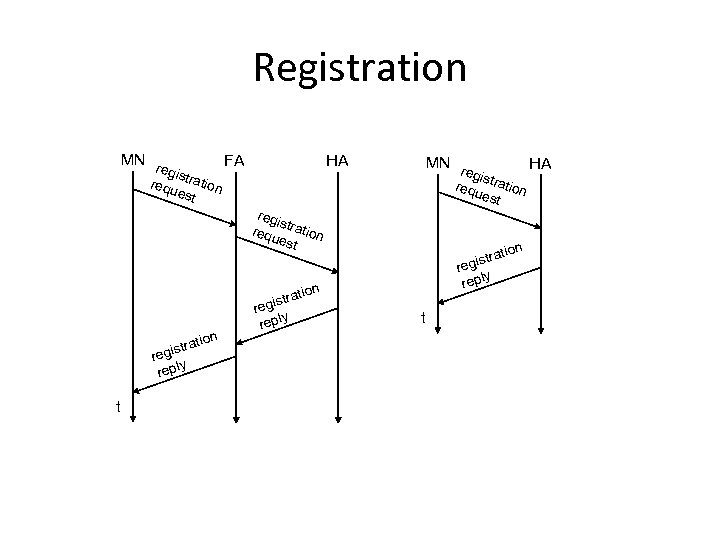
Registration MN r FA egis requ tration HA MN r HA egis requ tration es est t regi s requ tration est tion stra regi y repl t tion istra reg y repl tion stra regi y repl t
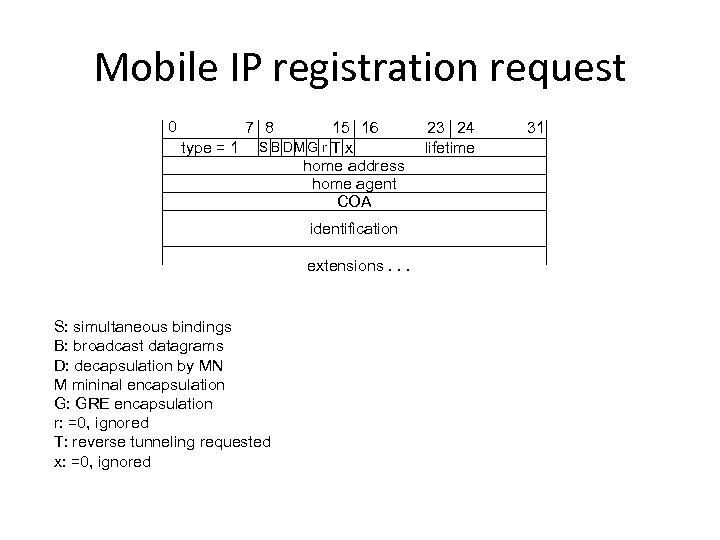
Mobile IP registration request 0 7 8 type = 1 15 16 S B DMG r T x home address home agent COA identification extensions. . . S: simultaneous bindings B: broadcast datagrams D: decapsulation by MN M mininal encapsulation G: GRE encapsulation r: =0, ignored T: reverse tunneling requested x: =0, ignored 23 24 lifetime 31
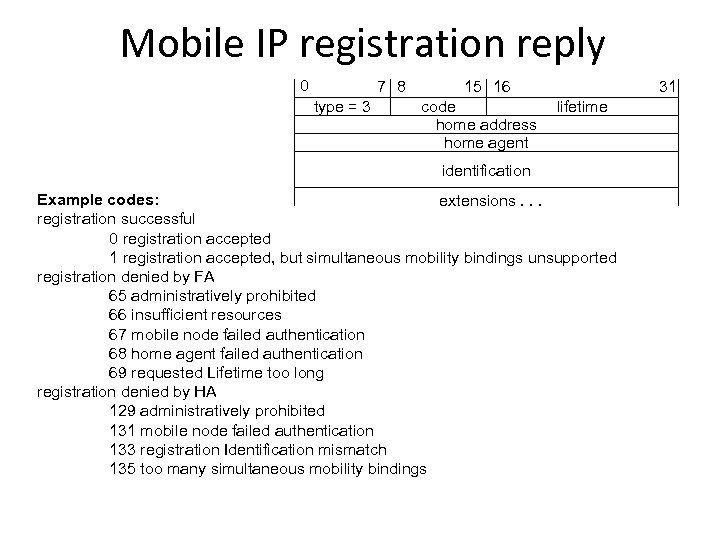
Mobile IP registration reply 0 7 8 type = 3 15 16 code home address home agent 31 lifetime identification Example codes: extensions. . . registration successful 0 registration accepted 1 registration accepted, but simultaneous mobility bindings unsupported registration denied by FA 65 administratively prohibited 66 insufficient resources 67 mobile node failed authentication 68 home agent failed authentication 69 requested Lifetime too long registration denied by HA 129 administratively prohibited 131 mobile node failed authentication 133 registration Identification mismatch 135 too many simultaneous mobility bindings
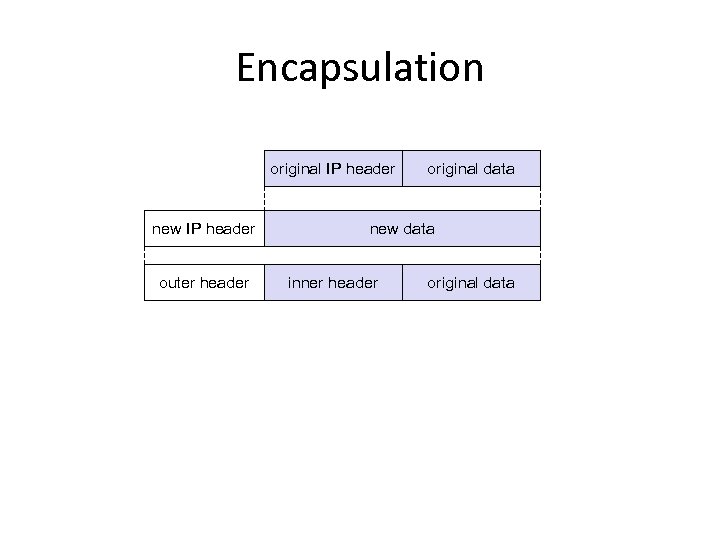
Encapsulation original IP header new IP header outer header original data new data inner header original data
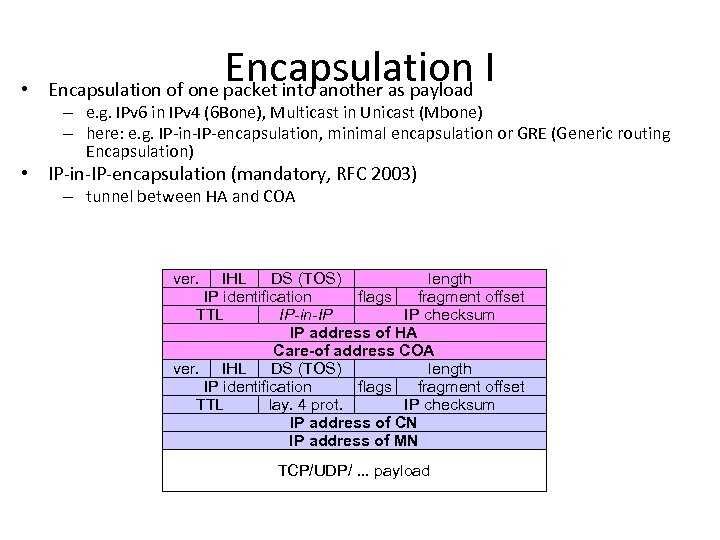
Encapsulation I • Encapsulation of one packet into another as payload – e. g. IPv 6 in IPv 4 (6 Bone), Multicast in Unicast (Mbone) – here: e. g. IP-in-IP-encapsulation, minimal encapsulation or GRE (Generic routing Encapsulation) • IP-in-IP-encapsulation (mandatory, RFC 2003) – tunnel between HA and COA ver. IHL DS (TOS) length IP identification flags fragment offset TTL IP-in-IP IP checksum IP address of HA Care-of address COA ver. IHL DS (TOS) length IP identification flags fragment offset TTL lay. 4 prot. IP checksum IP address of CN IP address of MN TCP/UDP/. . . payload
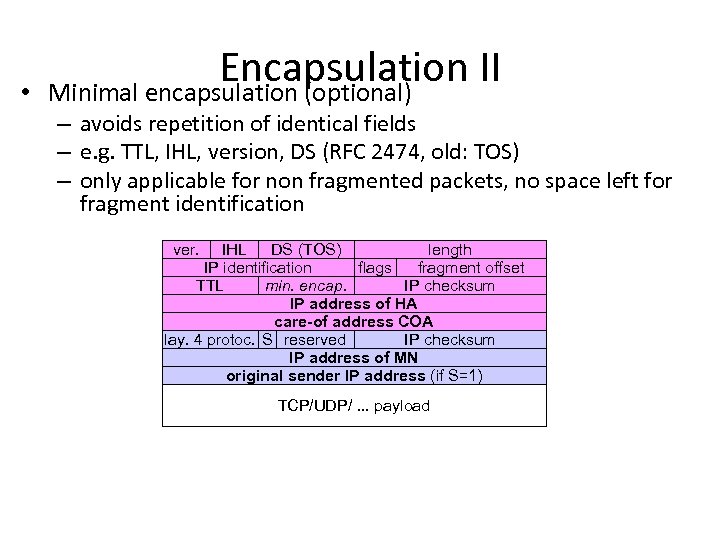
• Encapsulation II Minimal encapsulation (optional) – avoids repetition of identical fields – e. g. TTL, IHL, version, DS (RFC 2474, old: TOS) – only applicable for non fragmented packets, no space left for fragment identification ver. IHL DS (TOS) length IP identification flags fragment offset TTL min. encap. IP checksum IP address of HA care-of address COA lay. 4 protoc. S reserved IP checksum IP address of MN original sender IP address (if S=1) TCP/UDP/. . . payload
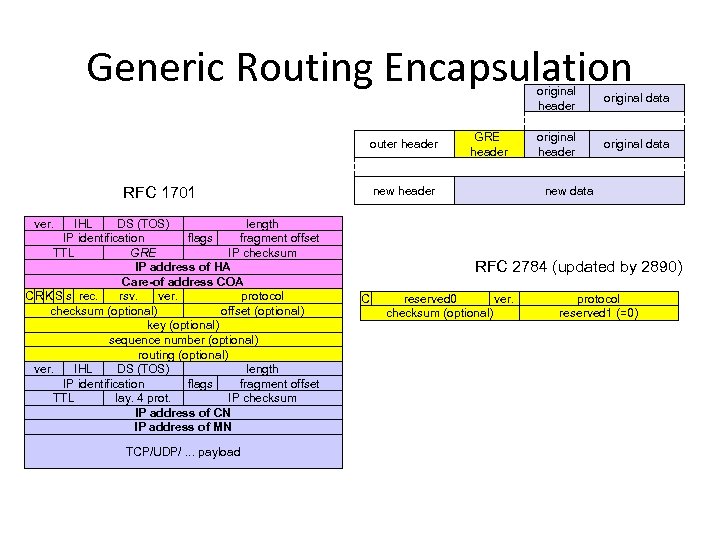
Generic Routing Encapsulation original header outer header new header RFC 1701 IHL DS (TOS) length IP identification flags fragment offset TTL GRE IP checksum IP address of HA Care-of address COA C R K S s rec. rsv. ver. protocol checksum (optional) offset (optional) key (optional) sequence number (optional) routing (optional) ver. IHL DS (TOS) length IP identification flags fragment offset TTL lay. 4 prot. IP checksum IP address of CN IP address of MN GRE header original data original header original data new data ver. TCP/UDP/. . . payload RFC 2784 (updated by 2890) C reserved 0 ver. checksum (optional) protocol reserved 1 (=0)
Optimization of packet forwarding • • • Problem: Triangular Routing – sender sends all packets via HA to MN – higher latency and network load “Solutions” – sender learns the current location of MN – direct tunneling to this location – HA informs a sender about the location of MN – big security problems! Change of FA – packets on-the-fly during the change can be lost – new FA informs old FA to avoid packet loss, old FA now forwards remaining packets to new FA – this information also enables the old FA to release resources for the MN
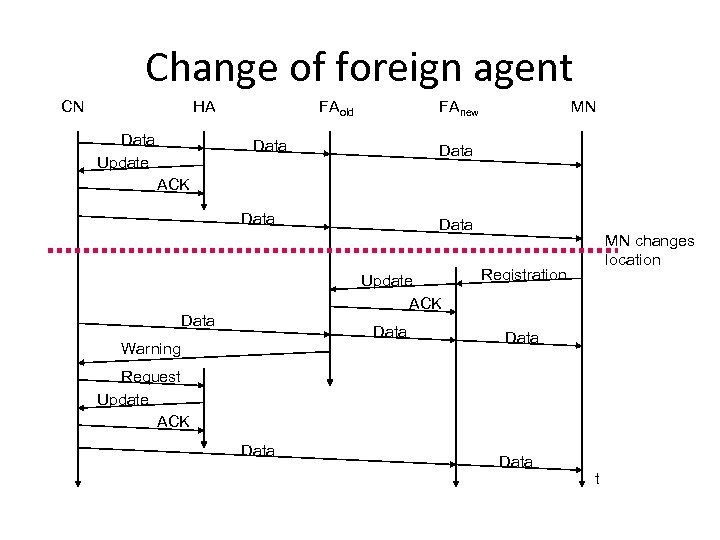
Change of foreign agent CN HA Data Update FAold FAnew Data MN Data ACK Data Update ACK Data Warning MN changes location Registration Data Request Update ACK Data t
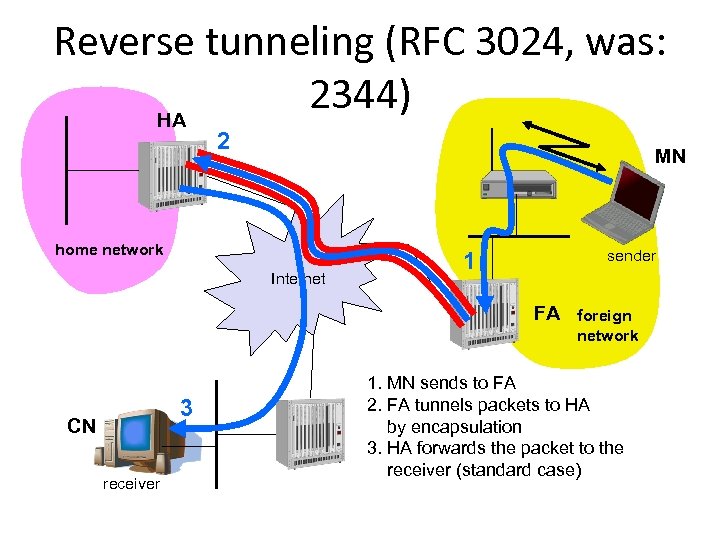
Reverse tunneling (RFC 3024, was: 2344) HA 2 MN home network Internet sender 1 FA 3 CN receiver foreign network 1. MN sends to FA 2. FA tunnels packets to HA by encapsulation 3. HA forwards the packet to the receiver (standard case)
Mobile IP with reverse tunneling • Router accept often only “topological correct“ addresses (firewall!) – a packet from the MN encapsulated by the FA is now topological correct – furthermore multicast and TTL problems solved (TTL in the home network correct, but MN is to far away from the receiver) • Reverse tunneling does not solve – problems with firewalls, the reverse tunnel can be abused to circumvent security mechanisms (tunnel hijacking) – optimization of data paths, i. e. packets will be forwarded through the tunnel via the HA to a sender (double triangular routing) • The standard is backwards compatible – the extensions can be implemented easily and cooperate with current implementations without these extensions – Agent Advertisements can carry requests for reverse tunneling
Mobile IP and IPv 6 (RFC 3775) • Mobile IP was developed for IPv 4, but IPv 6 simplifies the protocols – security is integrated and not an add-on, authentication of registration is included – COA can be assigned via auto-configuration (DHCPv 6 is one candidate), every node has address auto-configuration – no need for a separate FA, all routers perform router advertisement which can be used instead of the special agent advertisement; addresses are always co-located – MN can signal a sender directly the COA, sending via HA not needed in this case (automatic path optimization) – „soft“ hand-over, i. e. without packet loss, between two subnets is supported • MN sends the new COA to its old router • the old router encapsulates all incoming packets for the MN and forwards them to the new COA • authentication is always granted
Problems with mobile IP • • Security – authentication with FA problematic, for the FA typically belongs to another organization – no protocol for key management and key distribution has been standardized in the Internet – patent and export restrictions Firewalls – typically mobile IP cannot be used together with firewalls, special set-ups are needed (such as reverse tunneling) Qo. S – many new reservations in case of RSVP – tunneling makes it hard to give a flow of packets a special treatment needed for the Qo. S Security, firewalls, Qo. S etc. are topics of research and discussions
Security in Mobile IP • Security requirements (Security Architecture for the Internet Protocol, RFC 4301, was: 1825, 2401) – Integrity any changes to data between sender and receiver can be detected by the receiver – Authentication sender address is really the address of the sender and all data received is really data sent by this sender – Confidentiality only sender and receiver can read the data – Non-Repudiation sender cannot deny sending of data – Traffic Analysis creation of traffic and user profiles should not be possible – Replay Protection receivers can detect replay of messages
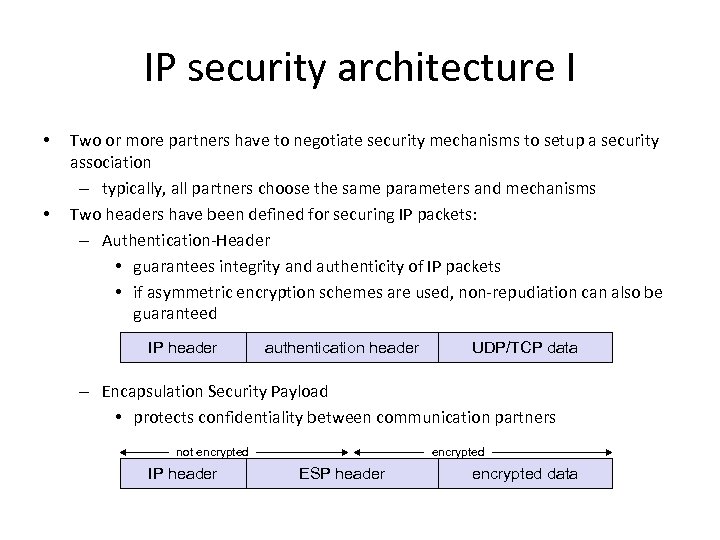
IP security architecture I • • Two or more partners have to negotiate security mechanisms to setup a security association – typically, all partners choose the same parameters and mechanisms Two headers have been defined for securing IP packets: – Authentication-Header • guarantees integrity and authenticity of IP packets • if asymmetric encryption schemes are used, non-repudiation can also be guaranteed IP-Header IP header Authentification-Header authentication header UDP/TCP-Paket UDP/TCP data – Encapsulation Security Payload • protects confidentiality between communication partners not encrypted IP header encrypted ESP header encrypted data
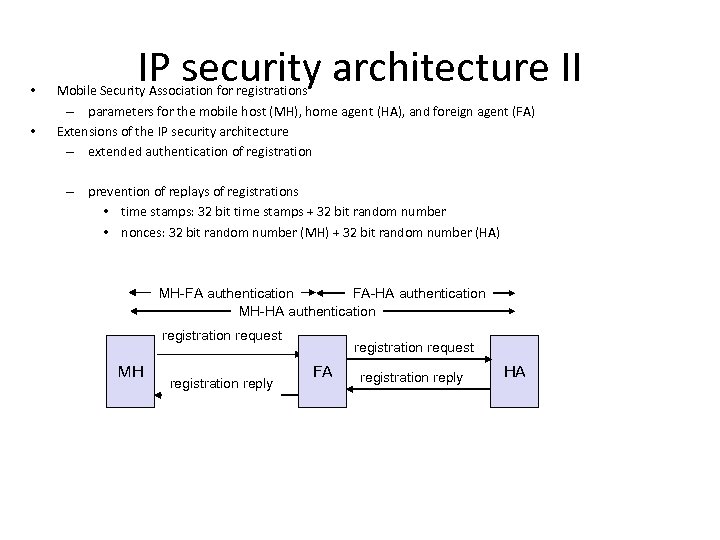
• • IP security architecture II Mobile Security Association for registrations – parameters for the mobile host (MH), home agent (HA), and foreign agent (FA) Extensions of the IP security architecture – extended authentication of registration – prevention of replays of registrations • time stamps: 32 bit time stamps + 32 bit random number • nonces: 32 bit random number (MH) + 32 bit random number (HA) MH-FA authentication FA-HA authentication MH-HA authentication registration request MH registration reply registration request FA registration reply HA
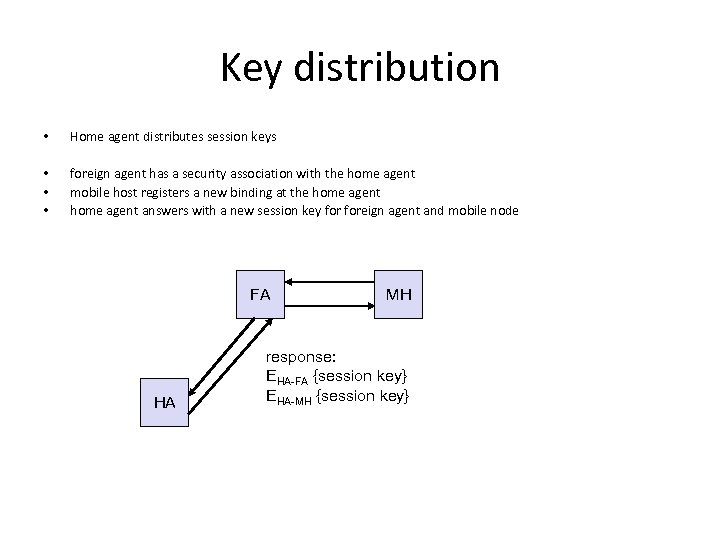
Key distribution • Home agent distributes session keys • • • foreign agent has a security association with the home agent mobile host registers a new binding at the home agent answers with a new session key foreign agent and mobile node FA HA MH response: EHA-FA {session key} EHA-MH {session key}
IP Micro-mobility support • Micro-mobility support: – Efficient local handover inside a foreign domain without involving a home agent – Reduces control traffic on backbone – Especially needed in case of route optimization • Example approaches (research, not products): – Cellular IP – HAWAII – Hierarchical Mobile IP (HMIP) • Important criteria: Security Efficiency, Scalability, Transparency, Manageability
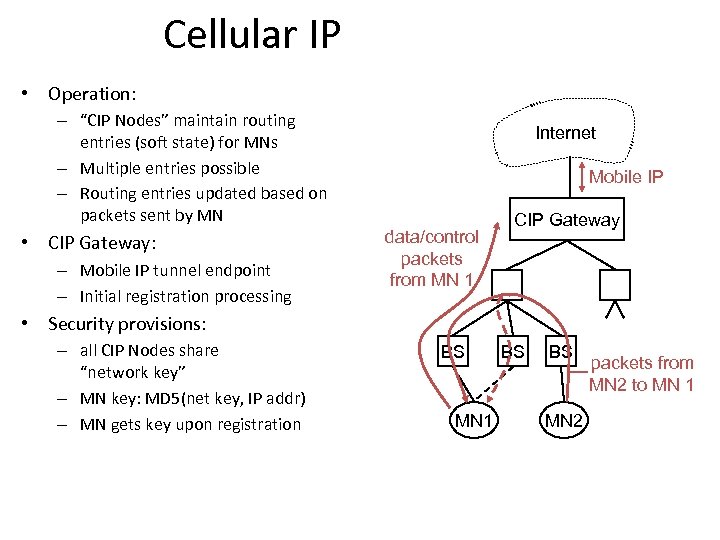
Cellular IP • Operation: – “CIP Nodes” maintain routing entries (soft state) for MNs – Multiple entries possible – Routing entries updated based on packets sent by MN • CIP Gateway: – Mobile IP tunnel endpoint – Initial registration processing Internet Mobile IP data/control packets from MN 1 CIP Gateway • Security provisions: – all CIP Nodes share “network key” – MN key: MD 5(net key, IP addr) – MN gets key upon registration BS MN 1 BS BS MN 2 packets from MN 2 to MN 1
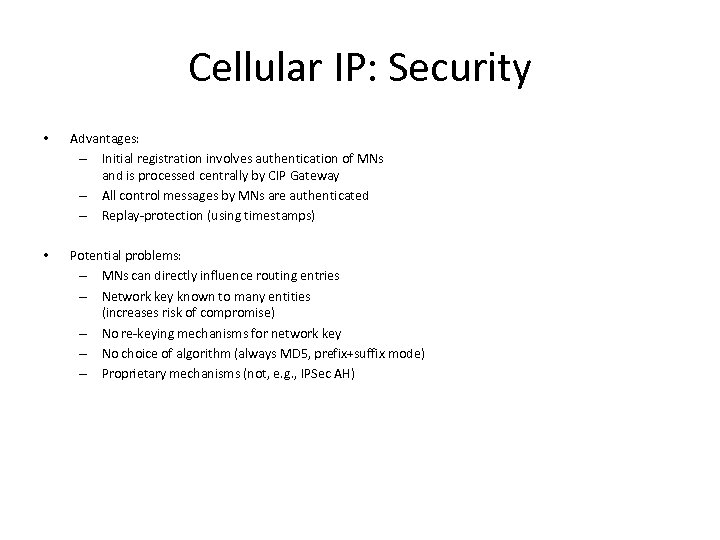
Cellular IP: Security • Advantages: – Initial registration involves authentication of MNs and is processed centrally by CIP Gateway – All control messages by MNs are authenticated – Replay-protection (using timestamps) • Potential problems: – MNs can directly influence routing entries – Network key known to many entities (increases risk of compromise) – No re-keying mechanisms for network key – No choice of algorithm (always MD 5, prefix+suffix mode) – Proprietary mechanisms (not, e. g. , IPSec AH)
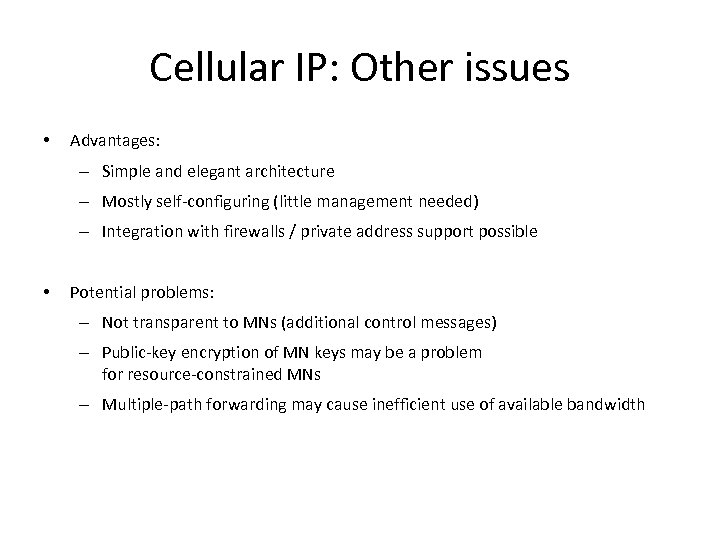
Cellular IP: Other issues • Advantages: – Simple and elegant architecture – Mostly self-configuring (little management needed) – Integration with firewalls / private address support possible • Potential problems: – Not transparent to MNs (additional control messages) – Public-key encryption of MN keys may be a problem for resource-constrained MNs – Multiple-path forwarding may cause inefficient use of available bandwidth
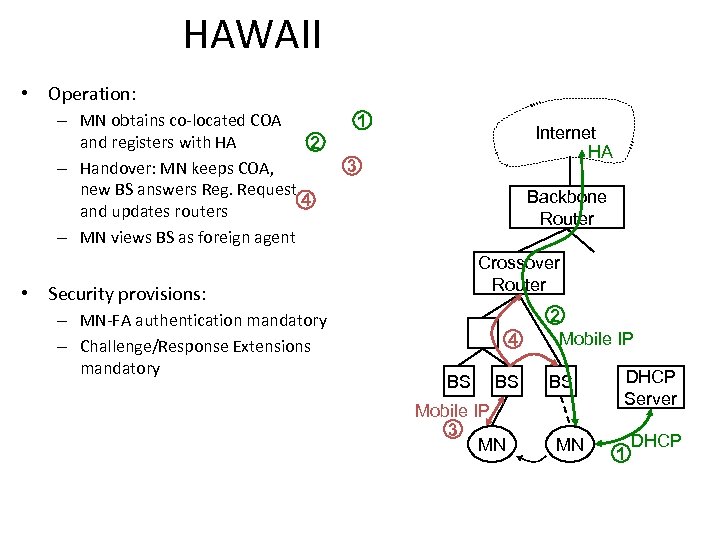
HAWAII • Operation: – MN obtains co-located COA and registers with HA 2 – Handover: MN keeps COA, new BS answers Reg. Request 4 and updates routers – MN views BS as foreign agent 1 Internet HA 3 Backbone Router Crossover Router • Security provisions: – MN-FA authentication mandatory – Challenge/Response Extensions mandatory 4 BS BS Mobile IP 3 MN 2 Mobile IP BS MN DHCP Server 1 DHCP
HAWAII: Security • Advantages: – Mutual authentication and C/R extensions mandatory – Only infrastructure components can influence routing entries • Potential problems: – Co-located COA raises DHCP security issues (DHCP has no strong authentication) – Decentralized security-critical functionality (Mobile IP registration processing during handover) in base stations – Authentication of HAWAII protocol messages unspecified (potential attackers: stationary nodes in foreign network) – MN authentication requires PKI or AAA infrastructure
HAWAII: Other issues • Advantages: – Mostly transparent to MNs (MN sends/receives standard Mobile IP messages) – Explicit support for dynamically assigned home addresses • Potential problems: – Mixture of co-located COA and FA concepts may not be supported by some MN implementations – No private address support possible because of co-located COA
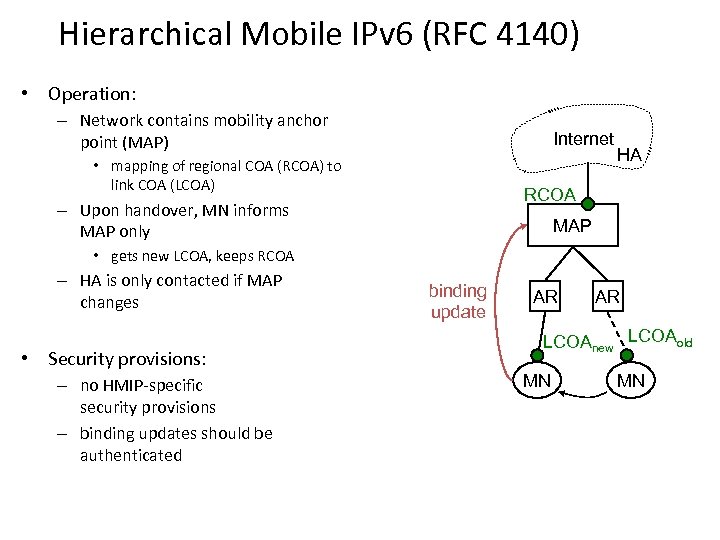
Hierarchical Mobile IPv 6 (RFC 4140) • Operation: – Network contains mobility anchor point (MAP) Internet • mapping of regional COA (RCOA) to link COA (LCOA) HA RCOA – Upon handover, MN informs MAP only MAP • gets new LCOA, keeps RCOA – HA is only contacted if MAP changes • Security provisions: – no HMIP-specific security provisions – binding updates should be authenticated binding update AR AR LCOAnew LCOAold MN MN
Hierarchical Mobile IP: Security • Advantages: – Local COAs can be hidden, which provides at least some location privacy – Direct routing between CNs sharing the same link is possible (but might be dangerous) • Potential problems: – Decentralized security-critical functionality (handover processing) in mobility anchor points – MNs can (must!) directly influence routing entries via binding updates (authentication necessary)
Hierarchical Mobile IP: Other issues • Advantages: – Handover requires minimum number of overall changes to routing tables – Integration with firewalls / private address support possible • Potential problems: – Not transparent to MNs – Handover efficiency in wireless mobile scenarios: • Complex MN operations • All routing reconfiguration messages sent over wireless link
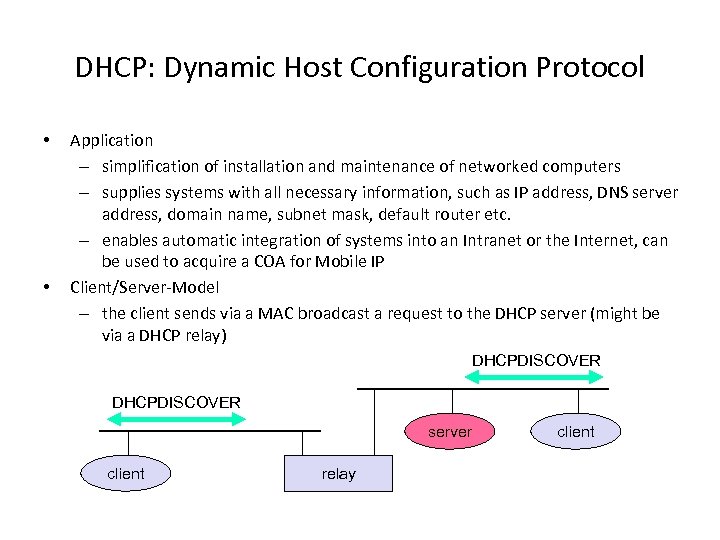
DHCP: Dynamic Host Configuration Protocol • • Application – simplification of installation and maintenance of networked computers – supplies systems with all necessary information, such as IP address, DNS server address, domain name, subnet mask, default router etc. – enables automatic integration of systems into an Intranet or the Internet, can be used to acquire a COA for Mobile IP Client/Server-Model – the client sends via a MAC broadcast a request to the DHCP server (might be via a DHCP relay) DHCPDISCOVER server client relay client
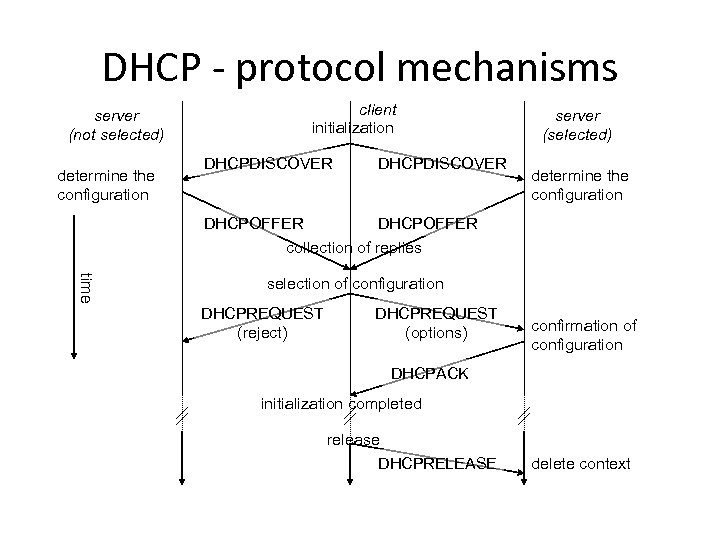
DHCP - protocol mechanisms server (not selected) determine the configuration client initialization DHCPDISCOVER server (selected) determine the configuration DHCPOFFER collection of replies time selection of configuration DHCPREQUEST (reject) DHCPREQUEST (options) confirmation of configuration DHCPACK initialization completed release DHCPRELEASE delete context
DHCP characteristics • Server – several servers can be configured for DHCP, coordination not yet standardized (i. e. , manual configuration) • Renewal of configurations – IP addresses have to be requested periodically, simplified protocol • Options – available for routers, subnet mask, NTP (network time protocol) timeserver, SLP (service location protocol) directory, DNS (domain name system)
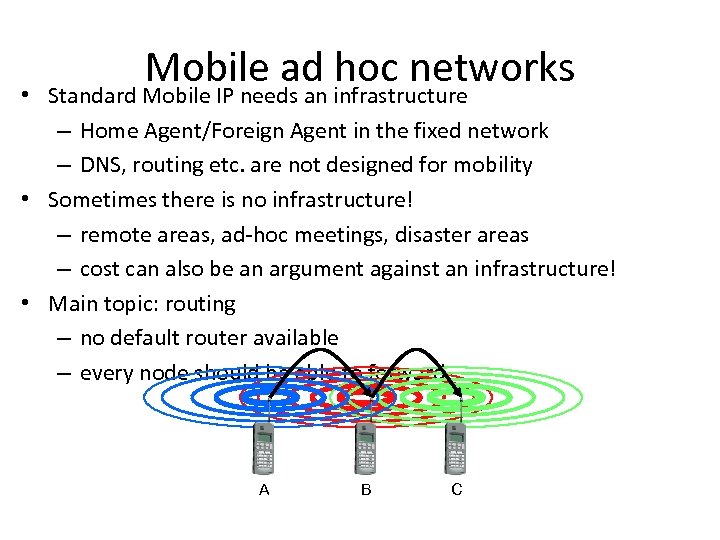
• Mobile ad infrastructure hoc networks Standard Mobile IP needs an – Home Agent/Foreign Agent in the fixed network – DNS, routing etc. are not designed for mobility • Sometimes there is no infrastructure! – remote areas, ad-hoc meetings, disaster areas – cost can also be an argument against an infrastructure! • Main topic: routing – no default router available – every node should be able to forward A B C
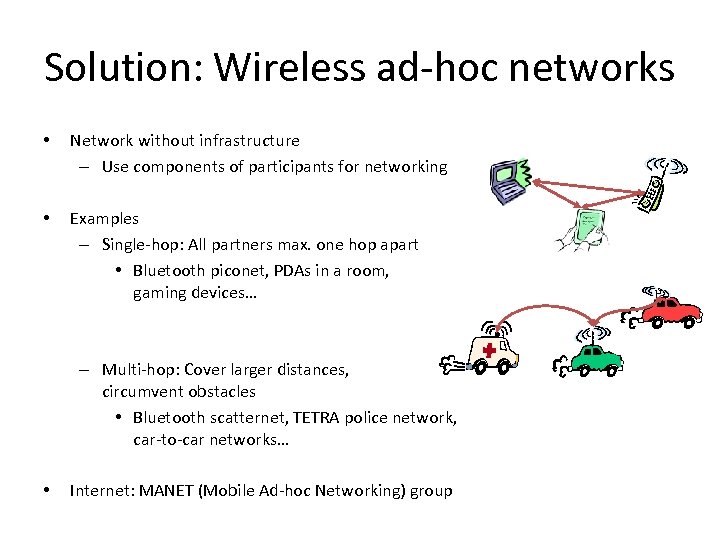
Solution: Wireless ad-hoc networks • Network without infrastructure – Use components of participants for networking • Examples – Single-hop: All partners max. one hop apart • Bluetooth piconet, PDAs in a room, gaming devices… – Multi-hop: Cover larger distances, circumvent obstacles • Bluetooth scatternet, TETRA police network, car-to-car networks… • Internet: MANET (Mobile Ad-hoc Networking) group
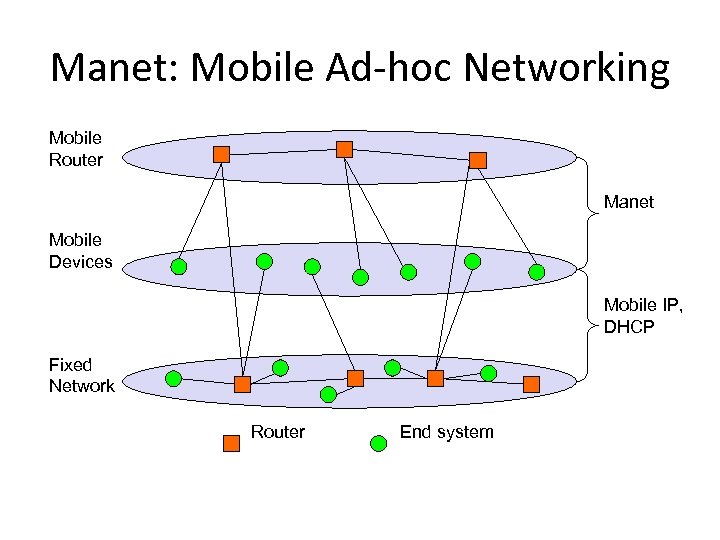
Manet: Mobile Ad-hoc Networking Mobile Router Manet Mobile Devices Mobile IP, DHCP Fixed Network Router End system
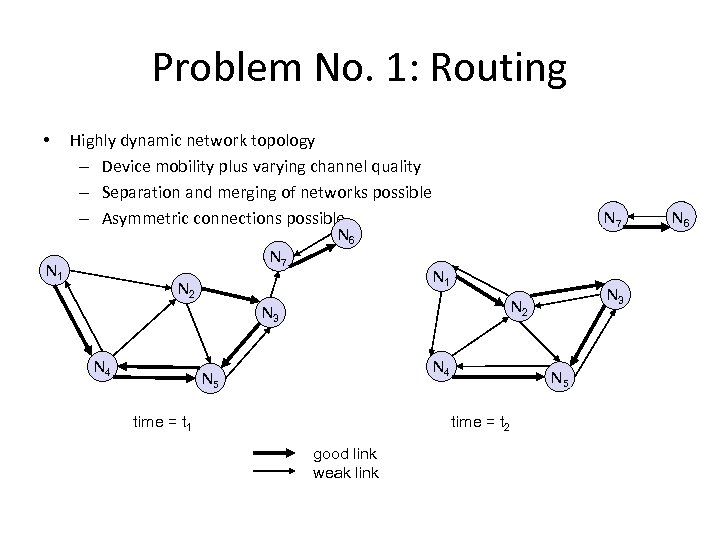
Problem No. 1: Routing • Highly dynamic network topology – Device mobility plus varying channel quality – Separation and merging of networks possible – Asymmetric connections possible N 7 N 6 N 7 N 1 N 2 N 3 N 4 N 3 N 2 N 4 N 5 time = t 1 N 5 time = t 2 good link weak link N 6
Traditional routing algorithms • Distance Vector – periodic exchange of messages with all physical neighbors that contain information about who can be reached at what distance – selection of the shortest path if several paths available • Link State – periodic notification of all routers about the current state of all physical links – router get a complete picture of the network • Example – ARPA packet radio network (1973), DV-Routing – every 7. 5 s exchange of routing tables including link quality – updating of tables also by reception of packets – routing problems solved with limited flooding
Routing in ad-hoc networks • THE big topic in many research projects – Far more than 50 different proposals exist – The most simplest one: Flooding! • Reasons – Classical approaches from fixed networks fail • Very slow convergence, large overhead – High dynamicity, low bandwidth, low computing power • Metrics for routing – Minimal • Number of nodes, loss rate, delay, congestion, interference … – Maximal • Stability of the logical network, battery run-time, time of connectivity …
Problems of traditional routing algorithms • Dynamic of the topology – frequent changes of connections, connection quality, participants • Limited performance of mobile systems – periodic updates of routing tables need energy without contributing to the transmission of user data, sleep modes difficult to realize – limited bandwidth of the system is reduced even more due to the exchange of routing information – links can be asymmetric, i. e. , they can have a direction dependent transmission quality
DSDV (Destination Sequenced Distance Vector, historical) • Early work – on demand version: AODV • Expansion of distance vector routing • Sequence numbers for all routing updates – assures in-order execution of all updates – avoids loops and inconsistencies • Decrease of update frequency – store time between first and best announcement of a path – inhibit update if it seems to be unstable (based on the stored time values)
Dynamic source routing I • Split routing into discovering a path and maintaining a path • Discover a path – only if a path for sending packets to a certain destination is needed and no path is currently available • Maintaining a path – only while the path is in use one has to make sure that it can be used continuously • No periodic updates needed!
Dynamic source routing II • Path discovery – broadcast a packet with destination address and unique ID – if a station receives a broadcast packet • if the station is the receiver (i. e. , has the correct destination address) then return the packet to the sender (path was collected in the packet) • if the packet has already been received earlier (identified via ID) then discard the packet • otherwise, append own address and broadcast packet – sender receives packet with the current path (address list) • Optimizations – limit broadcasting if maximum diameter of the network is known – caching of address lists (i. e. paths) with help of passing packets • stations can use the cached information for path discovery (own paths or paths for other hosts)
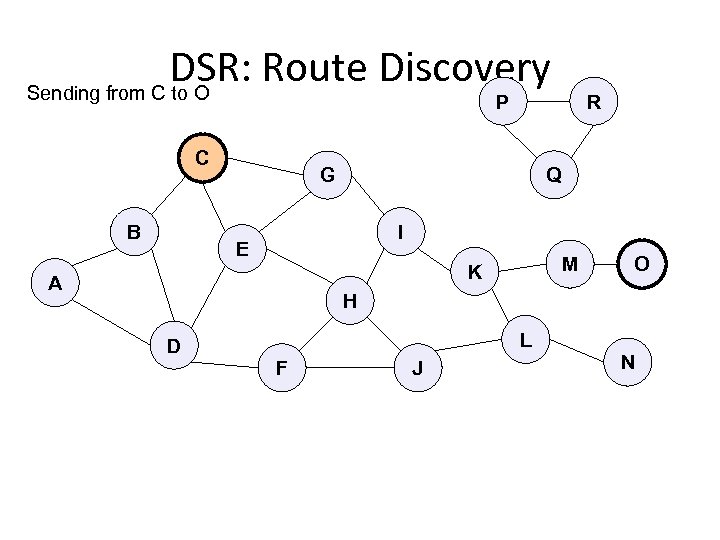
DSR: Route Discovery Sending from C to O P C B R Q G I E M K A O H L D F J N
![DSR: Route Discovery Broadcast P R [O, C, 4711] C B Q G [O,](https://present5.com/presentation/861cfdf5ef30cf05fa92390d043d9385/image-52.jpg "DSR: Route Discovery Broadcast P R [O, C, 4711] C B Q G [O,")
DSR: Route Discovery Broadcast P R [O, C, 4711] C B Q G [O, C, 4711] I E M K A O H L D F J N
![DSR: Route Discovery P R [O, C/G, 4711] C G [O, C/B, 4711] B](https://present5.com/presentation/861cfdf5ef30cf05fa92390d043d9385/image-53.jpg "DSR: Route Discovery P R [O, C/G, 4711] C G [O, C/B, 4711] B")
DSR: Route Discovery P R [O, C/G, 4711] C G [O, C/B, 4711] B [O, C/G, 4711] Q I E M K A O [O, C/E, 4711] H L D F J N
![DSR: Route Discovery P C B Q G [O, C/G/I, 4711] I E M](https://present5.com/presentation/861cfdf5ef30cf05fa92390d043d9385/image-54.jpg "DSR: Route Discovery P C B Q G [O, C/G/I, 4711] I E M")
DSR: Route Discovery P C B Q G [O, C/G/I, 4711] I E M K A H [O, C/B/A, 4711] R O [O, C/E/H, 4711] L D F [O, C/B/D, 4711] (alternatively: [O, C/E/D, 4711]) J N
![DSR: Route Discovery P C B Q G [O, C/G/I/K, 4711] I E M](https://present5.com/presentation/861cfdf5ef30cf05fa92390d043d9385/image-55.jpg "DSR: Route Discovery P C B Q G [O, C/G/I/K, 4711] I E M")
DSR: Route Discovery P C B Q G [O, C/G/I/K, 4711] I E M K A R O H L D F N J [O, C/B/D/F, 4711] [O, C/E/H/J, 4711]
![DSR: Route Discovery P C B Q G [O, C/G/I/K/M, 4711] I E M](https://present5.com/presentation/861cfdf5ef30cf05fa92390d043d9385/image-56.jpg "DSR: Route Discovery P C B Q G [O, C/G/I/K/M, 4711] I E M")
DSR: Route Discovery P C B Q G [O, C/G/I/K/M, 4711] I E M K A R O H L D F N J [O, C/E/H/J/L, 4711] (alternatively: [O, C/G/I/K/L, 4711])
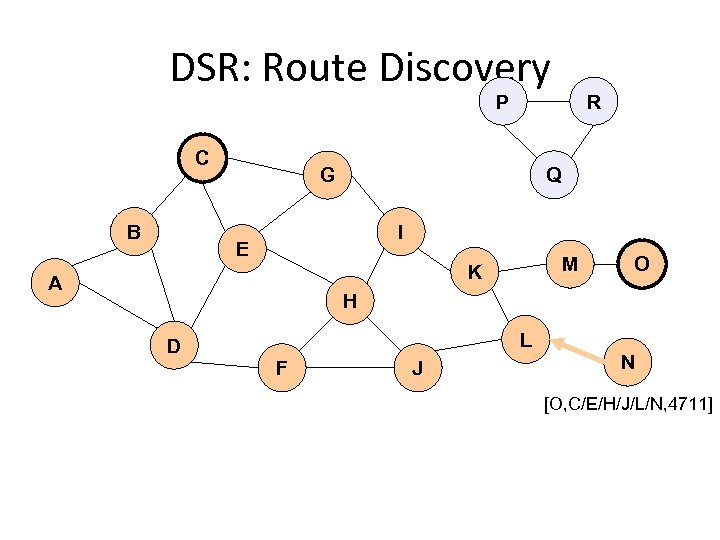
DSR: Route Discovery P C B R Q G I E M K A O H L D F J N [O, C/E/H/J/L/N, 4711]
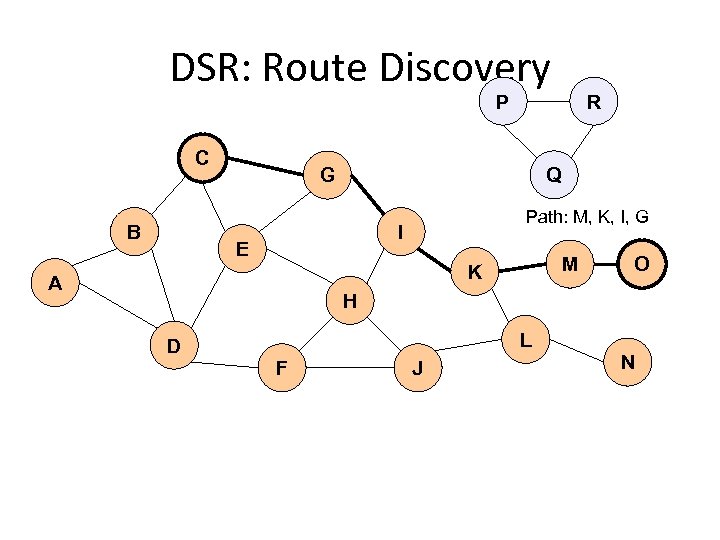
DSR: Route Discovery P C B Q G Path: M, K, I, G I E M K A R O H L D F J N
Dynamic Source Routing III • Maintaining paths – after sending a packet • wait for a layer 2 acknowledgement (if applicable) • listen into the medium to detect if other stations forward the packet (if possible) • request an explicit acknowledgement – if a station encounters problems it can inform the sender of a packet or look-up a new path locally
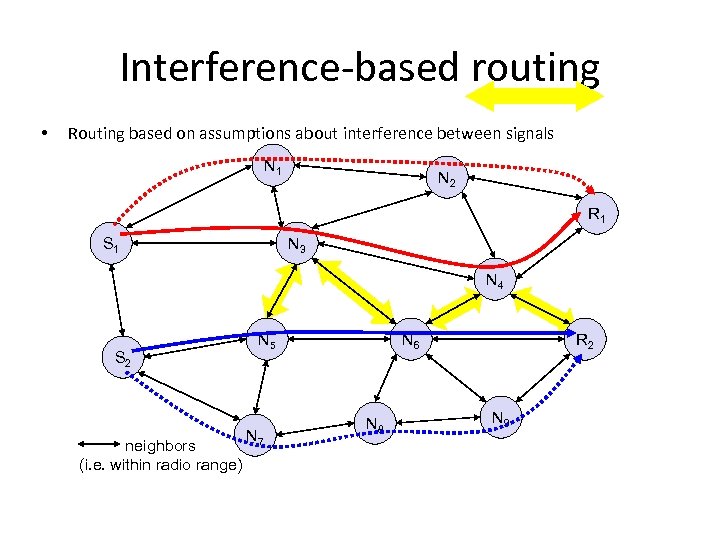
Interference-based routing • Routing based on assumptions about interference between signals N 1 N 2 R 1 S 1 N 3 N 4 S 2 neighbors (i. e. within radio range) N 5 N 7 N 6 N 8 R 2 N 9
Examples for interference based routing • Least Interference Routing (LIR) – calculate the cost of a path based on the number of stations that can receive a transmission • Max-Min Residual Capacity Routing (MMRCR) – calculate the cost of a path based on a probability function of successful transmissions and interference • Least Resistance Routing (LRR) – calculate the cost of a path based on interference, jamming and other transmissions • LIR is very simple to implement, only information from direct neighbors is necessary
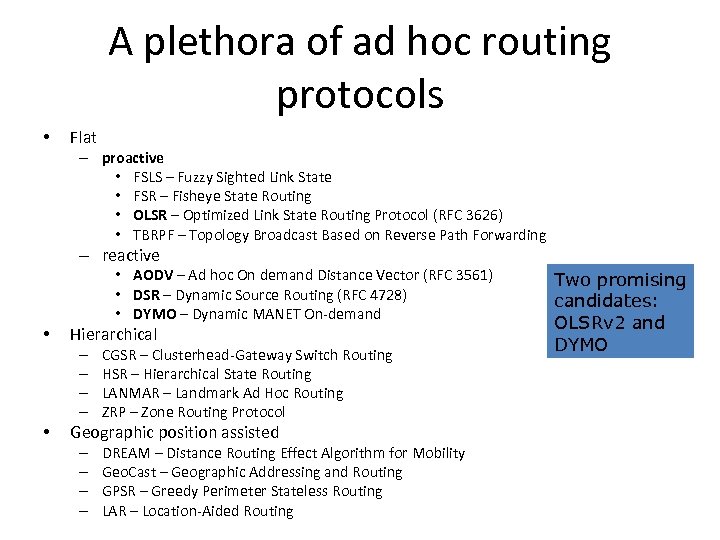
A plethora of ad hoc routing protocols • Flat – proactive • FSLS – Fuzzy Sighted Link State • FSR – Fisheye State Routing • OLSR – Optimized Link State Routing Protocol (RFC 3626) • TBRPF – Topology Broadcast Based on Reverse Path Forwarding – reactive • AODV – Ad hoc On demand Distance Vector (RFC 3561) • DSR – Dynamic Source Routing (RFC 4728) • DYMO – Dynamic MANET On-demand • Hierarchical – – • CGSR – Clusterhead-Gateway Switch Routing HSR – Hierarchical State Routing LANMAR – Landmark Ad Hoc Routing ZRP – Zone Routing Protocol Geographic position assisted – – DREAM – Distance Routing Effect Algorithm for Mobility Geo. Cast – Geographic Addressing and Routing GPSR – Greedy Perimeter Stateless Routing LAR – Location-Aided Routing Two promising candidates: OLSRv 2 and DYMO
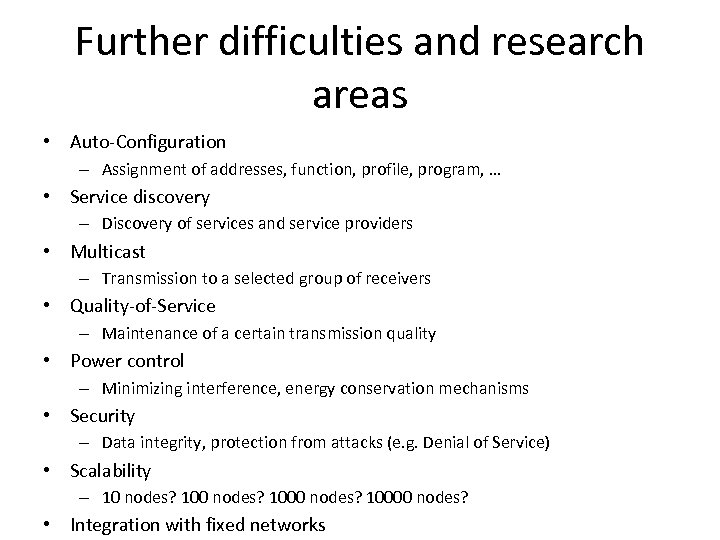
Further difficulties and research areas • Auto-Configuration – Assignment of addresses, function, profile, program, … • Service discovery – Discovery of services and service providers • Multicast – Transmission to a selected group of receivers • Quality-of-Service – Maintenance of a certain transmission quality • Power control – Minimizing interference, energy conservation mechanisms • Security – Data integrity, protection from attacks (e. g. Denial of Service) • Scalability – 10 nodes? 10000 nodes? • Integration with fixed networks
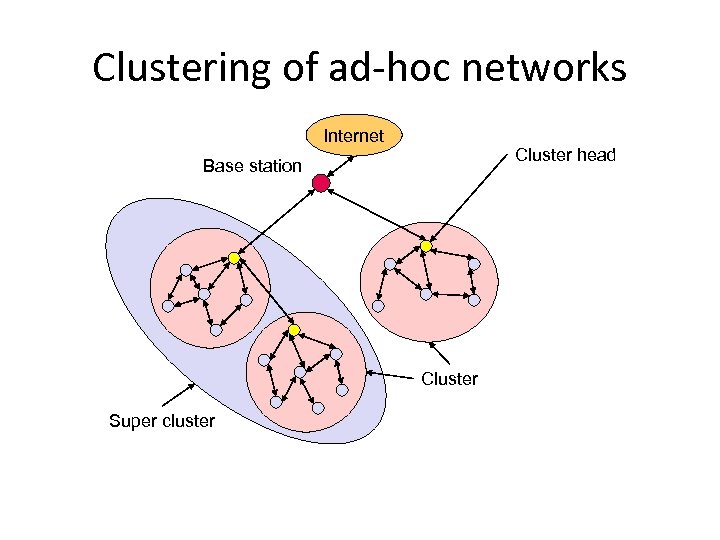
Clustering of ad-hoc networks Internet Cluster head Base station Cluster Super cluster
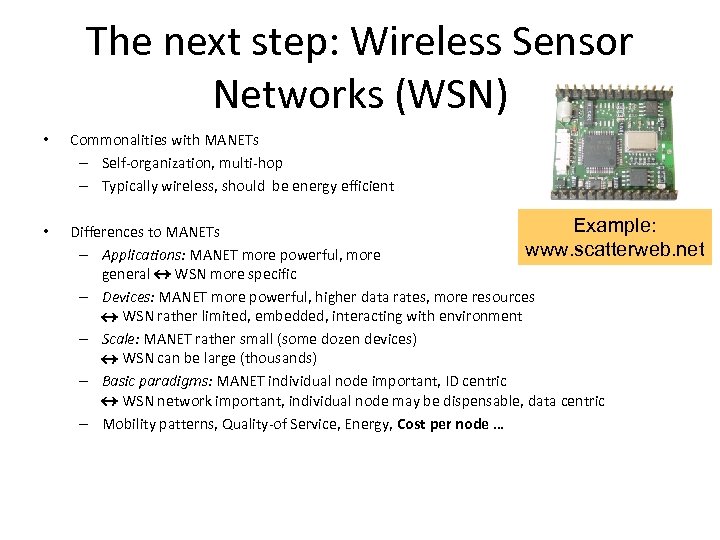
The next step: Wireless Sensor Networks (WSN) • Commonalities with MANETs – Self-organization, multi-hop – Typically wireless, should be energy efficient • Example: Differences to MANETs www. scatterweb. net – Applications: MANET more powerful, more general WSN more specific – Devices: MANET more powerful, higher data rates, more resources WSN rather limited, embedded, interacting with environment – Scale: MANET rather small (some dozen devices) WSN can be large (thousands) – Basic paradigms: MANET individual node important, ID centric WSN network important, individual node may be dispensable, data centric – Mobility patterns, Quality-of Service, Energy, Cost per node …
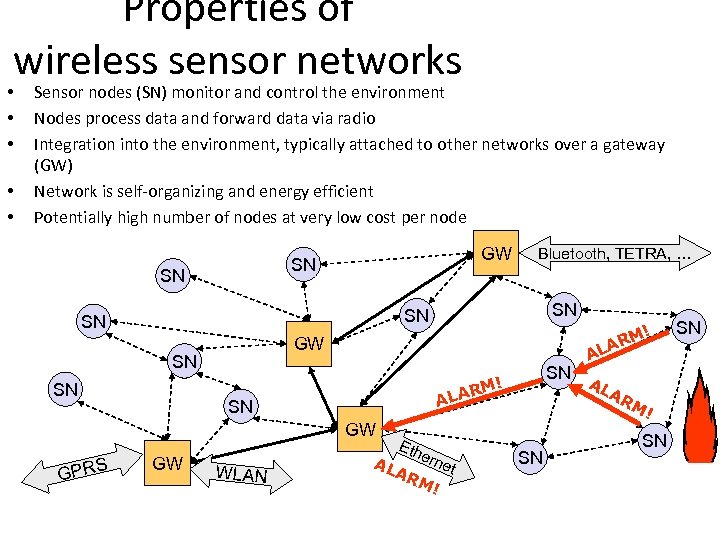
Properties of wireless sensor networks • • • Sensor nodes (SN) monitor and control the environment Nodes process data and forward data via radio Integration into the environment, typically attached to other networks over a gateway (GW) Network is self-organizing and energy efficient Potentially high number of nodes at very low cost per node GW SN SN SN AL GW WLAN SN A LA RM ! ! ARM SN GW ! RM A AL GW SN GPRS Bluetooth, TETRA, … AL Eth AR ern M! et SN SN SN
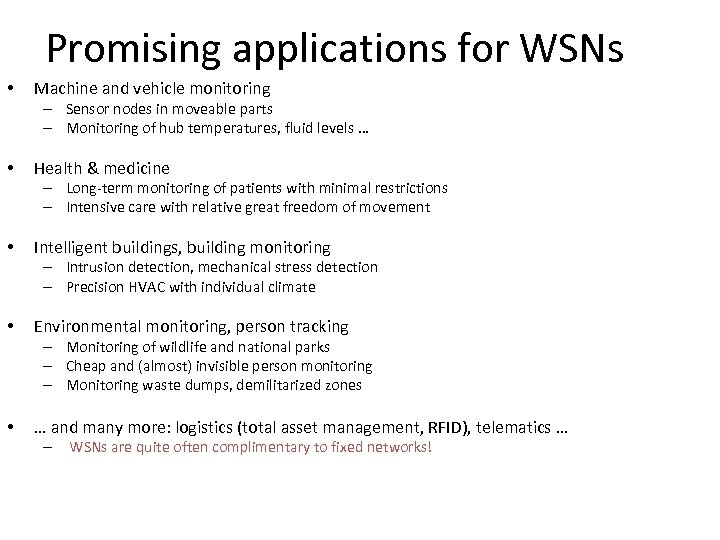
Promising applications for WSNs • Machine and vehicle monitoring – Sensor nodes in moveable parts – Monitoring of hub temperatures, fluid levels … • Health & medicine – Long-term monitoring of patients with minimal restrictions – Intensive care with relative great freedom of movement • Intelligent buildings, building monitoring – Intrusion detection, mechanical stress detection – Precision HVAC with individual climate • Environmental monitoring, person tracking – Monitoring of wildlife and national parks – Cheap and (almost) invisible person monitoring – Monitoring waste dumps, demilitarized zones • … and many more: logistics (total asset management, RFID), telematics … – WSNs are quite often complimentary to fixed networks!
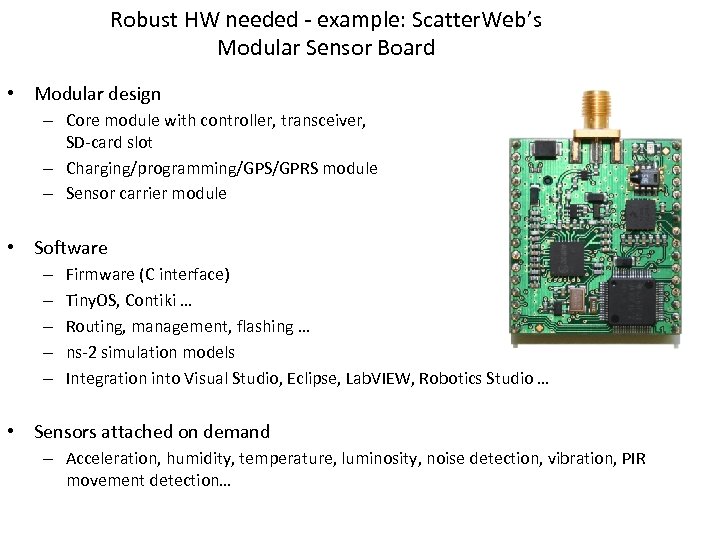
Robust HW needed - example: Scatter. Web’s Modular Sensor Board • Modular design – Core module with controller, transceiver, SD-card slot – Charging/programming/GPS/GPRS module – Sensor carrier module • Software – – – Firmware (C interface) Tiny. OS, Contiki … Routing, management, flashing … ns-2 simulation models Integration into Visual Studio, Eclipse, Lab. VIEW, Robotics Studio … • Sensors attached on demand – Acceleration, humidity, temperature, luminosity, noise detection, vibration, PIR movement detection…
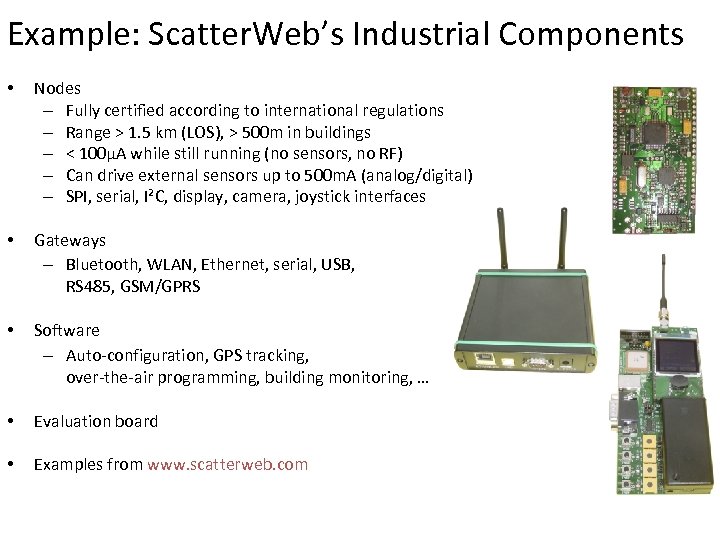
Example: Scatter. Web’s Industrial Components • Nodes – Fully certified according to international regulations – Range > 1. 5 km (LOS), > 500 m in buildings – < 100µA while still running (no sensors, no RF) – Can drive external sensors up to 500 m. A (analog/digital) – SPI, serial, I²C, display, camera, joystick interfaces • Gateways – Bluetooth, WLAN, Ethernet, serial, USB, RS 485, GSM/GPRS • Software – Auto-configuration, GPS tracking, over-the-air programming, building monitoring, … • Evaluation board • Examples from www. scatterweb. com
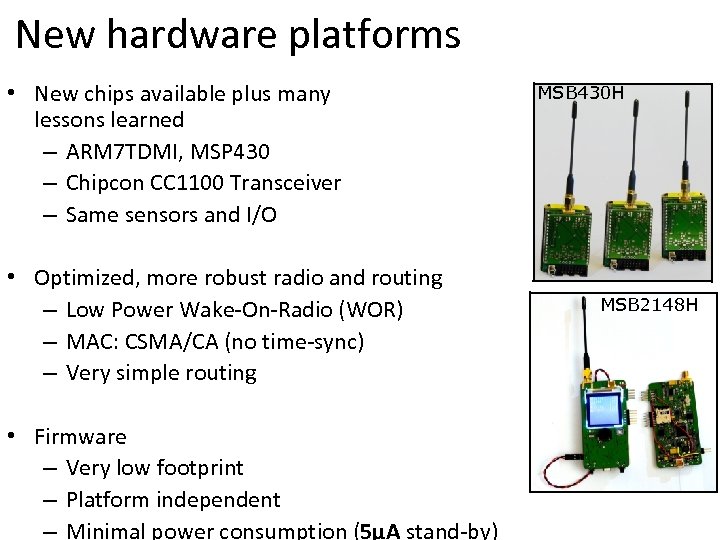
New hardware platforms • New chips available plus many lessons learned – ARM 7 TDMI, MSP 430 – Chipcon CC 1100 Transceiver – Same sensors and I/O • Optimized, more robust radio and routing – Low Power Wake-On-Radio (WOR) – MAC: CSMA/CA (no time-sync) – Very simple routing • Firmware – Very low footprint – Platform independent – Minimal power consumption (5µA stand-by) MSB 430 H MSB 2148 H
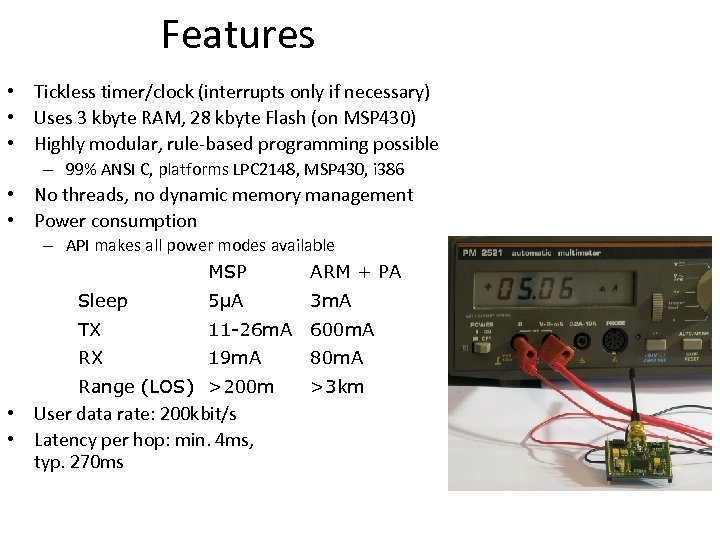
Features • Tickless timer/clock (interrupts only if necessary) • Uses 3 kbyte RAM, 28 kbyte Flash (on MSP 430) • Highly modular, rule-based programming possible – 99% ANSI C, platforms LPC 2148, MSP 430, i 386 • No threads, no dynamic memory management • Power consumption – API makes all power modes available MSP ARM + PA Sleep 5µA 3 m. A TX 11 -26 m. A 600 m. A RX 19 m. A 80 m. A Range (LOS) >200 m • User data rate: 200 kbit/s • Latency per hop: min. 4 ms, typ. 270 ms >3 km
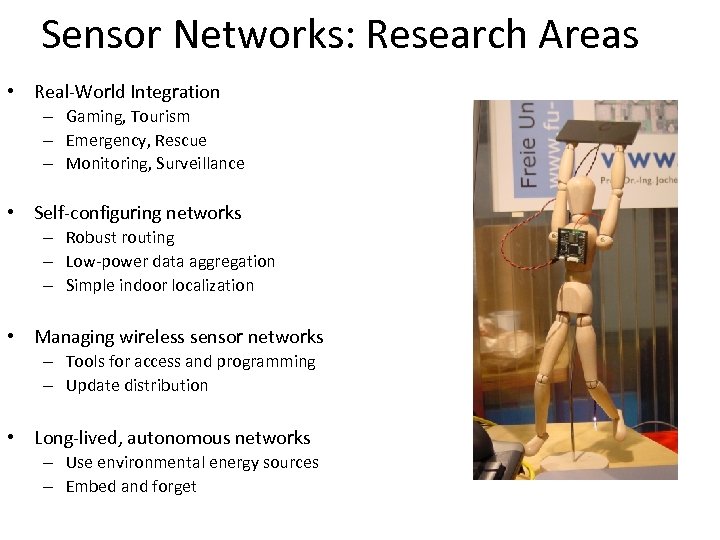
Sensor Networks: Research Areas • Real-World Integration – Gaming, Tourism – Emergency, Rescue – Monitoring, Surveillance • Self-configuring networks – Robust routing – Low-power data aggregation – Simple indoor localization • Managing wireless sensor networks – Tools for access and programming – Update distribution • Long-lived, autonomous networks – Use environmental energy sources – Embed and forget
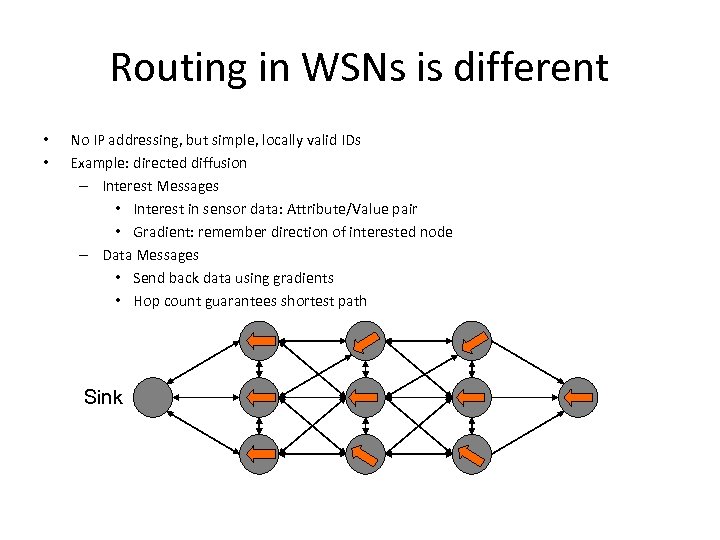
Routing in WSNs is different • • No IP addressing, but simple, locally valid IDs Example: directed diffusion – Interest Messages • Interest in sensor data: Attribute/Value pair • Gradient: remember direction of interested node – Data Messages • Send back data using gradients • Hop count guarantees shortest path Sink
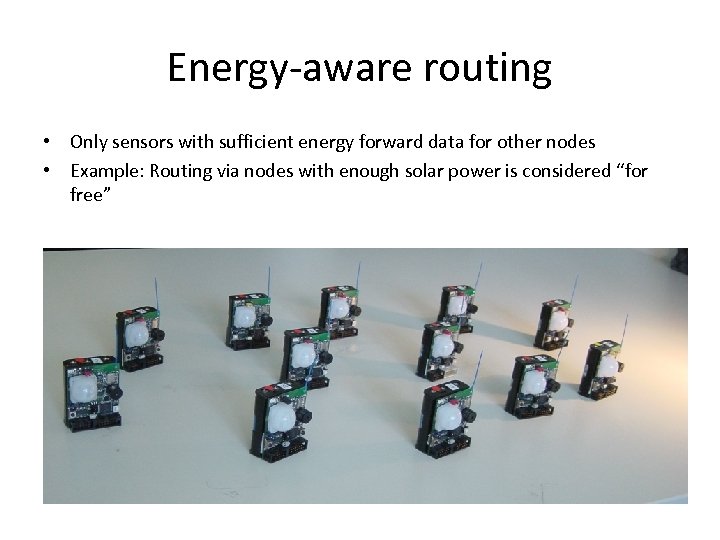
Energy-aware routing • Only sensors with sufficient energy forward data for other nodes • Example: Routing via nodes with enough solar power is considered “for free”
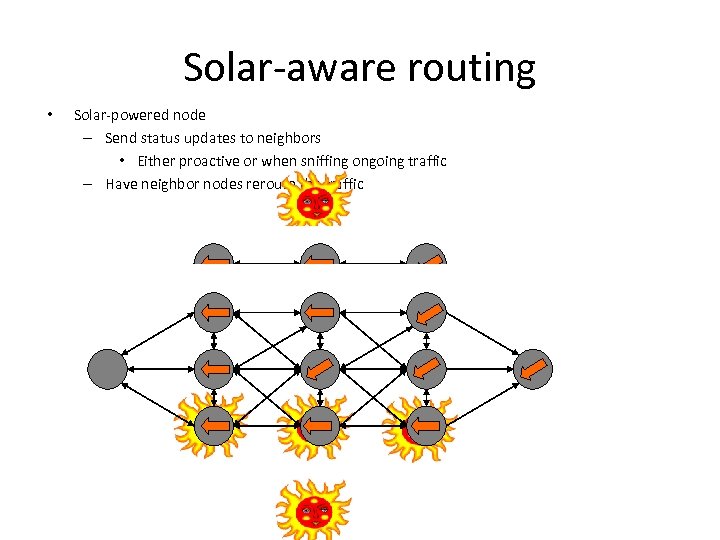
Solar-aware routing • Solar-powered node – Send status updates to neighbors • Either proactive or when sniffing ongoing traffic – Have neighbor nodes reroute the traffic
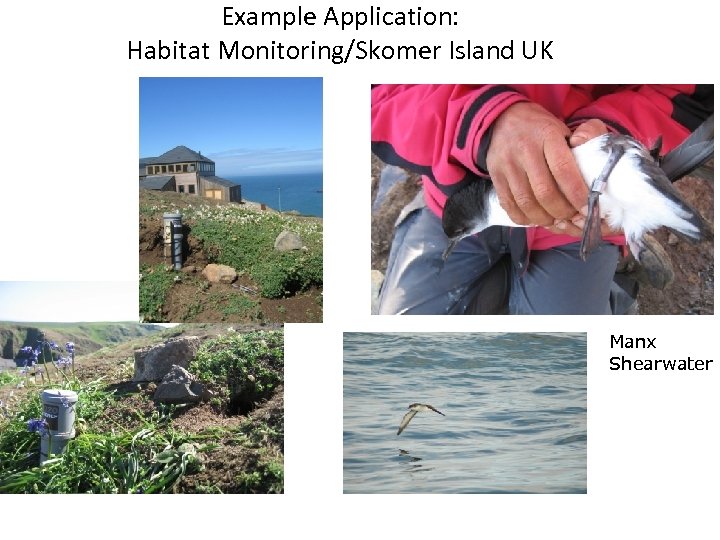
Example Application: Habitat Monitoring/Skomer Island UK Manx Shearwater
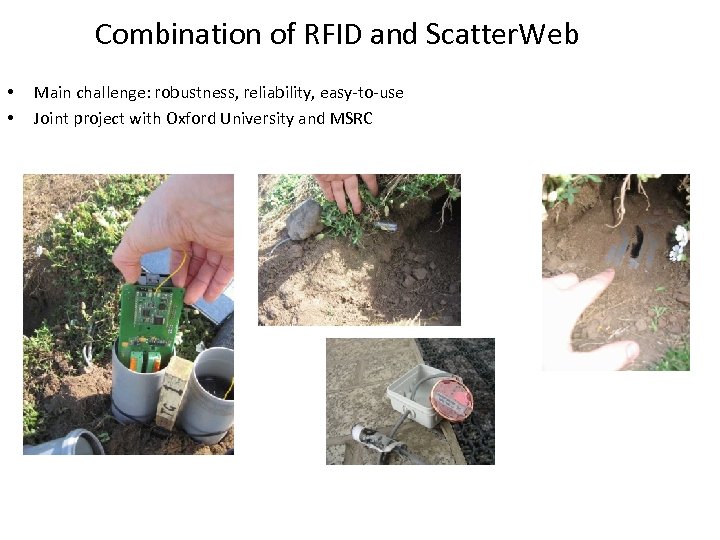
Combination of RFID and Scatter. Web • • Main challenge: robustness, reliability, easy-to-use Joint project with Oxford University and MSRC
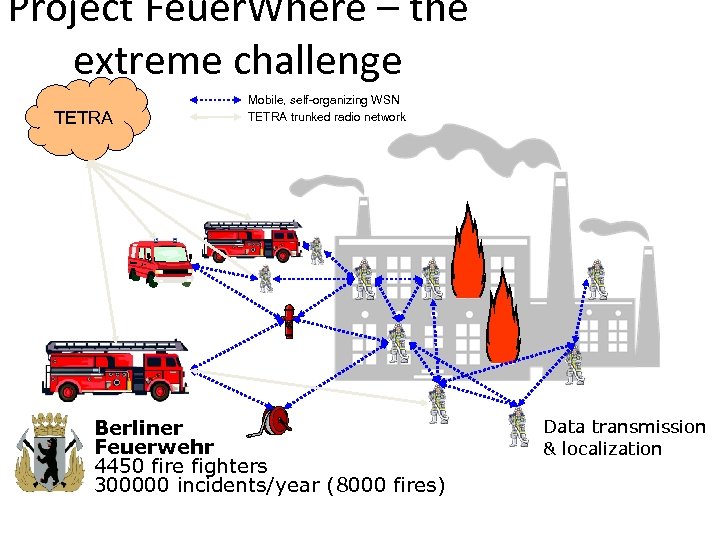
Project Feuer. Where – the extreme challenge TETRA Mobile, self-organizing WSN TETRA trunked radio network Berliner Feuerwehr 4450 fire fighters 300000 incidents/year (8000 fires) Data transmission & localization
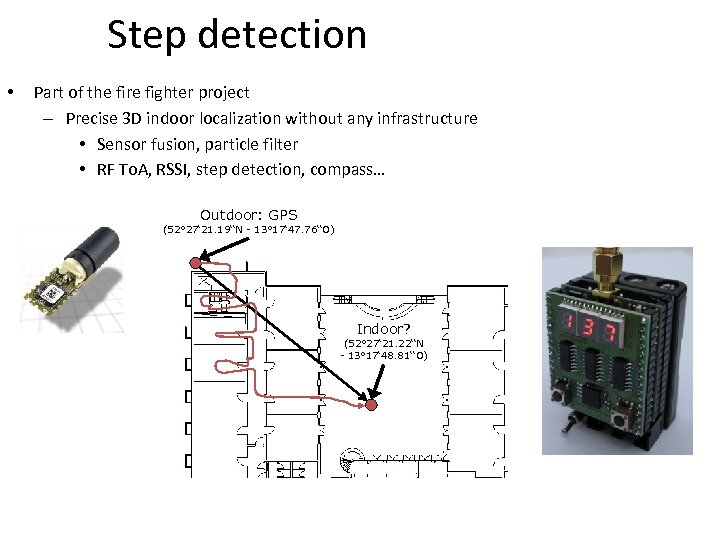
Step detection • Part of the fire fighter project – Precise 3 D indoor localization without any infrastructure • Sensor fusion, particle filter • RF To. A, RSSI, step detection, compass… Outdoor: GPS (52° 27‘ 21. 19‘‘N - 13° 17‘ 47. 76‘‘O) Indoor? (52° 27‘ 21. 22‘‘N - 13° 17‘ 48. 81‘‘O)
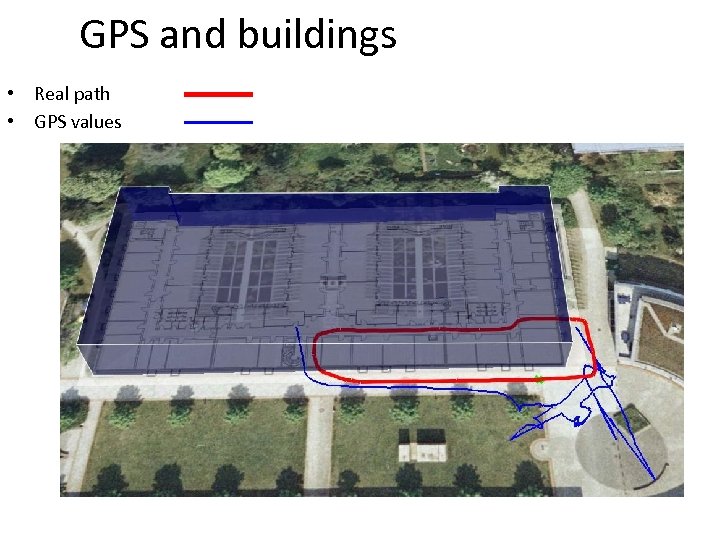
GPS and buildings • Real path • GPS values
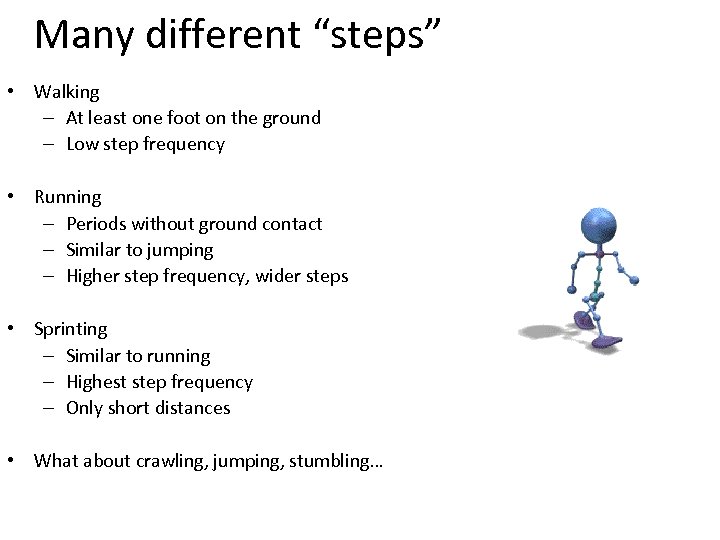
Many different “steps” • Walking – At least one foot on the ground – Low step frequency • Running – Periods without ground contact – Similar to jumping – Higher step frequency, wider steps • Sprinting – Similar to running – Highest step frequency – Only short distances • What about crawling, jumping, stumbling…
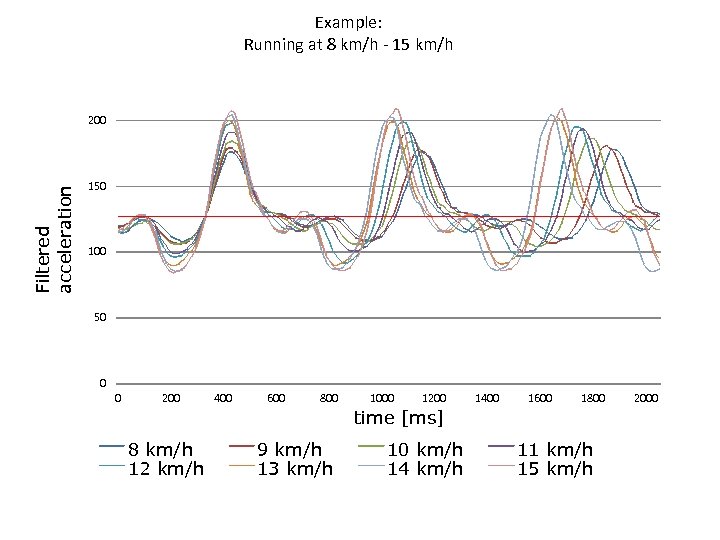
Example: Running at 8 km/h - 15 km/h Filtered acceleration 200 150 100 50 0 0 200 400 600 800 1000 1200 1400 1600 1800 time [ms] 8 km/h 12 km/h 9 km/h 13 km/h 10 km/h 14 km/h 11 km/h 15 km/h 2000
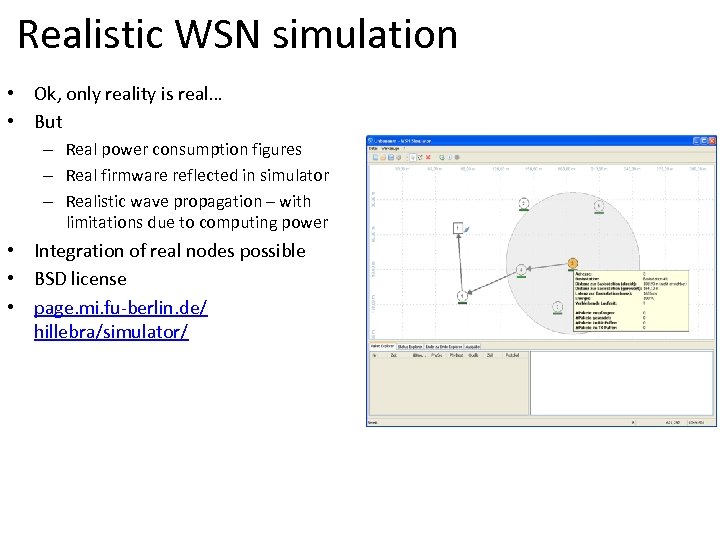
Realistic WSN simulation • Ok, only reality is real… • But – Real power consumption figures – Real firmware reflected in simulator – Realistic wave propagation – with limitations due to computing power • Integration of real nodes possible • BSD license • page. mi. fu-berlin. de/ hillebra/simulator/
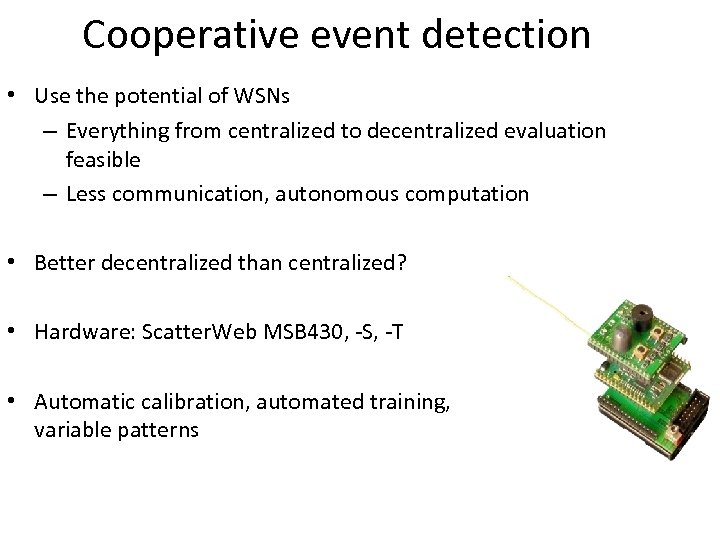
Cooperative event detection • Use the potential of WSNs – Everything from centralized to decentralized evaluation feasible – Less communication, autonomous computation • Better decentralized than centralized? • Hardware: Scatter. Web MSB 430, -S, -T • Automatic calibration, automated training, variable patterns
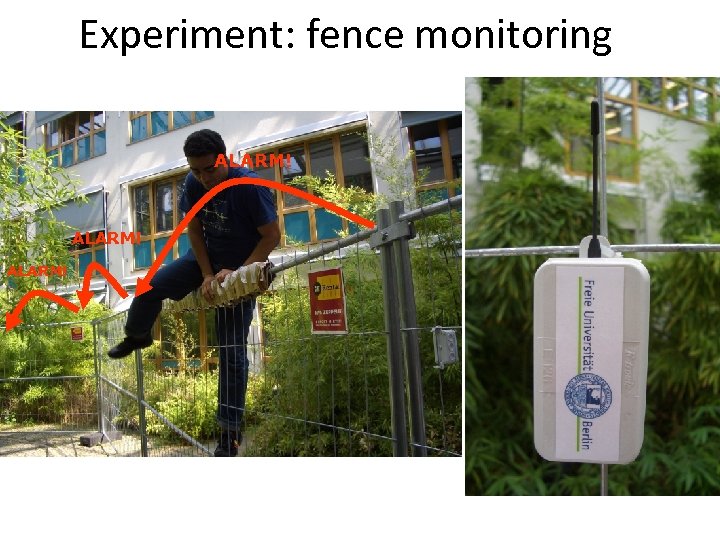
Experiment: fence monitoring ALARM!
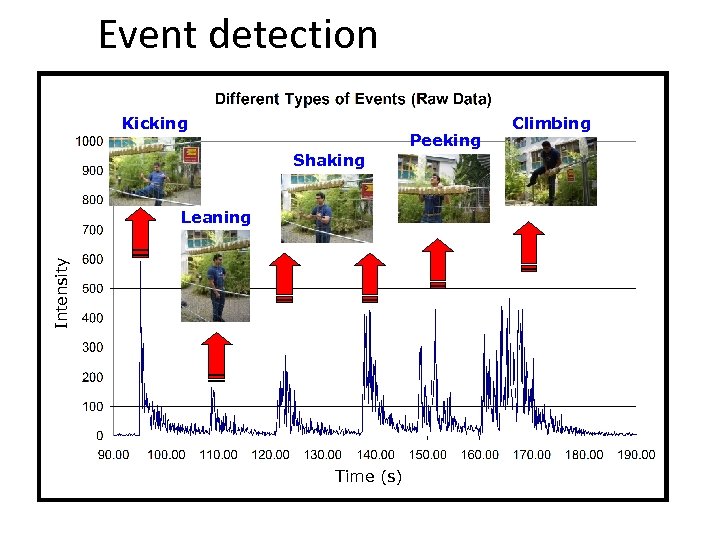
Event detection Kicking Peeking Shaking Intensity Leaning Time (s) Climbing
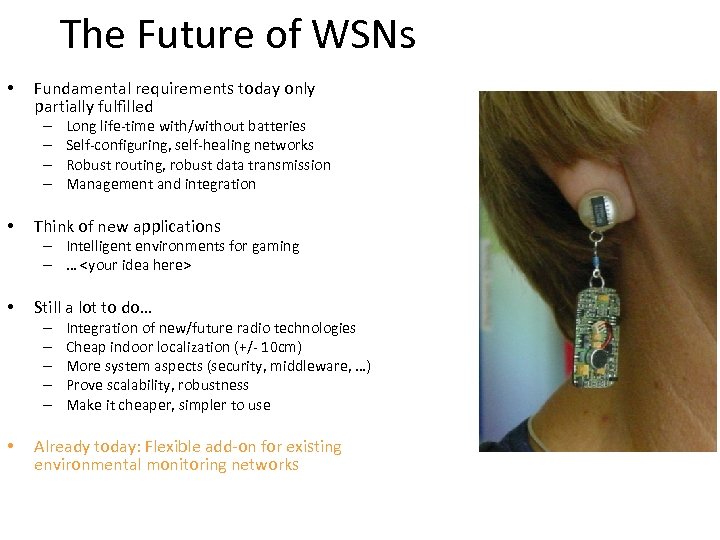
The Future of WSNs • Fundamental requirements today only partially fulfilled – – • Long life-time with/without batteries Self-configuring, self-healing networks Robust routing, robust data transmission Management and integration Think of new applications – Intelligent environments for gaming – … <your idea here> • Still a lot to do… – – – • Integration of new/future radio technologies Cheap indoor localization (+/- 10 cm) More system aspects (security, middleware, …) Prove scalability, robustness Make it cheaper, simpler to use Already today: Flexible add-on for existing environmental monitoring networks
Скачать презентацию Mobile Communications Unit-3 Mobile Network layer Motivation
861cfdf5ef30cf05fa92390d043d9385.ppt