 Скачать презентацию Mobile Communications Summer Term 2008 Freie Universität Berlin
c5de3bdecb136140473792ff29bee37f.ppt
- Количество слайдов: 31



Mobile Communications Summer Term 2008 Freie Universität Berlin - Computer Systems & Telematics Prof. Dr. -Ing. Jochen H. Schiller www. jochenschiller. de schiller@computer. org Prof. Dr. -Ing. Jochen H. Schiller www. jochenschiller. de MC - 2008 1. 1
Overview of the lecture • Introduction • Use-cases, applications • Definition of terms • Challenges, history • Wireless Transmission • Frequencies & regulations • Signals, antennas, signal propagation • Multiplexing, modulation, spread spectrum, cellular system • Medium Access • SDMA, FDMA, TDMA, CDMA • CSMA/CA, versions of Aloha • Collision avoidance, polling • Wireless Telecommunication Systems • GSM, HSCSD, GPRS, DECT, TETRA, UMTS, IMT-2000 • Satellite Systems • GEO, LEO, MEO, routing, handover Prof. Dr. -Ing. Jochen H. Schiller www. jochenschiller. de • Broadcast Systems • DAB, DVB • Wireless LANs • Basic Technology • IEEE 802. 11 a/b/g/…, . 15, Bluetooth, Zig. Bee • Network Protocols • Mobile IP • Ad-hoc networking • Routing • Transport Protocols • Reliable transmission • Flow control • Quality of Service • Support for Mobility • File systems, WWW, WAP, imode, J 2 ME, . . . • Outlook MC - 2008 1. 2
Mobile Communications Chapter 1: Introduction • A case for mobility – many aspects • History of mobile communication • Market • Areas of research Prof. Dr. -Ing. Jochen H. Schiller www. jochenschiller. de MC - 2008 1. 3
Computers for the next decades? • Computers are integrated • small, cheap, portable, replaceable - no more separate devices • Technology is in the background • computer are aware of their environment and adapt (“location awareness”) • computer recognize the location of the user and react appropriately (e. g. , call forwarding, fax forwarding, “context awareness”)) • Advances in technology • • • more computing power in smaller devices flat, lightweight displays with low power consumption new user interfaces due to small dimensions more bandwidth per cubic meter multiple wireless interfaces: wireless LANs, wireless WANs, regional wireless telecommunication networks etc. („overlay networks“) Prof. Dr. -Ing. Jochen H. Schiller www. jochenschiller. de MC - 2008 1. 4
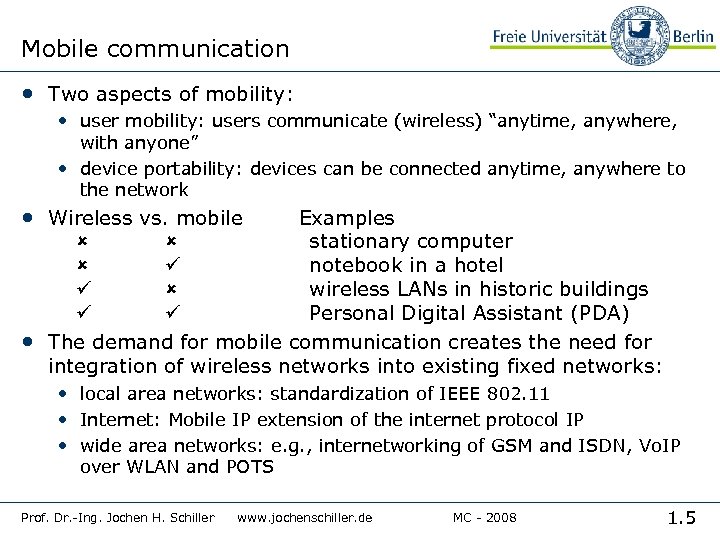
Mobile communication • Two aspects of mobility: • user mobility: users communicate (wireless) “anytime, anywhere, with anyone” • device portability: devices can be connected anytime, anywhere to the network • Wireless vs. mobile • Examples stationary computer notebook in a hotel wireless LANs in historic buildings Personal Digital Assistant (PDA) The demand for mobile communication creates the need for integration of wireless networks into existing fixed networks: • local area networks: standardization of IEEE 802. 11 • Internet: Mobile IP extension of the internet protocol IP • wide area networks: e. g. , internetworking of GSM and ISDN, Vo. IP over WLAN and POTS Prof. Dr. -Ing. Jochen H. Schiller www. jochenschiller. de MC - 2008 1. 5
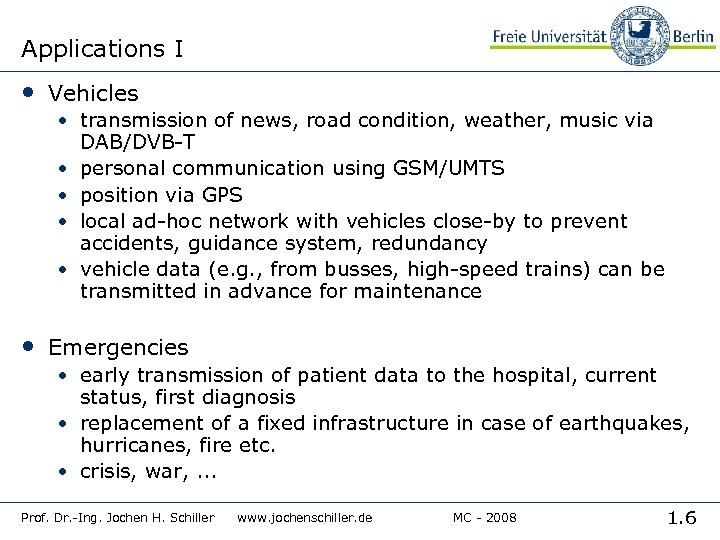
Applications I • Vehicles • transmission of news, road condition, weather, music via DAB/DVB-T • personal communication using GSM/UMTS • position via GPS • local ad-hoc network with vehicles close-by to prevent accidents, guidance system, redundancy • vehicle data (e. g. , from busses, high-speed trains) can be transmitted in advance for maintenance • Emergencies • early transmission of patient data to the hospital, current status, first diagnosis • replacement of a fixed infrastructure in case of earthquakes, hurricanes, fire etc. • crisis, war, . . . Prof. Dr. -Ing. Jochen H. Schiller www. jochenschiller. de MC - 2008 1. 6
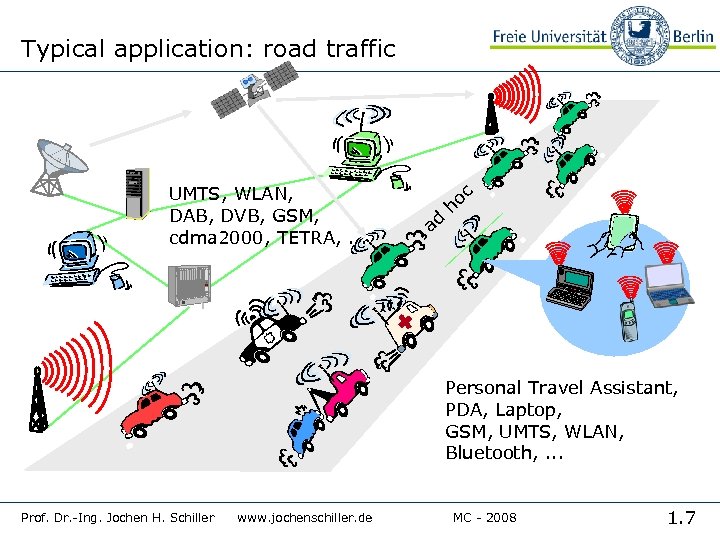
Typical application: road traffic UMTS, WLAN, DAB, DVB, GSM, cdma 2000, TETRA, . . . ad oc h Personal Travel Assistant, PDA, Laptop, GSM, UMTS, WLAN, Bluetooth, . . . Prof. Dr. -Ing. Jochen H. Schiller www. jochenschiller. de MC - 2008 1. 7
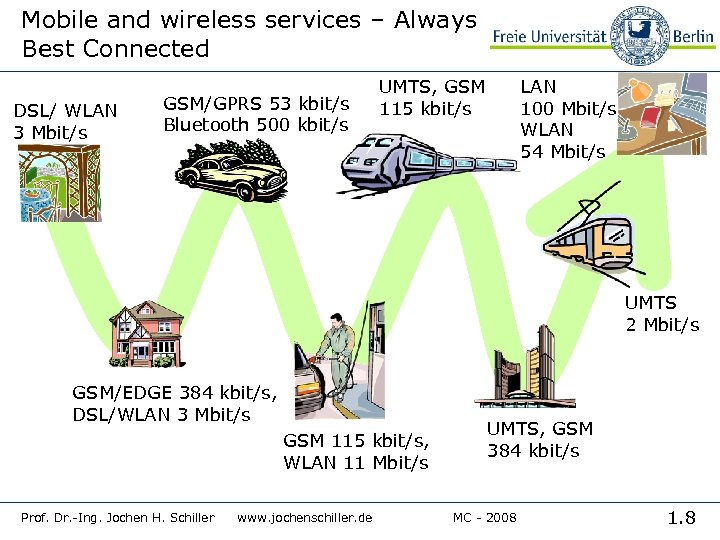
Mobile and wireless services – Always Best Connected DSL/ WLAN 3 Mbit/s GSM/GPRS 53 kbit/s Bluetooth 500 kbit/s UMTS, GSM 115 kbit/s LAN 100 Mbit/s, WLAN 54 Mbit/s UMTS 2 Mbit/s GSM/EDGE 384 kbit/s, DSL/WLAN 3 Mbit/s GSM 115 kbit/s, WLAN 11 Mbit/s Prof. Dr. -Ing. Jochen H. Schiller www. jochenschiller. de UMTS, GSM 384 kbit/s MC - 2008 1. 8
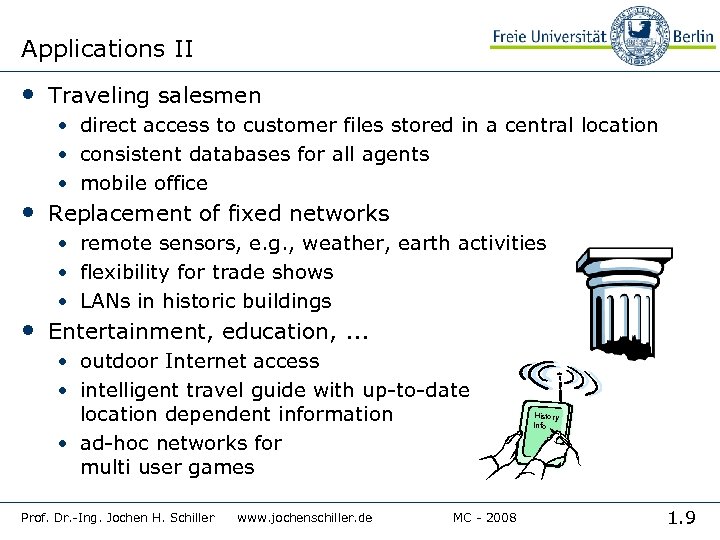
Applications II • Traveling salesmen • direct access to customer files stored in a central location • consistent databases for all agents • mobile office • Replacement of fixed networks • remote sensors, e. g. , weather, earth activities • flexibility for trade shows • LANs in historic buildings • Entertainment, education, . . . • outdoor Internet access • intelligent travel guide with up-to-date location dependent information • ad-hoc networks for multi user games Prof. Dr. -Ing. Jochen H. Schiller www. jochenschiller. de MC - 2008 History Info 1. 9
Location dependent services • Location aware services • what services, e. g. , printer, fax, phone, server etc. exist in the local environment • Follow-on services • automatic call-forwarding, transmission of the actual workspace to the current location • Information services • “push”: e. g. , current special offers in the supermarket • “pull”: e. g. , where is the Black Forrest Cheese Cake? • Support services • caches, intermediate results, state information etc. “follow” the mobile device through the fixed network • Privacy • who should gain knowledge about the location Prof. Dr. -Ing. Jochen H. Schiller www. jochenschiller. de MC - 2008 1. 10
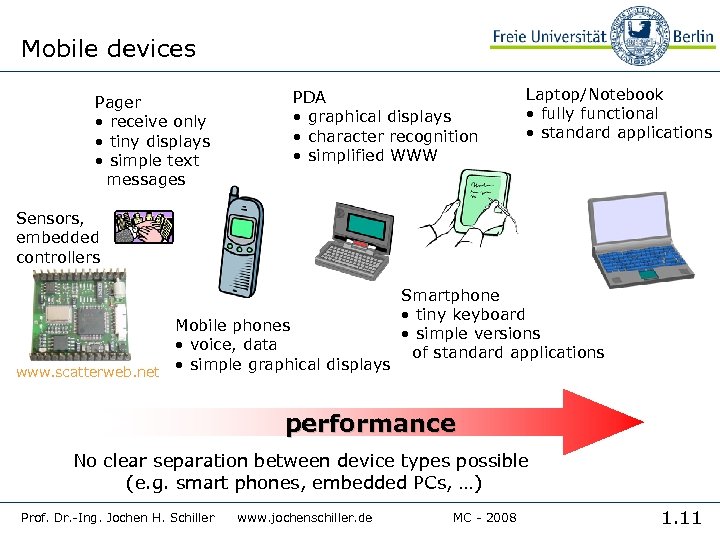
Mobile devices Pager • receive only • tiny displays • simple text messages PDA • graphical displays • character recognition • simplified WWW Laptop/Notebook • fully functional • standard applications Sensors, embedded controllers Mobile phones • voice, data • simple graphical displays www. scatterweb. net Smartphone • tiny keyboard • simple versions of standard applications performance No clear separation between device types possible (e. g. smart phones, embedded PCs, …) Prof. Dr. -Ing. Jochen H. Schiller www. jochenschiller. de MC - 2008 1. 11
Effects of device portability • Power consumption • limited computing power, low quality displays, small disks due to limited battery capacity • CPU: power consumption ~ CV 2 f • C: internal capacity, reduced by integration • V: supply voltage, can be reduced to a certain limit • f: clock frequency, can be reduced temporally • Loss of data • higher probability, has to be included in advance into the design (e. g. , defects, theft) • Limited user interfaces • compromise between size of fingers and portability • integration of character/voice recognition, abstract symbols • Limited memory • limited usage of mass memories with moving parts • flash-memory Prof. Dr. -Ing. Jochen H. Schiller www. jochenschiller. de MC - 2008 1. 12
Wireless networks in comparison to fixed networks • Higher loss-rates due to interference • emissions of, e. g. , engines, lightning • Restrictive regulations of frequencies • frequencies have to be coordinated, useful frequencies are almost all occupied • Low transmission rates • local some Mbit/s, regional currently, e. g. , 53 kbit/s with GSM/GPRS or about 150 kbit/s using EDGE • Higher delays, higher jitter • connection setup time with GSM in the second range, several hundred milliseconds for other wireless systems • Lower security, simpler active attacking • radio interface accessible for everyone, base station can be simulated, thus attracting calls from mobile phones • Always shared medium • secure access mechanisms important Prof. Dr. -Ing. Jochen H. Schiller www. jochenschiller. de MC - 2008 1. 13
Early history of wireless communication • Many people in history used light for communication • heliographs, flags (“semaphore”), . . . • 150 BC smoke signals for communication; (Polybius, Greece) • 1794, optical telegraph, Claude Chappe • Here electromagnetic waves are of special importance: • 1831 Faraday demonstrates electromagnetic induction • J. Maxwell (1831 -79): theory of electromagnetic Fields, wave equations (1864) • H. Hertz (1857 -94): demonstrates with an experiment the wave character of electrical transmission through space (1888, in Karlsruhe, Germany) Prof. Dr. -Ing. Jochen H. Schiller www. jochenschiller. de MC - 2008 1. 14
History of wireless communication I • 1896 Guglielmo Marconi • first demonstration of wireless telegraphy (digital!) • long wave transmission, high transmission power necessary (> 200 kw) • 1907 Commercial transatlantic connections • huge base stations (30 100 m high antennas) • 1915 Wireless voice transmission New York - San Francisco • 1920 Discovery of short waves by Marconi • reflection at the ionosphere • smaller sender and receiver, possible due to the invention of the vacuum tube (1906, Lee De. Forest and Robert von Lieben) • 1926 Train-phone on the line Hamburg - Berlin • wires parallel to the railroad track Prof. Dr. -Ing. Jochen H. Schiller www. jochenschiller. de MC - 2008 1. 15
History of wireless communication II • 1928 many TV broadcast trials (across Atlantic, color TV, news) • 1933 Frequency modulation (E. H. Armstrong) • 1958 A-Netz in Germany • analog, 160 MHz, connection setup only from the mobile station, no handover, 80% coverage, 1971 11000 customers • 1972 B-Netz in Germany • analog, 160 MHz, connection setup from the fixed network too (but location of the mobile station has to be known) • available also in A, NL and LUX, 1979 13000 customers in D • 1979 NMT at 450 MHz (Scandinavian countries) • 1982 Start of GSM-specification • goal: pan-European digital mobile phone system with roaming • 1983 Start of the American AMPS (Advanced Mobile Phone • System, analog) 1984 CT-1 standard (Europe) for cordless telephones Prof. Dr. -Ing. Jochen H. Schiller www. jochenschiller. de MC - 2008 1. 16
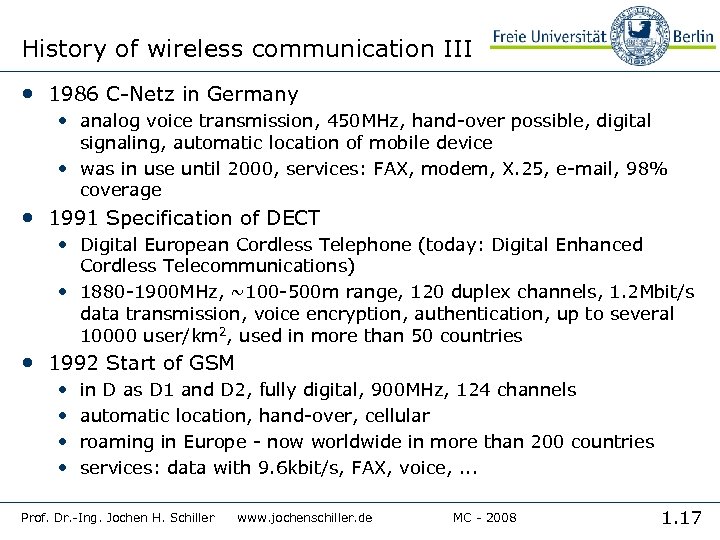
History of wireless communication III • 1986 C-Netz in Germany • analog voice transmission, 450 MHz, hand-over possible, digital signaling, automatic location of mobile device • was in use until 2000, services: FAX, modem, X. 25, e-mail, 98% coverage • 1991 Specification of DECT • Digital European Cordless Telephone (today: Digital Enhanced Cordless Telecommunications) • 1880 -1900 MHz, ~100 -500 m range, 120 duplex channels, 1. 2 Mbit/s data transmission, voice encryption, authentication, up to several 10000 user/km 2, used in more than 50 countries • 1992 Start of GSM • • in D as D 1 and D 2, fully digital, 900 MHz, 124 channels automatic location, hand-over, cellular roaming in Europe - now worldwide in more than 200 countries services: data with 9. 6 kbit/s, FAX, voice, . . . Prof. Dr. -Ing. Jochen H. Schiller www. jochenschiller. de MC - 2008 1. 17
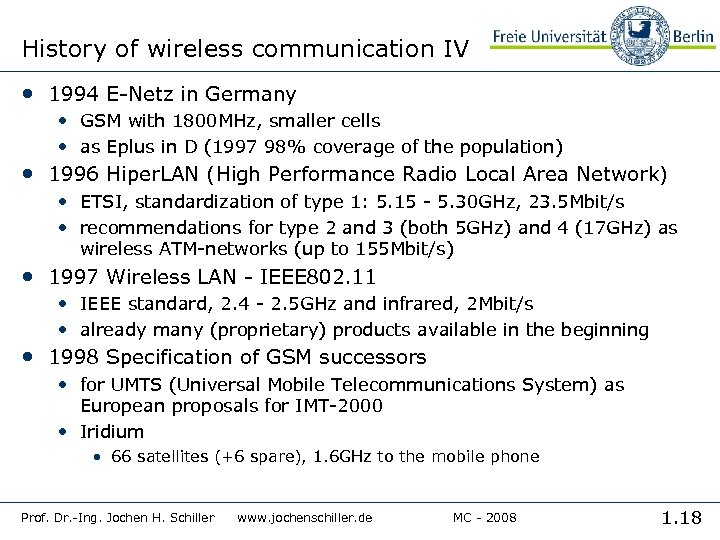
History of wireless communication IV • 1994 E-Netz in Germany • GSM with 1800 MHz, smaller cells • as Eplus in D (1997 98% coverage of the population) • 1996 Hiper. LAN (High Performance Radio Local Area Network) • ETSI, standardization of type 1: 5. 15 - 5. 30 GHz, 23. 5 Mbit/s • recommendations for type 2 and 3 (both 5 GHz) and 4 (17 GHz) as wireless ATM-networks (up to 155 Mbit/s) • 1997 Wireless LAN - IEEE 802. 11 • IEEE standard, 2. 4 - 2. 5 GHz and infrared, 2 Mbit/s • already many (proprietary) products available in the beginning • 1998 Specification of GSM successors • for UMTS (Universal Mobile Telecommunications System) as European proposals for IMT-2000 • Iridium • 66 satellites (+6 spare), 1. 6 GHz to the mobile phone Prof. Dr. -Ing. Jochen H. Schiller www. jochenschiller. de MC - 2008 1. 18
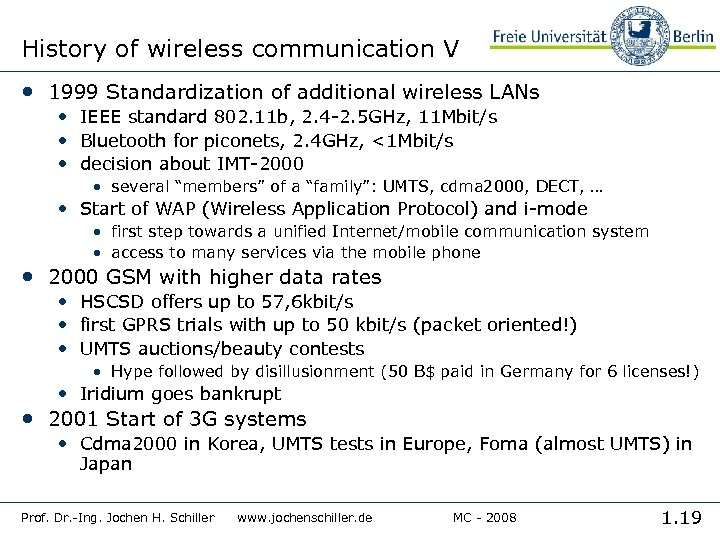
History of wireless communication V • 1999 Standardization of additional wireless LANs • IEEE standard 802. 11 b, 2. 4 -2. 5 GHz, 11 Mbit/s • Bluetooth for piconets, 2. 4 GHz, <1 Mbit/s • decision about IMT-2000 • several “members” of a “family”: UMTS, cdma 2000, DECT, … • Start of WAP (Wireless Application Protocol) and i-mode • first step towards a unified Internet/mobile communication system • access to many services via the mobile phone • 2000 GSM with higher data rates • HSCSD offers up to 57, 6 kbit/s • first GPRS trials with up to 50 kbit/s (packet oriented!) • UMTS auctions/beauty contests • Hype followed by disillusionment (50 B$ paid in Germany for 6 licenses!) • Iridium goes bankrupt • 2001 Start of 3 G systems • Cdma 2000 in Korea, UMTS tests in Europe, Foma (almost UMTS) in Japan Prof. Dr. -Ing. Jochen H. Schiller www. jochenschiller. de MC - 2008 1. 19
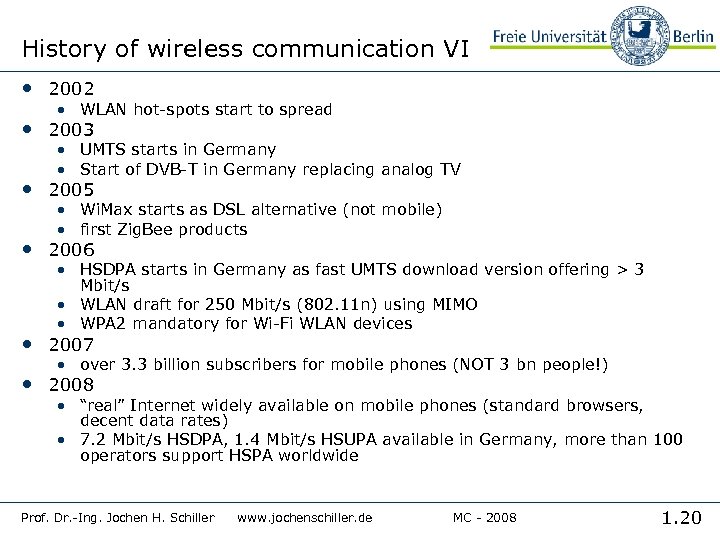
History of wireless communication VI • 2002 • WLAN hot-spots start to spread • 2003 • UMTS starts in Germany • Start of DVB-T in Germany replacing analog TV • 2005 • Wi. Max starts as DSL alternative (not mobile) • first Zig. Bee products • 2006 • HSDPA starts in Germany as fast UMTS download version offering > 3 Mbit/s • WLAN draft for 250 Mbit/s (802. 11 n) using MIMO • WPA 2 mandatory for Wi-Fi WLAN devices • 2007 • over 3. 3 billion subscribers for mobile phones (NOT 3 bn people!) • 2008 • “real” Internet widely available on mobile phones (standard browsers, decent data rates) • 7. 2 Mbit/s HSDPA, 1. 4 Mbit/s HSUPA available in Germany, more than 100 operators support HSPA worldwide Prof. Dr. -Ing. Jochen H. Schiller www. jochenschiller. de MC - 2008 1. 20
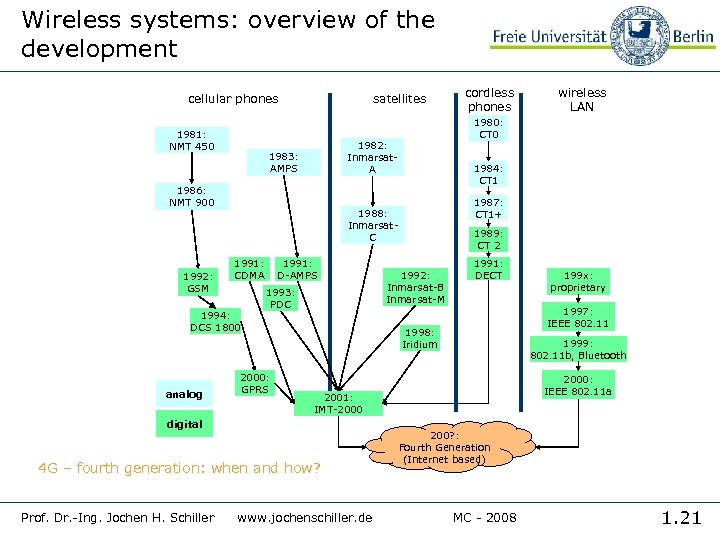
Wireless systems: overview of the development cellular phones 1981: NMT 450 satellites 1986: NMT 900 1992: GSM 1994: DCS 1800 analog 1991: D-AMPS 1993: PDC 1987: CT 1+ 2000: GPRS 1989: CT 2 1992: Inmarsat-B Inmarsat-M 1991: DECT 1999: 802. 11 b, Bluetooth 2000: IEEE 802. 11 a 2001: IMT-2000 4 G – fourth generation: when and how? www. jochenschiller. de 199 x: proprietary 1997: IEEE 802. 11 1998: Iridium digital Prof. Dr. -Ing. Jochen H. Schiller 1984: CT 1 1988: Inmarsat. C 1991: CDMA wireless LAN 1980: CT 0 1982: Inmarsat. A 1983: AMPS cordless phones 200? : Fourth Generation (Internet based) MC - 2008 1. 21
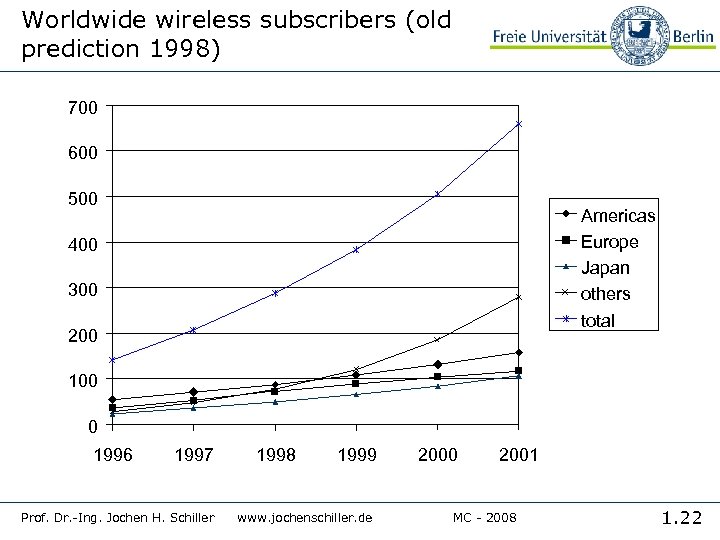
Worldwide wireless subscribers (old prediction 1998) 700 600 500 Americas Europe Japan others total 400 300 200 100 0 1996 1997 Prof. Dr. -Ing. Jochen H. Schiller 1998 1999 www. jochenschiller. de 2000 2001 MC - 2008 1. 22
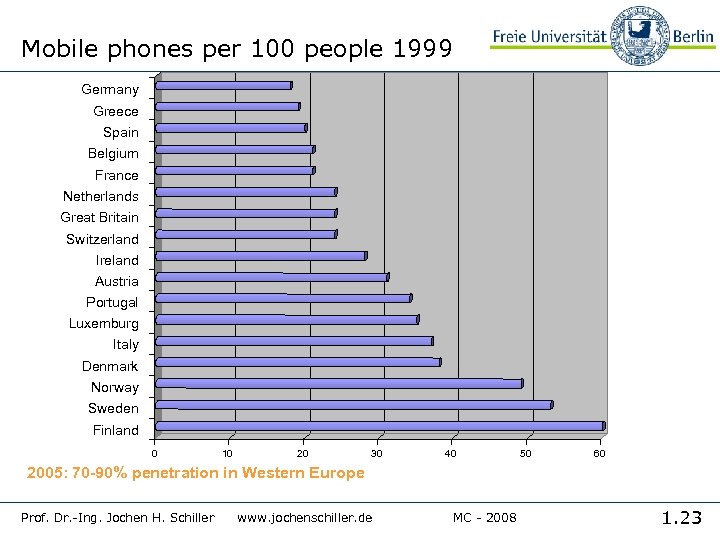
Mobile phones per 100 people 1999 Germany Greece Spain Belgium France Netherlands Great Britain Switzerland Ireland Austria Portugal Luxemburg Italy Denmark Norway Sweden Finland 0 10 20 30 40 50 60 2005: 70 -90% penetration in Western Europe Prof. Dr. -Ing. Jochen H. Schiller www. jochenschiller. de MC - 2008 1. 23
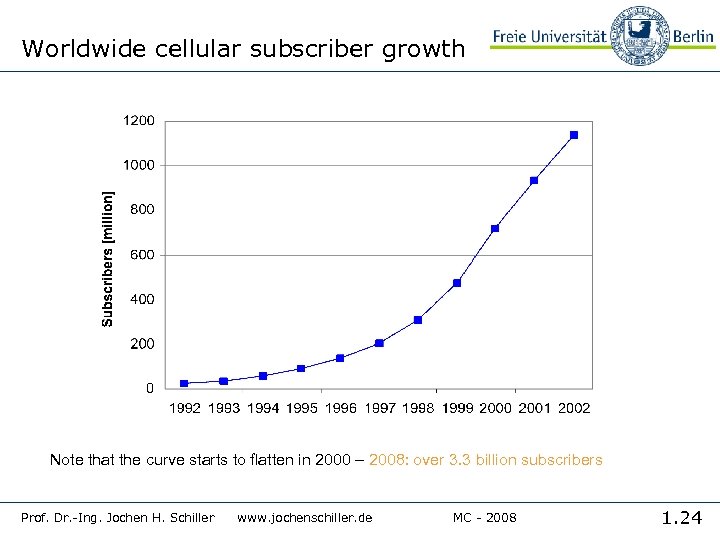
Worldwide cellular subscriber growth Note that the curve starts to flatten in 2000 – 2008: over 3. 3 billion subscribers Prof. Dr. -Ing. Jochen H. Schiller www. jochenschiller. de MC - 2008 1. 24
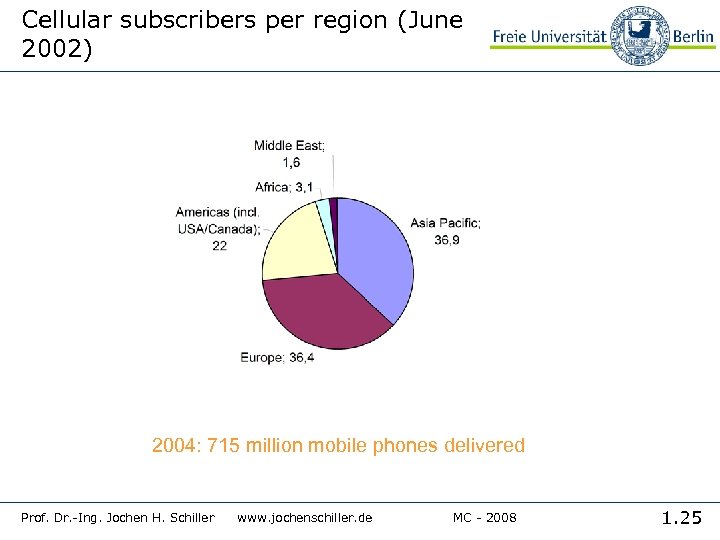
Cellular subscribers per region (June 2002) 2004: 715 million mobile phones delivered Prof. Dr. -Ing. Jochen H. Schiller www. jochenschiller. de MC - 2008 1. 25
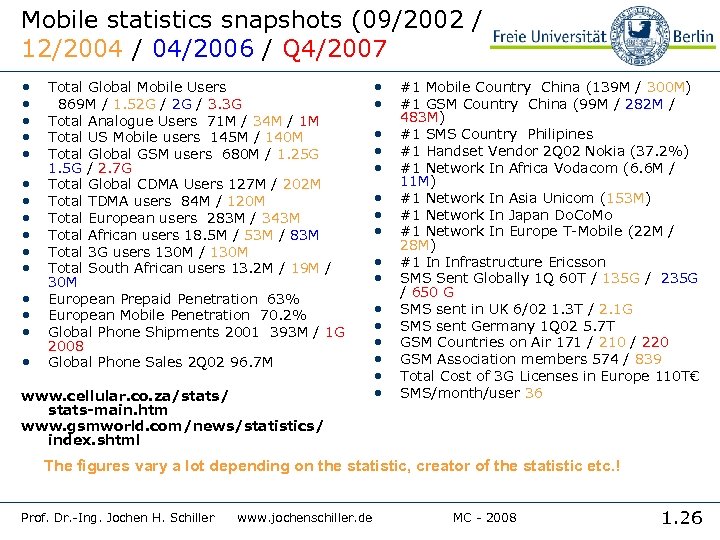
Mobile statistics snapshots (09/2002 / 12/2004 / 04/2006 / Q 4/2007 • • • • Total Global Mobile Users 869 M / 1. 52 G / 3. 3 G Total Analogue Users 71 M / 34 M / 1 M Total US Mobile users 145 M / 140 M Total Global GSM users 680 M / 1. 25 G 1. 5 G / 2. 7 G Total Global CDMA Users 127 M / 202 M Total TDMA users 84 M / 120 M Total European users 283 M / 343 M Total African users 18. 5 M / 53 M / 83 M Total 3 G users 130 M / 130 M Total South African users 13. 2 M / 19 M / 30 M European Prepaid Penetration 63% European Mobile Penetration 70. 2% Global Phone Shipments 2001 393 M / 1 G 2008 Global Phone Sales 2 Q 02 96. 7 M www. cellular. co. za/stats/ stats-main. htm www. gsmworld. com/news/statistics/ index. shtml • • • • #1 Mobile Country China (139 M / 300 M) #1 GSM Country China (99 M / 282 M / 483 M) #1 SMS Country Philipines #1 Handset Vendor 2 Q 02 Nokia (37. 2%) #1 Network In Africa Vodacom (6. 6 M / 11 M) #1 Network In Asia Unicom (153 M) #1 Network In Japan Do. Co. Mo #1 Network In Europe T-Mobile (22 M / 28 M) #1 In Infrastructure Ericsson SMS Sent Globally 1 Q 60 T / 135 G / 235 G / 650 G SMS sent in UK 6/02 1. 3 T / 2. 1 G SMS sent Germany 1 Q 02 5. 7 T GSM Countries on Air 171 / 210 / 220 GSM Association members 574 / 839 Total Cost of 3 G Licenses in Europe 110 T€ SMS/month/user 36 The figures vary a lot depending on the statistic, creator of the statistic etc. ! Prof. Dr. -Ing. Jochen H. Schiller www. jochenschiller. de MC - 2008 1. 26
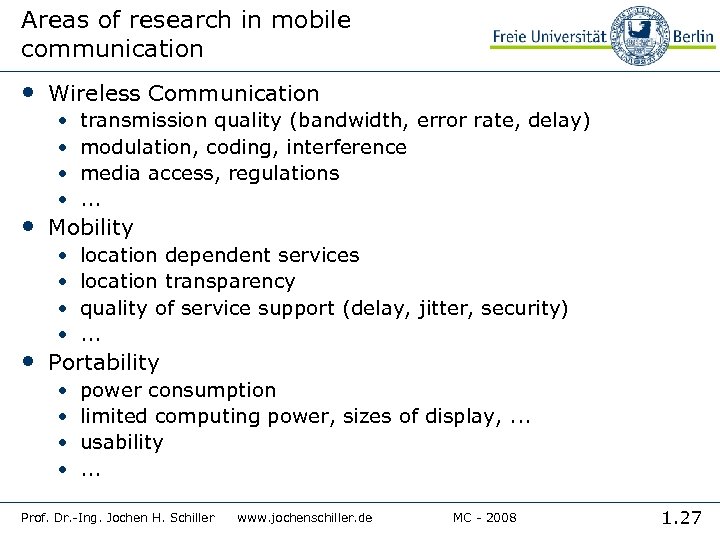
Areas of research in mobile communication • Wireless Communication • • transmission quality (bandwidth, error rate, delay) modulation, coding, interference media access, regulations. . . • • location dependent services location transparency quality of service support (delay, jitter, security). . . • • power consumption limited computing power, sizes of display, . . . usability. . . • Mobility • Portability Prof. Dr. -Ing. Jochen H. Schiller www. jochenschiller. de MC - 2008 1. 27
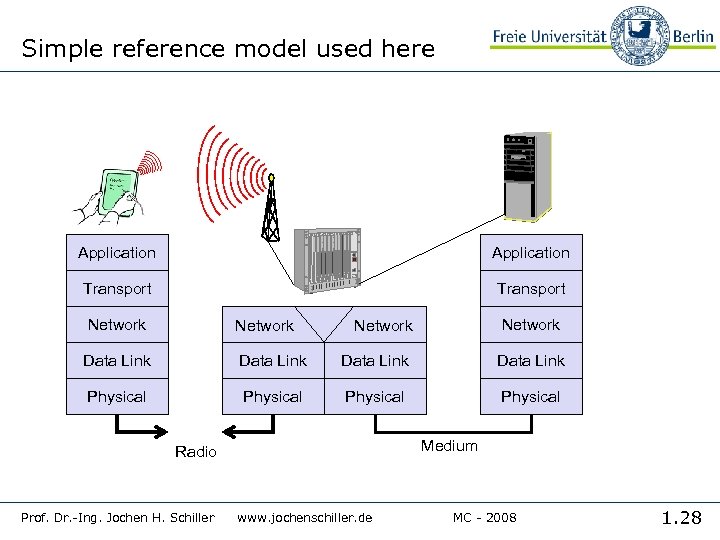
Simple reference model used here Application Transport Network Data Link Physical Medium Radio Prof. Dr. -Ing. Jochen H. Schiller www. jochenschiller. de MC - 2008 1. 28
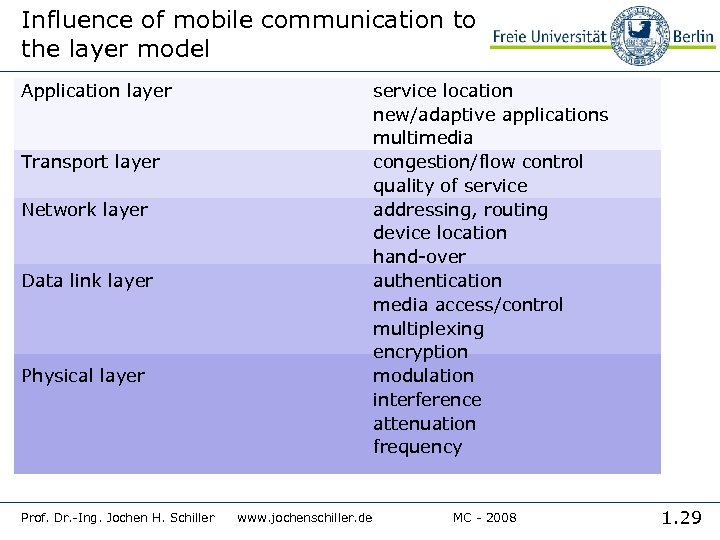
Influence of mobile communication to the layer model Application layer service location new/adaptive applications multimedia congestion/flow control quality of service addressing, routing device location hand-over authentication media access/control multiplexing encryption modulation interference attenuation frequency Transport layer Network layer Data link layer Physical layer Prof. Dr. -Ing. Jochen H. Schiller www. jochenschiller. de MC - 2008 1. 29
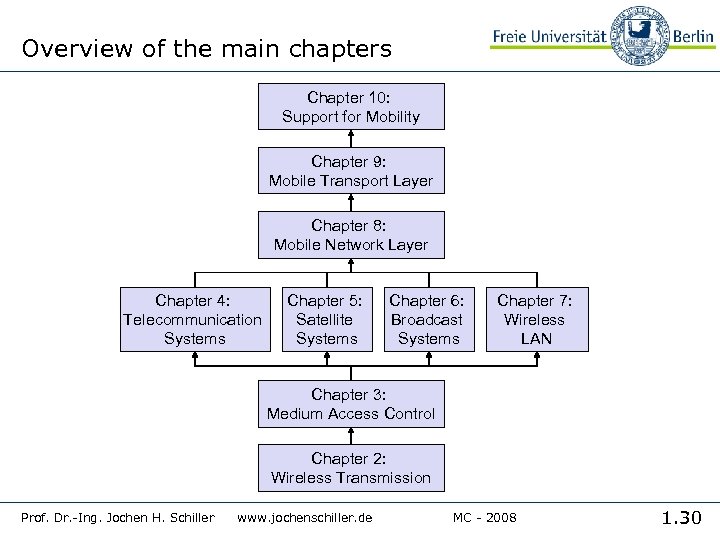
Overview of the main chapters Chapter 10: Support for Mobility Chapter 9: Mobile Transport Layer Chapter 8: Mobile Network Layer Chapter 4: Telecommunication Systems Chapter 5: Satellite Systems Chapter 6: Broadcast Systems Chapter 7: Wireless LAN Chapter 3: Medium Access Control Chapter 2: Wireless Transmission Prof. Dr. -Ing. Jochen H. Schiller www. jochenschiller. de MC - 2008 1. 30
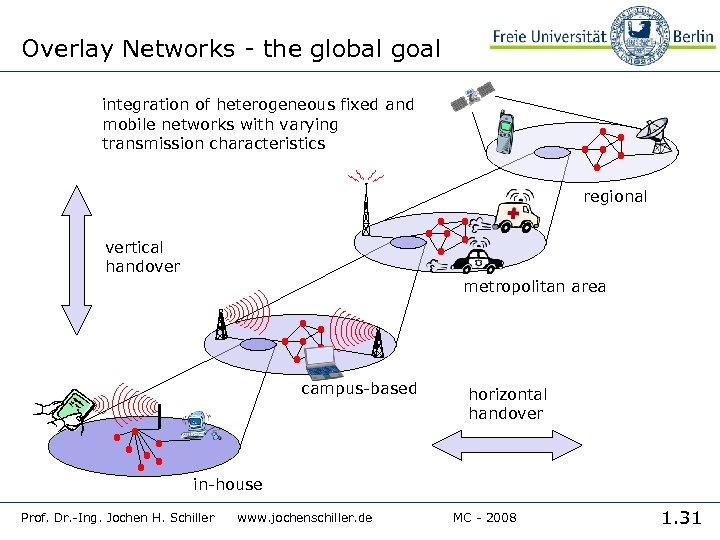
Overlay Networks - the global goal integration of heterogeneous fixed and mobile networks with varying transmission characteristics regional vertical handover metropolitan area campus-based horizontal handover in-house Prof. Dr. -Ing. Jochen H. Schiller www. jochenschiller. de MC - 2008 1. 31
Скачать презентацию Mobile Communications Summer Term 2008 Freie Universität Berlin
c5de3bdecb136140473792ff29bee37f.ppt