 Скачать презентацию Mobile Communications Chapter 7 Wireless LANs Characteristics IEEE
f8a8ae381aca8d9ebe51c8fdf11defd3.ppt
- Количество слайдов: 127



Mobile Communications Chapter 7: Wireless LANs Characteristics IEEE 802. 11 PHY MAC Roaming . 11 a, b, g, h, i … HIPERLAN Bluetooth / IEEE 802. 15. x IEEE 802. 16/. 20/. 21/. 22 RFID Comparison Prof. Dr. -Ing. Jochen Schiller, http: //www. jochenschiller. de/ MC SS 05 7. 1
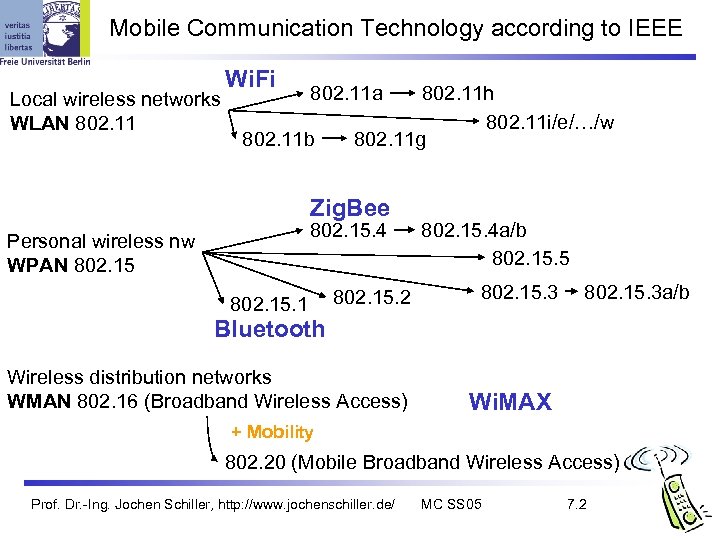
Mobile Communication Technology according to IEEE Local wireless networks WLAN 802. 11 Wi. Fi 802. 11 a 802. 11 b 802. 11 h 802. 11 i/e/…/w 802. 11 g Zig. Bee 802. 15. 4 Personal wireless nw WPAN 802. 15. 1 802. 15. 2 802. 15. 4 a/b 802. 15. 5 802. 15. 3 a/b Bluetooth Wireless distribution networks WMAN 802. 16 (Broadband Wireless Access) Wi. MAX + Mobility 802. 20 (Mobile Broadband Wireless Access) Prof. Dr. -Ing. Jochen Schiller, http: //www. jochenschiller. de/ MC SS 05 7. 2
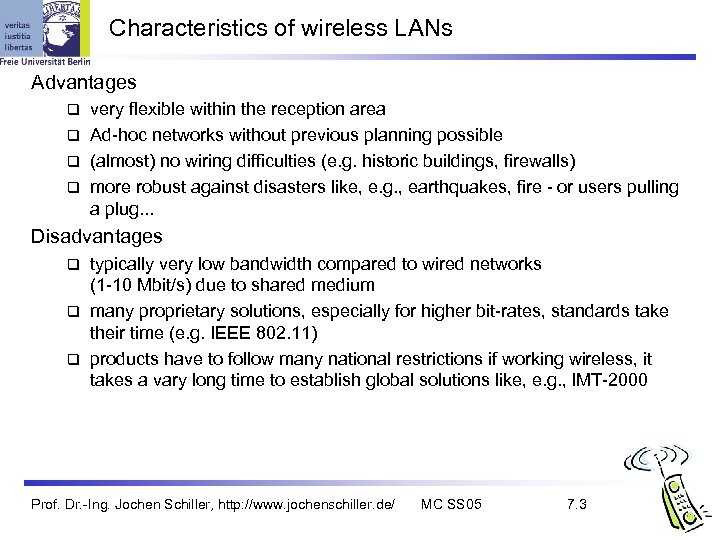
Characteristics of wireless LANs Advantages very flexible within the reception area Ad-hoc networks without previous planning possible (almost) no wiring difficulties (e. g. historic buildings, firewalls) more robust against disasters like, e. g. , earthquakes, fire - or users pulling a plug. . . Disadvantages typically very low bandwidth compared to wired networks (1 -10 Mbit/s) due to shared medium many proprietary solutions, especially for higher bit-rates, standards take their time (e. g. IEEE 802. 11) products have to follow many national restrictions if working wireless, it takes a vary long time to establish global solutions like, e. g. , IMT-2000 Prof. Dr. -Ing. Jochen Schiller, http: //www. jochenschiller. de/ MC SS 05 7. 3
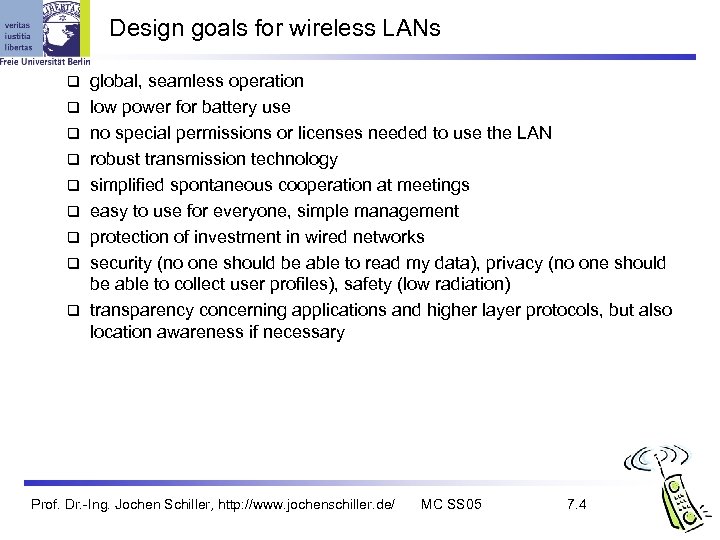
Design goals for wireless LANs global, seamless operation low power for battery use no special permissions or licenses needed to use the LAN robust transmission technology simplified spontaneous cooperation at meetings easy to use for everyone, simple management protection of investment in wired networks security (no one should be able to read my data), privacy (no one should be able to collect user profiles), safety (low radiation) transparency concerning applications and higher layer protocols, but also location awareness if necessary Prof. Dr. -Ing. Jochen Schiller, http: //www. jochenschiller. de/ MC SS 05 7. 4
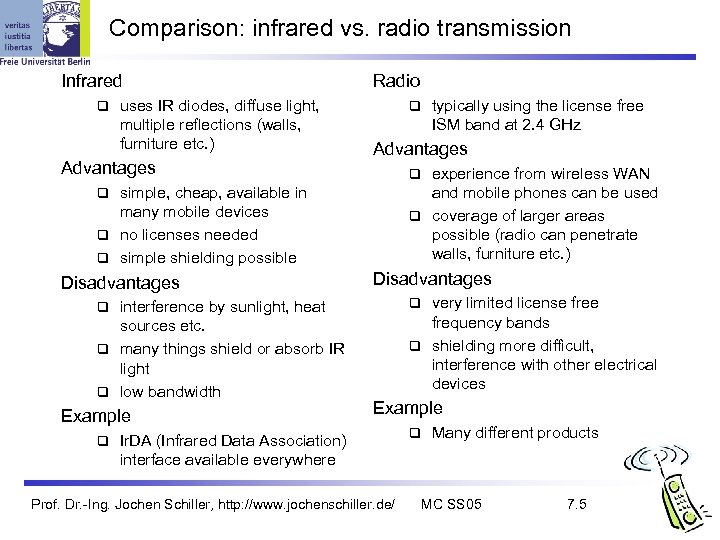
Comparison: infrared vs. radio transmission Infrared uses IR diodes, diffuse light, multiple reflections (walls, furniture etc. ) Advantages Radio Advantages experience from wireless WAN and mobile phones can be used coverage of larger areas possible (radio can penetrate walls, furniture etc. ) simple, cheap, available in many mobile devices no licenses needed simple shielding possible Disadvantages interference by sunlight, heat sources etc. many things shield or absorb IR light low bandwidth Disadvantages very limited license frequency bands shielding more difficult, interference with other electrical devices Example typically using the license free ISM band at 2. 4 GHz Example Ir. DA (Infrared Data Association) interface available everywhere Prof. Dr. -Ing. Jochen Schiller, http: //www. jochenschiller. de/ Many different products MC SS 05 7. 5
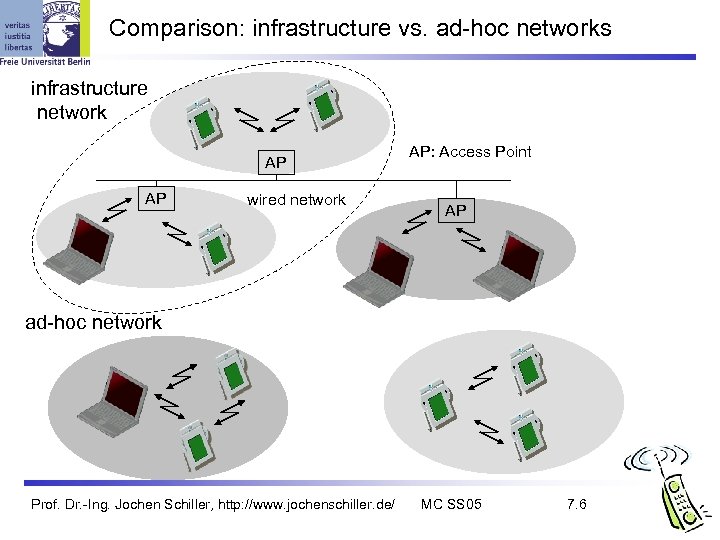
Comparison: infrastructure vs. ad-hoc networks infrastructure network AP AP wired network AP: Access Point AP ad-hoc network Prof. Dr. -Ing. Jochen Schiller, http: //www. jochenschiller. de/ MC SS 05 7. 6
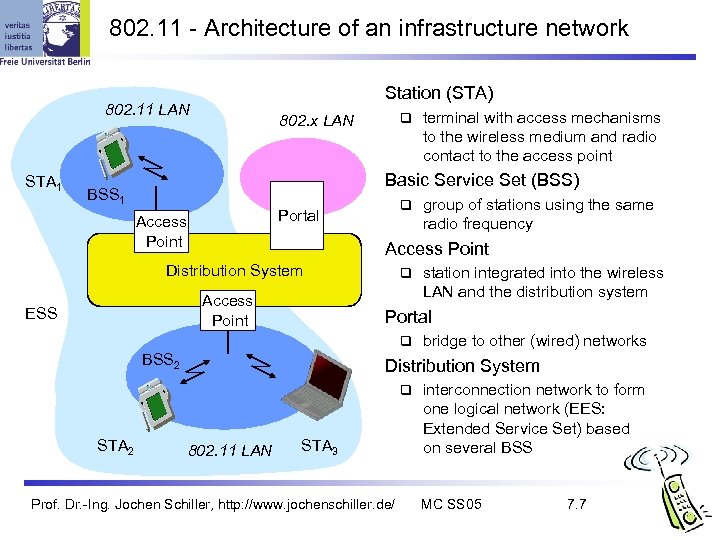
802. 11 - Architecture of an infrastructure network Station (STA) 802. 11 LAN STA 1 802. x LAN Basic Service Set (BSS) BSS 1 Portal Access Point ESS group of stations using the same radio frequency Access Point Distribution System station integrated into the wireless LAN and the distribution system Portal BSS 2 bridge to other (wired) networks Distribution System STA 2 terminal with access mechanisms to the wireless medium and radio contact to the access point 802. 11 LAN STA 3 Prof. Dr. -Ing. Jochen Schiller, http: //www. jochenschiller. de/ interconnection network to form one logical network (EES: Extended Service Set) based on several BSS MC SS 05 7. 7
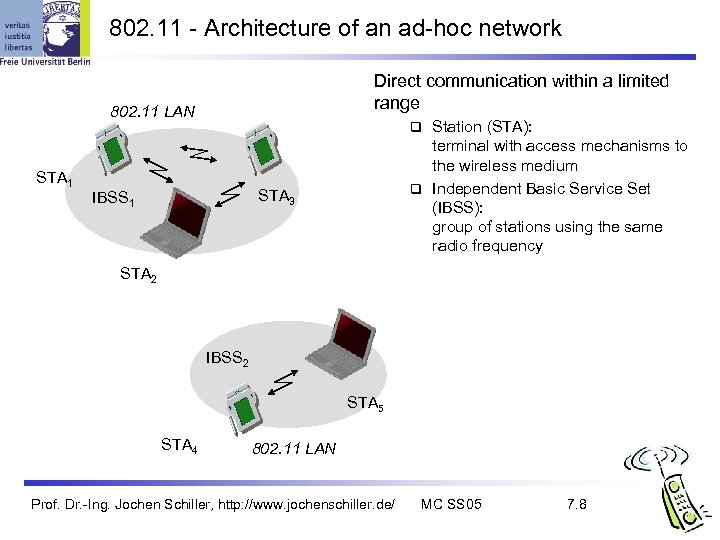
802. 11 - Architecture of an ad-hoc network Direct communication within a limited range 802. 11 LAN STA 1 Station (STA): terminal with access mechanisms to the wireless medium Independent Basic Service Set (IBSS): group of stations using the same radio frequency STA 3 IBSS 1 STA 2 IBSS 2 STA 5 STA 4 802. 11 LAN Prof. Dr. -Ing. Jochen Schiller, http: //www. jochenschiller. de/ MC SS 05 7. 8
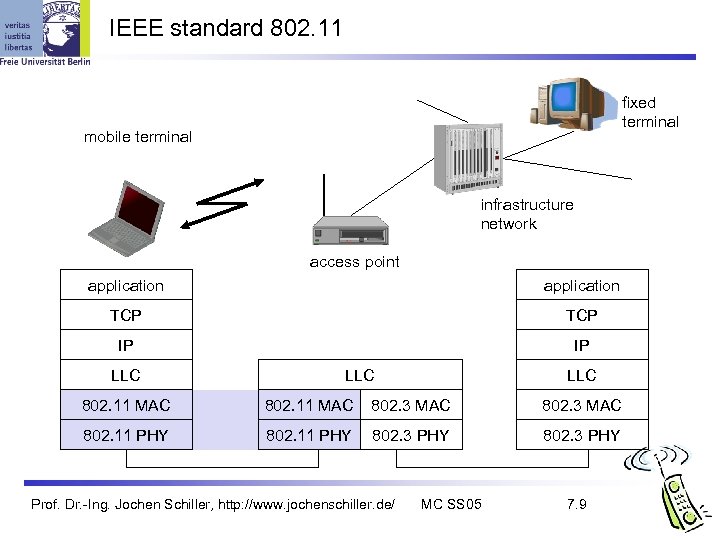
IEEE standard 802. 11 fixed terminal mobile terminal infrastructure network access point application TCP IP IP LLC LLC 802. 11 MAC 802. 3 MAC 802. 11 PHY 802. 3 PHY Prof. Dr. -Ing. Jochen Schiller, http: //www. jochenschiller. de/ MC SS 05 7. 9
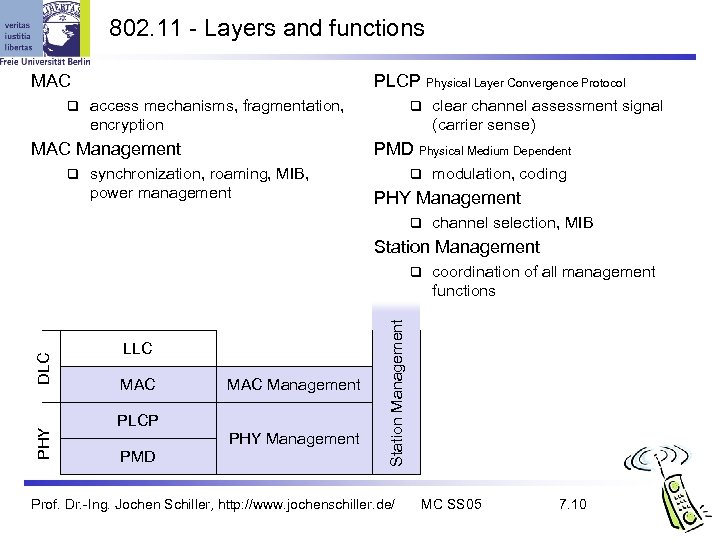
802. 11 - Layers and functions MAC PLCP Physical Layer Convergence Protocol access mechanisms, fragmentation, encryption MAC Management clear channel assessment signal (carrier sense) PMD Physical Medium Dependent synchronization, roaming, MIB, power management modulation, coding PHY Management channel selection, MIB Station Management LLC MAC Management PLCP PHY Management PMD coordination of all management functions Station Management PHY DLC Prof. Dr. -Ing. Jochen Schiller, http: //www. jochenschiller. de/ MC SS 05 7. 10
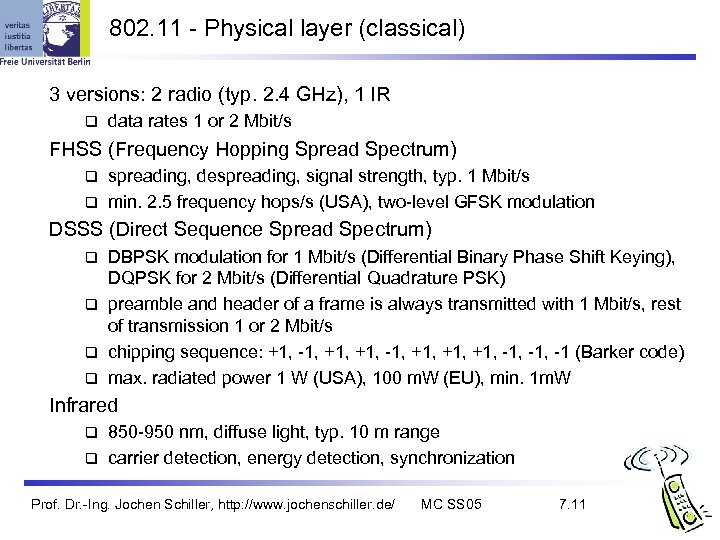
802. 11 - Physical layer (classical) 3 versions: 2 radio (typ. 2. 4 GHz), 1 IR data rates 1 or 2 Mbit/s FHSS (Frequency Hopping Spread Spectrum) spreading, despreading, signal strength, typ. 1 Mbit/s min. 2. 5 frequency hops/s (USA), two-level GFSK modulation DSSS (Direct Sequence Spread Spectrum) DBPSK modulation for 1 Mbit/s (Differential Binary Phase Shift Keying), DQPSK for 2 Mbit/s (Differential Quadrature PSK) preamble and header of a frame is always transmitted with 1 Mbit/s, rest of transmission 1 or 2 Mbit/s chipping sequence: +1, -1, +1, +1, -1, -1 (Barker code) max. radiated power 1 W (USA), 100 m. W (EU), min. 1 m. W Infrared 850 -950 nm, diffuse light, typ. 10 m range carrier detection, energy detection, synchronization Prof. Dr. -Ing. Jochen Schiller, http: //www. jochenschiller. de/ MC SS 05 7. 11
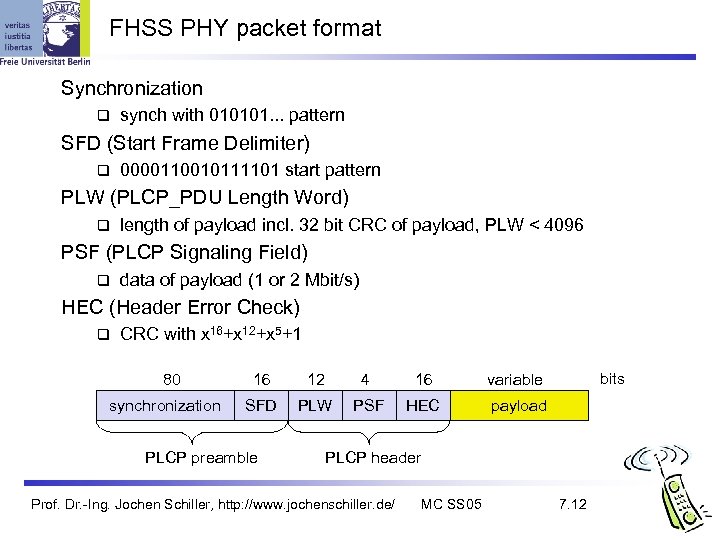
FHSS PHY packet format Synchronization synch with 010101. . . pattern SFD (Start Frame Delimiter) 0000110010111101 start pattern PLW (PLCP_PDU Length Word) length of payload incl. 32 bit CRC of payload, PLW < 4096 PSF (PLCP Signaling Field) data of payload (1 or 2 Mbit/s) HEC (Header Error Check) CRC with x 16+x 12+x 5+1 80 synchronization 16 12 4 16 SFD PLW PSF HEC bits variable payload PLCP preamble PLCP header Prof. Dr. -Ing. Jochen Schiller, http: //www. jochenschiller. de/ MC SS 05 7. 12
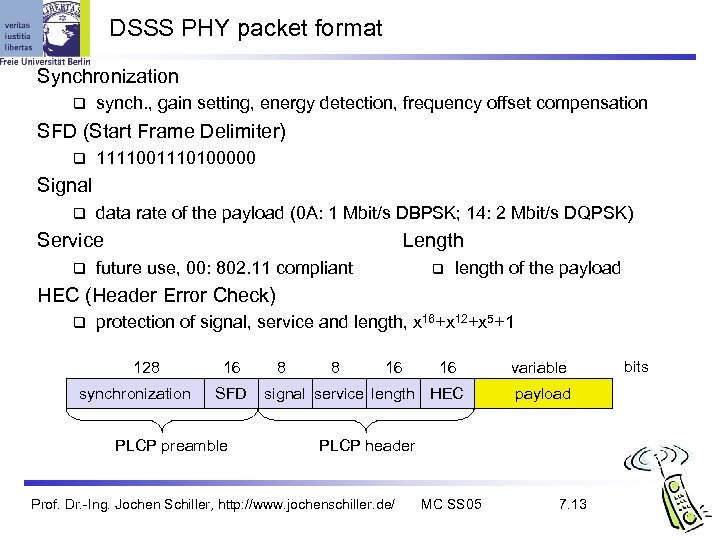
DSSS PHY packet format Synchronization synch. , gain setting, energy detection, frequency offset compensation SFD (Start Frame Delimiter) 1111001110100000 Signal data rate of the payload (0 A: 1 Mbit/s DBPSK; 14: 2 Mbit/s DQPSK) Service Length future use, 00: 802. 11 compliant length of the payload HEC (Header Error Check) protection of signal, service and length, x 16+x 12+x 5+1 128 synchronization 16 SFD PLCP preamble 8 8 16 16 signal service length HEC variable payload PLCP header Prof. Dr. -Ing. Jochen Schiller, http: //www. jochenschiller. de/ MC SS 05 7. 13 bits
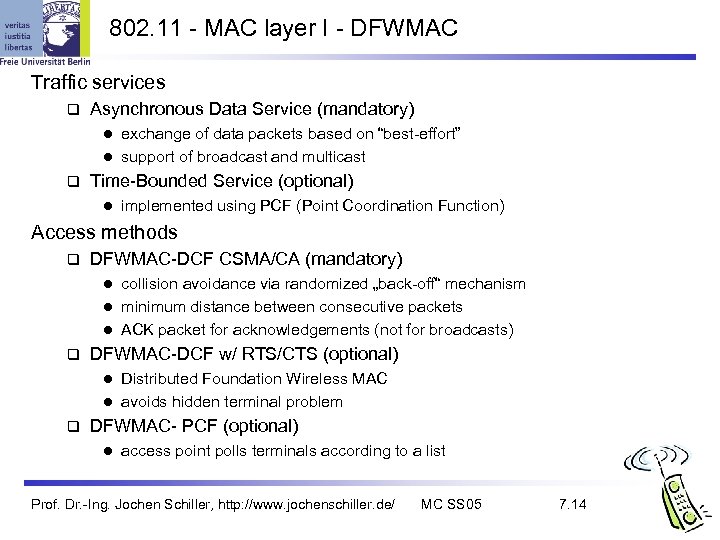
802. 11 - MAC layer I - DFWMAC Traffic services Asynchronous Data Service (mandatory) exchange of data packets based on “best-effort” l support of broadcast and multicast l Time-Bounded Service (optional) l implemented using PCF (Point Coordination Function) Access methods DFWMAC-DCF CSMA/CA (mandatory) collision avoidance via randomized „back-off“ mechanism l minimum distance between consecutive packets l ACK packet for acknowledgements (not for broadcasts) l DFWMAC-DCF w/ RTS/CTS (optional) Distributed Foundation Wireless MAC l avoids hidden terminal problem l DFWMAC- PCF (optional) l access point polls terminals according to a list Prof. Dr. -Ing. Jochen Schiller, http: //www. jochenschiller. de/ MC SS 05 7. 14
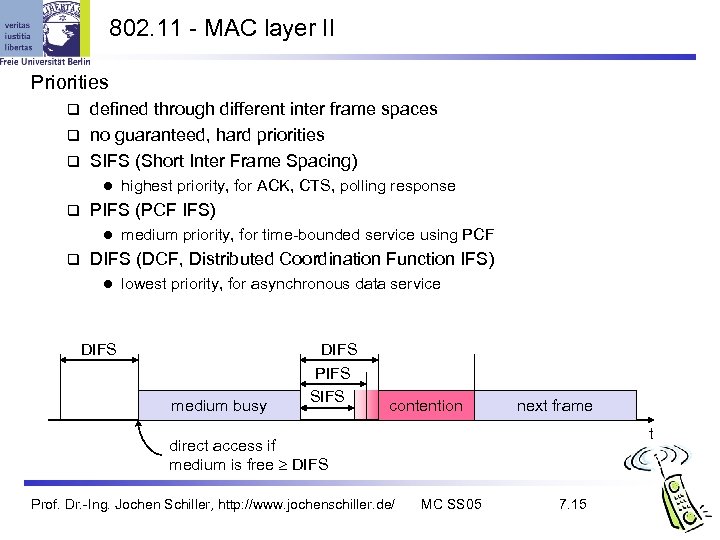
802. 11 - MAC layer II Priorities defined through different inter frame spaces no guaranteed, hard priorities SIFS (Short Inter Frame Spacing) l PIFS (PCF IFS) l highest priority, for ACK, CTS, polling response medium priority, for time-bounded service using PCF DIFS (DCF, Distributed Coordination Function IFS) l lowest priority, for asynchronous data service DIFS medium busy DIFS PIFS SIFS contention next frame t direct access if medium is free DIFS Prof. Dr. -Ing. Jochen Schiller, http: //www. jochenschiller. de/ MC SS 05 7. 15
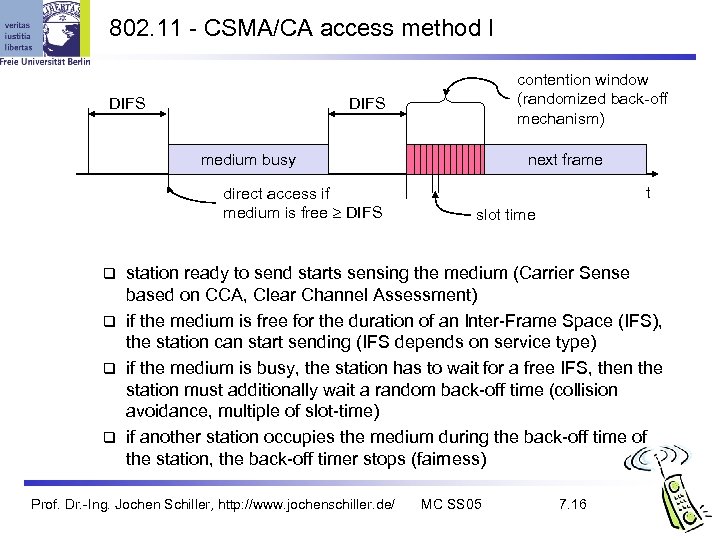
802. 11 - CSMA/CA access method I DIFS contention window (randomized back-off mechanism) DIFS medium busy direct access if medium is free DIFS next frame t slot time station ready to send starts sensing the medium (Carrier Sense based on CCA, Clear Channel Assessment) if the medium is free for the duration of an Inter-Frame Space (IFS), the station can start sending (IFS depends on service type) if the medium is busy, the station has to wait for a free IFS, then the station must additionally wait a random back-off time (collision avoidance, multiple of slot-time) if another station occupies the medium during the back-off time of the station, the back-off timer stops (fairness) Prof. Dr. -Ing. Jochen Schiller, http: //www. jochenschiller. de/ MC SS 05 7. 16
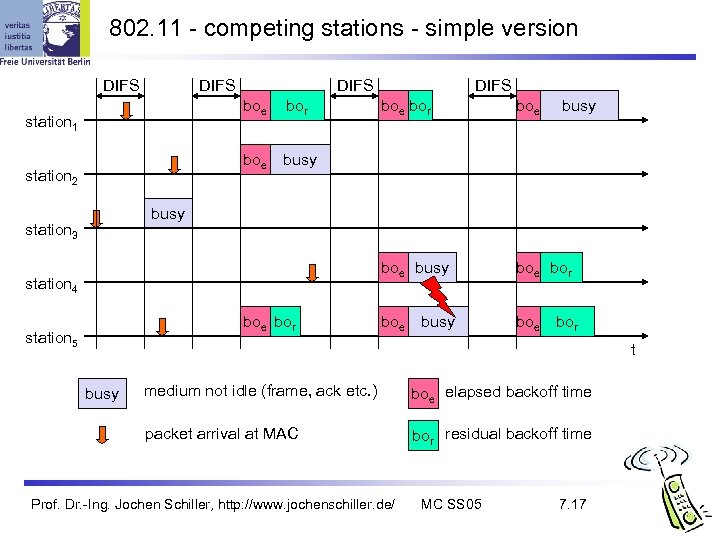
802. 11 - competing stations - simple version DIFS boe station 2 boe bor boe busy station 1 bor DIFS busy boe bor boe busy station 3 station 4 boe bor station 5 busy bor t medium not idle (frame, ack etc. ) boe elapsed backoff time packet arrival at MAC busy bor residual backoff time Prof. Dr. -Ing. Jochen Schiller, http: //www. jochenschiller. de/ MC SS 05 7. 17
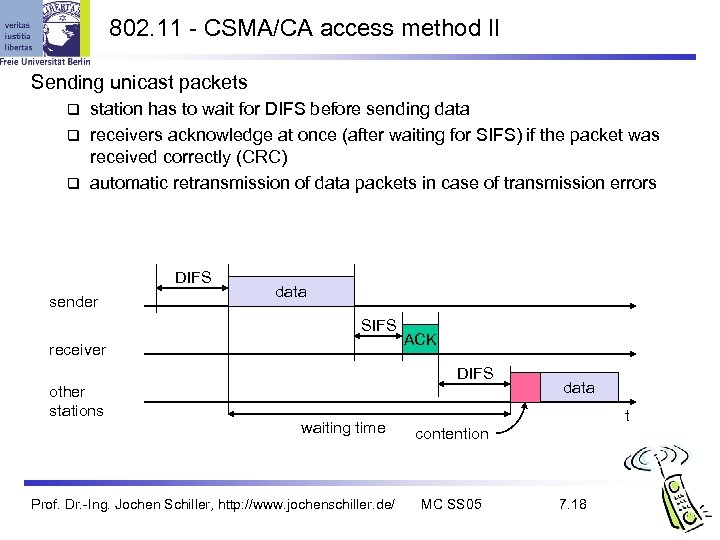
802. 11 - CSMA/CA access method II Sending unicast packets station has to wait for DIFS before sending data receivers acknowledge at once (after waiting for SIFS) if the packet was received correctly (CRC) automatic retransmission of data packets in case of transmission errors DIFS sender data SIFS receiver ACK DIFS other stations waiting time Prof. Dr. -Ing. Jochen Schiller, http: //www. jochenschiller. de/ data t contention MC SS 05 7. 18
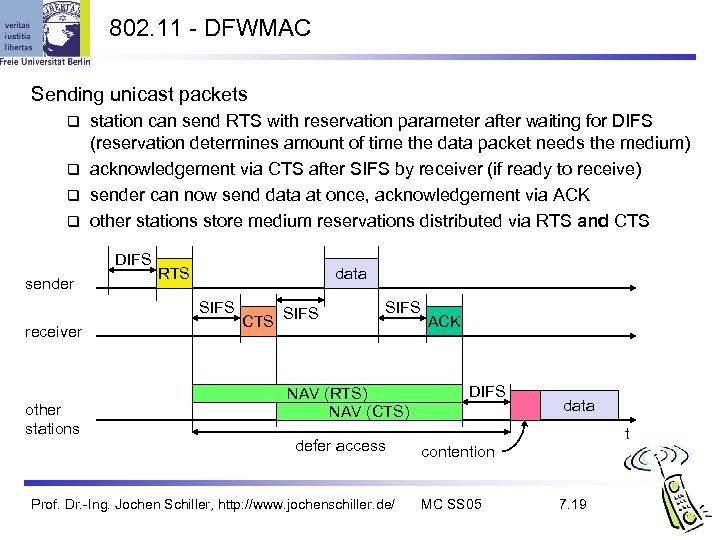
802. 11 - DFWMAC Sending unicast packets station can send RTS with reservation parameter after waiting for DIFS (reservation determines amount of time the data packet needs the medium) acknowledgement via CTS after SIFS by receiver (if ready to receive) sender can now send data at once, acknowledgement via ACK other stations store medium reservations distributed via RTS and CTS DIFS sender RTS data SIFS receiver other stations CTS SIFS NAV (RTS) NAV (CTS) defer access Prof. Dr. -Ing. Jochen Schiller, http: //www. jochenschiller. de/ ACK DIFS data t contention MC SS 05 7. 19
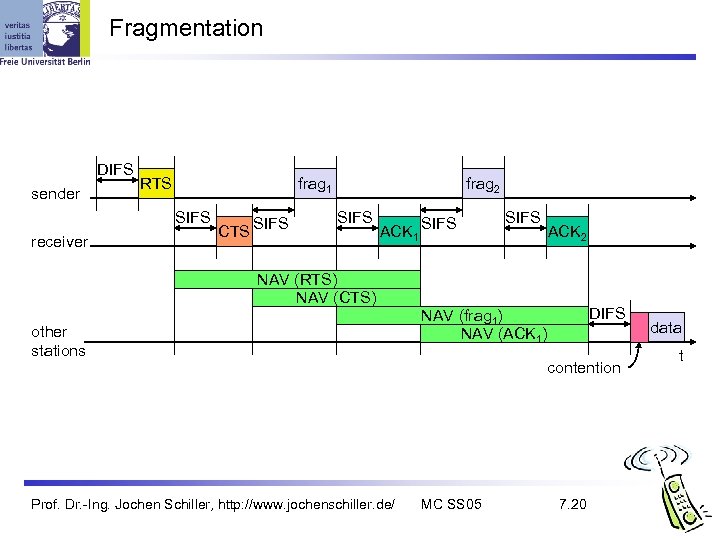
Fragmentation DIFS sender RTS frag 1 SIFS receiver CTS SIFS frag 2 SIFS ACK 1 SIFS ACK 2 NAV (RTS) NAV (CTS) other stations Prof. Dr. -Ing. Jochen Schiller, http: //www. jochenschiller. de/ DIFS NAV (frag 1) NAV (ACK 1) contention MC SS 05 7. 20 data t
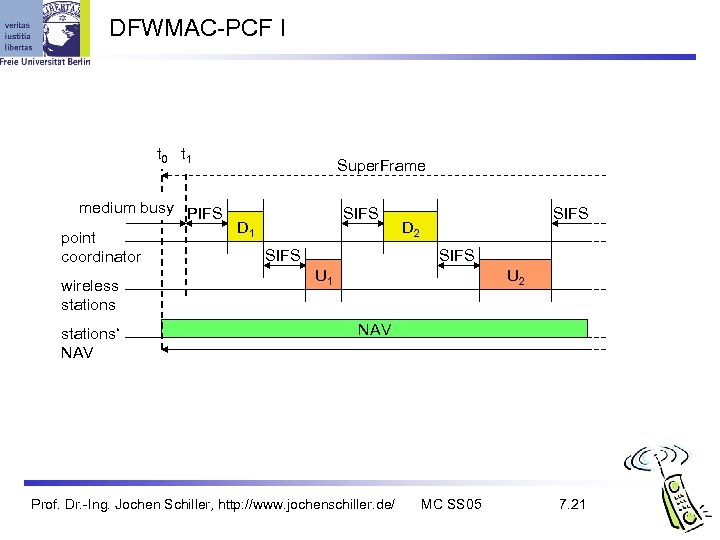
DFWMAC-PCF I t 0 t 1 Super. Frame medium busy PIFS D 1 point SIFS coordinator wireless stations‘ NAV SIFS D 2 SIFS U 1 U 2 NAV Prof. Dr. -Ing. Jochen Schiller, http: //www. jochenschiller. de/ MC SS 05 7. 21
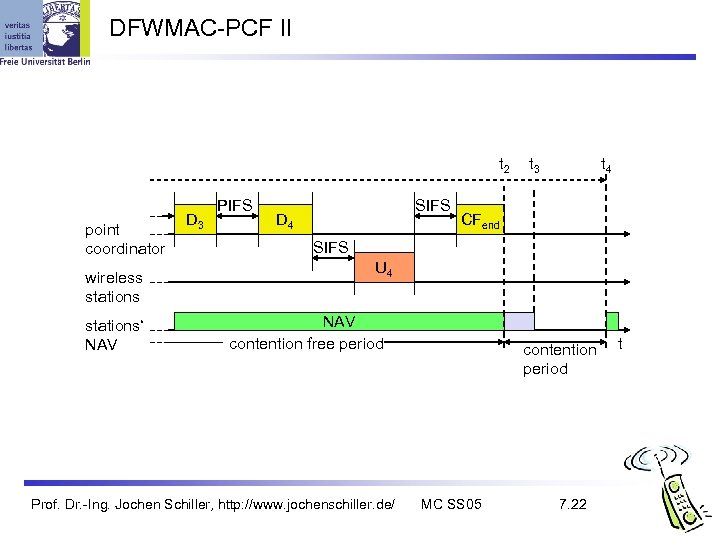
DFWMAC-PCF II t 2 point coordinator wireless stations‘ NAV D 3 PIFS SIFS D 4 t 3 t 4 CFend SIFS U 4 NAV contention free period Prof. Dr. -Ing. Jochen Schiller, http: //www. jochenschiller. de/ contention period MC SS 05 7. 22 t
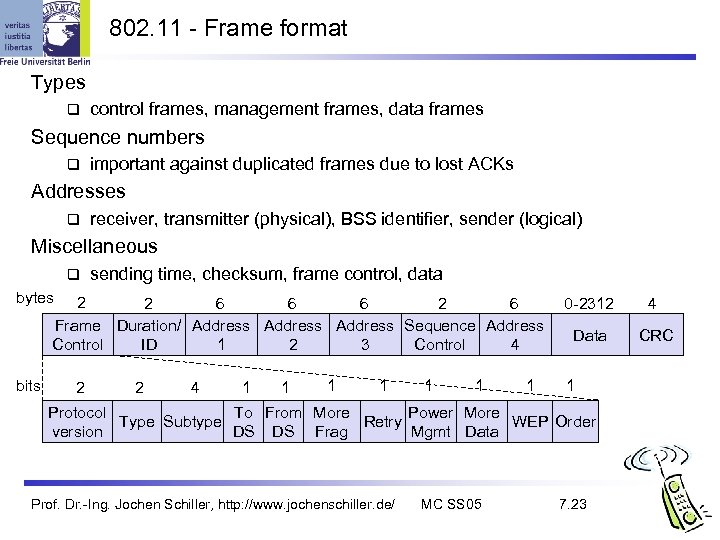
802. 11 - Frame format Types control frames, management frames, data frames Sequence numbers important against duplicated frames due to lost ACKs Addresses receiver, transmitter (physical), BSS identifier, sender (logical) Miscellaneous sending time, checksum, frame control, data bytes 2 2 6 6 6 2 6 Frame Duration/ Address Sequence Address Control ID 1 2 3 Control 4 bits 2 2 4 1 1 1 1 0 -2312 4 Data CRC 1 Protocol To From More Power More Type Subtype Retry WEP Order version DS DS Frag Mgmt Data Prof. Dr. -Ing. Jochen Schiller, http: //www. jochenschiller. de/ MC SS 05 7. 23
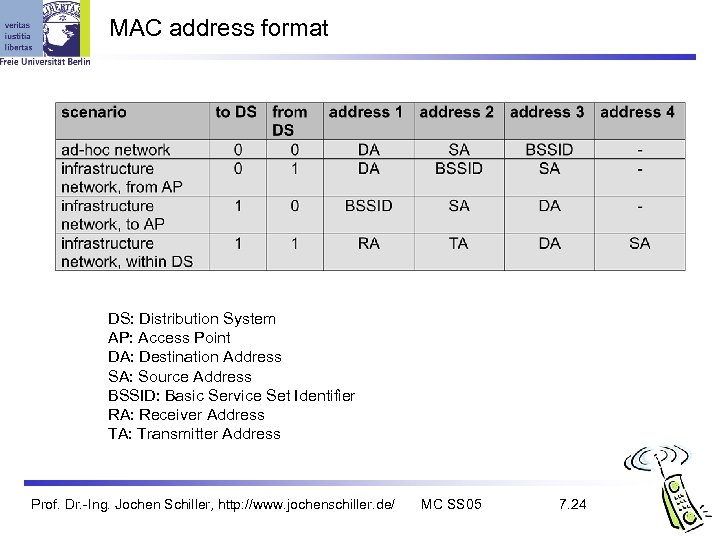
MAC address format DS: Distribution System AP: Access Point DA: Destination Address SA: Source Address BSSID: Basic Service Set Identifier RA: Receiver Address TA: Transmitter Address Prof. Dr. -Ing. Jochen Schiller, http: //www. jochenschiller. de/ MC SS 05 7. 24
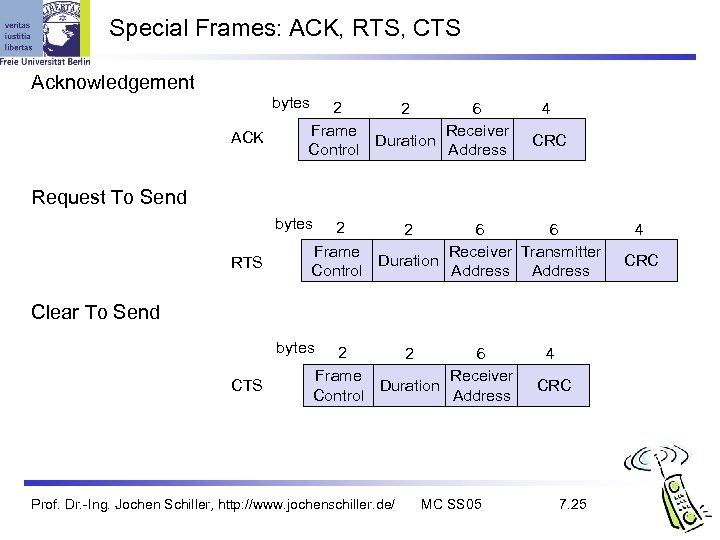
Special Frames: ACK, RTS, CTS Acknowledgement bytes ACK 2 2 6 Frame Receiver Duration Control Address 4 CRC Request To Send bytes RTS 2 2 6 6 Frame Receiver Transmitter Duration Control Address Clear To Send bytes CTS 2 2 6 Frame Receiver Duration Control Address Prof. Dr. -Ing. Jochen Schiller, http: //www. jochenschiller. de/ MC SS 05 4 CRC 7. 25 4 CRC
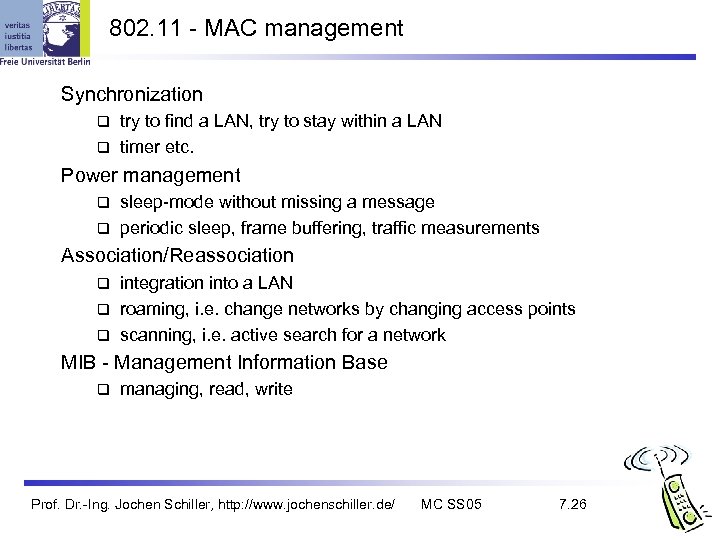
802. 11 - MAC management Synchronization try to find a LAN, try to stay within a LAN timer etc. Power management sleep-mode without missing a message periodic sleep, frame buffering, traffic measurements Association/Reassociation integration into a LAN roaming, i. e. change networks by changing access points scanning, i. e. active search for a network MIB - Management Information Base managing, read, write Prof. Dr. -Ing. Jochen Schiller, http: //www. jochenschiller. de/ MC SS 05 7. 26
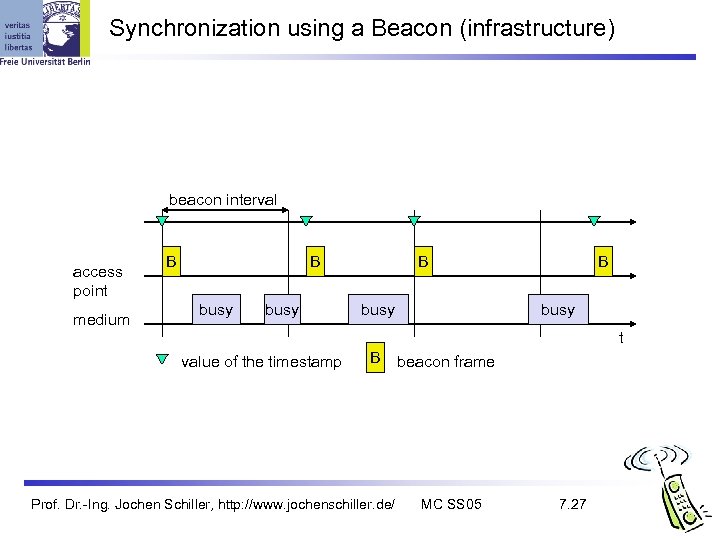
Synchronization using a Beacon (infrastructure) beacon interval access point medium B B busy t value of the timestamp B Prof. Dr. -Ing. Jochen Schiller, http: //www. jochenschiller. de/ beacon frame MC SS 05 7. 27
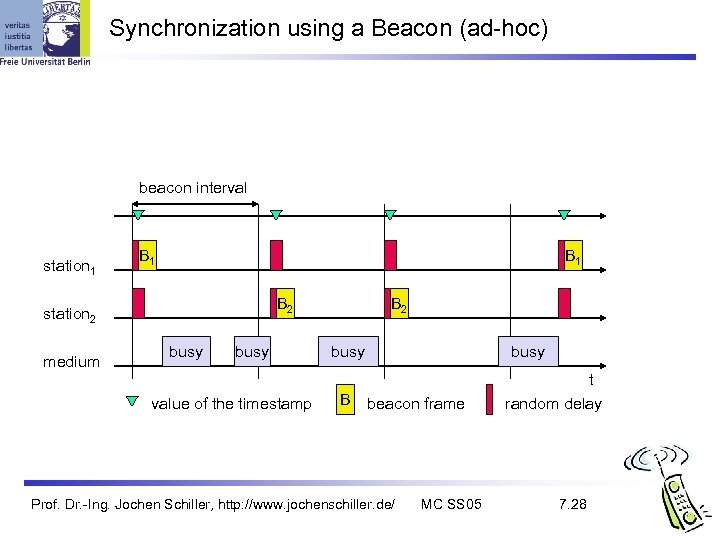
Synchronization using a Beacon (ad-hoc) beacon interval station 1 B 1 B 2 station 2 medium busy value of the timestamp B 2 busy B busy beacon frame Prof. Dr. -Ing. Jochen Schiller, http: //www. jochenschiller. de/ MC SS 05 t random delay 7. 28
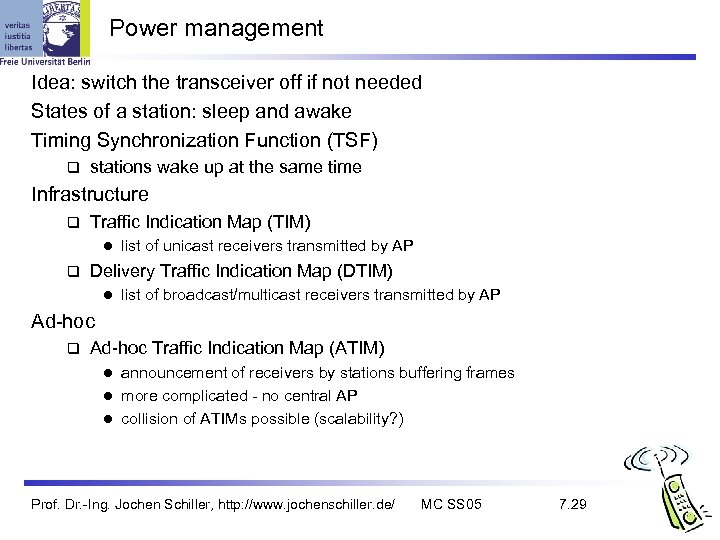
Power management Idea: switch the transceiver off if not needed States of a station: sleep and awake Timing Synchronization Function (TSF) stations wake up at the same time Infrastructure Traffic Indication Map (TIM) l list of unicast receivers transmitted by AP Delivery Traffic Indication Map (DTIM) l list of broadcast/multicast receivers transmitted by AP Ad-hoc Traffic Indication Map (ATIM) announcement of receivers by stations buffering frames l more complicated - no central AP l collision of ATIMs possible (scalability? ) l Prof. Dr. -Ing. Jochen Schiller, http: //www. jochenschiller. de/ MC SS 05 7. 29
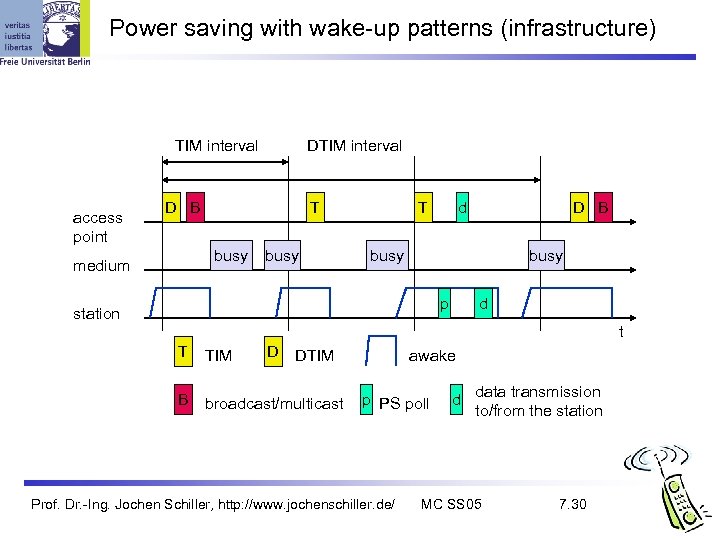
Power saving with wake-up patterns (infrastructure) TIM interval access point DTIM interval D B T busy medium busy T d D B busy p station d t T TIM D B broadcast/multicast DTIM awake p PS poll Prof. Dr. -Ing. Jochen Schiller, http: //www. jochenschiller. de/ d data transmission to/from the station MC SS 05 7. 30
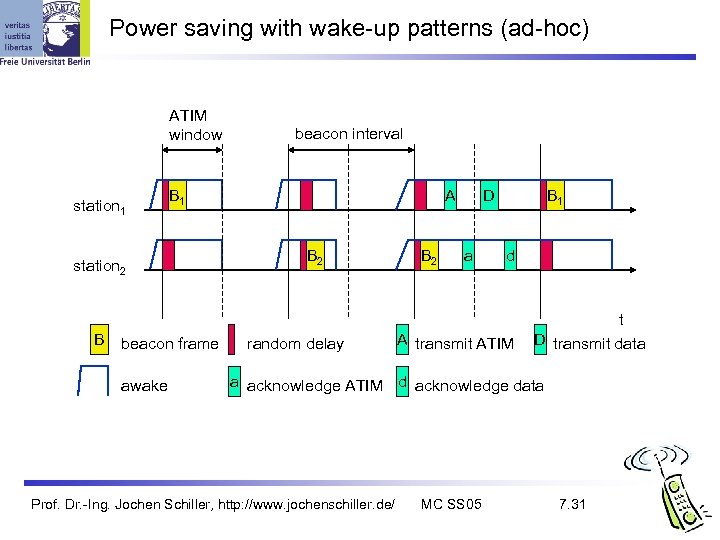
Power saving with wake-up patterns (ad-hoc) ATIM window station 1 B 1 station 2 B beacon frame awake beacon interval A B 2 random delay B 2 D a B 1 d A transmit ATIM t D transmit data a acknowledge ATIM d acknowledge data Prof. Dr. -Ing. Jochen Schiller, http: //www. jochenschiller. de/ MC SS 05 7. 31
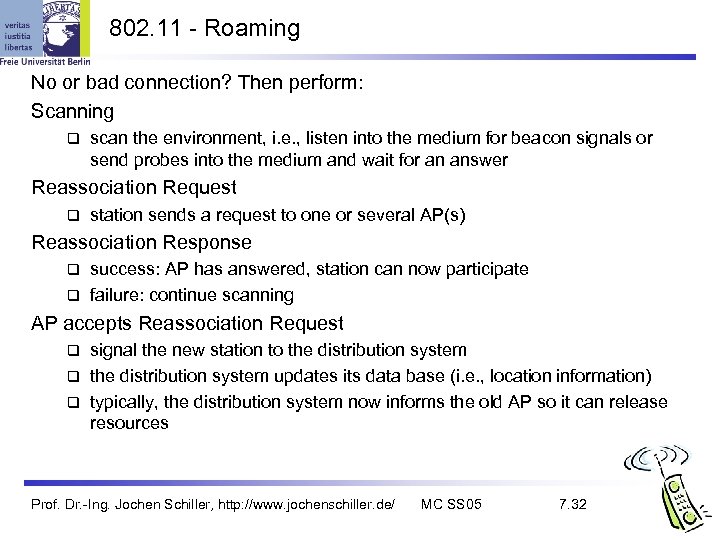
802. 11 - Roaming No or bad connection? Then perform: Scanning scan the environment, i. e. , listen into the medium for beacon signals or send probes into the medium and wait for an answer Reassociation Request station sends a request to one or several AP(s) Reassociation Response success: AP has answered, station can now participate failure: continue scanning AP accepts Reassociation Request signal the new station to the distribution system updates its data base (i. e. , location information) typically, the distribution system now informs the old AP so it can release resources Prof. Dr. -Ing. Jochen Schiller, http: //www. jochenschiller. de/ MC SS 05 7. 32
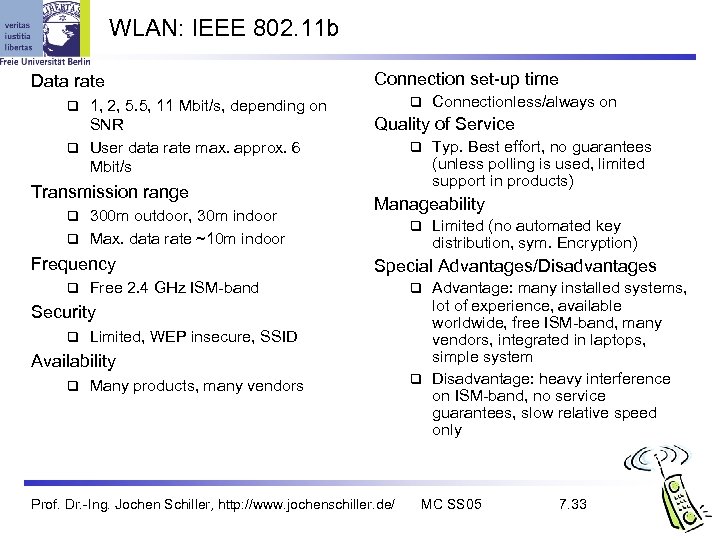
WLAN: IEEE 802. 11 b Data rate 1, 2, 5. 5, 11 Mbit/s, depending on SNR User data rate max. approx. 6 Mbit/s Connection set-up time Transmission range 300 m outdoor, 30 m indoor Max. data rate ~10 m indoor Frequency Quality of Service Limited (no automated key distribution, sym. Encryption) Special Advantages/Disadvantages Free 2. 4 GHz ISM-band Limited, WEP insecure, SSID Availability Typ. Best effort, no guarantees (unless polling is used, limited support in products) Manageability Security Connectionless/always on Many products, many vendors Prof. Dr. -Ing. Jochen Schiller, http: //www. jochenschiller. de/ Advantage: many installed systems, lot of experience, available worldwide, free ISM-band, many vendors, integrated in laptops, simple system Disadvantage: heavy interference on ISM-band, no service guarantees, slow relative speed only MC SS 05 7. 33
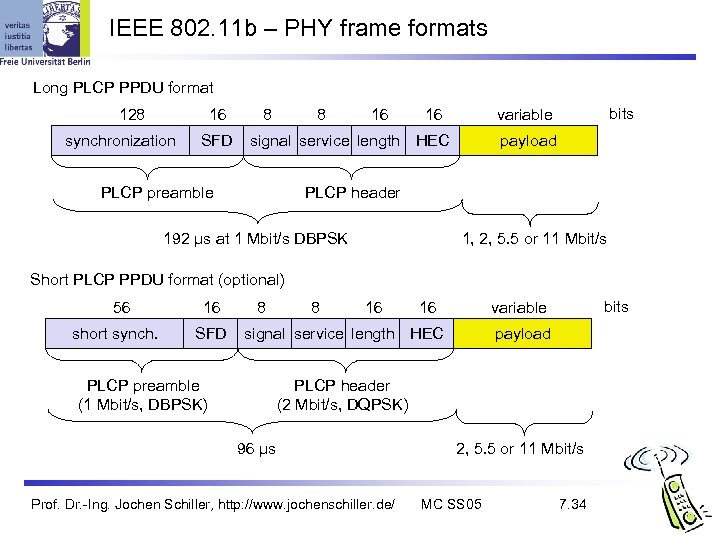
IEEE 802. 11 b – PHY frame formats Long PLCP PPDU format 128 16 synchronization SFD 8 8 16 16 signal service length HEC PLCP preamble bits variable payload PLCP header 192 µs at 1 Mbit/s DBPSK 1, 2, 5. 5 or 11 Mbit/s Short PLCP PPDU format (optional) 56 short synch. 16 SFD 8 8 16 16 signal service length HEC PLCP preamble (1 Mbit/s, DBPSK) bits variable payload PLCP header (2 Mbit/s, DQPSK) 96 µs Prof. Dr. -Ing. Jochen Schiller, http: //www. jochenschiller. de/ 2, 5. 5 or 11 Mbit/s MC SS 05 7. 34
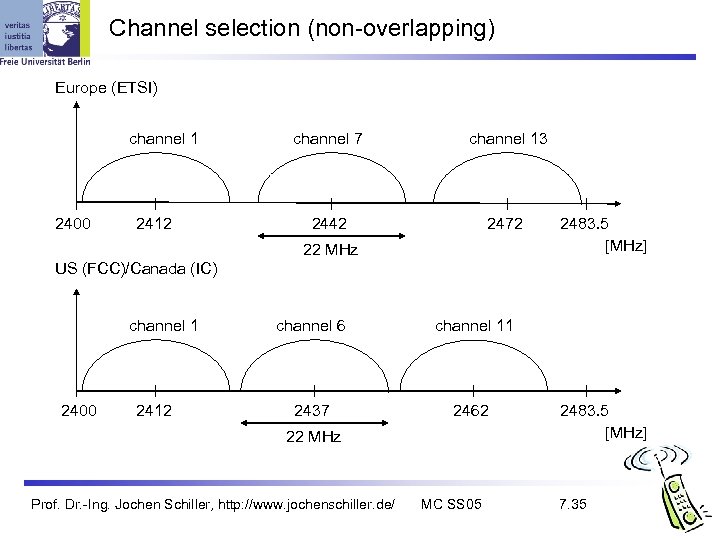
Channel selection (non-overlapping) Europe (ETSI) channel 1 2400 2412 channel 7 channel 13 2442 2472 22 MHz 2483. 5 [MHz] US (FCC)/Canada (IC) channel 1 2400 2412 channel 6 channel 11 2437 2462 22 MHz Prof. Dr. -Ing. Jochen Schiller, http: //www. jochenschiller. de/ MC SS 05 2483. 5 [MHz] 7. 35
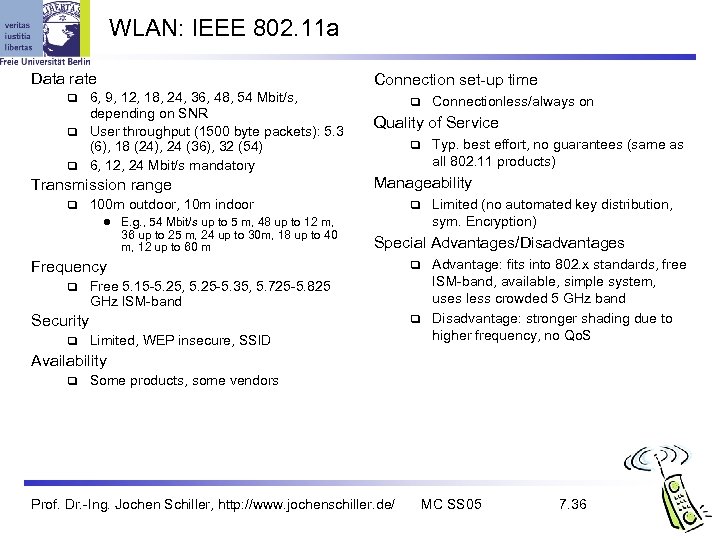
WLAN: IEEE 802. 11 a Data rate Connection set-up time 6, 9, 12, 18, 24, 36, 48, 54 Mbit/s, depending on SNR User throughput (1500 byte packets): 5. 3 (6), 18 (24), 24 (36), 32 (54) 6, 12, 24 Mbit/s mandatory Transmission range Quality of Service E. g. , 54 Mbit/s up to 5 m, 48 up to 12 m, 36 up to 25 m, 24 up to 30 m, 18 up to 40 m, 12 up to 60 m Free 5. 15 -5. 25, 5. 25 -5. 35, 5. 725 -5. 825 GHz ISM-band Security Limited (no automated key distribution, sym. Encryption) Special Advantages/Disadvantages Frequency Typ. best effort, no guarantees (same as all 802. 11 products) Manageability 100 m outdoor, 10 m indoor l Connectionless/always on Limited, WEP insecure, SSID Advantage: fits into 802. x standards, free ISM-band, available, simple system, uses less crowded 5 GHz band Disadvantage: stronger shading due to higher frequency, no Qo. S Availability Some products, some vendors Prof. Dr. -Ing. Jochen Schiller, http: //www. jochenschiller. de/ MC SS 05 7. 36
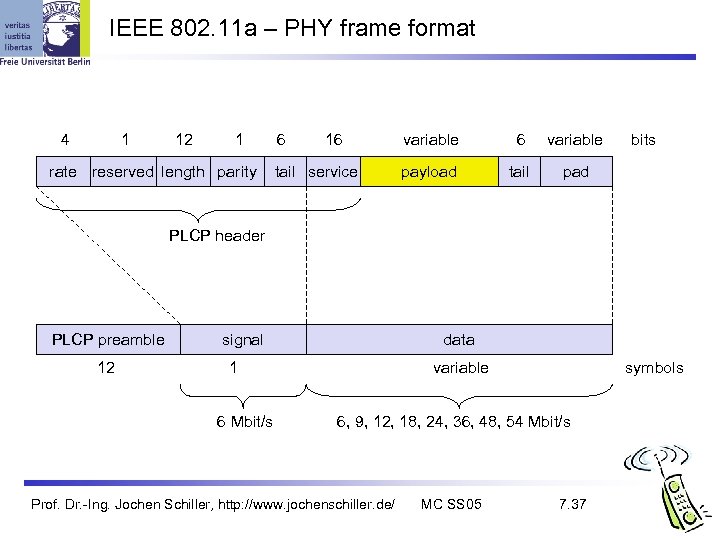
IEEE 802. 11 a – PHY frame format 4 1 12 1 rate reserved length parity 6 16 tail service variable 6 variable payload tail bits pad PLCP header PLCP preamble 12 signal data 1 6 Mbit/s variable symbols 6, 9, 12, 18, 24, 36, 48, 54 Mbit/s Prof. Dr. -Ing. Jochen Schiller, http: //www. jochenschiller. de/ MC SS 05 7. 37
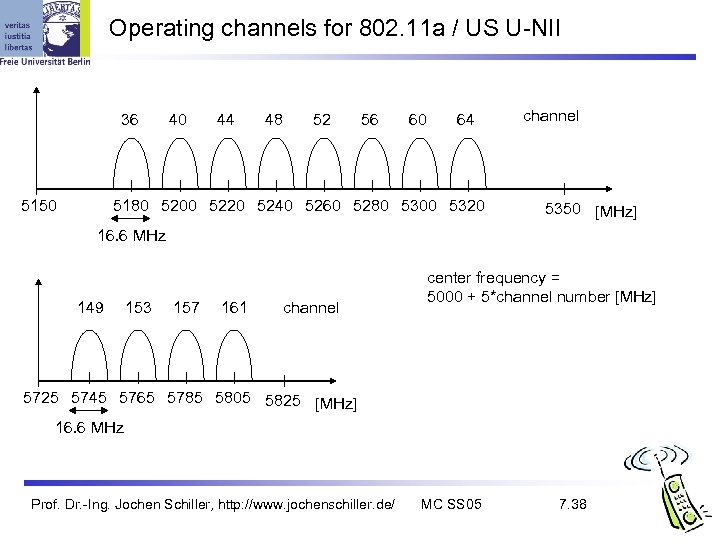
Operating channels for 802. 11 a / US U-NII 36 5150 40 44 48 52 56 60 64 5180 5200 5220 5240 5260 5280 5300 5320 channel 5350 [MHz] 16. 6 MHz 149 153 157 161 channel center frequency = 5000 + 5*channel number [MHz] 5725 5745 5765 5785 5805 5825 [MHz] 16. 6 MHz Prof. Dr. -Ing. Jochen Schiller, http: //www. jochenschiller. de/ MC SS 05 7. 38
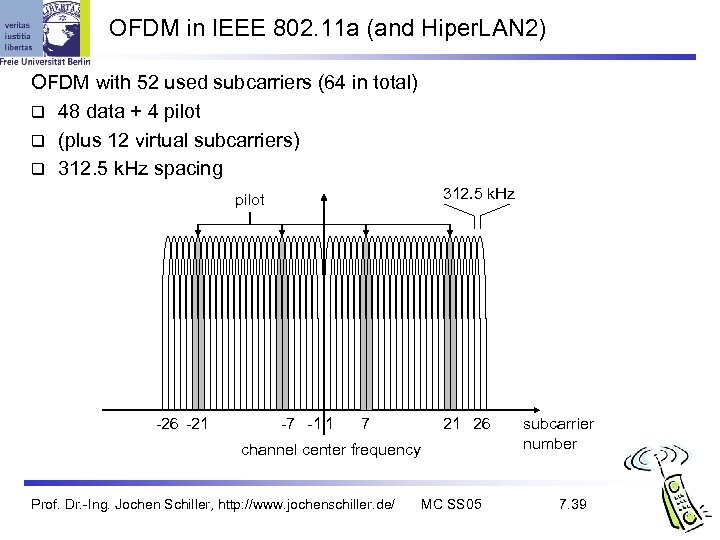
OFDM in IEEE 802. 11 a (and Hiper. LAN 2) OFDM with 52 used subcarriers (64 in total) 48 data + 4 pilot (plus 12 virtual subcarriers) 312. 5 k. Hz spacing 312. 5 k. Hz pilot -26 -21 -7 -1 1 7 21 26 channel center frequency Prof. Dr. -Ing. Jochen Schiller, http: //www. jochenschiller. de/ MC SS 05 subcarrier number 7. 39
WLAN: IEEE 802. 11 – future developments (03/2005) 802. 11 c: Bridge Support Definition of MAC procedures to support bridges as extension to 802. 1 D 802. 11 d: Regulatory Domain Update Support of additional regulations related to channel selection, hopping sequences 802. 11 e: MAC Enhancements – Qo. S Enhance the current 802. 11 MAC to expand support for applications with Quality of Service requirements, and in the capabilities and efficiency of the protocol Definition of a data flow (“connection”) with parameters like rate, burst, period… Additional energy saving mechanisms and more efficient retransmission 802. 11 f: Inter-Access Point Protocol Establish an Inter-Access Point Protocol for data exchange via the distribution system Currently unclear to which extend manufacturers will follow this suggestion 802. 11 g: Data Rates > 20 Mbit/s at 2. 4 GHz; 54 Mbit/s, OFDM Successful successor of 802. 11 b, performance loss during mixed operation with 11 b 802. 11 h: Spectrum Managed 802. 11 a Extension for operation of 802. 11 a in Europe by mechanisms like channel measurement for dynamic channel selection (DFS, Dynamic Frequency Selection) and power control (TPC, Transmit Power Control) Prof. Dr. -Ing. Jochen Schiller, http: //www. jochenschiller. de/ MC SS 05 7. 40
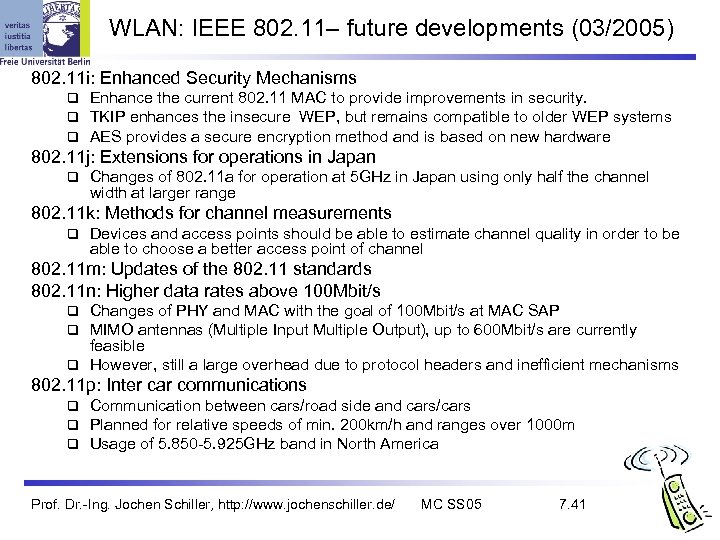
WLAN: IEEE 802. 11– future developments (03/2005) 802. 11 i: Enhanced Security Mechanisms Enhance the current 802. 11 MAC to provide improvements in security. TKIP enhances the insecure WEP, but remains compatible to older WEP systems AES provides a secure encryption method and is based on new hardware 802. 11 j: Extensions for operations in Japan Changes of 802. 11 a for operation at 5 GHz in Japan using only half the channel width at larger range 802. 11 k: Methods for channel measurements Devices and access points should be able to estimate channel quality in order to be able to choose a better access point of channel 802. 11 m: Updates of the 802. 11 standards 802. 11 n: Higher data rates above 100 Mbit/s Changes of PHY and MAC with the goal of 100 Mbit/s at MAC SAP MIMO antennas (Multiple Input Multiple Output), up to 600 Mbit/s are currently feasible However, still a large overhead due to protocol headers and inefficient mechanisms 802. 11 p: Inter car communications Communication between cars/road side and cars/cars Planned for relative speeds of min. 200 km/h and ranges over 1000 m Usage of 5. 850 -5. 925 GHz band in North America Prof. Dr. -Ing. Jochen Schiller, http: //www. jochenschiller. de/ MC SS 05 7. 41
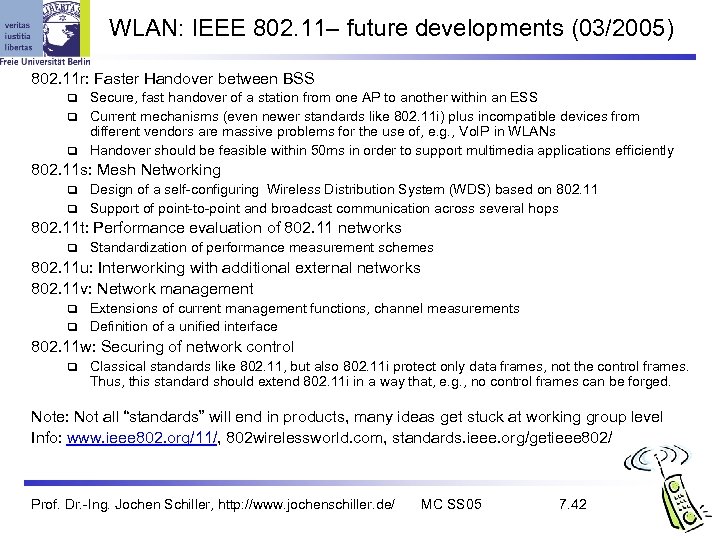
WLAN: IEEE 802. 11– future developments (03/2005) 802. 11 r: Faster Handover between BSS Secure, fast handover of a station from one AP to another within an ESS Current mechanisms (even newer standards like 802. 11 i) plus incompatible devices from different vendors are massive problems for the use of, e. g. , Vo. IP in WLANs Handover should be feasible within 50 ms in order to support multimedia applications efficiently 802. 11 s: Mesh Networking Design of a self-configuring Wireless Distribution System (WDS) based on 802. 11 Support of point-to-point and broadcast communication across several hops 802. 11 t: Performance evaluation of 802. 11 networks Standardization of performance measurement schemes 802. 11 u: Interworking with additional external networks 802. 11 v: Network management Extensions of current management functions, channel measurements Definition of a unified interface 802. 11 w: Securing of network control Classical standards like 802. 11, but also 802. 11 i protect only data frames, not the control frames. Thus, this standard should extend 802. 11 i in a way that, e. g. , no control frames can be forged. Note: Not all “standards” will end in products, many ideas get stuck at working group level Info: www. ieee 802. org/11/, 802 wirelessworld. com, standards. ieee. org/getieee 802/ Prof. Dr. -Ing. Jochen Schiller, http: //www. jochenschiller. de/ MC SS 05 7. 42
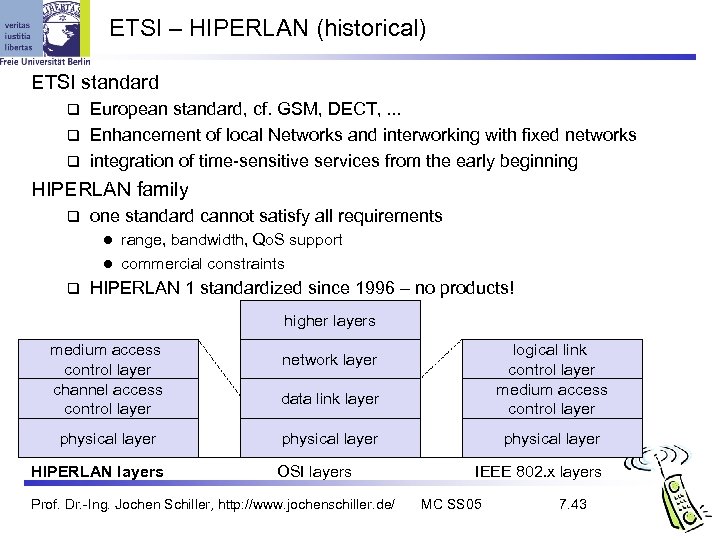
ETSI – HIPERLAN (historical) ETSI standard European standard, cf. GSM, DECT, . . . Enhancement of local Networks and interworking with fixed networks integration of time-sensitive services from the early beginning HIPERLAN family one standard cannot satisfy all requirements range, bandwidth, Qo. S support l commercial constraints l HIPERLAN 1 standardized since 1996 – no products! higher layers medium access control layer channel access control layer physical layer HIPERLAN layers logical link control layer medium access control layer network layer data link layer physical layer OSI layers Prof. Dr. -Ing. Jochen Schiller, http: //www. jochenschiller. de/ physical layer IEEE 802. x layers MC SS 05 7. 43
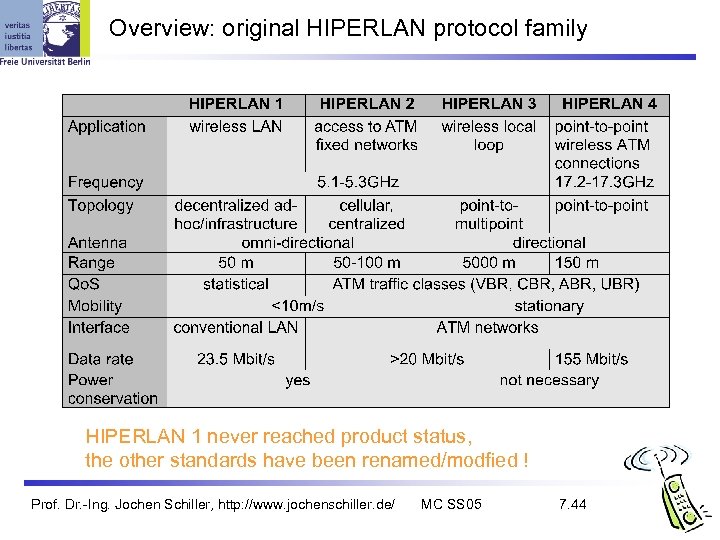
Overview: original HIPERLAN protocol family HIPERLAN 1 never reached product status, the other standards have been renamed/modfied ! Prof. Dr. -Ing. Jochen Schiller, http: //www. jochenschiller. de/ MC SS 05 7. 44
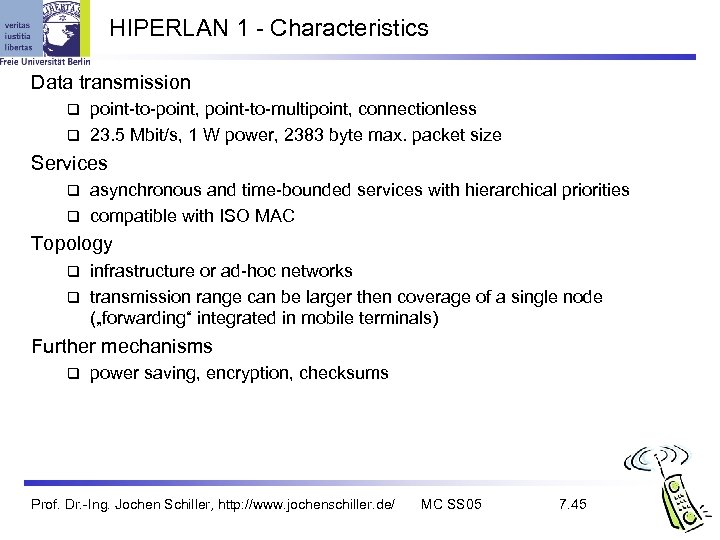
HIPERLAN 1 - Characteristics Data transmission point-to-point, point-to-multipoint, connectionless 23. 5 Mbit/s, 1 W power, 2383 byte max. packet size Services asynchronous and time-bounded services with hierarchical priorities compatible with ISO MAC Topology infrastructure or ad-hoc networks transmission range can be larger then coverage of a single node („forwarding“ integrated in mobile terminals) Further mechanisms power saving, encryption, checksums Prof. Dr. -Ing. Jochen Schiller, http: //www. jochenschiller. de/ MC SS 05 7. 45
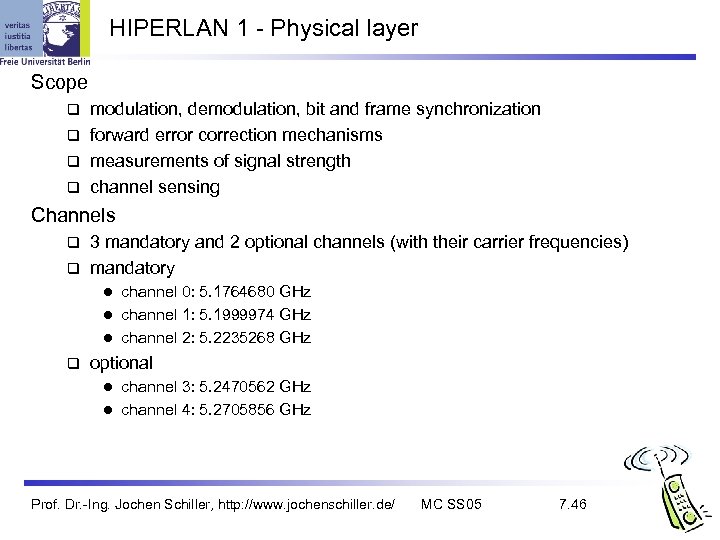
HIPERLAN 1 - Physical layer Scope modulation, demodulation, bit and frame synchronization forward error correction mechanisms measurements of signal strength channel sensing Channels 3 mandatory and 2 optional channels (with their carrier frequencies) mandatory channel 0: 5. 1764680 GHz l channel 1: 5. 1999974 GHz l channel 2: 5. 2235268 GHz l optional channel 3: 5. 2470562 GHz l channel 4: 5. 2705856 GHz l Prof. Dr. -Ing. Jochen Schiller, http: //www. jochenschiller. de/ MC SS 05 7. 46
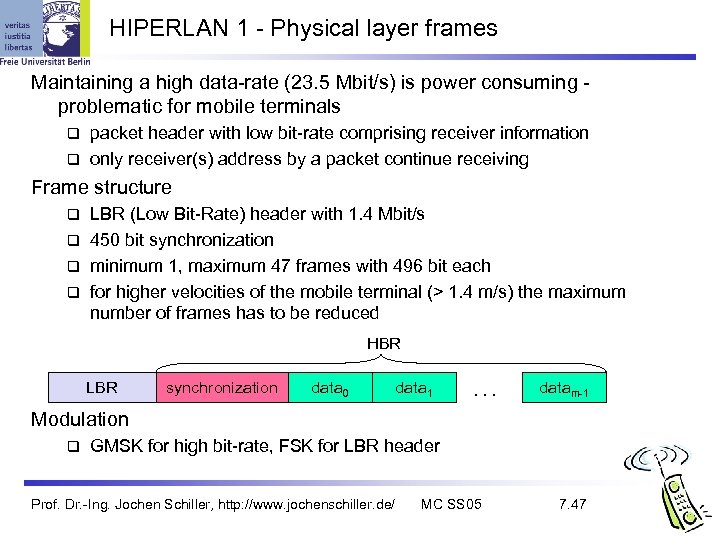
HIPERLAN 1 - Physical layer frames Maintaining a high data-rate (23. 5 Mbit/s) is power consuming problematic for mobile terminals packet header with low bit-rate comprising receiver information only receiver(s) address by a packet continue receiving Frame structure LBR (Low Bit-Rate) header with 1. 4 Mbit/s 450 bit synchronization minimum 1, maximum 47 frames with 496 bit each for higher velocities of the mobile terminal (> 1. 4 m/s) the maximum number of frames has to be reduced HBR LBR synchronization data 0 data 1 . . . datam-1 Modulation GMSK for high bit-rate, FSK for LBR header Prof. Dr. -Ing. Jochen Schiller, http: //www. jochenschiller. de/ MC SS 05 7. 47
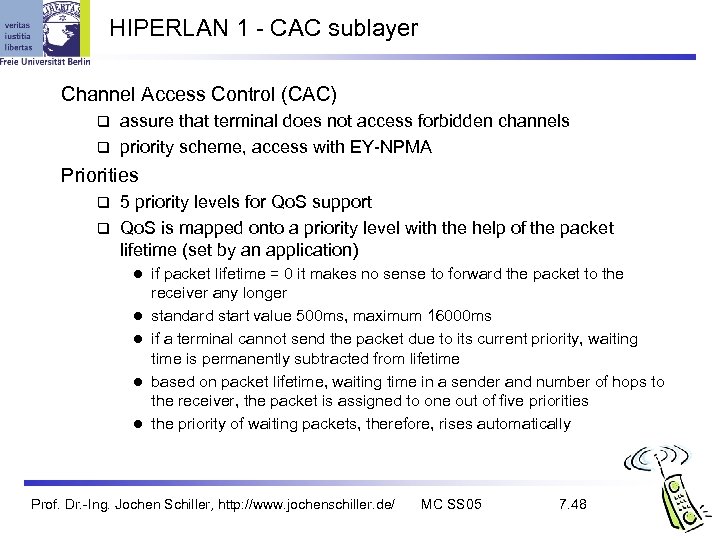
HIPERLAN 1 - CAC sublayer Channel Access Control (CAC) assure that terminal does not access forbidden channels priority scheme, access with EY-NPMA Priorities 5 priority levels for Qo. S support Qo. S is mapped onto a priority level with the help of the packet lifetime (set by an application) l l l if packet lifetime = 0 it makes no sense to forward the packet to the receiver any longer standard start value 500 ms, maximum 16000 ms if a terminal cannot send the packet due to its current priority, waiting time is permanently subtracted from lifetime based on packet lifetime, waiting time in a sender and number of hops to the receiver, the packet is assigned to one out of five priorities the priority of waiting packets, therefore, rises automatically Prof. Dr. -Ing. Jochen Schiller, http: //www. jochenschiller. de/ MC SS 05 7. 48
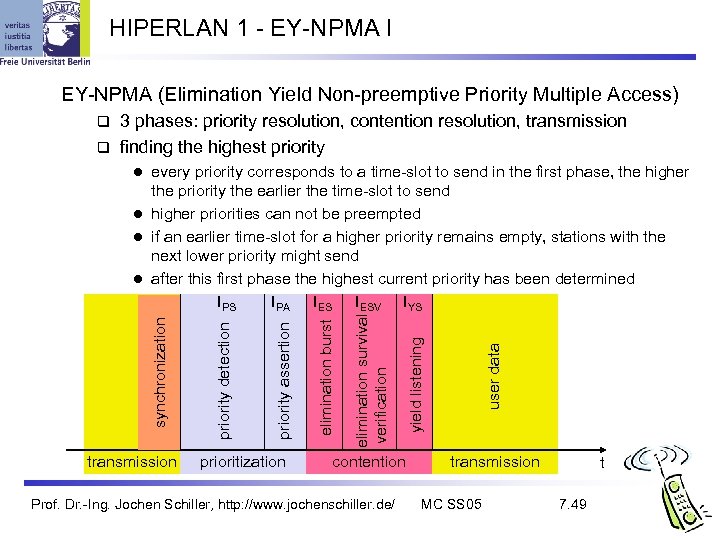
HIPERLAN 1 - EY-NPMA I EY-NPMA (Elimination Yield Non-preemptive Priority Multiple Access) 3 phases: priority resolution, contention resolution, transmission finding the highest priority every priority corresponds to a time-slot to send in the first phase, the higher the priority the earlier the time-slot to send l higher priorities can not be preempted l if an earlier time-slot for a higher priority remains empty, stations with the next lower priority might send l after this first phase the highest current priority has been determined IPS IPA IESV IYS transmission prioritization contention Prof. Dr. -Ing. Jochen Schiller, http: //www. jochenschiller. de/ user data yield listening elimination survival verification elimination burst priority assertion priority detection synchronization l transmission MC SS 05 t 7. 49
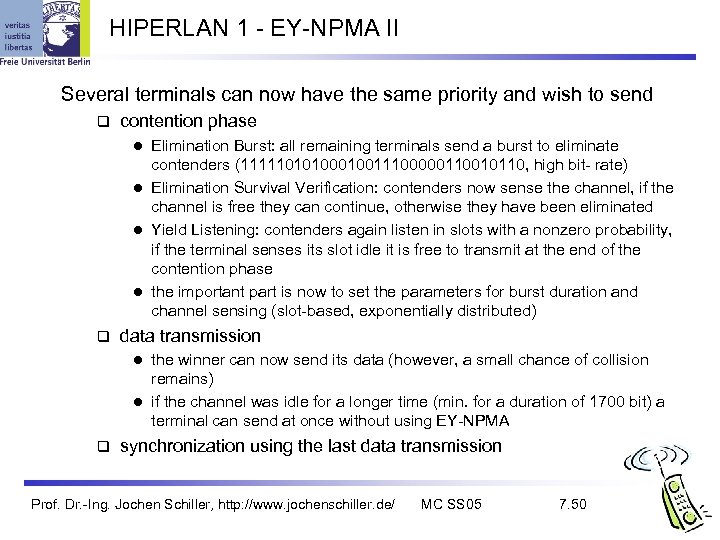
HIPERLAN 1 - EY-NPMA II Several terminals can now have the same priority and wish to send contention phase Elimination Burst: all remaining terminals send a burst to eliminate contenders (1111101010011100000110010110, high bit- rate) l Elimination Survival Verification: contenders now sense the channel, if the channel is free they can continue, otherwise they have been eliminated l Yield Listening: contenders again listen in slots with a nonzero probability, if the terminal senses its slot idle it is free to transmit at the end of the contention phase l the important part is now to set the parameters for burst duration and channel sensing (slot-based, exponentially distributed) l data transmission the winner can now send its data (however, a small chance of collision remains) l if the channel was idle for a longer time (min. for a duration of 1700 bit) a terminal can send at once without using EY-NPMA l synchronization using the last data transmission Prof. Dr. -Ing. Jochen Schiller, http: //www. jochenschiller. de/ MC SS 05 7. 50
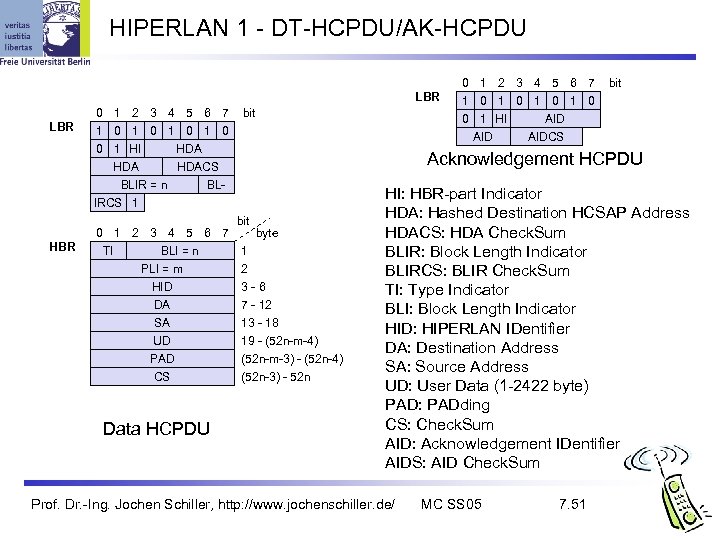
HIPERLAN 1 - DT-HCPDU/AK-HCPDU LBR 0 1 2 3 4 5 6 7 1 0 1 0 bit AID 0 1 HI HDA HDACS BLIR = n BLIRCS 1 HBR 0 1 2 3 4 5 6 7 TI BLI = n PLI = m HID DA SA UD PAD CS Data HCPDU 0 1 2 3 4 5 6 7 1 0 1 0 0 1 HI AID bit AIDCS Acknowledgement HCPDU bit byte 1 2 3 -6 7 - 12 13 - 18 19 - (52 n-m-4) (52 n-m-3) - (52 n-4) (52 n-3) - 52 n HI: HBR-part Indicator HDA: Hashed Destination HCSAP Address HDACS: HDA Check. Sum BLIR: Block Length Indicator BLIRCS: BLIR Check. Sum TI: Type Indicator BLI: Block Length Indicator HID: HIPERLAN IDentifier DA: Destination Address SA: Source Address UD: User Data (1 -2422 byte) PAD: PADding CS: Check. Sum AID: Acknowledgement IDentifier AIDS: AID Check. Sum Prof. Dr. -Ing. Jochen Schiller, http: //www. jochenschiller. de/ MC SS 05 7. 51
HIPERLAN 1 - MAC layer Compatible to ISO MAC Supports time-bounded services via a priority scheme Packet forwarding support of directed (point-to-point) forwarding and broadcast forwarding (if no path information is available) support of Qo. S while forwarding Encryption mechanisms integrated, but without key management Power conservation mechanisms mobile terminals can agree upon awake patterns (e. g. , periodic wake-ups to receive data) additionally, some nodes in the networks must be able to buffer data for sleeping terminals and to forward them at the right time (so called stores) Prof. Dr. -Ing. Jochen Schiller, http: //www. jochenschiller. de/ MC SS 05 7. 52
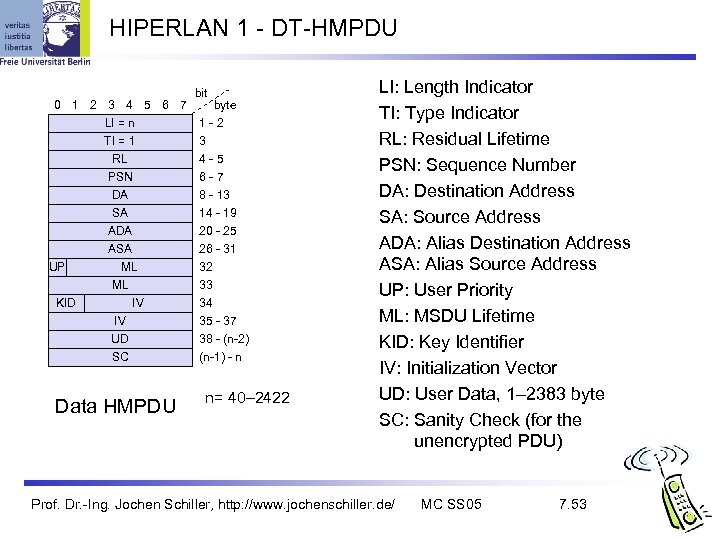
HIPERLAN 1 - DT-HMPDU 0 1 2 3 4 5 6 7 LI = n TI = 1 RL PSN DA SA ADA ASA UP KID ML ML IV IV UD SC Data HMPDU bit byte 1 -2 3 4 -5 6 -7 8 - 13 14 - 19 20 - 25 26 - 31 32 33 34 35 - 37 38 - (n-2) (n-1) - n n= 40– 2422 LI: Length Indicator TI: Type Indicator RL: Residual Lifetime PSN: Sequence Number DA: Destination Address SA: Source Address ADA: Alias Destination Address ASA: Alias Source Address UP: User Priority ML: MSDU Lifetime KID: Key Identifier IV: Initialization Vector UD: User Data, 1– 2383 byte SC: Sanity Check (for the unencrypted PDU) Prof. Dr. -Ing. Jochen Schiller, http: //www. jochenschiller. de/ MC SS 05 7. 53
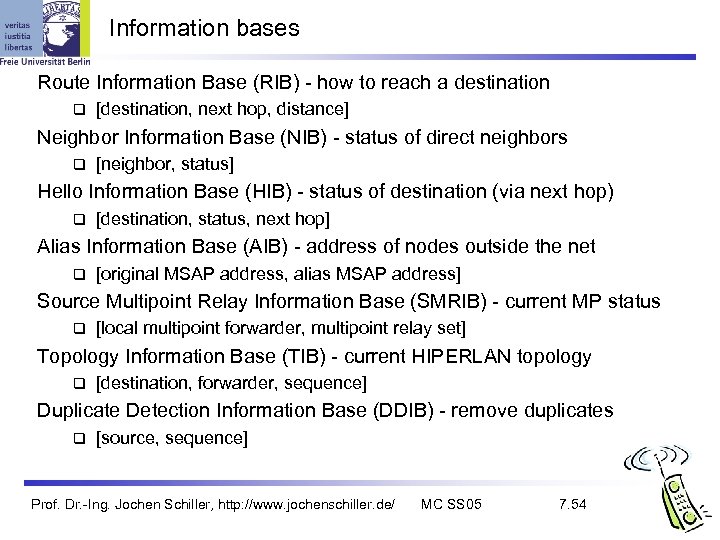
Information bases Route Information Base (RIB) - how to reach a destination [destination, next hop, distance] Neighbor Information Base (NIB) - status of direct neighbors [neighbor, status] Hello Information Base (HIB) - status of destination (via next hop) [destination, status, next hop] Alias Information Base (AIB) - address of nodes outside the net [original MSAP address, alias MSAP address] Source Multipoint Relay Information Base (SMRIB) - current MP status [local multipoint forwarder, multipoint relay set] Topology Information Base (TIB) - current HIPERLAN topology [destination, forwarder, sequence] Duplicate Detection Information Base (DDIB) - remove duplicates [source, sequence] Prof. Dr. -Ing. Jochen Schiller, http: //www. jochenschiller. de/ MC SS 05 7. 54
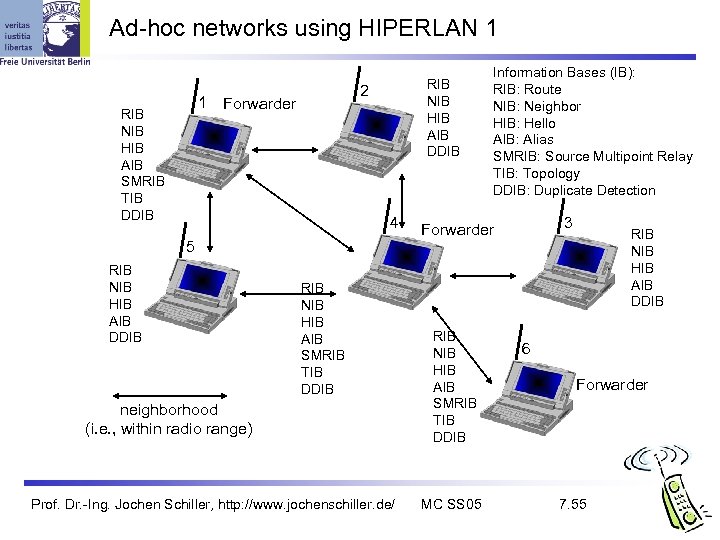
Ad-hoc networks using HIPERLAN 1 1 RIB NIB HIB AIB SMRIB TIB DDIB RIB NIB HIB AIB DDIB 2 Forwarder 4 5 RIB NIB HIB AIB DDIB RIB NIB HIB AIB SMRIB TIB DDIB neighborhood (i. e. , within radio range) Prof. Dr. -Ing. Jochen Schiller, http: //www. jochenschiller. de/ Information Bases (IB): RIB: Route NIB: Neighbor HIB: Hello AIB: Alias SMRIB: Source Multipoint Relay TIB: Topology DDIB: Duplicate Detection 3 Forwarder RIB NIB HIB AIB SMRIB TIB DDIB MC SS 05 RIB NIB HIB AIB DDIB 6 Forwarder 7. 55
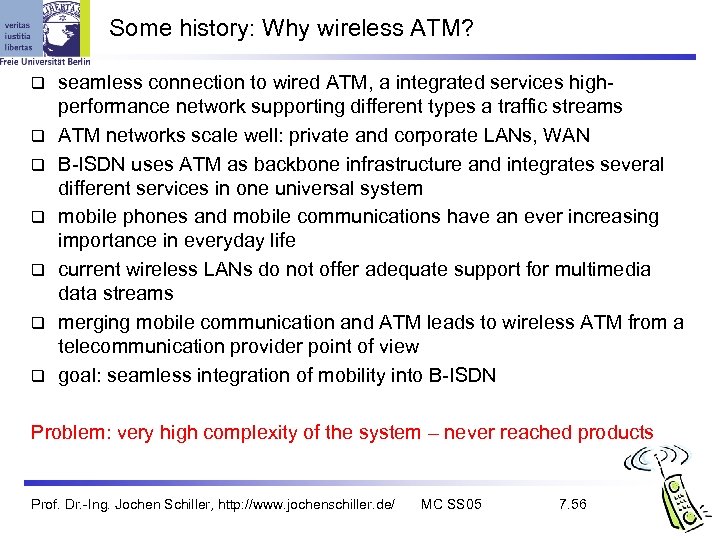
Some history: Why wireless ATM? seamless connection to wired ATM, a integrated services highperformance network supporting different types a traffic streams ATM networks scale well: private and corporate LANs, WAN B-ISDN uses ATM as backbone infrastructure and integrates several different services in one universal system mobile phones and mobile communications have an ever increasing importance in everyday life current wireless LANs do not offer adequate support for multimedia data streams merging mobile communication and ATM leads to wireless ATM from a telecommunication provider point of view goal: seamless integration of mobility into B-ISDN Problem: very high complexity of the system – never reached products Prof. Dr. -Ing. Jochen Schiller, http: //www. jochenschiller. de/ MC SS 05 7. 56
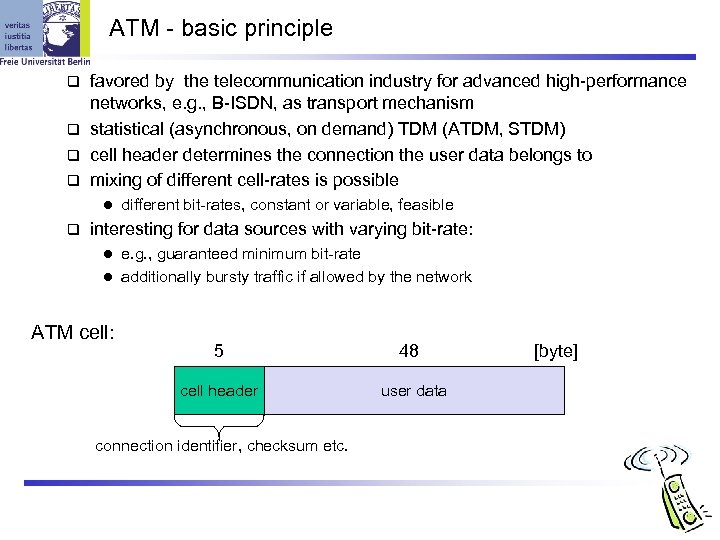
ATM - basic principle favored by the telecommunication industry for advanced high-performance networks, e. g. , B-ISDN, as transport mechanism statistical (asynchronous, on demand) TDM (ATDM, STDM) cell header determines the connection the user data belongs to mixing of different cell-rates is possible l different bit-rates, constant or variable, feasible interesting for data sources with varying bit-rate: e. g. , guaranteed minimum bit-rate l additionally bursty traffic if allowed by the network l ATM cell: 5 cell header connection identifier, checksum etc. 48 user data [byte]
Cell-based transmission asynchronous, cell-based transmission as basis for ATM continuous cell-stream additional cells necessary for operation and maintenance of the network (OAM cells; Operation and Maintenance) OAM cells can be inserted after fixed intervals to create a logical frame structure if a station has no data to send it automatically inserts idle cells that can be discarded at every intermediate system without further notice if no synchronous frame is available for the transport of cells (e. g. , SDH or Sonet) cell boundaries have to be detected separately (e. g. , via the checksum in the cell header)
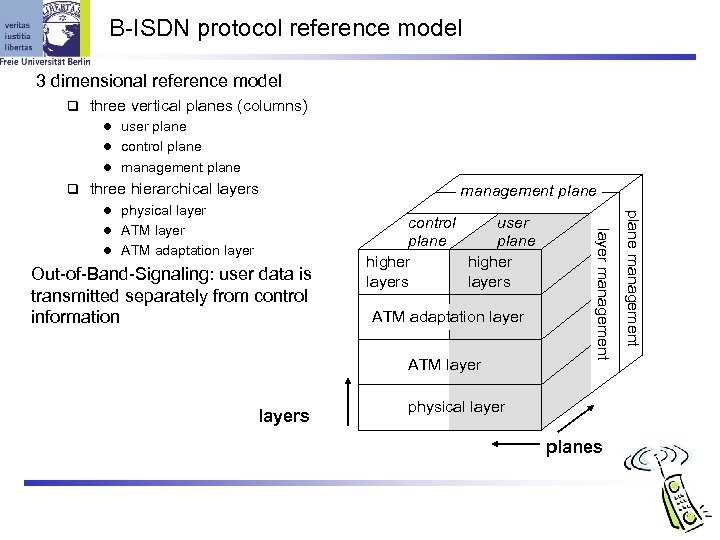
B-ISDN protocol reference model 3 dimensional reference model three vertical planes (columns) l user plane l control plane l management plane three hierarchical layers l ATM adaptation layer Out-of-Band-Signaling: user data is transmitted separately from control information control user plane higher layers ATM adaptation layer ATM layers layer management l ATM layer physical layer planes plane management l physical layer management plane
ATM layers Physical layer, consisting of two sub-layers physical medium dependent sub-layer coding l bit timing l transmission convergence sub-layer HEC (Header Error Correction) sequence generation and verification l transmission frame adaptation, generation, and recovery l cell delineation, cell rate decoupling l ATM layer cell multiplexing/demultiplexing VPI/VCI translation cell header generation and verification GFC (Generic Flow Control) ATM adaptation layer (AAL) Prof. Dr. -Ing. Jochen Schiller, http: //www. jochenschiller. de/ MC SS 05 7. 60
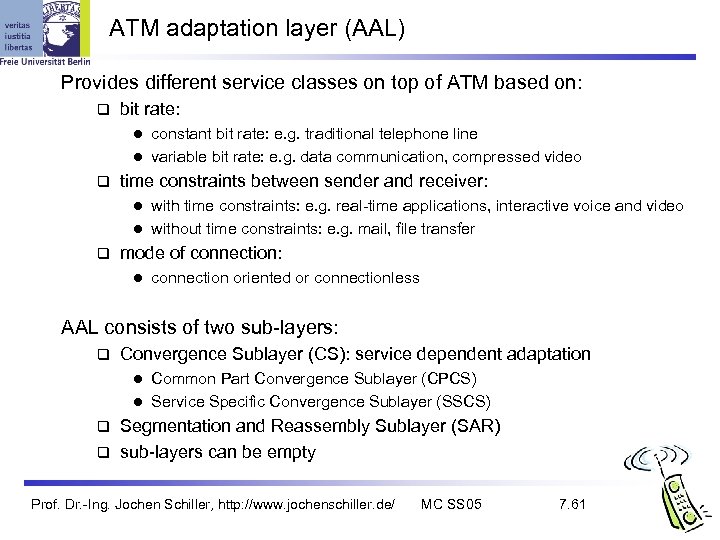
ATM adaptation layer (AAL) Provides different service classes on top of ATM based on: bit rate: constant bit rate: e. g. traditional telephone line l variable bit rate: e. g. data communication, compressed video l time constraints between sender and receiver: with time constraints: e. g. real-time applications, interactive voice and video l without time constraints: e. g. mail, file transfer l mode of connection: l connection oriented or connectionless AAL consists of two sub-layers: Convergence Sublayer (CS): service dependent adaptation Common Part Convergence Sublayer (CPCS) l Service Specific Convergence Sublayer (SSCS) l Segmentation and Reassembly Sublayer (SAR) sub-layers can be empty Prof. Dr. -Ing. Jochen Schiller, http: //www. jochenschiller. de/ MC SS 05 7. 61
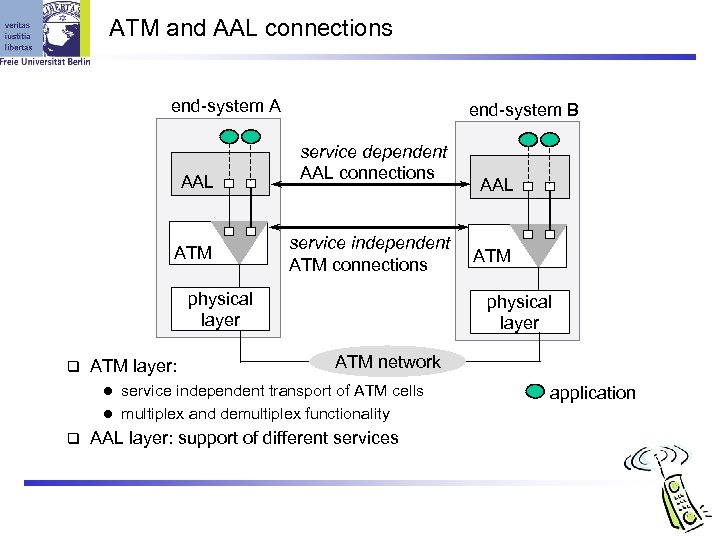
ATM and AAL connections end-system A AAL ATM end-system B service dependent AAL connections service independent ATM connections physical layer ATM layer: ATM physical layer ATM network service independent transport of ATM cells l multiplex and demultiplex functionality l AAL layer: support of different services application
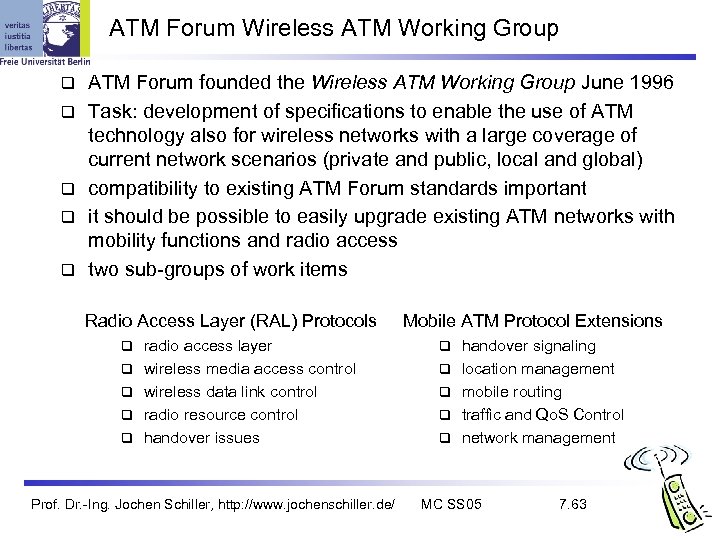
ATM Forum Wireless ATM Working Group ATM Forum founded the Wireless ATM Working Group June 1996 Task: development of specifications to enable the use of ATM technology also for wireless networks with a large coverage of current network scenarios (private and public, local and global) compatibility to existing ATM Forum standards important it should be possible to easily upgrade existing ATM networks with mobility functions and radio access two sub-groups of work items Radio Access Layer (RAL) Protocols radio access layer wireless media access control wireless data link control radio resource control handover issues Prof. Dr. -Ing. Jochen Schiller, http: //www. jochenschiller. de/ Mobile ATM Protocol Extensions handover signaling location management mobile routing traffic and Qo. S Control network management MC SS 05 7. 63
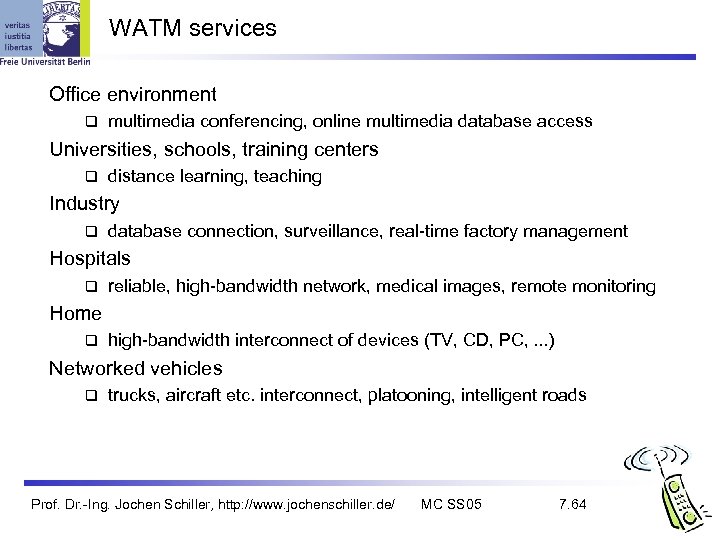
WATM services Office environment multimedia conferencing, online multimedia database access Universities, schools, training centers distance learning, teaching Industry database connection, surveillance, real-time factory management Hospitals reliable, high-bandwidth network, medical images, remote monitoring Home high-bandwidth interconnect of devices (TV, CD, PC, . . . ) Networked vehicles trucks, aircraft etc. interconnect, platooning, intelligent roads Prof. Dr. -Ing. Jochen Schiller, http: //www. jochenschiller. de/ MC SS 05 7. 64
WATM components WMT (Wireless Mobile ATM Terminal) RAS (Radio Access System) EMAS-E (End-user Mobility-supporting ATM Switch - Edge) EMAS-N (End-user Mobility-supporting ATM Switch - Network) M-NNI (Network-to-Network Interface with Mobility support) LS (Location Server) AUS (Authentication Server) Prof. Dr. -Ing. Jochen Schiller, http: //www. jochenschiller. de/ MC SS 05 7. 65
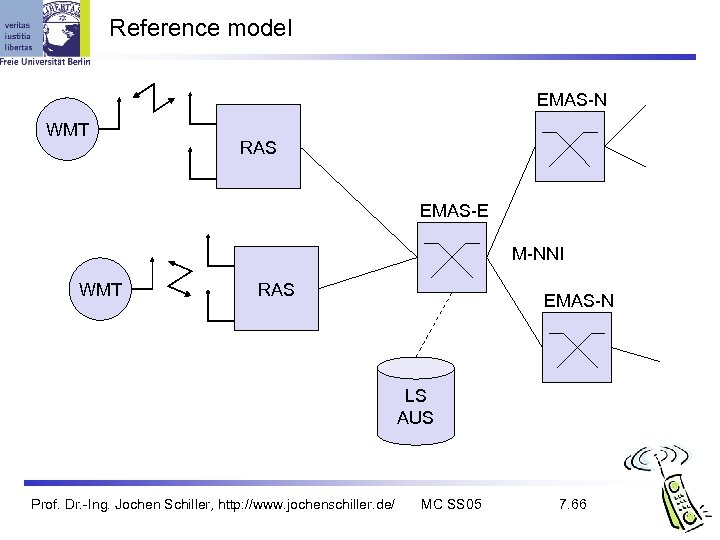
Reference model EMAS-N WMT RAS EMAS-E M-NNI WMT RAS EMAS-N LS AUS Prof. Dr. -Ing. Jochen Schiller, http: //www. jochenschiller. de/ MC SS 05 7. 66
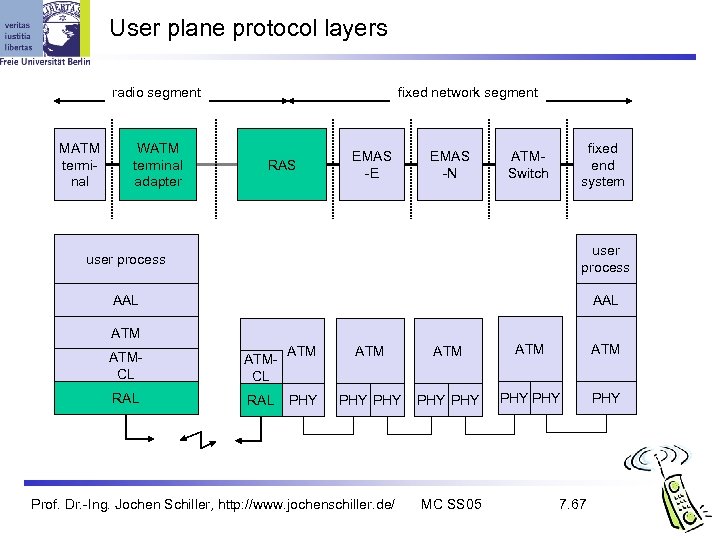
User plane protocol layers fixed network segment radio segment MATM terminal WATM terminal adapter RAS EMAS -E EMAS -N fixed end system ATMSwitch user process AAL ATMCL RAL ATM ATM ATM PHY PHY Prof. Dr. -Ing. Jochen Schiller, http: //www. jochenschiller. de/ MC SS 05 7. 67
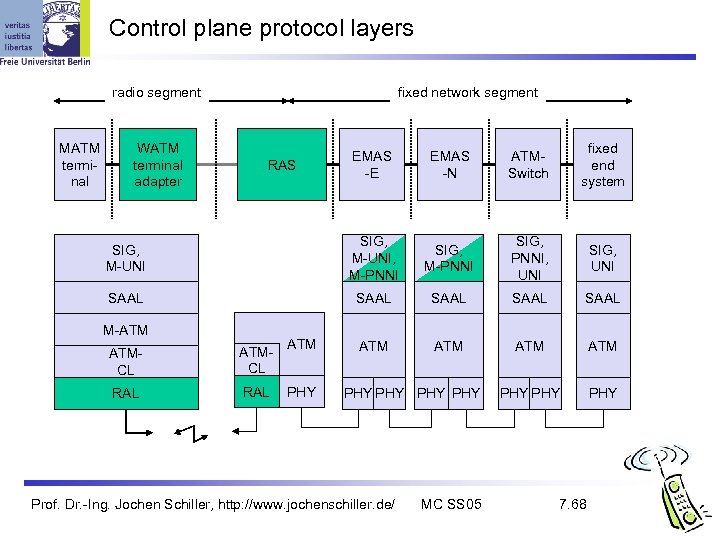
Control plane protocol layers fixed network segment radio segment MATM terminal WATM terminal adapter EMAS -E EMAS -N ATMSwitch fixed end system SIG, M-UNI, M-PNNI SIG, PNNI, UNI SIG, UNI SAAL SAAL ATM ATM PHY PHY RAS M-ATM ATMCL RAL ATM PHY PHY PHY Prof. Dr. -Ing. Jochen Schiller, http: //www. jochenschiller. de/ MC SS 05 7. 68
Reference model with further access scenarios I 1: wireless ad-hoc ATM network 2: wireless mobile ATM terminals 3: mobile ATM terminals 4: mobile ATM switches 5: fixed ATM terminals 6: fixed wireless ATM terminals WMT: wireless mobile terminal WT: wireless terminal MT: mobile terminal T: terminal AP: access point EMAS: end-user mobility supporting ATM switch (-E: edge, -N: network) NMAS: network mobility supporting ATM switch MS: mobile ATM switch Prof. Dr. -Ing. Jochen Schiller, http: //www. jochenschiller. de/ MC SS 05 7. 69
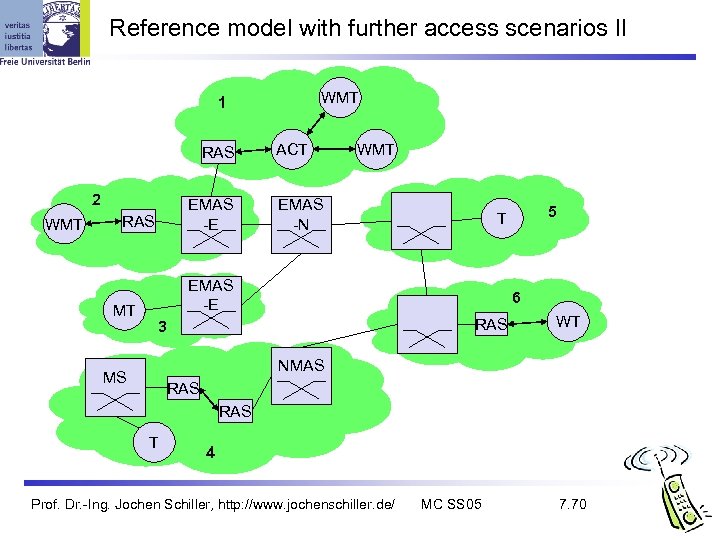
Reference model with further access scenarios II WMT 1 RAS 2 WMT EMAS -E RAS MT ACT WMT EMAS -N 5 T EMAS -E 6 RAS 3 WT NMAS MS RAS T 4 Prof. Dr. -Ing. Jochen Schiller, http: //www. jochenschiller. de/ MC SS 05 7. 70
BRAN – Broadband Radio Access Networks Motivation deregulation, privatization, new companies, new services How to reach the customer? l alternatives: x. DSL, cable, satellite, radio Radio access flexible (supports traffic mix, multiplexing for higher efficiency, can be asymmetrical) quick installation economic (incremental growth possible) Market private customers (Internet access, tele-xy. . . ) small and medium sized business (Internet, MM conferencing, VPN) Scope of standardization access networks, indoor/campus mobility, 25 -155 Mbit/s, 50 m-5 km coordination with ATM Forum, IETF, ETSI, IEEE, . . Prof. Dr. -Ing. Jochen Schiller, http: //www. jochenschiller. de/ MC SS 05 7. 71
Broadband network types Common characteristics ATM Qo. S (CBR, VBR, UBR, ABR) HIPERLAN/2 short range (< 200 m), indoor/campus, 25 Mbit/s user data rate access to telecommunication systems, multimedia applications, mobility (<10 m/s) HIPERACCESS wider range (< 5 km), outdoor, 25 Mbit/s user data rate fixed radio links to customers (“last mile”), alternative to x. DSL or cable modem, quick installation Several (proprietary) products exist with 155 Mbit/s plus Qo. S HIPERLINK – currently no activities intermediate link, 155 Mbit/s connection of HIPERLAN access points or connection between HIPERACCESS nodes Prof. Dr. -Ing. Jochen Schiller, http: //www. jochenschiller. de/ MC SS 05 7. 72
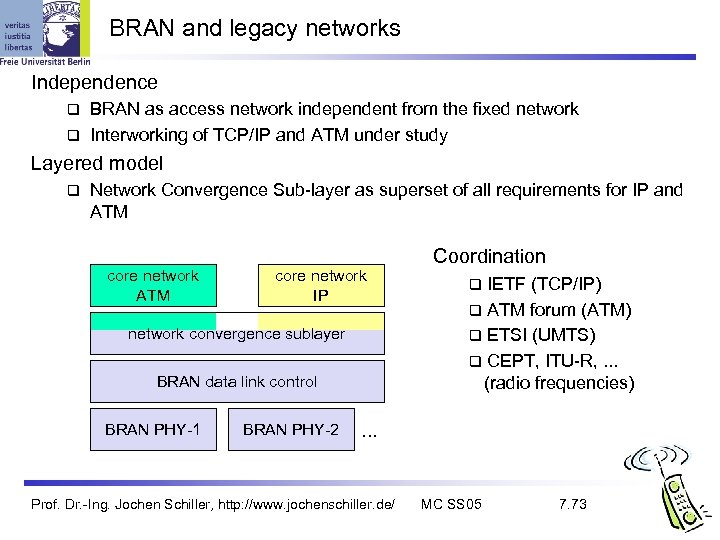
BRAN and legacy networks Independence BRAN as access network independent from the fixed network Interworking of TCP/IP and ATM under study Layered model Network Convergence Sub-layer as superset of all requirements for IP and ATM core network IP network convergence sublayer BRAN data link control BRAN PHY-1 BRAN PHY-2 Coordination IETF (TCP/IP) ATM forum (ATM) ETSI (UMTS) CEPT, ITU-R, . . . (radio frequencies) . . . Prof. Dr. -Ing. Jochen Schiller, http: //www. jochenschiller. de/ MC SS 05 7. 73
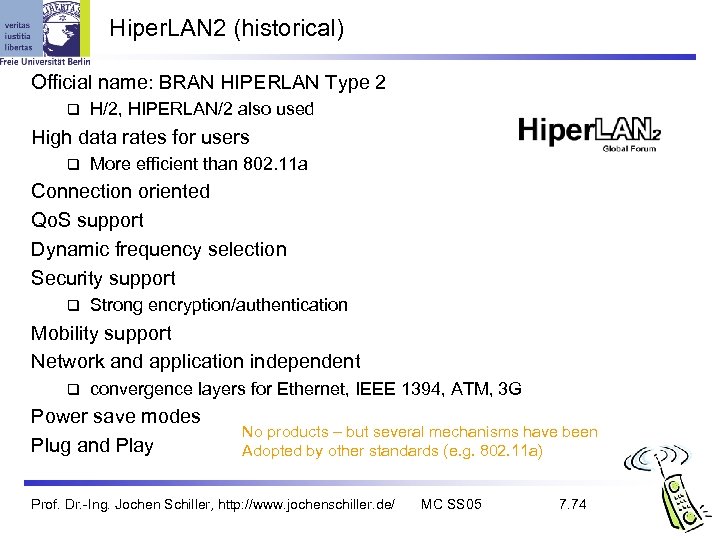
Hiper. LAN 2 (historical) Official name: BRAN HIPERLAN Type 2 H/2, HIPERLAN/2 also used High data rates for users More efficient than 802. 11 a Connection oriented Qo. S support Dynamic frequency selection Security support Strong encryption/authentication Mobility support Network and application independent convergence layers for Ethernet, IEEE 1394, ATM, 3 G Power save modes Plug and Play No products – but several mechanisms have been Adopted by other standards (e. g. 802. 11 a) Prof. Dr. -Ing. Jochen Schiller, http: //www. jochenschiller. de/ MC SS 05 7. 74
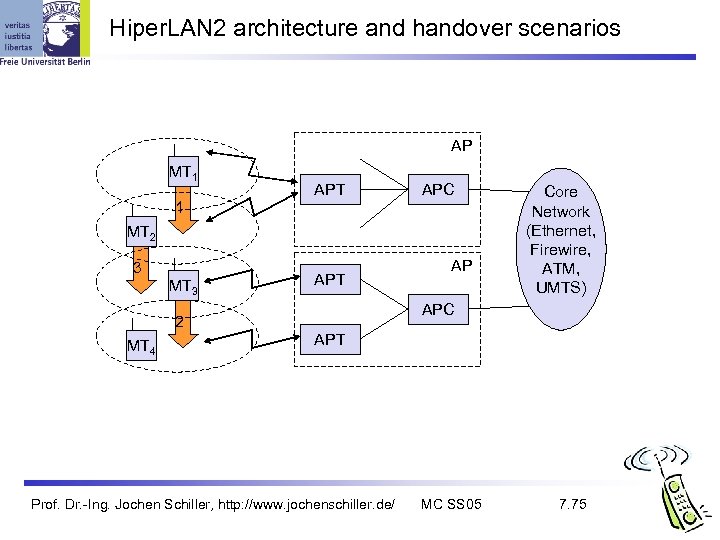
Hiper. LAN 2 architecture and handover scenarios AP MT 1 APT APC 1 MT 2 3 MT 3 APT APC 2 MT 4 AP Core Network (Ethernet, Firewire, ATM, UMTS) APT Prof. Dr. -Ing. Jochen Schiller, http: //www. jochenschiller. de/ MC SS 05 7. 75
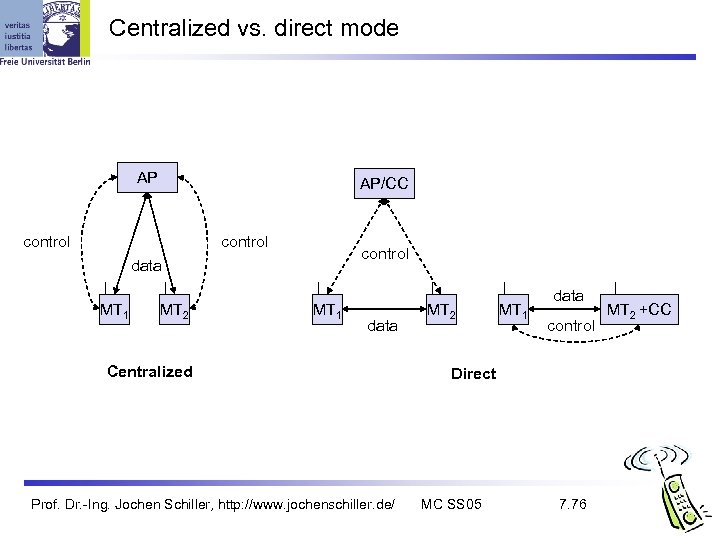
Centralized vs. direct mode AP AP/CC control data MT 1 MT 2 MT 1 data Centralized Prof. Dr. -Ing. Jochen Schiller, http: //www. jochenschiller. de/ MT 2 MT 1 data control Direct MC SS 05 7. 76 MT 2 +CC
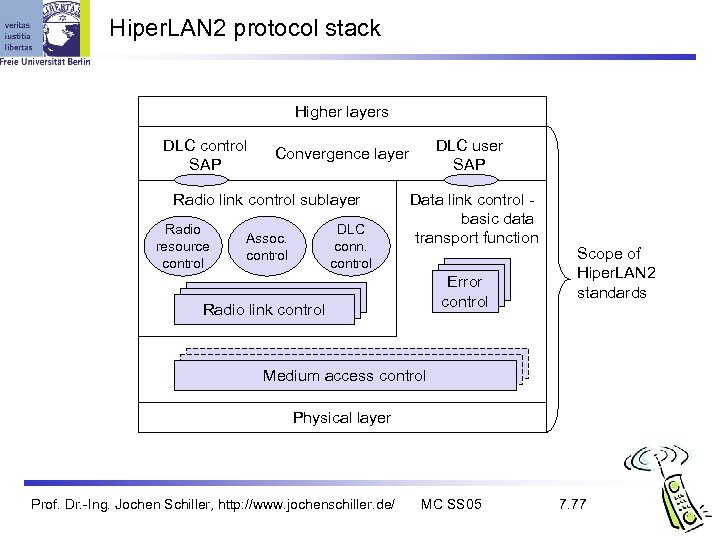
Hiper. LAN 2 protocol stack Higher layers DLC control SAP Radio link control sublayer Radio resource control DLC user SAP Convergence layer DLC conn. control Assoc. control Data link control basic data transport function Error control Radio link control Scope of Hiper. LAN 2 standards Medium access control Physical layer Prof. Dr. -Ing. Jochen Schiller, http: //www. jochenschiller. de/ MC SS 05 7. 77
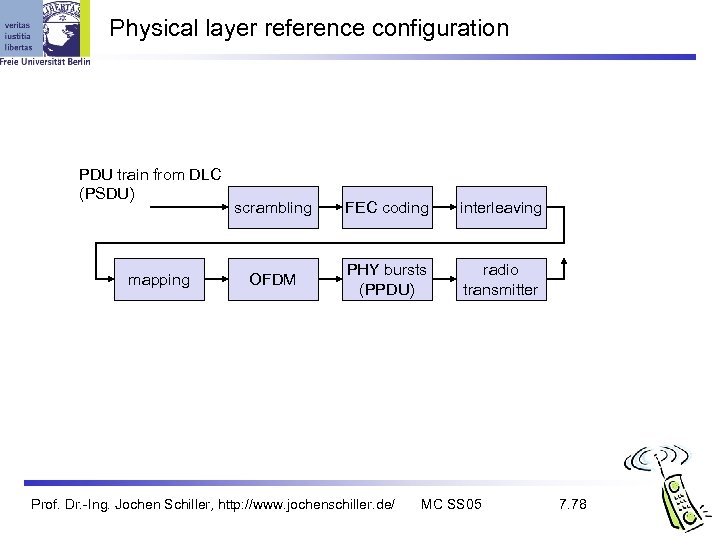
Physical layer reference configuration PDU train from DLC (PSDU) mapping scrambling FEC coding interleaving OFDM PHY bursts (PPDU) radio transmitter Prof. Dr. -Ing. Jochen Schiller, http: //www. jochenschiller. de/ MC SS 05 7. 78
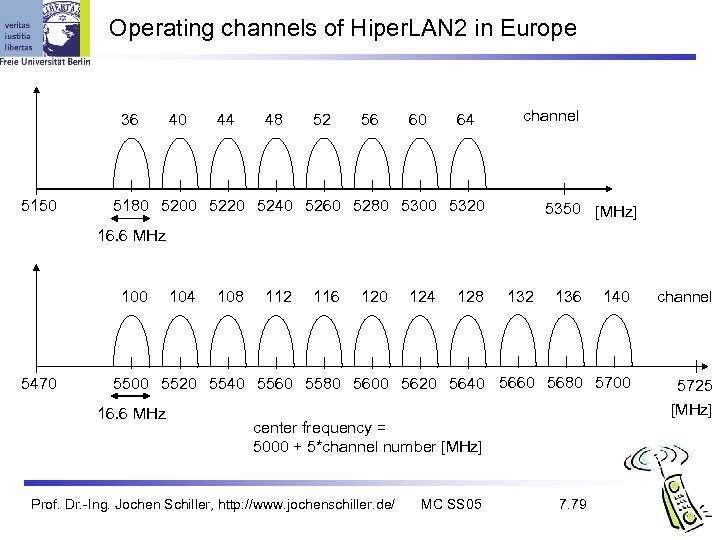
Operating channels of Hiper. LAN 2 in Europe 36 5150 40 44 48 52 56 60 64 channel 5180 5200 5220 5240 5260 5280 5300 5320 5350 [MHz] 16. 6 MHz 100 5470 140 channel 5500 5520 5540 5560 5580 5600 5620 5640 5660 5680 5700 5725 [MHz] 16. 6 MHz 104 108 112 116 120 124 128 132 136 center frequency = 5000 + 5*channel number [MHz] Prof. Dr. -Ing. Jochen Schiller, http: //www. jochenschiller. de/ MC SS 05 7. 79
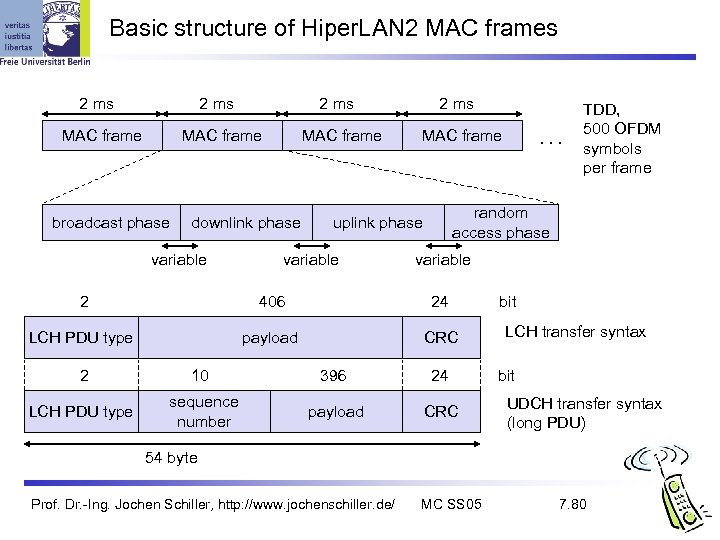
Basic structure of Hiper. LAN 2 MAC frames 2 ms MAC frame broadcast phase MAC frame downlink phase variable 2 ms MAC frame random access phase uplink phase variable . . . TDD, 500 OFDM symbols per frame variable 2 406 24 LCH PDU type payload CRC 2 10 396 24 LCH PDU type sequence number payload CRC bit LCH transfer syntax bit UDCH transfer syntax (long PDU) 54 byte Prof. Dr. -Ing. Jochen Schiller, http: //www. jochenschiller. de/ MC SS 05 7. 80
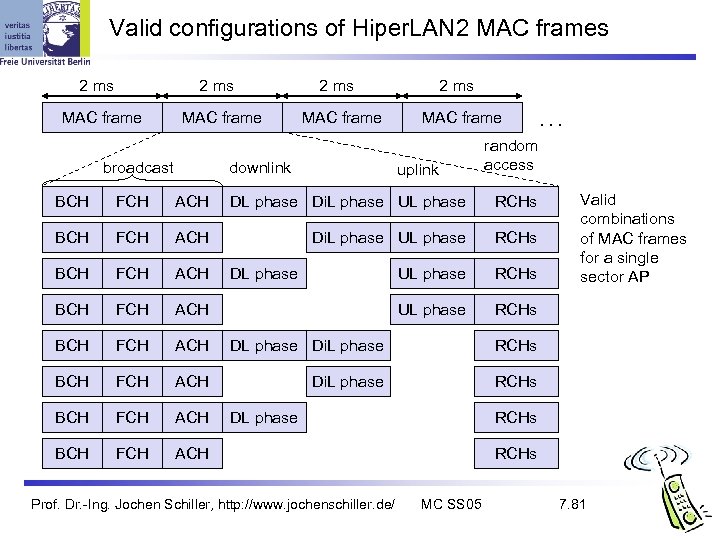
Valid configurations of Hiper. LAN 2 MAC frames 2 ms MAC frame broadcast 2 ms MAC frame downlink 2 ms MAC frame uplink . . . random access BCH FCH ACH DL phase Di. L phase UL phase RCHs BCH FCH ACH DL phase Di. L phase RCHs BCH FCH ACH Valid combinations of MAC frames for a single sector AP DL phase Prof. Dr. -Ing. Jochen Schiller, http: //www. jochenschiller. de/ RCHs MC SS 05 7. 81
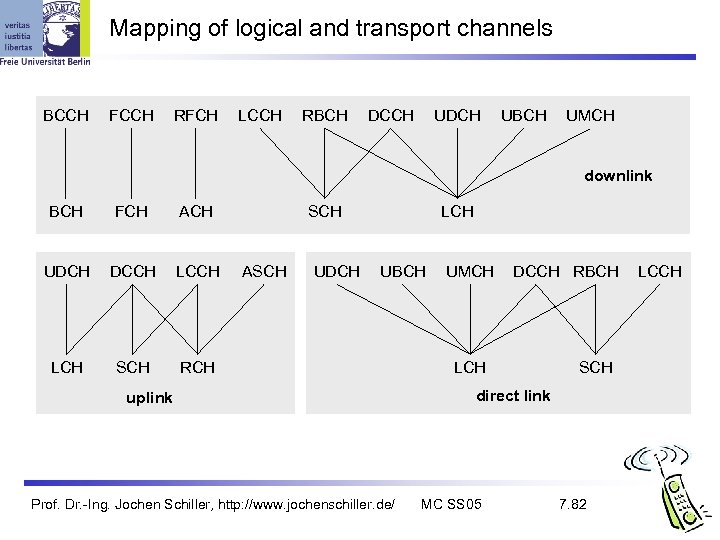
Mapping of logical and transport channels BCCH FCCH RFCH LCCH RBCH DCCH UDCH UBCH UMCH downlink BCH FCH ACH UDCH DCCH LCH SCH RCH ASCH UDCH LCH UBCH uplink Prof. Dr. -Ing. Jochen Schiller, http: //www. jochenschiller. de/ UMCH DCCH RBCH LCH SCH direct link MC SS 05 7. 82 LCCH
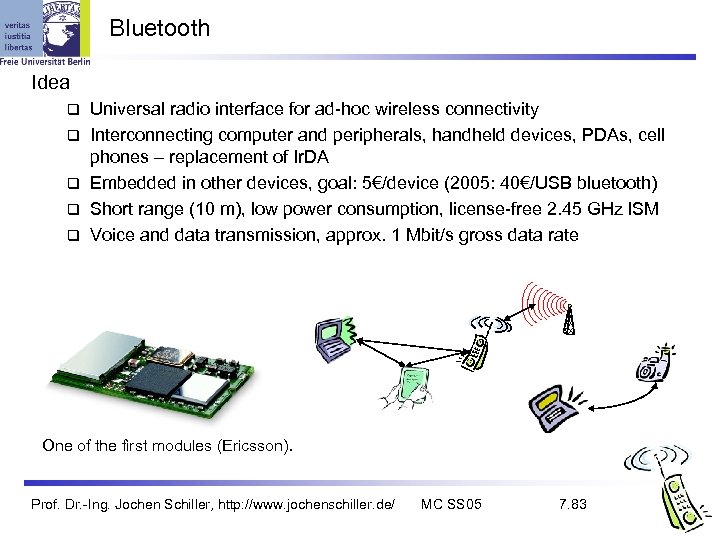
Bluetooth Idea Universal radio interface for ad-hoc wireless connectivity Interconnecting computer and peripherals, handheld devices, PDAs, cell phones – replacement of Ir. DA Embedded in other devices, goal: 5€/device (2005: 40€/USB bluetooth) Short range (10 m), low power consumption, license-free 2. 45 GHz ISM Voice and data transmission, approx. 1 Mbit/s gross data rate One of the first modules (Ericsson). Prof. Dr. -Ing. Jochen Schiller, http: //www. jochenschiller. de/ MC SS 05 7. 83
Bluetooth History 1994: Ericsson (Mattison/Haartsen), “MC-link” project Renaming of the project: Bluetooth according to Harald “Blåtand” Gormsen [son of Gorm], King of Denmark in the 10 th century (was: ) 1998: foundation of Bluetooth SIG, www. bluetooth. org 1999: erection of a rune stone at Ercisson/Lund ; -) 2001: first consumer products for mass market, spec. version 1. 1 released 2005: 5 million chips/week Special Interest Group Original founding members: Ericsson, Intel, IBM, Nokia, Toshiba Added promoters: 3 Com, Agere (was: Lucent), Microsoft, Motorola > 2500 members Common specification and certification of products Prof. Dr. -Ing. Jochen Schiller, http: //www. jochenschiller. de/ MC SS 05 7. 84
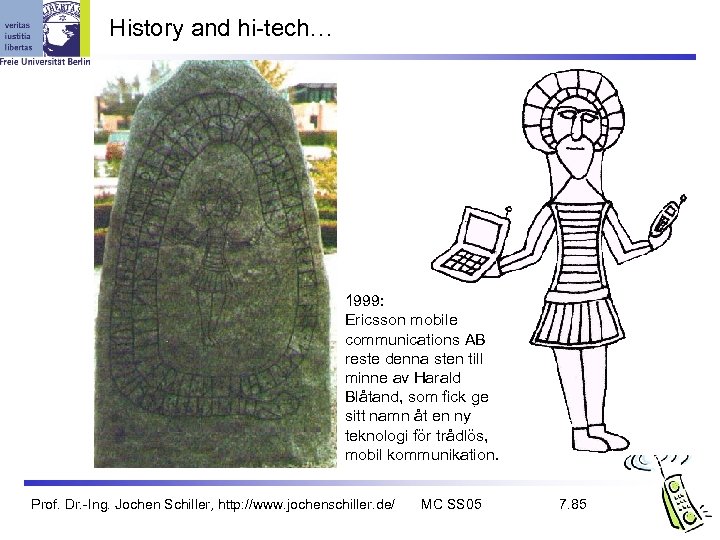
History and hi-tech… 1999: Ericsson mobile communications AB reste denna sten till minne av Harald Blåtand, som fick ge sitt namn åt en ny teknologi för trådlös, mobil kommunikation. Prof. Dr. -Ing. Jochen Schiller, http: //www. jochenschiller. de/ MC SS 05 7. 85
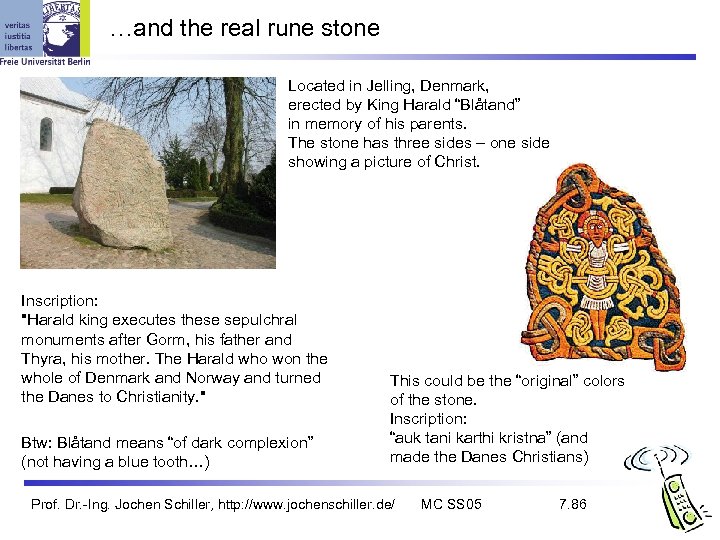
…and the real rune stone Located in Jelling, Denmark, erected by King Harald “Blåtand” in memory of his parents. The stone has three sides – one side showing a picture of Christ. Inscription: "Harald king executes these sepulchral monuments after Gorm, his father and Thyra, his mother. The Harald who won the whole of Denmark and Norway and turned the Danes to Christianity. " Btw: Blåtand means “of dark complexion” (not having a blue tooth…) This could be the “original” colors of the stone. Inscription: “auk tani karthi kristna” (and made the Danes Christians) Prof. Dr. -Ing. Jochen Schiller, http: //www. jochenschiller. de/ MC SS 05 7. 86
Characteristics 2. 4 GHz ISM band, 79 (23) RF channels, 1 MHz carrier spacing Channel 0: 2402 MHz … channel 78: 2480 MHz G-FSK modulation, 1 -100 m. W transmit power FHSS and TDD Frequency hopping with 1600 hops/s Hopping sequence in a pseudo random fashion, determined by a master Time division duplex for send/receive separation Voice link – SCO (Synchronous Connection Oriented) FEC (forward error correction), no retransmission, 64 kbit/s duplex, point-to -point, circuit switched Data link – ACL (Asynchronous Connection. Less) Asynchronous, fast acknowledge, point-to-multipoint, up to 433. 9 kbit/s symmetric or 723. 2/57. 6 kbit/s asymmetric, packet switched Topology Overlapping piconets (stars) forming a scatternet Prof. Dr. -Ing. Jochen Schiller, http: //www. jochenschiller. de/ MC SS 05 7. 87
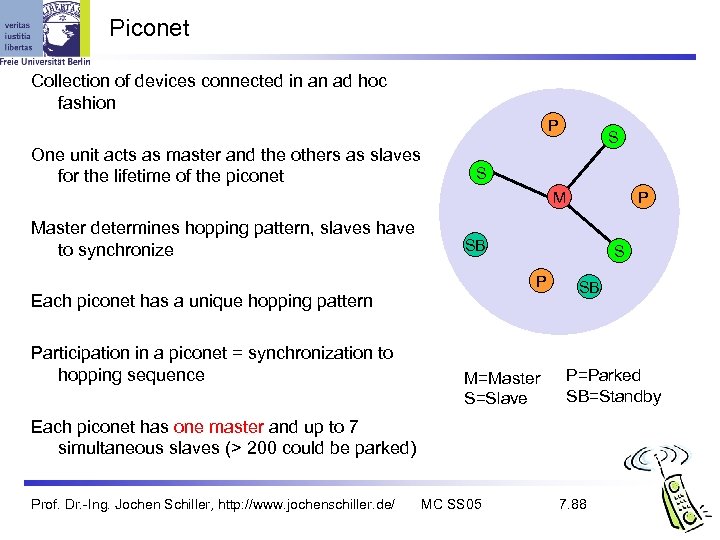
Piconet Collection of devices connected in an ad hoc fashion P One unit acts as master and the others as slaves for the lifetime of the piconet S S M Master determines hopping pattern, slaves have to synchronize SB S P Each piconet has a unique hopping pattern Participation in a piconet = synchronization to hopping sequence P M=Master S=Slave SB P=Parked SB=Standby Each piconet has one master and up to 7 simultaneous slaves (> 200 could be parked) Prof. Dr. -Ing. Jochen Schiller, http: //www. jochenschiller. de/ MC SS 05 7. 88
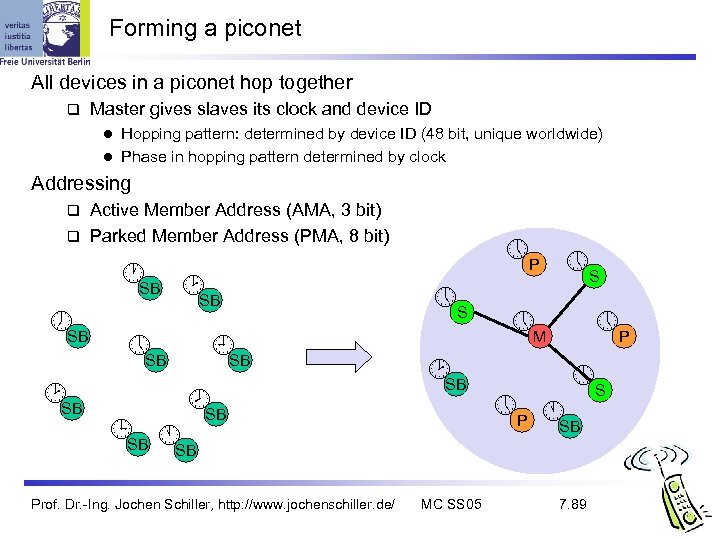
Forming a piconet All devices in a piconet hop together Master gives slaves its clock and device ID Hopping pattern: determined by device ID (48 bit, unique worldwide) l Phase in hopping pattern determined by clock l Addressing Active Member Address (AMA, 3 bit) Parked Member Address (PMA, 8 bit) SB SB SB SB S SB SB SB Prof. Dr. -Ing. Jochen Schiller, http: //www. jochenschiller. de/ MC SS 05 P S M P S P SB 7. 89
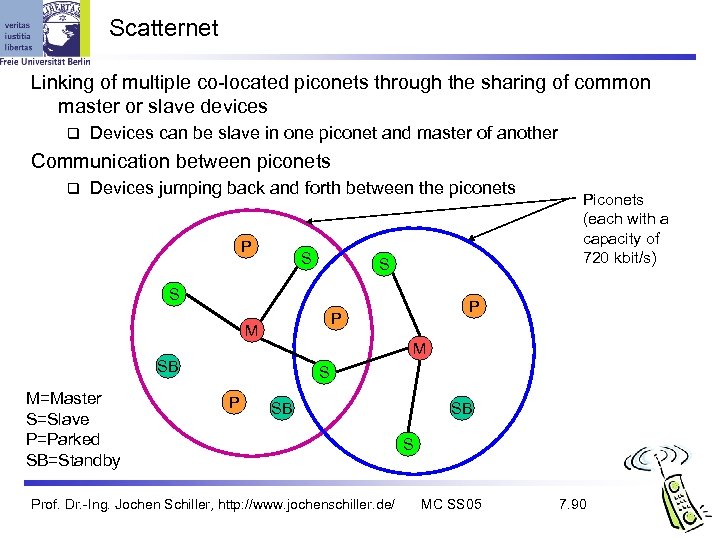
Scatternet Linking of multiple co-located piconets through the sharing of common master or slave devices Devices can be slave in one piconet and master of another Communication between piconets Devices jumping back and forth between the piconets P S S S P P M Piconets (each with a capacity of 720 kbit/s) M SB M=Master S=Slave P=Parked SB=Standby S P SB Prof. Dr. -Ing. Jochen Schiller, http: //www. jochenschiller. de/ SB S MC SS 05 7. 90
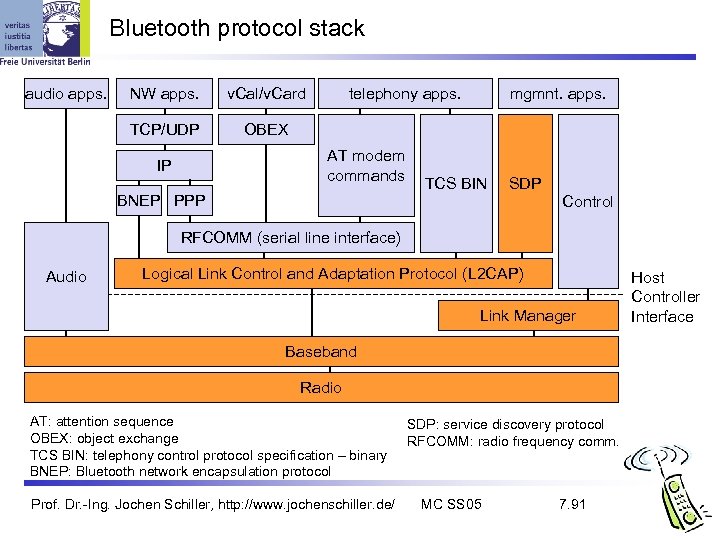
Bluetooth protocol stack audio apps. NW apps. v. Cal/v. Card TCP/UDP telephony apps. OBEX AT modem commands IP BNEP PPP mgmnt. apps. TCS BIN SDP Control RFCOMM (serial line interface) Audio Logical Link Control and Adaptation Protocol (L 2 CAP) Link Manager Baseband Radio AT: attention sequence OBEX: object exchange TCS BIN: telephony control protocol specification – binary BNEP: Bluetooth network encapsulation protocol Prof. Dr. -Ing. Jochen Schiller, http: //www. jochenschiller. de/ SDP: service discovery protocol RFCOMM: radio frequency comm. MC SS 05 7. 91 Host Controller Interface
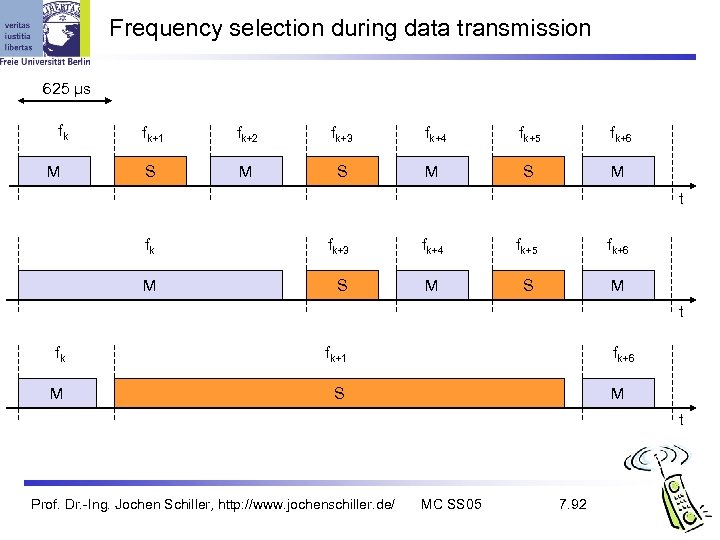
Frequency selection during data transmission 625 µs fk M fk+1 fk+2 fk+3 fk+4 fk+5 fk+6 S M S M t fk fk+3 fk+4 fk+5 fk+6 M S M t fk fk+1 M fk+6 S M t Prof. Dr. -Ing. Jochen Schiller, http: //www. jochenschiller. de/ MC SS 05 7. 92
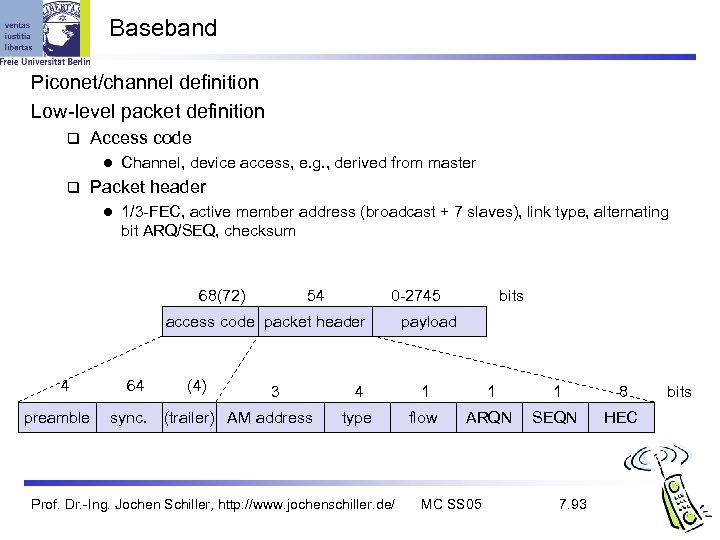
Baseband Piconet/channel definition Low-level packet definition Access code l Channel, device access, e. g. , derived from master Packet header l 1/3 -FEC, active member address (broadcast + 7 slaves), link type, alternating bit ARQ/SEQ, checksum 68(72) 54 0 -2745 access code packet header 4 preamble 64 sync. (4) 3 (trailer) AM address bits payload 4 1 1 1 8 type flow ARQN SEQN HEC Prof. Dr. -Ing. Jochen Schiller, http: //www. jochenschiller. de/ MC SS 05 7. 93 bits
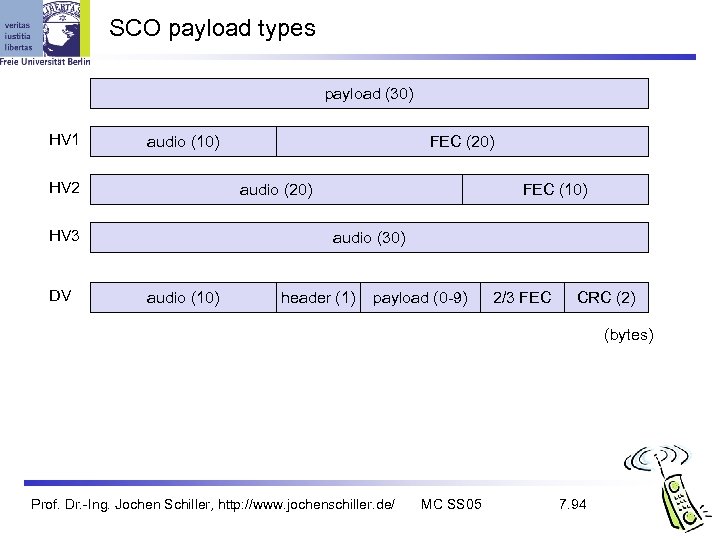
SCO payload types payload (30) HV 1 audio (10) HV 2 audio (20) HV 3 DV FEC (20) FEC (10) audio (30) audio (10) header (1) payload (0 -9) 2/3 FEC CRC (2) (bytes) Prof. Dr. -Ing. Jochen Schiller, http: //www. jochenschiller. de/ MC SS 05 7. 94
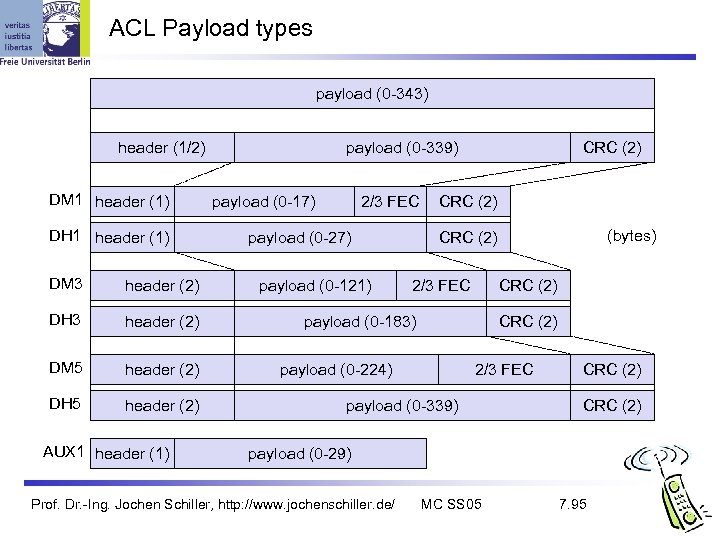
ACL Payload types payload (0 -343) header (1/2) DM 1 header (1) DH 1 header (1) DM 3 header (2) DH 3 header (2) DM 5 header (2) DH 5 header (2) AUX 1 header (1) payload (0 -339) payload (0 -17) 2/3 FEC payload (0 -27) payload (0 -121) CRC (2) (bytes) CRC (2) 2/3 FEC CRC (2) payload (0 -183) CRC (2) payload (0 -224) 2/3 FEC payload (0 -339) CRC (2) payload (0 -29) Prof. Dr. -Ing. Jochen Schiller, http: //www. jochenschiller. de/ MC SS 05 7. 95
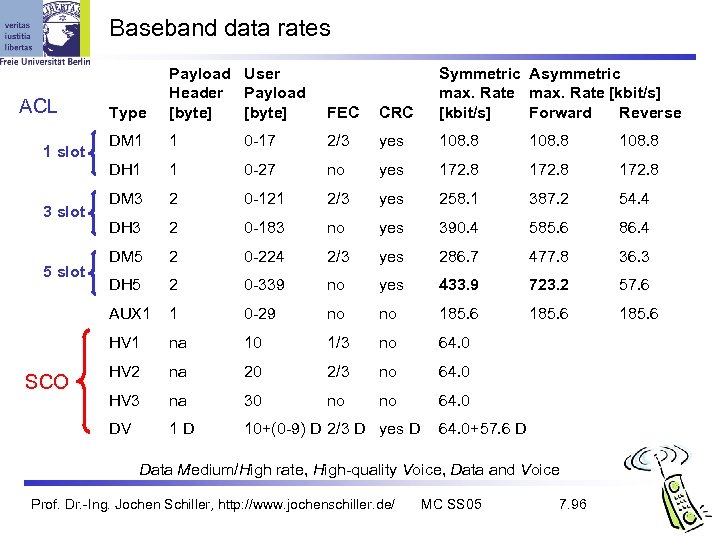
Baseband data rates SCO DM 1 1 0 -17 2/3 yes 108. 8 1 0 -27 no yes 172. 8 DM 3 2 0 -121 2/3 yes 258. 1 387. 2 54. 4 DH 3 2 0 -183 no yes 390. 4 585. 6 86. 4 DM 5 2 0 -224 2/3 yes 286. 7 477. 8 36. 3 DH 5 2 0 -339 no yes 433. 9 723. 2 57. 6 1 0 -29 no no 185. 6 na 10 1/3 no 64. 0 HV 2 na 20 2/3 no 64. 0 HV 3 na 30 no no 64. 0 DV 5 slot CRC HV 1 3 slot FEC AUX 1 1 slot Type Symmetric Asymmetric max. Rate [kbit/s] Forward Reverse DH 1 ACL Payload User Header Payload [byte] 1 D 10+(0 -9) D 2/3 D yes D 64. 0+57. 6 D Data Medium/High rate, High-quality Voice, Data and Voice Prof. Dr. -Ing. Jochen Schiller, http: //www. jochenschiller. de/ MC SS 05 7. 96
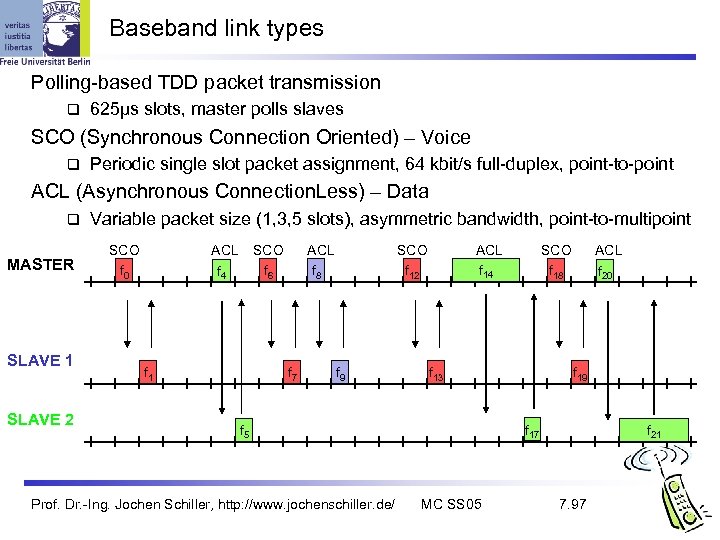
Baseband link types Polling-based TDD packet transmission 625µs slots, master polls slaves SCO (Synchronous Connection Oriented) – Voice Periodic single slot packet assignment, 64 kbit/s full-duplex, point-to-point ACL (Asynchronous Connection. Less) – Data MASTER SLAVE 1 SLAVE 2 Variable packet size (1, 3, 5 slots), asymmetric bandwidth, point-to-multipoint SCO f 0 ACL f 4 SCO f 6 f 1 ACL f 8 f 7 SCO f 12 f 9 ACL f 14 f 13 ACL f 20 f 19 f 17 f 5 Prof. Dr. -Ing. Jochen Schiller, http: //www. jochenschiller. de/ SCO f 18 MC SS 05 f 21 7. 97
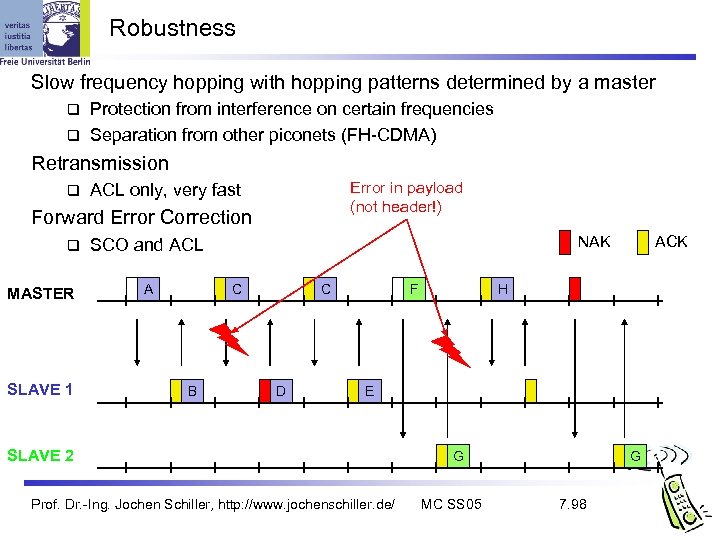
Robustness Slow frequency hopping with hopping patterns determined by a master Protection from interference on certain frequencies Separation from other piconets (FH-CDMA) Retransmission Error in payload (not header!) ACL only, very fast Forward Error Correction MASTER SLAVE 1 NAK SCO and ACL A C B C D F ACK H E SLAVE 2 Prof. Dr. -Ing. Jochen Schiller, http: //www. jochenschiller. de/ G MC SS 05 G 7. 98
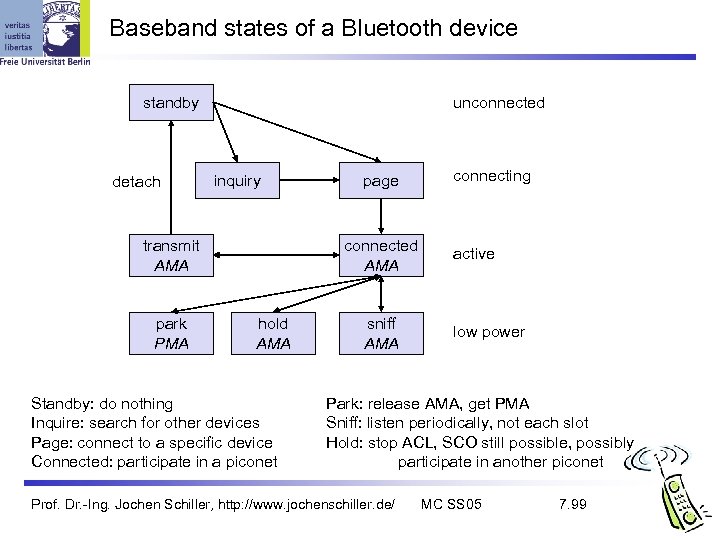
Baseband states of a Bluetooth device unconnected standby detach inquiry transmit AMA park PMA page connected AMA hold AMA Standby: do nothing Inquire: search for other devices Page: connect to a specific device Connected: participate in a piconet sniff AMA connecting active low power Park: release AMA, get PMA Sniff: listen periodically, not each slot Hold: stop ACL, SCO still possible, possibly participate in another piconet Prof. Dr. -Ing. Jochen Schiller, http: //www. jochenschiller. de/ MC SS 05 7. 99
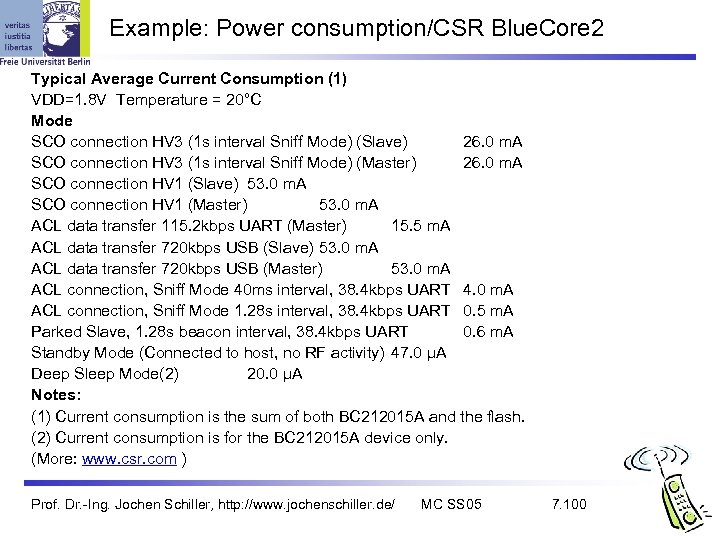
Example: Power consumption/CSR Blue. Core 2 Typical Average Current Consumption (1) VDD=1. 8 V Temperature = 20°C Mode SCO connection HV 3 (1 s interval Sniff Mode) (Slave) 26. 0 m. A SCO connection HV 3 (1 s interval Sniff Mode) (Master) 26. 0 m. A SCO connection HV 1 (Slave) 53. 0 m. A SCO connection HV 1 (Master) 53. 0 m. A ACL data transfer 115. 2 kbps UART (Master) 15. 5 m. A ACL data transfer 720 kbps USB (Slave) 53. 0 m. A ACL data transfer 720 kbps USB (Master) 53. 0 m. A ACL connection, Sniff Mode 40 ms interval, 38. 4 kbps UART 4. 0 m. A ACL connection, Sniff Mode 1. 28 s interval, 38. 4 kbps UART 0. 5 m. A Parked Slave, 1. 28 s beacon interval, 38. 4 kbps UART 0. 6 m. A Standby Mode (Connected to host, no RF activity) 47. 0 µA Deep Sleep Mode(2) 20. 0 µA Notes: (1) Current consumption is the sum of both BC 212015 A and the flash. (2) Current consumption is for the BC 212015 A device only. (More: www. csr. com ) Prof. Dr. -Ing. Jochen Schiller, http: //www. jochenschiller. de/ MC SS 05 7. 100
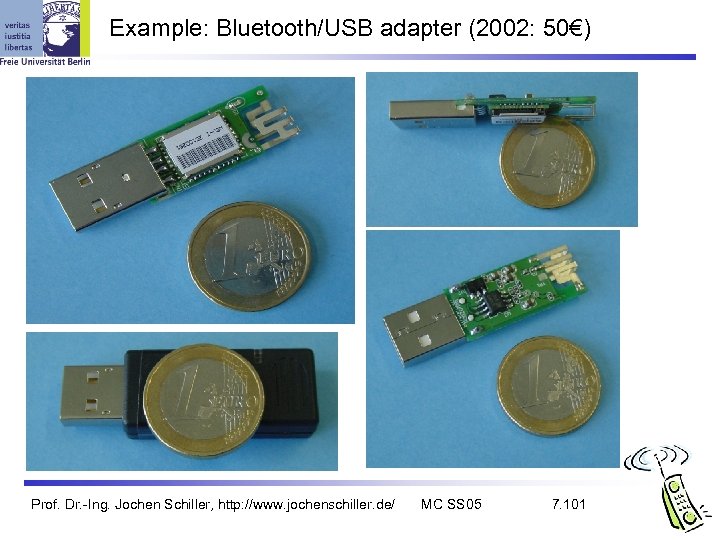
Example: Bluetooth/USB adapter (2002: 50€) Prof. Dr. -Ing. Jochen Schiller, http: //www. jochenschiller. de/ MC SS 05 7. 101
L 2 CAP - Logical Link Control and Adaptation Protocol Simple data link protocol on top of baseband Connection oriented, connectionless, and signalling channels Protocol multiplexing RFCOMM, SDP, telephony control Segmentation & reassembly Up to 64 kbyte user data, 16 bit CRC used from baseband Qo. S flow specification per channel Follows RFC 1363, specifies delay, jitter, bursts, bandwidth Group abstraction Create/close group, add/remove member Prof. Dr. -Ing. Jochen Schiller, http: //www. jochenschiller. de/ MC SS 05 7. 102
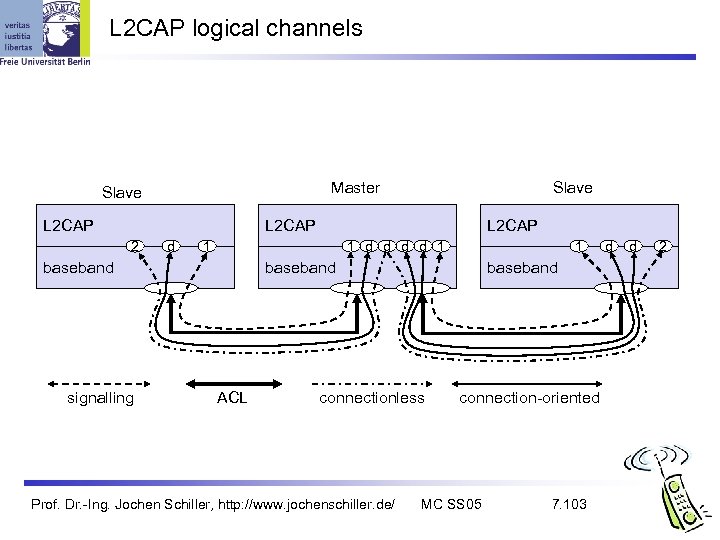
L 2 CAP logical channels Master Slave L 2 CAP 2 d 1 1 d d 1 baseband signalling L 2 CAP 1 baseband ACL baseband connectionless Prof. Dr. -Ing. Jochen Schiller, http: //www. jochenschiller. de/ connection-oriented MC SS 05 7. 103 d d 2
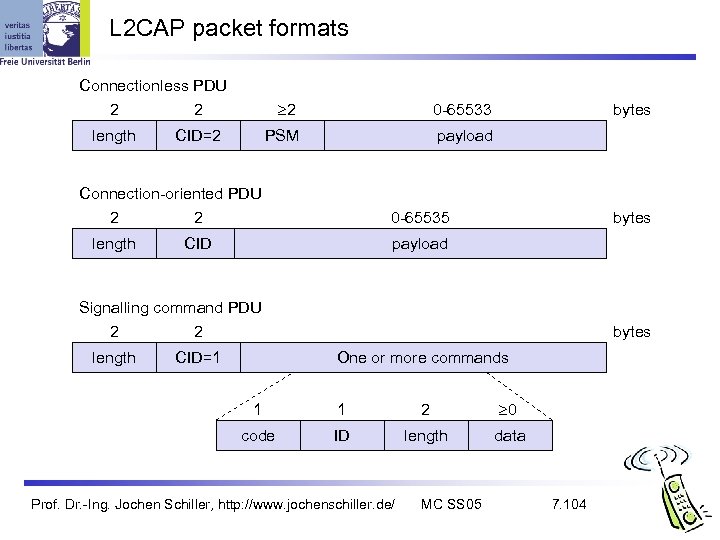
L 2 CAP packet formats Connectionless PDU 2 2 length 2 PSM CID=2 0 -65533 payload Connection-oriented PDU 2 2 length bytes 0 -65535 CID bytes payload Signalling command PDU 2 2 length CID=1 bytes One or more commands 1 1 2 0 code ID length data Prof. Dr. -Ing. Jochen Schiller, http: //www. jochenschiller. de/ MC SS 05 7. 104
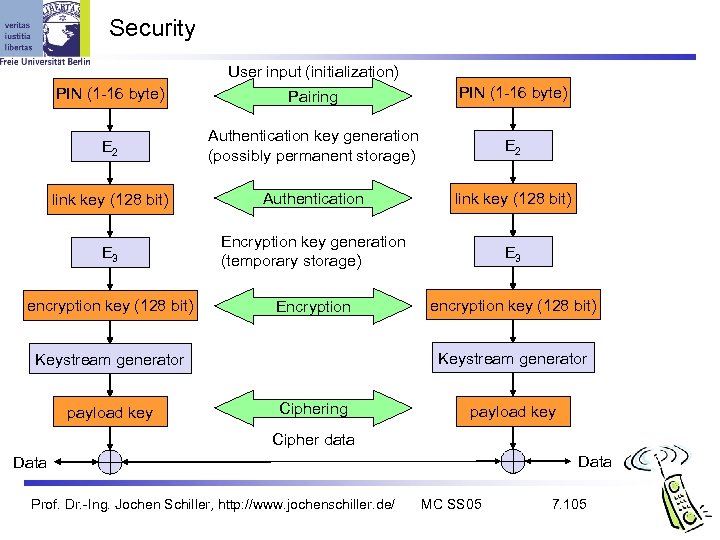
Security User input (initialization) PIN (1 -16 byte) Pairing PIN (1 -16 byte) E 2 Authentication key generation (possibly permanent storage) E 2 link key (128 bit) Authentication link key (128 bit) E 3 Encryption key generation (temporary storage) E 3 encryption key (128 bit) Encryption encryption key (128 bit) Keystream generator payload key Ciphering payload key Cipher data Data Prof. Dr. -Ing. Jochen Schiller, http: //www. jochenschiller. de/ MC SS 05 7. 105
SDP – Service Discovery Protocol Inquiry/response protocol for discovering services Searching for and browsing services in radio proximity Adapted to the highly dynamic environment Can be complemented by others like SLP, Jini, Salutation, … Defines discovery only, not the usage of services Caching of discovered services Gradual discovery Service record format Information about services provided by attributes Attributes are composed of an 16 bit ID (name) and a values may be derived from 128 bit Universally Unique Identifiers (UUID) Prof. Dr. -Ing. Jochen Schiller, http: //www. jochenschiller. de/ MC SS 05 7. 106
Additional protocols to support legacy protocols/apps. RFCOMM Emulation of a serial port (supports a large base of legacy applications) Allows multiple ports over a single physical channel Telephony Control Protocol Specification (TCS) Call control (setup, release) Group management OBEX Exchange of objects, Ir. DA replacement WAP Interacting with applications on cellular phones Prof. Dr. -Ing. Jochen Schiller, http: //www. jochenschiller. de/ MC SS 05 7. 107
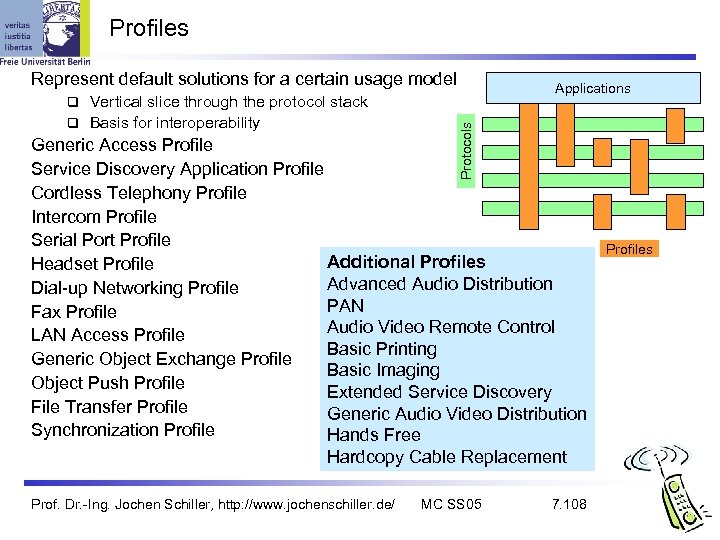
Profiles Represent default solutions for a certain usage model Vertical slice through the protocol stack Basis for interoperability Applications Protocols Generic Access Profile Service Discovery Application Profile Cordless Telephony Profile Intercom Profile Serial Port Profile Additional Profiles Headset Profile Advanced Audio Distribution Dial-up Networking Profile PAN Fax Profile Audio Video Remote Control LAN Access Profile Basic Printing Generic Object Exchange Profile Basic Imaging Object Push Profile Extended Service Discovery File Transfer Profile Generic Audio Video Distribution Synchronization Profile Hands Free Hardcopy Cable Replacement Prof. Dr. -Ing. Jochen Schiller, http: //www. jochenschiller. de/ MC SS 05 7. 108 Profiles
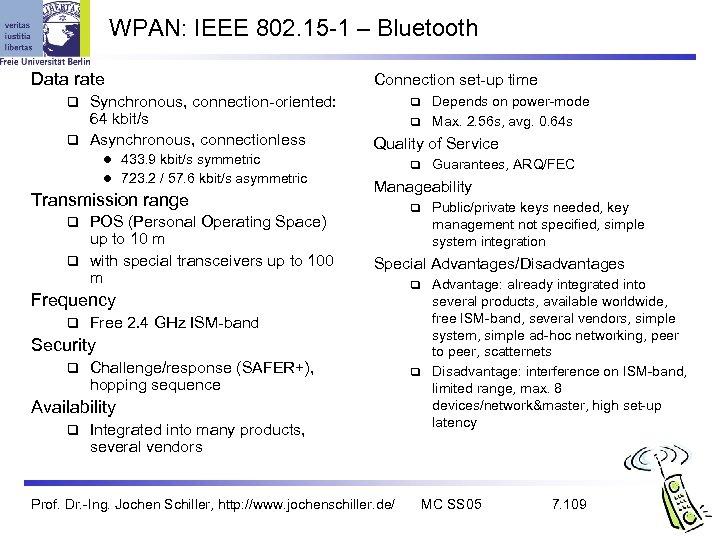
WPAN: IEEE 802. 15 -1 – Bluetooth Data rate Synchronous, connection-oriented: 64 kbit/s Asynchronous, connectionless Connection set-up time Depends on power-mode Max. 2. 56 s, avg. 0. 64 s l 433. 9 kbit/s symmetric l 723. 2 / 57. 6 kbit/s asymmetric Transmission range POS (Personal Operating Space) up to 10 m with special transceivers up to 100 m Quality of Service Manageability Free 2. 4 GHz ISM-band Security Challenge/response (SAFER+), hopping sequence Availability Public/private keys needed, key management not specified, simple system integration Special Advantages/Disadvantages Frequency Guarantees, ARQ/FEC Integrated into many products, several vendors Prof. Dr. -Ing. Jochen Schiller, http: //www. jochenschiller. de/ Advantage: already integrated into several products, available worldwide, free ISM-band, several vendors, simple system, simple ad-hoc networking, peer to peer, scatternets Disadvantage: interference on ISM-band, limited range, max. 8 devices/network&master, high set-up latency MC SS 05 7. 109
WPAN: IEEE 802. 15 – future developments 1 802. 15 -2: Coexistance Coexistence of Wireless Personal Area Networks (802. 15) and Wireless Local Area Networks (802. 11), quantify the mutual interference 802. 15 -3: High-Rate Standard for high-rate (20 Mbit/s or greater) WPANs, while still lowpower/low-cost Data Rates: 11, 22, 33, 44, 55 Mbit/s Quality of Service isochronous protocol Ad hoc peer-to-peer networking Security Low power consumption Low cost Designed to meet the demanding requirements of portable consumer imaging and multimedia applications Prof. Dr. -Ing. Jochen Schiller, http: //www. jochenschiller. de/ MC SS 05 7. 110
WPAN: IEEE 802. 15 – future developments 2 Several working groups extend the 802. 15. 3 standard 802. 15. 3 a: Alternative PHY with higher data rate as extension to 802. 15. 3 Applications: multimedia, picture transmission 802. 15. 3 b: Enhanced interoperability of MAC Correction of errors and ambiguities in the standard 802. 15. 3 c: Alternative PHY at 57 -64 GHz Goal: data rates above 2 Gbit/s Not all these working groups really create a standard, not all standards will be found in products later … Prof. Dr. -Ing. Jochen Schiller, http: //www. jochenschiller. de/ MC SS 05 7. 111
WPAN: IEEE 802. 15 – future developments 3 802. 15 -4: Low-Rate, Very Low-Power Low data rate solution with multi-month to multi-year battery life and very low complexity Potential applications are sensors, interactive toys, smart badges, remote controls, and home automation Data rates of 20 -250 kbit/s, latency down to 15 ms Master-Slave or Peer-to-Peer operation Up to 254 devices or 64516 simpler nodes Support for critical latency devices, such as joysticks CSMA/CA channel access (data centric), slotted (beacon) or unslotted Automatic network establishment by the PAN coordinator Dynamic device addressing, flexible addressing format Fully handshaked protocol for transfer reliability Power management to ensure low power consumption 16 channels in the 2. 4 GHz ISM band, 10 channels in the 915 MHz US ISM band one channel in the European 868 MHz band Basis of the Zig. Bee technology – www. zigbee. org Prof. Dr. -Ing. Jochen Schiller, http: //www. jochenschiller. de/ MC SS 05 7. 112
Zig. Bee Relation to 802. 15. 4 similar to Bluetooth / 802. 15. 1 Pushed by Chipcon, ember, freescale (Motorola), Honeywell, Mitsubishi, Motorola, Philips, Samsung More than 150 members Promoter (40000$/Jahr), Participant (9500$/Jahr), Adopter (3500$/Jahr) No free access to the specifications (only promoters and participants) Zig. Bee platforms comprise IEEE 802. 15. 4 for layers 1 and 2 Zig. Bee protocol stack up to the applications Prof. Dr. -Ing. Jochen Schiller, http: //www. jochenschiller. de/ MC SS 05 7. 113
WPAN: IEEE 802. 15 – future developments 4 Several working groups extend the 802. 15. 4 standard 802. 15. 4 a: Alternative PHY with lower data rate as extension to 802. 15. 4 Properties: precise localization (< 1 m precision), extremely low power consumption, longer range Two PHY alternatives l UWB (Ultra Wideband): ultra short pulses, communication and localization l CSS (Chirp Spread Spectrum): communication only 802. 15. 4 b: Extensions, corrections, and clarifications regarding 802. 15. 4 Usage of new bands, more flexible security mechanisms 802. 15. 5: Mesh Networking Partial meshes, full meshes Range extension, more robustness, longer battery live Not all these working groups really create a standard, not all standards will be found in products later … Prof. Dr. -Ing. Jochen Schiller, http: //www. jochenschiller. de/ MC SS 05 7. 114
Some more IEEE standards for mobile communications IEEE 802. 16: Broadband Wireless Access / Wireless. MAN / Wi. Max Wireless distribution system, e. g. , for the last mile, alternative to DSL 75 Mbit/s up to 50 km LOS, up to 10 km NLOS; 2 -66 GHz band Initial standards without roaming or mobility support 802. 16 e adds mobility support, allows for roaming at 150 km/h l Unclear relation to 802. 20, 802. 16 started as fixed system… IEEE 802. 20: Mobile Broadband Wireless Access (MBWA) Licensed bands < 3. 5 GHz, optimized for IP traffic Peak rate > 1 Mbit/s per user Different mobility classes up to 250 km/h and ranges up to 15 km IEEE 802. 21: Media Independent Handover Interoperability Standardize handover between different 802. x and/or non 802 networks IEEE 802. 22: Wireless Regional Area Networks (WRAN) Radio-based PHY/MAC for use by license-exempt devices on a noninterfering basis in spectrum that is allocated to the TV Broadcast Service Prof. Dr. -Ing. Jochen Schiller, http: //www. jochenschiller. de/ MC SS 05 7. 115
WLAN: Home RF – yet another standard, no success Data rate 0. 8, 1. 6, 5, 10 Mbit/s Transmission range 2. 4 GHz ISM Security Strong encryption, no open access Like DECT & 802 -LANs Special Advantages/Disadvantages Advantage: extended Qo. S support, host/client and peer/peer, power saving, security Disadvantage: future uncertain due to DECT-only devices plus 802. 11 a/b for data Adapter 130€, base station 230€ Availability Up to 8 streams A/V, up to 8 voice streams, priorities, best-effort Manageability Cost 10 ms bounded latency Quality of Service 300 m outdoor, 30 m indoor Frequency Connection set-up time Several products from different vendors, no more support Prof. Dr. -Ing. Jochen Schiller, http: //www. jochenschiller. de/ MC SS 05 7. 116
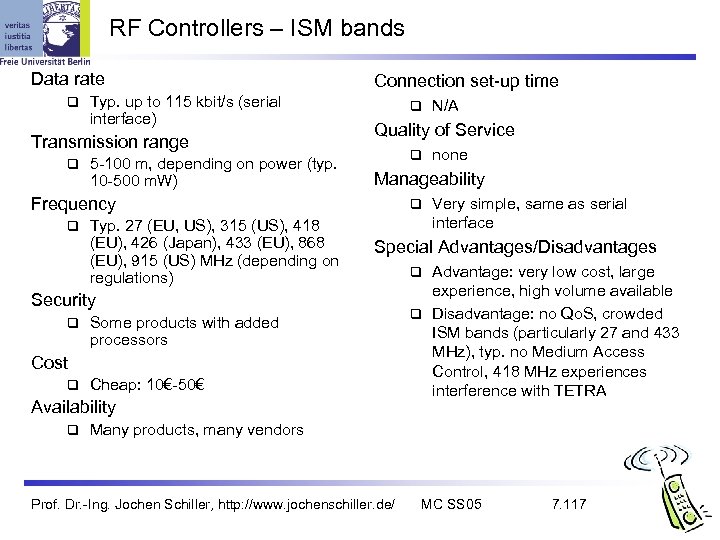
RF Controllers – ISM bands Data rate Typ. up to 115 kbit/s (serial interface) Transmission range 5 -100 m, depending on power (typ. 10 -500 m. W) Connection set-up time Quality of Service Typ. 27 (EU, US), 315 (US), 418 (EU), 426 (Japan), 433 (EU), 868 (EU), 915 (US) MHz (depending on regulations) Some products with added processors Cost Cheap: 10€-50€ Availability Very simple, same as serial interface Special Advantages/Disadvantages Security none Manageability Frequency N/A Advantage: very low cost, large experience, high volume available Disadvantage: no Qo. S, crowded ISM bands (particularly 27 and 433 MHz), typ. no Medium Access Control, 418 MHz experiences interference with TETRA Many products, many vendors Prof. Dr. -Ing. Jochen Schiller, http: //www. jochenschiller. de/ MC SS 05 7. 117
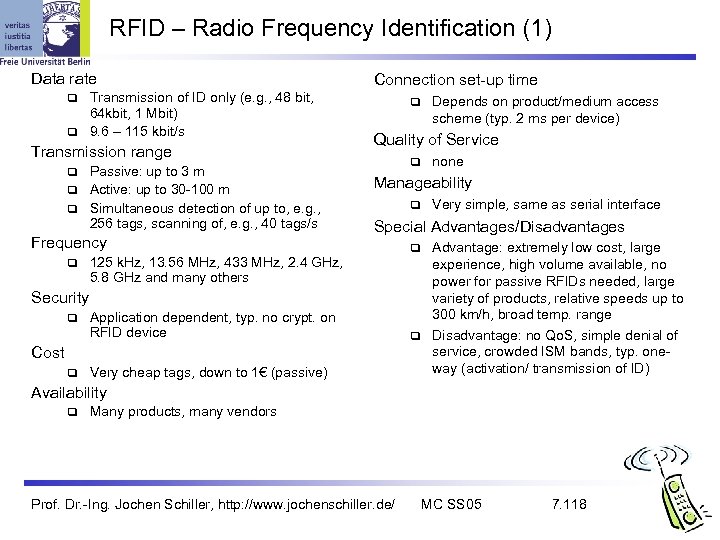
RFID – Radio Frequency Identification (1) Data rate Transmission of ID only (e. g. , 48 bit, 64 kbit, 1 Mbit) 9. 6 – 115 kbit/s Connection set-up time Transmission range Passive: up to 3 m Active: up to 30 -100 m Simultaneous detection of up to, e. g. , 256 tags, scanning of, e. g. , 40 tags/s Frequency Quality of Service Very simple, same as serial interface Special Advantages/Disadvantages Security Application dependent, typ. no crypt. on RFID device none Manageability 125 k. Hz, 13. 56 MHz, 433 MHz, 2. 4 GHz, 5. 8 GHz and many others Depends on product/medium access scheme (typ. 2 ms per device) Very cheap tags, down to 1€ (passive) Cost Advantage: extremely low cost, large experience, high volume available, no power for passive RFIDs needed, large variety of products, relative speeds up to 300 km/h, broad temp. range Disadvantage: no Qo. S, simple denial of service, crowded ISM bands, typ. oneway (activation/ transmission of ID) Availability Many products, many vendors Prof. Dr. -Ing. Jochen Schiller, http: //www. jochenschiller. de/ MC SS 05 7. 118
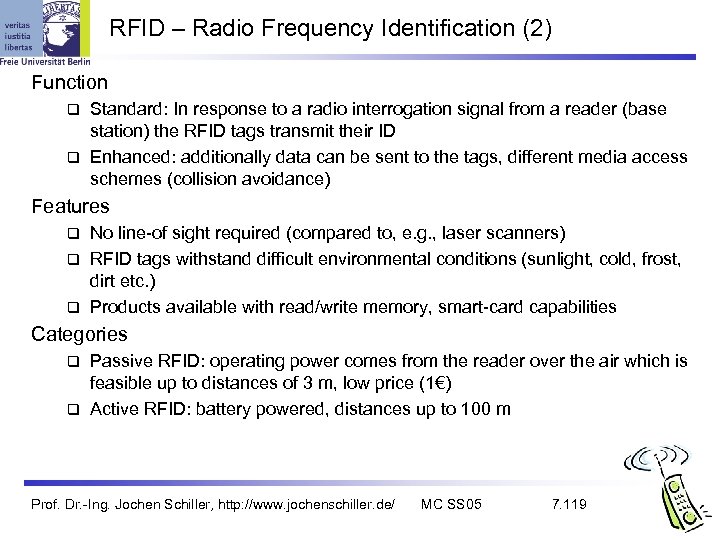
RFID – Radio Frequency Identification (2) Function Standard: In response to a radio interrogation signal from a reader (base station) the RFID tags transmit their ID Enhanced: additionally data can be sent to the tags, different media access schemes (collision avoidance) Features No line-of sight required (compared to, e. g. , laser scanners) RFID tags withstand difficult environmental conditions (sunlight, cold, frost, dirt etc. ) Products available with read/write memory, smart-card capabilities Categories Passive RFID: operating power comes from the reader over the air which is feasible up to distances of 3 m, low price (1€) Active RFID: battery powered, distances up to 100 m Prof. Dr. -Ing. Jochen Schiller, http: //www. jochenschiller. de/ MC SS 05 7. 119
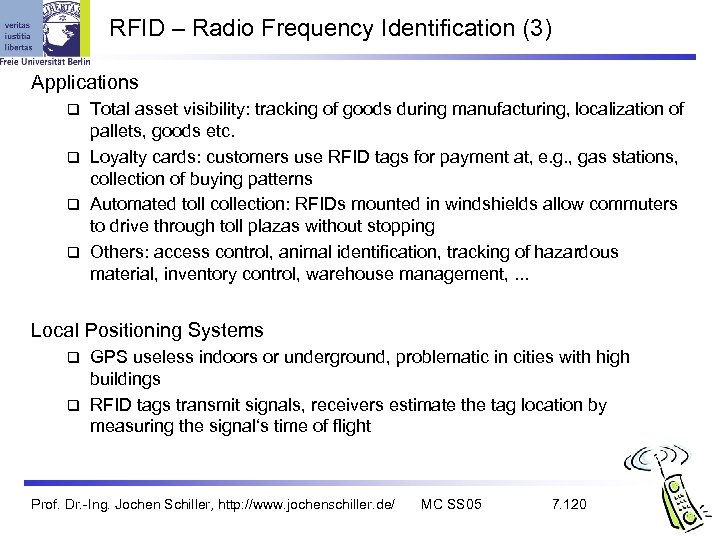
RFID – Radio Frequency Identification (3) Applications Total asset visibility: tracking of goods during manufacturing, localization of pallets, goods etc. Loyalty cards: customers use RFID tags for payment at, e. g. , gas stations, collection of buying patterns Automated toll collection: RFIDs mounted in windshields allow commuters to drive through toll plazas without stopping Others: access control, animal identification, tracking of hazardous material, inventory control, warehouse management, . . . Local Positioning Systems GPS useless indoors or underground, problematic in cities with high buildings RFID tags transmit signals, receivers estimate the tag location by measuring the signal‘s time of flight Prof. Dr. -Ing. Jochen Schiller, http: //www. jochenschiller. de/ MC SS 05 7. 120
RFID – Radio Frequency Identification (4) Security Denial-of-Service attacks are always possible l Interference of the wireless transmission, shielding of transceivers IDs via manufacturing or one time programming Key exchange via, e. g. , RSA possible, encryption via, e. g. , AES Future Trends RTLS: Real-Time Locating System – big efforts to make total asset visibility come true Integration of RFID technology into the manufacturing, distribution and logistics chain Creation of „electronic manifests“ at item or package level (embedded inexpensive passive RFID tags) 3 D tracking of children, patients Prof. Dr. -Ing. Jochen Schiller, http: //www. jochenschiller. de/ MC SS 05 7. 121
RFID – Radio Frequency Identification (5) Devices and Companies AXCESS Inc. , www. axcessinc. com Checkpoint Systems Group, www. checkpointsystems. com GEMPLUS, www. gemplus. com/app/smart_tracking Intermec/Intellitag, www. intermec. com I-Ray Technologies, www. i-ray. com RF Code, www. rfcode. com Texas Instruments, www. ti-rfid. com/id Where. Net, www. wherenet. com Wireless Mountain, www. wirelessmountain. com XCI, www. xci-inc. com Only a very small selection… Prof. Dr. -Ing. Jochen Schiller, http: //www. jochenschiller. de/ MC SS 05 7. 122
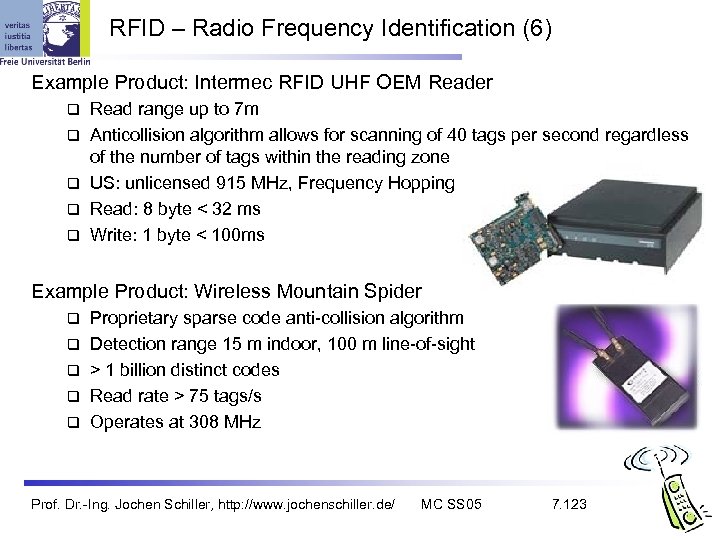
RFID – Radio Frequency Identification (6) Example Product: Intermec RFID UHF OEM Reader Read range up to 7 m Anticollision algorithm allows for scanning of 40 tags per second regardless of the number of tags within the reading zone US: unlicensed 915 MHz, Frequency Hopping Read: 8 byte < 32 ms Write: 1 byte < 100 ms Example Product: Wireless Mountain Spider Proprietary sparse code anti-collision algorithm Detection range 15 m indoor, 100 m line-of-sight > 1 billion distinct codes Read rate > 75 tags/s Operates at 308 MHz Prof. Dr. -Ing. Jochen Schiller, http: //www. jochenschiller. de/ MC SS 05 7. 123
RFID – Radio Frequency Identification (7) Relevant Standards American National Standards Institute l Automatic Identification and Data Capture Techniques l ISO TC 104 / SC 4, www. autoid. org/tc 104_sc 4_wg 2. htm, www. aimglobal. org/standards/rfidstds/TC 104. htm Road Transport and Traffic Telematics l JTC 1/SC 17, www. sc 17. com, www. aimglobal. org/standards/rfidstds/sc 17. htm, Identification and communication l ETSI, www. etsi. org, www. aimglobal. org/standards/rfidstds/ETSI. htm Identification Cards and related devices l ERO, www. ero. dk, www. aimglobal. org/standards/rfidstds/ERO. htm European Telecommunications Standards Institute l JTC 1/SC 31, www. uc-council. com/sc 31/home. htm, www. aimglobal. org/standards/rfidstds/sc 31. htm European Radiocommunications Office l ANSI, www. ansi. org, www. aimglobal. org/standards/rfidstds/ANSIT 6. html CEN TC 278, www. nni. nl, www. aimglobal. org/standards/rfidstds/CENTC 278. htm Transport Information and Control Systems l ISO/TC 204, www. sae. org/technicalcommittees/gits. htm, www. aimglobal. org/standards/rfidstds/ISOTC 204. htm Prof. Dr. -Ing. Jochen Schiller, http: //www. jochenschiller. de/ MC SS 05 7. 124
RFID – Radio Frequency Identification (8) ISO Standards ISO 15418 MH 10. 8. 2 Data Identifiers l EAN. UCC Application Identifiers l ISO 15434 - Syntax for High Capacity ADC Media ISO 15962 - Transfer Syntax ISO 18000 l l l Part 2, 125 -135 k. Hz Part 3, 13. 56 MHz Part 4, 2. 45 GHz Part 5, 5. 8 GHz Part 6, UHF (860 -930 MHz, 433 MHz) ISO 18047 - RFID Device Conformance Test Methods ISO 18046 - RF Tag and Interrogator Performance Test Methods Prof. Dr. -Ing. Jochen Schiller, http: //www. jochenschiller. de/ MC SS 05 7. 125
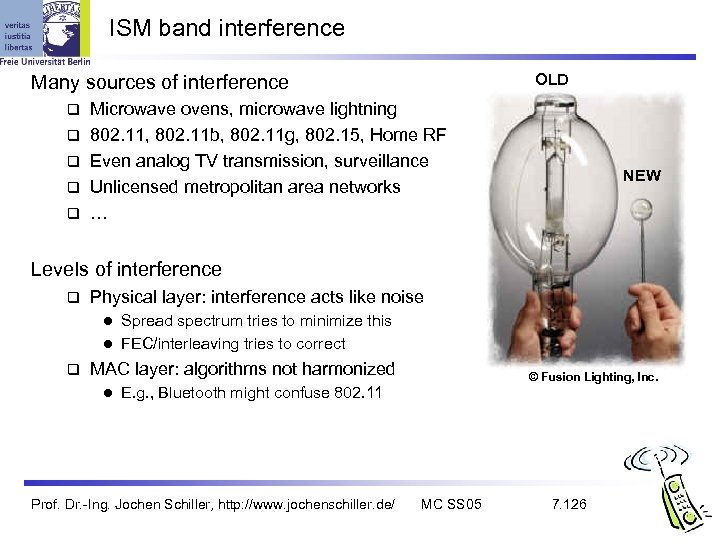
ISM band interference OLD Many sources of interference Microwave ovens, microwave lightning 802. 11, 802. 11 b, 802. 11 g, 802. 15, Home RF Even analog TV transmission, surveillance Unlicensed metropolitan area networks … NEW Levels of interference Physical layer: interference acts like noise Spread spectrum tries to minimize this l FEC/interleaving tries to correct l MAC layer: algorithms not harmonized l © Fusion Lighting, Inc. E. g. , Bluetooth might confuse 802. 11 Prof. Dr. -Ing. Jochen Schiller, http: //www. jochenschiller. de/ MC SS 05 7. 126
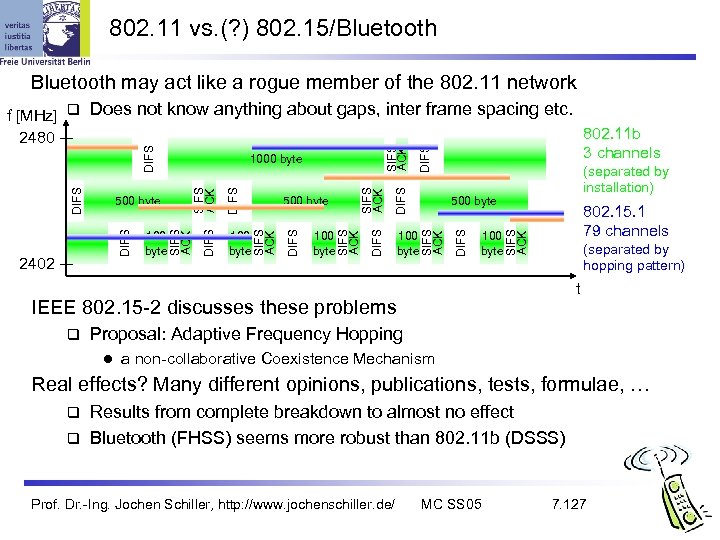
802. 11 vs. (? ) 802. 15/Bluetooth may act like a rogue member of the 802. 11 network 100 byte 802. 15. 1 79 channels SIFS ACK 100 byte DIFS SIFS ACK DIFS 100 byte (separated by installation) 500 byte DIFS 100 byte SIFS ACK 500 byte SIFS ACK DIFS 2402 100 byte DIFS 500 byte SIFS ACK DIFS f [MHz] Does not know anything about gaps, inter frame spacing etc. 802. 11 b 2480 3 channels 1000 byte (separated by hopping pattern) t IEEE 802. 15 -2 discusses these problems Proposal: Adaptive Frequency Hopping l a non-collaborative Coexistence Mechanism Real effects? Many different opinions, publications, tests, formulae, … Results from complete breakdown to almost no effect Bluetooth (FHSS) seems more robust than 802. 11 b (DSSS) Prof. Dr. -Ing. Jochen Schiller, http: //www. jochenschiller. de/ MC SS 05 7. 127
Скачать презентацию Mobile Communications Chapter 7 Wireless LANs Characteristics IEEE
f8a8ae381aca8d9ebe51c8fdf11defd3.ppt