 Скачать презентацию Mobile Communication Systems Part 1 — Introduction
5c55dc1e90e5a1c68dcfa9672d313770.ppt
- Количество слайдов: 49



Mobile Communication Systems Part 1 - Introduction & Principles Professor Fary Z Ghassemlooy School of Computing, Engineering and Information Scinces University of Northumbria U. K. http: //soe. unn. ac. uk/ocr Prof. Z. Ghssemlooy
Reading List - Mobile and Data Communications Systems, D Wong, D Britland, Pub: Artech House - Mobile Communications, A Jagoda, M De. Villepin, Pub: J. Wiley - Mobile Information Systems, Editor: J. Walker, Pub: Artech House -Introduction to Digital Mobile Communications, Y Akaiwa, Pub: J. Wiley - Mobile Communications, 2 nd Ed, J Schiller, ISBN 0 -32112381 -6 Prof. Z. Ghssemlooy
Contents § § § § § Frequency Band History Principles Transmission Properties Cellular Concept Traffic Engineering Propagation Modulation Performance Part I Prof. Z. Ghssemlooy
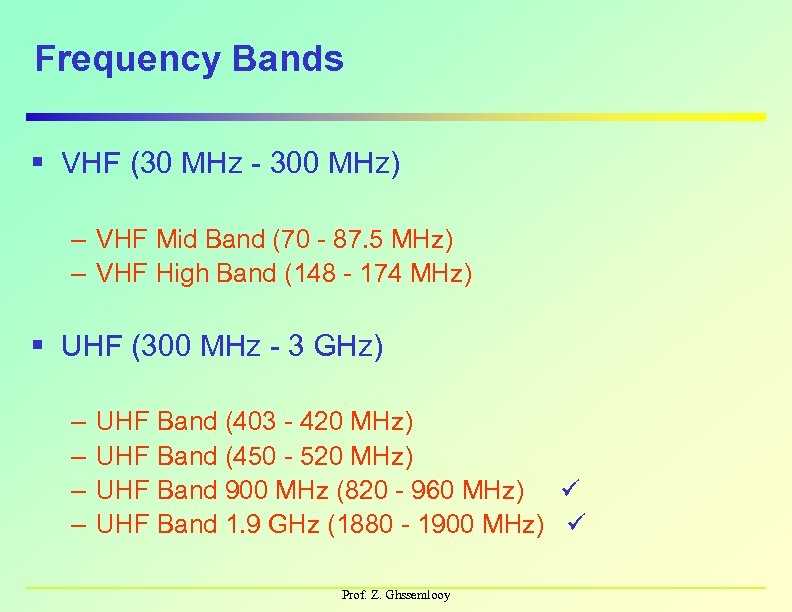
Frequency Bands § VHF (30 MHz - 300 MHz) – VHF Mid Band (70 - 87. 5 MHz) – VHF High Band (148 - 174 MHz) § UHF (300 MHz - 3 GHz) – – UHF Band (403 - 420 MHz) UHF Band (450 - 520 MHz) UHF Band 900 MHz (820 - 960 MHz) UHF Band 1. 9 GHz (1880 - 1900 MHz) Prof. Z. Ghssemlooy
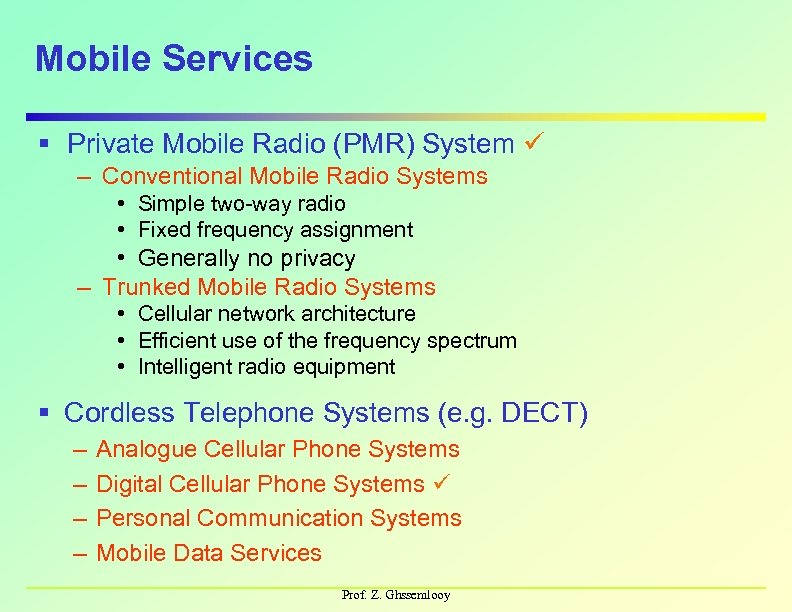
Mobile Services § Private Mobile Radio (PMR) System – Conventional Mobile Radio Systems • Simple two-way radio • Fixed frequency assignment • Generally no privacy – Trunked Mobile Radio Systems • Cellular network architecture • Efficient use of the frequency spectrum • Intelligent radio equipment § Cordless Telephone Systems (e. g. DECT) – – Analogue Cellular Phone Systems Digital Cellular Phone Systems Personal Communication Systems Mobile Data Services Prof. Z. Ghssemlooy
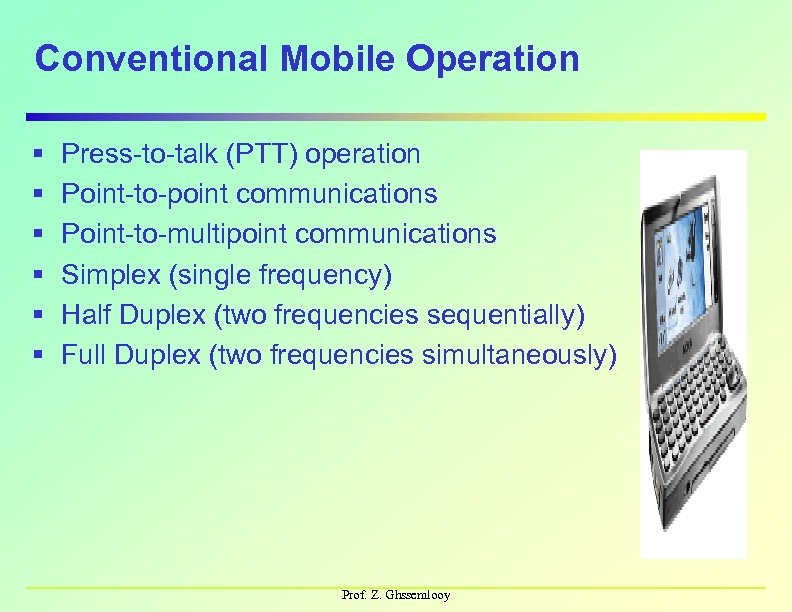
Conventional Mobile Operation § § § Press-to-talk (PTT) operation Point-to-point communications Point-to-multipoint communications Simplex (single frequency) Half Duplex (two frequencies sequentially) Full Duplex (two frequencies simultaneously) Prof. Z. Ghssemlooy
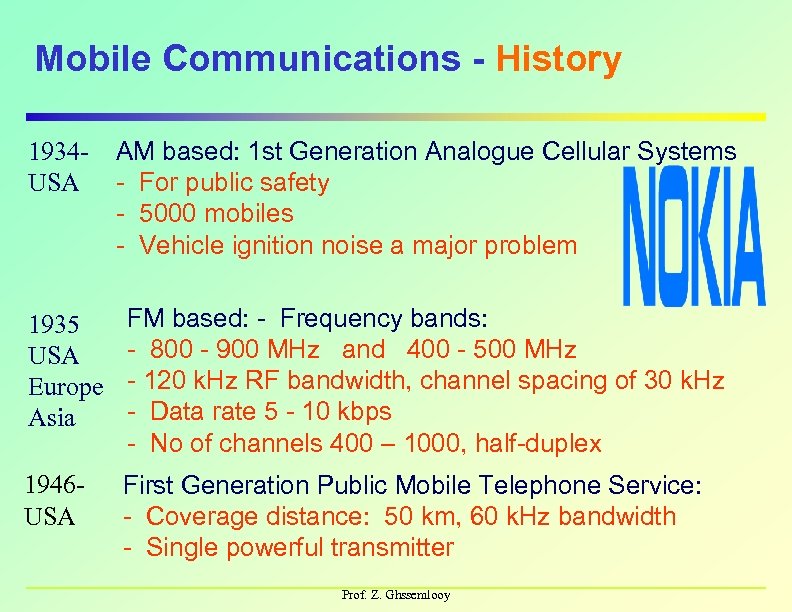
Mobile Communications - History 1934 USA AM based: 1 st Generation Analogue Cellular Systems - For public safety - 5000 mobiles - Vehicle ignition noise a major problem 1935 USA Europe Asia FM based: - Frequency bands: - 800 - 900 MHz and 400 - 500 MHz - 120 k. Hz RF bandwidth, channel spacing of 30 k. Hz - Data rate 5 - 10 kbps - No of channels 400 – 1000, half-duplex 1946 USA First Generation Public Mobile Telephone Service: - Coverage distance: 50 km, 60 k. Hz bandwidth - Single powerful transmitter Prof. Z. Ghssemlooy
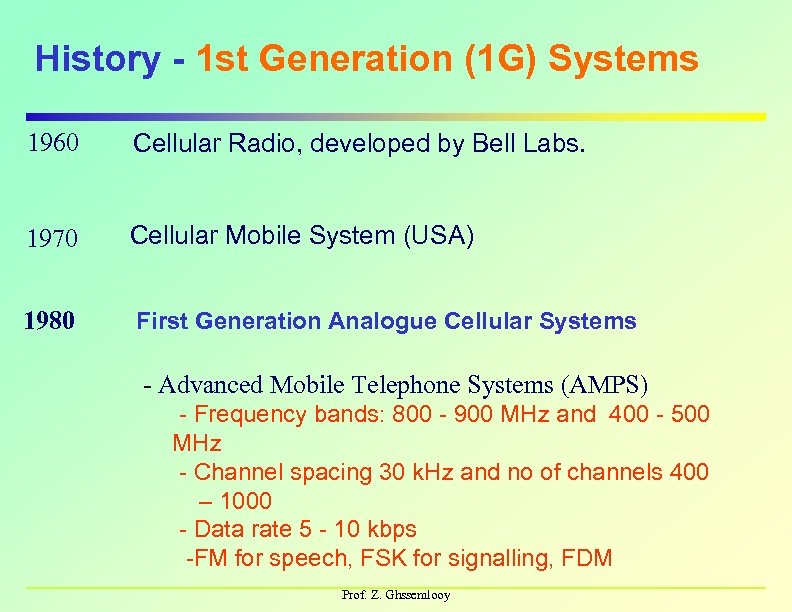
History - 1 st Generation (1 G) Systems 1960 Cellular Radio, developed by Bell Labs. 1970 Cellular Mobile System (USA) 1980 First Generation Analogue Cellular Systems - Advanced Mobile Telephone Systems (AMPS) - Frequency bands: 800 - 900 MHz and 400 - 500 MHz - Channel spacing 30 k. Hz and no of channels 400 – 1000 - Data rate 5 - 10 kbps -FM for speech, FSK for signalling, FDM Prof. Z. Ghssemlooy
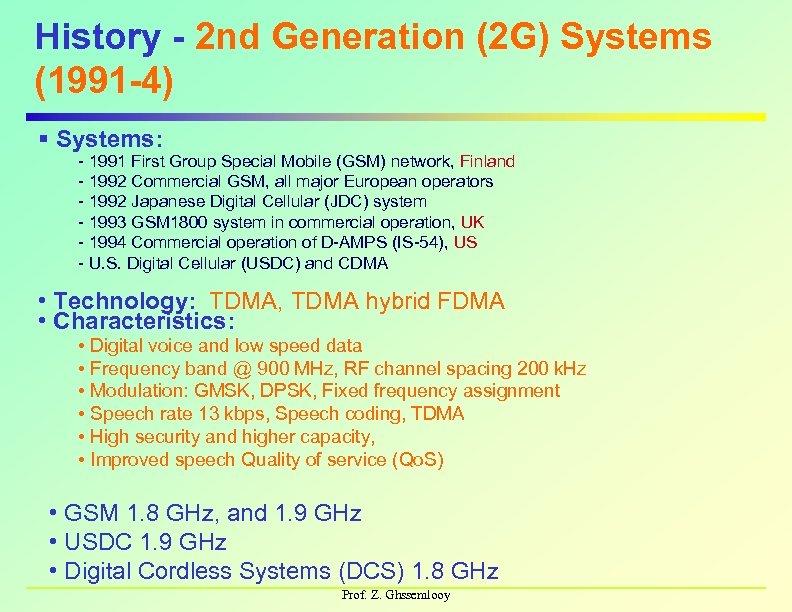
History - 2 nd Generation (2 G) Systems (1991 -4) § Systems: - 1991 First Group Special Mobile (GSM) network, Finland - 1992 Commercial GSM, all major European operators - 1992 Japanese Digital Cellular (JDC) system - 1993 GSM 1800 system in commercial operation, UK - 1994 Commercial operation of D-AMPS (IS-54), US - U. S. Digital Cellular (USDC) and CDMA • Technology: TDMA, TDMA hybrid FDMA • Characteristics: • Digital voice and low speed data • Frequency band @ 900 MHz, RF channel spacing 200 k. Hz • Modulation: GMSK, DPSK, Fixed frequency assignment • Speech rate 13 kbps, Speech coding, TDMA • High security and higher capacity, • Improved speech Quality of service (Qo. S) • GSM 1. 8 GHz, and 1. 9 GHz • USDC 1. 9 GHz • Digital Cordless Systems (DCS) 1. 8 GHz Prof. Z. Ghssemlooy
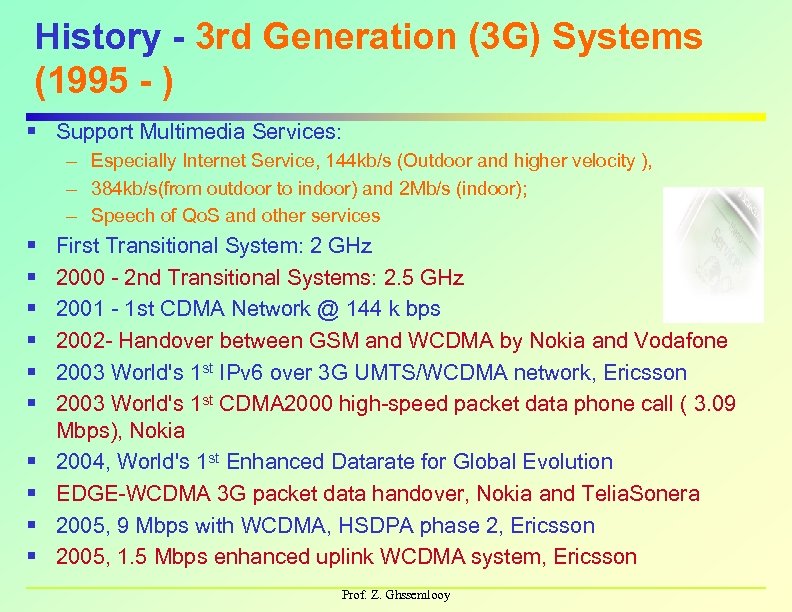
History - 3 rd Generation (3 G) Systems (1995 - ) § Support Multimedia Services: – Especially Internet Service, 144 kb/s (Outdoor and higher velocity ), – 384 kb/s(from outdoor to indoor) and 2 Mb/s (indoor); – Speech of Qo. S and other services § § § § § First Transitional System: 2 GHz 2000 - 2 nd Transitional Systems: 2. 5 GHz 2001 - 1 st CDMA Network @ 144 k bps 2002 - Handover between GSM and WCDMA by Nokia and Vodafone 2003 World's 1 st IPv 6 over 3 G UMTS/WCDMA network, Ericsson 2003 World's 1 st CDMA 2000 high-speed packet data phone call ( 3. 09 Mbps), Nokia 2004, World's 1 st Enhanced Datarate for Global Evolution EDGE-WCDMA 3 G packet data handover, Nokia and Telia. Sonera 2005, 9 Mbps with WCDMA, HSDPA phase 2, Ericsson 2005, 1. 5 Mbps enhanced uplink WCDMA system, Ericsson Prof. Z. Ghssemlooy
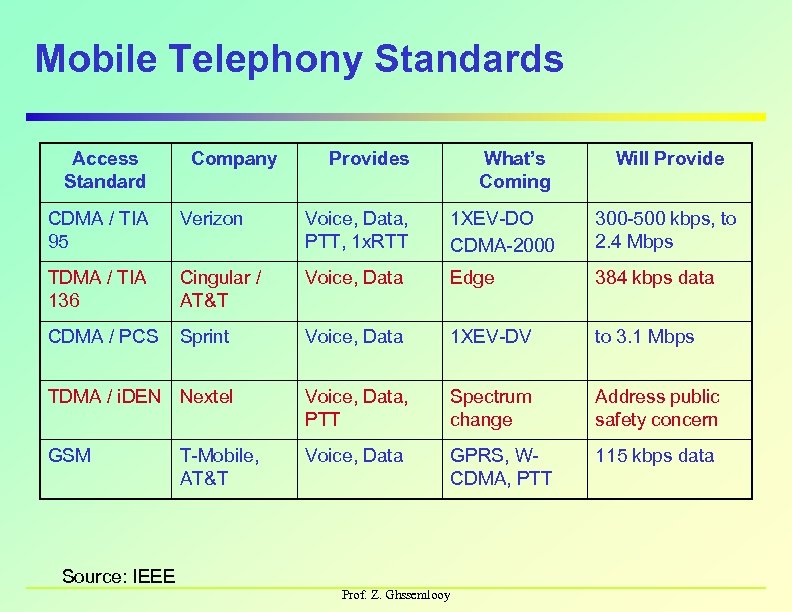
Mobile Telephony Standards Access Standard Company Provides What’s Coming Will Provide CDMA / TIA 95 Verizon Voice, Data, PTT, 1 x. RTT 1 XEV-DO CDMA-2000 300 -500 kbps, to 2. 4 Mbps TDMA / TIA 136 Cingular / AT&T Voice, Data Edge 384 kbps data CDMA / PCS Sprint Voice, Data 1 XEV-DV to 3. 1 Mbps TDMA / i. DEN Nextel Voice, Data, PTT Spectrum change Address public safety concern GSM Voice, Data GPRS, WCDMA, PTT 115 kbps data T-Mobile, AT&T Source: IEEE Prof. Z. Ghssemlooy
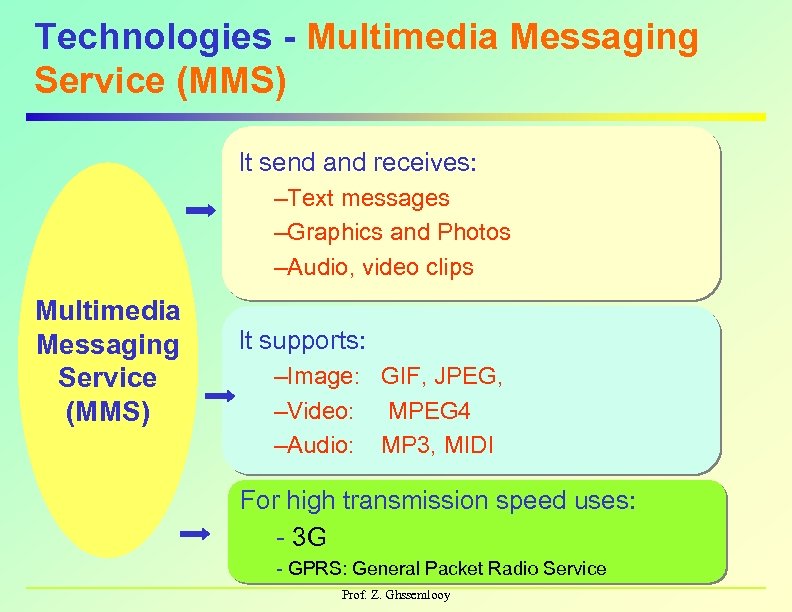
Technologies - Multimedia Messaging Service (MMS) It send and receives: –Text messages –Graphics and Photos –Audio, video clips Multimedia Messaging Service (MMS) It supports: –Image: GIF, JPEG, –Video: MPEG 4 –Audio: MP 3, MIDI For high transmission speed uses: - 3 G - GPRS: General Packet Radio Service Prof. Z. Ghssemlooy
Technologies - General Packet Radio Service (GPRS) § Packet based: – subs are always on line – easy and quick access § Provide high speed wireless Internet and data communications § Speed four times higher than conventional GSM systems Prof. Z. Ghssemlooy
Technologies - Bluetooth § § § Short range RF technology A global standard No wiring Data and voice communications Offers ad hoc network and synchronicity between all personal devices Prof. Z. Ghssemlooy
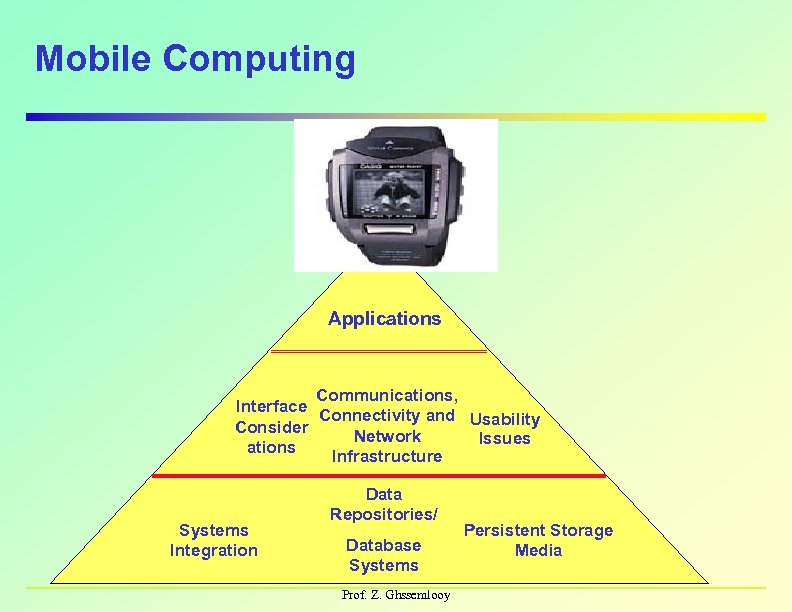
Mobile Computing Applications Communications, Interface Connectivity and Usability Consider Network Issues ations Infrastructure Systems Integration Data Repositories/ Database Systems Prof. Z. Ghssemlooy Persistent Storage Media
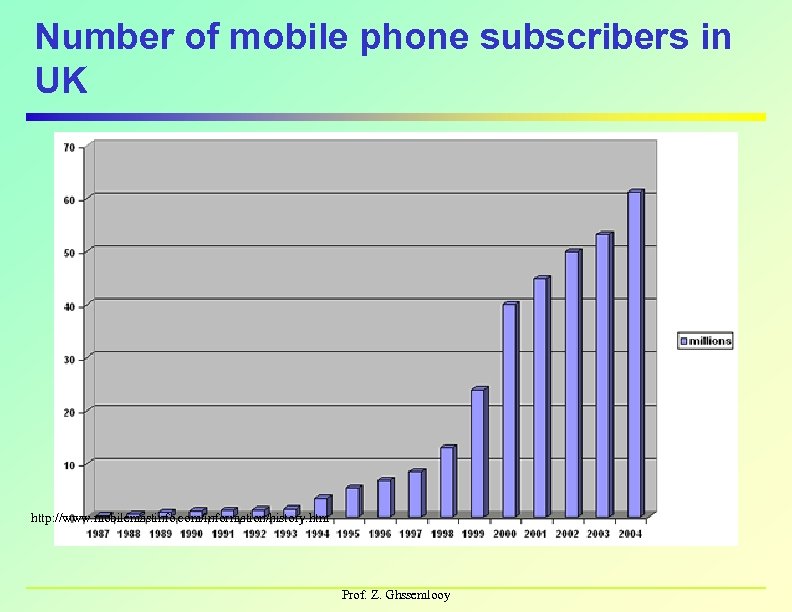
Number of mobile phone subscribers in UK http: //www. mobilemastinfo. com/information/history. htm Prof. Z. Ghssemlooy
Mobile in UK § Usage – – "61. 2 million mobile phone subscribers 85% households have mobile phones 9% UK households have mobile phones but no landlines 27% of all calls are made from mobile phones § Total revenues – exceed those of fixed-line calls – Mobile calls almost doubled (from 34 billion minutes to 62 billion) between 2000 and 2004. – Between 2003 and 2004, mobile telecoms revenues increased by 16% to £ 12. 3 billion. § 3 G mobile telephony is still in its infancy, with 2. 5 million subscribers by the end of 2004. " ‘The Communications Market 2005’ Prof. Z. Ghssemlooy
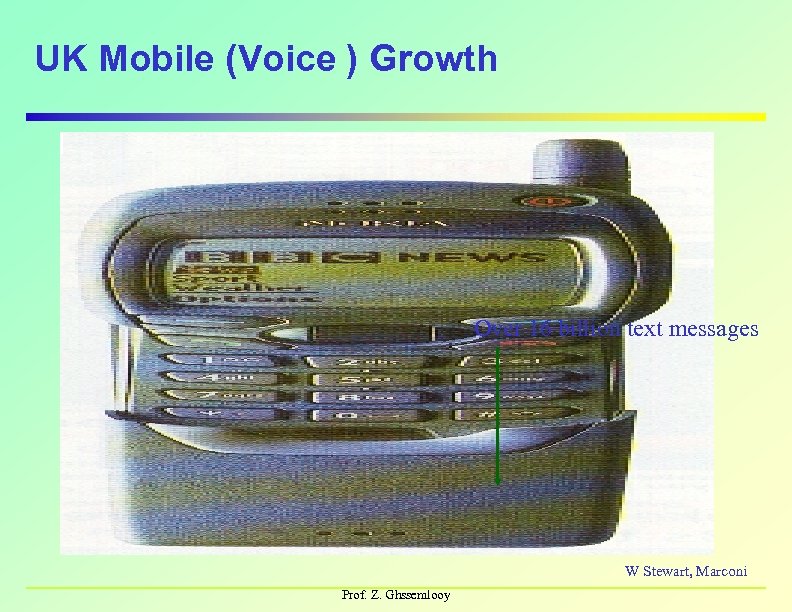
UK Mobile (Voice ) Growth Over 16 billion text messages W Stewart, Marconi Prof. Z. Ghssemlooy
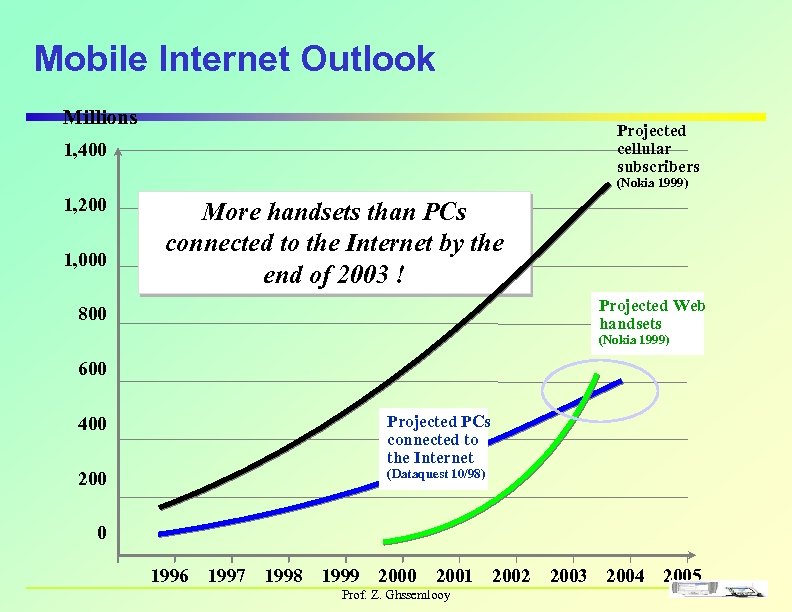
Mobile Internet Outlook Millions Projected cellular subscribers 1, 400 (Nokia 1999) 1, 200 1, 000 More handsets than PCs connected to the Internet by the end of 2003 ! Projected Web handsets 800 (Nokia 1999) 600 Projected PCs connected to the Internet 400 (Dataquest 10/98) 200 0 1996 1997 1998 1999 2000 2001 2002 Prof. Z. Ghssemlooy 2003 2004 2005
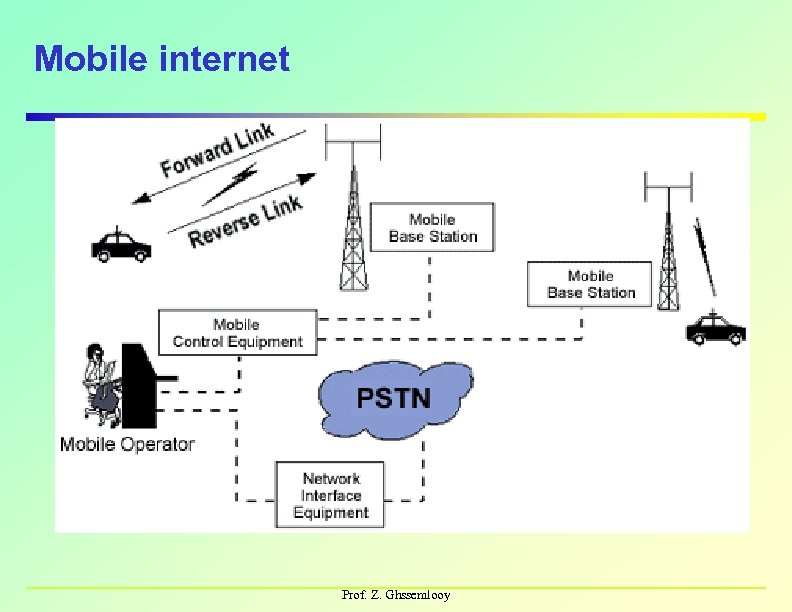
Mobile internet Prof. Z. Ghssemlooy
Mobile Network in UK 5 network operators 45, 000 base station sites. § 2/3 are installed on existing buildings or structures. § < 2% are mounted on schools. Additional mobile phone base stations will need to be built to support 3 G services. It is possible that the number of base station sites will rise to 50, 000 by 2007. Prof. Z. Ghssemlooy
Mobile Technology- Applications § Transport – – transmission of news, road condition, weather, music via DAB personal communication using GSM position and tracking via GPS local ad-hoc network with vehicles close-by to prevent accidents, guidance system, redundancy – vehicle data (e. g. , from buses, high-speed trains) can be transmitted in advance for maintenance § Emergencies – early transmission of patient data to the hospital, current status, first diagnosis – replacement of a fixed infrastructure in case of earthquakes, hurricanes, fire etc. – crisis, war, . . . Prof. Z. Ghssemlooy
Mobile Technology- Applications § Business - Traveling salesmen – direct access to customer files stored in a central location – consistent databases for all agents/clients – mobile office § Entertainment, education – outdoor Internet access – intelligent travel guide with up-to-date location dependent information – ad-hoc networks for multi user games § Healthcare – Health Care Support Prof. Z. Ghssemlooy
Mobile Communications - Definition § Designed to operate over a very large area with a limited bandwidth § A cellular mobile comms. system uses a large number of low-power wireless transmitters (100 W oe less) § Offers larger capacity through cell splitting § Variable power levels allow cells to be sized according to subscriber density& demand within a particular region § As mobile users travel from cell to cell, their conversations are handed off between cells § Channels (frequencies) used in one cell can be reused in another cell some distance away Prof. Z. Ghssemlooy
Mobile Communications - Principles § Wave propagation mechanism is closely affected by the wavelengths of the propagating frequency § Uses a separate radio channel to talk to the cell site § Cell site talks to many mobiles at once, using one channel per mobile § Channels use a pair of frequencies for: • forward link for transmitting from the cell site • reverse link for the cell site to receive calls from the users § Radio energy dissipates over distance, so mobiles must stay near the base station to maintain communications § Basic structure of mobile networks includes telephone systems and radio services Prof. Z. Ghssemlooy
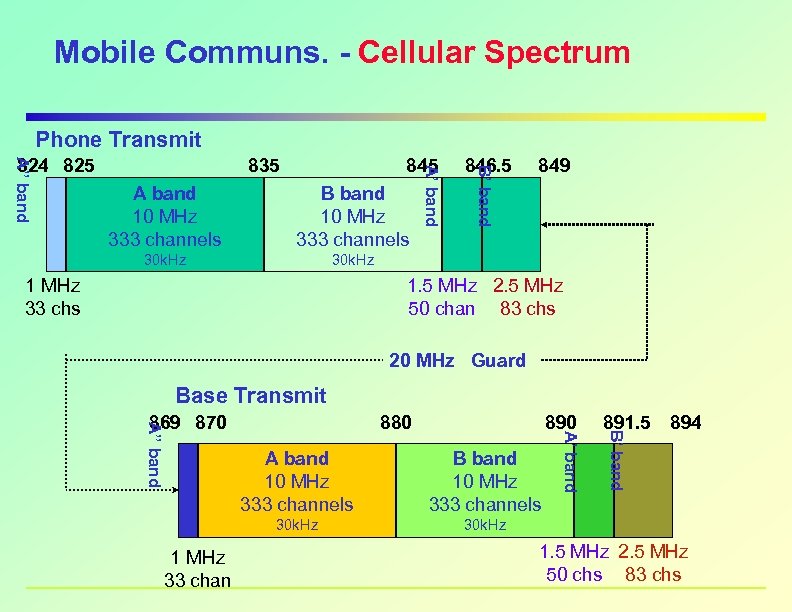
Mobile Communs. - Cellular Spectrum Phone Transmit 845 A band 10 MHz 333 channels B band 10 MHz 333 channels 30 k. Hz 846. 5 B’ band 835 A’ band A” band 824 825 849 30 k. Hz 1 MHz 33 chs 1. 5 MHz 2. 5 MHz 50 chan 83 chs 20 MHz Guard Base Transmit 890 B band 10 MHz 333 channels 30 k. Hz 1 MHz 33 chan A band 10 MHz 333 channels 891. 5 B’ band 880 A’ band A” band 869 870 894 30 k. Hz 1. 5 MHz 2. 5 MHz 50 chs 83 chs
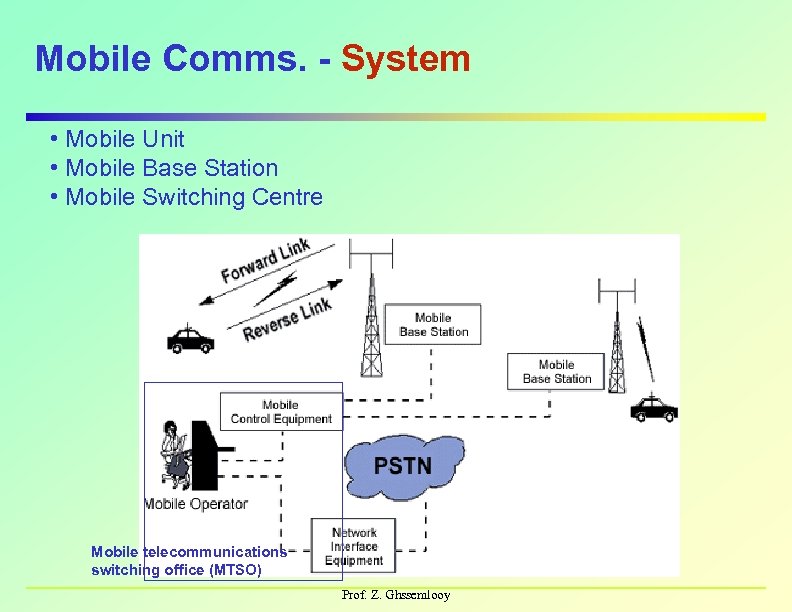
Mobile Comms. - System • Mobile Unit • Mobile Base Station • Mobile Switching Centre Mobile telecommunications switching office (MTSO) Prof. Z. Ghssemlooy
Mobile Comms. - Components § Mobile Base Station (MBS): – includes – an antenna, – a controller, – a number of receivers § Mobile telecommunications switching office (MTSO) – connects calls between mobile units § Channels between mobile unit and MBS – Control channels: to exchange information related to setting up and maintaining calls – Traffic channels: to carry voice or data connection between users Prof. Z. Ghssemlooy
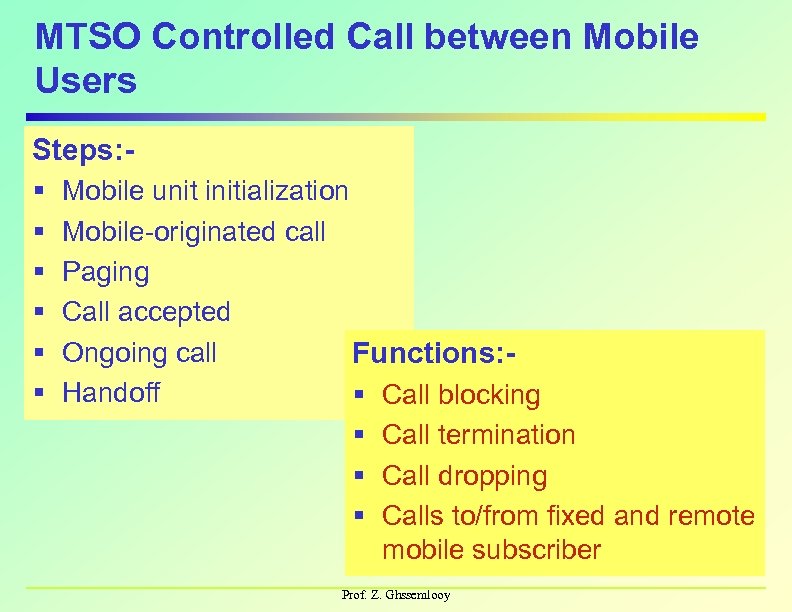
MTSO Controlled Call between Mobile Users Steps: § § § Mobile unit initialization Mobile-originated call Paging Call accepted Ongoing call Functions: Handoff § Call blocking § Call termination § Call dropping § Calls to/from fixed and remote mobile subscriber Prof. Z. Ghssemlooy
Mobile Radio Environment § § § § § Propagation Path Loss Multipath Fading Frequency-Selective Fading Doppler Shift Co-Channel Interference Adjacent Channel Interference Man-Made Noise Urban Environment Suburban Environment Rural Environment Prof. Z. Ghssemlooy
System Characteristics § Frequency sharing amongst users § Multipath interference environment § Line-of sight coverage (UHF) § High base station antenna (30 m) § Low mobile antenna (1. 5 m - 3 m) § Beyond Line-of-sight (VHF) § Long distance (HF) Prof. Z. Ghssemlooy
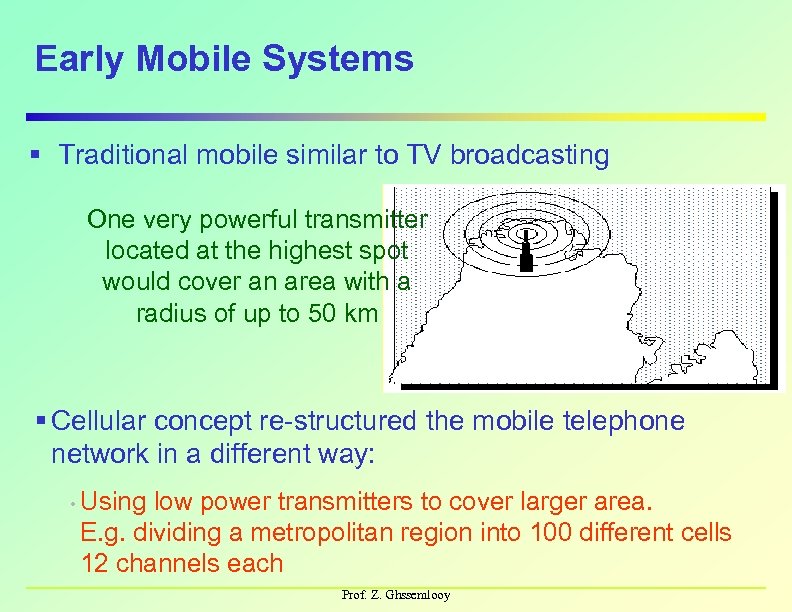
Early Mobile Systems § Traditional mobile similar to TV broadcasting One very powerful transmitter located at the highest spot would cover an area with a radius of up to 50 km § Cellular concept re-structured the mobile telephone network in a different way: • Using low power transmitters to cover larger area. E. g. dividing a metropolitan region into 100 different cells 12 channels each Prof. Z. Ghssemlooy
Digital Cellular- what does it offers? Ø Best quality compared with analogue system Ø Improved bandwidth efficiency - Reduced from 30 k. Hz to 10 k. Hz, and then to 5 k. Hz. This is achieved via 3 -time-slot Time Division Multiple Access (TDMA) (i. e. three pairs of people using a 30 k. Hz radio channel simultaneously) Ø Use of micro-cellular technology to accommodate smaller and smaller cells particularly around the new frequency band of 2 GHz Ø Improved frequency reuse Prof. Z. Ghssemlooy
Transmission Properties § Deep Radio Shadow § Radio Horizon § Reflection, Refraction and Scattering § Multi-path § Attenuation § Bandwidth § Delay Distortion § Noise and Interference Prof. Z. Ghssemlooy
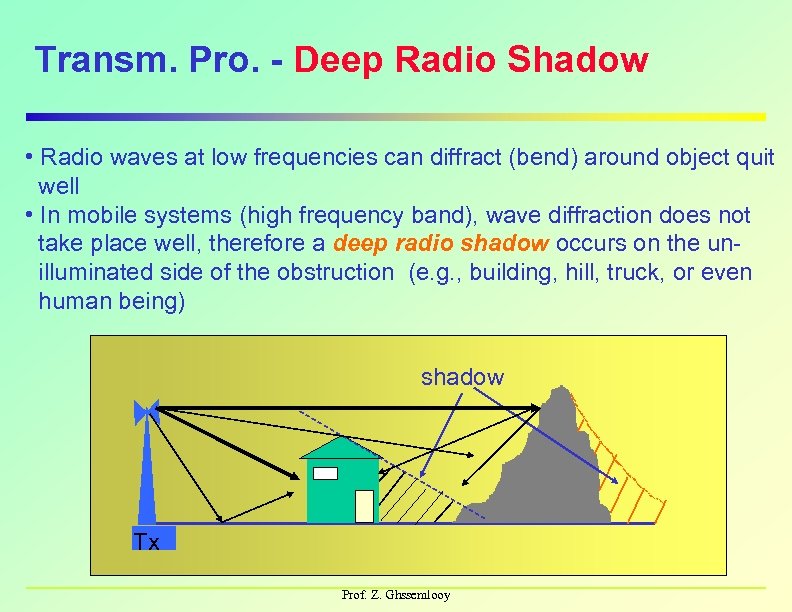
Transm. Pro. - Deep Radio Shadow • Radio waves at low frequencies can diffract (bend) around object quit well • In mobile systems (high frequency band), wave diffraction does not take place well, therefore a deep radio shadow occurs on the unilluminated side of the obstruction (e. g. , building, hill, truck, or even human being) shadow Tx Prof. Z. Ghssemlooy
Transm. Pro. - Radio Horizon (1/2) • Is 30% farther from the transmitting antenna than the equivalent visible horizon due to the reduction of the refraction in the upper atmosphere as compared to that at ground level. Beyond radio horizon, the signal strength falls very rapidly so that in areas well beyond the horizon the same frequency can be reused without causing interference. • The higher the transmitter antenna, the further away is its radio horizon. Prof. Z. Ghssemlooy
Transm. Pro. - Radio Horizon (2/2) § The coverage area (not the radius) is approximately proportional to the antenna heights of both transmitter and receiver. § With a higher transmitter tower, the far flung horizon prevents close reuse of the same frequency. § Between the transmitter and horizon, in open, flat country, the received power reduces approximately as the inverse fourth power of distance from the transmitter (as we see later on). Prof. Z. Ghssemlooy
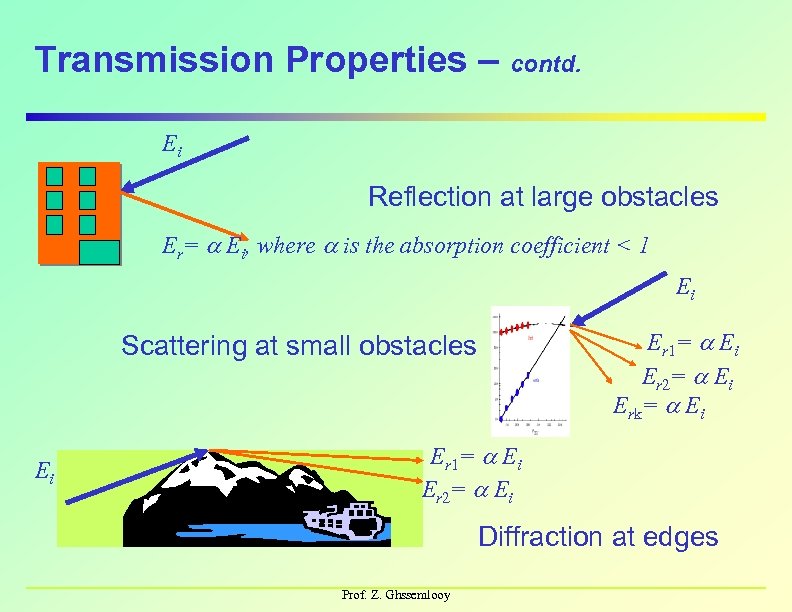
Transmission Properties – contd. Ei Reflection at large obstacles Er= Ei, where is the absorption coefficient < 1 Ei Er 1= Ei Er 2= Ei Erk= Ei Scattering at small obstacles Ei Er 1= Ei Er 2= Ei Diffraction at edges Prof. Z. Ghssemlooy
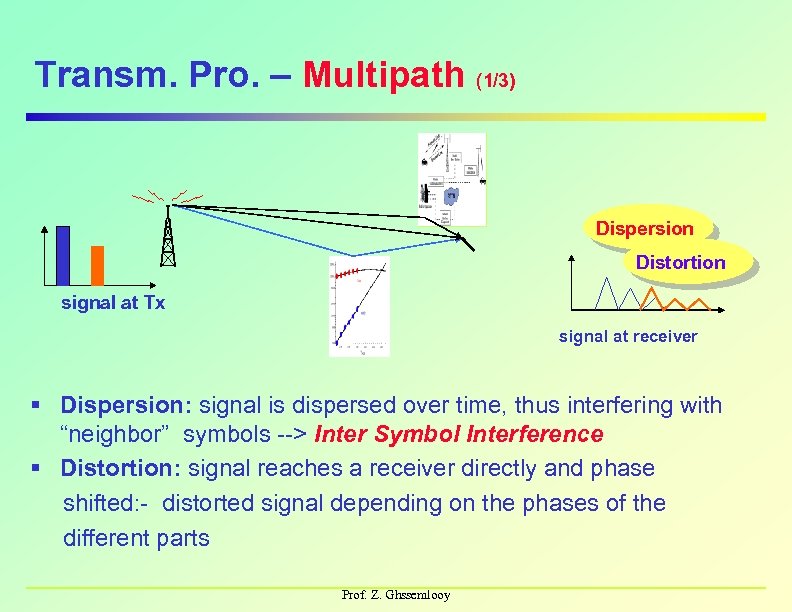
Transm. Pro. – Multipath (1/3) Dispersion Distortion signal at Tx signal at receiver § Dispersion: signal is dispersed over time, thus interfering with “neighbor” symbols --> Inter Symbol Interference § Distortion: signal reaches a receiver directly and phase shifted: - distorted signal depending on the phases of the different parts Prof. Z. Ghssemlooy
Transm. Pro. - Attenuation • The strength (amplitude) of the signals reduces as it propagate through the channel. This is called signal attenuation or loss, which is due to: • Absorption of energy • Scattering of energy • Limits the maximum coverage distance. • Can be overcome by in line amplification. High frequencies penetrates building fairly well, mostly through doors, windows, and thin non-metallic roofs. Typical mean building penetration losses are 10 to 20 d. B, but penetration losses as high as 40 d. B have been encountered. Prof. Z. Ghssemlooy
Transm. Pro. - Bandwidth • All real channels have a limited bandwidth. • Not all the frequency components of transmitted signal will pass through the channel. • At the receiver, exact regeneration of the original signal becomes quite difficult. • Resulting in the received signal distortion Prof. Z. Ghssemlooy
Transm. Pro. – Multipath Fading In a multipath propagation environment signal are: - Generally added to strengthen the received signal - At some point they subtract from one another, thus causing fading, (at approximately half wavelength intervals). - The fade power level is typically 20 d. B weaker than the local average field strength. Fades that are 40 d. B weaker are not uncommon. - The combination of shadowing and multipath fading results in a radio field that varies wildly over a short ranges (up to 60 or 70 d. B difference between the maximum and minimum street level value within a 100 m 2). Prof. Z. Ghssemlooy
Transm. Pro. - Delay Distortion • Critical in complex waveform transmission, such as Digital Signals, where different frequency components of the same signal travel at slightly different speeds. • As the propagation link increases, fast components of one bit (edges) may eventually catch up the proceeding slow moving components of the bit (flat top). Thus resulting in distortion. Prof. Z. Ghssemlooy
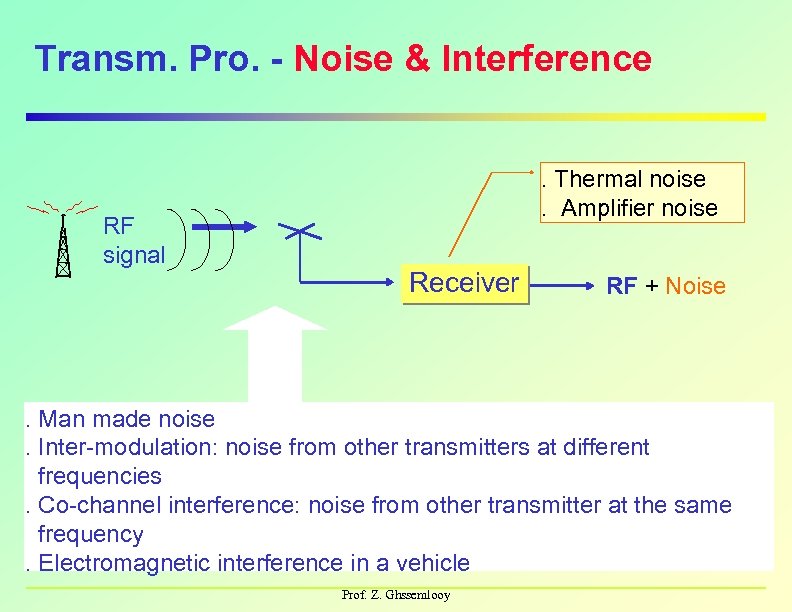
Transm. Pro. - Noise & Interference RF signal . Thermal noise. Amplifier noise Receiver RF + Noise . Man made noise. Inter-modulation: noise from other transmitters at different frequencies. Co-channel interference: noise from other transmitter at the same frequency. Electromagnetic interference in a vehicle Prof. Z. Ghssemlooy
Mobile Phones Technology Disadvantages Although the development of mobile phones brought convenient and advantages to the world. But the disadvantages brought along with the fast grown technology cannot be ignored. These problems not only influenced people personally but also the society at large. § Symptoms caused by the radiation of mobile phones are: – headache, earaches, blurring of vision and even causing cancer Though, these problems are still under research. Mobile phone users are advice to reduce the usage on mobile phones if it is possible. § Mobile phone addiction. – Mobile phone addiction is becoming one of the biggest non-drug addictions in the 21 st century in particular among the teenagers. – New models of mobile phones are released almost everyday. In order to get up-to-date, people tend to change their mobile phones once in a while. These became habits among the mobile phone users causing them to spend unnecessary cost on mobile bills and Prof. Z. Ghssemlooy
Mobile Phone Technology - Future Development § Mobile phones are getting more and more sophisticated, just like computer § The technology is growing everyday with different functions and usage § From the network system from mobile phones, it is still developing. – The new 3 G system had just been launched not long ago, – 4 G system expected in 2010. It is expected that the 4 G system will be able to deliver • • a much faster speed up to 100 Mb per second during connection, tighter network security High quality during communication no matter on voice or video calls. security system, and surveillance on certain items. The 4 G system will be expected to be launched in 2010. Prof. Z. Ghssemlooy
Mobile Phone Technology - Future Development § Mobile phone, the piece of communication device itself is also becoming a multi functioned device. Smartphones and PDA phones are already launched in the market. § Mobile phone with computing functions replacing lap -tops Prof. Z. Ghssemlooy
Summary § § § History Mobile technologies Principle Characteristics Transmission properties Prof. Z. Ghssemlooy
Next Lecture Cellular Concept Prof. Z. Ghssemlooy
Скачать презентацию Mobile Communication Systems Part 1 — Introduction
5c55dc1e90e5a1c68dcfa9672d313770.ppt