


 Скачать презентацию MOA-II Microlensing Survey Takahiro Sumi Nagoya University the
3616817b070e657ba83e421f92cbc04f.ppt
- Количество слайдов: 44
 MOA-II Microlensing Survey Takahiro Sumi (Nagoya University) the MOA collaboration Abe, F; Bennett, P. D; Bond, I. A. ; Fukui, A; Furusawa, K; Hearnshaw, J. B. ; Itow, Y; Kilmartin, P. M. ; Koki, K; Masuda, K. ; Matsubara, Y. ; Miyake, N; Muraki, Y. ; Nagaya, M; Okumura, M; Ohnishi, K; Rattenbury, N. J. ; Saitou, T; Sako, T. ; Sullivan, D. J. ; Sumi, T. ; Tristram, P. ; Wood, J. N. ; Yock, P. C. M.
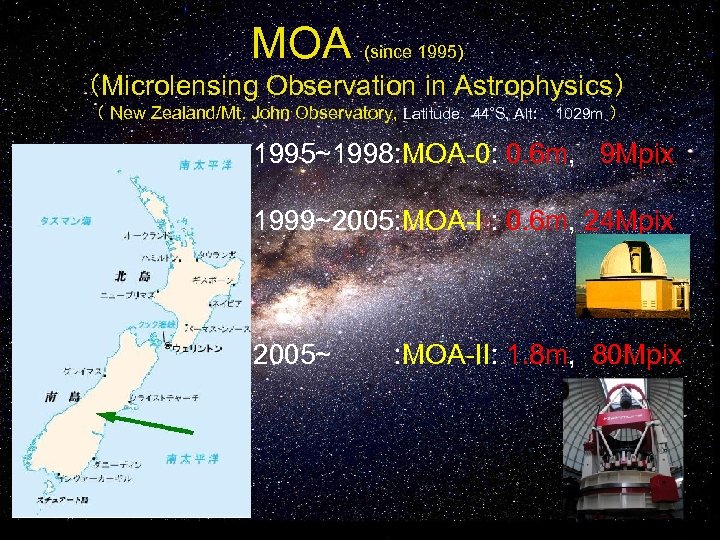 MOA (since 1995) (Microlensing Observation in Astrophysics) ( New Zealand/Mt. John Observatory, Latitude: 44 S, Alt: 1029 m ) 1995~1998: MOA-0: 0. 6 m, 9 Mpix 1999~2005: MOA-I : 0. 6 m, 24 Mpix 2005~ : MOA-II: 1. 8 m, 80 Mpix
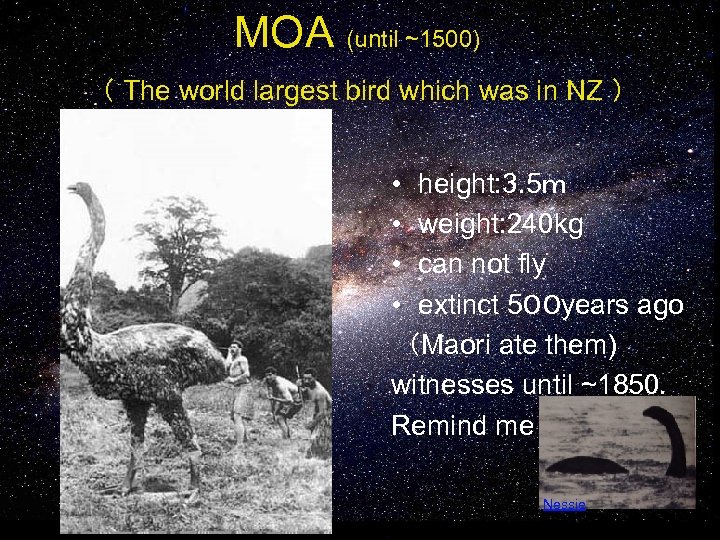 MOA (until ~1500) ( The world largest bird which was in NZ ) • height: 3. 5m • weight: 240 kg • can not fly • extinct 500 years ago (Maori ate them) witnesses until ~1850. Remind me … Nessie
 MOA’s scientific goals 1, Galactic Dark Matter (towards the LMC & SMC) Halo MACHOs or self-lensing?
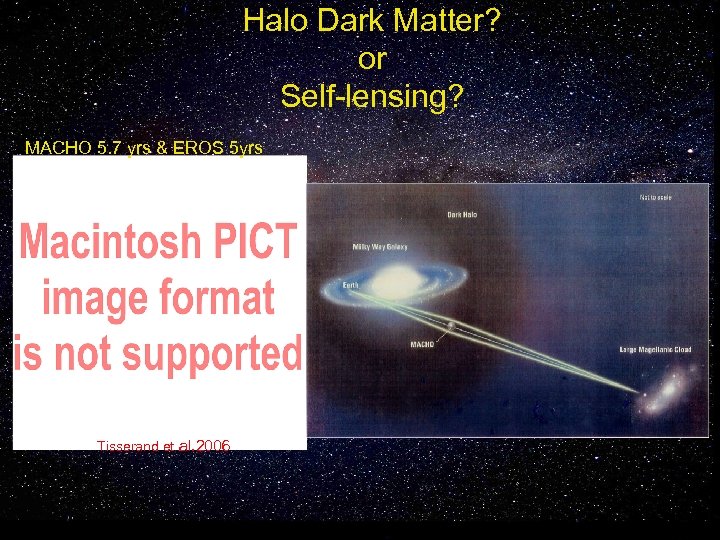 Halo Dark Matter? or Self-lensing? MACHO 5. 7 yrs & EROS 5 yrs Tisserand et al. 2006
 MOA’s scientific goals 1, Galactic Dark Matter (towards the LMC & SMC) Halo MACHOs or self-lensing? 2, The Galactic structure (towards the Bulge) Optical depth time scale, t. E Red Clump Giants
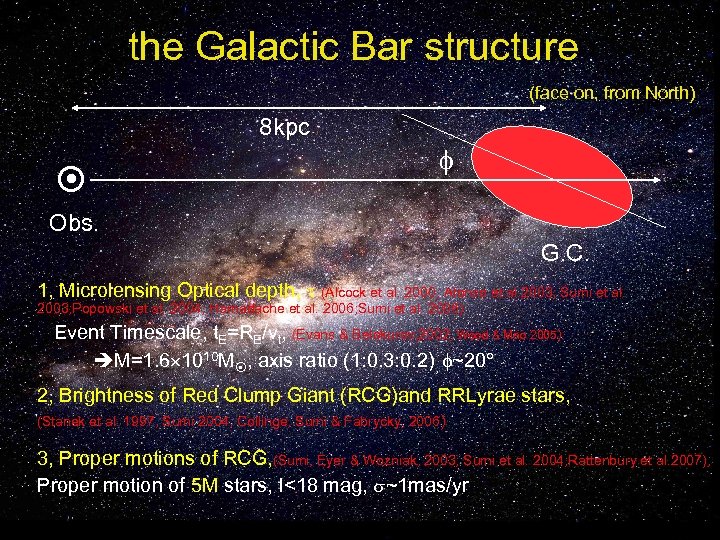 the Galactic Bar structure (face on, from North) 8 kpc Obs. G. C. 1, Microlensing Optical depth, (Alcock et al. 2000; Afonso et al. 2003; Sumi et al. 2003; Popowski et al. 2004; Hamadache et al. 2006; Sumi et al. 2006) Event Timescale, t. E=RE/vt, (Evans & Belokurov, 2002, Wood & Mao 2005) M=1. 6 1010 M , axis ratio (1: 0. 3: 0. 2), ~20 2, Brightness of Red Clump Giant (RCG)and RRLyrae stars, (Stanek et al. 1997, Sumi 2004; Collinge, Sumi & Fabrycky, 2006) 3, Proper motions of RCG, (Sumi, Eyer & Wozniak, 2003; Sumi et al. 2004; Rattenbury et al. 2007), Proper motion of 5 M stars, I<18 mag, ~1 mas/yr
 MOA’s scientific goals 1, Galactic Dark Matter (towards the LMC & SMC) Halo MACHOs or self-lensing? 2, The Galactic structure (towards the Bulge) Optical depth time scale, t. E Red Clump Giants 3, Exoplanets (towards the Bulge) Microlensing & transit
 Theoretical v. s. Observation Simulation Observation 100 m/s 1 m/s red:Gass Giants 青:Ice planets 緑:Rocky planets Ida & Lin, 2004
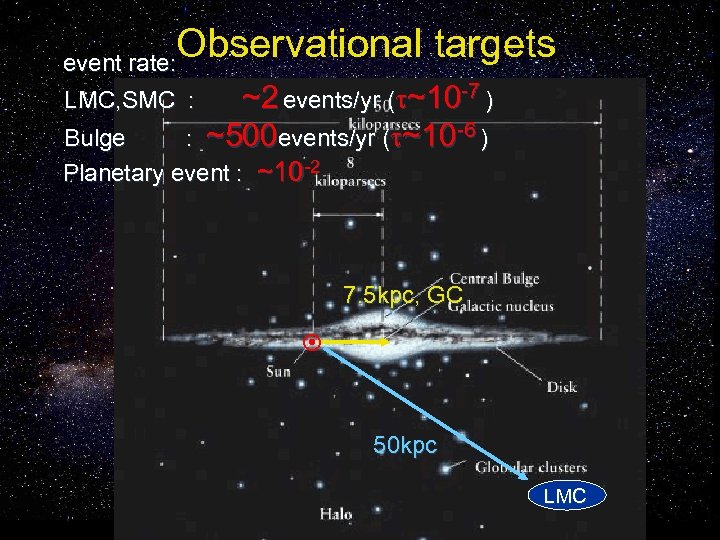 Observational targets event rate: LMC, SMC : ~2 events/yr ( ~10 -7 ) Bulge : ~500 events/yr ( ~10 -6 ) Planetary event : ~10 -2 7. 5 kpc, GC 50 kpc LMC
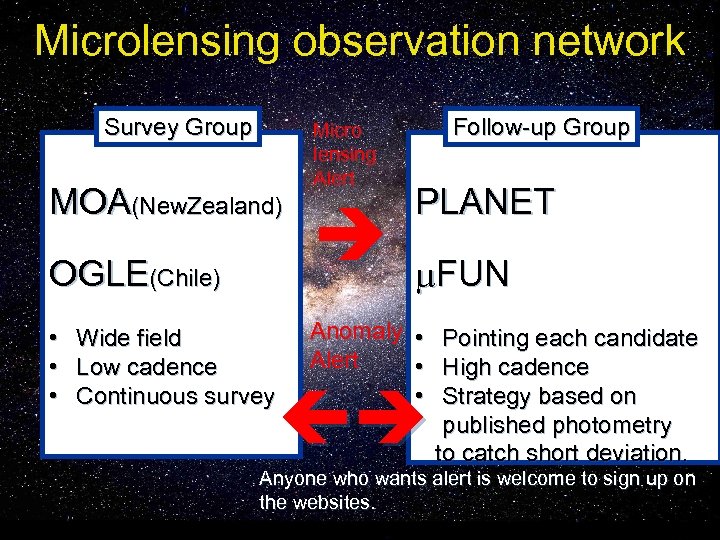 Microlensing observation network Survey Group MOA(New. Zealand) OGLE(Chile) • • • Micro lensing Alert Anomaly Wide field Alert Low cadence Continuous survey Follow-up Group PLANET FUN • • • Pointing each candidate High cadence Strategy based on published photometry to catch short deviation. Anyone who wants alert is welcome to sign up on the websites.
 Paczyński’s Legacy • The planet discovery via microlensing by collaboration of these groups are Paczyński’s Legacy • Idea of the method. • Idea of putting data on public and sharing photometry with other groups. useful to decide strategy to catch rare short planetary deviation.
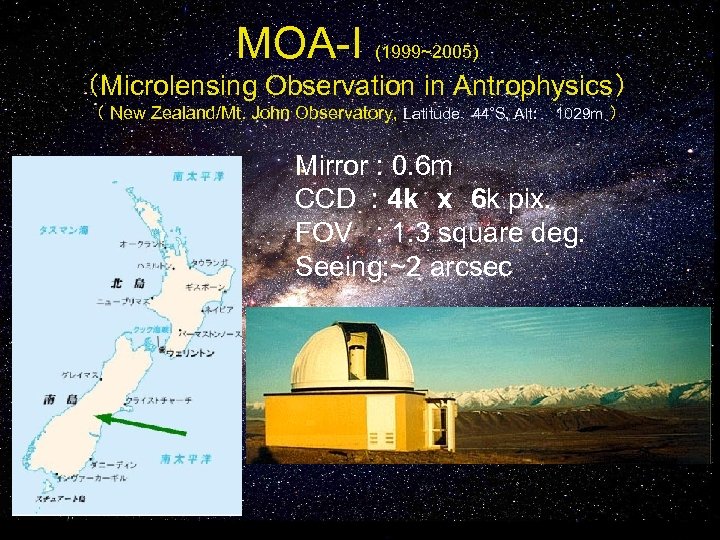 MOA-I (1999~2005) (Microlensing Observation in Antrophysics) ( New Zealand/Mt. John Observatory, Latitude: 44 S, Alt: 1029 m ) Mirror : 0. 6 m CCD : 4 k x 6 k pix. FOV : 1. 3 square deg. Seeing: ~2 arcsec
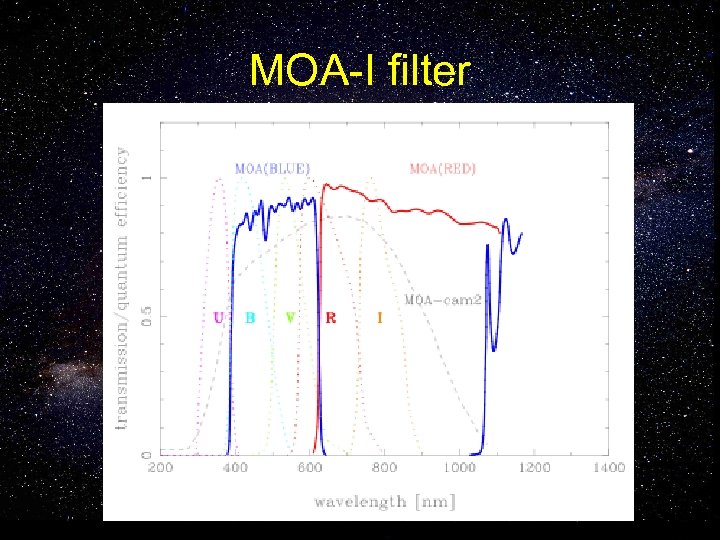 MOA-I filter
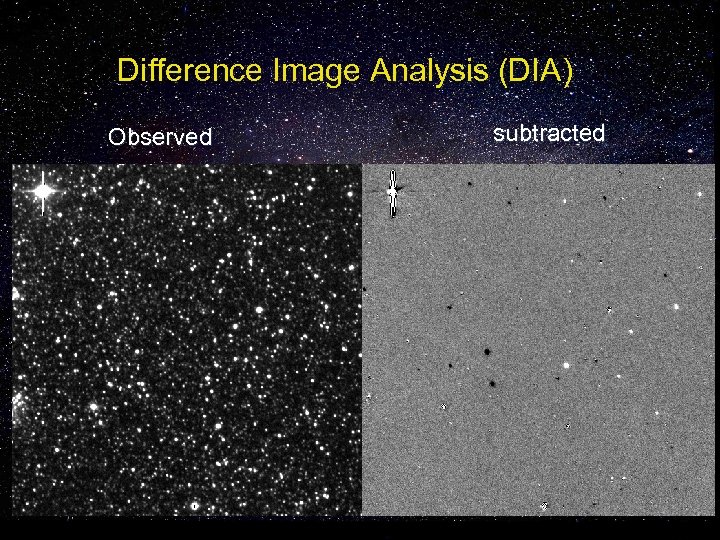 Difference Image Analysis (DIA) Observed subtracted
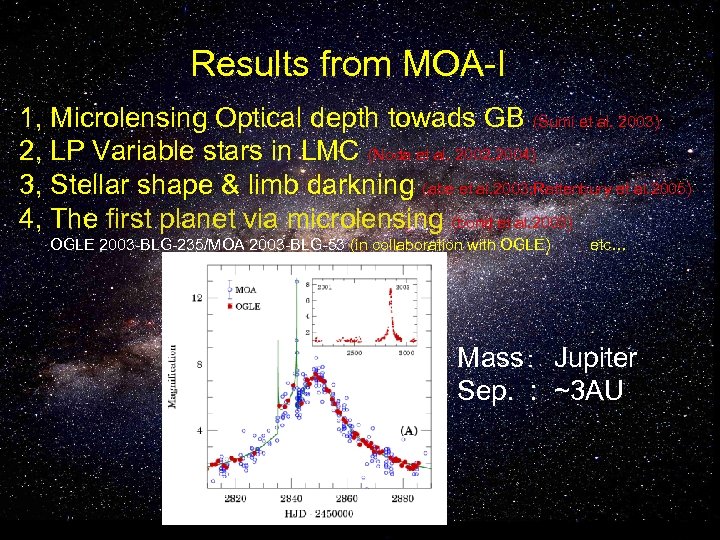 Results from MOA-I 1, Microlensing Optical depth towads GB (Sumi et al. 2003) 2, LP Variable stars in LMC (Noda et al. 2002, 2004) 3, Stellar shape & limb darkning (abe et al. 2003; Rattenbury et al. 2005) 4, The first planet via microlensing (bond et al. 2003) OGLE 2003 -BLG-235/MOA 2003 -BLG-53 (in collaboration with OGLE) etc… Mass: Jupiter Sep. : ~3 AU
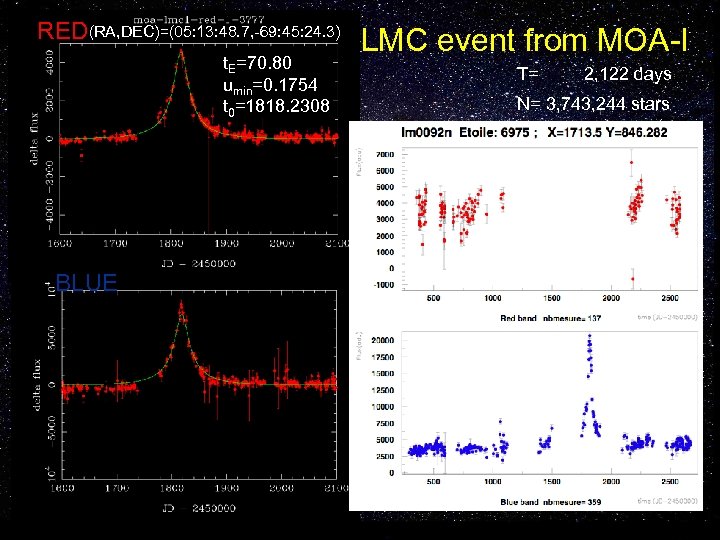 RED (RA, DEC)=(05: 13: 48. 7, -69: 45: 24. 3) t. E=70. 80 umin=0. 1754 t 0=1818. 2308 BLUE LMC event from MOA-I T= 2, 122 days N= 3, 743, 244 stars
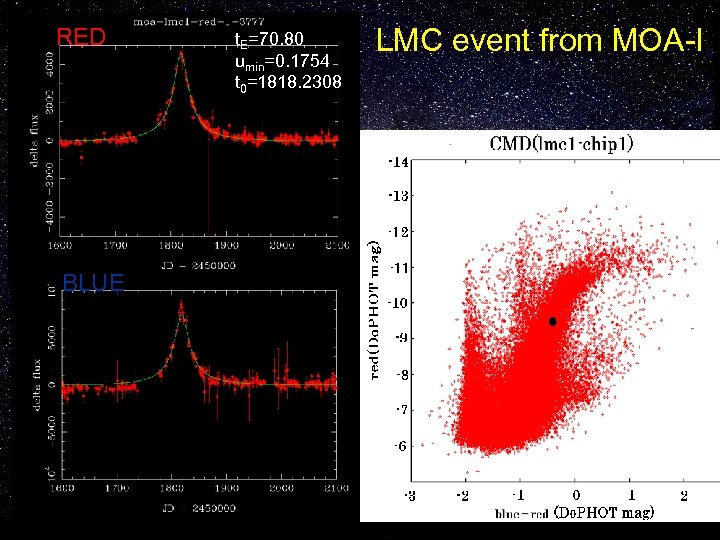 RED BLUE t. E=70. 80 umin=0. 1754 t 0=1818. 2308 LMC event from MOA-I
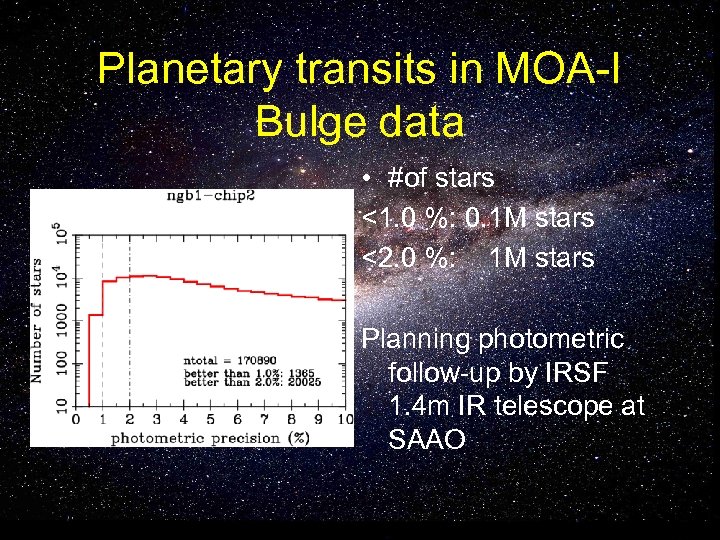 Planetary transits in MOA-I Bulge data • #of stars <1. 0 %: 0. 1 M stars <2. 0 %: 1 M stars Planning photometric follow-up by IRSF 1. 4 m IR telescope at SAAO
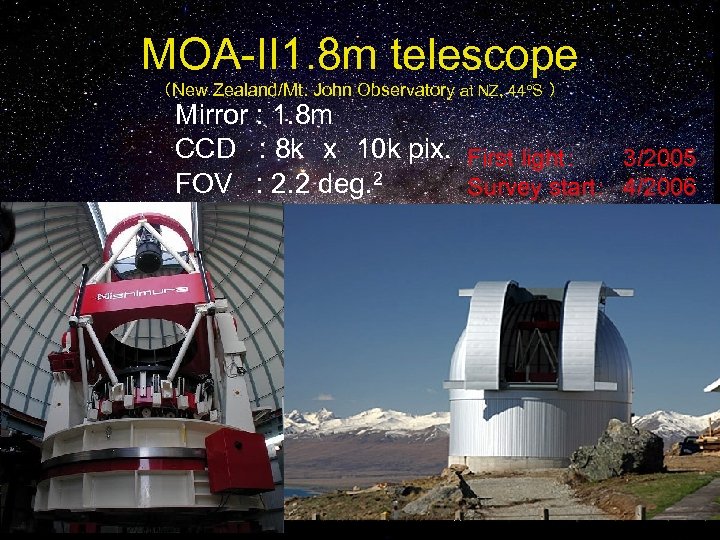 MOA-II 1. 8 m telescope (New Zealand/Mt. John Observatory at NZ, 44 S ) Mirror : 1. 8 m CCD : 8 k x 10 k pix. First light: 3/2005 FOV : 2. 2 deg. 2 Survey start: 4/2006
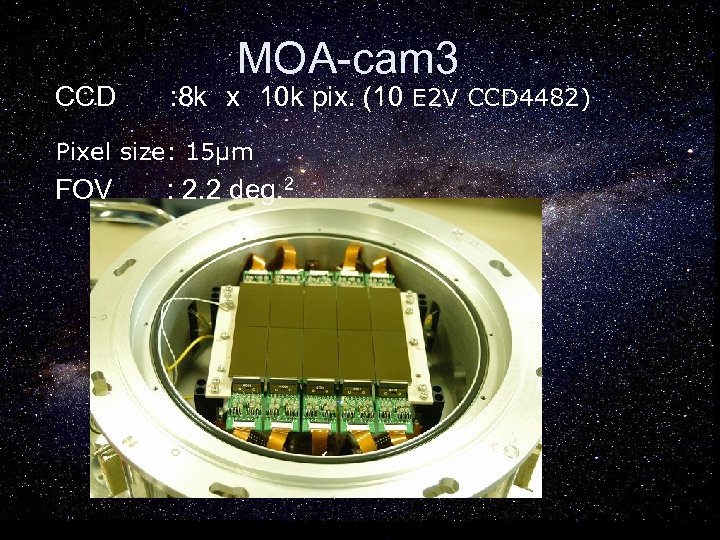 MOA-cam 3 CCD : 8 k x 10 k pix. (10 E 2 V CCD 4482) Pixel size: 15μm FOV : 2. 2 deg. 2
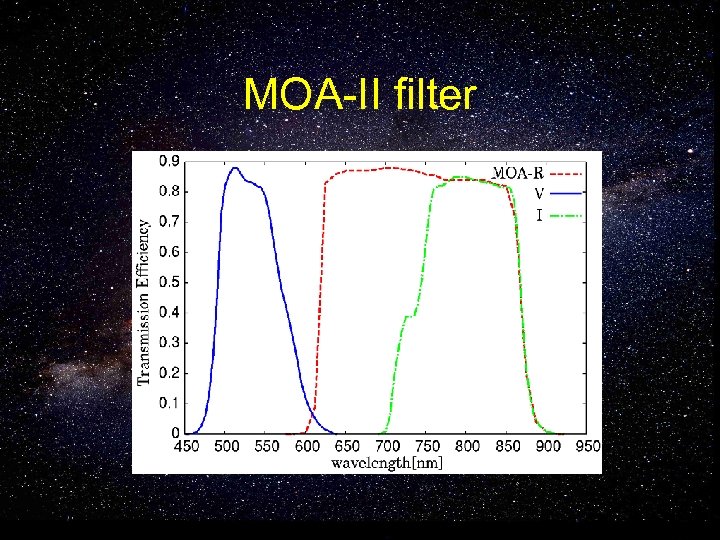 MOA-II filter
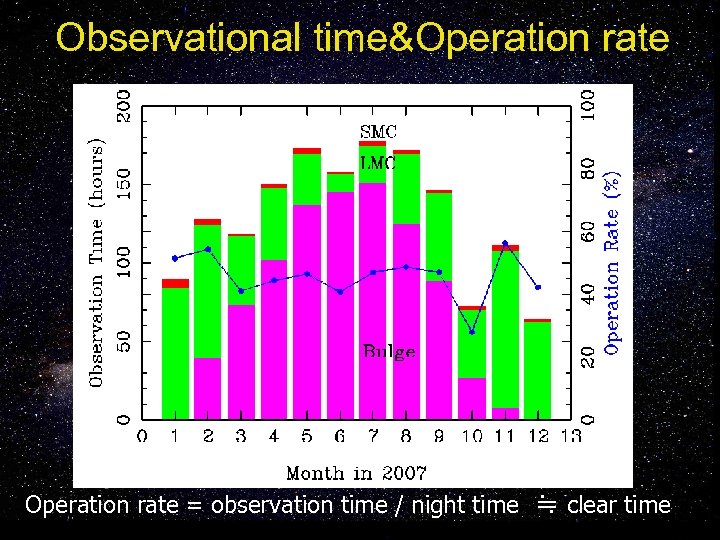 Observational time&Operation rate Bulge Operation rate = observation time / night time ≒ clear time
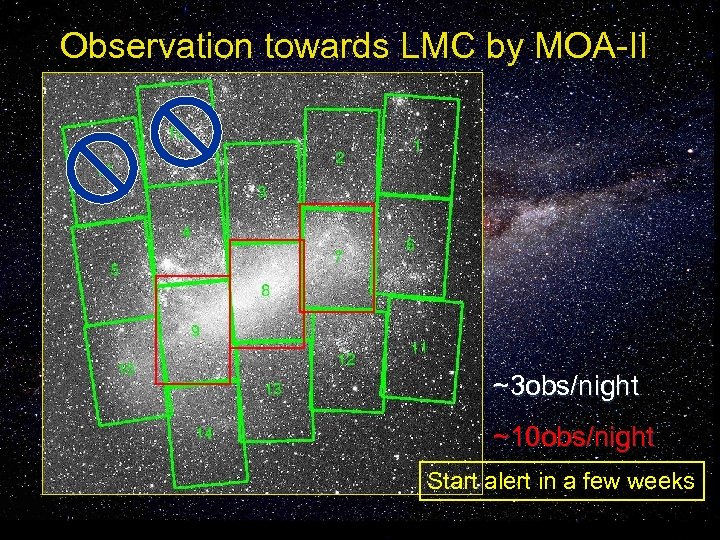 Observation towards LMC by MOA-II ~3 obs/night ~10 obs/night Start alert in a few weeks
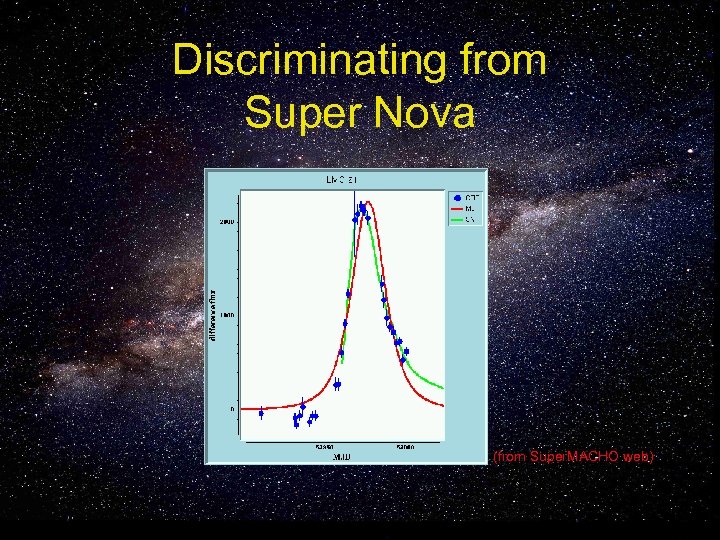 Discriminating from Super Nova (from Super. MACHO web)
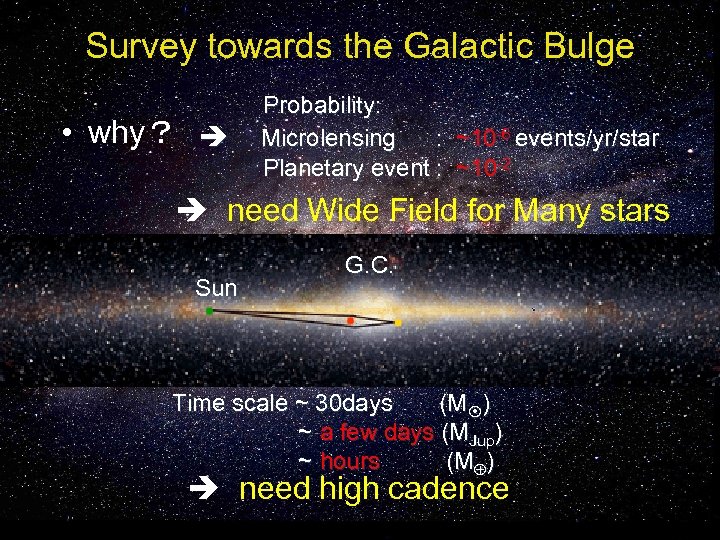 Survey towards the Galactic Bulge • why? Probability: Microlensing : ~10 -6 events/yr/star Planetary event : ~10 -2 need Wide Field for Many stars Sun G. C. Time scale ~ 30 days (M ) ~ a few days (MJup) ~ hours (M ) need high cadence
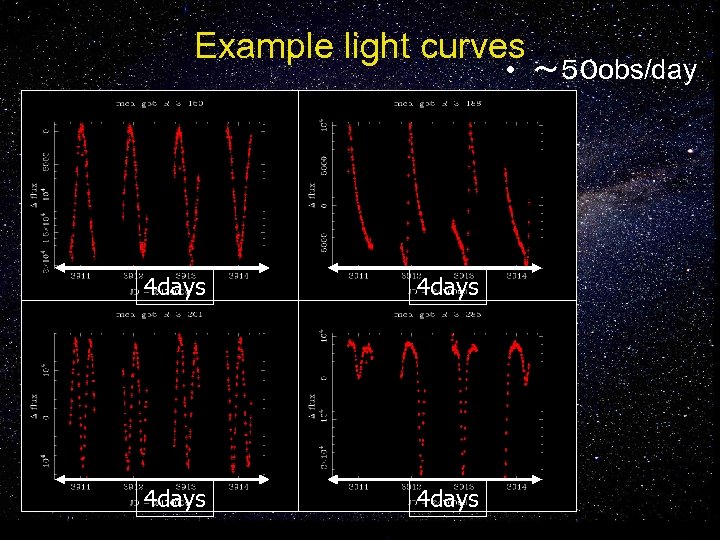
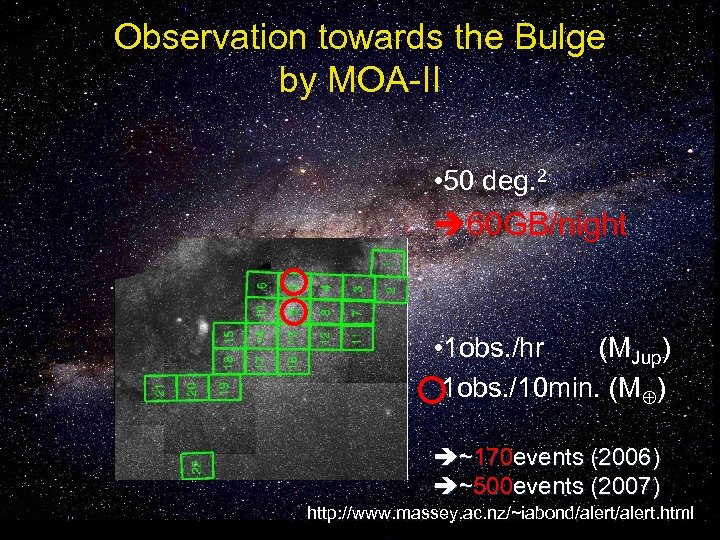 Observation towards the Bulge by MOA-II • 50 deg. 2 60 GB/night • 1 obs. /hr (MJup) 1 obs. /10 min. (M ) ~170 events (2006) ~500 events (2007) http: //www. massey. ac. nz/~iabond/alert. html
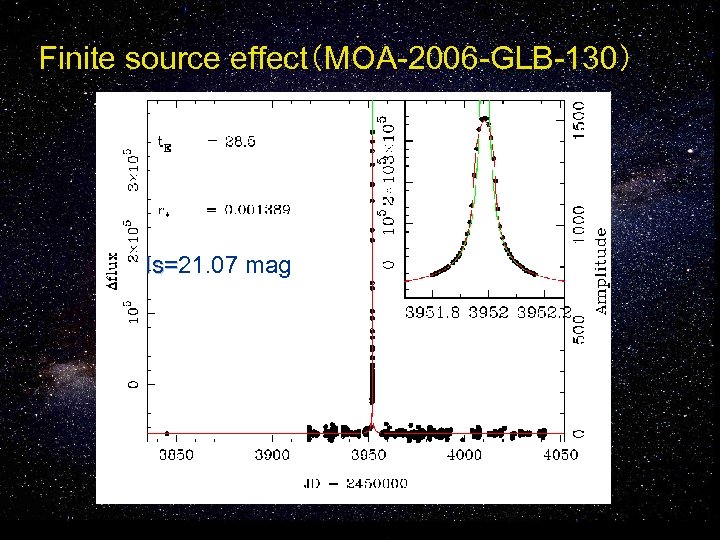
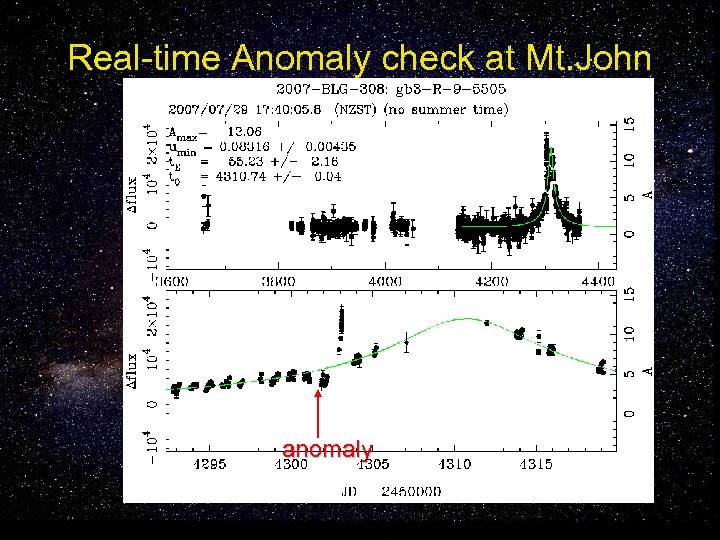
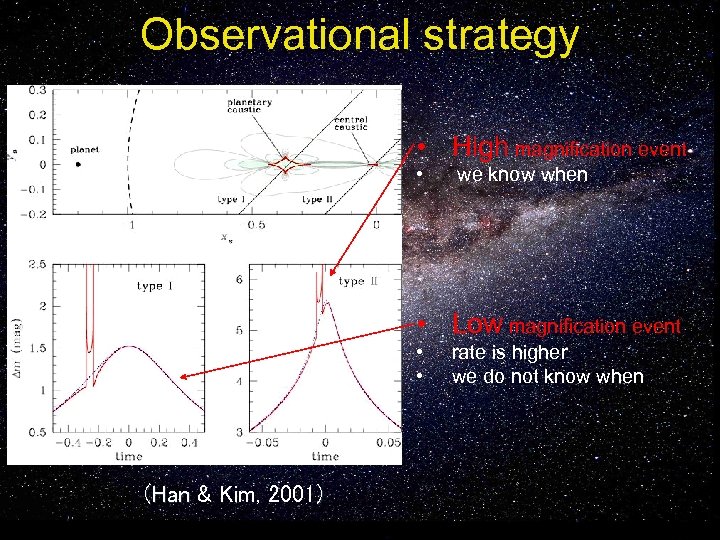 Observational strategy • High magnification event • we know when • Low magnification event • • (Han & Kim, 2001) rate is higher we do not know when
 Example light curves • 〜50 obs/day 4 days
 Finite source effect(MOA-2006 -GLB-130) Is=21. 07 mag Is=
 Real-time Anomaly check at Mt. John anomaly
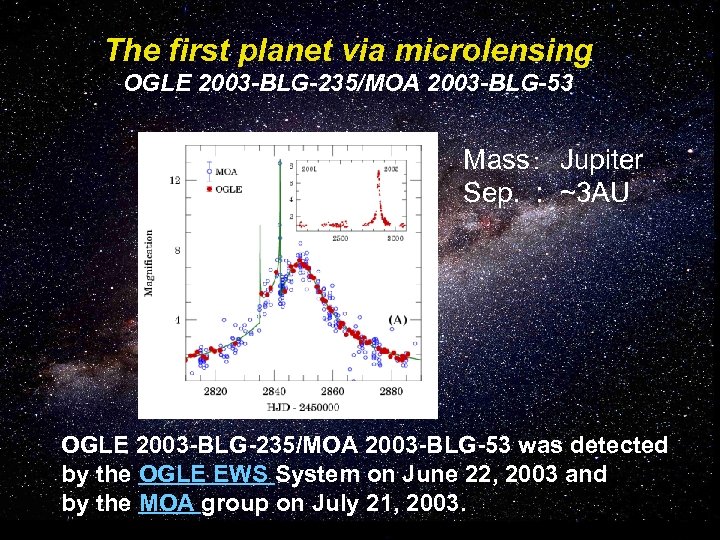 The first planet via microlensing OGLE 2003 -BLG-235/MOA 2003 -BLG-53 Mass: Jupiter Sep. : ~3 AU OGLE 2003 -BLG-235/MOA 2003 -BLG-53 was detected by the OGLE EWS System on June 22, 2003 and by the MOA group on July 21, 2003.
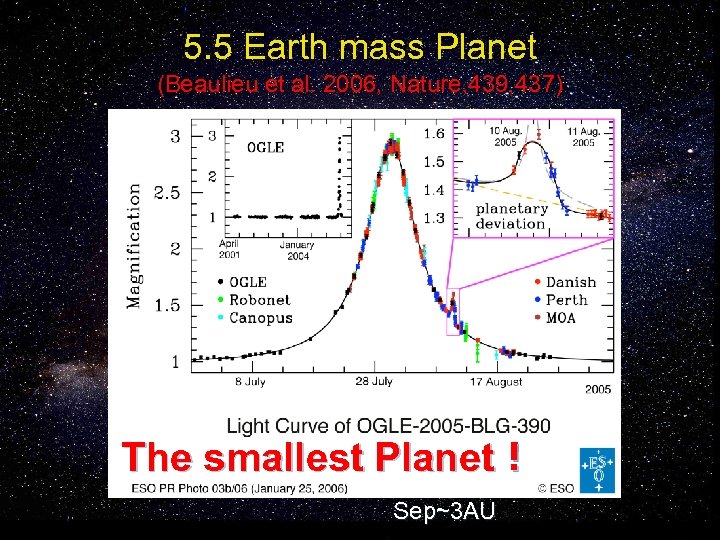 5. 5 Earth mass Planet (Beaulieu et al. 2006, Nature, 439, 437) The smallest Planet! Sep~3 AU
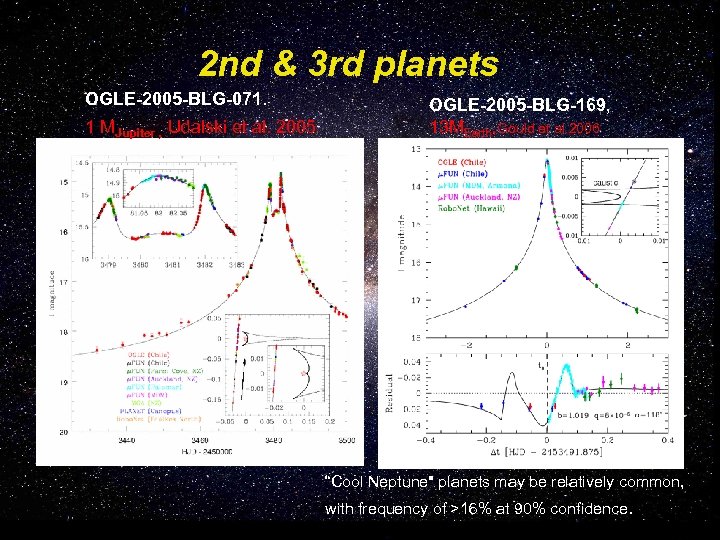 2 nd & 3 rd planets OGLE-2005 -BLG-071. 1 MJupiter , Udalski et al. 2005 OGLE-2005 -BLG-169, 13 MEarth, Gould et al. 2006 “Cool Neptune" planets may be relatively common, with frequency of >16% at 90% confidence.
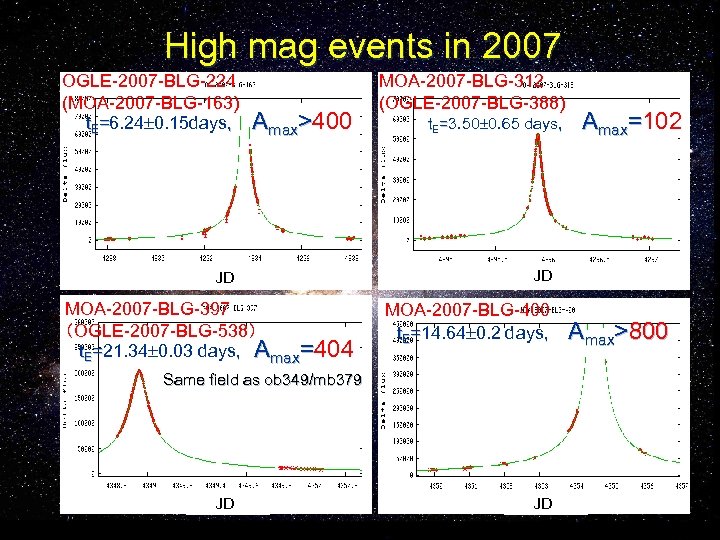 High mag events in 2007 OGLE-2007 -BLG-224 (MOA-2007 -BLG-163) t. E=6. 24 0. 15 days, Amax>400 MOA-2007 -BLG-312 (OGLE-2007 -BLG-388) t. E=3. 50 0. 65 days, Amax=102 JD JD MOA-2007 -BLG-397 (OGLE-2007 -BLG-538) t. E=21. 34 0. 03 days, Amax=404 MOA-2007 -BLG-400 t. E=14. 64 0. 2 days, Amax>800 Same field as ob 349/mb 379 JD JD
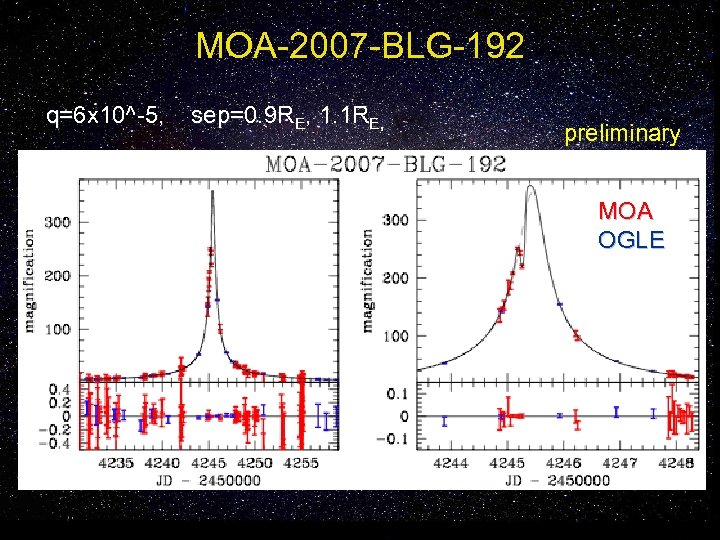 MOA-2007 -BLG-192 q=6 x 10^-5, sep=0. 9 RE, 1. 1 RE, q= , sep= preliminary MOA OGLE
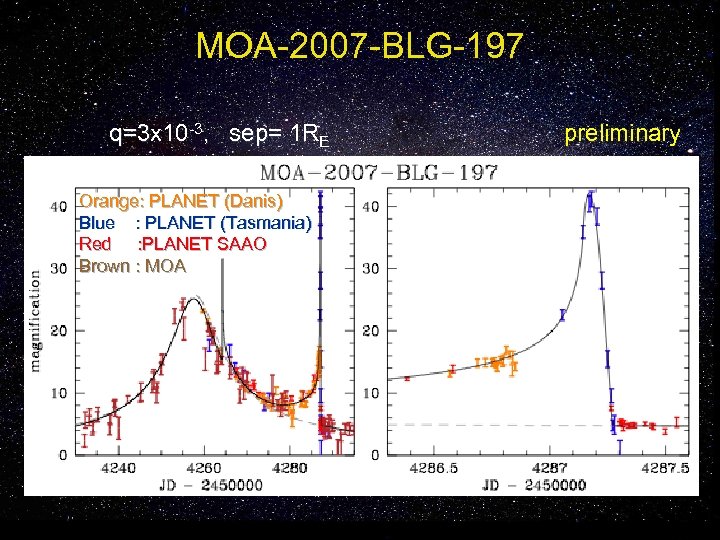 MOA-2007 -BLG-197 q=3 x 10 -3, sep= 1 RE q=3 , sep= Orange: PLANET (Danis) Blue : PLANET (Tasmania) Red : PLANET SAAO Brown : MOA 1年 preliminary
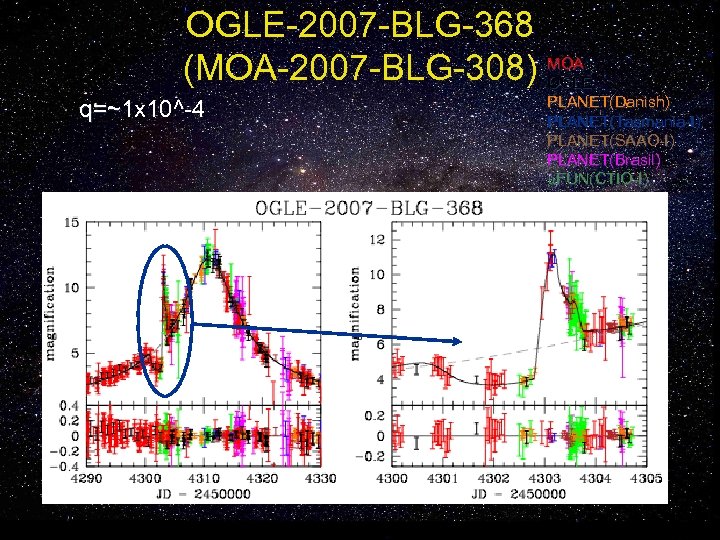 OGLE-2007 -BLG-368 (MOA-2007 -BLG-308) MOA OGLE q=~1 x 10^-4 q=~ PLANET(Danish) PLANET(Tasmania-I) PLANET(SAAO-I) PLANET(Brasil) FUN(CTIO-I)
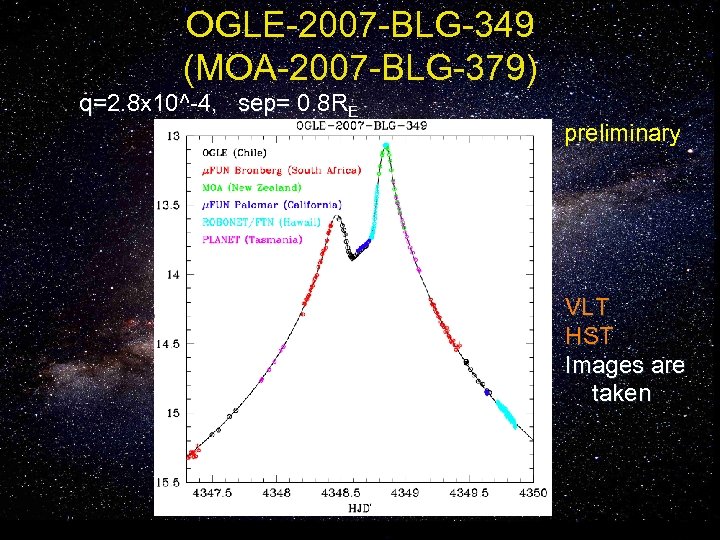 OGLE-2007 -BLG-349 (MOA-2007 -BLG-379) q=2. 8 x 10^-4, sep= 0. 8 RE q= , sep= preliminary VLT HST Images are taken
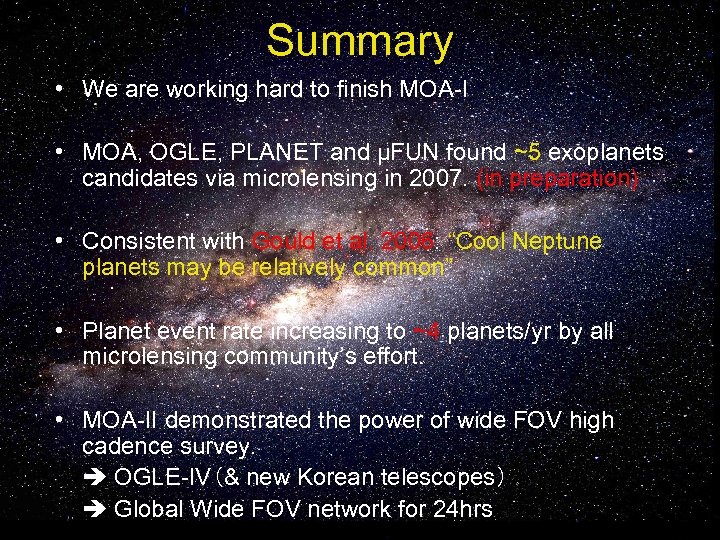
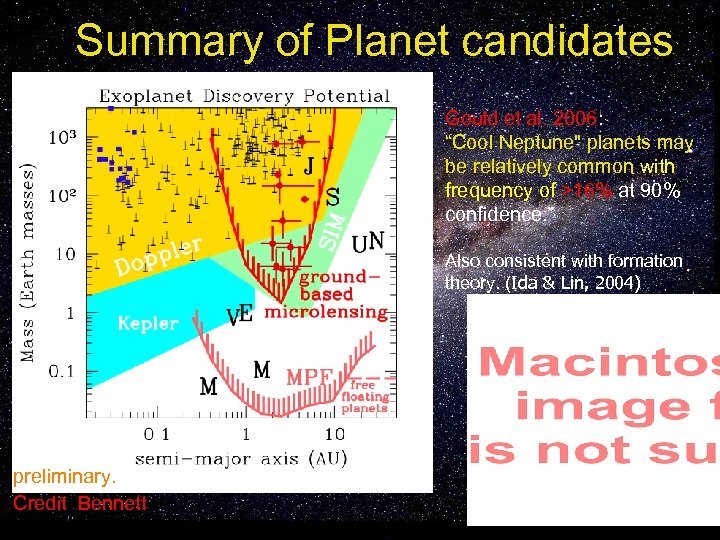 Summary of Planet candidates Gould et al. 2006: “Cool Neptune" planets may be relatively common with frequency of >16% at 90% confidence. ” Also consistent with formation theory. (Ida & Lin, 2004) preliminary. Credit Bennett
 Number of planets via Microlensing
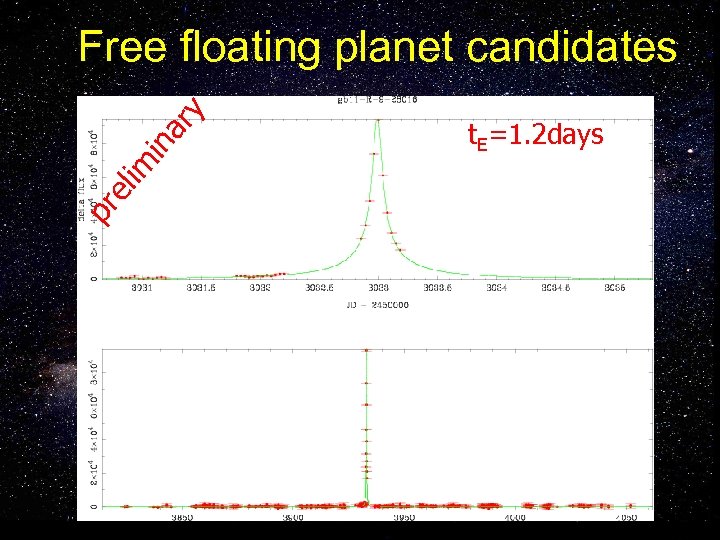 pr el im in ar y Free floating planet candidates t. E=1. 2 days
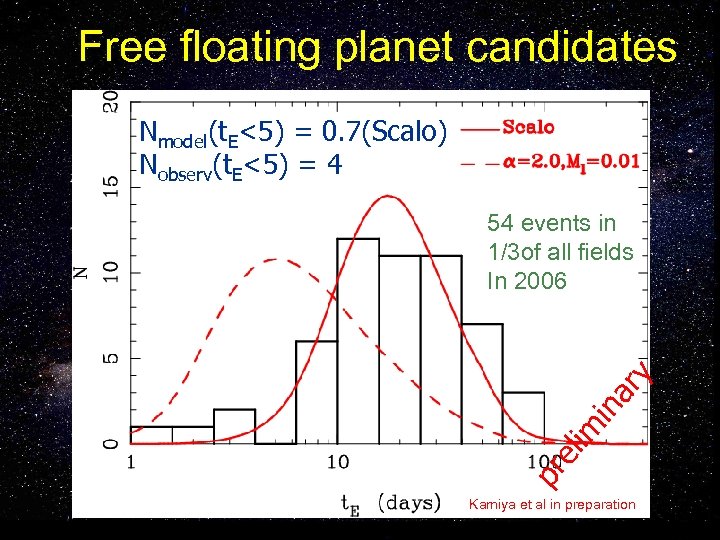 ar y Free floating planet candidates el im in ar y 54 events in 1/3 of all fields In 2006 pr pr el im in Nmodel(t. E<5) = 0. 7(Scalo) t. E=1. 2 days Nobserv(t. E<5) = 4 Kamiya et al in preparation
 Summary • We are working hard to finish MOA-I • MOA, OGLE, PLANET and μFUN found ~5 exoplanets candidates via microlensing in 2007. (in preparation) • Consistent with Gould et al. 2006: “Cool Neptune planets may be relatively common” • Planet event rate increasing to ~4 planets/yr by all microlensing community’s effort. • MOA-II demonstrated the power of wide FOV high cadence survey. OGLE-IV(& new Korean telescopes) Global Wide FOV network for 24 hrs