


 Скачать презентацию Mo MAR a coordinated and multidisciplinary long-term
3411f54e71f71cc1fd9ce2aa778cec5e.ppt
- Количество слайдов: 2
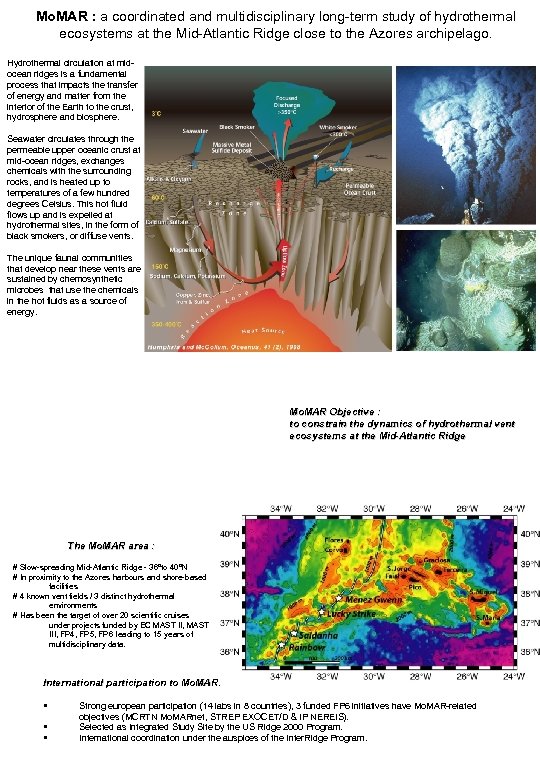 Mo. MAR : a coordinated and multidisciplinary long-term study of hydrothermal ecosystems at the Mid-Atlantic Ridge close to the Azores archipelago. Hydrothermal circulation at midocean ridges is a fundamental process that impacts the transfer of energy and matter from the interior of the Earth to the crust, hydrosphere and biosphere. Seawater circulates through the permeable upper oceanic crust at mid-ocean ridges, exchanges chemicals with the surrounding rocks, and is heated up to temperatures of a few hundred degrees Celsius. This hot fluid flows up and is expelled at hydrothermal sites, in the form of black smokers, or diffuse vents. The unique faunal communities that develop near these vents are sustained by chemosynthetic microbes that use the chemicals in the hot fluids as a source of energy. Mo. MAR Objective : to constrain the dynamics of hydrothermal vent ecosystems at the Mid-Atlantic Ridge Mid- The Mo. MAR area : # Slow-spreading Mid-Atlantic Ridge - 36°to 40°N # In proximity to the Azores harbours and shore-based facilities # 4 known vent fields / 3 distinct hydrothermal environments # Has been the target of over 20 scientific cruises under projects funded by EC MAST II, MAST III, FP 4, FP 5, FP 6 leading to 15 years of multidisciplinary data. International participation to Mo. MAR: • • • Strong european participation (14 labs in 8 countries), 3 funded FP 6 initiatives have Mo. MAR-related objectives (MCRTN Mo. MARnet, STREP EXOCET/D & IP NEREIS). Selected as Integrated Study Site by the US Ridge 2000 Program. International coordination under the auspices of the Inter. Ridge Program.
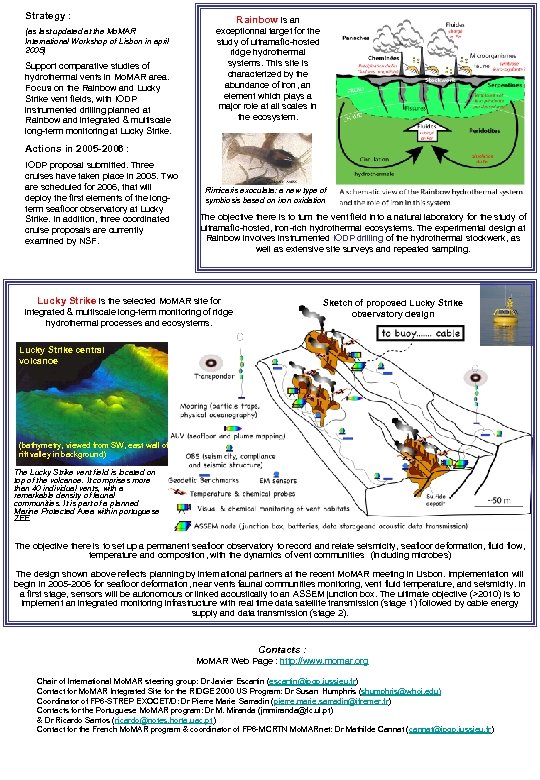 Strategy : (as last updated at the Mo. MAR International Workshop of Lisbon in april 2005) Support comparative studies of hydrothermal vents in Mo. MAR area. Focus on the Rainbow and Lucky Strike vent fields, with IODP instrumented drilling planned at Rainbow and integrated & multiscale long-term monitoring at Lucky Strike. Rainbow is an exceptionnal target for the study of ultramafic-hosted ridge hydrothermal systems. This site is characterized by the abundance of iron, an element which plays a major role at all scales in the ecosystem. Actions in 2005 -2006 : IODP proposal submitted. Three cruises have taken place in 2005. Two are scheduled for 2006, that will deploy the first elements of the longterm seafloor observatory at Lucky Strike. In addition, three coordinated cruise proposals are currently examined by NSF. Rimicaris exoculata: a new type of symbiosis based on iron oxidation The objective there is to turn the vent field into a natural laboratory for the study of ultramafic-hosted, iron-rich hydrothermal ecosystems. The experimental design at Rainbow involves instrumented IODP drilling of the hydrothermal stockwerk, as well as extensive site surveys and repeated sampling. Lucky Strike is the selected Mo. MAR site for integrated & multiscale long-term monitoring of ridge hydrothermal processes and ecosystems. Sketch of proposed Lucky Strike observatory design Lucky Strike central volcanoe (bathymetry, viewed from SW, east wall of rift valley in background) Lucky Strike observatorydesign 2006 -2010 The Lucky Strike vent field is located on top of the volcanoe. It comprises more than 40 individual vents, with a remarkable density of faunal communities. It is part of a planned Marine Protected Area within portuguese ZEE. The objective there is to set up a permanent seafloor observatory to record and relate seismicity, seafloor deformation, fluid flow, temperature and composition, with the dynamics of vent communities (including microbes) The design shown above reflects planning by international partners at the recent Mo. MAR meeting in Lisbon. Implementation will begin in 2005 -2006 for seafloor deformation, near vents faunal communities monitoring, vent fluid temperature, and seismicity. In a first stage, sensors will be autonomous or linked acoustically to an ASSEM junction box. The ultimate objective (>2010) is to implement an integrated monitoring infrastructure with real time data satellite transmission (stage 1) followed by cable energy supply and data transmission (stage 2). Contacts : Mo. MAR Web Page : http: //www. momar. org Chair of International Mo. MAR steering group: Dr Javier Escartin (escartin@ipgp. jussieu. fr) Contact for Mo. MAR Integrated Site for the RIDGE 2000 US Program: Dr Susan Humphris (shumphris@whoi. edu) Coordinator of FP 6 -STREP EXOCET/D: Dr Pierre Marie Sarradin (pierre. marie. sarradin@ifremer. fr) Contacts for the Portuguese Mo. MAR program: Dr M. Miranda (jmmiranda@fc. ul. pt) & Dr Ricardo Santos (ricardo@notes. horta. uac. pt) Contact for the French Mo. MAR program & coordinator of FP 6 -MCRTN Mo. MARnet: Dr Mathilde Cannat (cannat@ipgp. jussieu. fr)