


 Скачать презентацию MLI 28 C 060 — Corporate Finance Seminar
46ff723469a5efcb8bf83ed78d5e965a.ppt
- Количество слайдов: 11
 MLI 28 C 060 - Corporate Finance Seminar 11
 Question 1. Define working capital. Why is it’s management so important to firms?
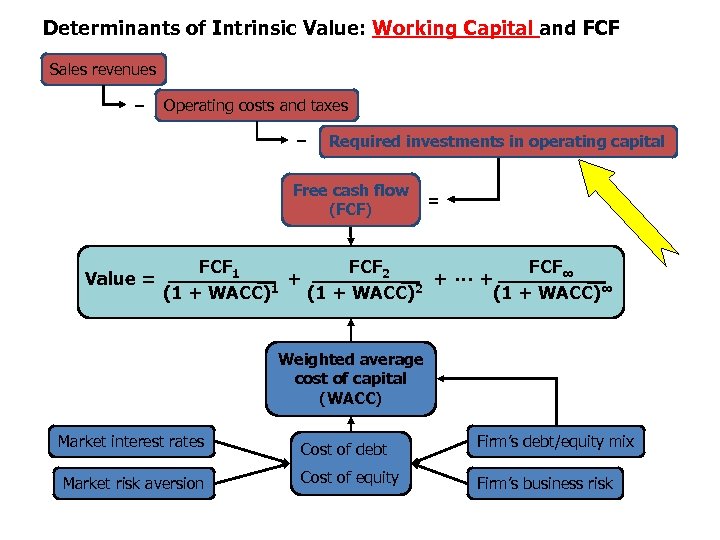 Determinants of Intrinsic Value: Working Capital and FCF Sales revenues − Operating costs and taxes − Required investments in operating capital Free cash flow (FCF) Value = = FCF 1 FCF 2 FCF∞ + + ··· + (1 + WACC)1 (1 + WACC)2 (1 + WACC)∞ Weighted average cost of capital (WACC) Market interest rates Cost of debt Firm’s debt/equity mix Market risk aversion Cost of equity Firm’s business risk
 Working Capital • Current assets – Current liabilities • It measures how much in liquid assets a company has available to build its business. • A short term loan which provides money to buy earning assets. • Allows to avail of unexpected opportunities. • Positive working capital is required to ensure that a firm is able to continue its operations and that it has sufficient funds to satisfy both maturing short-term debt and upcoming operational expenses. The management of working capital involves managing inventories, accounts receivable and payable and cash. • An increase in working capital indicates that the business has either increased current assets (that is received cash, or other current assets) or has decreased current liabilities, for example has paid off some short-term creditors.
 Why working Capital is important? • Investment in Current Assets (CA) represents a substantial portion of total investment. • Investment in Current Assets (CA) and level of Current Liabilities (CL) have to be geared quickly to changes in sales.
 Net Working Capital • CA – CL • Referred as ‘point of view of an Accountant’. • It indicates liquidity position of a firm & suggests the extent to which working capital needs may be financed by permanent sources of funds.
 CONSTITUENTS OF WORKING CAPITAL • CURRENT ASSETS § § Inventory Sundry Debtors Cash and Bank Balances Loans and advances • CURRENT LIABILITIES § Sundry creditors § Short term loans § Provisions
 Characteristics of Current Assets • Short Life Span I. e. cash balances may be held idle for a week or two , thus a/c may have a life span of 30 -60 days etc. • Swift Transformation into other Asset forms I. e. each CA is swiftly transformed into other asset forms like cash is used for acquiring raw materials , raw materials are transformed into finished goods and these sold on credit are convertible into A/R & finlly into cash.
 Question 2. What is the matching principle and why is it important?
 Matching Principle • If a firm finances a long term asset(like machinery) with a S-T Debt then it will have to be periodically finance the asset which will be risky as well as inconvenient. • i. e. maturity of sources of financing should be properly matched with maturity of assets being financed. • Thus Fixed Assets & permanent CA should be supported with L-T sources of finance & fluctuating CA by S-T sources.
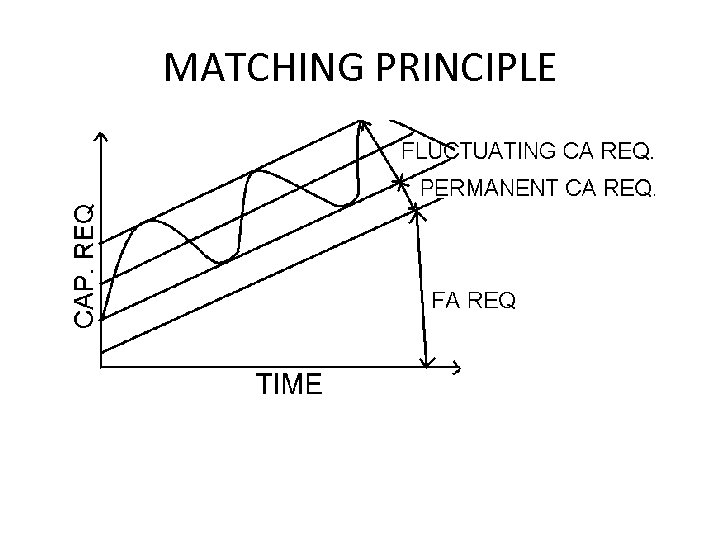 MATCHING PRINCIPLE