


 Скачать презентацию MLEs and the JISC SWa NI Programme Veronica
e29d5da3b961ea9377867a07ffb71cf9.ppt
- Количество слайдов: 28
 MLEs and the JISC SWa. NI Programme Veronica Adamson Jane Plenderleith Glenaffric Ltd 19 Sept 2002 JISC/SURF/Internet 2, Oxford Supporting further and higher education
 Background to JISC MLE Programme JISC Five year strategy (2001 - 2005) Help institutions create and maintain Managed Learning Environments (MLEs) to support students JISC leads UK FE and HE sectors in the innovative use of technology – Funds JANET – Funds many services including advisory services, licensing deals for electronic content, delivers thousands of electronic objects to FE and HE – Funds development programmes that work with FE and HE to explore key technologies – £ 60 m annual budget
 Institutional context and drivers • English FE funded and encouraged to research MLEs and open standards • Scottish FE funding specifically for VLEs • HE: – increasing use of technology and VLEs – mainstreaming learning technologies – national strategies such as NGf. L, Uf. I/SUf. I and the e-University
 MLEs defined ‘The whole range of information systems and processes of an institution (including a VLE if appropriate) that contribute directly, or indirectly, to learning and the management of that learning. ’ (JISC MLE Steering Group, 2000) • MLEs are concepts not physical systems • MLEs are particular to an institution • UK-specific term at the moment (growing international interest)
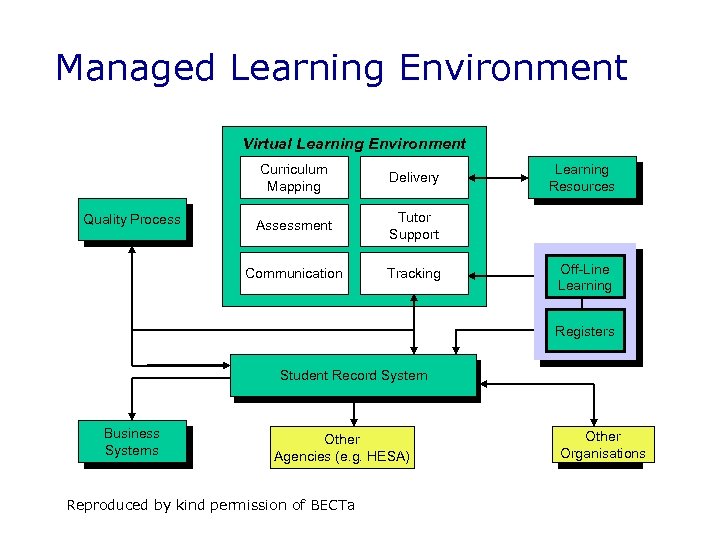 Managed Learning Environment Virtual Learning Environment Curriculum Mapping Assessment Tutor Support Communication Quality Process Delivery Tracking Learning Resources Off-Line Learning Registers Student Record System Business Systems Other Agencies (e. g. HESA) Reproduced by kind permission of BECTa Other Organisations
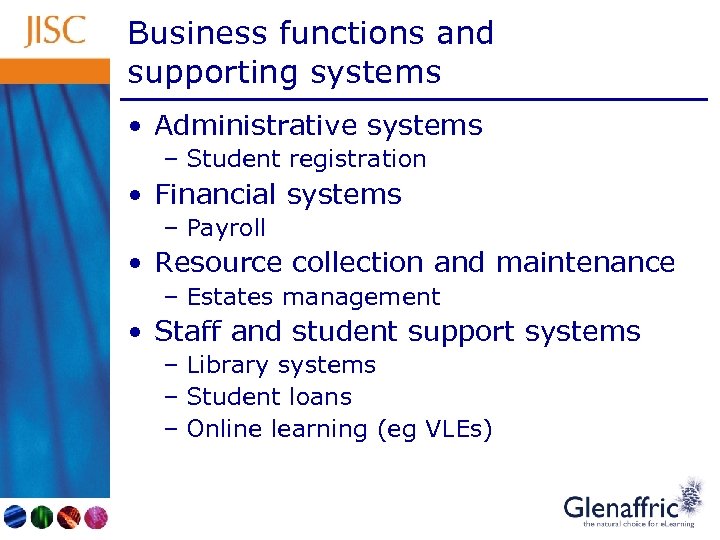 Business functions and supporting systems • Administrative systems – Student registration • Financial systems – Payroll • Resource collection and maintenance – Estates management • Staff and student support systems – Library systems – Student loans – Online learning (eg VLEs)
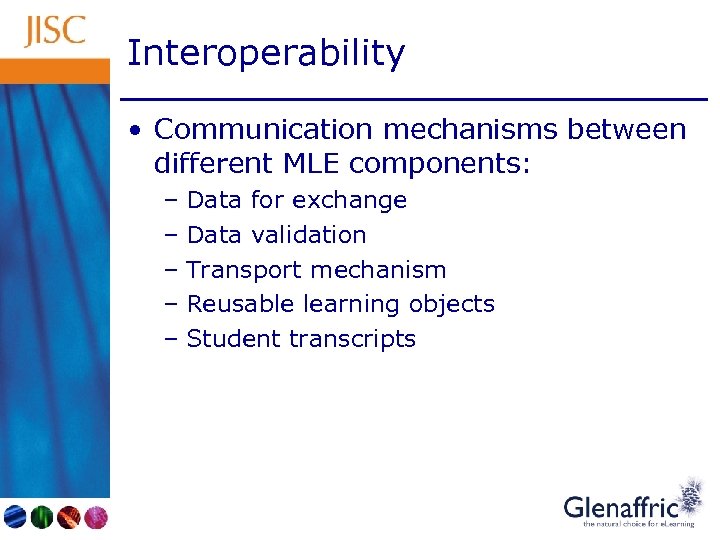 Interoperability • Communication mechanisms between different MLE components: – Data for exchange – Data validation – Transport mechanism – Reusable learning objects – Student transcripts
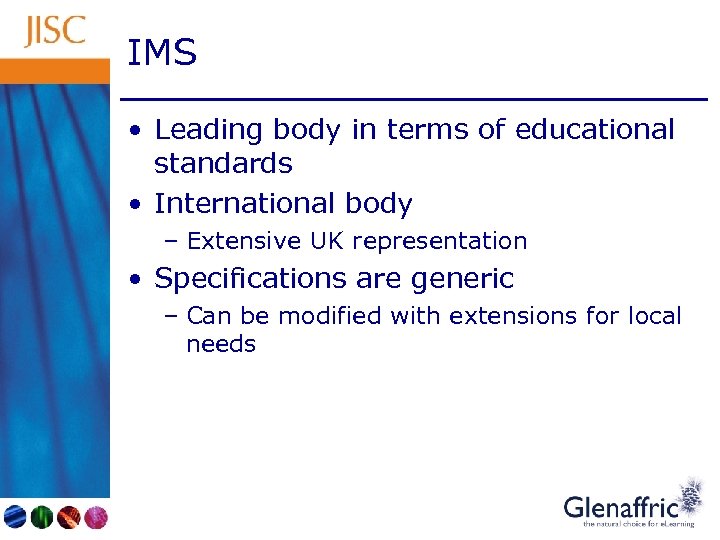 IMS • Leading body in terms of educational standards • International body – Extensive UK representation • Specifications are generic – Can be modified with extensions for local needs
 Strategic MLE development • Working with universities, FE colleges, and commercial companies to develop MLEs or parts of MLEs – Soft and hard issues – Technical systems integration – Using standards and specifications to: • Describe what we want e-learning systems to do (e. g. learning design) • Get systems to work together (interoperate) – Exploration of institutional processes and cultural change to support MLE implementation
 JISC role in MLE development • Funding institutions/consortia through development programmes – Providing support • Project management • Technical implementation – Providing resources • Financial and technical – Providing impartial advice • From a national (and international) perspective – Working with system vendors • Making the outcomes available – Workshops, conferences, briefing papers, reports etc
 JISC MLE Programme - 1 • 1999/2000 – MLE Steering Group – Building MLEs in HE programme • 14 funded projects of 1 -2 years – MLE Interoperability Projects in FE • Awareness raising programme • 12 funded projects of 1 year – Supporting activities • Centre for Recording Achievement (CRA) • CETIS • Specific studies - authentication, landscape, cultural and organisational issues
 JISC MLE Programme - 2 • 2001/2002 – Building MLEs across HE and FE • Phase 1 - NIIMLE and SHELL – SWa. NI FE Interoperability Projects • 7 funded projects across Scotland, Wales and Northern Ireland – Linking Digital Libraries with Virtual Learning Environments (Di. VLE) • Recommended by Inspiral project • 10 funded projects • 2003/2005 – Building MLEs across HE and FE • Phase 2 - NIIMLE and SHELL continue plus 9 other projects
 SWa. NI Programme Aims • Follow-on from English FE pilots • Further explore theory that vendors can achieve interoperability between core component systems found in MLEs by designing and building each component system to agreed specifications • To use IMS specifications (with FE extensions)
 SWa. NI Projects • Scotland – Banff and Buchan – Perth (plus Lauder) – Falkirk (plus Stow, Stevenson, Fife and Glenrothes) • Wales – Llandrillo – Menai – Sir Gar – Ystrad Mynach
 Project Themes Perth - MIS/VLE (2 -way) Falkirk - MIS/VLE Banff & Buchan - MIS/VLE/Intranet Sir Gar - Content packaging Menai - MIS/VLE + language Llandrillo - MIS/VLE Ystrad Mynach - Student transcripts/PDP
 Formative Evaluation To contribute to the overall achievement of the programme which will maximise the longterm benefits to the sector and provide synergy with the MLE for Lifelong Learning Programme (01 -01)
 Objectives 1. 2. 3. 4. 5. 6. 7. 8. 9. To identify the project management activities and systems that are most effective in achieving project objectives To explore factors influencing effective relationships with vendors and how these relationships may be sustained To explore the models of consortium working used in the projects and evaluate their effectiveness To identify and explore the organisational factors that are influential in determining the impact of project deliverables To identify the aspects of programme management that most contribute to project activities To investigate the overall impact and potential benefits of the SWa. NI programme To explore the extent to which cultural differences influence the achievements of the SWa. NI programme To establish the lessons that can be learned from the SWa. NI programme with relevance to the MLEs for Lifelong Learning Programme and for future interoperability initiatives To suggest themes, indicators and methods that may inform the summative evaluation of the SWa. NI programme
 The Process • Initial consultation with Project Managers (telephone interviews) • Attend SWa. NI meetings • Engage with MLE Evaluation Team (01 -01) • Documentary analysis: 1. Interview summary transcripts 2. Project reports etc 3. Related programme reports and studies • Visit projects • Other interviews - vendors, partners etc
 Key Respondents A SWa. NI programme manager, project leaders, project partners and other project workers B Lead institution senior manager ideally with a strategic role in the provision of information systems, support and management within their institution C Administrative staff who may be involved with the newly interoperable systems within their institution D Academic staff who may be involved with the newly interoperable systems within their institution E Vendors of the interoperability system technologies F Agencies with an over-arching role (CETIS, RSCs)
 Project Management • • Hit the ground running Scope/Capacity/Naivety Project management toolkit Buy-in versus nurture
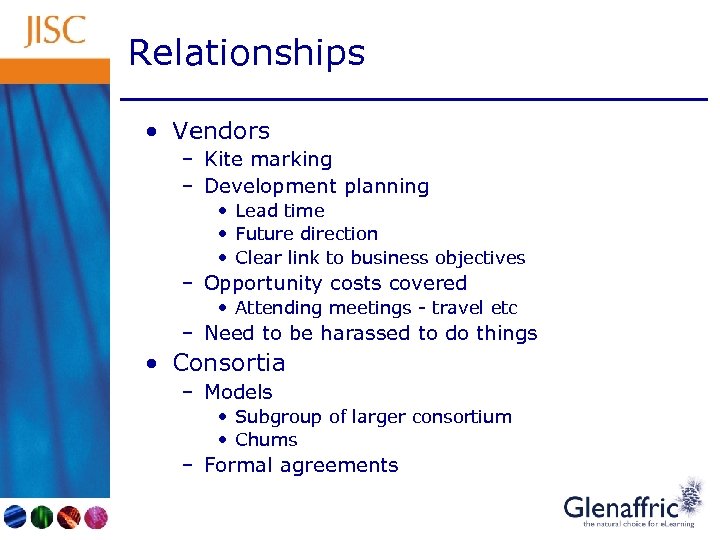 Relationships • Vendors – Kite marking – Development planning • Lead time • Future direction • Clear link to business objectives – Opportunity costs covered • Attending meetings - travel etc – Need to be harassed to do things • Consortia – Models • Subgroup of larger consortium • Chums – Formal agreements
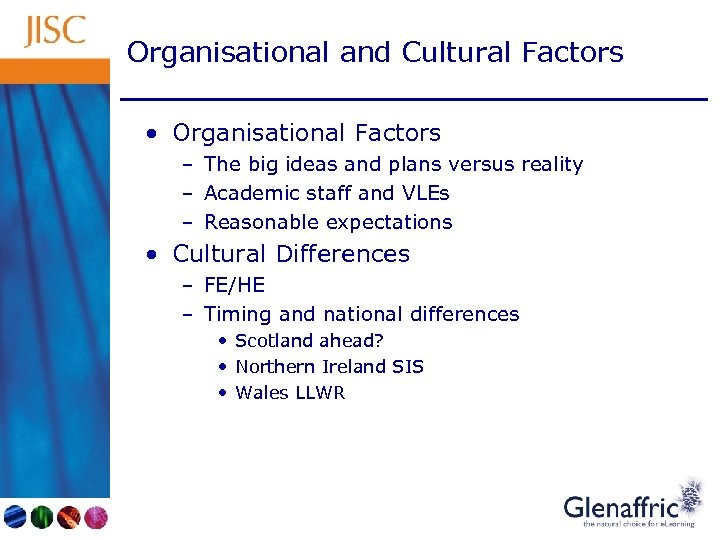 Organisational and Cultural Factors • Organisational Factors – The big ideas and plans versus reality – Academic staff and VLEs – Reasonable expectations • Cultural Differences – FE/HE – Timing and national differences • Scotland ahead? • Northern Ireland SIS • Wales LLWR
 Impact and Benefits • Sector • Institutional • Individual – Project staff – College staff – Learners
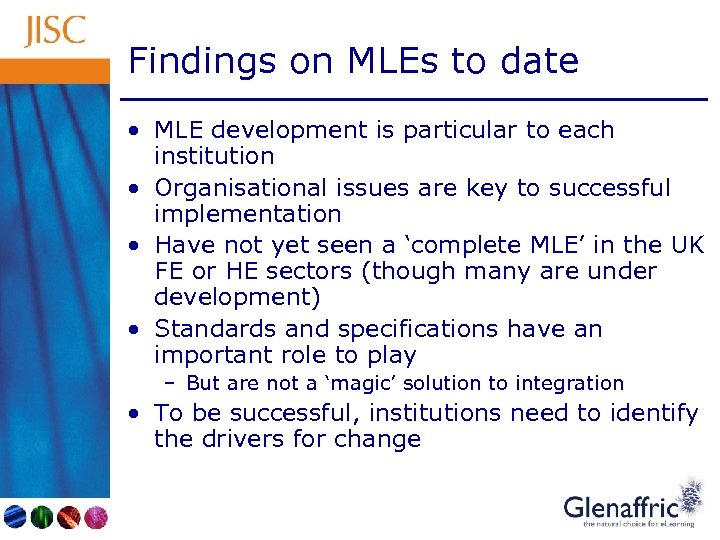 Findings on MLEs to date • MLE development is particular to each institution • Organisational issues are key to successful implementation • Have not yet seen a ‘complete MLE’ in the UK FE or HE sectors (though many are under development) • Standards and specifications have an important role to play – But are not a ‘magic’ solution to integration • To be successful, institutions need to identify the drivers for change
 Technical issues • Application profiles – English FE pilots + extensions – Profiles agreed with vendors – XML schema devised • Use cases – Understand business processes – Steep learning curve - slow to develop • Transport mechanism – SOAP with attachments – Timescale too short for vendors - ad hoc solutions • Testing – System – User
 FE/HE community benefits • MLE developer’s pack – step-by-step guide to MLE planning and implementation (Early 2004) – Case studies of implementation – Recommendations and guidelines for good and bad practice – Recommendations about the use of standards to create MLEs (the ‘building block’ approach) • MLE Landscape Study – survey and report in July 2003 – More information about what the Jones’ are doing • Free tools and ‘glueware’ • Input to the development of international e-learning standards
 Sources of information and advice • Regional Support Centres • JISC Info. NET – Started on 2 nd Jan 2003 – Supporting UK FE and HE in the planning and implementation of Information Systems – Information systems; learning and teaching technologies; approaches to technology
 Contacts Veronica Adamson - veronica@glenaffric. com Jane Plenderleith - jane@glenaffric. com Glenaffric Ltd 14 Lewiston, Drumnadrochit, Inverness, IV 63 6 UW T: 01456 459106 F: 0870 052 9151 W: www. glenaffric. com 19 Sept 2002 JISC/SURF/Internet 2, Oxford Supporting further and higher education