 Скачать презентацию MLA Style Using parenthetical documentation The basics
MLA Style--citation copy.ppt
- Количество слайдов: 9



MLA Style Using parenthetical documentation
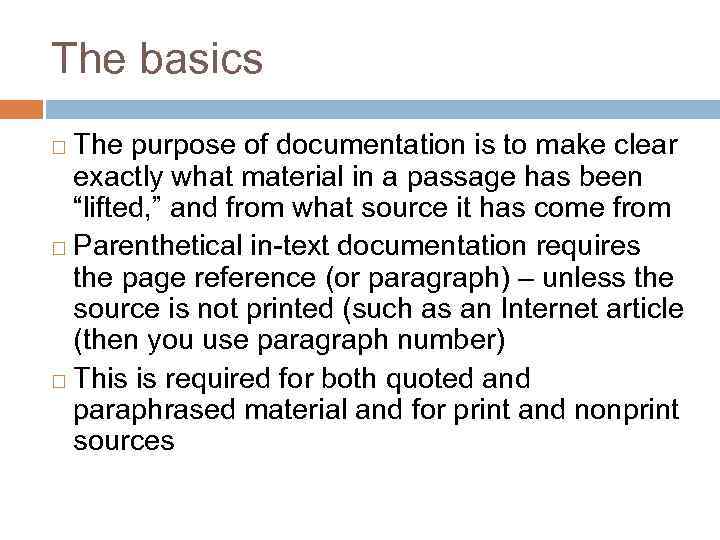
The basics The purpose of documentation is to make clear exactly what material in a passage has been “lifted, ” and from what source it has come from ¨ Parenthetical in-text documentation requires the page reference (or paragraph) – unless the source is not printed (such as an Internet article (then you use paragraph number) ¨ This is required for both quoted and paraphrased material and for print and nonprint sources ¨
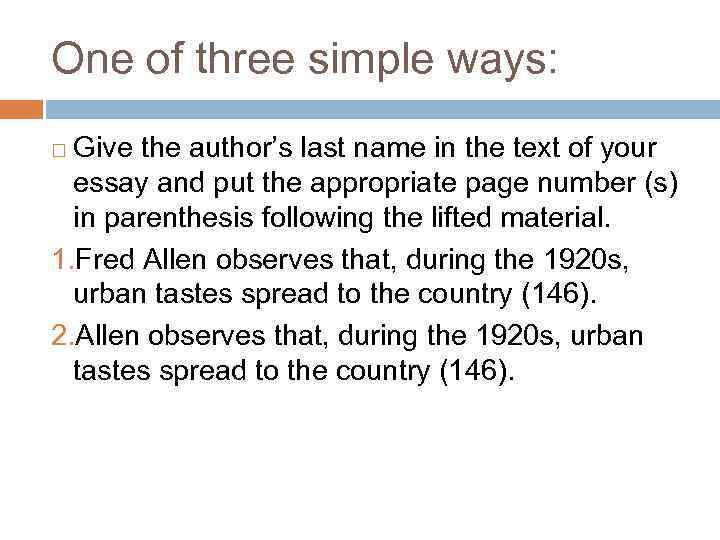
One of three simple ways: Give the author’s last name in the text of your essay and put the appropriate page number (s) in parenthesis following the lifted material. 1. Fred Allen observes that, during the 1920 s, urban tastes spread to the country (146). 2. Allen observes that, during the 1920 s, urban tastes spread to the country (146). ¨
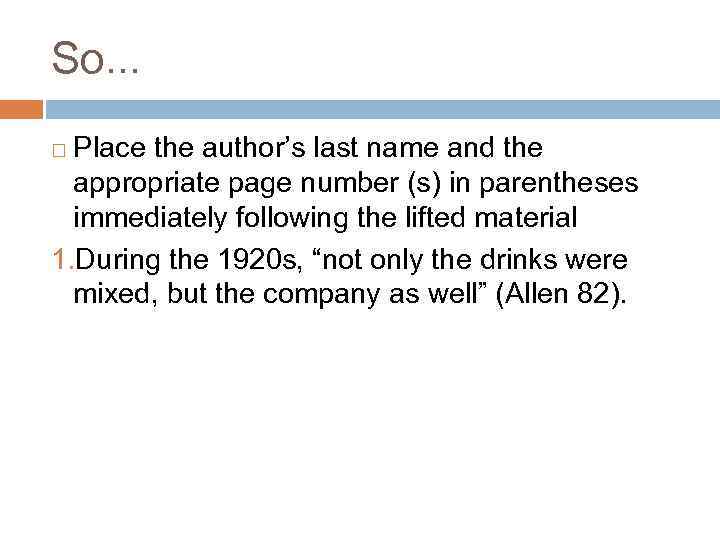
So. . . Place the author’s last name and the appropriate page number (s) in parentheses immediately following the lifted material 1. During the 1920 s, “not only the drinks were mixed, but the company as well” (Allen 82). ¨
So… When you cite an entire work (summarizing) give the author’s name in the text and omit page numbers…since there won’t be a specific page 1. Frederick Allen explains, to both parents and teachers, the specific ways in which gender matters. ¨
Keep in mind These in-text references are complete only when the full citation is placed in the Works Cited section of your paper 1. Allen, Frederick. Only Yesterday: A Boring History of the 1920 s. New York: Harper, 1931. Print. ¨
For complex sources: ¨ When you need to cite two or more authors, volumes, an unknown author, two or more works by the same author, consult an MLA handbook
For Internet sources (Last name par. 7). ¨ (Last name pars. 2 -4). ¨
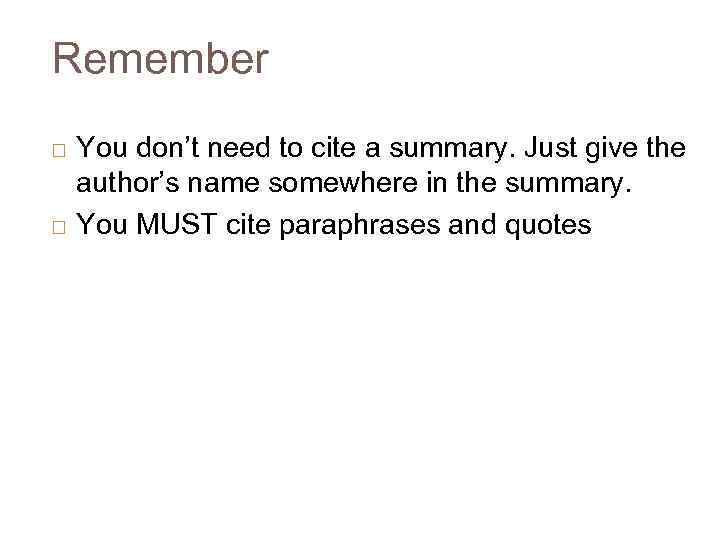
Remember 9 ¨ ¨ You don’t need to cite a summary. Just give the author’s name somewhere in the summary. You MUST cite paraphrases and quotes
Скачать презентацию MLA Style Using parenthetical documentation The basics
MLA Style--citation copy.ppt