


 Скачать презентацию MKTG 3231 Fall 2015 Mrs Tamara L Cohen
0da4bd821c8f3f35c12b3d813053b5e1.ppt
- Количество слайдов: 31
 MKTG 3231 Fall 2015 Mrs. Tamara L. Cohen Global Marketing Management Global Pricing Decisions Class # 21
 KEY TERMS • • Parallel Imports Full-cost versus variable-cost pricing Skimming Penetration pricing Countertrade Transfer pricing Cartels
 KEY CONCEPTS • Price escalation – causes – how it works – how to bring it down • FTZs • Essential elements of international price quotations
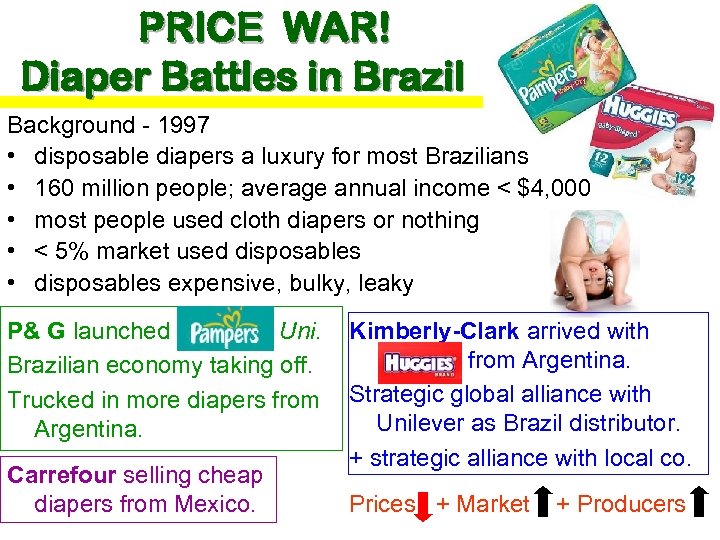 PRICE WAR! Diaper Battles in Brazil Background - 1997 • disposable diapers a luxury for most Brazilians • 160 million people; average annual income < $4, 000 • most people used cloth diapers or nothing • < 5% market used disposables • disposables expensive, bulky, leaky P& G launched Pampers Uni. Brazilian economy taking off. Trucked in more diapers from Argentina. Carrefour selling cheap diapers from Mexico. Kimberly-Clark arrived with from Argentina. Strategic global alliance with Unilever as Brazil distributor. + strategic alliance with local co. Prices + Market + Producers
 Global Perspective – the Price War • Setting right price for product / = key to success or failure Disneyland opening-day price $32 (2005) (now $66 in 2015) service e. g. Hong Kong • Price must reflect quality + value consumer perceives in product (as always) • Globalization of world markets intensifies competition among multinational & homebased companies • Marketing manager’s responsibility = set & control actual price of goods in different markets with different variables • Can use price for specific objective - profit, ROI, market share, sales volume, liquidity
 Parallel Imports Importers buy products from distributors in one country & sell in another country to distributors not part of manufacturer’s regular distribution system 1. whenever price differences > cost of transportation between 2 markets 2. also caused by high tariffs 3. competitive price structures 4. exclusive distribution - protect high retail margins Major problem for pharmaceutical co’s
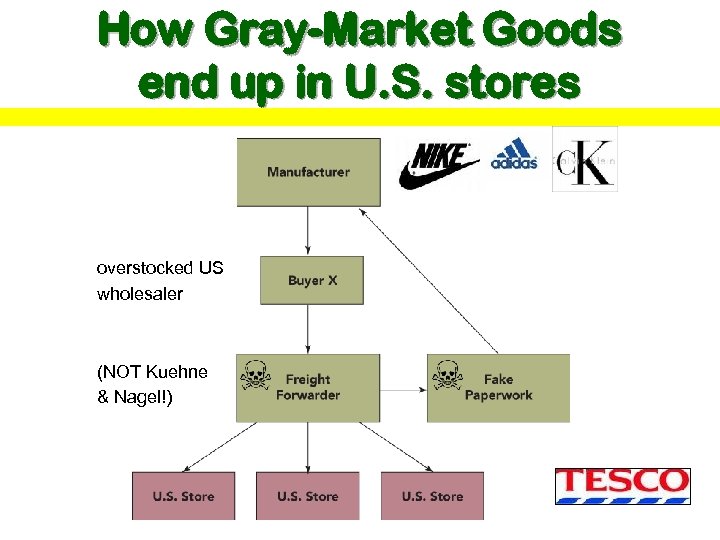 How Gray-Market Goods end up in U. S. stores overstocked US wholesaler (NOT Kuehne & Nagel!)
 Full-Cost vs Variable-Cost Pricing • Full-cost pricing – company insists that no unit of similar product is different from any other unit in terms of cost – each unit must bear full share of total fixed + variable costs – When company has high variable costs relative to fixed costs • Variable-cost pricing (= marginal cost pricing) – firm concerned only with marginal or incremental cost of producing goods to be sold in overseas markets – practical when high fixed costs + unused production capacity – foreign sales are bonus
 Skimming vs Penetration Pricing • Skimming – objective to reach segment of market that is relatively price insensitive - elastic – market is willing to pay premium price for value received – – maximize profit when product is new / unique common in markets with 2 income levels: high & low (no middle) J&J disposable diaper pricing policy in Brazil before P&G came Unilever in India before P&G came • Penetration pricing policy – stimulate market & sales growth by deliberately offering products at low prices – to acquire & hold market share as competitive maneuver – common in markets where middle class growing rapidly & company wants to stimulate growth, even when no competition yet – e. g. 2004 soap war in India: P&G vs Unilever
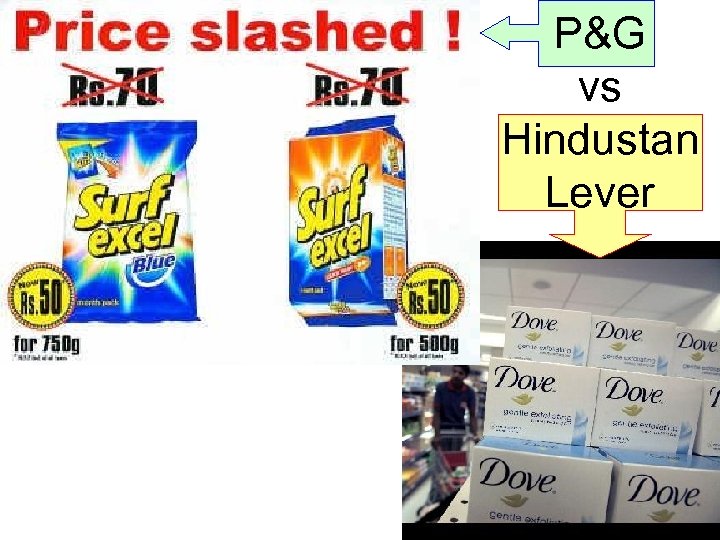 P&G vs Hindustan Lever
 Price Escalation = added cost due to exporting e. g. costs of shipping, insurance, packing, tariffs, longer distribution channels, middlemen margins, special taxes, admin. costs, exchange rate variations • Inflation – in countries with rapid inflation or exchange variation, selling price must be related to cost of goods sold and cost of replacing items • Deflation – essential for company to keep prices low and raise brand value to win trust of consumers • Exchange rate fluctuations – don’t know future value of currency – transactions increasingly being written in terms of supplier’s national currency
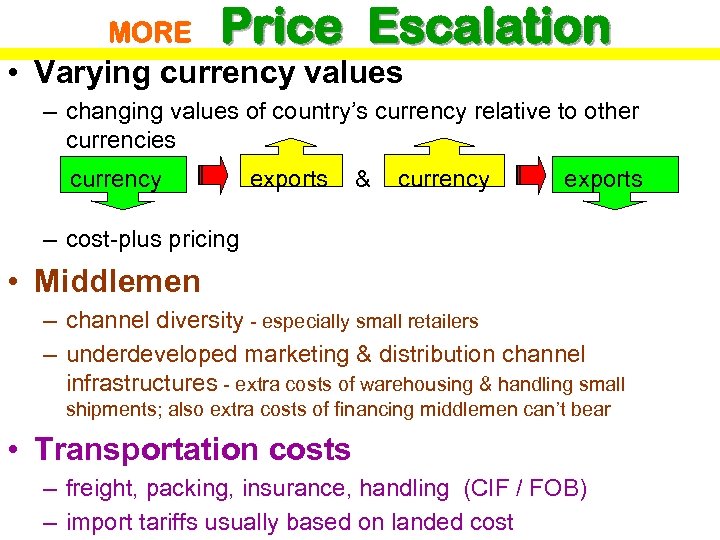 MORE Price Escalation • Varying currency values – changing values of country’s currency relative to other currencies currency exports & currency exports – cost-plus pricing • Middlemen – channel diversity - especially small retailers – underdeveloped marketing & distribution channel infrastructures - extra costs of warehousing & handling small shipments; also extra costs of financing middlemen can’t bear • Transportation costs – freight, packing, insurance, handling (CIF / FOB) – import tariffs usually based on landed cost
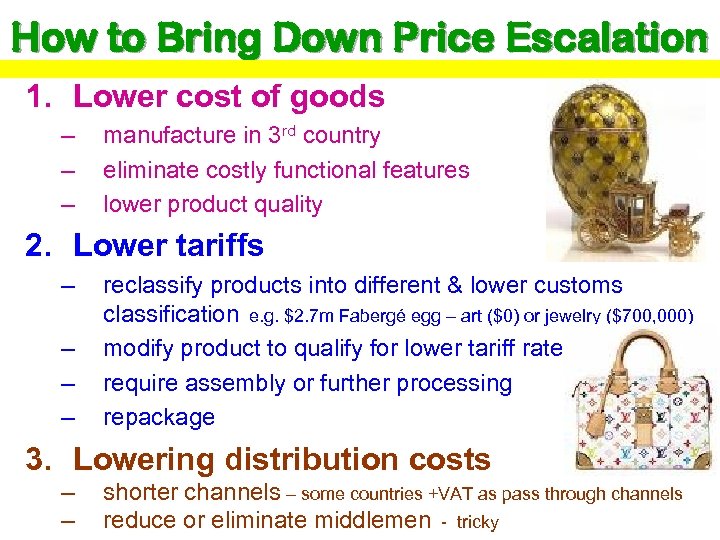 How to Bring Down Price Escalation 1. Lower cost of goods – – – manufacture in 3 rd country eliminate costly functional features lower product quality 2. Lower tariffs – – reclassify products into different & lower customs classification e. g. $2. 7 m Fabergé egg – art ($0) or jewelry ($700, 000) modify product to qualify for lower tariff rate require assembly or further processing repackage 3. Lowering distribution costs – – shorter channels – some countries +VAT as pass through channels reduce or eliminate middlemen - tricky
 More Ways to Bring Down Price Escalation 4. Use Foreign Trade Zones (FTZs) = free ports – tax-free enclave not considered part of country – postpones payment of duties and tariffs – if finished goods not imported into US from FTZ then no US tariffs apply 5. Dumping – use of marginal (variable) cost pricing – sell goods in foreign country below price of same goods in home market
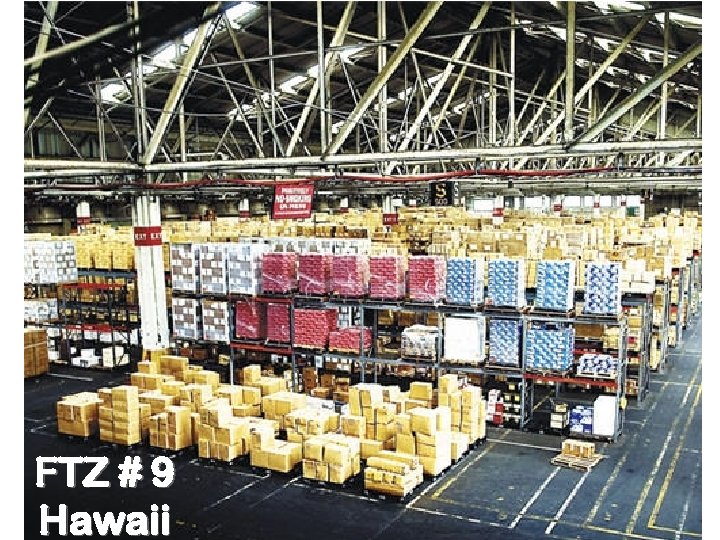 FTZ # 9 Hawaii
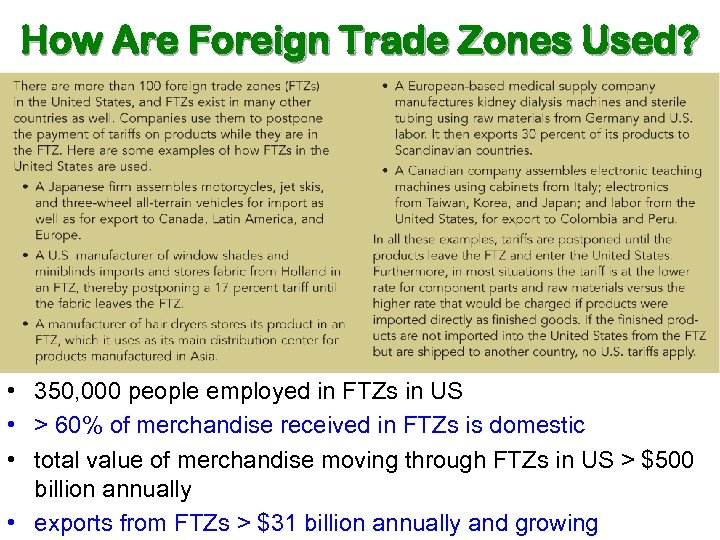 How Are Foreign Trade Zones Used? • 350, 000 people employed in FTZs in US • > 60% of merchandise received in FTZs is domestic • total value of merchandise moving through FTZs in US > $500 billion annually • exports from FTZs > $31 billion annually and growing
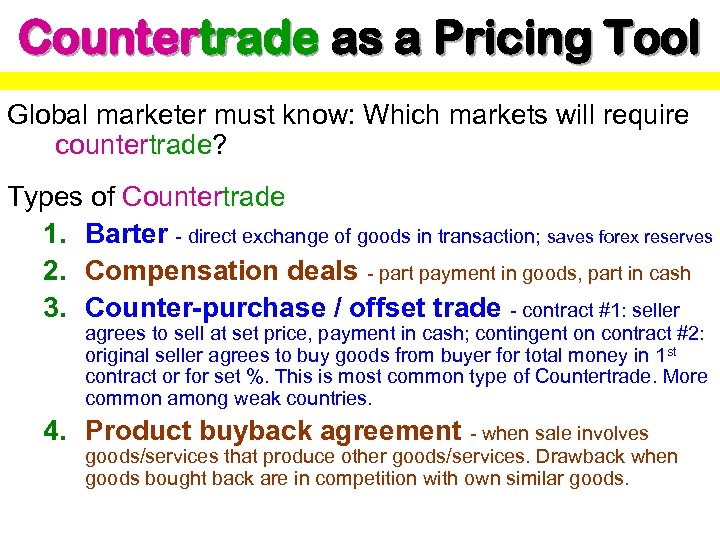 Countertrade as a Pricing Tool Global marketer must know: Which markets will require countertrade? Types of Countertrade 1. Barter - direct exchange of goods in transaction; saves forex reserves 2. Compensation deals - part payment in goods, part in cash 3. Counter-purchase / offset trade - contract #1: seller agrees to sell at set price, payment in cash; contingent on contract #2: original seller agrees to buy goods from buyer for total money in 1 st contract or for set %. This is most common type of Countertrade. More common among weak countries. 4. Product buyback agreement - when sale involves goods/services that produce other goods/services. Drawback when goods bought back are in competition with own similar goods.
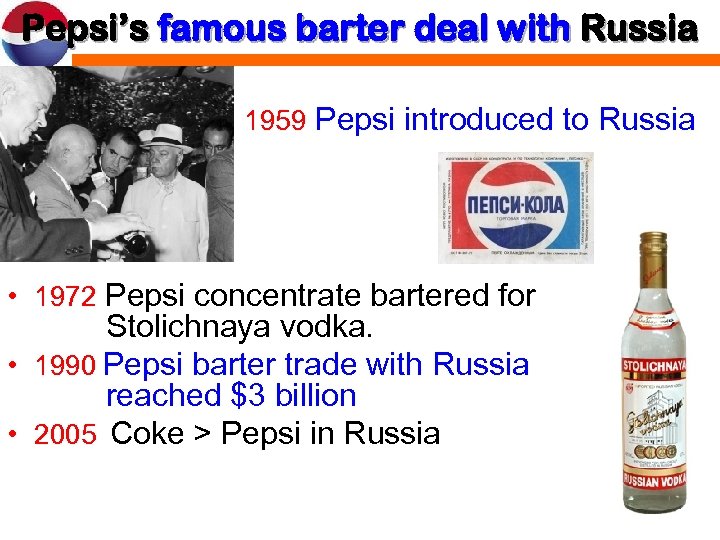 Pepsi’s famous barter deal with Russia 1959 Pepsi introduced to Russia • 1972 Pepsi concentrate bartered for Stolichnaya vodka. • 1990 Pepsi barter trade with Russia reached $3 billion • 2005 Coke > Pepsi in Russia
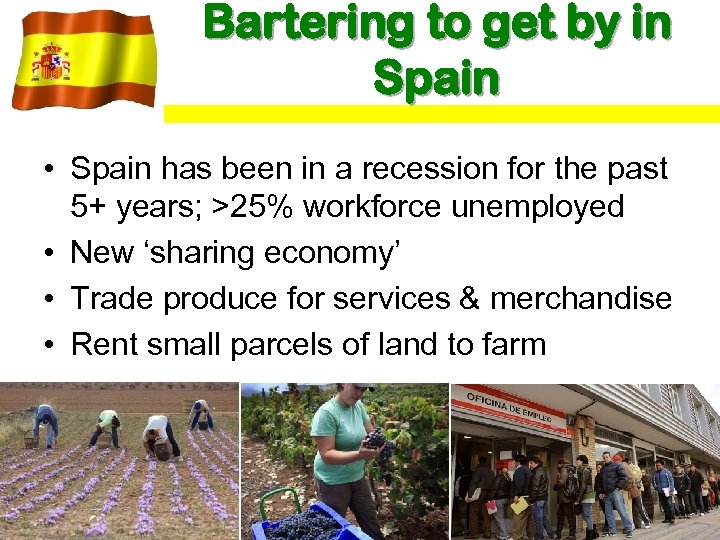 Bartering to get by in Spain • Spain has been in a recession for the past 5+ years; >25% workforce unemployed • New ‘sharing economy’ • Trade produce for services & merchandise • Rent small parcels of land to farm
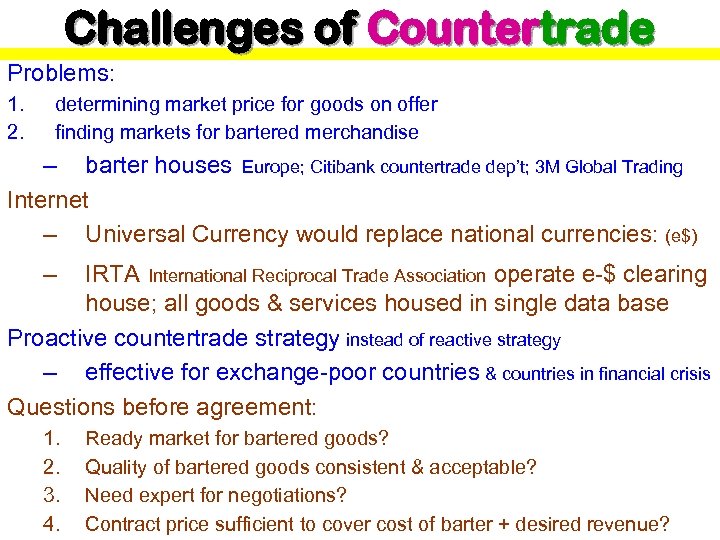 Challenges of Countertrade Problems: 1. 2. determining market price for goods on offer finding markets for bartered merchandise – barter houses Europe; Citibank countertrade dep’t; 3 M Global Trading Internet – Universal Currency would replace national currencies: (e$) – IRTA International Reciprocal Trade Association operate e-$ clearing house; all goods & services housed in single data base Proactive countertrade strategy instead of reactive strategy – effective for exchange-poor countries & countries in financial crisis Questions before agreement: 1. 2. 3. 4. Ready market for bartered goods? Quality of bartered goods consistent & acceptable? Need expert for negotiations? Contract price sufficient to cover cost of barter + desired revenue?
 Transfer Pricing Strategy = price of goods transferred from company’s operations or sales units in one country to its units elsewhere Benefits 1. 2. 3. 4. enhance ultimate profit of company lower duty costs reduce income taxes in high-tax countries facilitate dividend repatriation when dividend repatriation is curtailed by government policy 5. facilitate parent-company control Arm’s-length sales = using same prices as quoted to independent customers
 International Price Quotations Essential Ingredients 1. 2. 3. 4. 5. 6. 7. 8. PRICE Credit Sales terms Transportation Currency Type of documentation required Define quantity (units of measurement) Define quality (agreed quality standards)
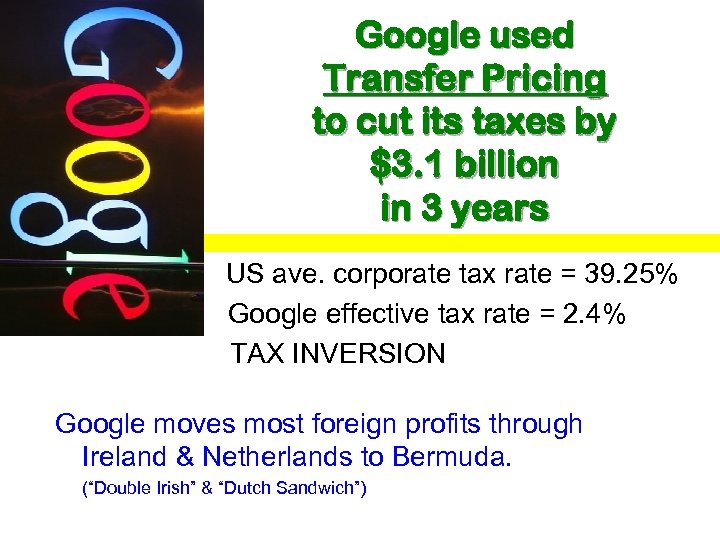 Google used Transfer Pricing to cut its taxes by $3. 1 billion in 3 years US ave. corporate tax rate = 39. 25% Google effective tax rate = 2. 4% TAX INVERSION Google moves most foreign profits through Ireland & Netherlands to Bermuda. (“Double Irish” & “Dutch Sandwich”)
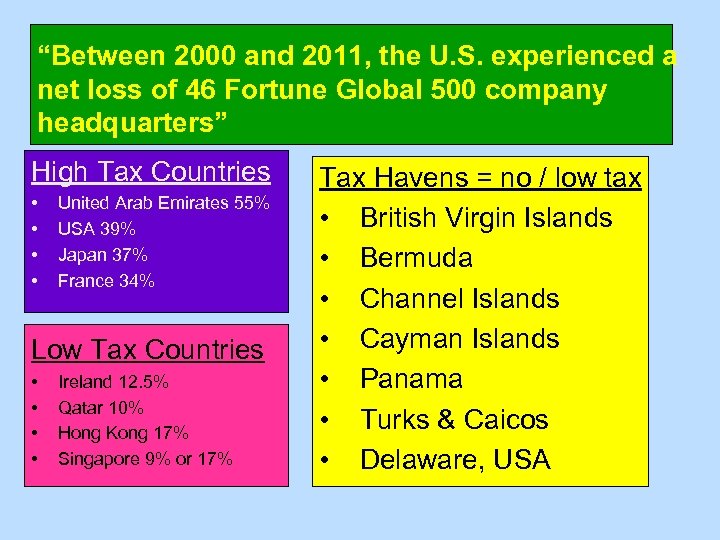 “Between 2000 and 2011, the U. S. experienced a net loss of 46 Fortune Global 500 company headquarters” High Tax Countries • • United Arab Emirates 55% USA 39% Japan 37% France 34% Low Tax Countries • • Ireland 12. 5% Qatar 10% Hong Kong 17% Singapore 9% or 17% Tax Havens = no / low tax • British Virgin Islands • Bermuda • Channel Islands • Cayman Islands • Panama • Turks & Caicos • Delaware, USA
 Administered Pricing = attempt to establish prices for entire market q competitor cooperation / governments / international agreement q goal to reduce or eliminate price competition q governments try to lessen effects of destructive competition CARTELS = companies producing similar products or services work together to control their markets – may use formal agreements • • • set prices establish levels of production & sales allocate market territories redistribute profits may take over entire selling function
 Cartels OPEC Organization of Petroleum Exporting Countries • controls price of oil • early 1970 s OPEC supplied industrial world with 2/3 of its oil, quadrupled price, causing major world recession Trans-Atlantic Conference Agreement • controls shipping • set rates on 70% of cargo between US & northern Europe De Beers • • controls diamond market mines ½ world’s diamonds takes in another ¼ through contracts with other mines “outside buying office” buys up last ¼ to protect prices
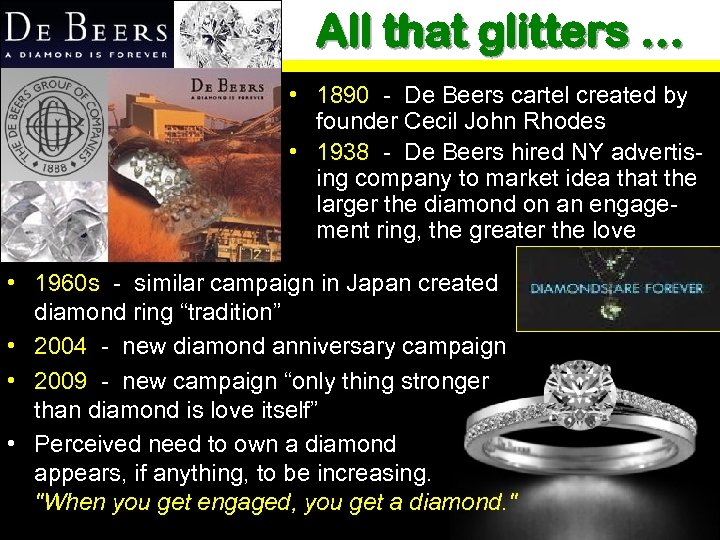 All that glitters … • 1890 - De Beers cartel created by founder Cecil John Rhodes • 1938 - De Beers hired NY advertising company to market idea that the larger the diamond on an engagement ring, the greater the love • 1960 s - similar campaign in Japan created diamond ring “tradition” • 2004 - new diamond anniversary campaign • 2009 - new campaign “only thing stronger than diamond is love itself” • Perceived need to own a diamond appears, if anything, to be increasing. "When you get engaged, you get a diamond. "
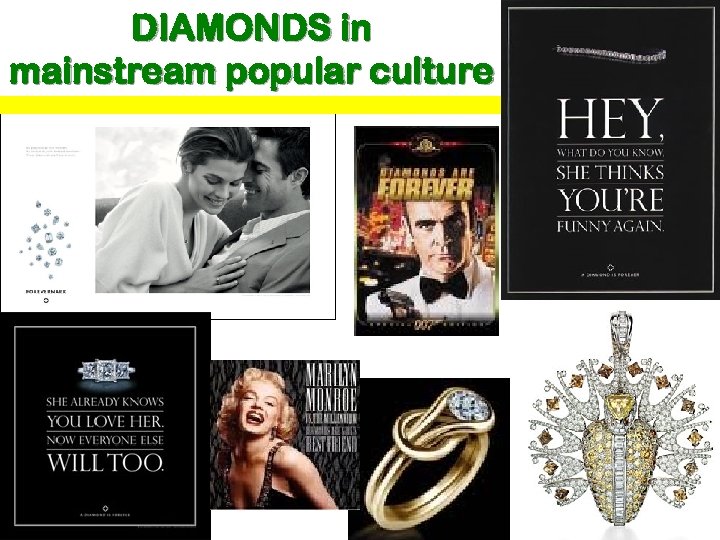 DIAMONDS in mainstream popular culture
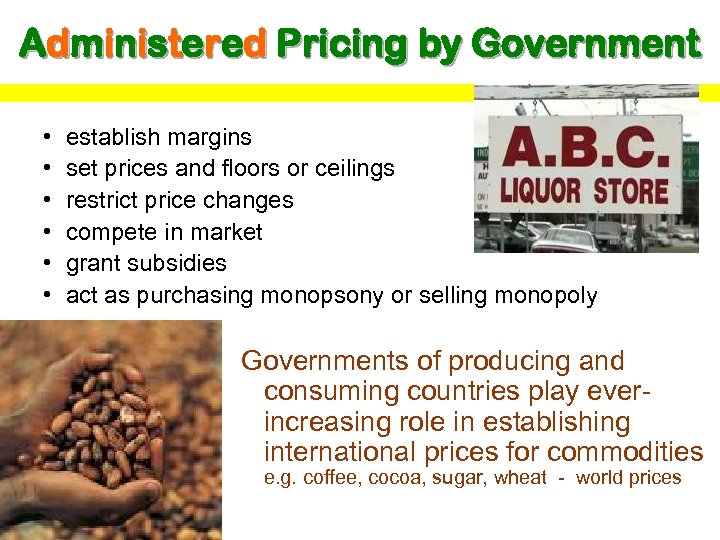 Administered Pricing by Government • • • establish margins set prices and floors or ceilings restrict price changes compete in market grant subsidies act as purchasing monopsony or selling monopoly Governments of producing and consuming countries play everincreasing role in establishing international prices for commodities e. g. coffee, cocoa, sugar, wheat - world prices
 Keys to success in Global Pricing Decisions Pricing is complex and tricky. Work within established marketing objectives and company policy, with enough flexibility for tactical price movement. Important concepts: • control costs that lead to price escalation • Internet facilitates ‘perfect information’ and arbitrage • countertrade tool especially in developing countries • knowledge of local (host country) regulations • transfer pricing (= intracompany pricing), not only to optimize corporate profit, but also to enhance pricing in host country Foreign Trade Zones (FTZs) = regions or ports that are holding areas for imported goods before quotas or customs duties applied
 Next class: Global Distribution Decisions