


 Скачать презентацию MKTG 3110 Spring 2015 Mrs Tamara L Cohen
fef6e6bc6bd62d9ac4abcf2ebc9c6417.ppt
- Количество слайдов: 48
 MKTG 3110 Spring 2015 Mrs. Tamara L. Cohen Marketing Concepts Class #6 Services & B 2 B Marketing
 Marketing Services
 KEY TERMS • • • Services Idle production capacity Off-peak pricing Non-profit organizations Relationship marketing Customer contact audit
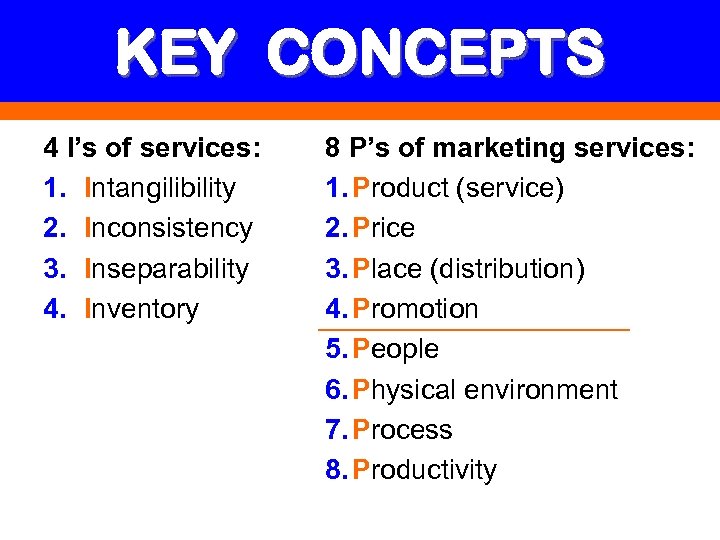 KEY CONCEPTS 4 I’s of services: 1. Intangilibility 2. Inconsistency 3. Inseparability 4. Inventory 8 P’s of marketing services: 1. Product (service) 2. Price 3. Place (distribution) 4. Promotion 5. People 6. Physical environment 7. Process 8. Productivity
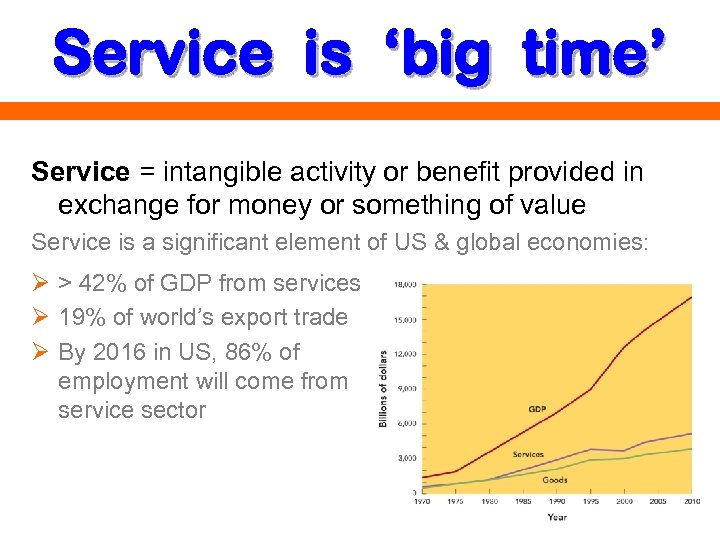 Service is ‘big time’ Service = intangible activity or benefit provided in exchange for money or something of value Service is a significant element of US & global economies: Ø > 42% of GDP from services Ø 19% of world’s export trade Ø By 2016 in US, 86% of employment will come from service sector
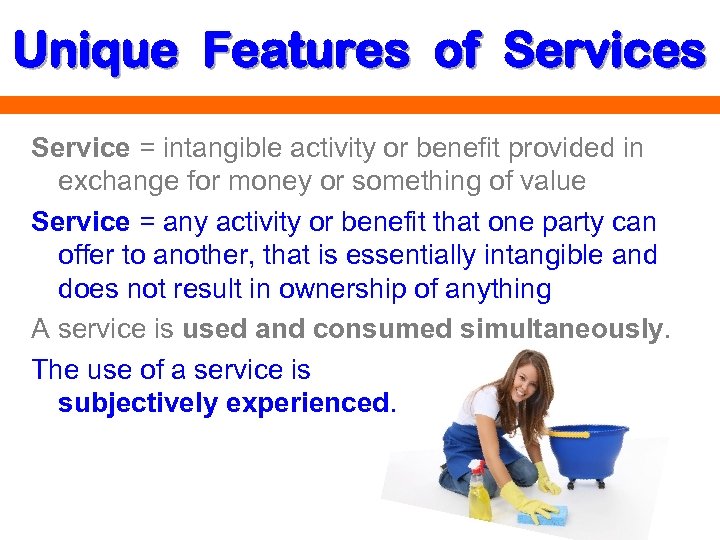 Unique Features of Services Service = intangible activity or benefit provided in exchange for money or something of value Service = any activity or benefit that one party can offer to another, that is essentially intangible and does not result in ownership of anything A service is used and consumed simultaneously. The use of a service is subjectively experienced.
 What are Services? Professional services (physicians, pharmacists, dentists, attorneys, architects, civil engineers, teachers) Business services (advertising, financial planning, mail, computer & data processing, consulting, training, recruiting) Counseling services (weight loss, career planning, pastoral, psychiatric) Transportation services (trucks, buses, taxis, limos, car rental) Personal services (pets, health clubs, catering, barbers, hairdressers, beauticians, realtors, funeral parlors, wedding planning) Restaurants & lodging (diners, hotels, resorts) Social services (child day care, residential care) Maintenance services (landscaping, plumbing & electrical, equipment, cars)
 Why is demand for Services growing so fast in the US? 1. 2. 3. 4. 5. Increased affluence Increased leisure time Greater life expectancy Changing work force demographics Increased complexity of products/ technological advancement 6. Increased complexity of life 7. Increased environmental awareness 8. Increased number of available services
 4 I’s of services 1. Intangibility 2. Inconsistency 3. Inseparability 4. Inventory
 1. Intangibility • Services are INTANGIBLE because they can’t be seen, tasted, felt, heard or smelled before purchasing. • “Signals” of service quality reduce uncertainty. • Marketer of service must make service tangible to send right signals about quality = evidence management
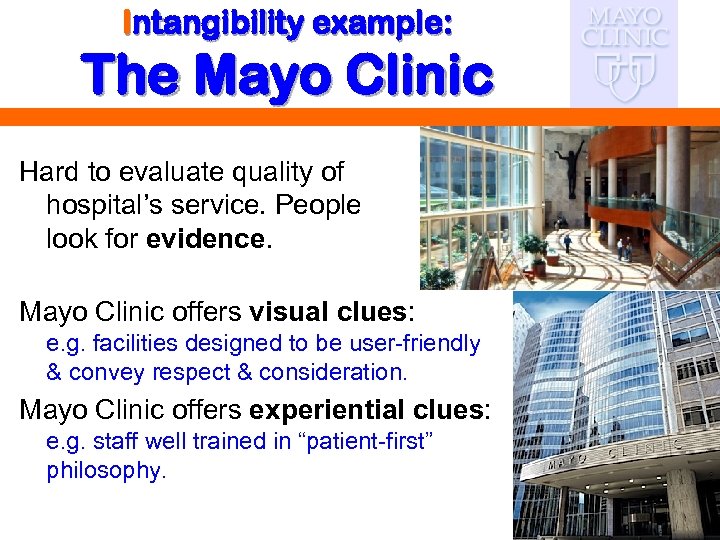 Intangibility example: The Mayo Clinic Hard to evaluate quality of hospital’s service. People look for evidence. Mayo Clinic offers visual clues: e. g. facilities designed to be user-friendly & convey respect & consideration. Mayo Clinic offers experiential clues: e. g. staff well trained in “patient-first” philosophy.
 2. Inconsistency = variability of quality Quality of services depends on who provides them; also when, where & how they are provided. Quality varies with each person’s capabilities & day-to-day performance. Inconsistency is more of a problem for services than for goods. Organizations try to minimize inconsistency by standardization & training.
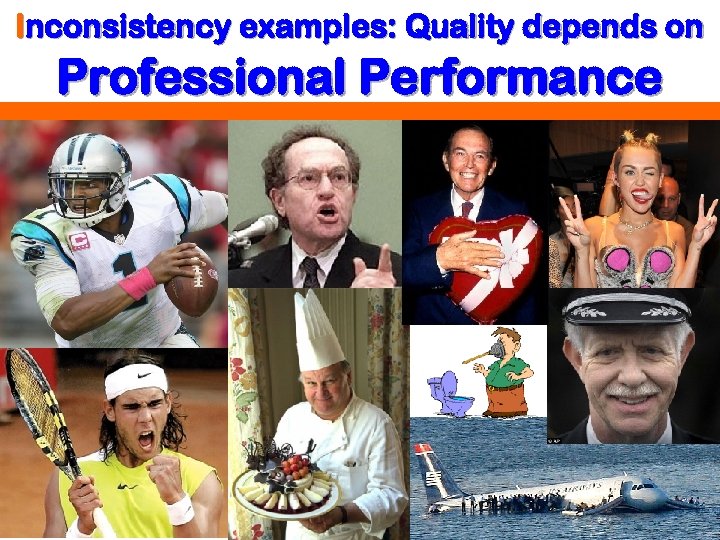 Inconsistency examples: Quality depends on Professional Performance
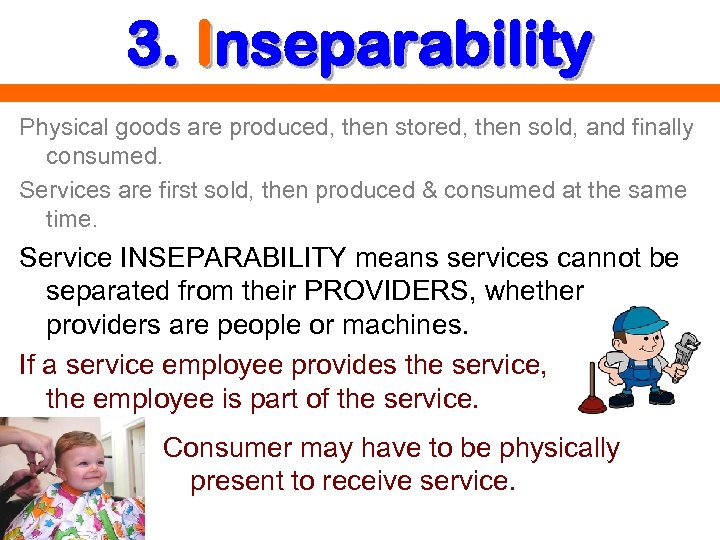 3. Inseparability Physical goods are produced, then stored, then sold, and finally consumed. Services are first sold, then produced & consumed at the same time. Service INSEPARABILITY means services cannot be separated from their PROVIDERS, whether providers are people or machines. If a service employee provides the service, the employee is part of the service. Consumer may have to be physically present to receive service.
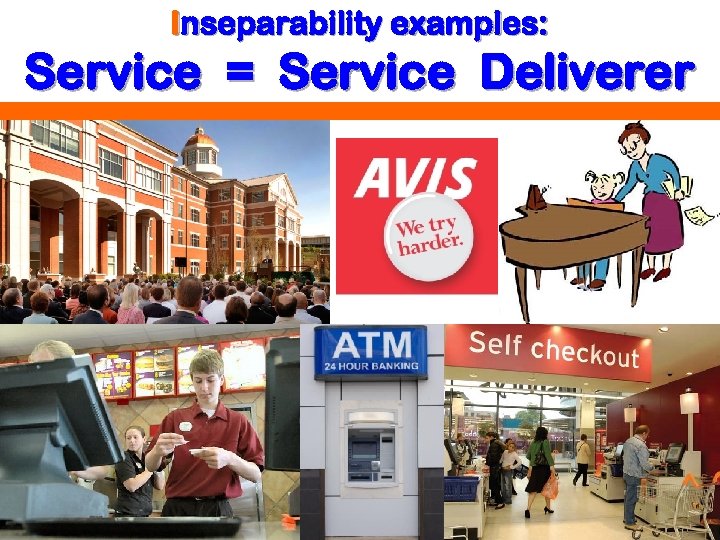 Inseparability examples: Service = Service Deliverer
 4. Inventory Services are perishable. They cannot be stored for later sale or use. Inventory cost of a service = cost of paying service provider + associated equipment e. g. fixed cost of idle doctor, barber, plumber, lawyer, etc. Idle production capacity = service provider is available but there is no demand, e. g. appointment scheduling for doctors, hairdressers, lawyers, etc. Inventory costs can be lowered by designing compensation systems accordingly, e. g. paying on commission Value of TIME to consumers adds pressure to service providers maintaining production capacity.
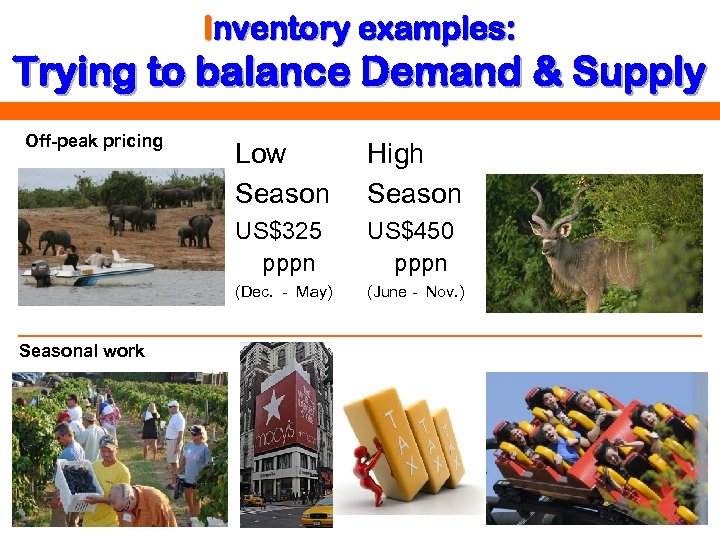 Inventory examples: Trying to balance Demand & Supply Off-peak pricing High Season US$325 pppn US$450 pppn (Dec. - May) Seasonal work Low Season (June - Nov. )
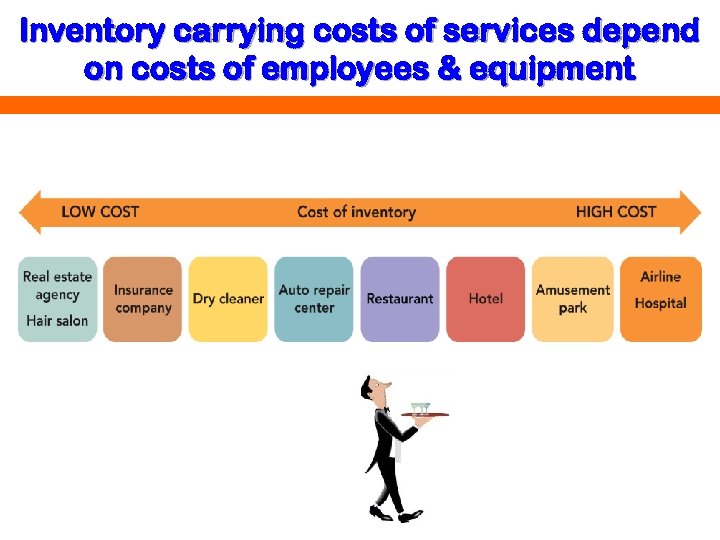 Inventory carrying costs of services depend on costs of employees & equipment
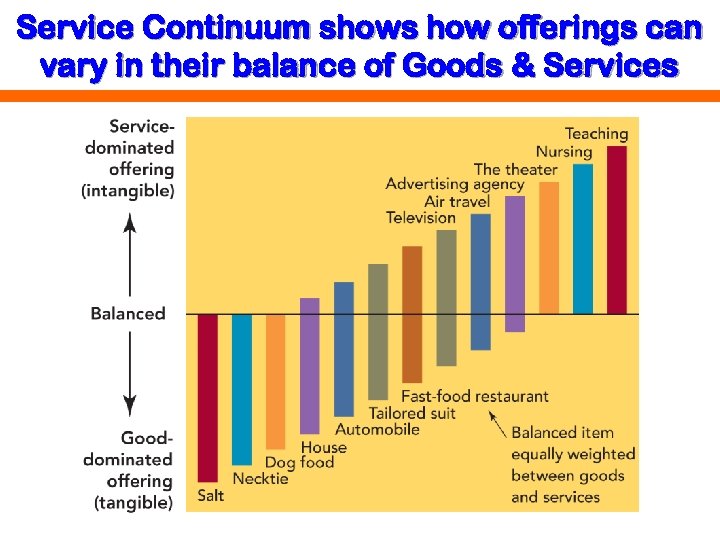 Service Continuum shows how offerings can vary in their balance of Goods & Services
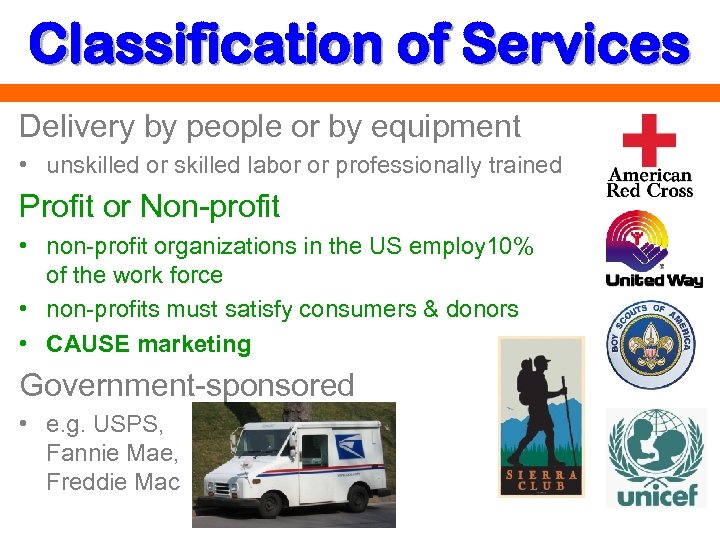 Classification of Services Delivery by people or by equipment • unskilled or skilled labor or professionally trained Profit or Non-profit • non-profit organizations in the US employ 10% of the work force • non-profits must satisfy consumers & donors • CAUSE marketing Government-sponsored • e. g. USPS, Fannie Mae, Freddie Mac
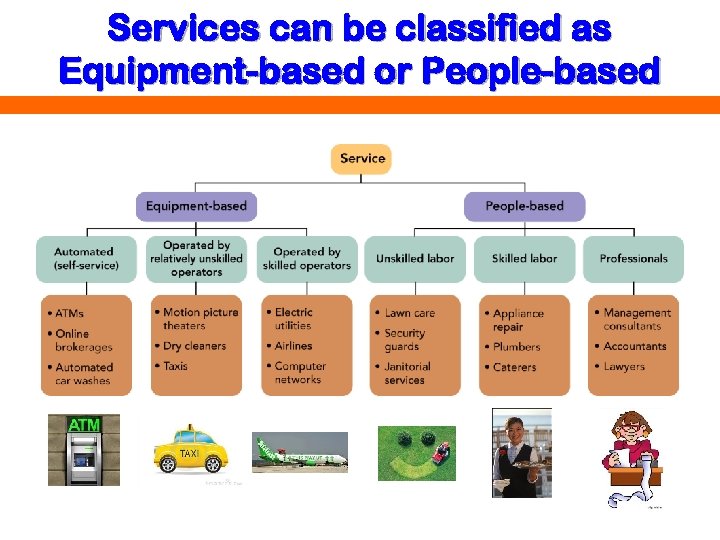 Services can be classified as Equipment-based or People-based
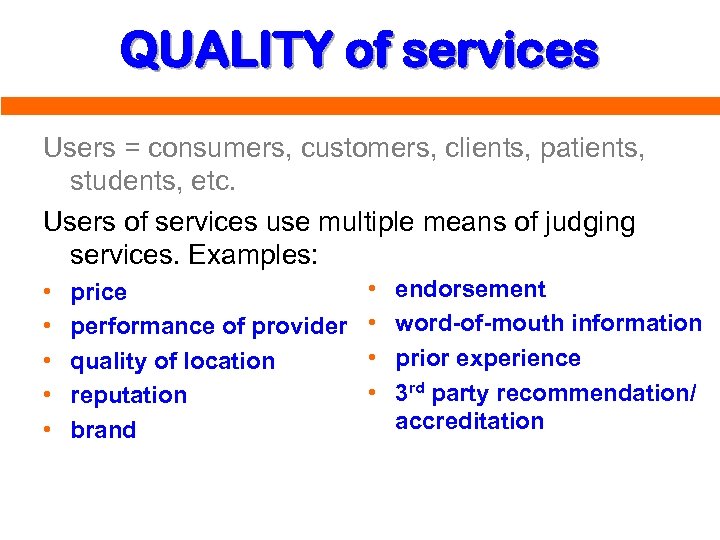 QUALITY of services Users = consumers, customers, clients, patients, students, etc. Users of services use multiple means of judging services. Examples: • • • price performance of provider quality of location reputation brand • • endorsement word-of-mouth information prior experience 3 rd party recommendation/ accreditation
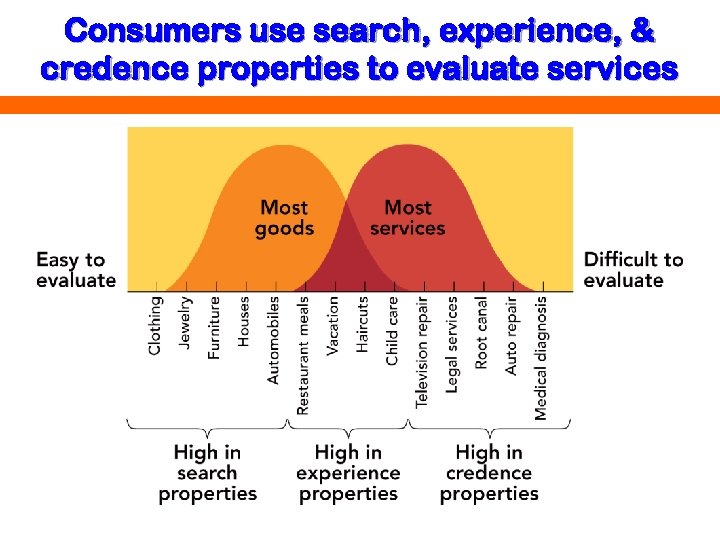 Consumers use search, experience, & credence properties to evaluate services
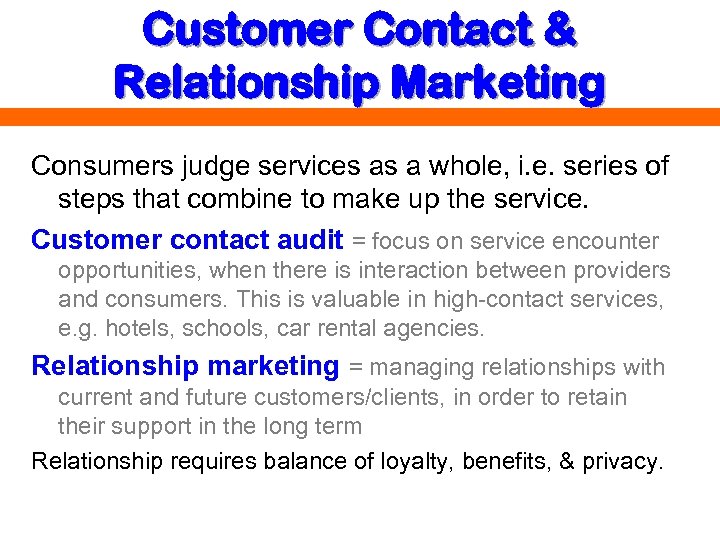 Customer Contact & Relationship Marketing Consumers judge services as a whole, i. e. series of steps that combine to make up the service. Customer contact audit = focus on service encounter opportunities, when there is interaction between providers and consumers. This is valuable in high-contact services, e. g. hotels, schools, car rental agencies. Relationship marketing = managing relationships with current and future customers/clients, in order to retain their support in the long term Relationship requires balance of loyalty, benefits, & privacy.
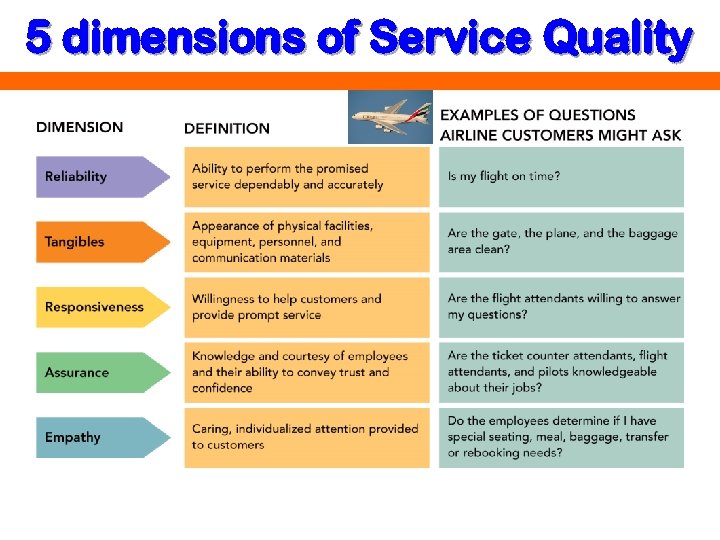 5 dimensions of Service Quality
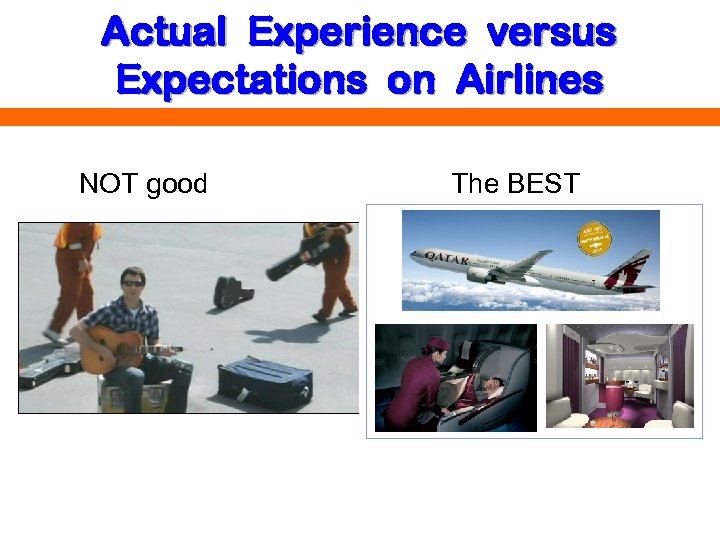 Actual Experience versus Expectations on Airlines NOT good The BEST
 8 P’s of Services Marketing 1. 2. 3. 4. Product (service) Price Place (distribution) Promotion 5. People 6. Physical environment 7. Process 8. Productivity
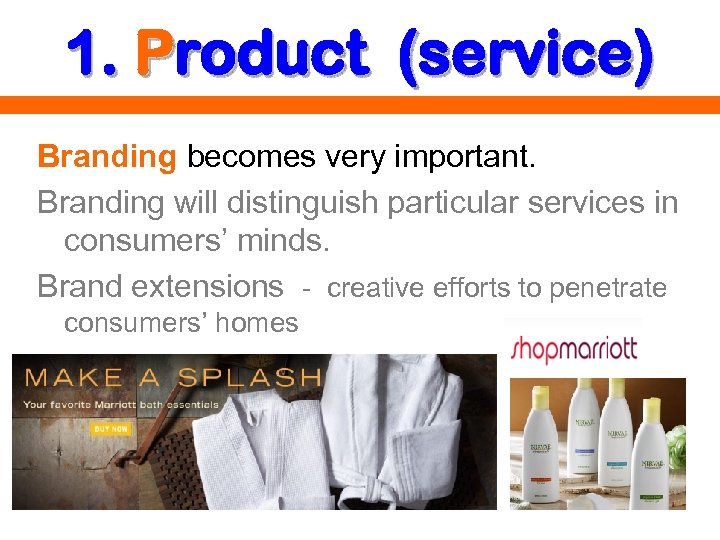 1. Product (service) Branding becomes very important. Branding will distinguish particular services in consumers’ minds. Brand extensions - creative efforts to penetrate consumers’ homes
 SA PR L IC E E 2. Price = charges (hospitals, hotels); fees (doctors, lawyers, accountants, consultants); fares (airlines, taxis, trains); rates (hotels); tuition (educational institutions) Price as a quality cue Pricing can be used as a tool to manage demand, e. g. off-peak pricing
 3. Place is a major factor in marketing strategy because of INSEPARABILITY of service provider. Consumer usually must go to service provider’s physical location to purchase or receive service. Technology is used to deliver services remotely. Electronic dissemination is increasingly valuable e. g. education, travel, entertainment
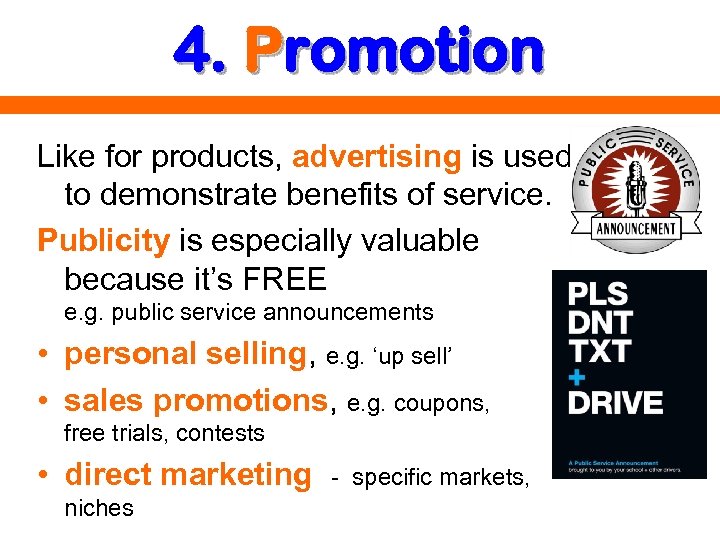 4. Promotion Like for products, advertising is used to demonstrate benefits of service. Publicity is especially valuable because it’s FREE e. g. public service announcements • personal selling, e. g. ‘up sell’ • sales promotions, e. g. coupons, free trials, contests • direct marketing niches - specific markets,
 5. People Many services depend on people for creation & delivery of service experience. Customers often judge quality of service experience based on performance of provider. Training programs can be critical in preparing providers appropriately and in ensuring consistent quality.
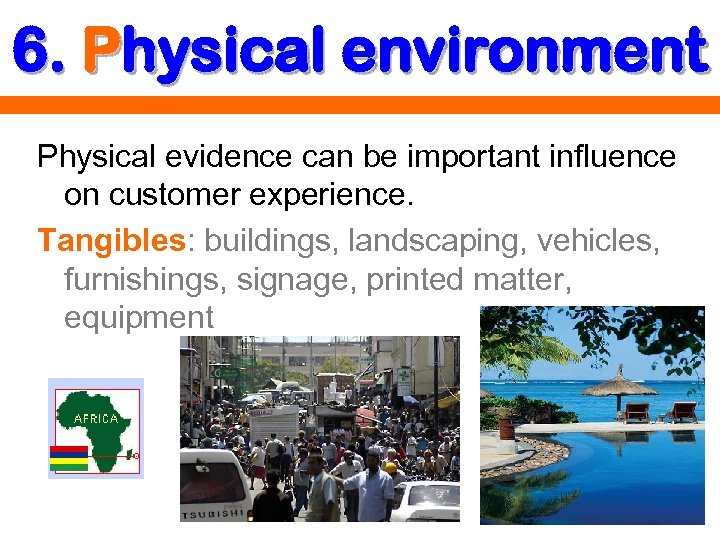 6. Physical environment Physical evidence can be important influence on customer experience. Tangibles: buildings, landscaping, vehicles, furnishings, signage, printed matter, equipment
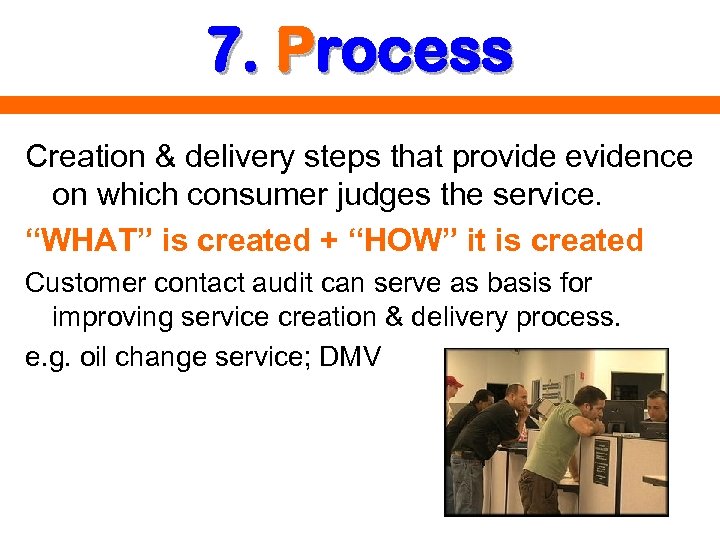 7. Process Creation & delivery steps that provide evidence on which consumer judges the service. “WHAT” is created + “HOW” it is created Customer contact audit can serve as basis for improving service creation & delivery process. e. g. oil change service; DMV
 8. Productivity Inseparability of service & provider means the service capacity is limited. Challenges to match demand with supply = capacity management e. g. airline contracts, price codes, etc. Technology will be key. “Think global and act local” to optimize service quality.
 break
break
 B 2 B Business to Business Marketing
 KEY TERMS Business-to-Business marketing Derived demand Supplier development Just-in-time inventory management system Reciprocity Supply partnership E-Marketplaces
 KEY CONCEPTS Organizational buyers: 1. Industrial markets - original equipment manufacturers 2. Reseller markets - wholesalers, brokers, distributors 3. Government markets - federal, state, local 4. Institutions - schools, hospitals, religious institutions, charities ISO 9000 Online auctions: 1. traditional auction 2. reverse auction
 B 2 B is ‘big time’ The US government is the biggest single purchaser of products & services in the country, spending > $300 billion annually. B 2 B accounts for > half business activity in developed countries More marketing majors begin their careers in B 2 B than in consumer marketing.
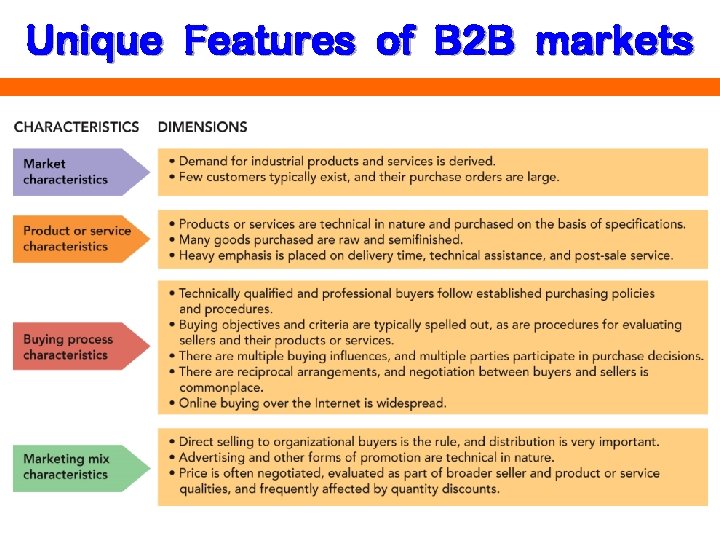 Unique Features of B 2 B markets
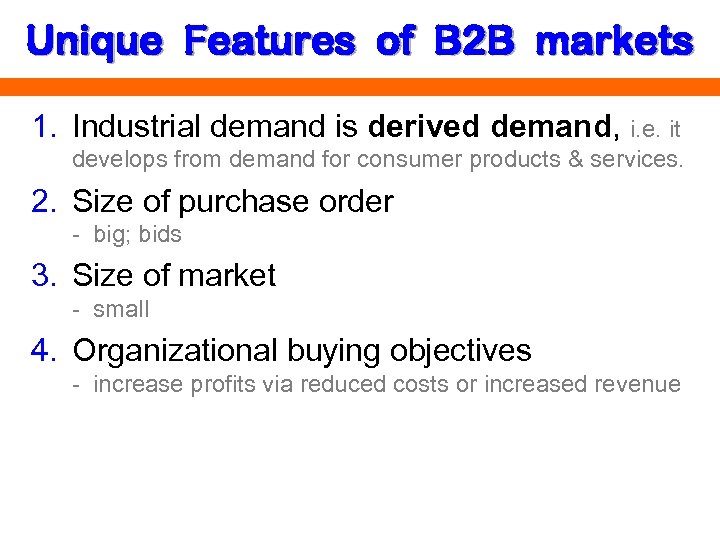 Unique Features of B 2 B markets 1. Industrial demand is derived demand, i. e. it develops from demand for consumer products & services. 2. Size of purchase order - big; bids 3. Size of market - small 4. Organizational buying objectives - increase profits via reduced costs or increased revenue
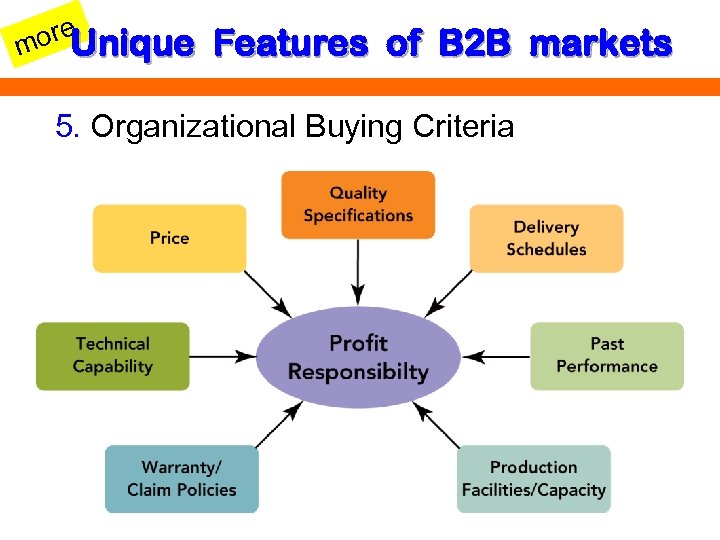 ore m Unique Features of B 2 B markets 5. Organizational Buying Criteria
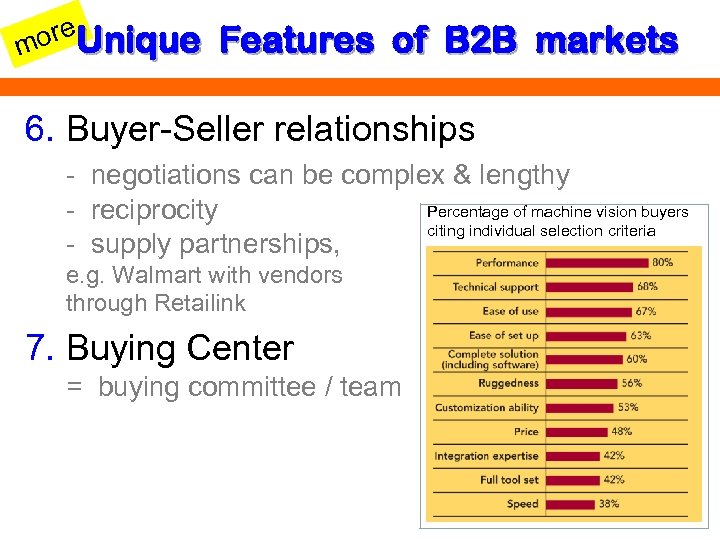 ore. Unique m Features of B 2 B markets 6. Buyer-Seller relationships - negotiations can be complex & lengthy Percentage of machine vision buyers - reciprocity citing individual selection criteria - supply partnerships, e. g. Walmart with vendors through Retailink 7. Buying Center = buying committee / team
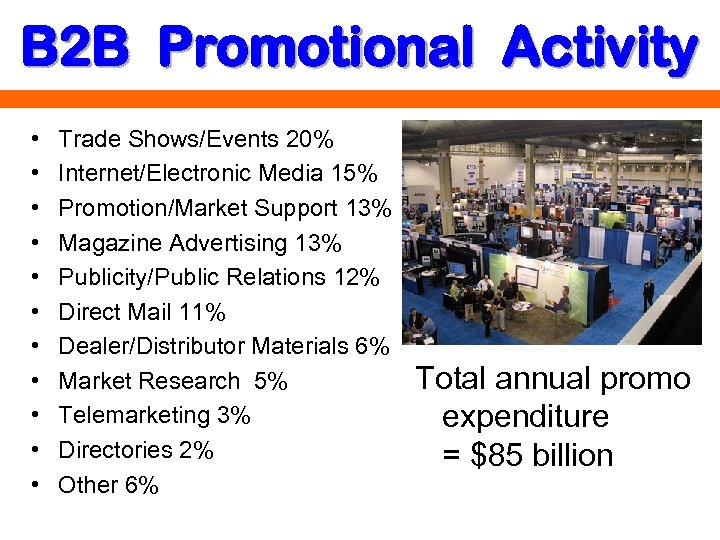 B 2 B Promotional Activity • • • Trade Shows/Events 20% Internet/Electronic Media 15% Promotion/Market Support 13% Magazine Advertising 13% Publicity/Public Relations 12% Direct Mail 11% Dealer/Distributor Materials 6% Market Research 5% Telemarketing 3% Directories 2% Other 6% Total annual promo expenditure = $85 billion
 Online Buying • Critical, time-sensitive information is communicated via Internet - availability, technical specifications, application uses, price, delivery details • E-marketplaces bring together buyers & supplier organizations • Online auctions: 1. traditional auction 2. reverse auction
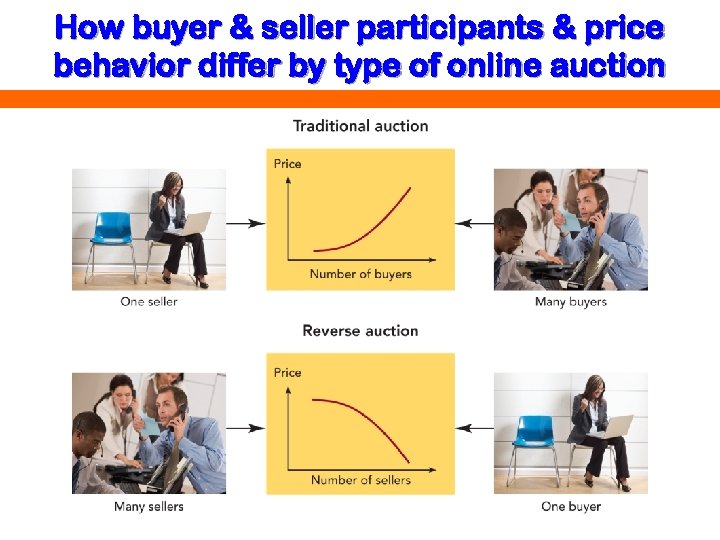 How buyer & seller participants & price behavior differ by type of online auction
 Next class: Marketing in the big wide world (global marketing) Preparation: Read ch. 7 (assigned pages) Homework: Ethnocentrism