


 Скачать презентацию MKTG 3110 Fall 2015 Mrs Tamara L Cohen
b1514e67a6bdcb2726ea9b7c336ca351.ppt
- Количество слайдов: 39
 MKTG 3110 Fall 2015 Mrs. Tamara L. Cohen Marketing Concepts Class#11 Price
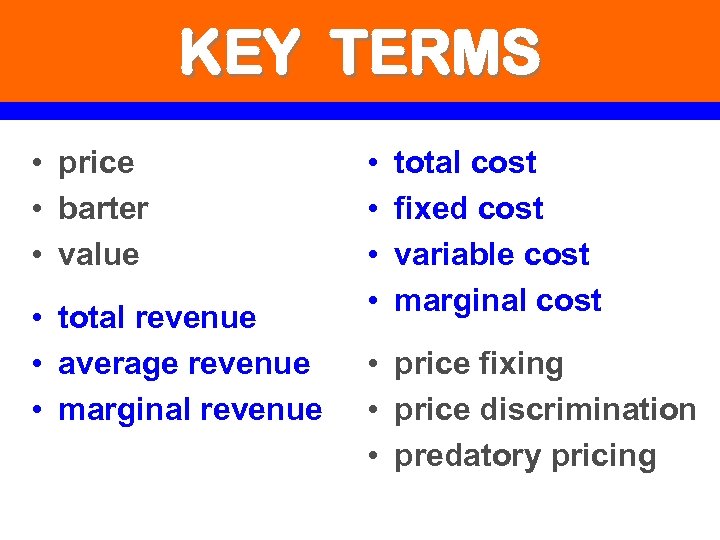 KEY TERMS • price • barter • value • total revenue • average revenue • marginal revenue • • total cost fixed cost variable cost marginal cost • price fixing • price discrimination • predatory pricing
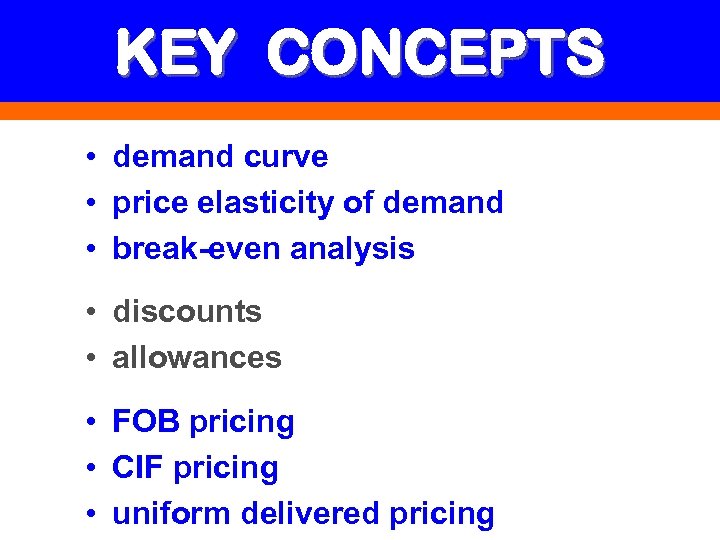 KEY CONCEPTS • demand curve • price elasticity of demand • break-even analysis • discounts • allowances • FOB pricing • CIF pricing • uniform delivered pricing
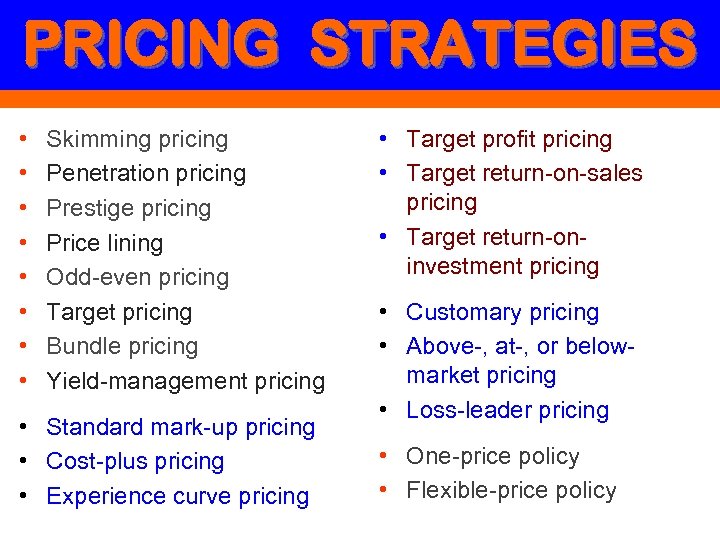 PRICING STRATEGIES • • Skimming pricing Penetration pricing Prestige pricing Price lining Odd-even pricing Target pricing Bundle pricing Yield-management pricing • Standard mark-up pricing • Cost-plus pricing • Experience curve pricing • Target profit pricing • Target return-on-sales pricing • Target return-oninvestment pricing • Customary pricing • Above-, at-, or belowmarket pricing • Loss-leader pricing • One-price policy • Flexible-price policy
 What is PRICE? = amount of money charged for a product or service = sum of all values the consumer exchanges for the benefits of owning or using a product or service ≠ cost PRICE is • the only element in the marketing mix that produces revenue; all other elements represent costs • one of the most flexible elements of marketing mix: price can be changed quickly • the biggest problem for many marketing executives • historically the major factor affecting buyer choice (but this has waned in recent years)
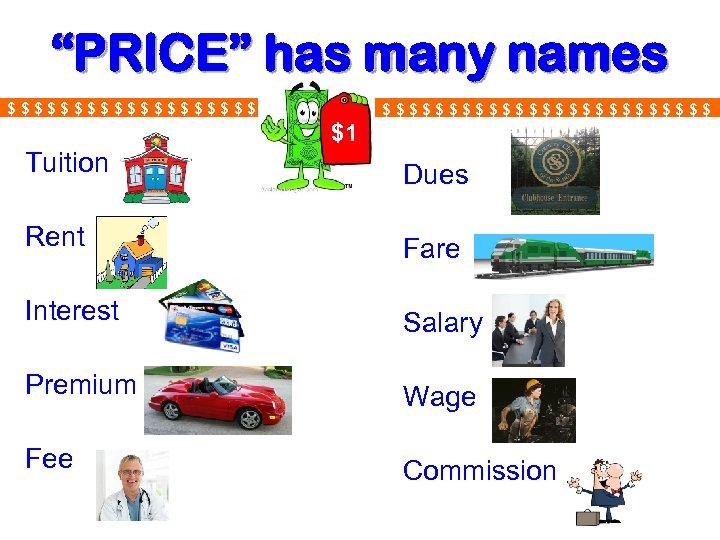 “PRICE” has many names $$$$$$$$$$$$$$$$$$$$$$$$$ $1 Tuition Dues Rent Fare Interest Salary Premium Wage Fee Commission
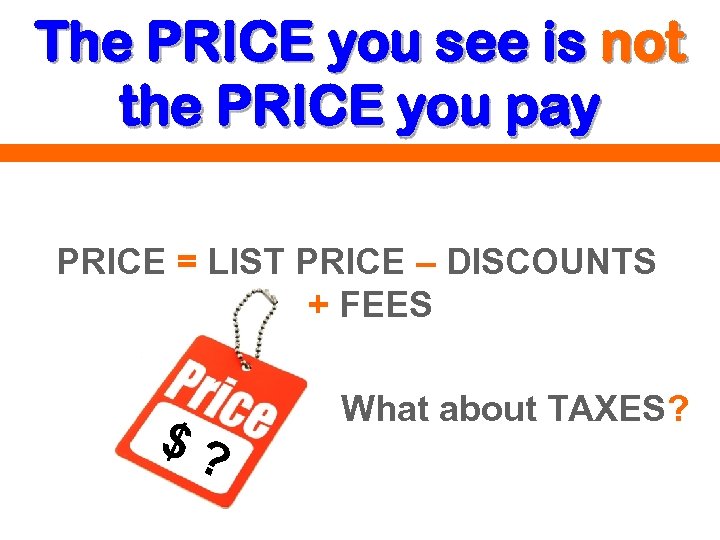 The PRICE you see is not the PRICE you pay PRICE = LIST PRICE – DISCOUNTS + FEES $? What about TAXES?
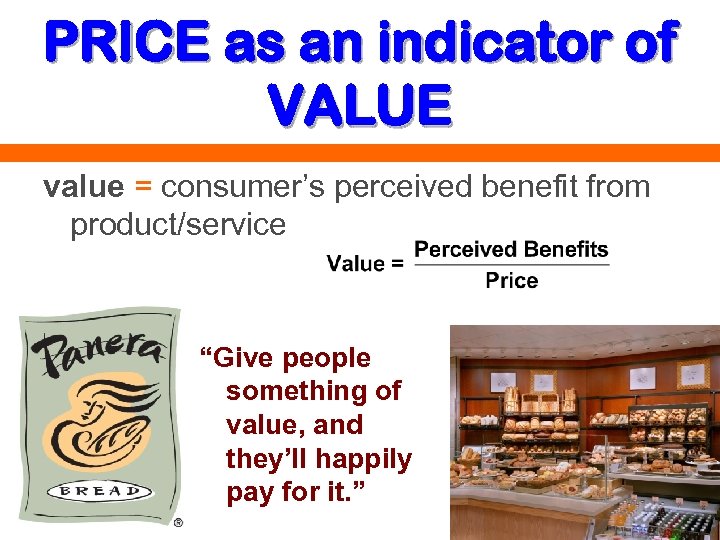 PRICE as an indicator of VALUE value = consumer’s perceived benefit from product/service “Give people something of value, and they’ll happily pay for it. ”
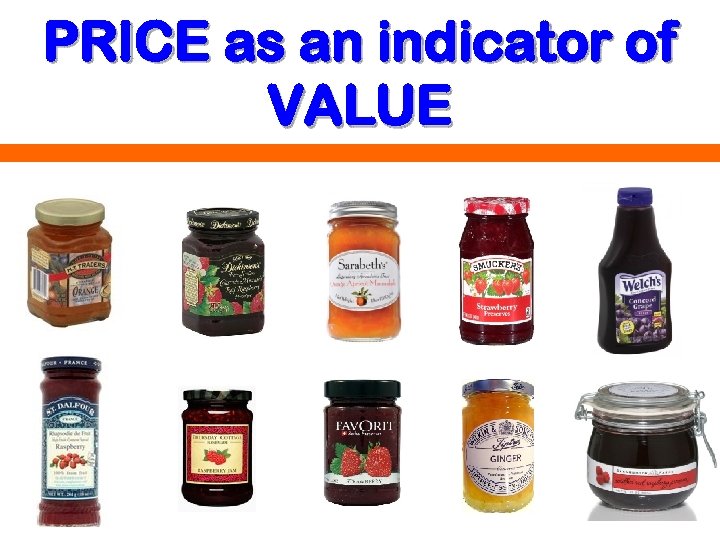 PRICE as an indicator of VALUE
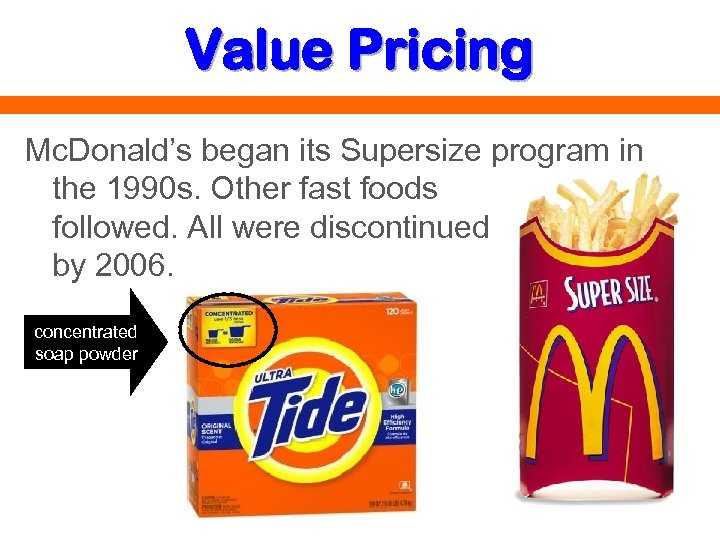 Value Pricing Mc. Donald’s began its Supersize program in the 1990 s. Other fast foods followed. All were discontinued by 2006. concentrated soap powder
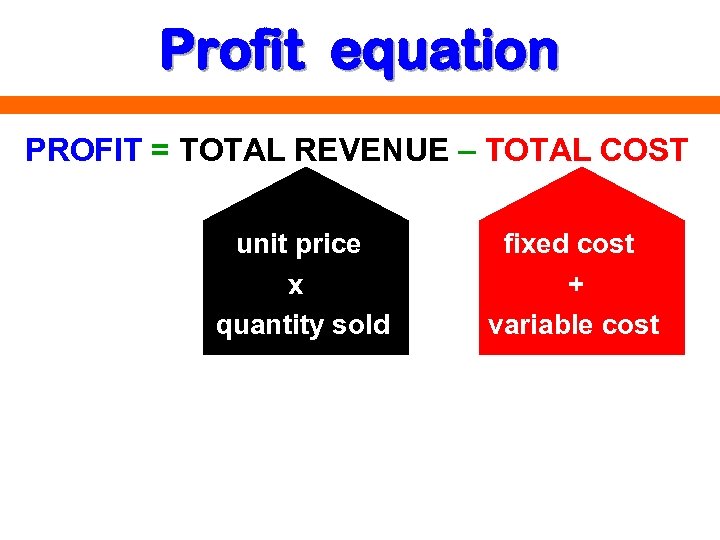 Profit equation PROFIT = TOTAL REVENUE – TOTAL COST unit price x quantity sold fixed cost + variable cost
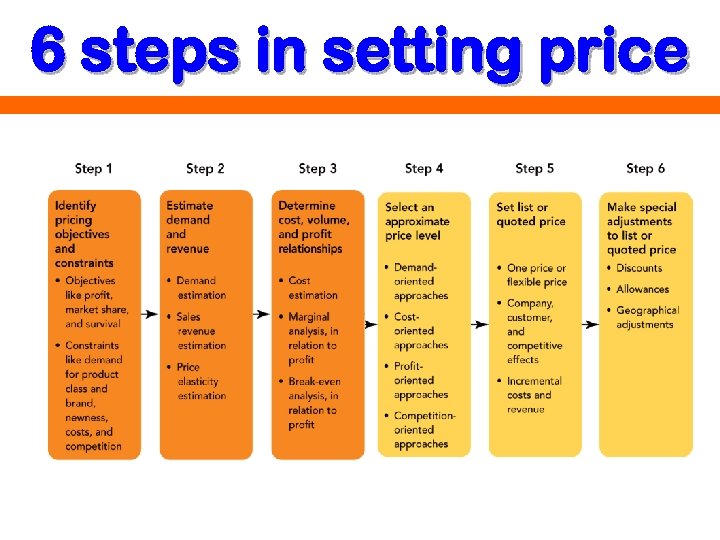 6 steps in setting price
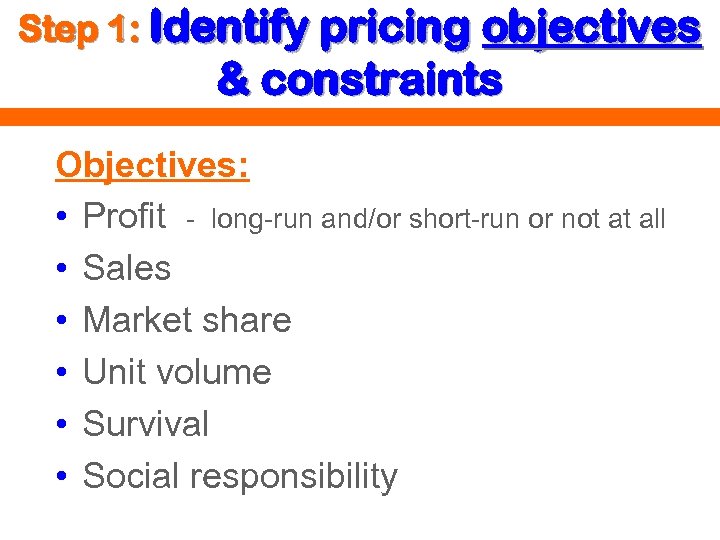 Step 1: Identify pricing objectives & constraints Objectives: • Profit - long-run and/or short-run or not at all • Sales • Market share • Unit volume • Survival • Social responsibility
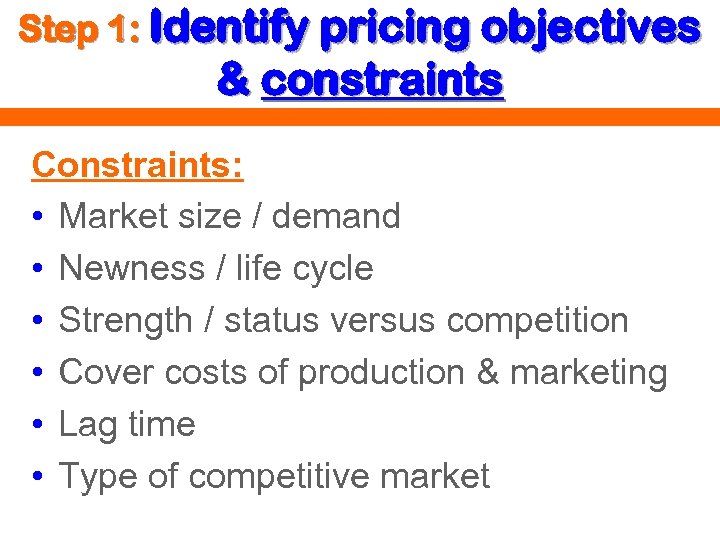 Step 1: Identify pricing objectives & constraints Constraints: • Market size / demand • Newness / life cycle • Strength / status versus competition • Cover costs of production & marketing • Lag time • Type of competitive market
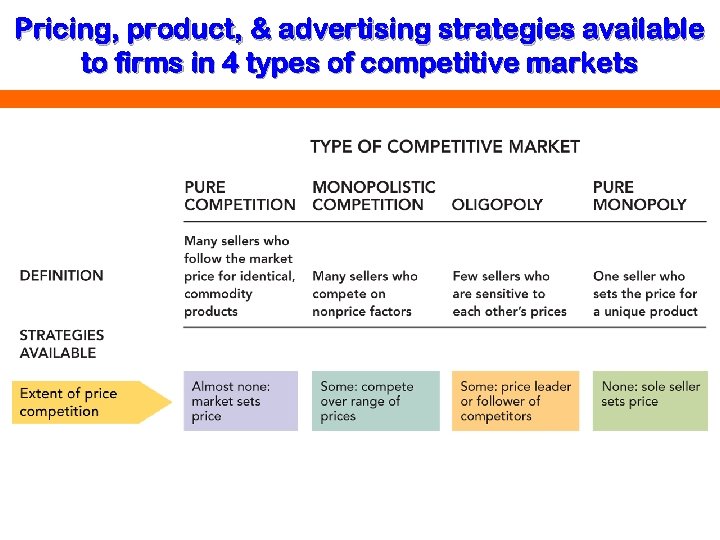 Pricing, product, & advertising strategies available to firms in 4 types of competitive markets
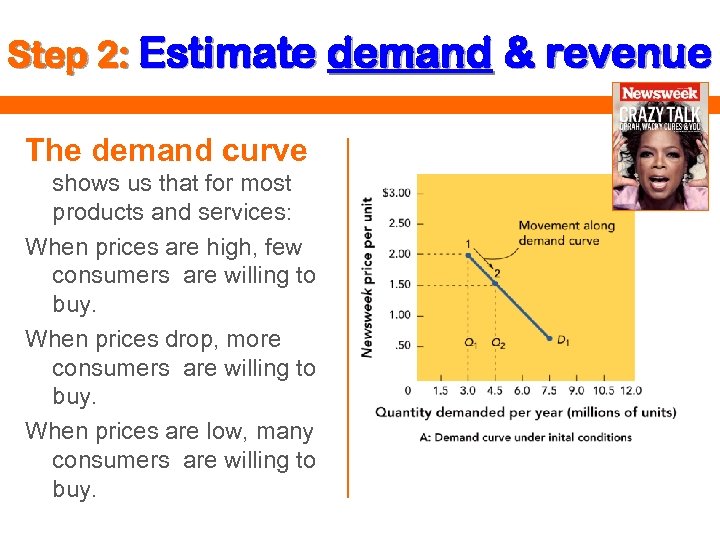 Step 2: Estimate demand & revenue The demand curve shows us that for most products and services: When prices are high, few consumers are willing to buy. When prices drop, more consumers are willing to buy. When prices are low, many consumers are willing to buy.
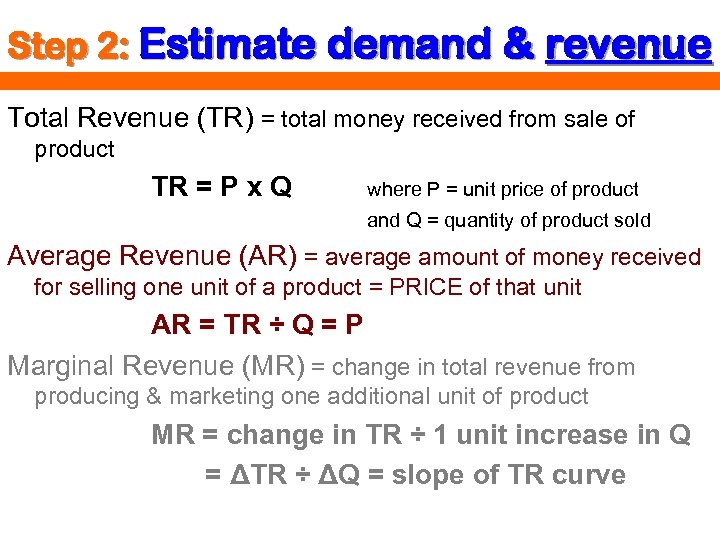 Step 2: Estimate demand & revenue Total Revenue (TR) = total money received from sale of product TR = P x Q where P = unit price of product and Q = quantity of product sold Average Revenue (AR) = average amount of money received for selling one unit of a product = PRICE of that unit AR = TR ÷ Q = P Marginal Revenue (MR) = change in total revenue from producing & marketing one additional unit of product MR = change in TR ÷ 1 unit increase in Q = ΔTR ÷ ΔQ = slope of TR curve
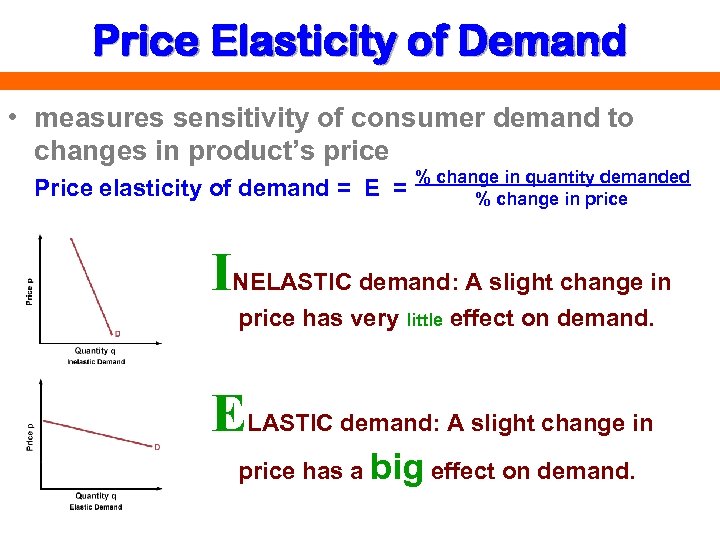 Price Elasticity of Demand • measures sensitivity of consumer demand to changes in product’s price Price elasticity of demand = E = % change in quantity demanded % change in price INELASTIC demand: A slight change in price has very little effect on demand. ELASTIC demand: A slight change in price has a big effect on demand.
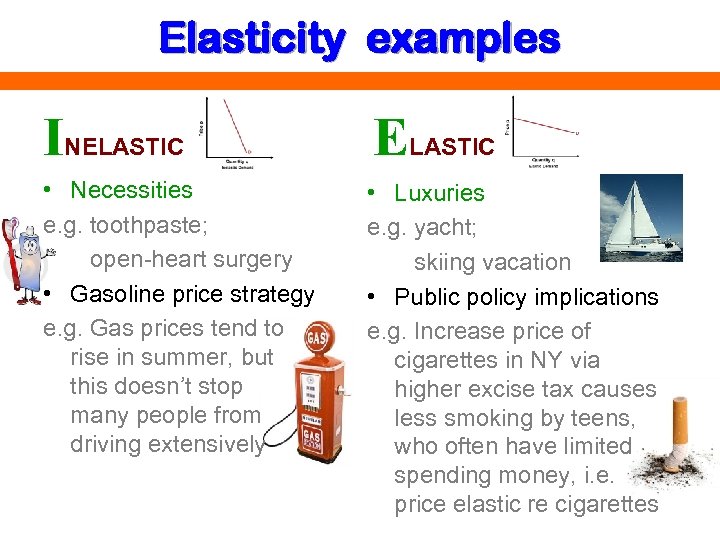 Elasticity examples INELASTIC • Necessities e. g. toothpaste; open-heart surgery • Gasoline price strategy e. g. Gas prices tend to rise in summer, but this doesn’t stop many people from driving extensively • Luxuries e. g. yacht; skiing vacation • Public policy implications e. g. Increase price of cigarettes in NY via higher excise tax causes less smoking by teens, who often have limited spending money, i. e. price elastic re cigarettes
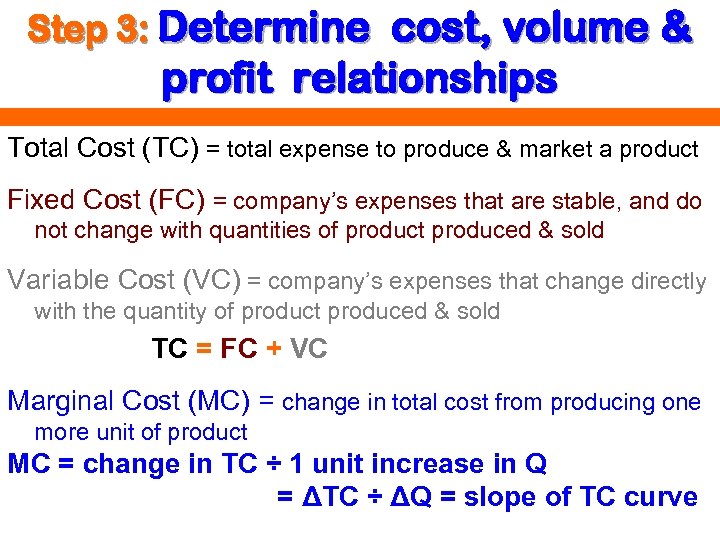 Step 3: Determine cost, volume & profit relationships Total Cost (TC) = total expense to produce & market a product Fixed Cost (FC) = company’s expenses that are stable, and do not change with quantities of product produced & sold Variable Cost (VC) = company’s expenses that change directly with the quantity of product produced & sold TC = FC + VC Marginal Cost (MC) = change in total cost from producing one more unit of product MC = change in TC ÷ 1 unit increase in Q = ΔTC ÷ ΔQ = slope of TC curve
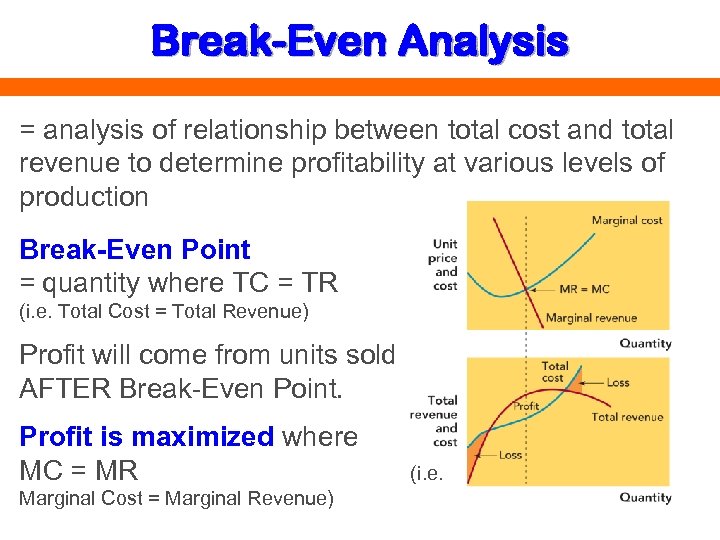 Break-Even Analysis = analysis of relationship between total cost and total revenue to determine profitability at various levels of production Break-Even Point = quantity where TC = TR (i. e. Total Cost = Total Revenue) Profit will come from units sold AFTER Break-Even Point. Profit is maximized where MC = MR Marginal Cost = Marginal Revenue) (i. e.
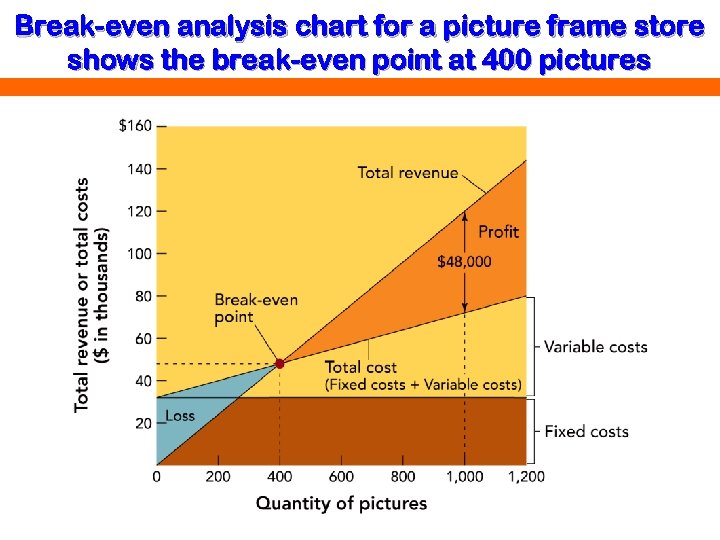 Break-even analysis chart for a picture frame store shows the break-even point at 400 pictures
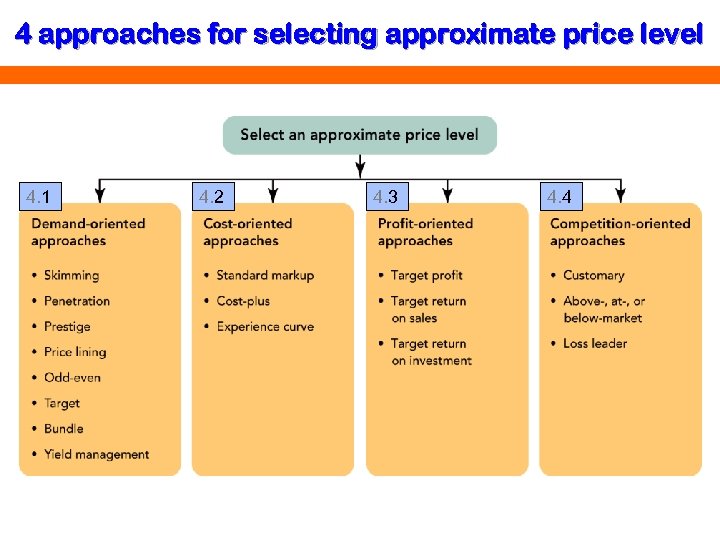 4 approaches for selecting approximate price level 4. 1 4. 2 4. 3 4. 4
 Step 4: Select an approximate price level Demand-oriented approaches to pricing: 1. Skimming 2. Penetration 3. Prestige 4. Price lining 5. Odd-even 6. Target 7. Bundle 8. Yield management
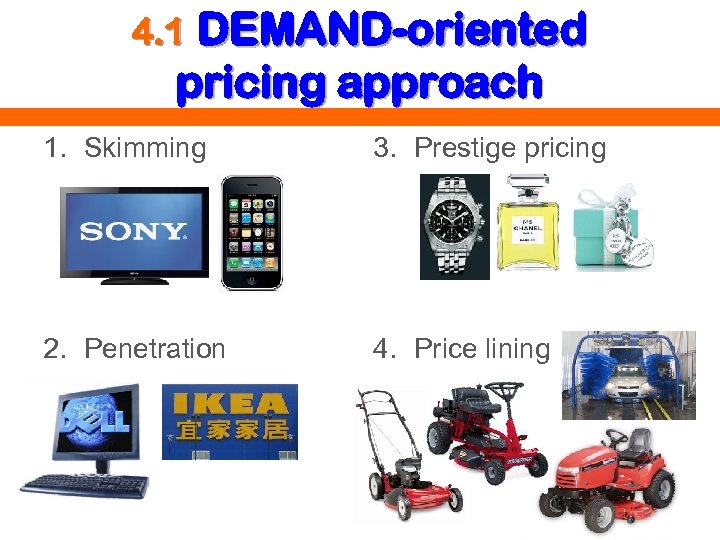 4. 1 DEMAND-oriented pricing approach 1. Skimming 3. Prestige pricing 2. Penetration 4. Price lining
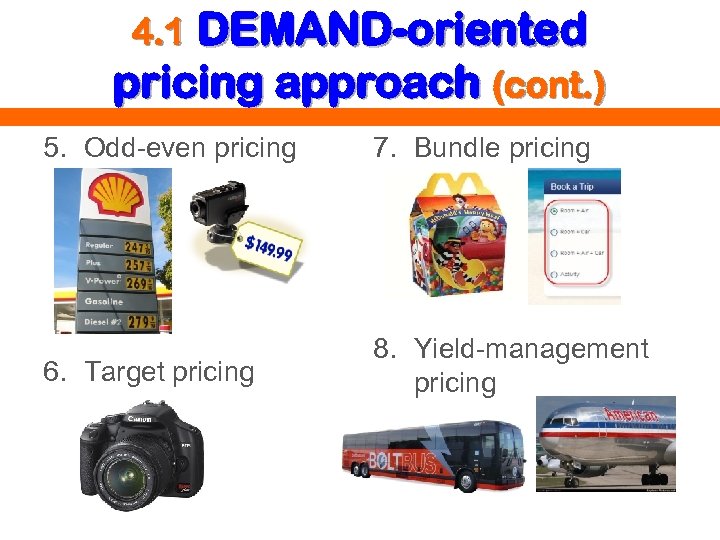 4. 1 DEMAND-oriented pricing approach (cont. ) 5. Odd-even pricing 7. Bundle pricing 6. Target pricing 8. Yield-management pricing
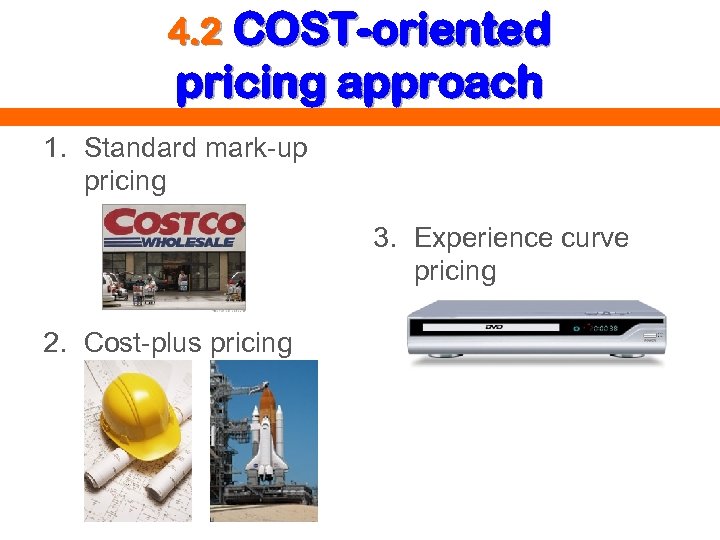 4. 2 COST-oriented pricing approach 1. Standard mark-up pricing 3. Experience curve pricing 2. Cost-plus pricing
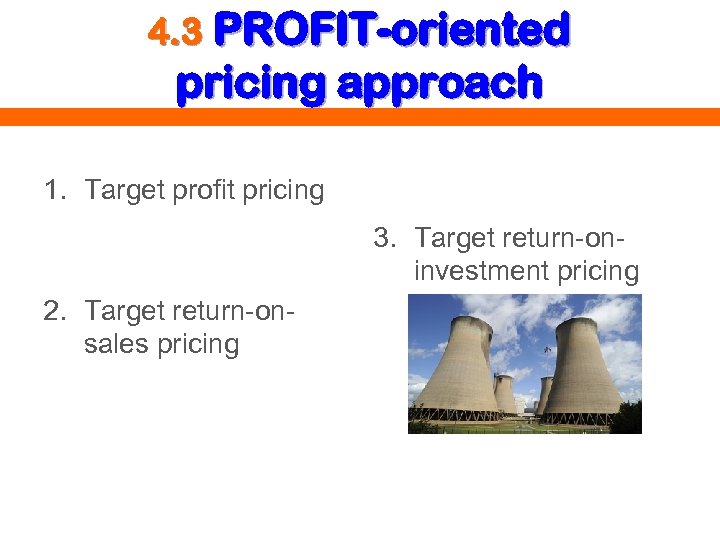 4. 3 PROFIT-oriented pricing approach 1. Target profit pricing 3. Target return-oninvestment pricing 2. Target return-onsales pricing
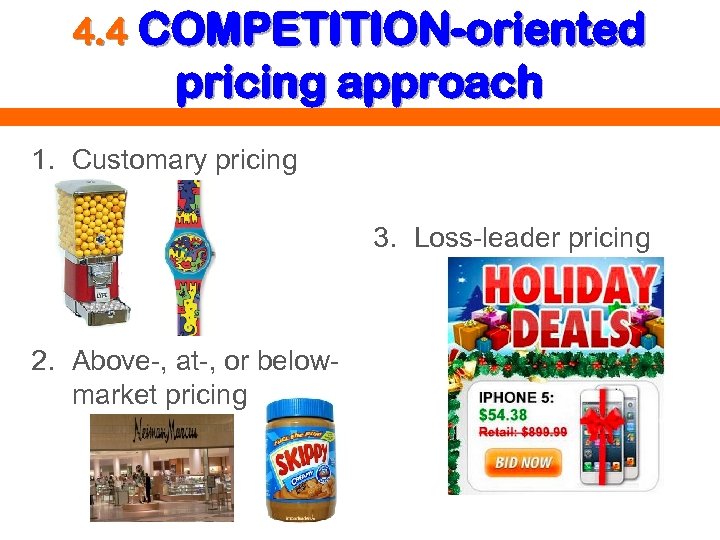 4. 4 COMPETITION-oriented pricing approach 1. Customary pricing 3. Loss-leader pricing 2. Above-, at-, or belowmarket pricing
 Step 5: Set the List or Quoted Price One-price policy = fixed pricing Flexible-price policy = dynamic pricing
 Effects on Pricing Company effects • • product substitutes & complementary products product line pricing type of consumer product stage of product life cycle Customer effects • beware of setting different kinds of middlemen against one another Competitive effects • price war (successive price cutting by competitors)
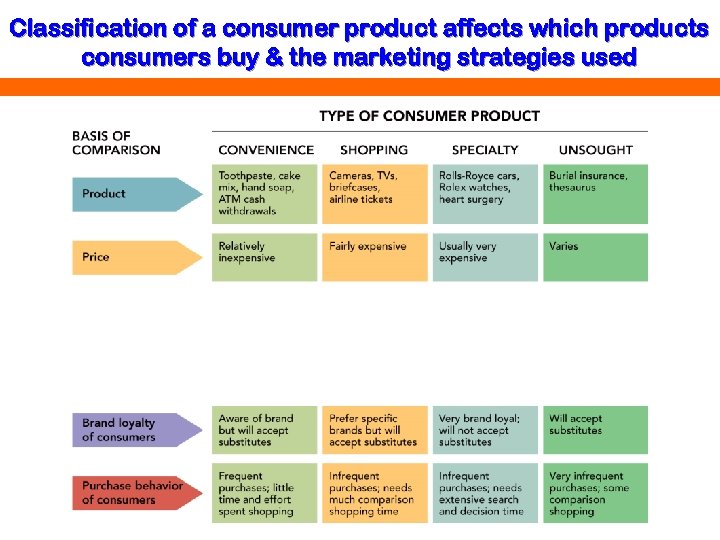 Classification of a consumer product affects which products consumers buy & the marketing strategies used
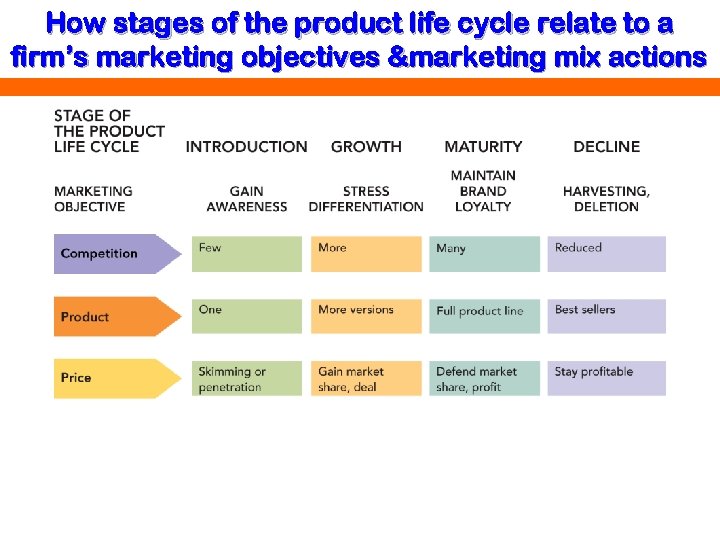 How stages of the product life cycle relate to a firm’s marketing objectives &marketing mix actions
 Step 6: Adjust the List or Quoted Price Discount = straight reduction in price on purchases during stated period of time Allowance = promotional money paid by manufacturers to retailers in return for featuring manufacturer’s products FOB pricing = geographical pricing strategy where goods are placed Free On Board (FOB) a carrier; customer pays freight from factory to destination Delivered pricing = geographical pricing strategy where company charges same price plus freight to all customers, regardless of location CIF pricing = price includes Cost + Insurance + Freight (CIF)
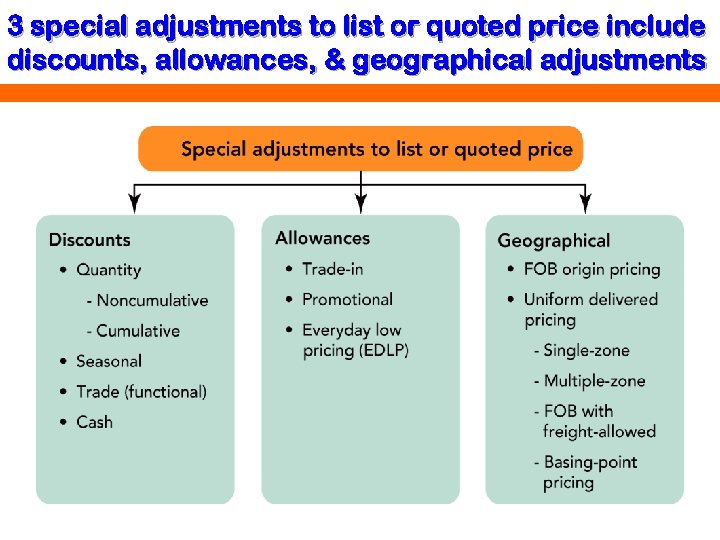 3 special adjustments to list or quoted price include discounts, allowances, & geographical adjustments
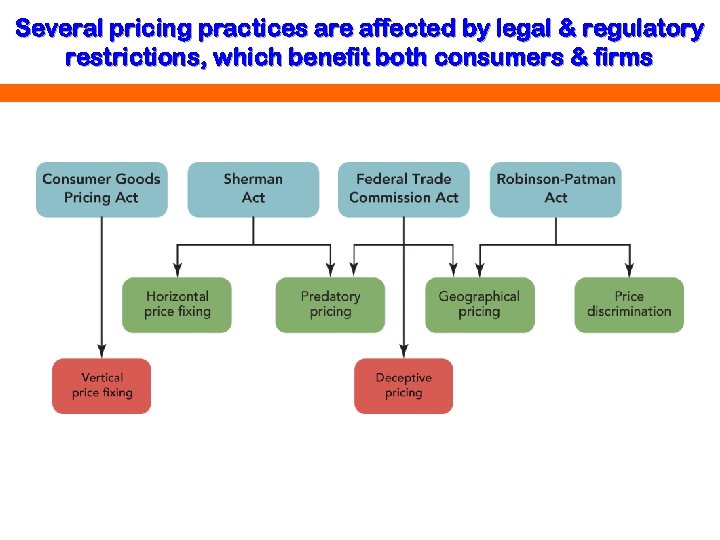 Several pricing practices are affected by legal & regulatory restrictions, which benefit both consumers & firms
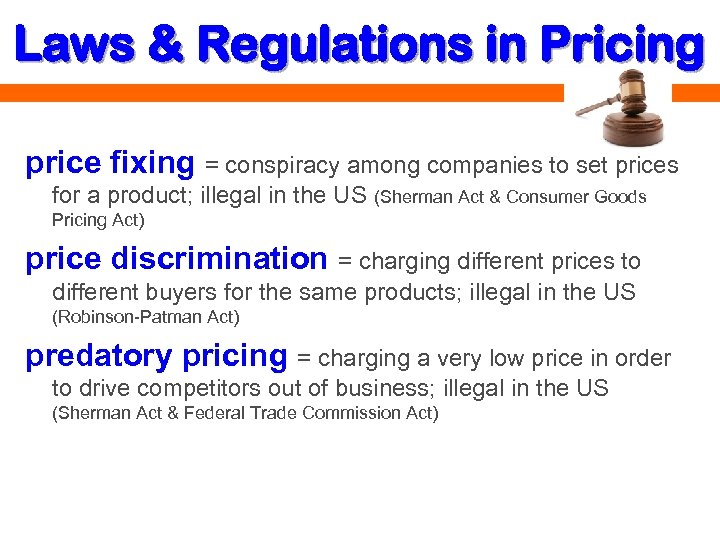 Laws & Regulations in Pricing price fixing = conspiracy among companies to set prices for a product; illegal in the US (Sherman Act & Consumer Goods Pricing Act) price discrimination = charging different prices to different buyers for the same products; illegal in the US (Robinson-Patman Act) predatory pricing = charging a very low price in order to drive competitors out of business; illegal in the US (Sherman Act & Federal Trade Commission Act)
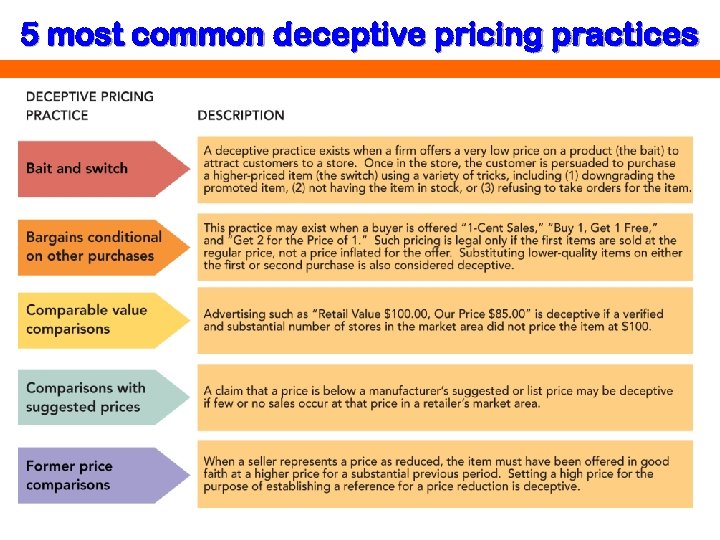 5 most common deceptive pricing practices
 Next class: Promotion Preparation: assigned reading pages Homework #7: Sales Promotion