


 Скачать презентацию Mitigation of GHG Emission New Technology and other
fec8a30a0b3ad4b0e2b7450e7be9d8ee.ppt
- Количество слайдов: 87
 Mitigation of GHG Emission: New Technology and other nontechnological measures 7 January 2008 By K. S. Lam Poly. U
 References l IPCC Fourth Assessment Report- Climate Change 2007: Mitigation of Climate Change – l Greenhouse Gas Emission Control Study – l 2007, IPCC Second Assessment Report 2000, Environmental Protection Department International Conference on Climate Change, 2007, Hong Kong
 Declaration l In this presentation, most information - are extracted from IPCC reports and EPD report; - show the numbers of technology reducing GHG emissions; - do not include the cost of technology; - do not include the barrier of technology; - do not include the mitigation options with vulnerability, adaptation and sustainable development
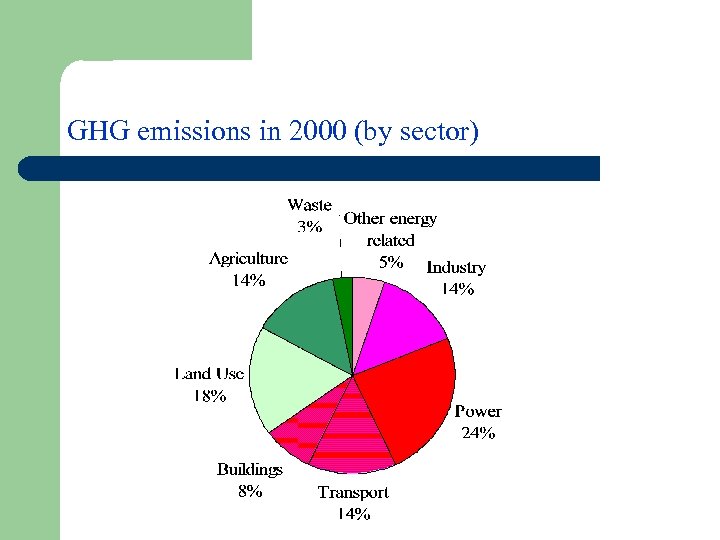 GHG emissions in 2000 (by sector)
 Mitigation Approach l l l To stabilize GHG at 550 ppm, GHG needs to be cut by 80% from today’s level. No one single technology can achieve this reduction. Mitigation has to be achieved in all sectors. GHG can be cut in 4 ways: – Increased efficiency – Reducing demand – Action on non-energy emissions – Switch to low-carbon technologies
 1. Increase Efficiency and Reduce Demand
 1. 1 Increase efficiency in Power Generation l Change from coal fired to gas fired.
 Schematic of Gas fired Plant
 Gas - Natural Gas (Less carbon-intensive sources of energy) l Efficiency of coal fired power Plants: about 35% Efficiency of gas fired power Plants: can reach 56% l CO 2 emission of gas fired is 57% of coal fired l
 1. 2. Increase efficiency in Transport – – (1) Aviation (2) Rail (3) Road transport (4) Shipping
 Aviation l Fuel efficiency improvement by (1) Aerodynamic improvements (2) weight reductions (3) engine fuel efficient development Air traffic control Open more air corridor, shortest path saves energy l Alternative fuel - HYDROGEN l l
 Rail l l Energy efficiency technologies for railways are discussed in http: //www. railwayenergy. org/tfee/index. php Aims of technology (1) Reducing aerodynamic resistance (2) Reducing train weight (3) Regenerative braking (4) Higher efficiency propulsion system
 Road Transport l l l Incremental improvements in current vehicle technologies Advanced technologies: greater use of electricdrive technologies (hybrid electric power trains, fuel cells and battery electric vehicles) Alternative fuels: natural gas, biofuels, electricity, hydrogen
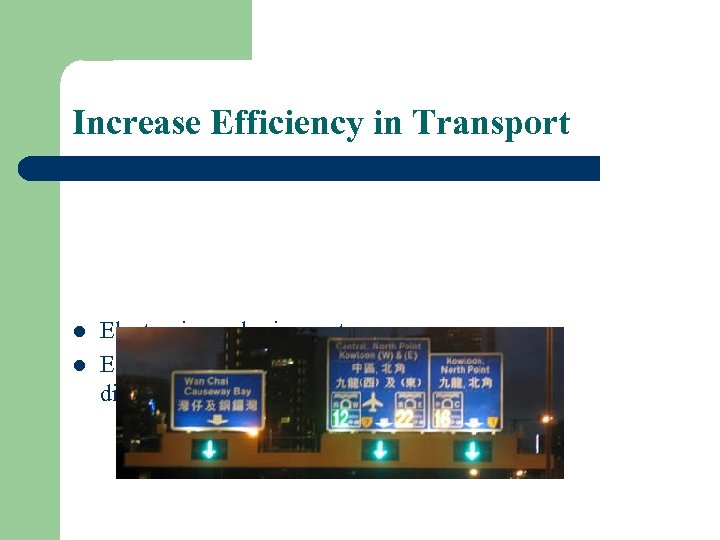 Increase Efficiency in Transport l l Electronic road price system. Electronic real-time traffic volume information dissemination.
 Increase Efficiency in Transport l l Flying cars in the future? Levitation in the future?
 1. 3 Building GHG mitigation options 1. Overview of energy efficiency principles - Reduce heating, cooling and lighting loads (structural insulation panel, glazing layer) - Increase efficiency of appliances, heating and cooling equipment and ventilation
 1. 3 Building GHG mitigation options 1. Overview of energy efficiency principles - Improve operations and maintenance - Change behaviour - Utilize active solar energy and other environmental heat sources and sinks - Utilize system approaches to building design - Consider building form, orientation and related attributes - Minimize halocarbon emissions
 Building GHG mitigation options 2. 3. Thermal envelope - Refers to the shell of the building as a barrier to unwanted heat or mass transfer between the interior of the building and the outside conditions - Insulation material - Thermal performance of windows (e. g. multiple glazing layers, low-emissivity coastings, use of framing material) - Air leakage (seals leaks) Heating systems - Passive solar heating - Space heating systems
 Building GHG mitigation options 4. 5. Radiant Cooling Panel Cooling and cooling loads - Reducing the cooling load, 25. 5 C rather than 20 C - Natural ventilation Heating, ventilation and air conditioning (HVAC) system for commercial buildings, 2 alternatives: Radiant chilled-ceiling cooling, Displacement ventilation 6. Building energy management systems (BEMS) (2)
 Building GHG mitigation options 7. 8. Active collection and transformation of solar energy - Building-integrated Photovoltaic (Bi. PV) - Solar thermal energy for heating water Domestic hot water - use of water saving fixtures - use of more efficient and better insulated water heaters - use of tankless water heaters - recovery of heat from warm waste water - use of air-sources or exhaust-air heat pumps
 Building GHG mitigation options 9. Household appliances, consumer electronics and office equipment
 1. 3 Increase Efficiency of A/C l Change A/C from air cool to water cool, save >20% electricity.
 Building GHG mitigation options 9. Lighting systems - natural light, light well, light pipe
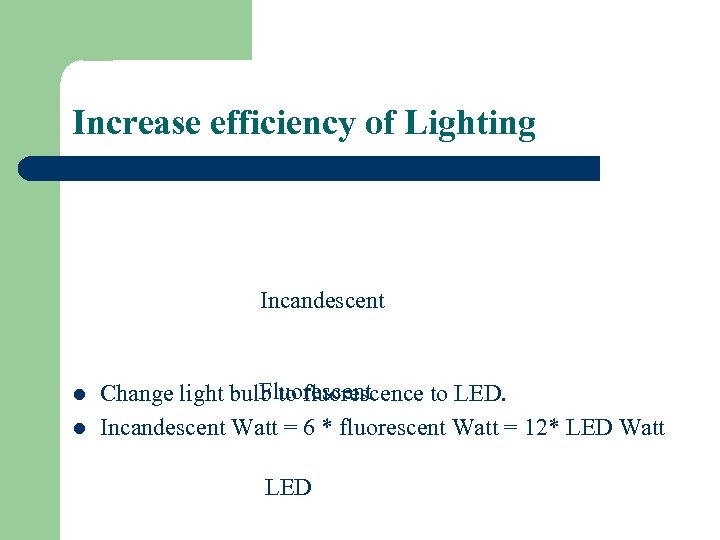 Increase efficiency of Lighting Incandescent l l Fluorescent Change light bulb to fluorescence to LED. Incandescent Watt = 6 * fluorescent Watt = 12* LED Watt LED
 Increase efficiency of Lighting l Future: – – Building will use LED PV/LED, use solar energy to power LED lighting
 Increase efficiency in Lift l l l One for low floors and one for high floors? Odd/Even floors vs all floors? Double deck?
 1. 4. Industry Measures for reducing GHG emissions ü Management practices ü Energy efficiency ü Fuel switching, including the use of waste materials ü Heat and power recovery ü Renewable energy ü Material efficiency and recycling ü Carbon dioxide capture and storage (CCS), including oxy -fuel combustion Most technologies are discussed in the previous sections
 1. 5 General principles to reduce Demand l l l l Reduce population. Reduce waste. Use only when it is needed. Purchase energy efficient products. Reduce size of products. Walk – bicycle – mass transit – motor vehicle. Satellite city: home near office. Work at home? Home office?
 2. Action on Non-Energy Emissions
 2. 1 Mitigating GHG emissions from agricultural ecosystems l l l l Cropland management Grazing land management/pasture improvement Management of organic soil Restoration of degraded land Livestock management Manure/biosolid management Bioenergy Source: IPCC 2007 Assessment Report: Mitigation of Climate Chnage
 2. 2. Forestry l l 1 m 3 of wood stores 0. 92 t. CO 2 Mitigation Activities (1) Maintaining or increasing the forest area (2) Maintaining or increasing the carbon density (3) Increasing off-site carbon stocks in wood products and enhancing product and fuel substitution
 2. 3. Methane from Landfill Site (1) landfilling with landfill gas recovery (CH 4) - Active landfill gas extraction system
 Methane from Landfill Site Tai Kwu Ling Landfill Site Plant
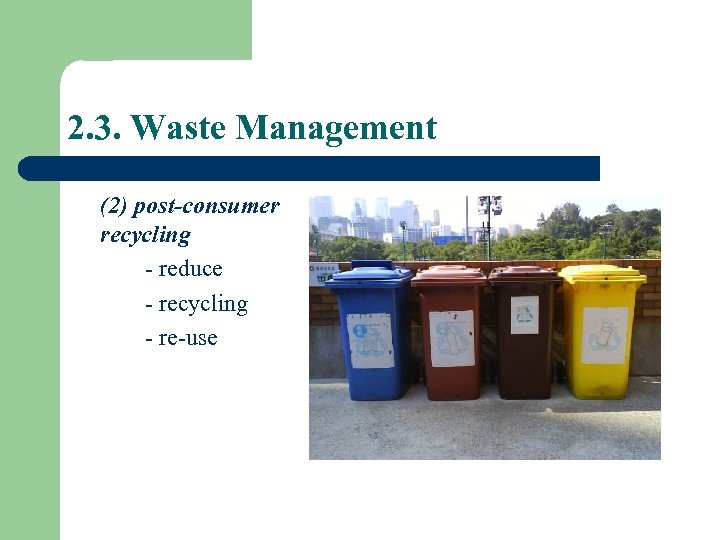 2. 3. Waste Management (2) post-consumer recycling - reduce - recycling - re-use
 2. 3 Waste Management (3) Composting of selected waste fractions - Fluorinated gases (CFCs and HCFCs) (4) Processes that reduce GHG generation compared to landfilling - incineration - production of refuse-derived fuel - industrial co-combustion - Biological treatment (compositing, anaerobic digestion and mechanical biological treatment) - wastewater and sludge treatment
 3. Low Carbon Emission Technologies
 3. 1 Carbon Dioxide Capture and Storage (CCS) l l CCS - an approach to mitigating global warming by capturing carbon dioxide (CO 2) from large point sources such as fossil fuel power plants and subsequently storing it instead of releasing it into the atmosphere CO 2 Storage: (1) geological storage, (2) ocean storage, (3) mineral storage
 Carbon Dioxide Capture and Storage
 1. 1 Integrated gasification combined cycle
 IGCC l l l Clean coal technology – coal gasification and combined cycle. Coal gasification – coal is partially combusted with oxygen and steam to produce syngas. The syngas then is cleaned before entering gas turbine. Combine cycle – syngas drive gas turbine first, the residual heat then make steam which drive steam turbine. Consume less fuel per k. Whr.
 Geological Storage
 Ocean Storage
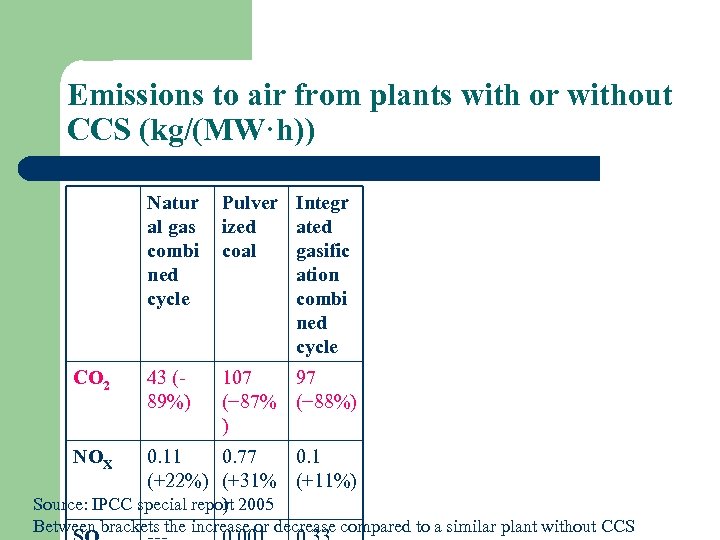 Emissions to air from plants with or without CCS (kg/(MW·h)) Natur al gas combi ned cycle CO 2 Pulver Integr ized ated coal gasific ation combi ned cycle 43 (89%) 107 97 (− 87% (− 88%) ) NOX 0. 11 0. 77 0. 1 (+22%) (+31% (+11%) Source: IPCC special report 2005 ) Between brackets the increase or decrease compared to a similar plant without CCS
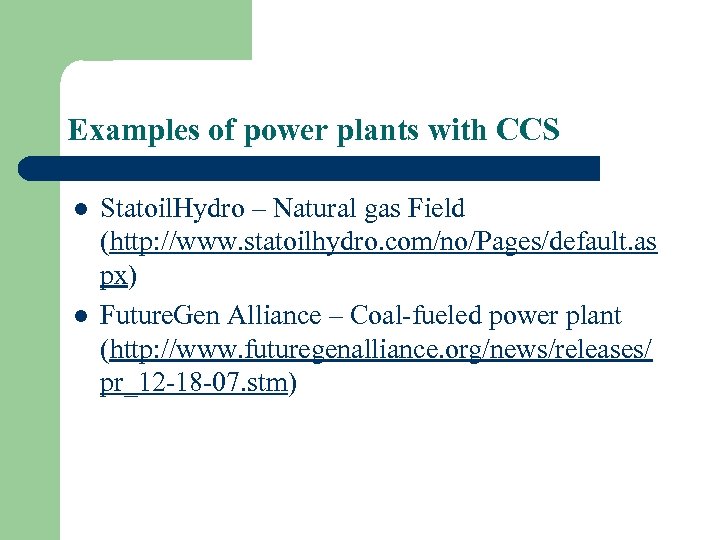 Examples of power plants with CCS l l Statoil. Hydro – Natural gas Field (http: //www. statoilhydro. com/no/Pages/default. as px) Future. Gen Alliance – Coal-fueled power plant (http: //www. futuregenalliance. org/news/releases/ pr_12 -18 -07. stm)
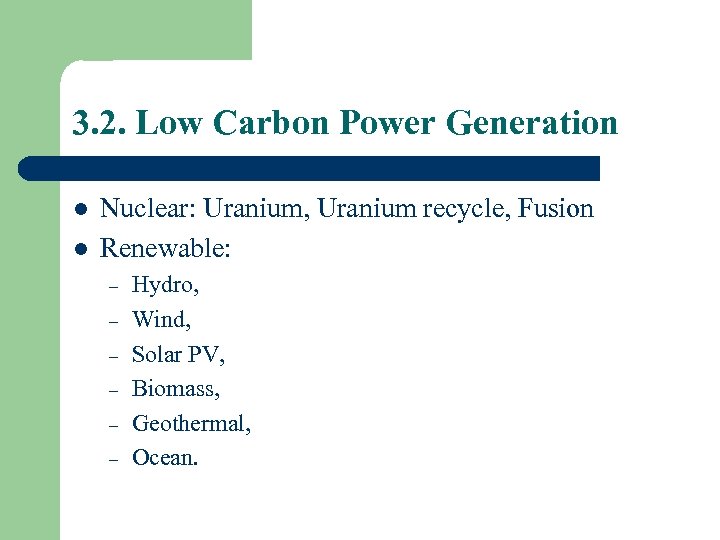 3. 2. Low Carbon Power Generation l l Nuclear: Uranium, Uranium recycle, Fusion Renewable: – – – Hydro, Wind, Solar PV, Biomass, Geothermal, Ocean.
 Nuclear Energy
 Nuclear Power l l l It is considered as a non-renewable energy Little GHG emissions. Total life-cycle GHG emissions per unit of electricity produced from nuclear power are below 40 g. CO 2 eq/k. Wh. It is considered to be the short to medium term solution for mitigation of CO 2 emission. As of December 2006, 442 nuclear power plants were in operation with a total installed capacity of about 370 GWe In 2005, 2626 TWh of electricity (16% of the world total) was generated by nuclear power
 Daya Bay Nuclear Power Plant
 Renewable Energies
 Renewable energy l l Renewable energy accounted for over 15% of world energy supply in 2004 Renewable: Hydro, Wind, Biomass, Geothermal, Solar PV, Ocean
 Technology of renewable energy l Category (A): Large and small hydro, woody biomass combustion, Geothermal, landfill gas, crystalline silicon PV solar water heating, onshore wind, bioethanol from sugars and starch
 Technology of renewable energy l Category (B): Municipal solid waste-to-energy, anaerobic digestion, biodiesel, co-firing of biomass, concentrating solar dishes and troughs, solar-assisted air conditioning, mini- and microhydro, offshore wind
 Technology of renewable energy l l Category (C): thin-film PV, concentrating PV, tidal range and currents, wave power, biomass gasification and pyrolysis, bioethanol from lignocellulose, solar thermal tower Category (D): organic and inorganic nanotechnology solar cells, artificial photosynthesis, biological hydrogen production involving biomass, algae and bacteria, biorefineries, ocean thermal and saline gradients, ocean currents
 Hydropower l l l emissions-free, reliable energy source, zero CO 2 -emissions, Hydropower's fuel—water—is essentially infinite and is not depleted in the production of energy. preserve our nation's independence from supply disruptions overseas. hydropower excels at preserving the stability and reliability of the electrical grid due to its unique operating characteristics.
 Wind Energy l l The wind push a propeller to rotate. The motor that attach to the propeller generates electricity. Can be small scale.
 Solar technologies l l Passive Active Photovoltaics Solar thermal electric
 A passive solar house. Sunlight streams into the house during low sun of winter months. The overhead sun is blocked in summer months. Interior walls absorbs energy and emit heat all the time.
 Active solar systems l Active solar systems generally employ rooftop panels that collect heat from sunlight and store it in water or some other medium. This solar energy can then be used to heat domestic hot water or to heat the interior of the building
 Medium temperature Concentrating Parabolic Collector
 Photovoltaics l Thin wafers of materials such as silicon that emits electrons when struck by sunlight.
 Array of photovoltaic cells. It is like thousands of batteries connected together.
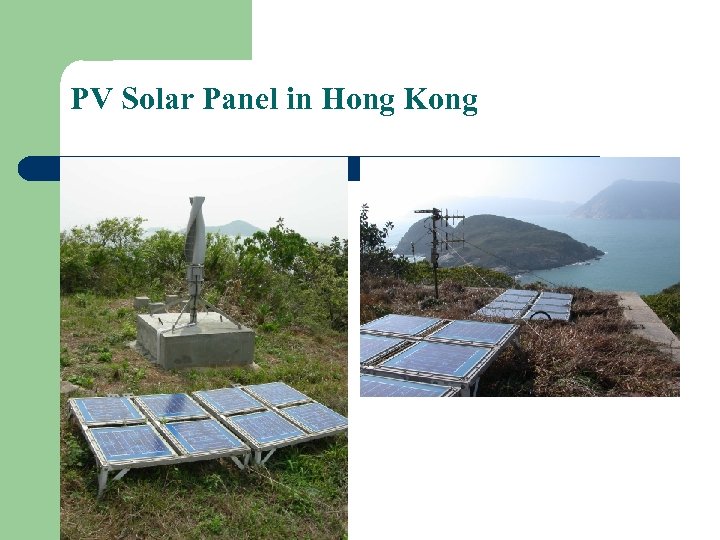 PV Solar Panel in Hong Kong
 Solar Thermal Electric Solar thermal electric using parabolic reflectors. It heat up oil filled tubes and in turn heat water to produce steam.
 High temperature Roof Collector
 Biomass Energy l Biomass is organic matter such as wood or crop wastes that can be burned or converted into gaseous or liquid fuels.
 Geothermal Energy l l Geothermal energy is a renewable resource created primarily from magma, molten rock beneath the crust. It is an enormous, underused heat and power resource that is clean (emits little or no greenhouse gases), reliable (average system availability of 95%), and homegrown.
 Geothermal Energy
 Simple application case
 Ocean Energy l l l Tidal energy schemes capture water at high tide and release it at low tide. Wave energy: the oscillating motion of an incoming and outgoing wave is used to drive turbines that generate electricity. Ocean thermal energy conversion uses the difference in temperature between warm surface water and cold deep ocean water to make electricity.
 Tidal Energy Dam of a Tidal power generation station. The dam opens during high tide to allow water level to raise. The close when tidal started to ebb and lock the water level. The side gate then release water at low tides to generate electricity.
 How it works
 Second-generation tidal power plants l l Two types- vertical axis and horizontal axis Harness the energy of tidal streams More efficient because they allow for energy production on both the ebbing and surging tides One site has potential to equal the generating power of 3 nuclear power plants
 3. 4 Low Carbon Emission Vehicles Alternative fuels - Natural Gas (CNG/LTL) - Biofuels - Electric vehicles - Hydrogen / Fuel Cells
 4. Advance Technologies and Latest Development
 4. 1. Future Technologies l l l l Integration of different technologies Hydrogen Fuel Cells Nuclear Fusion Waste-to Energy Facility (WEF) Enhanced anaerobic digestion for Municipal Solid Waste Sludge incineration
 Integration of Technologies l Hybrid vehicles: – Electric drive + gasoline
 Integration of Technologies l Hybrid vehicles: – gasoline + Hydrogen
 Hydrogen Fuel l l Over 70% of earth’s surface is ocean. The problem is how to collect enough solar power to convert water to H 2 fuel. This approach could completely solve the GHG emission problem. E. g. Outerspace/desert/tundra PV plants.
 Outerspace Power Stations Space-based solar power offers energy from an unending source with no emissions and very little environmental impact
 FUEL CELL Ø Reversed Electrolysis Device Ø Pt coated electrodes Ø Use air as a source of O 2
 How Does it Work Ø Electrolyte- proton-exchange -membrane (PEM), Phosphoric Acid Ø Combines Fuel and Oxygen Ø Produces H 20 (l), heat, CO 2
 Fuel Cell
 Fuel Cell can be used in small or large scale applications
 Useful Links l l l IPCC special report on carbon dioxide capture and storage (http: //www. ipcc. ch/ipccreports/special-reports. htm) IPCC forth assessment report : Mitigation of Climate Change (http: //www. ipcc. ch/ipccreports/ar 4 -wg 3. htm) Greenhouse Gas Emission Control Study (http: //www. epd. gov. hk/epd/english/environmentinhk/air/ studyrpts/greenhouse_gas_study. html)
 4. 2. Eco-City / Carbon Neutral City l l l l Dongtan Eco-city (near Shanghai) An island with 500, 000 people. 40% land used for building, others to green space and farmland. Integrate all aspects of sustainability. Low energy consumption that is as close to carbon neutral as possible, most energy derive from solar, wind and biomass. Pedestrian, bicycle and fuel cell transport. Recycled city waste organic farming self-sufficient in water and food sourced from the surrounding farmland. Another city is Sseesamirembe (Uganda)
 4. 2. Eco-City / Carbon Neutral City l Dontang Eco-city (near Shanghai)
 End
End