


 Скачать презентацию MIT International Center for Air Transportation Application of
e478e306cdfe874021a5a4bc329ab908.ppt
- Количество слайдов: 49
 MIT International Center for Air Transportation Application of Monte-Carlo Simulation to Noise Abatement Approach Procedure Design Liling Ren, Nhut Tan Ho, and John-Paul B. Clarke Massachusetts Institute of Technology First DLR/Lufthansa/MIT Workshop Lufthansa Training Center Seeheim, Germany, 17 -Aug-2004
 Acknowledgement Part of the work presented here is based on the joint effort of Boeing, FAA, MIT, NASA, UPS and Louisville Regional Airport Authority 17 -Aug-2004 2
 Agenda q Introduction q Overview of Noise Abatement Approach Procedure Design q Monte-Carlo Simulation Tool q Separation Analysis Methodology q Louisville (SDF) Case Study § Wind Analysis § Traffic Analysis § Weight Analysis § ATC altitude constraints analysis § Initial Separation Analysis 17 -Aug-2004 3
 Introduction q Aircraft Noise Is: § A critical problem at many airports • Example: as of 2002, O'Hare has spent $197. 5 million* on sound isolation for 79 schools significantly affected by aircraft noise § A limiting factor for aircraft operations and airport expansion q Noise Control Measures § Quieter aircraft • How about existing fleet? § Airport restrictions and curfews § Low noise operation procedures • Fly preferable paths, and • Departure procedures - essentially redistribute noise impact - Steeper climb; slower acceleration; thrust cut back • Arrival procedures - reduce noise generated, increase height • Procedures provide additional noise benefit for any given aircraft * Source: O’Hare International Airport, 2002 17 -Aug-2004 4
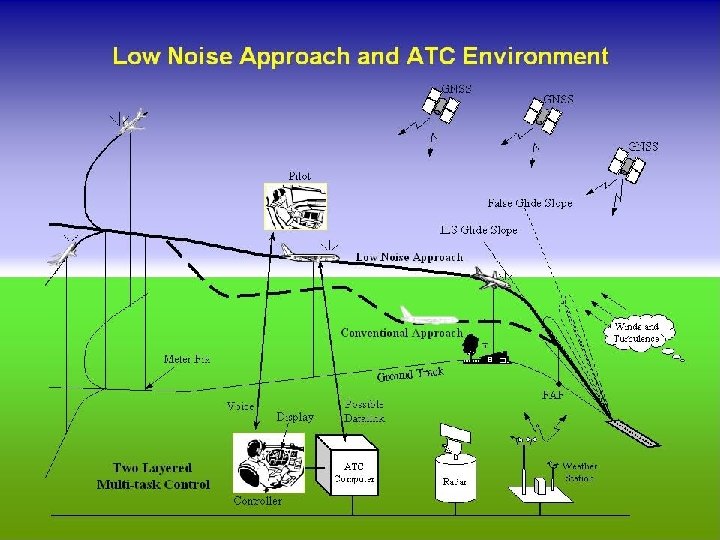
 Focus on Approach Procedures q Why Approach Procedures § Arrival noise contributes an increasing proportion, due to the 3° ILS glideslope constraint * § Noise, and additional emission reduction and cost saving benefits § Challenging issues in implementation q Typical Noise Abatement Approach Procedures § Vertically segmented descent (part of descent is steeper) § Low Power Low Drag approach (LPLD) § Early intercepting of final glide slope § 3 degree decelerating approach (TDDA/Modified TDDA) § Continuous descent approach (CDA) / RNAV based CDA q Technology Opportunity § GPS based Area Navigation (RNAV) § Flight Management System (FMS) * Kershaw et al. 2000 17 -Aug-2004 5
 17 -Aug-2004 6
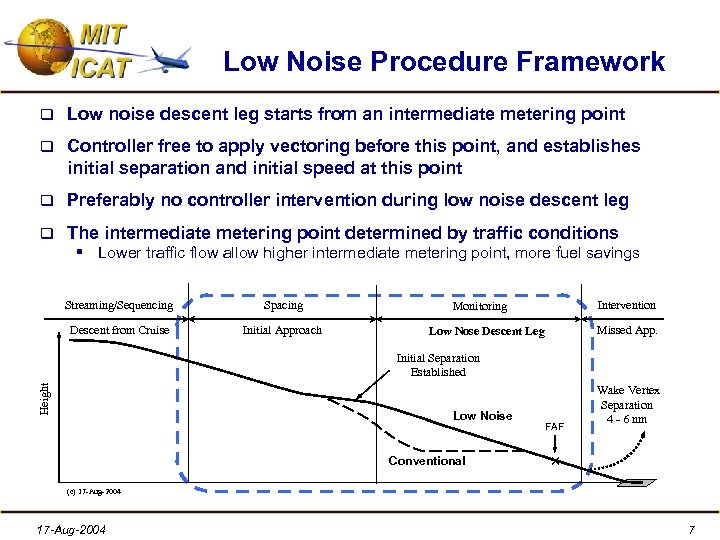 Low Noise Procedure Framework q Low noise descent leg starts from an intermediate metering point q Controller free to apply vectoring before this point, and establishes initial separation and initial speed at this point q Preferably no controller intervention during low noise descent leg q The intermediate metering point determined by traffic conditions § Lower traffic flow allow higher intermediate metering point, more fuel savings Streaming/Sequencing Spacing Descent from Cruise Initial Approach Intervention Monitoring Missed App. Low Nose Descent Leg Height Initial Separation Established Low Noise Conventional FAF Wake Vertex Separation 4 - 6 nm (c) 17 -Aug-2004 7
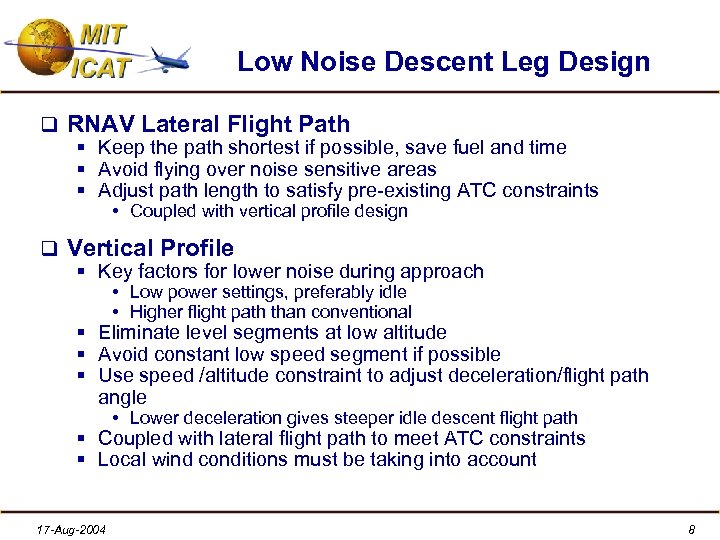 Low Noise Descent Leg Design q RNAV Lateral Flight Path § Keep the path shortest if possible, save fuel and time § Avoid flying over noise sensitive areas § Adjust path length to satisfy pre-existing ATC constraints • Coupled with vertical profile design q Vertical Profile § Key factors for lower noise during approach • Low power settings, preferably idle • Higher flight path than conventional § Eliminate level segments at low altitude § Avoid constant low speed segment if possible § Use speed /altitude constraint to adjust deceleration/flight path angle • Lower deceleration gives steeper idle descent flight path § Coupled with lateral flight path to meet ATC constraints § Local wind conditions must be taking into account 17 -Aug-2004 8
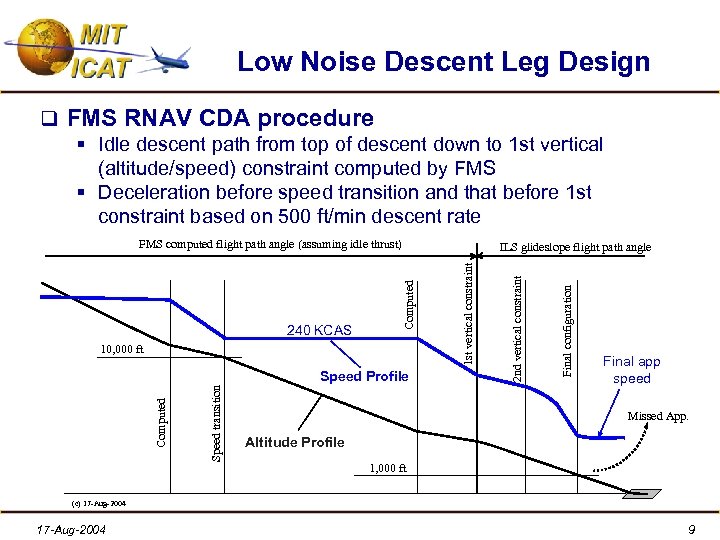 Low Noise Descent Leg Design q FMS RNAV CDA procedure § Idle descent path from top of descent down to 1 st vertical (altitude/speed) constraint computed by FMS § Deceleration before speed transition and that before 1 st constraint based on 500 ft/min descent rate Speed transition Computed Final configuration Speed Profile 2 nd vertical constraint 10, 000 ft ILS glideslope flight path angle 1 st vertical constraint 240 KCAS Computed FMS computed flight path angle (assuming idle thrust) Final app speed Missed App. Altitude Profile 1, 000 ft (c) 17 -Aug-2004 9
 Simulation Software q MIT Fast-Time Aircraft Simulator q MATLAB Based § 2001, Initial Version • 2 D longitudinal model, straight in approach • With pilot action delay model, Monte-Carlo scheme • Aircraft specific code § 2002 Version • 2 D plus pitch for better accuracy, also improved efficiency • Added wind effects § 2003 Version • System fully redesigned, became aircraft independent code • Added lateral motion, added INM interface § Current Version • Added VNAV capability and new aircraft types - With help from David H. Williams (NASA) and Kevin R. Elmer (Boeing) 17 -Aug-2004 10
 Simulation Software q Aircraft Dynamics § Non-steady-state force equations § Generic side force model § Assume proper rotational control by aircraft control systems • Avoided use of moment equations § For simplicity and proper behavior under winds and turbulence q Control Architecture § FMS module builds flight path, provides autopilot control command pilot cue § Autopilot module performs thrust and aircraft attitude control § Pilot module controls flap, speed brake and gear extension q Pilot action delay model § Mean delay time with random variation § Parameters extracted from previous motion simulator experiment 17 -Aug-2004 11
 Simulation Inputs q Approach Procedure Definitions § Lateral path defined by waypoints § Lateral control modes: LNAV or non-LNAV (hdg-hold etc. ) § Vertical path defined by vertical constraints, starting altitude, runway threshold elevation and ILS glide slope § Vertical control modes: VNAV or non-VNAV (Alt-Hold etc. ) q Aircraft Configuration § Aircraft weight at starting altitude § Final approach speed, fixed value or based on VREF § Flap schedule, by speed (may be VREF based), altitude, or distance to runway q Wind Profile § External wind profile, as a function of altitude, or time, or location § FMS wind forecast 17 -Aug-2004 12
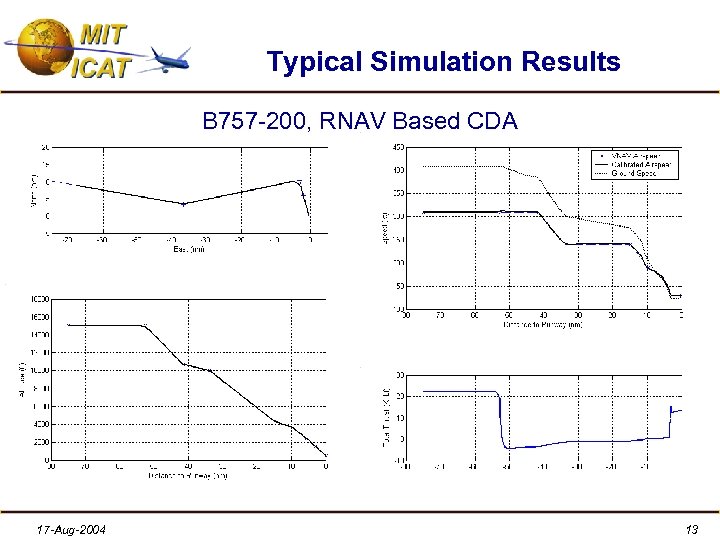 Typical Simulation Results B 757 -200, RNAV Based CDA 17 -Aug-2004 13
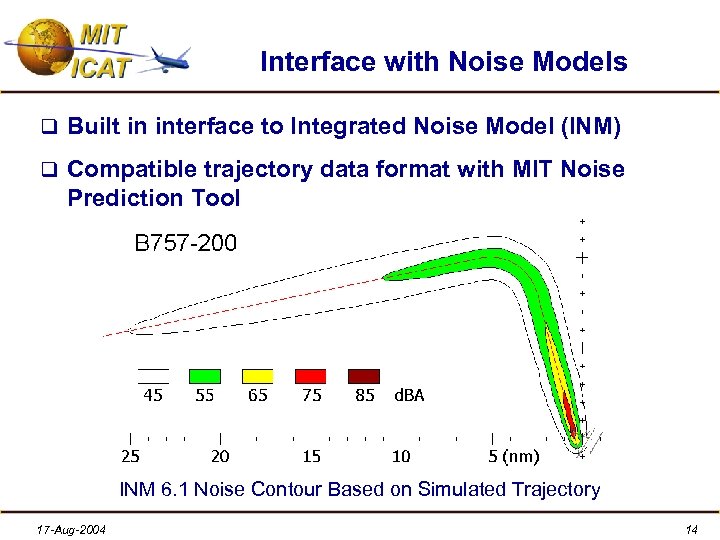 Interface with Noise Models q Built in interface to Integrated Noise Model (INM) q Compatible trajectory data format with MIT Noise Prediction Tool INM 6. 1 Noise Contour Based on Simulated Trajectory 17 -Aug-2004 14
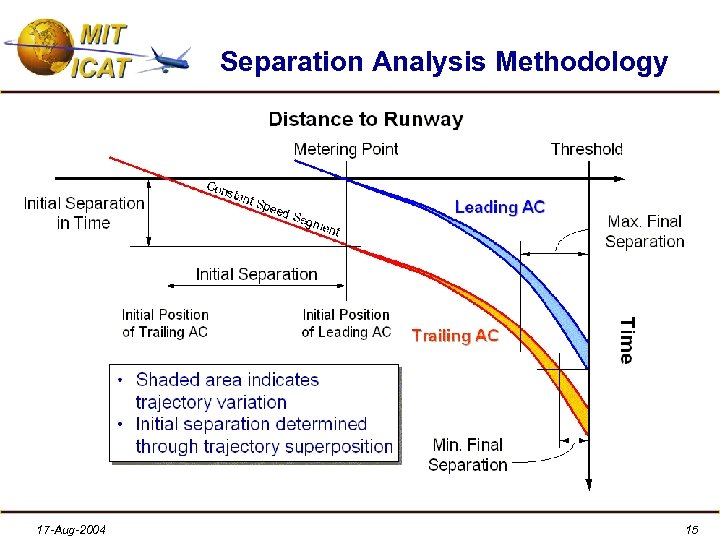 Separation Analysis Methodology 17 -Aug-2004 15
 SDF CDA Case Study q Multiple-aircraft RNAV based CDA procedures for UPS west flow landing to runway 17 R and 35 L q Determine variation in performance § Performance variations due to: • • Wind Pilot actions Aircraft type (B 757 -200 versus B 767 -300) Aircraft weight § Identify potential problems for further study q ATC Constraint Compatibility Analysis q Separation Analysis § Analyze separation changes along the course of CDA descent § Recommend miles-in-trial spacing at intermediate altitude 17 -Aug-2004 16
 Wind Analysis q Data Source § National Oceanic and Atmospheric Administration (NOAA) Forecast Systems Laboratory (FSL) Aircraft Report Data • Decoded and quality controlled ACARS/AMDAR automated weather reports from commercial aircraft • Provided in web-based graphical displays, or as downloadable binary data in net. CDF (network Common Data Form) • Real time with 12 minutes delay, historical data available for 30 days § Data may be used for research use, request access from FSL q Data Content § Latitude, longitude, altitude, observation time § Wind direction, wind speed § Temperature, downlinked relative humidity § Heading, mach number, aircraft roll angle flag § Originating airport & destination airport § Very limited reports on gust and icing conditions etc. 17 -Aug-2004 17
 Wind Analysis q Using Binary Data § Higher resolution § More efficient for batch and automatic processing q Collecting Data § Data has been collected at daily bases since February 10, 2004 § Covers the airspace within 100 nm from SDF § Covers reports starting 03 hours UTC for 5 hours each day • 22: 00 – 3: 00 hours EST, covers most UPS night arrivals § Will gain access to historical data from the past 2 years q Data Processing § Developed a c based software tool to extract weather information from raw binary data, and export it into MATLAB m file § MATLAB code has been developed to filter, and process data § Raw data are kept intact for further analysis 17 -Aug-2004 18
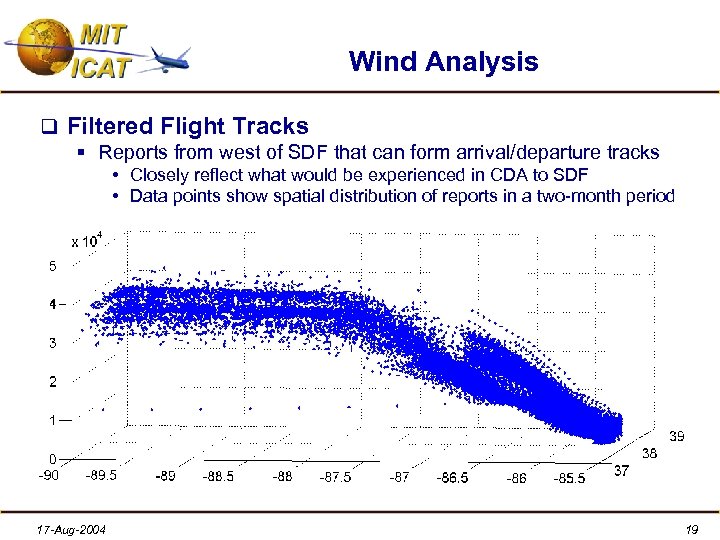 Wind Analysis q Filtered Flight Tracks § Reports from west of SDF that can form arrival/departure tracks • Closely reflect what would be experienced in CDA to SDF • Data points show spatial distribution of reports in a two-month period 17 -Aug-2004 19
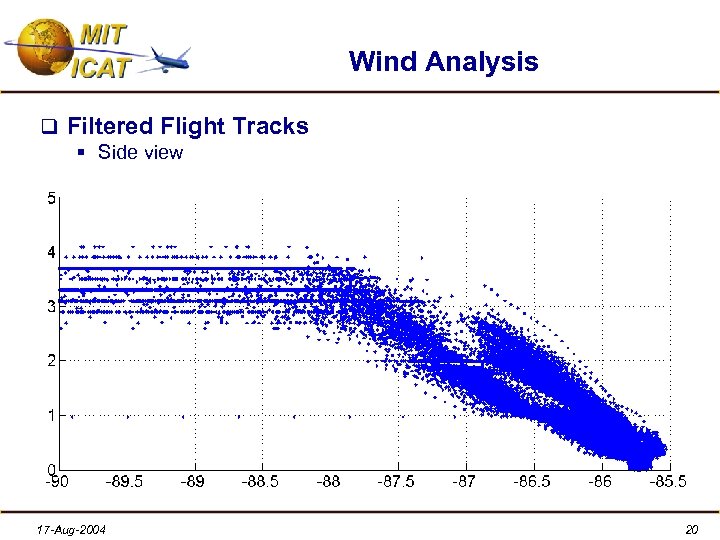 Wind Analysis q Filtered Flight Tracks § Side view 17 -Aug-2004 20
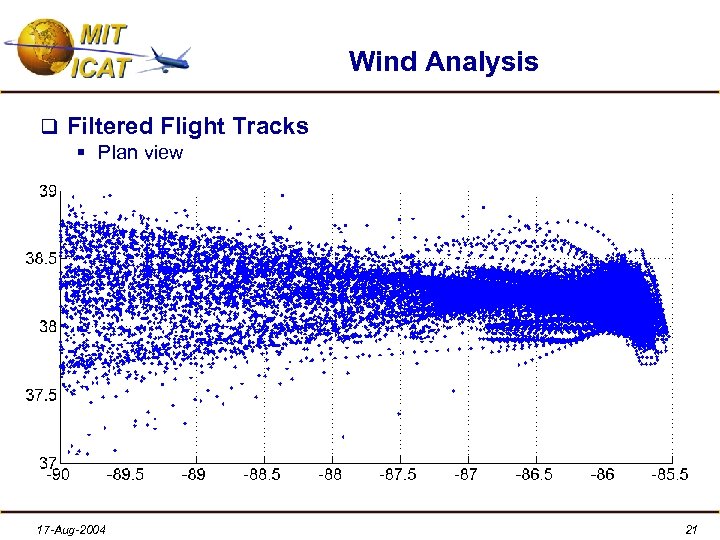 Wind Analysis q Filtered Flight Tracks § Plan view 17 -Aug-2004 21
 Wind Statistical Analysis Method q Wind report of filtered flight tracks linearly interpolated at a set of altitudes with 1, 000 ft interval q All interpolated data points at a given altitude analyzed together and gave statistics at that altitude q Mean wind speed and standard deviation computed based on the absolute wind speed value of each interpolated data point q Mean wind direction is computed based on the wind direction of each interpolated data point using unit vector method (not weighted) 17 -Aug-2004 22
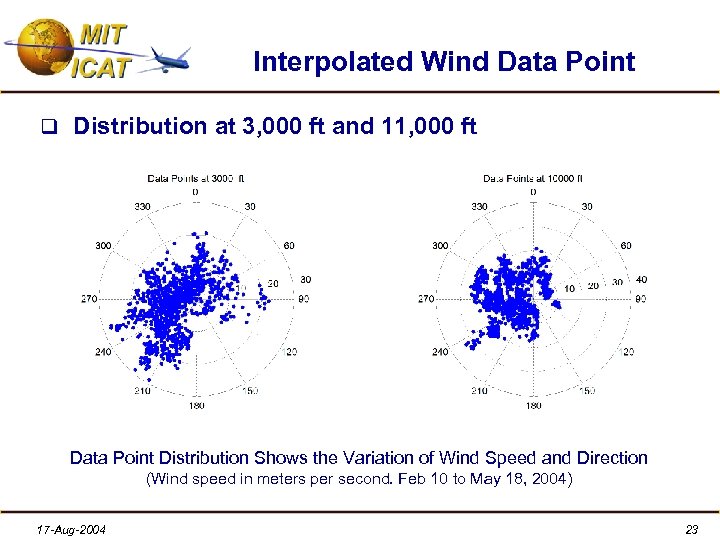 Interpolated Wind Data Point q Distribution at 3, 000 ft and 11, 000 ft Data Point Distribution Shows the Variation of Wind Speed and Direction (Wind speed in meters per second. Feb 10 to May 18, 2004) 17 -Aug-2004 23
 Mean, 2σ and Maximum Wind High altitude data not reliable due to lack of reports. Feb 10 to August 12, 2004 17 -Aug-2004 24
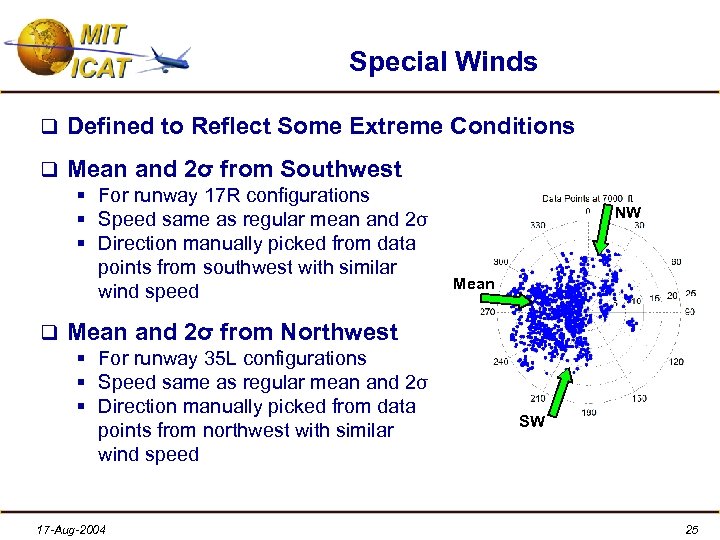 Special Winds q Defined to Reflect Some Extreme Conditions q Mean and 2σ from Southwest § For runway 17 R configurations § Speed same as regular mean and 2σ § Direction manually picked from data points from southwest with similar wind speed q Mean and 2σ from Northwest § For runway 35 L configurations § Speed same as regular mean and 2σ § Direction manually picked from data points from northwest with similar wind speed 17 -Aug-2004 NW Mean SW 25
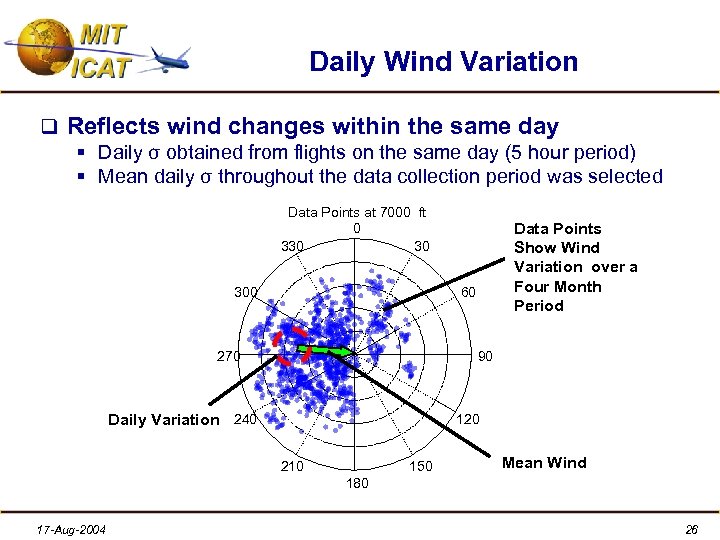 Daily Wind Variation q Reflects wind changes within the same day § Daily σ obtained from flights on the same day (5 hour period) § Mean daily σ throughout the data collection period was selected Data Points at 7000 ft 0 330 30 300 Data Points Show Wind Variation over a Four Month Period 60 270 90 Daily Variation 240 120 210 150 Mean Wind 180 17 -Aug-2004 26
 FMS Use of Wind q Limited use of wind forecast by FMS during descent, in general, benefits of very detailed wind forecast for FMS would be limited q Since FMS will mix the current wind measurement with wind forecast when computing vertical path, even if no wind forecast is entered, the vertical path will still be different for different winds q When there is significant change in wind, or when wind at lower altitude is relatively strong and has a different direction, the execution of the planned vertical path may be affected 17 -Aug-2004 27
 SDF UPS Night Arrival Traffic q April 14 -15, 2003, Landing to Runway 17 R • Data Source: Passur SDF airport monitoring website 17 -Aug-2004 28
 SDF UPS Night Arrival Traffic q April 14 -15, 2003, Last Block from West to 17 R 17 -Aug-2004 29
 SDF UPS Night Arrival Traffic q April 14 -15, 2003, Time of Arrival at 17 R Threshold • The arrival rate of the last block from west was roughly 16 aircraft per hour • Peak arrival rate was roughly 24 aircraft per hour 17 -Aug-2004 30
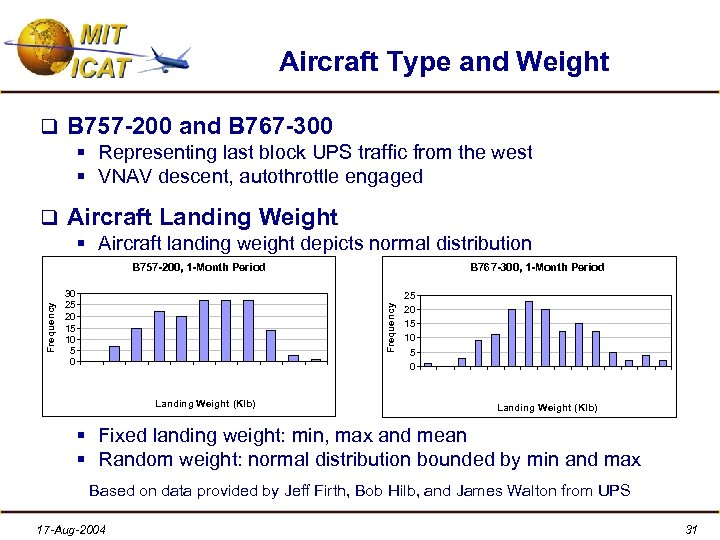 Aircraft Type and Weight q B 757 -200 and B 767 -300 § Representing last block UPS traffic from the west § VNAV descent, autothrottle engaged q Aircraft Landing Weight § Aircraft landing weight depicts normal distribution 30 25 20 15 10 5 0 B 767 -300, 1 -Month Period Frequency B 757 -200, 1 -Month Period Landing Weight (Klb) 25 20 15 10 5 0 Landing Weight (Klb) § Fixed landing weight: min, max and mean § Random weight: normal distribution bounded by min and max Based on data provided by Jeff Firth, Bob Hilb, and James Walton from UPS 17 -Aug-2004 31
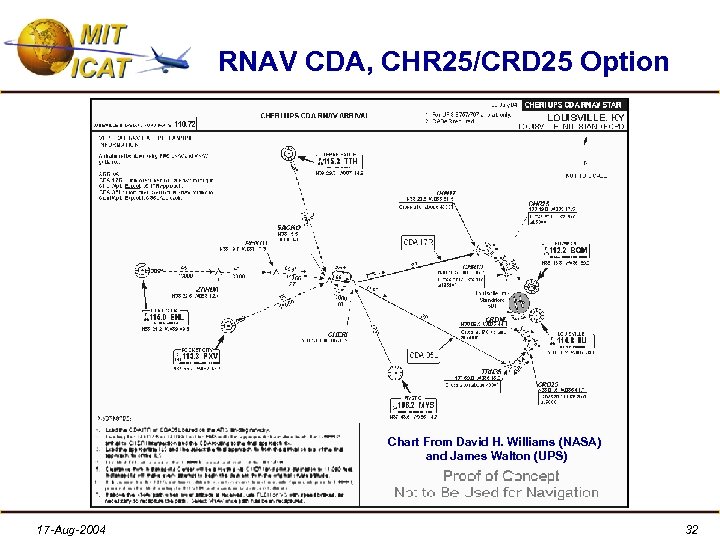 RNAV CDA, CHR 25/CRD 25 Option Chart From David H. Williams (NASA) and James Walton (UPS) 17 -Aug-2004 32
 ATC Constraint Analysis q ATC Altitude Constraint at CHERI § Currently Indianapolis Air Route Traffic Control Center (Indy ARTCC) can only clear aircraft down to 11, 000 ft at CHERI § Need estimate the range of altitude variation at CHERI for aircraft perform CDA, so that procedure design or ATC agreement can be made accordingly q Simulation Setup § B 757 -200 and B 767 -300 § Max and minimum aircraft weight § Zero, mean, 2σ wind conditions § No pilot delay variation, less significant factor for large wind variation q Simulation Results (for BLGRS and CRD 25 Option) § Altitude at CHERI ranges from 10, 509 ft to 15471 (2 -Aug-2004 simulation setting) 17 -Aug-2004 33
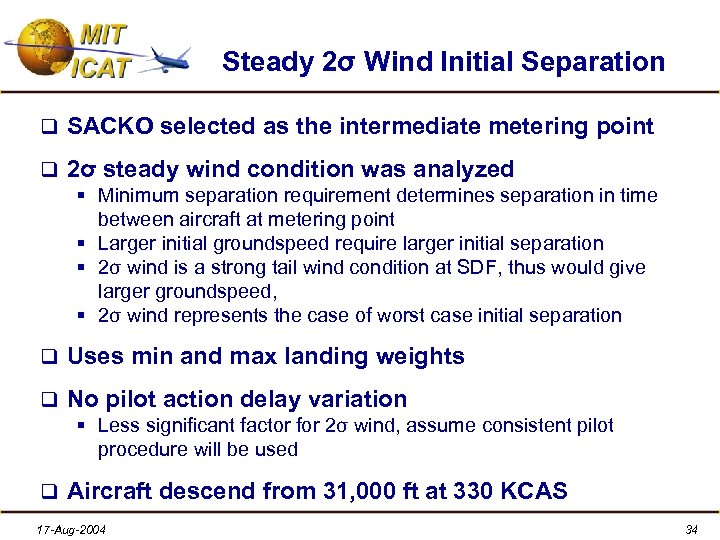 Steady 2σ Wind Initial Separation q SACKO selected as the intermediate metering point q 2σ steady wind condition was analyzed § Minimum separation requirement determines separation in time between aircraft at metering point § Larger initial groundspeed require larger initial separation § 2σ wind is a strong tail wind condition at SDF, thus would give larger groundspeed, § 2σ wind represents the case of worst case initial separation q Uses min and max landing weights q No pilot action delay variation § Less significant factor for 2σ wind, assume consistent pilot procedure will be used q Aircraft descend from 31, 000 ft at 330 KCAS 17 -Aug-2004 34
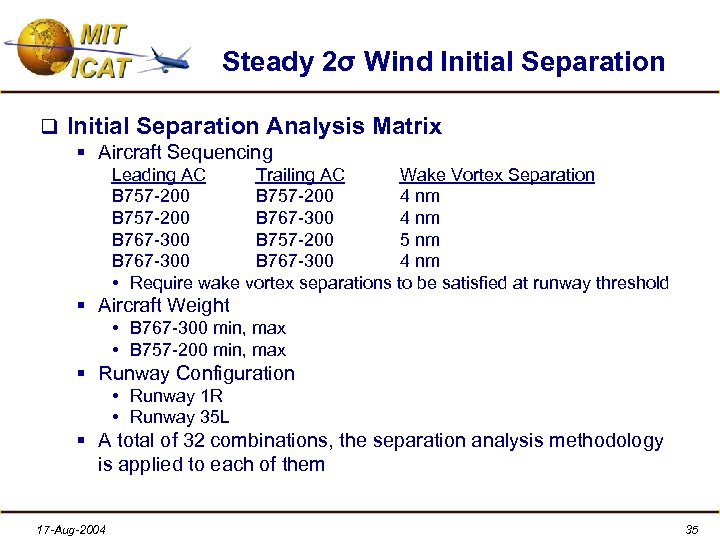 Steady 2σ Wind Initial Separation q Initial Separation Analysis Matrix § Aircraft Sequencing Leading AC Trailing AC Wake Vortex Separation B 757 -200 4 nm B 757 -200 B 767 -300 4 nm B 767 -300 B 757 -200 5 nm B 767 -300 4 nm • Require wake vortex separations to be satisfied at runway threshold § Aircraft Weight • B 767 -300 min, max • B 757 -200 min, max § Runway Configuration • Runway 1 R • Runway 35 L § A total of 32 combinations, the separation analysis methodology is applied to each of them 17 -Aug-2004 35
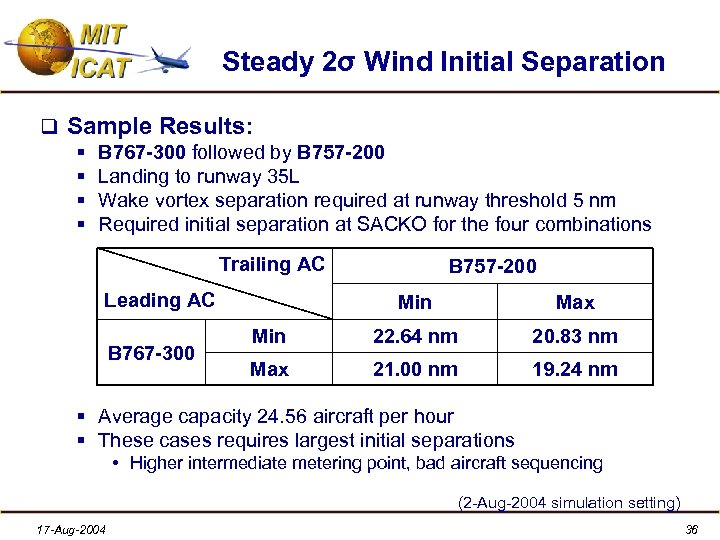 Steady 2σ Wind Initial Separation q Sample Results: § B 767 -300 followed by B 757 -200 § Landing to runway 35 L § Wake vortex separation required at runway threshold 5 nm § Required initial separation at SACKO for the four combinations Trailing AC Leading AC B 767 -300 B 757 -200 Min Max Min 22. 64 nm 20. 83 nm Max 21. 00 nm 19. 24 nm § Average capacity 24. 56 aircraft per hour § These cases requires largest initial separations • Higher intermediate metering point, bad aircraft sequencing (2 -Aug-2004 simulation setting) 17 -Aug-2004 36
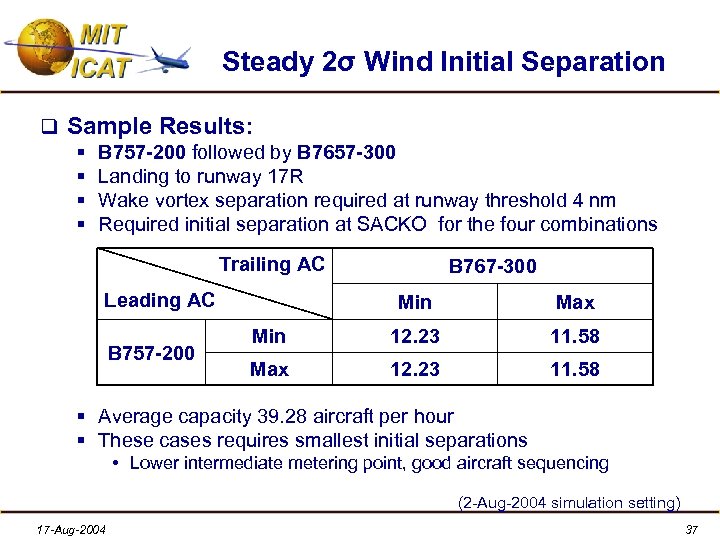 Steady 2σ Wind Initial Separation q Sample Results: § B 757 -200 followed by B 7657 -300 § Landing to runway 17 R § Wake vortex separation required at runway threshold 4 nm § Required initial separation at SACKO for the four combinations Trailing AC Leading AC B 757 -200 B 767 -300 Min Max Min 12. 23 11. 58 Max 12. 23 11. 58 § Average capacity 39. 28 aircraft per hour § These cases requires smallest initial separations • Lower intermediate metering point, good aircraft sequencing (2 -Aug-2004 simulation setting) 17 -Aug-2004 37
 Full Monte-Carlo Simulation q SACKO selected as the intermediate metering point q Mean wind condition as an example § Representing most common wind conditions § Daily random wind variation presenting worst wind variation between flights q Random aircraft weight § Normally distributed aircraft weight bounded by max and min q Random pilot action delay variation q Aircraft descend from 31, 000 ft at 330 KCAS q Initial descent speed at SACKO is targeted at 330 KCAS but actual simulation maybe different 17 -Aug-2004 38
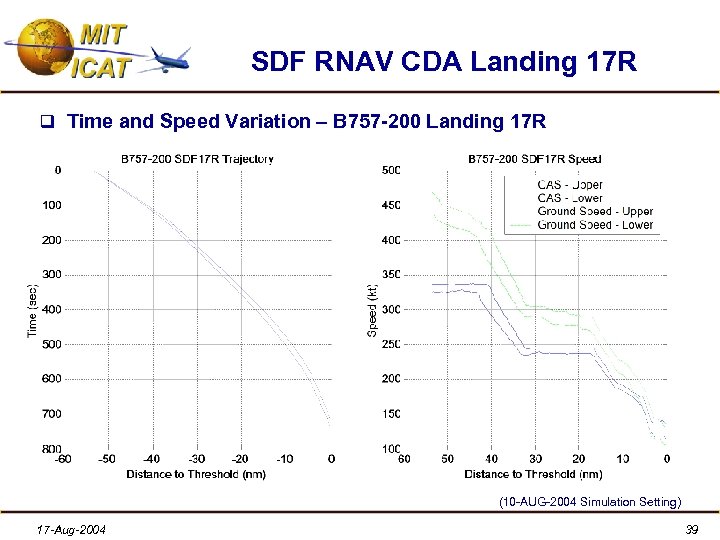 SDF RNAV CDA Landing 17 R q Time and Speed Variation – B 757 -200 Landing 17 R (10 -AUG-2004 Simulation Setting) 17 -Aug-2004 39
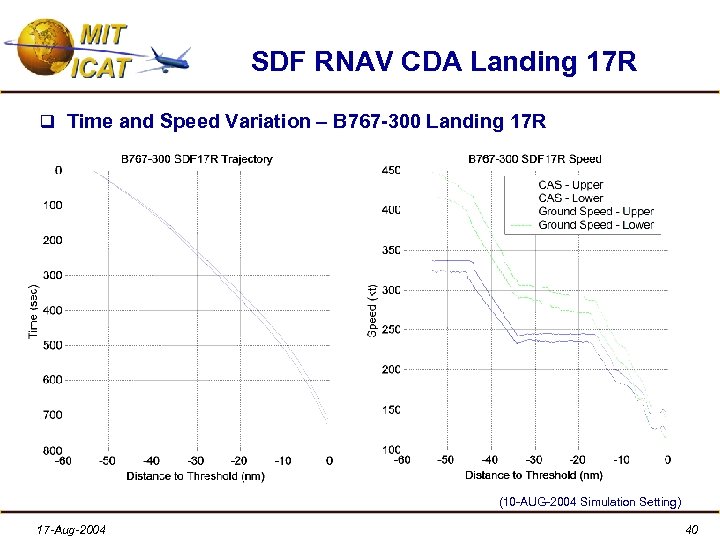 SDF RNAV CDA Landing 17 R q Time and Speed Variation – B 767 -300 Landing 17 R (10 -AUG-2004 Simulation Setting) 17 -Aug-2004 40
 SDF RNAV CDA Landing 17 R q Final Separation at Runway Threshold: 4/5 nm q Separation at SACKO Point § B 757 -200/B 757 -200: • 140. 2 sec time interval, or 25. 7 aircraft per hour • 18. 25 nm initial separation § B 757 -200/B 767 -300: • 127. 2 sec time interval, or 28. 3 aircraft per hour • 15. 83 nm initial separation § B 767 -300/B 757 -200: • 158. 8 sec time interval, or 22. 7 aircraft per hour • 20. 67 nm initial separation § B 767 -300/B 767 -300: • 122. 7 sec time interval, or 29. 3 aircraft per hour • 15. 26 nm initial separation § Average: • 15. 26 - 20. 67 nm initial separation, gives 26. 5 aircraft per hour 17 -Aug-2004 41
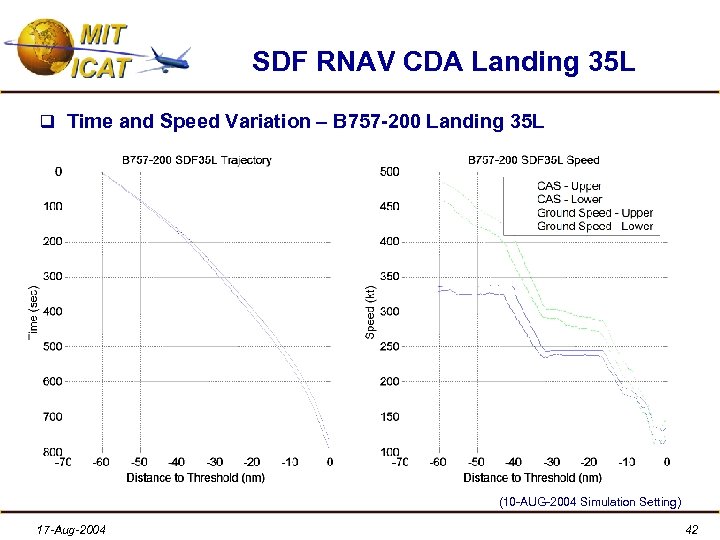 SDF RNAV CDA Landing 35 L q Time and Speed Variation – B 757 -200 Landing 35 L (10 -AUG-2004 Simulation Setting) 17 -Aug-2004 42
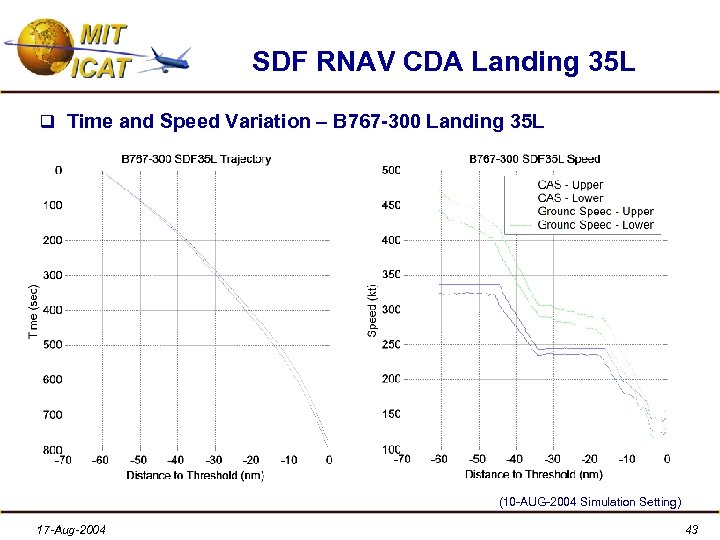 SDF RNAV CDA Landing 35 L q Time and Speed Variation – B 767 -300 Landing 35 L (10 -AUG-2004 Simulation Setting) 17 -Aug-2004 43
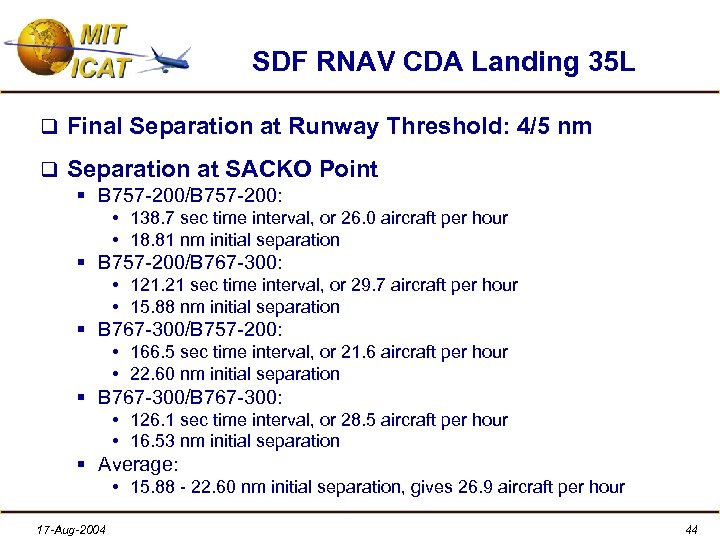 SDF RNAV CDA Landing 35 L q Final Separation at Runway Threshold: 4/5 nm q Separation at SACKO Point § B 757 -200/B 757 -200: • 138. 7 sec time interval, or 26. 0 aircraft per hour • 18. 81 nm initial separation § B 757 -200/B 767 -300: • 121. 21 sec time interval, or 29. 7 aircraft per hour • 15. 88 nm initial separation § B 767 -300/B 757 -200: • 166. 5 sec time interval, or 21. 6 aircraft per hour • 22. 60 nm initial separation § B 767 -300/B 767 -300: • 126. 1 sec time interval, or 28. 5 aircraft per hour • 16. 53 nm initial separation § Average: • 15. 88 - 22. 60 nm initial separation, gives 26. 9 aircraft per hour 17 -Aug-2004 44
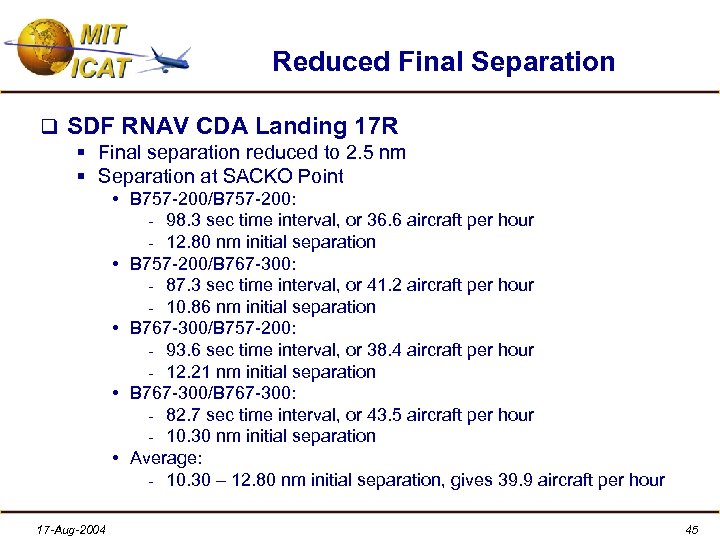 Reduced Final Separation q SDF RNAV CDA Landing 17 R § Final separation reduced to 2. 5 nm § Separation at SACKO Point • B 757 -200/B 757 -200: - 98. 3 sec time interval, or 36. 6 aircraft per hour - 12. 80 nm initial separation • B 757 -200/B 767 -300: - 87. 3 sec time interval, or 41. 2 aircraft per hour - 10. 86 nm initial separation • B 767 -300/B 757 -200: - 93. 6 sec time interval, or 38. 4 aircraft per hour - 12. 21 nm initial separation • B 767 -300/B 767 -300: - 82. 7 sec time interval, or 43. 5 aircraft per hour - 10. 30 nm initial separation • Average: - 10. 30 – 12. 80 nm initial separation, gives 39. 9 aircraft per hour 17 -Aug-2004 45
 Reduced Final Separation q SDF RNAV CDA Landing 35 L § Final separation reduced to 2. 5 nm § Separation at SACKO Point • B 757 -200/B 757 -200: - 97. 4 sec time interval, or 37. 0 aircraft per hour - 13. 22 nm initial separation • B 757 -200/B 767 -300: - 80. 0 sec time interval, or 45. 0 aircraft per hour - 10. 48 nm initial separation • B 767 -300/B 757 -200: - 102. 3 sec time interval, or 35. 18 aircraft per hour - 13. 88 nm initial separation • B 767 -300/B 767 -300: - 84. 9 sec time interval, or 42. 4 aircraft per hour - 11. 12 nm initial separation • Average: - 11. 12 – 13. 88 nm initial separation, gives 39. 9 aircraft per hour 17 -Aug-2004 46
 Simulation Discussion q Monte-Carlo Simulation Finding New Things § Monte-Carlo simulation revealed that at low aircraft landing weights, it’s very difficult to decelerate if flaps are extended at recommended speeds based on VREF § This could easily be ignored if Monte-Carlo simulation were not used, internalized particular experience may not speak out loud § The simulation results thus suggested revising the altitude/speed constraints and/or pilot procedures developed for CDA q Fast Simulation § We showed results from few simulation condition settings, however, for noise abatement procedures design, large number of condition settings shall be studied § The Monte-Carlo scheme presented is flexible for different condition settings, and it is fast-time, can be executed in batch mode 17 -Aug-2004 47
 Simulation Discussion q Separation Analysis § In the case shown, the separation method gave results that would meet ‘ 100%’ cases, the required initial separations are large § Directly applied, they would not yield optimal noise reduction results in many cases § Airline schedule may be disrupted and may causes extra-delays § If final approach separation can be relaxed, or if not all cases are to be met (such as 95%, not shown here), the required initial separation can be significantly reduced § This means if occasionally the initial separation gets lower, the safety requirements can still be satisfied § Or, when potential violation is predicted, air traffic controller can always intervene § This is true for the SDF project, it would probably be applicable to many other projects 17 -Aug-2004 48
 Simulation Discussion q Pilot action is the most difficult part to simulate § Speed brake application § Throttle control when autothrottle is not engaged § Need data from pilot-in-the-loop flight test/experiment to support modeling § Trajectory variation due this can be reduced through pilot procedure design and proper training q Other Issues? 17 -Aug-2004 49