 Скачать презентацию Missouri s Business Services Transformation Retooling our Approach for
428f26346148b33f85bc4ec3c2d3ebb1.ppt
- Количество слайдов: 11



Missouri’s Business Services Transformation Retooling our Approach for a Greater Impact on Missouri’s Economic Prosperity
Background n n Traditional workforce development strategies have tended to focus on reactive supply side solutions (i. e. job-seeker gets more attention); Traditional economic development strategies in the static 20 th Century economy tended to focus on targeted tax incentive packages to positively impact business recruitment and retention decisions without much regard for the development of human talent. Today’s knowledge-based economy insists that we change both these to succeed. The ultimate business service is ensuring a steady supply of skilled workers
Business Services Representatives n What they were: Heavily focused on marketing the One-Stop Career Centers; ¨ Ensuring labor exchange job orders were posted; ¨ Typically were reactive – waited until businesses contacted them for services. ¨
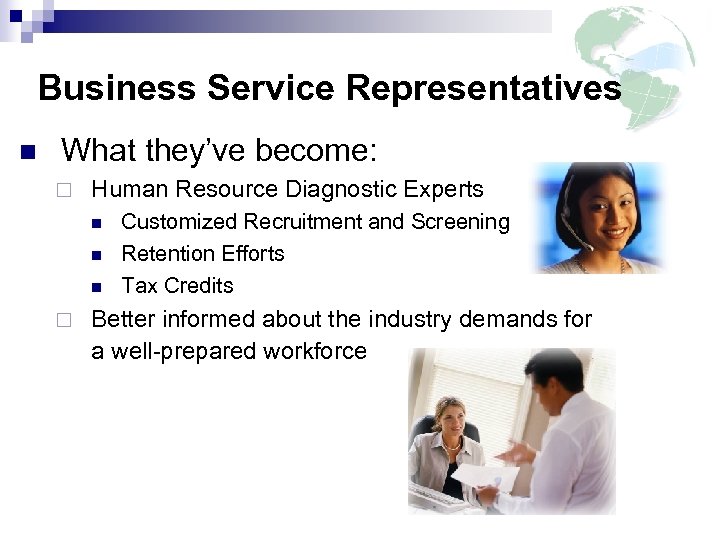
Business Service Representatives n What they’ve become: ¨ Human Resource Diagnostic Experts n n n ¨ Customized Recruitment and Screening Retention Efforts Tax Credits Better informed about the industry demands for a well-prepared workforce
Layoffs and Closures Approach n What it was: ¨ Reactive – only initiated when business was already closing (Rapid Response). n What it has become: Business Retention and Early Warning Networks ¨ Monitor formal and informal indicators of business distress n n n Layoff Notices Change of ownership Loss of contracts ¨ Provide assistance to troubled firms
Business Retention and Early Warning Networks q 4 pilot LWIBs through the 2006 Skilled Workforce Initiative (SWI). Extended to 7 through the 2007 SWI. q. Will be implemented statewide q. Partnership with workforce, economic development, and other non-traditional partners (i. e. utility companies) q. Conduct feasibility studies for distressed companies. q. Outcomes: In 2006, over 200 companies were assisted and over 250 jobs retained due to retention network intervention.
Incumbent Worker Training: q. What it was: q. Prior to PY 06, the State didn’t offer any Incumbent Worker Training through federal funds. q. The State’s investment in Incumbent Worker Training was exclusively through state-funded industry training programs.
Incumbent Worker Training n What it is now: Through the Skilled Workforce Initiative (SWI), Missouri offers Incumbent Worker Training grants to local areas funded through WIA 15% funds. ¨ The SWI Incumbent Worker Training grants target industries, occupations, or training not targeted by the state-funded industry training programs to provide maximum resources. ¨ Outcomes: Went from 0 people to over 1000 trained in the first year. ¨
Additional Business Services Transformations n n n Missouri Career Readiness Certificate (Mo. CRC) Skilled Workforce Initiative: Talent Acquisition and Development Category Workforce Intelligence Enhancements Real Time Labor Market Information ¨ Job Vacancy Surveys ¨
Challenges Overcome n n n Traditional attitudes of government “assistance” businesses typically have Confidentiality fears on Business Retention Networks Aversion to Change Language of Business vs. Language of Government Rapid Pace of Change in the New Economy
Questions/Comments? Dawn Busick Assistant Director, Missouri Division of Workforce Development dawn. busick@ded. mo. gov
Скачать презентацию Missouri s Business Services Transformation Retooling our Approach for
428f26346148b33f85bc4ec3c2d3ebb1.ppt