 Скачать презентацию Missouri Board of Pharmacy Practice Act Review October
5a430855184c99ab13cd2e048bfda822.ppt
- Количество слайдов: 89



Missouri Board of Pharmacy Practice Act Review October 5 th, 2004
State Statutes • 338. 010: Definition of Practice – DUR; Acts, Services, Operations, Transactions of a pharmacy • 338. 013: Registration of Technicians • 338. 050: Expiration Dates of Licenses – Pharmacist-Pharmacy-Drug Distributor >October 31
338. 055: Unprofessional Conduct • Drug or Alcohol Impairment • Criminal Prosecution - Guilty or Nolo Contendere • Fraud, Misrepresentation to Secure License • Obtain Fees or Charges by Fraud • Incompetency, Misconduct, Gross Negligence or Dishonesty……. . .
338. 055: Unprofessional Conduct • Violating or Assisting in Violations of Chapter 338 and Rules • Impersonation • Disciplining Actions from other Agencies or States • Incapacitation • Failure to Maintain Current License • Personal Use of C. S. Unless Prescribed, Dispensed or Administered by Qualified Health Provider…. .
338. 055: Unprofessional Conduct • Mistake of Fact - Issuance of License • Failure to Display Valid License • Violation of Professional Trust or Confidence • False or Misleading Advertising • Violation of Drug Laws (F/S) • Violation of Drug Substitution Law
338. 056/057: Generic Substitution Law • • Name of Manufacturer on Rx or Label Two line Blank Actual Name of Drug on Label Procedure for Oral Rx: Document Prescriber Approval
State Statutes • 338. 059: Rx/Wholesale Labeling • 338. 060: Pharmacist License (Renewal) – Exemptions for Military Service – Lapsed License – CE Requirements
338. 100: Rx Records • Total Retention Time: 5 Years – 3 Years Hard Copy – 2 Years Microfiche or EDP* • Authority to Inspect • Copies • Court Proceedings
State Statutes • • • 338. 110: Board of Pharmacy; Description 338. 140: Board Authority 338. 150: Inspection Authority 338. 155: Immunity 338. 180/185/190/195: Access to Criminal Records; Prosecution Authority; Conviction Level (Licensed vs. Unlicensed)
State Statutes • 338. 196: Rx Originating from Out-of-State • 338. 210: Definition of a Pharmacy • 338. 220/240/250: Permit Requirements and Classes. Consignment Arrangement • 338. 260: Business Name-->Supervised by R. Ph. • 338. 300: No Transfer of Permits
State Statutes • 338. 315: Receipt of Drugs • 338. 330: Definition of Drug Distributors • 338. 333: Licensing – Temporary vs. Permanent – Exemption for Consignment Delivery • 338. 337: Out-of-State Distributors • 338. 340: No Distribution w/o License
State Statutes • 338. 365: Injunctive Authority • 338. 370: Penalty Provisions
Board of Pharmacy Rules/Regulations 13/75
2. 010 -Operational Standards • • • Supervision No Pharmacist on Duty Facility Requirements Warehouses Owner Responsibility Rx Files (Manual vs. EDP); Refills; Three File System…….
2. 010 -Operational Standards • Drug/Device Transfer Record Requirements • Drug Inventories • Drug Samples
2. 015 -Termination of Business as a Pharmacy • Written Notice to the Board----> 15 Days • Date of Closing • Disposition of the Inventory and Records (Retrievable within 7 Working Days) • Termination Date--->Inventory of Controlled Substances (copies with each licensee)…….
2. 015 -Termination of Business as a Pharmacy • No transfer of Misbranded or Adulterated Drugs • Return of License (Permit) to the Board
2. 018 -Prescription Requirements • Conformance with Two-line Blank or Originate form Out of State • Date, Assigned Unique Readily Retrievable Identifier** • Patient(s) • Prescriber Indication of Drug Name, Dosage, Directions for Use, Actual Name and Dosage…….
2. 018 -Prescription Requirements • Refills • Quantity Dispensed and Pharmacist Initials • Alterations to a Rx. Based on Prescriber Contact • Controlled Substance Information as Required by Law • Required on All Rx. ---->Handwritten; Telephone; Oral; Fax; Electronic
2. 020 -Pharmacy Permits • Change of Ownership – Business is Sold* – Changes to or Within a Partnership* – Death of an Owner (One year Provision) – Corporate Ownership* – Stock Transfers* *30 Day Grace Period • Change of Location(Application/Inspection) vs. Remodeling
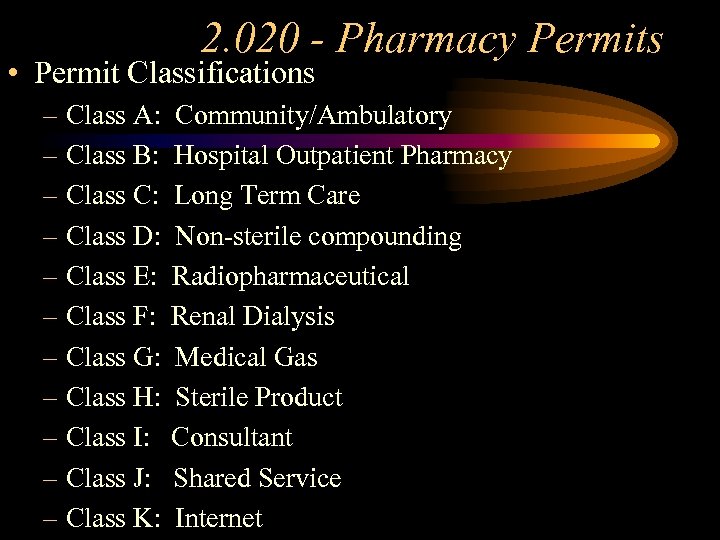
2. 020 - Pharmacy Permits • Permit Classifications – Class A: – Class B: – Class C: – Class D: – Class E: – Class F: – Class G: – Class H: – Class I: – Class J: – Class K: Community/Ambulatory Hospital Outpatient Pharmacy Long Term Care Non-sterile compounding Radiopharmaceutical Renal Dialysis Medical Gas Sterile Product Consultant Shared Service Internet
2. 050 -Public Complaint Handling • • Written Complaints Log Book Communication with Complainant Records Release/Confidentiality
2. 080 -E. D. P. • • • (1)Original Rx. vs. Refill Documentation (2) System Capability Requirements (3) Rx Records Available During Inspection (4) Proof of Refill Information Accuracy (5) Logbook or Separate Signature File (7) On-Line Record Retrieval During Inspection
2. 080 -E. D. P. • (8) Auxiliary Record System Maintained • (9) Prescription Transfers-Deactivation • (10) Purge Requirements---Record Production---> 3 Business Days • (13) Drug Utilization Review Requirements
2. 085 -Electronic Transmission of Prescription Data • Includes both Image and/or Data Transmission with Validation Requirements • Generation of Hard Copies - Security Paper • Defines Electronic Signature • Original facsimile of Rx. Must be Maintained in Files • System Must Guard Against and Detect Unauthorized Access • Rx. Alterations Must be Documented and Identify Responsible Pharmacist
2. 090 -Pharmacist-in-Charge • Number of Pharmacies is not Restricted • Change in Status---->P. I. C. is Responsible • Change in P. I. C. Inventory of Controlled Substances……. . • Maintain Compliance with Automated Dispensing and Storage System Requirements
2. 090 -Pharmacist-in-Charge • • • Appropriate and Direct Supervision Maintain Adequate Security “No Pharmacist on Duty” Posted All Licenses Current and Displayed Compliance with Recordkeeping Laws Compliance with Controlled Substance Laws………. .
2. 090 -Pharmacist-in-Charge • Compliance with Labeling Laws • Compliance with Generic Substitution Laws and Formulary • Maintenance of Poison Register • Maintenance of Sanitation • Maintenance of Equipment • Inventory Free of Outdated Drugs…….
2. 090 -Pharmacist-in-Charge • Compliance with Drug Sample Laws • Inventory Q/A >Misbranded Drugs >Adulterated Drugs • Compliance with Drug Distributor Laws • Compliance with Patient Counseling Laws • Compliance with P/P for Proper Registration and Supervision of Technicians
2. 100 Continuing Education • 30 Contact Hours Required - Biennial Renewal • ACPE or Board Approved Programs • Programs Approved by Other State Boards of Pharmacy • Inactive License – No Practice of Pharmacy – Makeup of Hours before Reinstatement to Active Status
2. 110 -PRN Refills • 1 Year Limit from Date Rx. is Written • Assurance that All Rx. have Proper Prescriber/Patient Relationship • Documentation of Authorizations Must Appear in Records in Uniform Fashion
2. 120 -Transfer of Prescription Information • Controlled Substances: 1 Transfer and Must be Between Two Licensed Pharmacists • Pharmacies Sharing E. D. P. Database May Transfer as long as Refills Available • Records of Transferred Controlled Substances Must Include Dates and Locations of all Previous Refills…….
2. 120 -Transfer of Prescription Information • Recordkeeping (Transferring Pharmacy) – Indicate transfer; Indicate Pharmacy – Date of Transfer; Transferring Pharmacist – Voiding of Rx. – Controlled Substances--->Address and DEA Number of Pharmacy and Pharmacist Receiving Rx. ……….
2. 120 -Transfer of Prescription Information • Receiving Pharmacy – Rx. Information; Indicate Transfer and the Name of the Original Pharmacy and Transferring Pharmacist – Original Rx. Date; Original Dispensing Date (if different) – Original Number of Refills; Remaining Refills; Date of Last Refill; Original Rx. Number…….
2. 120 Transfer of Prescription Information • Receiving Pharmacy (cont. ) – Controlled Substance Rx. - Address and DEA Number from all Previous Transferring Pharmacies
2. 130 -Drug Repackaging • Pre-Packs • Pharmacies that Repackage or Relabel for Outside Distribution to Other Facilities or Practitioners Must: – Register with FDA as Repackager and be Subject to GMP Inspections – Annual Listing of All Drugs Repackaged…. .
2. 130 -Drug Repackaging • Standards for Pre-packs – Minimum USP Requirements – Expiration Date: Manufacturers Expiration or 12 Months, Whichever is Less. ** – Labeling: Name and Strength of Drug, Name of Manufacturer or Distributor, Expiration Date and Assigned Lot Number – Containers: Class “B” Minimum 37/75
2. 140 -Long Term Care • Policy and Procedure Manual Required – Dispensing Procedures – Notification to Institution of Unavailability of Drug – Labeling – Drug Returns/Destruction • Disposition of Controlled Substances – Direction Change Labels: Temporary Labels Used by LTC Staff.
2. 140 - Long Term Care • Definitions: – Long Term Care Facility: Nursing home, retirement care, mental care or other facility or institution which provides extended health care to resident patients. – Remote Dispensing System: Any system of an automated or manual design that is used to provide doses of medication for immediate administration by authorized health care personnel and is not licensed as a pharmacy. >
2. 140 -Long Term Care – Pharmacist Must Supervise Restocking of System. – Repackaging Requirements – Security - P/P • Prescription Drug Order Defined – Exception to Rx Two Line Blank – Separate Rx File is Allowed – Meds. That Leave the Facility
2. 145 - Standards for Multi-Med Dispensing (Packaging) • • Customized Packaging with Proper Consent Solid Oral Dosage Forms Patient Package Insert for Each Drug Packaging Must Meet Board Requirements or Manufacturer if More Stringent • Packaging Can Show Evidence of Tampering • Child Resistant Packaging Standards Required
Standards for Multi-Med Dispensing (Labeling) • Each Container Labeled for Time of Administration • Label Must Include: Patient Name; Med Pack Serial Number (Additional to Rx); Name, Strength, Physical Description/ID, Quantity of Each Product; Directions for Use/Caution Statements for Each Product; Storage Requirements; Prescriber for Each Product; …………. . .
Standards for Multi-Med Dispensing (Labeling) Date of Preparation; Beyond Use Date (No More than 60 Days Beyond Preparation Date); Name/Address/Telephone of the Pharmacy; All Other Required Statements of Manufacturer or USP • Each Separate Container Must ID Drug Products Contained Therein
Standards for Multi-Med Dispensing (Files) • Maintain Separate Record for Med-Packs. Each Record Contains: – Name and Address of the Patient – Rx. Number for Each Drug Contained Therein – Identity of Manufacturer/Labeler and Lot Number for Each Product – Description of Med-Pack Sufficient to Provide Patient with Duplicate Med-Pack for Future Refills……………….
Standards for Multi-Med Dispensing (Files) – Preparation Date and Beyond Use Date – Special Labeling Instructions – Initials of the Dispensing Pharmacist • Custom Packaging Restrictions – No Return and Reuse Allowed – No Custom Packaging of Controlled Substances Allowed
2. 190 -Patient Counseling • Maintain and Review of Patient Information • Minimum Requirement--->Offer – Any Pharmacy Employee – Written Offer When Patient or Caregiver Not Available – “Offer” Required on All New and Refill Rx. – Inpatients are Exempt
4 CSR 220 -2. 200 Sterile Pharmaceuticals • Definitions> – Batch: Compounding of multiple units within a single discrete process by the same individual(s)…. . one limited time period. – Beyond Use Date: Date After Which a Product Should not be Used. Assignment Based on Immediate/Short Term Use. – Emergency Dispensing: High Risk Level Product Needed Prior to Appropriate Testing. Documentation - Need/Prescriber Approval • Separate Authorizations Required
4 CSR 220 -2. 200 Sterile Pharmaceuticals – Validation: Documentation that can show consistent Quality Assurance that Processes Used will Produce Products Meeting Predetermined Specifications and Quality. • Risk Levels – 1: Stored at Room Temperature (48 Hours) • • • Stored under Refrigeration (7 Days) Stored Frozen (30 Days) Unpreserved Product (Administered to 1 patient) Preserved Product (Batch Prepared for > 1 patient) Closed System Aseptic Transfers
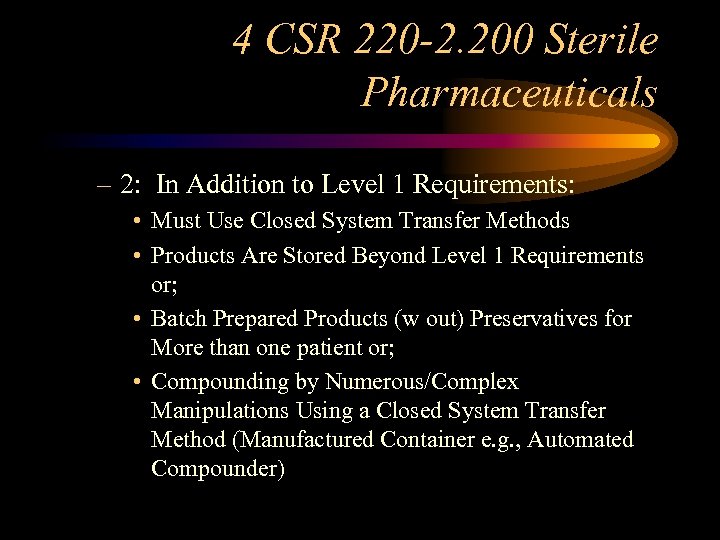
4 CSR 220 -2. 200 Sterile Pharmaceuticals – 2: In Addition to Level 1 Requirements: • Must Use Closed System Transfer Methods • Products Are Stored Beyond Level 1 Requirements or; • Batch Prepared Products (w out) Preservatives for More than one patient or; • Compounding by Numerous/Complex Manipulations Using a Closed System Transfer Method (Manufactured Container e. g. , Automated Compounder)
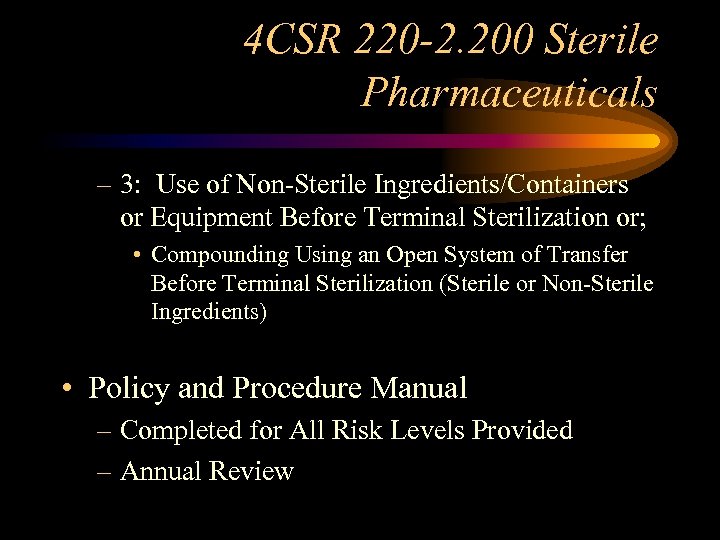
4 CSR 220 -2. 200 Sterile Pharmaceuticals – 3: Use of Non-Sterile Ingredients/Containers or Equipment Before Terminal Sterilization or; • Compounding Using an Open System of Transfer Before Terminal Sterilization (Sterile or Non-Sterile Ingredients) • Policy and Procedure Manual – Completed for All Risk Levels Provided – Annual Review
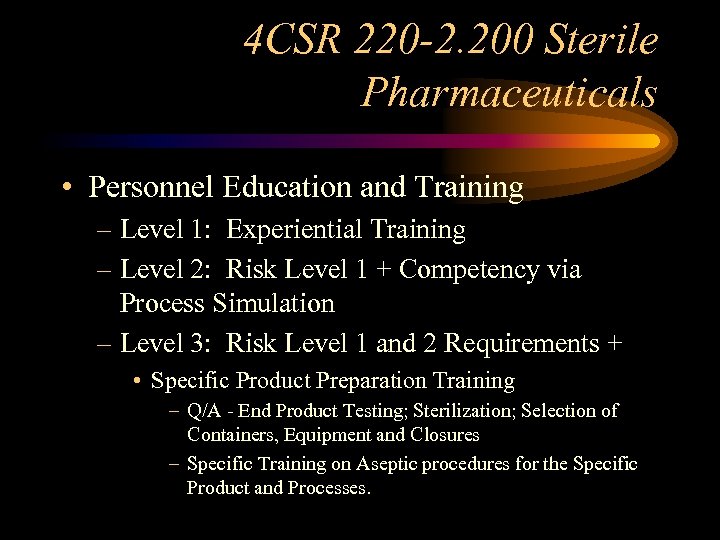
4 CSR 220 -2. 200 Sterile Pharmaceuticals • Personnel Education and Training – Level 1: Experiential Training – Level 2: Risk Level 1 + Competency via Process Simulation – Level 3: Risk Level 1 and 2 Requirements + • Specific Product Preparation Training – Q/A - End Product Testing; Sterilization; Selection of Containers, Equipment and Closures – Specific Training on Aseptic procedures for the Specific Product and Processes.
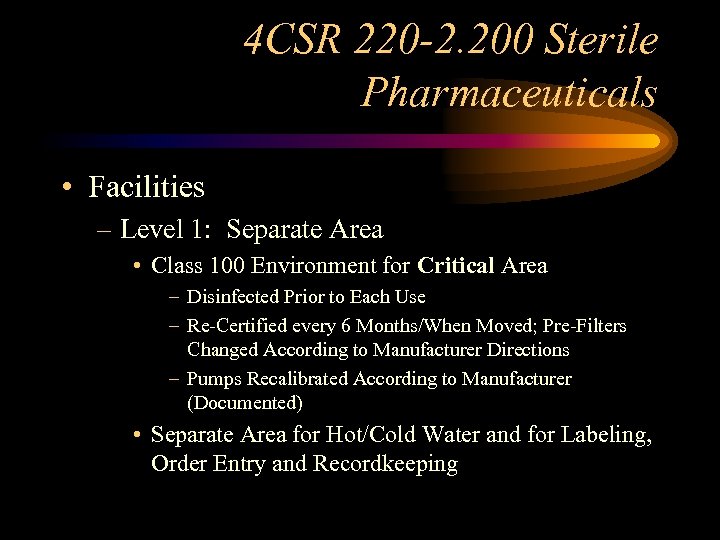
4 CSR 220 -2. 200 Sterile Pharmaceuticals • Facilities – Level 1: Separate Area • Class 100 Environment for Critical Area – Disinfected Prior to Each Use – Re-Certified every 6 Months/When Moved; Pre-Filters Changed According to Manufacturer Directions – Pumps Recalibrated According to Manufacturer (Documented) • Separate Area for Hot/Cold Water and for Labeling, Order Entry and Recordkeeping
4 CSR 220 -2. 200 Sterile Pharmaceutical • Level 2: In Addition to Risk Level 1: – Controlled Area Must Meet Class 10, 000 Standards; – Floors Disinfected Daily; Equipment Surfaces Daily and Walls Monthly – Environmental Monitoring of Air and Surfaces – Critical Area Cleaned Between Batches – Automated Compounders: Calibrated and Accuracy Verified According to Manufacturer Requirements
4 CSR 220 -2. 200 Sterile Pharmaceuticals • Level 3: In Addition to Risk Level 1 and 2; – Compounding in a Class 100 Workbench Within a Class 10, 000 Clean Room – Compounding in a Class 100 Clean Room – Compounding Within a Positive Pressure Barrier Isolator – Walls and Ceilings Disinfected Weekly – Sterilized Equipment Only in Contact with Sterile Products
4 CSR 220 -2. 200 Sterile Pharmaceuticals • Apparel – Risk Level 1: No Requirements – Risk Level 2: Low Particulate Clothing covers; Head and Facial Hair covered (Gowns/Mask) • Gloves Maintained – Risk Level 3: Level 2 Requirements + Shoe Covers • Exemption for Positive Pressure Barrier Isolator Box
4 CSR 220 -2. 200 Sterile Pharmaceuticals • Product Preparation and Validation – Risk Level 1: • Work Environment • Ingredients and Closures – Essential Materials Only: Arranged for Proper Air Flow – Disinfect all Surfaces, Equipment and Containers • Aseptic Technique/Validation – Scrub – Restrict Extemporaneous Activities – Technique Validation Annually (Additional Validation)
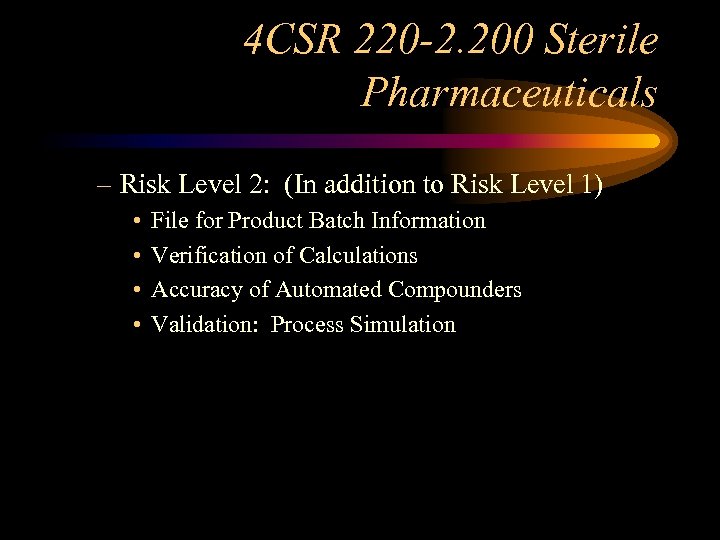
4 CSR 220 -2. 200 Sterile Pharmaceuticals – Risk Level 2: (In addition to Risk Level 1) • • File for Product Batch Information Verification of Calculations Accuracy of Automated Compounders Validation: Process Simulation
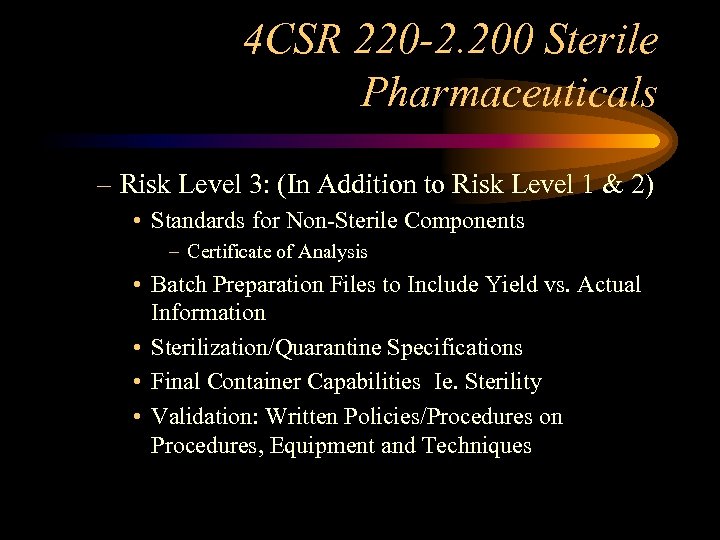
4 CSR 220 -2. 200 Sterile Pharmaceuticals – Risk Level 3: (In Addition to Risk Level 1 & 2) • Standards for Non-Sterile Components – Certificate of Analysis • Batch Preparation Files to Include Yield vs. Actual Information • Sterilization/Quarantine Specifications • Final Container Capabilities Ie. Sterility • Validation: Written Policies/Procedures on Procedures, Equipment and Techniques
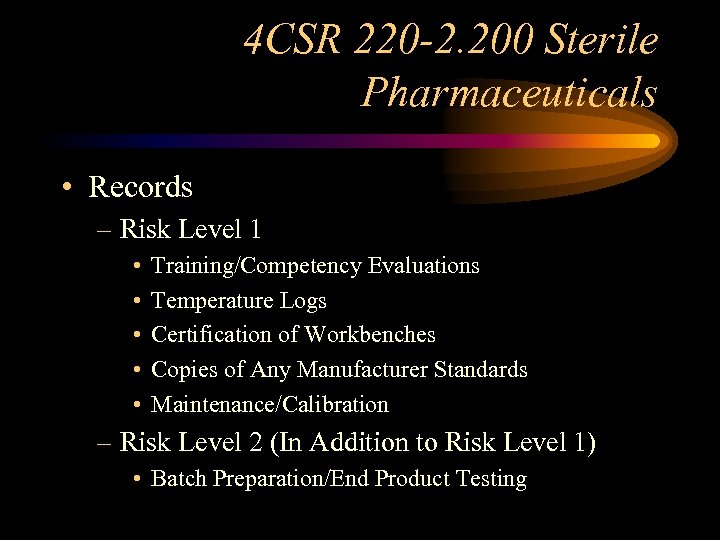
4 CSR 220 -2. 200 Sterile Pharmaceuticals • Records – Risk Level 1 • • • Training/Competency Evaluations Temperature Logs Certification of Workbenches Copies of Any Manufacturer Standards Maintenance/Calibration – Risk Level 2 (In Addition to Risk Level 1) • Batch Preparation/End Product Testing
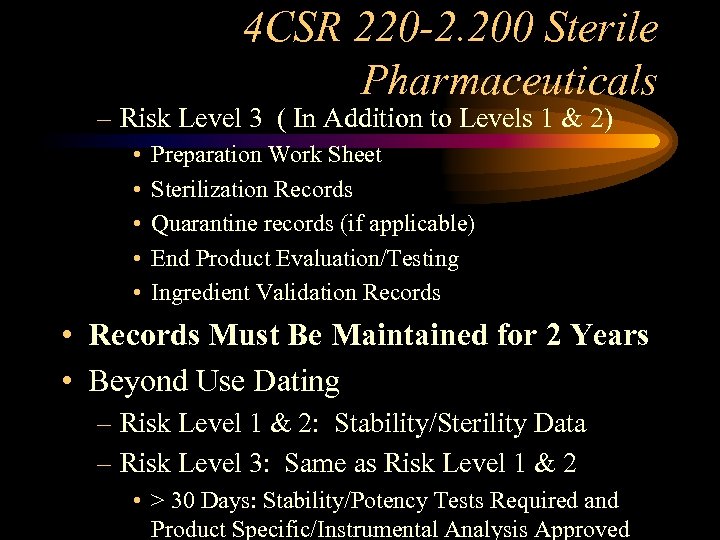
4 CSR 220 -2. 200 Sterile Pharmaceuticals – Risk Level 3 ( In Addition to Levels 1 & 2) • • • Preparation Work Sheet Sterilization Records Quarantine records (if applicable) End Product Evaluation/Testing Ingredient Validation Records • Records Must Be Maintained for 2 Years • Beyond Use Dating – Risk Level 1 & 2: Stability/Sterility Data – Risk Level 3: Same as Risk Level 1 & 2 • > 30 Days: Stability/Potency Tests Required and Product Specific/Instrumental Analysis Approved
4 CSR 220 -2. 200 Sterile Pharmaceuticals • End Product Evaluation – Risk Level 1 & 2 Require Visual Inspection – Risk Level 3 Requires a Statistically Valid Sampling Plan for: • Sterility Testing • Parenteral Products - Pyrogenicity • Non-Sterile to Sterile Products: Quarantined Pending Tests for Sterility and Pyrogenicity; Potency Confirmation if Stored for > 30 Days • Emergency Dispensing of Level 3 Products • Exemption
4 CSR 220 -2. 200 Sterile Pharmaceuticals • Compare/Contrast with USP Chapter 797 – Defining Risk Levels • Type of Materials Used (See Handout) (>) • Storage Conditions for Final Products (>) • Exposure to Inferior Quality Air (Level 3) (>) – Clean Rooms • • Physical Characteristics of Construction(>) Environmental Controls (<) Critical Area Requirements (<) Filter Maintenance (<)
4 CSR 220 -2. 200 Sterile Pharmaceuticals – Gowning • All Risk Levels (>) – Validation Requirements • Specific Media Fill Requirements (>) – Recordkeeping (<) – Cytotoxic Drug Controls (<)
2. 300 -Record Confidentiality • Patient Care Records-->CONFIDENTIAL – Rx. , Rx. Orders, Patient Profiles, – Must Maintain Adequate Security – Records Released to: Patient, Prescriber or Current Practitioner, Requests or Subpoenas from a Lawful Court, Person Authorized by Court Order, Patient Authorized Access, Pharmacist/Pharmacist, As Authorized Under HIPPA – Board Rep. : Authority to Inspect and Copy
2. 400 -Compounding Standards • Compounding: Based on Rx. or Research • Manufacturing: Extraction or Synthesis; Promotion of Product(s)…… • Batch Product Defined* – “Specific quantity…compounded in a single, discrete process…. during one limited time…” • Beyond Use Date is Defined*
2. 400 -Compounding Standards • Space and Equipment • Ingredient and Container Control • Q/A Procedures – Safety and Effectiveness – Recordkeeping: Separate Log*--->Methods to insure quality and purity; date; R. Ph. ; Ingredients; Process; Source/Lot #; Identifier – Product Inventory Must be Reflective of Rx. History--->3 Months of Inventory External Use Products--->1 Year…. . .
2. 400 -Compounding Standards • Q/A (cont. ) – Records Must be Maintained--->2 Years – Actual Name of Each Therapeutic Ingredient on Label to Consumer* – Illness or Lesions Must be Excluded from Contact with Product or Equipment – No Solicitation of Business for Specific Products
2. 400 - Compounding Standards • Management of Compounding* – Pharmacist Responsibility (Identity; Quality; Purity) Assure that Processes Are Completed – Drugs Must Meet Compendial Standards-C/A – Drug Monitoring Systems • • Infection Rates Adverse Drug Reactions Incidence of Recalls Complaints from Patients and Prescribers – Recall Standards (Physicians/Patients/Board)
2. 400 - Compounding Standards • Compounding of Commercial Products is Prohibited* – Products Withdrawn or are Unavailable – Clinical Necessity • Modification of OTC Products is By Rx. Only* • Authority to Compound a Drug: By Patient Specific Rx. Only
2. 600 -Standards for Class F Renal Dialysis Pharmacy • Limited to Dispensing Pre-packaged Drugs to Patients at Residence or Dialysis Clinic and Directly Related to Dialysis. • P. I. C. -Consultant – Weekly Review of Operations: • • Appropriate Supervision Only Formulary Drugs Provided Patients Adequately Trained Approve all Drug Related P/P
2. 650 Standards for Class J Pharmacy: Shared Services • Shared Service: Processing by one pharmacy of a request from another pharmacy. – Dispensing – DUR – Claims Adjudication – Refill Authorizations – Therapeutic Interventions
2. 650 - Class J: Shared Service Pharmacies • Requirements – Same Ownership or Contract that provides for services provided; Responsibilities of each licensee; Accountability for services provided – Maintain separate licenses at each location involved – Share EDP or Sufficient Information Necessary to Fill or Refill a Rx. That is Real Time/On-line Access.
2. 650 - Class J: Shared Service Pharmacy – P/P Manual • Methods of Compliance with State and Federal Drug Laws • Maintenance of Records that can Identify the Pharmacist Responsible for Dispensing and Counseling • Rx. Order Processing • Adequate Protections for Confidentiality and Integrity of Patient Records • Quality Assurance Program that Monitors for Proper Patient Outcomes
2. 700 Pharmacy Technician Registration • Registration Completed and Mailed to Board of Pharmacy Upon Employment • Registration or Copy of Application On Site • Disqualification List: – Barred from Employment – Conditional Employment • Persons Assisting in the Practice of Pharmacy
2. 800 - Vacuum Tube Systems • Ensure Security – Right Drug to the Right Patient – Secure System from Tampering – Multiple or Switchable Systems are Prohibited – No R. Ph. On Duty - System Must not be in Operation • No Direct Line of Sight Then Must Use Video and Audio Systems. (12” Wide Video Minimum)
Automated Dispensing and Storage Systems • Mechanical Systems Used to Store, Distribute and Account for All Drug Transactions • Documentation Requirements: Locations; System Events; P/P on System Operations, Waste and Security Measures Used • Pharmacist Supervises Technicians that Restock • No Return and Reuse of Drugs
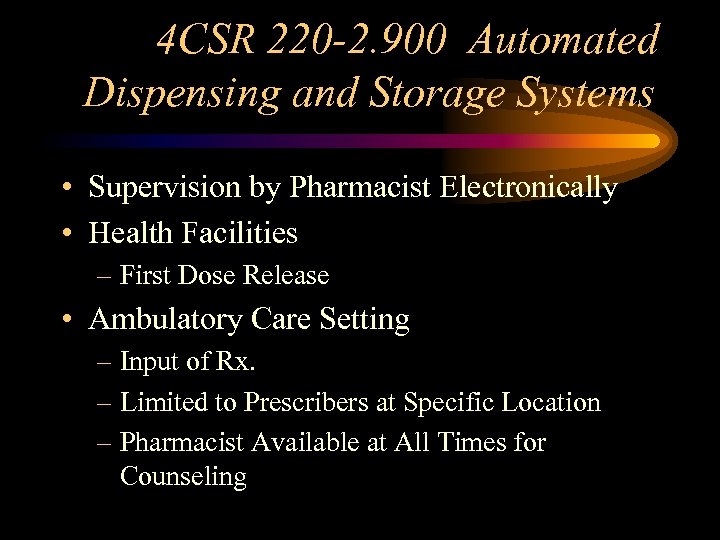
4 CSR 220 -2. 900 Automated Dispensing and Storage Systems • Supervision by Pharmacist Electronically • Health Facilities – First Dose Release • Ambulatory Care Setting – Input of Rx. – Limited to Prescribers at Specific Location – Pharmacist Available at All Times for Counseling
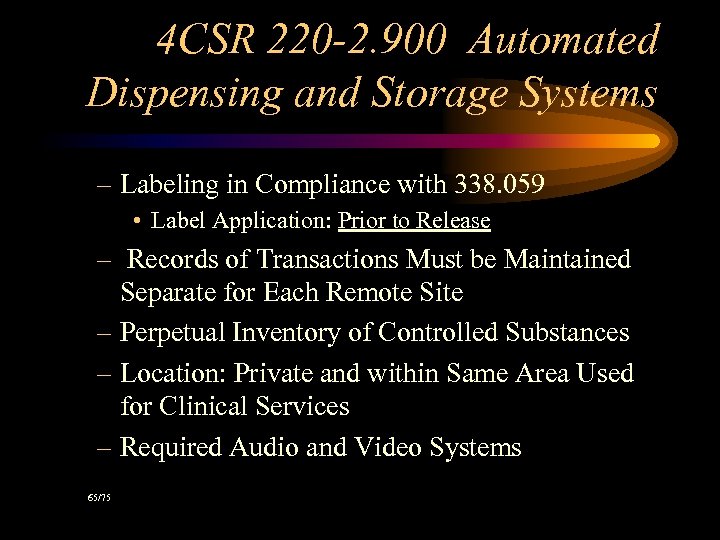
4 CSR 220 -2. 900 Automated Dispensing and Storage Systems – Labeling in Compliance with 338. 059 • Label Application: Prior to Release – Records of Transactions Must be Maintained Separate for Each Remote Site – Perpetual Inventory of Controlled Substances – Location: Private and within Same Area Used for Clinical Services – Required Audio and Video Systems 65/75
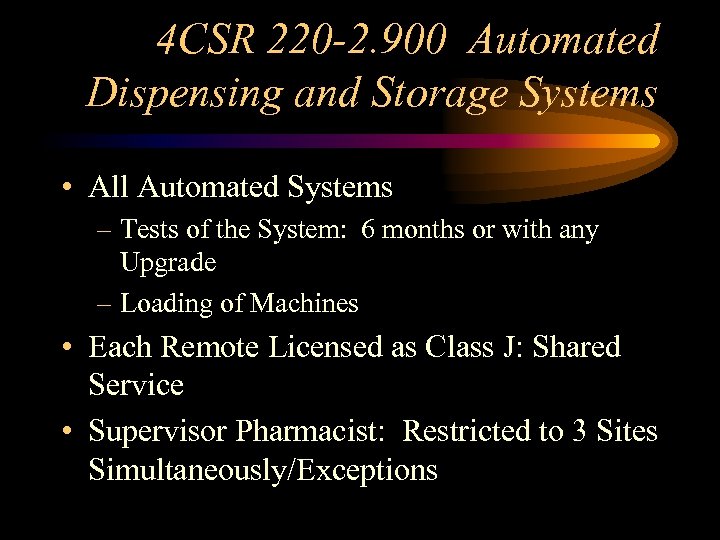
4 CSR 220 -2. 900 Automated Dispensing and Storage Systems • All Automated Systems – Tests of the System: 6 months or with any Upgrade – Loading of Machines • Each Remote Licensed as Class J: Shared Service • Supervisor Pharmacist: Restricted to 3 Sites Simultaneously/Exceptions
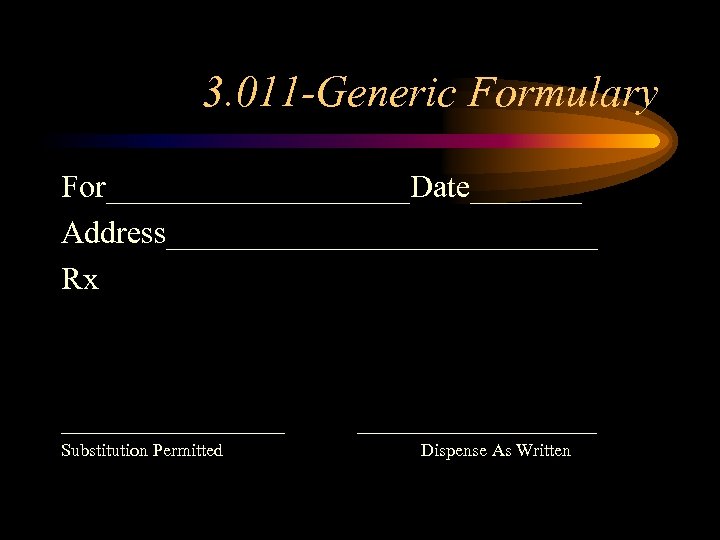
3. 011 -Generic Formulary For__________Date_______ Address______________ Rx _______ Substitution Permitted ________ Dispense As Written
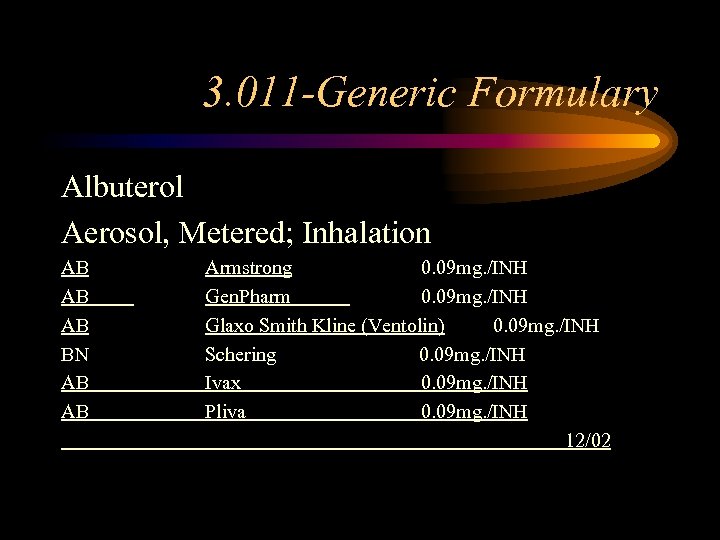
3. 011 -Generic Formulary Albuterol Aerosol, Metered; Inhalation AB AB AB BN AB AB Armstrong 0. 09 mg. /INH Gen. Pharm 0. 09 mg. /INH Glaxo Smith Kline (Ventolin) 0. 09 mg. /INH Schering 0. 09 mg. /INH Ivax 0. 09 mg. /INH Pliva 0. 09 mg. /INH 12/02
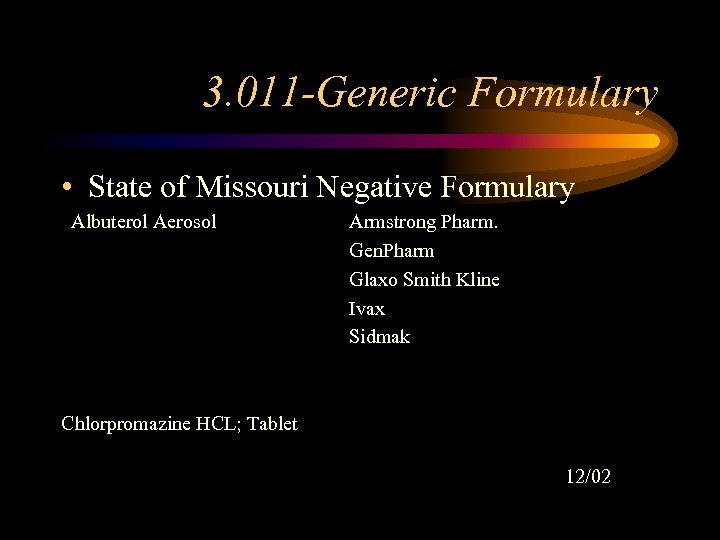
3. 011 -Generic Formulary • State of Missouri Negative Formulary Albuterol Aerosol Armstrong Pharm. Gen. Pharm Glaxo Smith Kline Ivax Sidmak Chlorpromazine HCL; Tablet 12/02
3. 040 -Return and Reuse of Drugs • Accepted from Institutions Only – Hospitals – LTC Facilities – Hospice Facilities • Assurance of Storage Requirements – Manufacturer/USP – Pharmacy Originally Dispensed Drug • Lot Number and Expiration Date Traceable
3. 040 Return and Re-Use of Drugs • Returns for Re-use Must: – Original Manufacturer’s Packaging with T-ES – Federal Registered Repackagers with T-ES* – Licensed Pharmacy Products that are Un-used with T-ES* – Licensed Pharmacy Products where Un-used Portion can be separated and Re-used* NO PRODUCTS CAN BE REPACKAGED* AND RE-USED MORE THAN ONE TIME
Drug Distributor: 5. 020 and 5. 025 -Licensing Requirements • Licensure: Same as Pharmacy – Initial Applications – Change of Ownership – Change of Location • Temporary License Authority---> 1 Year • Out-of-State Facilities: Domestic/Foreign
Drug Distributor: 5. 030 Definitions and Standards • Personnel • Facility: Size, Temp. , Sanitation, Segregation of Distressed Drugs • Security: Facility and Records • Drug Storage • P/P Manual Required: Drug Handling, Recalls, Stock Rotation, Loss Reports, Disasters…….
Drug Distributor: 5. 030 Definitions and Standards • Recordkeeping – Source; Identity; Quantity; Dates of Receipt and Distribution – Records Maintained---> 3 Years – Account for all Outdated, Damaged, Misbranded or Adulterated Articles • Exemption from Licensure---5% Total Gross Sales of the Pharmacy (Rx)
Medical Gas Distributor - 5. 070 • Defined: Compressed/Liquid - Labeled for Medical Use • Exemptions: Temperature/Humidity; Floor Pallets; Separate Inventory for Vet. Use; Water Supply; Outdated Drugs; Refrigeration; Exterior Lighting*; Alarm Systems*; Secure Storage Area* • Federal Registration: Transfilling • *Nitrous Oxide
6. 030 -Drug and Medical Information • Transfers Between Pharmacists or from Pharmacists to Other Health Care Practitioners is Now “Recognized. ” – Initial Rx. Transfers (Recordkeeping) – Verbal Orders from Prescribers Noted by Pharmacists in Patient Records
Скачать презентацию Missouri Board of Pharmacy Practice Act Review October
5a430855184c99ab13cd2e048bfda822.ppt