


 Скачать презентацию Mission Organization of the USN and USNR
e2115b30bb8fb86a436d4f0150f4dcfc.ppt
- Количество слайдов: 41
 Mission & Organization of the USN and USNR Lesson 2
 Learning Objectives • The student will know. . . • (1) the operational and administrative chains of command within the DON. • (2) the missions of the DON • (3) The 5 fundamental roles the Navy fulfills in support of the National Security Strategy
 Learning Objectives • The student will know. . . • (4) the primary and secondary Mission of the Naval Reserve • (5) the role of the active forces in the training of the Naval Reserve • (6) the importance of channeling personnel serving with or under their leadership into the Naval Reserve should they decide to leave active service.
 The United States Navy • What is our mission? What are our guiding principles? (What are we about? ) • Forward. . . From the Sea (1994) • Our “Corporate Mission Statement” • Naval forces must be sufficient for • forward-presence operations in peacetime • credible enough to act as a significant deterrent • be able to fight from the sea in time of war. • Combines efforts of the Navy & USMC
 The Department of the Navy • Guided by Forward. . . From the Sea, the mission of the DON is to • organize, train, equip, prepare, and maintain readiness of the US Navy & Marine Corps. • Support Navy and Marine forces when assigned to unified commands.
 DON Composition • Navy Department • SECNAV • CNO, CMC, (Commandant of USCG) • Operating Forces • Ships, Aircraft, Submarines • Marines • Direct-support bases • Shore establishments not directly involved in supporting the fleet (NROTC, recruiting)
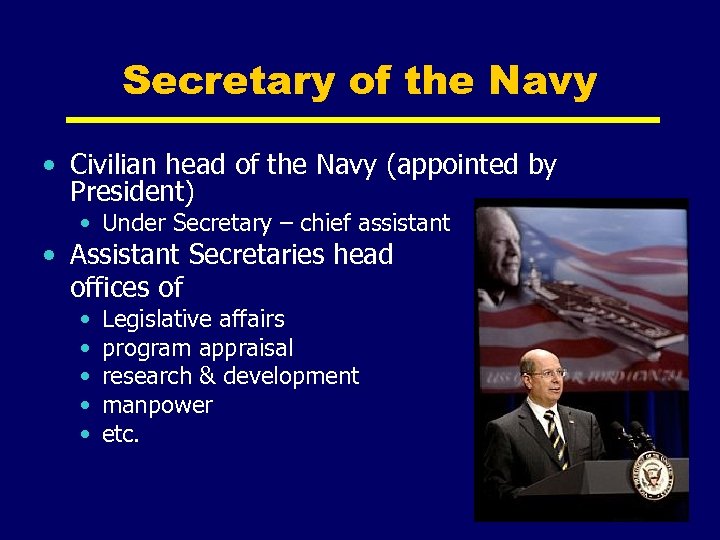 Secretary of the Navy • Civilian head of the Navy (appointed by President) • Under Secretary – chief assistant • Assistant Secretaries head offices of • • • Legislative affairs program appraisal research & development manpower etc.
 Chief of Naval Operations • • Senior military officer in the Navy Member of the JCS Principle advisor to SECNAV and President In command of all administrative & training commands
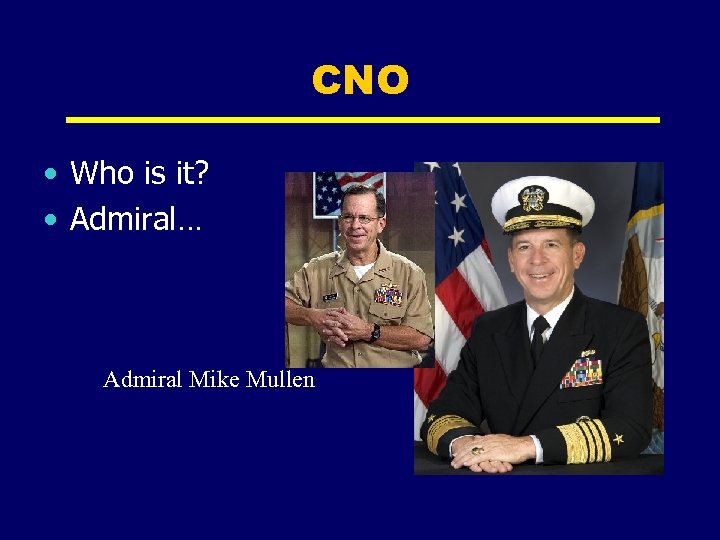 CNO • Who is it? • Admiral… Admiral Mike Mullen
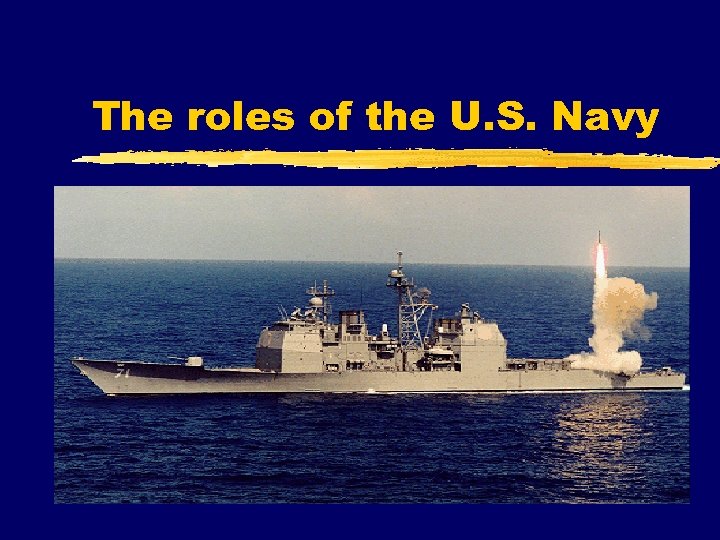 The roles of the U. S. Navy
 Five roles of the US Navy • • • Projection of power from sea to land Sea control and maritime supremacy Strategic Deterrence Strategic Sealift Forward Naval Presence
 Projection of power from sea to land Objectives • • Deliver and support troops ashore Secure land from the enemy Destroy offensive capability of opponent Harassment/Intimidation
 Projection of power from sea to land • Tactics • • Amphibious assault Naval bombardment Tactical air projection SSBN deterrent patrol
 Projection of power from sea to land • Forces used in power projection • • Marines Carrier air wings Naval bombardment (used to with BB’s) Cruise missiles (Tomahawk)
 Sea Control and Maritime Supremacy • Objectives • Maintain use of the sea while denying its use to the enemy. • Control SLOC’s • • Ensure industrial supply lines remain open Reinforce/resupply military forces overseas Provide wartime economic/military supplies to allies Provide safety for naval forces projecting power ashore
 Sea Control and Maritime Supremacy • Tactics • Sortie control • “Intercept” the enemy in port through blockade • Choke point control • Use geographic choke points to hinder enemy • Open-area operations • seek out and neutralize enemy on the open ocean • Local engagement
 Sea Control and Maritime Supremacy • Forces used in sea control • • Carrier air wings Surface combatants Attack subs Mines
 Strategic Deterrence • Objectives • Deter all-out attack on US or allies • To pose threat of unacceptable losses to a potential aggressor • To maintain a stable international political environment
 Strategic Deterrence • Background • Navy is responsible for one part of the nuclear triad • US Strategic Command with B-1’s, B-2’s • Land-based missiles (MX, Minuteman, Midgetman) • Seagoing nuclear-powered, fleet-ballistic missile submarines (SSBNs) • With the end of the Cold War, SSBNs are the primary mode of deterrence today.
 Strategic Deterrence • Tactics • Assured second strike • Trident missile - 4, 000+ mile range. 24 per sub • Submarine is a survivable and credible deterrent • Controlled response • Attack plans can be changed in case of partial attack. • CVN, Tomahawk strike capability • Deter Third-World powers • Maintain balance of power
 Strategic Sealift • Objective • To deliver U. S. (and allied) forces and sustaining supplies to any part of the world whenever needed
 Strategic Sealift • Tactics • Prepositioning • Allows U. S. to place fuel, ammunition, etc. near crisis areas for delivery • Surge • Initial deployment of U. S. -based equipment and supplies in support of a contingency • Sustainment • Transport of re-supply cargo to stay abreast of force consumption rates and build up reserves
 Forward Naval Presence • Objectives • To deter actions not in the interests of the United States or its allies • To encourage actions that are in the interests of the United States or its allies
 Forward Naval Presence • Tactics • Preventative deployments • Provides forward presence • Routine ops (Med, Westpac) • Reactive deployments • Response to crisis • Iran, Beirut, Kuwait
 Forward Naval Presence • Forces used • Carrier Battlegroups • One CVN • Two CG • Two DD/DDG • Two SSN • One FFG* • One Supply ship (AOE)
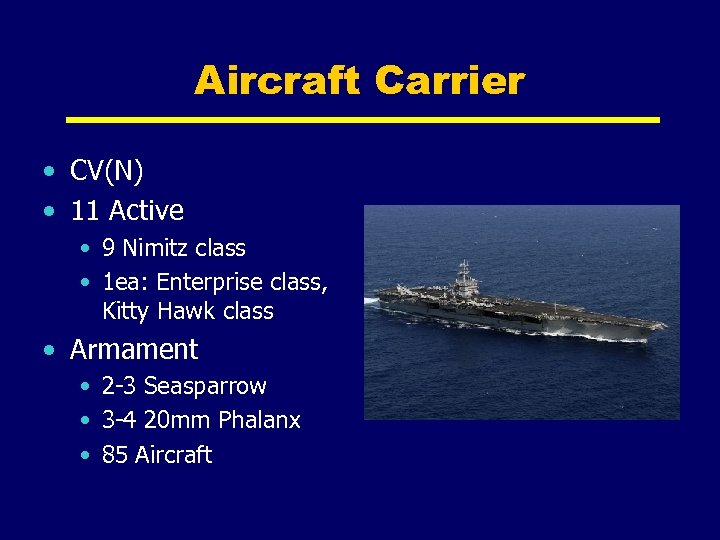 Aircraft Carrier • CV(N) • 11 Active • 9 Nimitz class • 1 ea: Enterprise class, Kitty Hawk class • Armament • 2 -3 Seasparrow • 3 -4 20 mm Phalanx • 85 Aircraft
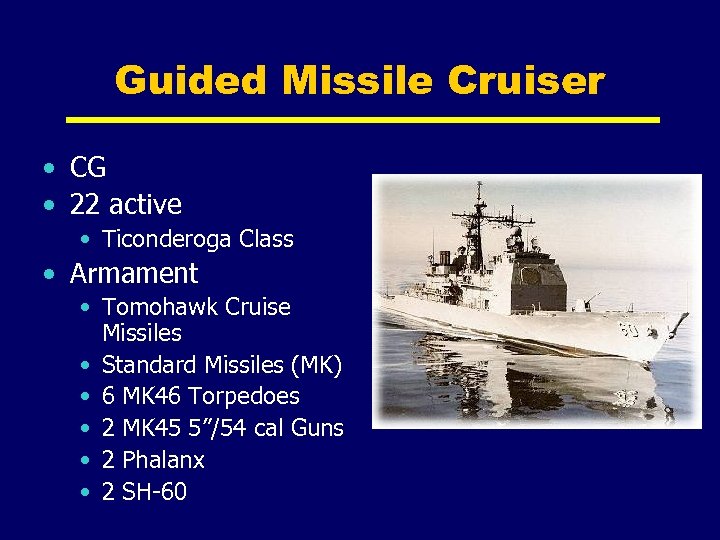 Guided Missile Cruiser • CG • 22 active • Ticonderoga Class • Armament • Tomohawk Cruise Missiles • Standard Missiles (MK) • 6 MK 46 Torpedoes • 2 MK 45 5”/54 cal Guns • 2 Phalanx • 2 SH-60
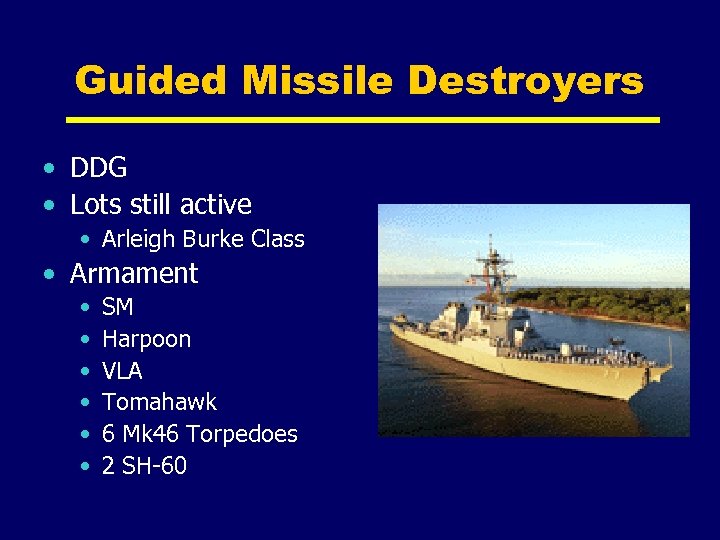 Guided Missile Destroyers • DDG • Lots still active • Arleigh Burke Class • Armament • • • SM Harpoon VLA Tomahawk 6 Mk 46 Torpedoes 2 SH-60
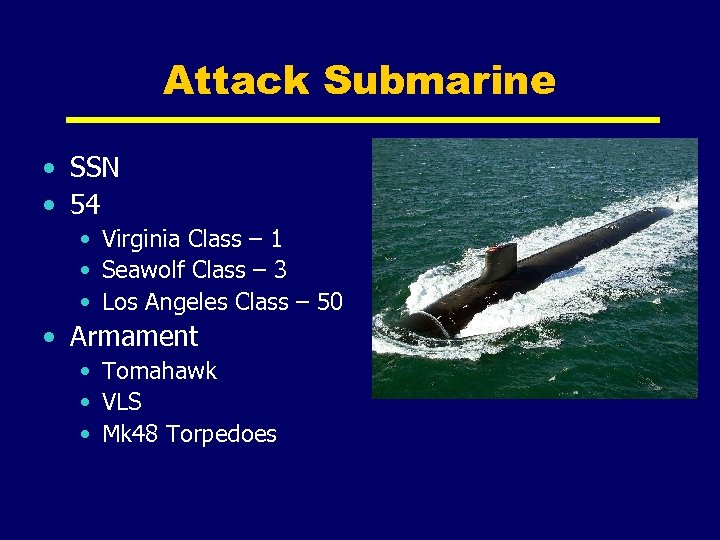 Attack Submarine • SSN • 54 • Virginia Class – 1 • Seawolf Class – 3 • Los Angeles Class – 50 • Armament • Tomahawk • VLS • Mk 48 Torpedoes
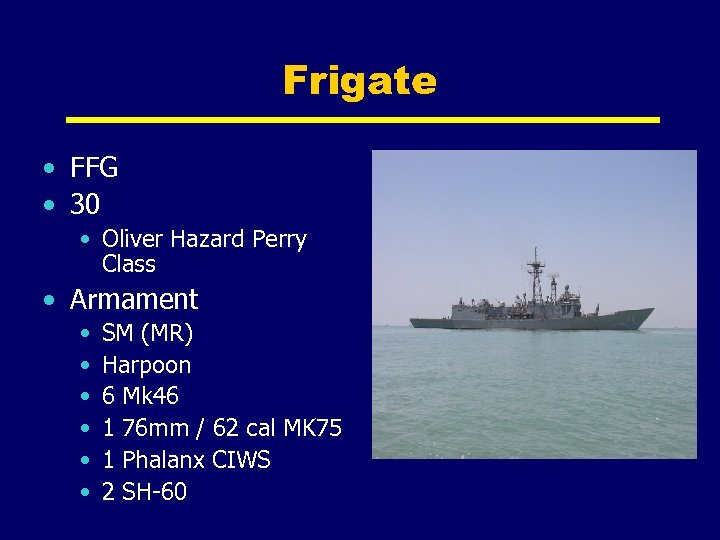 Frigate • FFG • 30 • Oliver Hazard Perry Class • Armament • • • SM (MR) Harpoon 6 Mk 46 1 76 mm / 62 cal MK 75 1 Phalanx CIWS 2 SH-60
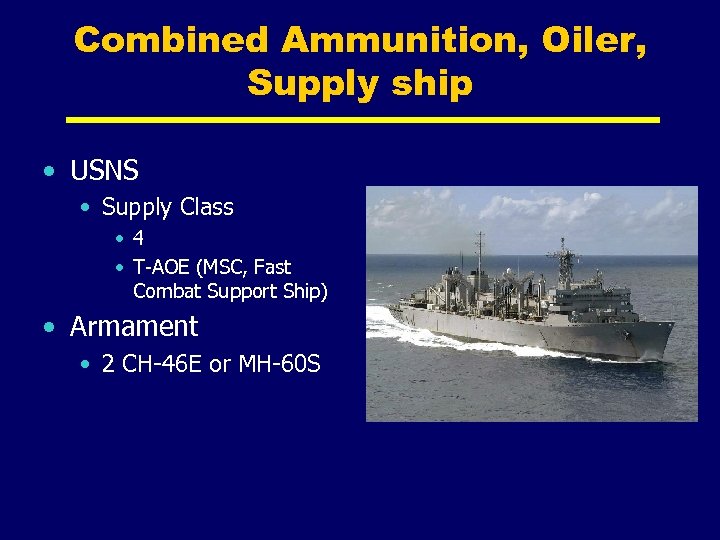 Combined Ammunition, Oiler, Supply ship • USNS • Supply Class • 4 • T-AOE (MSC, Fast Combat Support Ship) • Armament • 2 CH-46 E or MH-60 S
 The U. S. Naval Reserve
 Mission of the US Naval Reserve • Primary: • To provide trained units and qualified individuals for active duty in time of war or national emergency and at other times required by national security • Secondary: • Assist active force in accomplishing its peacetime mission as a by-product of training for mobilization
 Total Force Concept • Includes all the resources available to perform national defense missions. • Budgetary constraints do not allow for an active force capable of handling all contingencies. • Reserve training MUST be meaningful and mobilization enhancing.
 Naval Reserve Categories • Ready Reserve • Consists of: • Selected Reserve • “One weekend per month, 2 weeks in the summer. ” • Individual Ready Reserve • Not required to train • Can be called up for active duty for up to 90 days
 Naval Reserve Categories • Training and Administration of Reserves (TAR) • Reservists serving in a full-time active duty status in support of Naval Reserve units
 Naval Reserve Categories • Standby Reserve • 2 categories • Active Standby Reserve • Inactive Standby Reserve • Retired Reserve
 Naval Reserve Units • Commissioned Units • Composed of ships, squadrons, construction battalions • Complete units delivered to an operating force • Reinforcing Units • Augment regular Navy commissioned units • Sustaining Units • Reinforce fleet and force support activities • Surge capabilities
 Naval Reserve Administration • Organization • Chief of Naval Reserve – Active duty, reports to CNO • Commander Naval Reserve Force – Administration and Management • Elements • Surface – 4% of all commissioned ships • Air Reserve – 6% of the Navy’s aircraft inventory • Other Programs: Intel, Shipbuilding, Supply, Medical, Legal
 Naval Reserve Training • Consists of • • Regularly scheduled drill (weekends) Rate training Officer Professional Development Shipboard Simulators
 QUESTIONS? Reading: BJM Ch 3, 4 http: //www. defenselink. mil/specials/ insignias/enlisted. html