


 Скачать презентацию Mission Operations and Data Flow Overview Koji Mukai
54e7886a2be5c128c8d838caccbfe230.ppt
- Количество слайдов: 15
 Mission Operations and Data Flow Overview Koji Mukai Astro-E 2 Guest Observer Facility Valentine's Day 2005 Astro-E 2 Users' Group Meeting
 Valentine's Day 2005 Astro-E 2 Users' Group Meeting 2
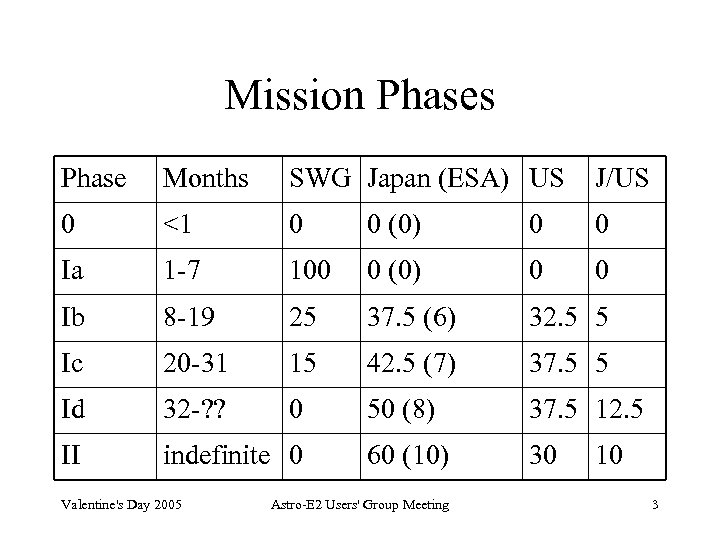 Mission Phases Phase Months SWG Japan (ESA) US J/US 0 <1 0 0 (0) 0 0 Ia 1 -7 100 0 (0) 0 0 Ib 8 -19 25 37. 5 (6) 32. 5 5 Ic 20 -31 15 42. 5 (7) 37. 5 5 Id 32 -? ? 0 50 (8) 37. 5 12. 5 II indefinite 0 60 (10) 30 Valentine's Day 2005 Astro-E 2 Users' Group Meeting 10 3
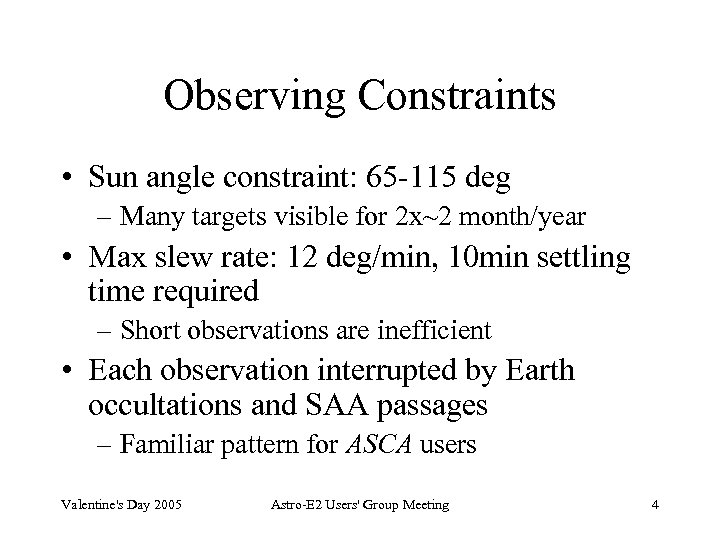 Observing Constraints • Sun angle constraint: 65 -115 deg – Many targets visible for 2 x~2 month/year • Max slew rate: 12 deg/min, 10 min settling time required – Short observations are inefficient • Each observation interrupted by Earth occultations and SAA passages – Familiar pattern for ASCA users Valentine's Day 2005 Astro-E 2 Users' Group Meeting 4
 Total Available Time • ASCA achieved 37 ksec of on-source data/day – Astro-E 2 observing efficiency may well be higher • Astro-E 2 will be operated ~360 days/year (minus New Year holidays, typhoons) • Observatory time: 5%, TOO time: 3% – The remainder is available for normal (SWG or GO) observations • Net observing time: 12. 3 Msec/year Valentine's Day 2005 Astro-E 2 Users' Group Meeting 5
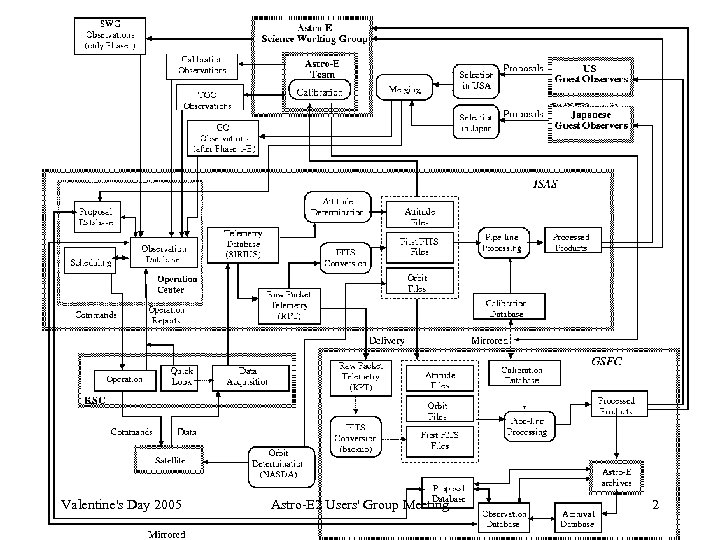
 Division of Labor • ISAS is responsible for: – – The ground station (Uchinoura Space Center, USC) Command generation and upload Telemetry downlink and quick-look Processing & data distribution for non-US PIs • GSFC provides: – Scheduling software and personel – Processing & data distribution for US Pis – Software and English-language documentation support Valentine's Day 2005 Astro-E 2 Users' Group Meeting 6
 Observation Data. Base (ODB) • ODB at ISAS is at the focal point of mission operation and contains – Details of accepted observations • PIs will be contacted for possible updates several weeks before actual observation – – Scheduling information Operation commands Special notes, at any (e. g. , TOO interrupts) Items returned from the processing pipelines • A subset of these items will be copied to public databases such as HEASARC Browse Valentine's Day 2005 Astro-E 2 Users' Group Meeting 7
 Mission Scheduling (Tako) • Astro-E 2 will use Tako for scheduling – Tako was developed for ASTRO-E based on ASCA experiences using Spike – Currently used by Swift (on-board); will be used by RXTE, Astro-F, and GLAST – Chris Baluta, stationed at ISAS, will run and maintain the Astro-E 2 version of Tako • Vast majority of observations will be long stares (with inevitable low Earth orbit interruptions) relatively easy to schedule Valentine's Day 2005 Astro-E 2 Users' Group Meeting 8
 Commands and Contacts • ASCA command generation was a very labor intensive process – Astro-E 2 process is more automated • Only one ground station (USC) used – Up to 5 contacts a day – Shared with other ISAS missions; launch of Astro-F, Solar-B etc. can reduce no. of available contacts • On-board detector records data at one of several possible rates; up to 1. 25 Gbytes raw telemetry downlinked per day. Valentine's Day 2005 Astro-E 2 Users' Group Meeting 9
 Quick-look analysis will be performed at USC and at ISAS • To confirm the intended target is successfully observed • To monitor satellite and instrument status • Additionally, to search for gamma-ray bursts in the HXD background data Valentine's Day 2005 Astro-E 2 Users' Group Meeting 10
 Attitude file and RPT generation • Raw telemetry will be concatnated and archived in the ISAS “Sirius” database • Telemetry will be depacketed and divided into observations and saved as raw packet telemetry (RPT) files • Satellite attitude will be determined from star tracker and gyro data by ISAS contractors • Astro-E 2 orbit will be determined by another division of JAXA Valentine's Day 2005 Astro-E 2 Users' Group Meeting 11
 Background: ASCA experiences • FTOOLS were in their infancy at the start of the ASCA mission • Instrument teams in Japan developed their own software framework (“animal software”) which persisted throughout the ~7 year mission • ISAS lacked the infrastructure for standard processing of data - each user was on his/her own • For Astro-E 2, we need one software system and a uniform starting point for analysis for every user Valentine's Day 2005 Astro-E 2 Users' Group Meeting 12
 Parallel Processing • ISAS will create First FITS Files (fff) from RPTs (GSFC can do the same if necessary) • FFFs copied over the network to GSFC • All data are processed at ISAS and at GSFC using identical software • Produces OGIP-standard FITS files with HEADAS software for analysis • See Ken Ebisawa’s talk for further details of processing Valentine's Day 2005 Astro-E 2 Users' Group Meeting 13
 Data Distribution • When processed, Astro-E 2 GOF will inform US PIs of their data’s availability – ISAS will notify all other PIs – For JUS observations, both PIs will be notified • PGP-encrypted data will be available for download via HEASARC (see Lorella Angelini’s presentation) – No CD-ROM/tape etc. Valentine's Day 2005 Astro-E 2 Users' Group Meeting 14
 Instrument Team Access to Data • Instrument teams will access data (including proprietary ones) for the purpose of performance monitoring and continued calibration. – Similarly, mission operation teams and GOF members may access data for verification and for troubleshooting • Instrument teams are strongly encouraged to use the same FITS files the GOs will use • Trend archive will be created and made publicly available Valentine's Day 2005 Astro-E 2 Users' Group Meeting 15