 Скачать презентацию MIS 643 Agent-Based Modeling and Simulation 2016 2017 Fall
cad83a3c6c5fb468e9f6f4b037366e75.ppt
- Количество слайдов: 45



MIS 643 Agent-Based Modeling and Simulation 2016/2017 Fall Chapter 2 Models, Modeling Cycle and the ODD Protocol
Outline 1. What is Model 2. Modeling Cycle 3. Summery and Conclusions
1. What is a Model? • A model is a purposeful simpoified representation of a real system • In science: – How thinks work – Explain patterns that are observed – Predict systems bevaior in response to some change • Social systems – Too complex or slowly changing to be experimentally studied
Models • Formulate a model – design its assumptions and algorithms • Different ways of simplfing real systems – Which aspect to include , which to ignore • Purpase – The questions to be answered is the filter • all aspects of the real system – irrelevant or insufficiently important – to answer the question are filtered out
Searching Mushrooms in a Forest • Is there a best strategy for searching mushrooms? • observation: – mushrooms in clusters • An intuitive strategy: – scanning an area in wide sweeps – upon finding a mushroom turning to smaller scale sweeps – as mushrroms in clusters
Searching Mushrooms in a Forest • What is large, small sweeps? and • How long to search in smaller sweeps? • Humans searching – prizes, jobs, low price goods, peace with neighbors • mushroom hunter – sensing radius is limited – must move to detect new mushrooms
Why develop a model for the problem • try different search strategies – not obvious with textual models • clearly formulated purpose: – what search strategy maximizes musrooms found in a given time • Ignore trees and vegitables, soil type • Include: mushrooms are distributed as clusters
Simplified hunter • mushroom hunter – moving point – having a sensing radius – track of • how many mushrooms found • how much time passed since last mushroom fouınd
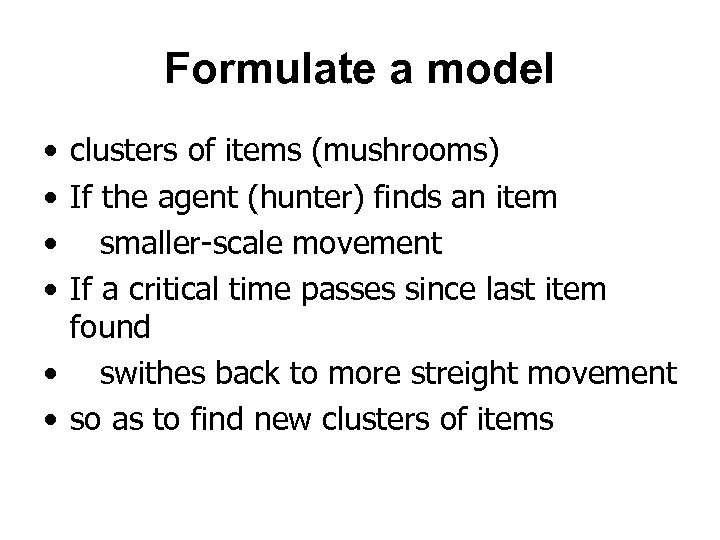
Formulate a model • clusters of items (mushrooms) • If the agent (hunter) finds an item • smaller-scale movement • If a critical time passes since last item found • swithes back to more streight movement • so as to find new clusters of items
Why model • Here processes and behavior is simple • in general what factors are important – regarding the question addresed by the model – not possible So – formulate – implement in computers – analize • rigorously explore consequences of assumptions
First Formulation • First formulation of the model – Preliminary understanding about how the system works – Proceses structure • Based on – Empirical knowledge system’s behavior – Theory – Earlier models with the same purpose – Intiution or imagination
no idea • about how a system works • not formulate a model • e. g. : human consciousness
Good model • Assumptions at first experimental • Test whether they are appropriate and useful • Need a criteria – model is a good representation of the real system – Patterns and regularities • Example: Stock market model – Volatility and trends of stock prices volumes, …
Fisrt Versions • First version – Too simple - lack of prcecesses structure – Inconsistant -
2. The Modeling Cycle • When developing a model – Series of tasks – systematically – consequences of simplfiing assumptions • Iterating through the tasks – First models are – Too simple , too complex or wrong questions
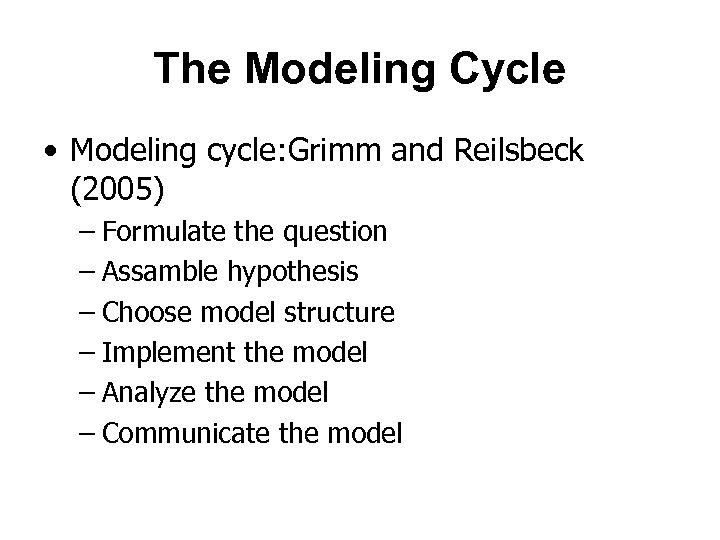
The Modeling Cycle • Modeling cycle: Grimm and Reilsbeck (2005) – Formulate the question – Assamble hypothesis – Choose model structure – Implement the model – Analyze the model – Communicate the model
Formulate the Question • Clear research question • Primary compass or filter for designing the model • clear focus • Experimental may be reformulated • E. g. : for MH Model – what strategies maximizes the rate of findng items if they are distributed in clusters
Assamble Hypothesis • Whether an element or prosses is an esential for addresing the modeling questions - an hypothesis – True or false • Modeling: – Build a model with working hypothsis – Test – useful and sufficient – Explanation, prediction - observed phenomena
Assamble Hypothesis (cont. ) • Hypothesis of the conceptual model – Verbally graphically – Based on Theory and experience • Theory provides a framework to persive a system • Experience – Knowlede who use the sysem
Assamble Hypothesis (cont. ) • Formulate many hypothesis • What process and structures are essentiaal • Start top-down – What factors have a strong influence on the phenomena – Are these factors independent or interacting – Are they affected by ohter important factors
Assamble Hypothesis (cont. ) • Influence diagrams, flow charts • Based on – Existing knowledge, simplifications –
Basic Strategy • Start with as simple as possible • even you are sure that some factors are important • Gilbert: analogy null hypothesis in satatistics – agaainst my claim • Implement as soon as possible
Guidelines • Mere realizm is a poor guideline for modeling – must be guided by a problem or question about a real system – not by just the system itself • Constraints are esential to modeling – on information understanding time • Modeling is hardwired into our brains – we use powerful modeling heuristics to solve problems
Heuristics for Modeling • pleusable way or reasonalble approach that has often proved to be useful • Rephrase the problem • Draw simple diagrams • Inagine that you are indide the system • Try to idendify esential variables • identify assumptions • Use salami tactics
E. g. : MH Model • Esential process • swithcing between large scale movements and small scale searching • Depending on how long it has been since the hunter has found an item.
Choose scale, state variable, processes, parameters • Variables derscribing environment • Not all charcteristics – Relevant wtih the question • Examples – Position (location)Age, gender, education, income, state of – mind , …
Choose scale, state variable, processes, parameters • Example • Parameter being constant • Exchange rate between dolar and euro – Constrant for travelers, not for traders
Choose scale, state variable, processes, parameters • Scale – Time and spatial • Grain: smalest slica of time or space • Extent: total time or area covered by the model • The gain or time spen: step over which we ignore variation in variables
Choose scale, state variable, processes, parameters • Choose scales, entities, state variables processes and parameters • Transfering hypothesis into equations rules • Describing dynamics of entities
Choose scale, state variable, processes, parameters • Variables – derscribing state of thr system • The essential process – cause change of these variables • In ABM – interacting individuals • agent-agent, agent-environment – Variables – individual – parameters
E. g. : HM Model • Space items are in and hunter moves • Objects - agents – one hunter and items to be searched • hunter – state variables • time • how many items found • time last found – bevaior: search strategy
Implementation • Mathematics or computer programs • To translate verbal conceptual model into annimated objects • Implemented model has its own dynamics and life
Implementation • Assumption may be wong or incomplete but impolementation is right – Allows to explore the consequences of assumption • Start with the simplest - null model • Set parameters , initial values of variables
Analysis • Analysing the model and learing with the aid of the model • Most time consuming and demanding part • Not just implementing agents and run the model • What agents behavior can explain important characteristics of real systems • When to stop iterations of the model cycle?
E. g. : HM Model • Try different search algorithms – with different parameters • to see which search algorithm – strategy is the best
Communication of the model • Communicate model and results to – Scientific community – Managers • Observations, experiments, findings and insights are only when • Others repreduce the finings independently and get the same insights
Example of a Model • Consumer behavior model: – How friends influence consumer choices of indivduals • Buy according to their preferences • what one buys influeces her friends decisions – interraction
Example of a Model • verbal • mathematical – theoretical model – Emprical : statistical equations • estimated from real data based on questioners • simulation models of customer behavior – ABMS – interractions, learning, formation of networks
Theoretical Models • Analytical models • Restrictive assumptions – Rationality of agent – Representative agents – Equilibrium • Contradicts with observations – Labaratory experiments about humman subjects
Theoretical Models • as precision get higher explanatory power lower – closed form solutions • Relaxation of assumptions – geting a closed form solution is impossible
Emprical Models • Historically mathematical differential equations • Or emprical models represente by algberic or difference equations whose parameters are to be estimated
Simulation Models • Simulation • ABMS: – Represent indiduals as autonomous units, their interractions with each other and environment – Chracteristics – variables – and behavior • Variables – state of the whole system
How ABM differs • Units agents differ in terms of resourses, size history • Adaptive behavior: adjust themselfs looking current state which may hold information about past as well. other agent environment or by forming expectations about future states • Emergence: ABM across-level models
Skills • A new language for thiking about or derscribing models • Software • Strategy for model development and analysis
3. Summery and Conclustions • ABM relatively new – way of looking old as well as new problems – complex (adaptive) systems – improve understanding • What is modeling • What ABM brings • Model development cycle
Скачать презентацию MIS 643 Agent-Based Modeling and Simulation 2016 2017 Fall
cad83a3c6c5fb468e9f6f4b037366e75.ppt