


 Скачать презентацию MIRG Farming Decision Making Trends and Implications
ab0cd310d7bef054d696cbe371a85f4a.ppt
- Количество слайдов: 26
 MIRG Farming : Decision Making, Trends and Implications Caroline Brock Land Resources Ph. D Student University of Wisconsin-Madison PATS/Agricultural and Applied Economics Affiliation This research was partially funded in part by a grant from the Sustainable Agriculture Research and Education (SARE) Graduate Student Program
 Introduction: Objectives for Doctoral Research n Provide a descriptive picture of Wisconsin alternative dairy sectors as well as confinement n Explore factors that influence management choice decision making (social, spiritual, economic and ecological). You can help! This is where I am at now. n Compare dairy sectors and identify factors that may influence viability
 Alternative Systems: the Decision Making Process for the Family Farm “You don’t know who is right and who is wrong because there’s conventional and there’s organic and they’re all tugging in different directions as far as what you should do. “ – Farmer Interview (Low-Intensity Grazier)
 Alternative Systems: the Decision Making Process for the Family Farm The Economic Realm as a Starting Base Unbounded Rationality vs Bounded Rationality Unbounded Rationality- assumes full information and time In contrast, bounded rationality considers information constraints and social influences –rules of thumb, often more concerned with losses than gains, anchoring on a small dimension of the problem
 Bounded Rationality: Information Constraints The Unknown As we know, There are knowns. There are things we know. We also know What are the information There are known unknowns. That is to say “bounds” of alternative systems We know there are some things We do not know. But there also unknowns, The ones we don't know We don't know. —D. H. Rumsfeld Feb. 12, 2002, Department of Defense news briefing ?
 MIRG and Organic –Cases for Bounded Rationality Are both integrated systems w/ many unknowns n Minimal research support/Extension n Thus, mostly relies on localized knowledge (tacit vs codified) n Social networks may have significant influence in adoption decisions n
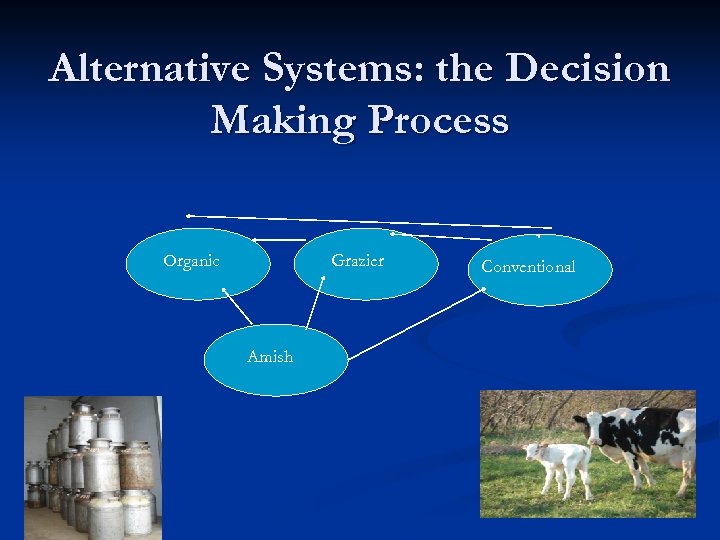 Alternative Systems: the Decision Making Process Organic Grazier Amish Conventional
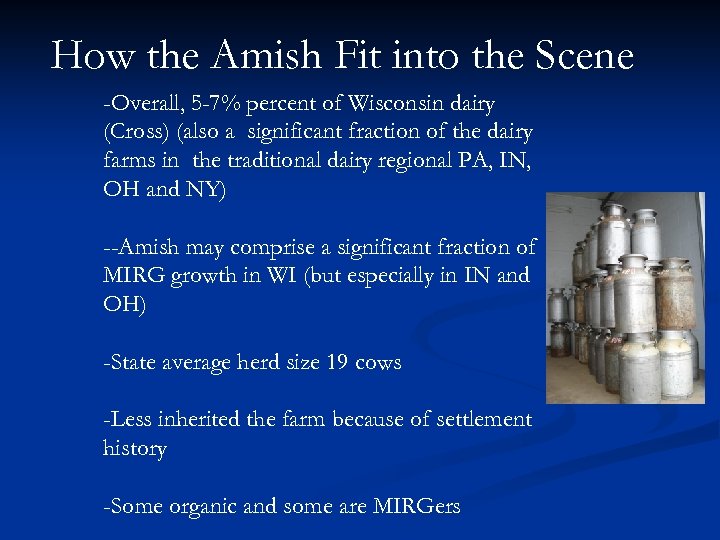 How the Amish Fit into the Scene -Overall, 5 -7% percent of Wisconsin dairy (Cross) (also a significant fraction of the dairy farms in the traditional dairy regional PA, IN, OH and NY) --Amish may comprise a significant fraction of MIRG growth in WI (but especially in IN and OH) -State average herd size 19 cows -Less inherited the farm because of settlement history -Some organic and some are MIRGers
 Amish Dairy --Milk by Hand - Old Order Amish Settlements sell canned milk --Don’t use r. BST, very little vet services as well as other modern technologies --Average Herd Size 14 Cashton = early settlers mostly from Ohio Hillsboro = early settlers mostly from IN --They allow electric fence and were familiar with MIRG
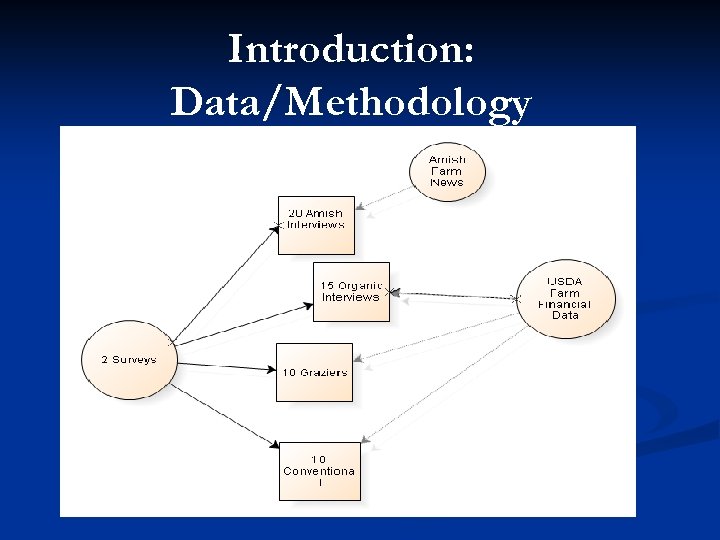 Introduction: Data/Methodology
 Consider the Possibilities Survey and interviews results indicate that MIRG and Organic are viable management systems…
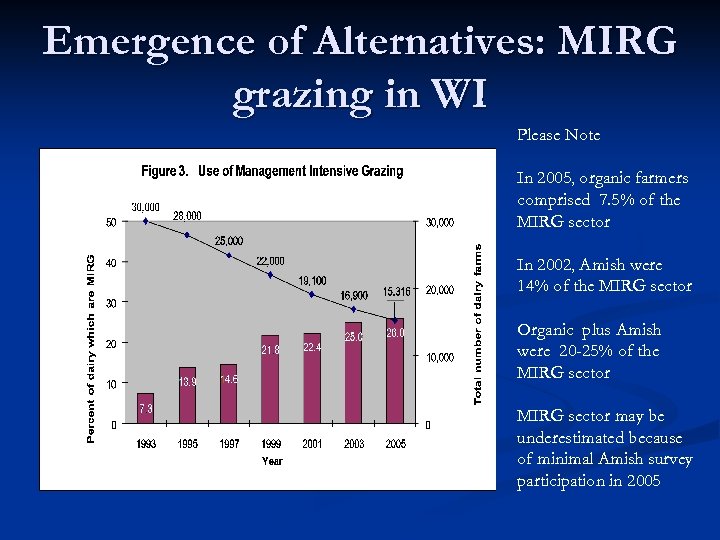 Emergence of Alternatives: MIRG grazing in WI Please Note In 2005, organic farmers comprised 7. 5% of the MIRG sector In 2002, Amish were 14% of the MIRG sector Organic plus Amish were 20 -25% of the MIRG sector may be underestimated because of minimal Amish survey participation in 2005
 Prevalence of Grazing in WI 24% of WI dairy farmers use pasture intensively (rotating cows on pasture more than once a week) n Low cost entry into farming, good for smaller operations (Over 80% of WI’s dairy farms are fewer than 100 cows) & easier transition to organics given the importance of ‘grazing’ to the strategy n Also primarily located in SW/WC Wisconsin where organics are growing fastest. n
 MIRG Profitability Research n Tom Kriegl’s research indicates grazing is highly profitable with selected farms (e. g. NIFO/cow Grazier--$737. 18 Conventional--$521. 50) NIFO= Net Farm Income from Farm Operations n Survey (QOL/PATS) research indicate highest quality of life (especially amongst the most intense graziers = large scale confinement) n Recent USDA ARMS 2005 data suggests that it is not competitive but there is not enough sample size (40 graziers in the whole Midwest region) to make definitive call
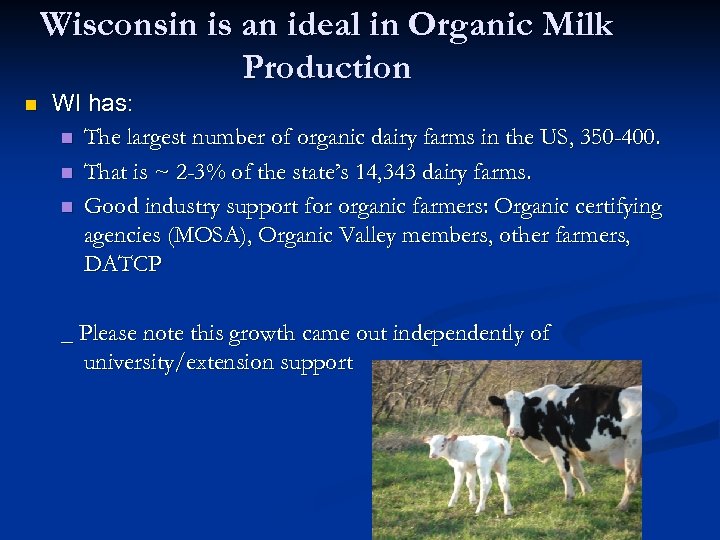 Wisconsin is an ideal in Organic Milk Production n WI has: n The largest number of organic dairy farms in the US, 350 -400. n That is ~ 2 -3% of the state’s 14, 343 dairy farms. n Good industry support for organic farmers: Organic certifying agencies (MOSA), Organic Valley members, other farmers, DATCP _ Please note this growth came out independently of university/extension support
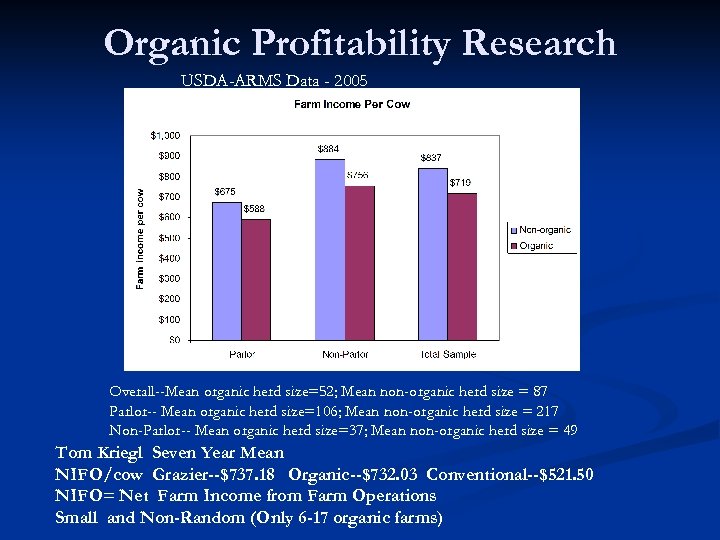 Organic Profitability Research USDA-ARMS Data - 2005 Overall--Mean organic herd size=52; Mean non-organic herd size = 87 Parlor-- Mean organic herd size=106; Mean non-organic herd size = 217 Non-Parlor-- Mean organic herd size=37; Mean non-organic herd size = 49 Tom Kriegl Seven Year Mean NIFO/cow Grazier--$737. 18 Organic--$732. 03 Conventional--$521. 50 NIFO= Net Farm Income from Farm Operations Small and Non-Random (Only 6 -17 organic farms)
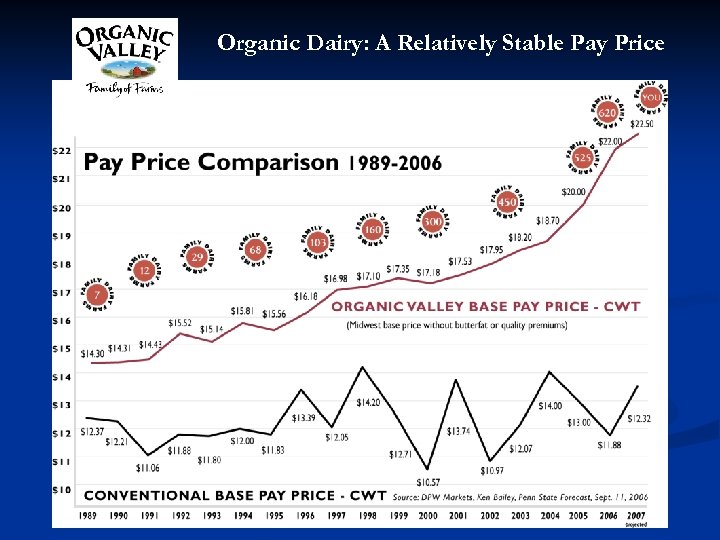 Organic Dairy: A Relatively Stable Pay Price Dairy
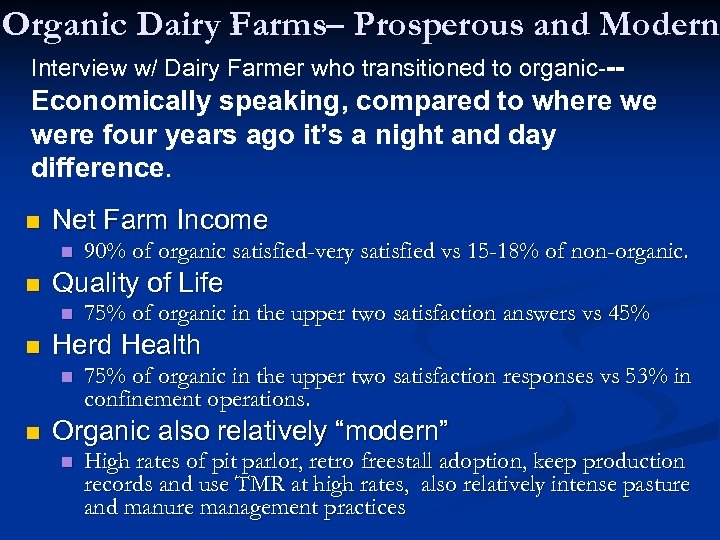 Organic Dairy Farms– Prosperous and Modern Interview w/ Dairy Farmer who transitioned to organic--- Economically speaking, compared to where we were four years ago it’s a night and day difference. n Net Farm Income n n Quality of Life n n 75% of organic in the upper two satisfaction answers vs 45% Herd Health n n 90% of organic satisfied-very satisfied vs 15 -18% of non-organic. 75% of organic in the upper two satisfaction responses vs 53% in confinement operations. Organic also relatively “modern” n High rates of pit parlor, retro freestall adoption, keep production records and use TMR at high rates, also relatively intense pasture and manure management practices
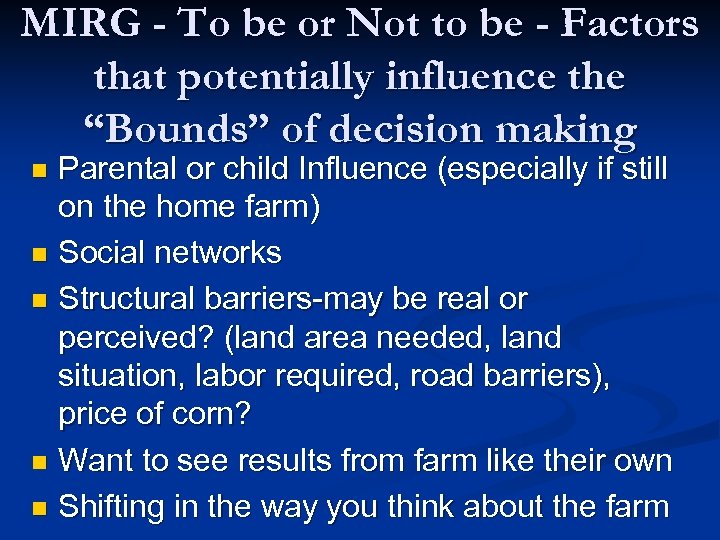 MIRG - To be or Not to be - Factors that potentially influence the “Bounds” of decision making Parental or child Influence (especially if still on the home farm) n Social networks n Structural barriers-may be real or perceived? (land area needed, land situation, labor required, road barriers), price of corn? n Want to see results from farm like their own n Shifting in the way you think about the farm n
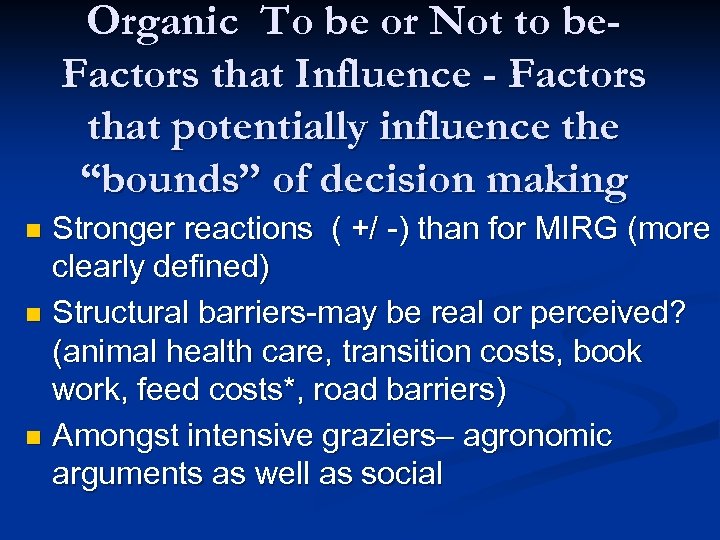 Organic To be or Not to be. Factors that Influence - Factors that potentially influence the “bounds” of decision making Stronger reactions ( +/ -) than for MIRG (more clearly defined) n Structural barriers-may be real or perceived? (animal health care, transition costs, book work, feed costs*, road barriers) n Amongst intensive graziers– agronomic arguments as well as social n
 Distinctive characteristics in adoption of organic and graziers amongst different (perceptions of govt, cheating with organic, milk is milk) Cashton #1 - “People cheat with organic! Not Amish but some other people do it… It is a temptation for people to be dishonest the way it is set up. . ” Hillsboro #1 - “I would have to buy some organic straw and I like to get it from a local fellow that I know. ”
 Pasture Based Dairy-- Needs for the Future Research (ideally regional) which explores perceptions and the “realities” of organic and MIRG n Need for research which looks at individual variation within organic– i. e. what makes MIRG/organic farms successful. Also looks at differences amongst Amish/Mennonite settlements n Research which follows farmers through the transition into MIRG and organic n
 Discussion/Questions THANK YOU FOR YOUR INTEREST! n CONTACT ? Caroline Brock ccbrock@wisc. edu n
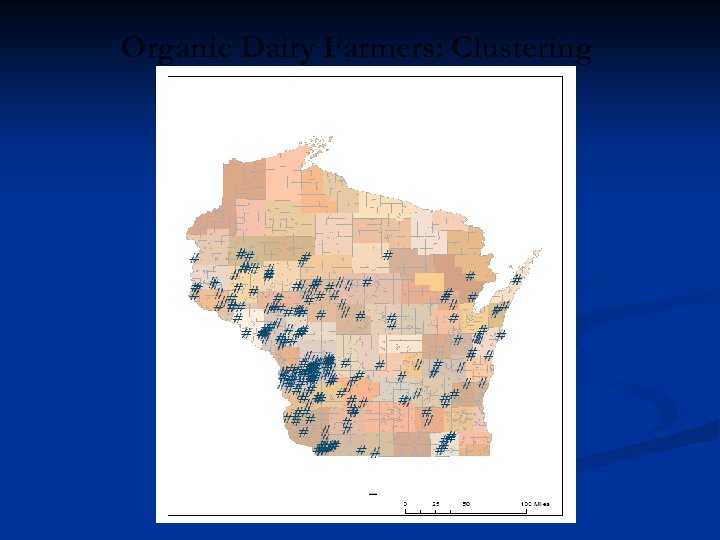 Organic Dairy Farmers: Clustering
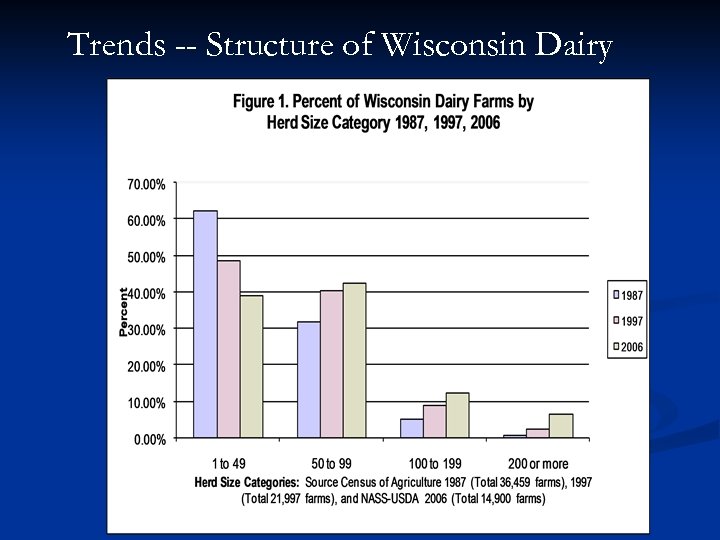 Trends -- Structure of Wisconsin Dairy
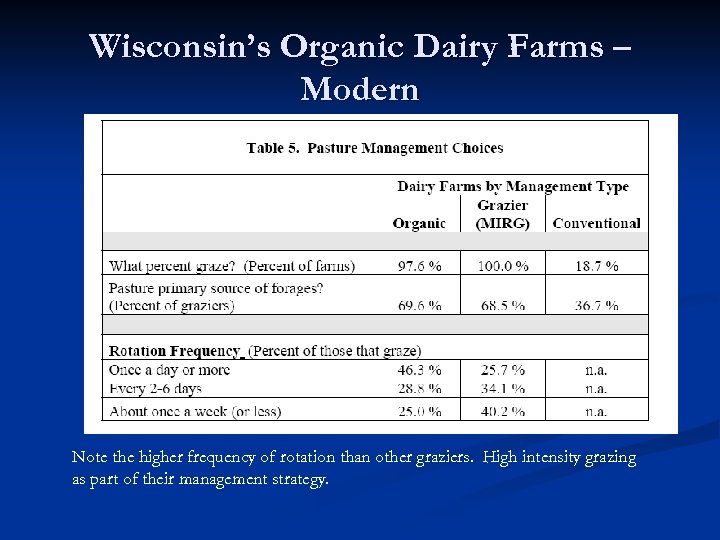 Wisconsin’s Organic Dairy Farms – Modern Note the higher frequency of rotation than other graziers. High intensity grazing as part of their management strategy.