


 Скачать презентацию Minor Notional Parts of Speech Meet the Pronoun
Lecture 10.ppt
- Количество слайдов: 23
 Minor Notional Parts of Speech: Meet the Pronoun & the Numeral Lecture 10
 Plan: § 1. The Pronoun (Pron) § 1. 1. General Characteristics § 1. 2. Traditional Semantic Classification § 1. 3. Grammatical Categories § 1. 4. Deictic and Textual Functions § 2. The Numeral (Num) § 2. 1. General Characteristics § 2. 2. Substantivization of Numerals § 2. 3. Reading Fractions
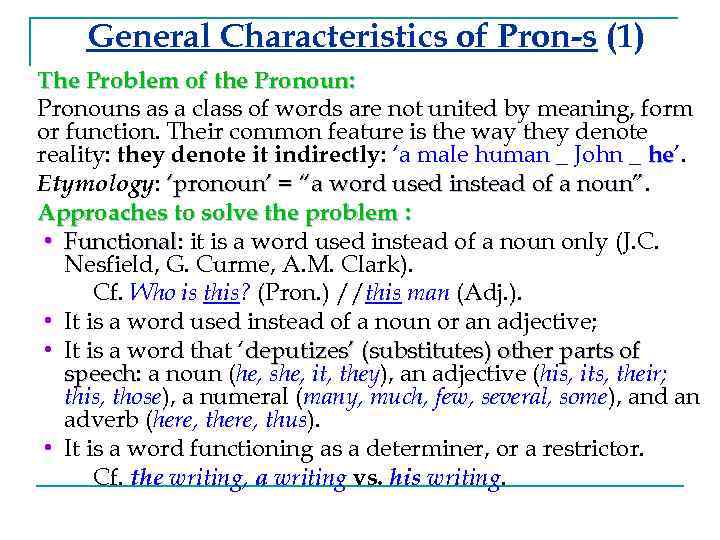 General Characteristics of Pron-s (1) The Problem of the Pronoun: Pronouns as a class of words are not united by meaning, form or function. Their common feature is the way they denote reality: they denote it indirectly: ‘a male human _ John _ he’. he Etymology: ‘pronoun’ = “a word used instead of a noun” Approaches to solve the problem : • Functional: it is a word used instead of a noun only (J. C. Functional Nesfield, G. Curme, A. M. Clark). Cf. Who is this? (Pron. ) //this man (Adj. ). • It is a word used instead of a noun or an adjective; • It is a word that ‘deputizes’ (substitutes) other parts of speech: a noun (he, she, it, they), an adjective (his, its, their; speech this, those), a numeral (many, much, few, several, some), and an adverb (here, thus). • It is a word functioning as a determiner, or a restrictor. Cf. the writing, a writing vs. his writing.
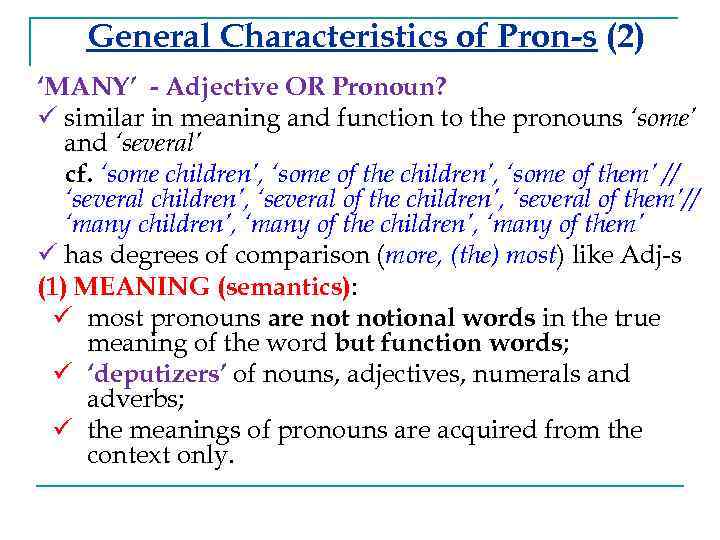 General Characteristics of Pron-s (2) ‘MANY’ - Adjective OR Pronoun? ü similar in meaning and function to the pronouns ‘some’ and ‘several’ cf. ‘some children’, ‘some of them’ // ‘several children’, ‘several of them’// ‘many children’, ‘many of them’ ü has degrees of comparison (more, (the) most) like Adj-s (1) MEANING (semantics): ü most pronouns are notional words in the true meaning of the word but function words; ü ‘deputizers’ of nouns, adjectives, numerals and adverbs; ü the meanings of pronouns are acquired from the context only.
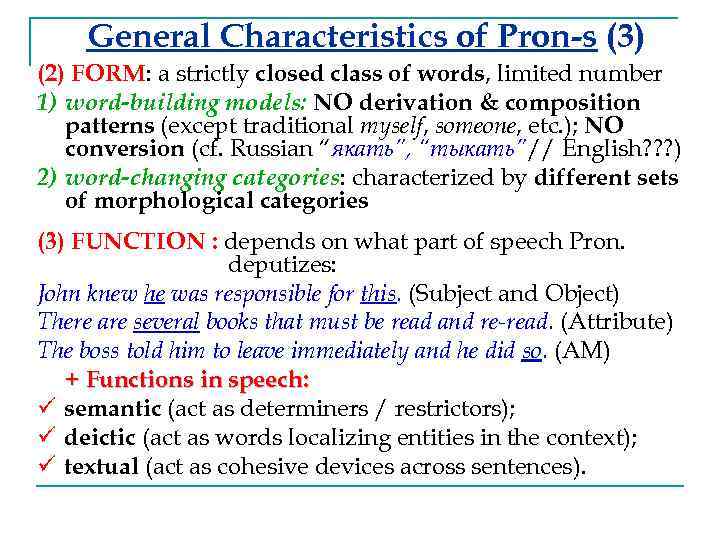 General Characteristics of Pron-s (3) (2) FORM: a strictly closed class of words, limited number 1) word-building models: NO derivation & composition patterns (except traditional myself, someone, etc. ); NO conversion (cf. Russian “якать”, “тыкать”// English? ? ? ) 2) word-changing categories: characterized by different sets of morphological categories (3) FUNCTION : depends on what part of speech Pron. deputizes: John knew he was responsible for this. (Subject and Object) There are several books that must be read and re-read. (Attribute) The boss told him to leave immediately and he did so. (AM) + Functions in speech: ü semantic (act as determiners / restrictors); ü deictic (act as words localizing entities in the context); ü textual (act as cohesive devices across sentences).
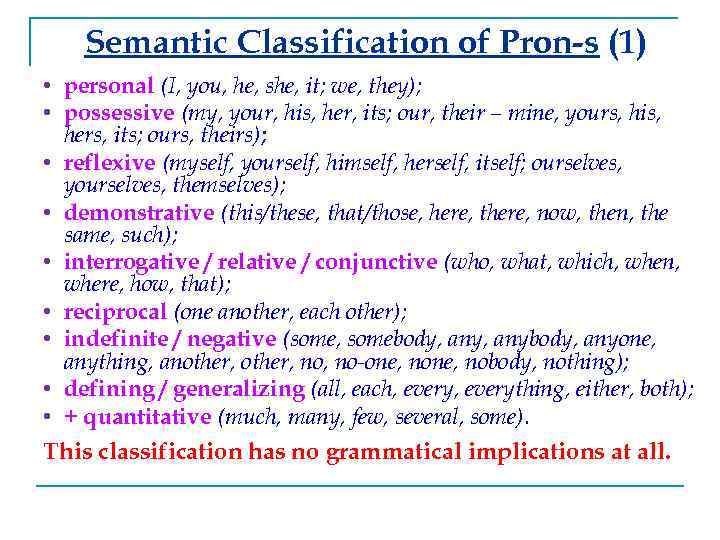 Semantic Classification of Pron-s (1) • personal (I, you, he, she, it; we, they); • possessive (my, your, his, her, its; our, their – mine, yours, his, hers, its; ours, theirs); • reflexive (myself, yourself, himself, herself, itself; ourselves, yourselves, themselves); • demonstrative (this/these, that/those, here, there, now, then, the same, such); • interrogative / relative / conjunctive (who, what, which, when, where, how, that); • reciprocal (one another, each other); • indefinite / negative (some, somebody, anybody, anyone, anything, another, no, no-one, nobody, nothing); • defining / generalizing (all, each, everything, either, both); • + quantitative (much, many, few, several, some). This classification has no grammatical implications at all.
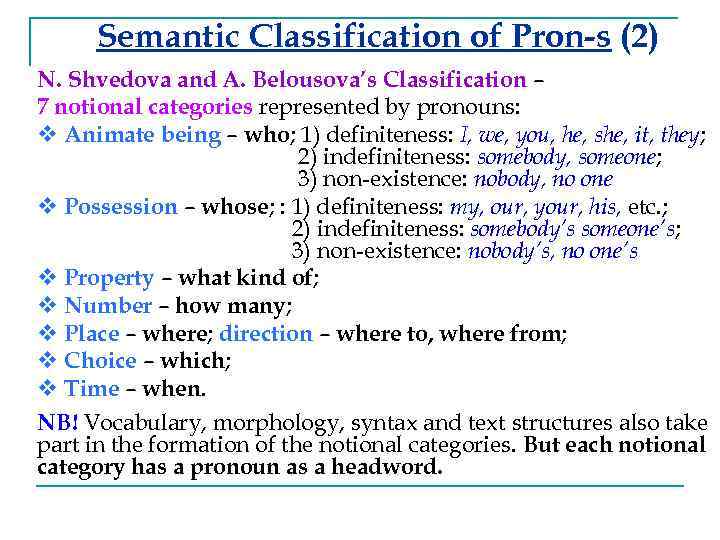 Semantic Classification of Pron-s (2) N. Shvedova and A. Belousova’s Classification – 7 notional categories represented by pronouns: v Animate being – who; 1) definiteness: I, we, you, he, she, it, they; 2) indefiniteness: somebody, someone; 3) non-existence: nobody, no one v Possession – whose; : 1) definiteness: my, our, your, his, etc. ; 2) indefiniteness: somebody’s someone’s; 3) non-existence: nobody’s, no one’s v Property – what kind of; v Number – how many; v Place – where; direction – where to, where from; v Choice – which; v Time – when. NB! Vocabulary, morphology, syntax and text structures also take part in the formation of the notional categories. But each notional category has a pronoun as a headword.
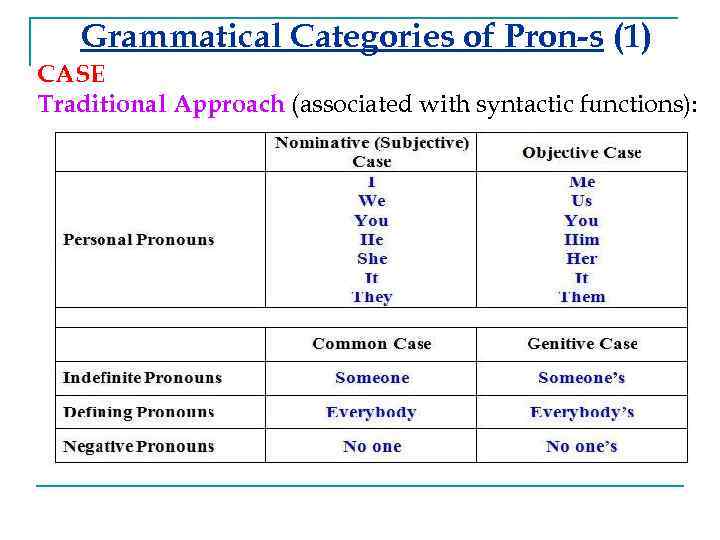 Grammatical Categories of Pron-s (1) CASE Traditional Approach (associated with syntactic functions):
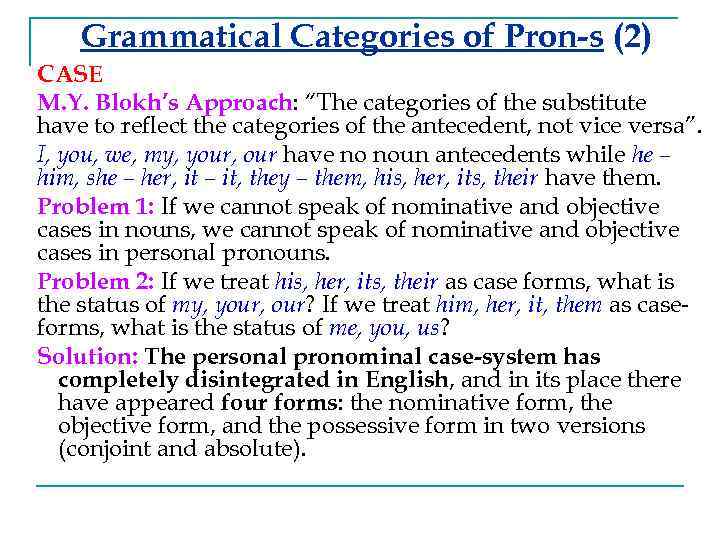 Grammatical Categories of Pron-s (2) CASE M. Y. Blokh’s Approach: “The categories of the substitute have to reflect the categories of the antecedent, not vice versa”. I, you, we, my, your, our have no noun antecedents while he – him, she – her, it – it, they – them, his, her, its, their have them. Problem 1: If we cannot speak of nominative and objective cases in nouns, we cannot speak of nominative and objective cases in personal pronouns. Problem 2: If we treat his, her, its, their as case forms, what is the status of my, your, our? If we treat him, her, it, them as caseforms, what is the status of me, you, us? Solution: The personal pronominal case-system has completely disintegrated in English, and in its place there have appeared four forms: the nominative form, the objective form, and the possessive form in two versions (conjoint and absolute).
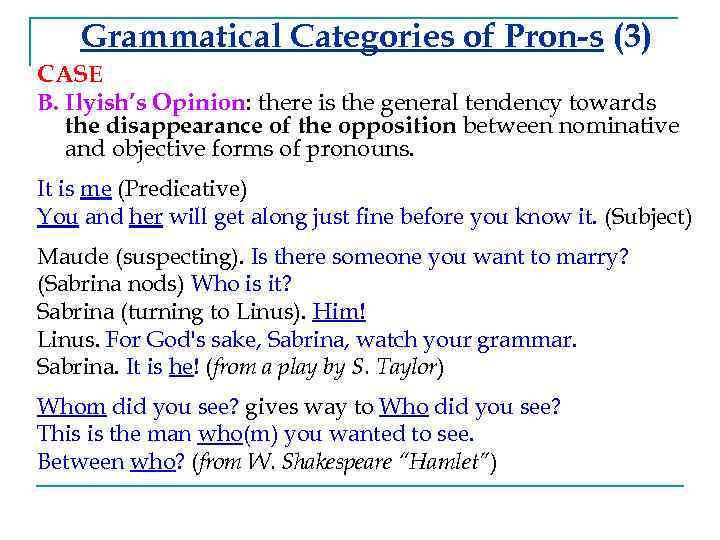 Grammatical Categories of Pron-s (3) CASE B. Ilyish’s Opinion: there is the general tendency towards the disappearance of the opposition between nominative and objective forms of pronouns. It is me (Predicative) You and her will get along just fine before you know it. (Subject) Maude (suspecting). Is there someone you want to marry? (Sabrina nods) Who is it? Sabrina (turning to Linus). Him! Linus. For God's sake, Sabrina, watch your grammar. Sabrina. It is he! (from a play by S. Taylor) Whom did you see? gives way to Who did you see? This is the man who(m) you wanted to see. Between who? (from W. Shakespeare “Hamlet”)
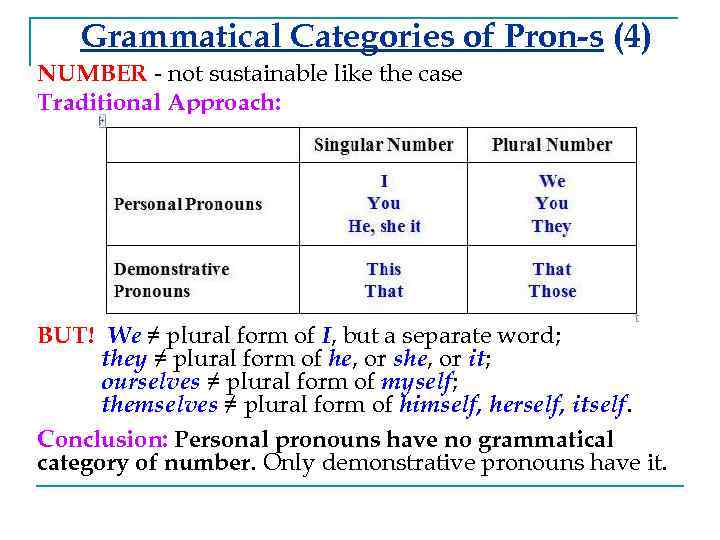 Grammatical Categories of Pron-s (4) NUMBER - not sustainable like the case Traditional Approach: BUT! We ≠ plural form of I, but a separate word; they ≠ plural form of he, or she, or it; ourselves ≠ plural form of myself; themselves ≠ plural form of himself, herself, itself. Conclusion: Personal pronouns have no grammatical category of number. Only demonstrative pronouns have it.
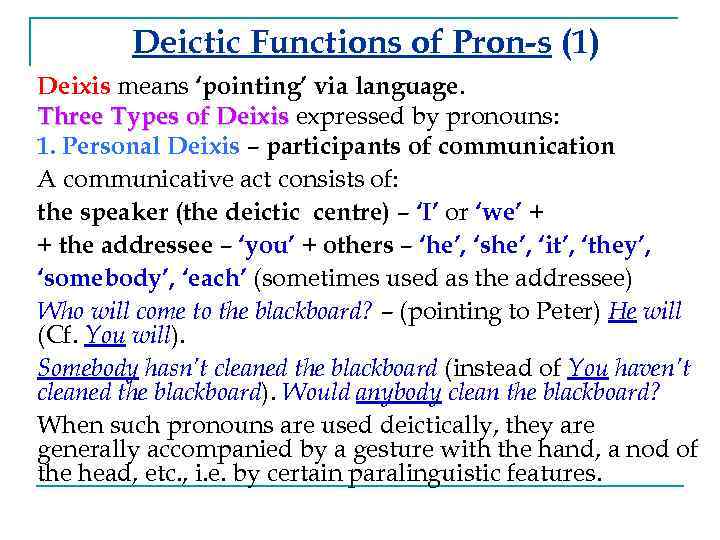 Deictic Functions of Pron-s (1) Deixis means ‘pointing’ via language. Three Types of Deixis expressed by pronouns: 1. Personal Deixis – participants of communication A communicative act consists of: the speaker (the deictic centre) – ‘I’ or ‘we’ + + the addressee – ‘you’ + others – ‘he’, ‘she’, ‘it’, ‘they’, ‘somebody’, ‘each’ (sometimes used as the addressee) Who will come to the blackboard? – (pointing to Peter) He will (Cf. You will). Somebody hasn’t cleaned the blackboard (instead of You haven’t cleaned the blackboard). Would anybody clean the blackboard? When such pronouns are used deictically, they are generally accompanied by a gesture with the hand, a nod of the head, etc. , i. e. by certain paralinguistic features.
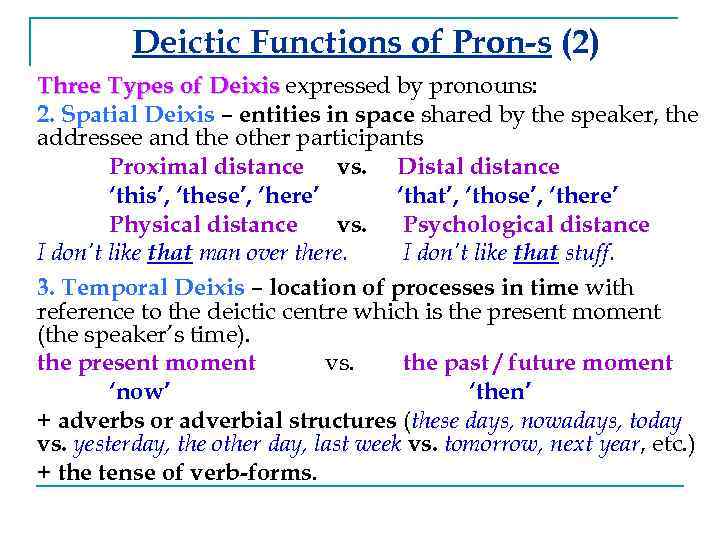 Deictic Functions of Pron-s (2) Three Types of Deixis expressed by pronouns: 2. Spatial Deixis – entities in space shared by the speaker, the addressee and the other participants Proximal distance vs. Distal distance ‘this’, ‘these’, ‘here’ ‘that’, ‘those’, ‘there’ Physical distance vs. Psychological distance I don’t like that man over there. I don’t like that stuff. 3. Temporal Deixis – location of processes in time with reference to the deictic centre which is the present moment (the speaker’s time). the present moment vs. the past / future moment ‘now’ ‘then’ + adverbs or adverbial structures (these days, nowadays, today vs. yesterday, the other day, last week vs. tomorrow, next year, etc. ) + the tense of verb-forms.
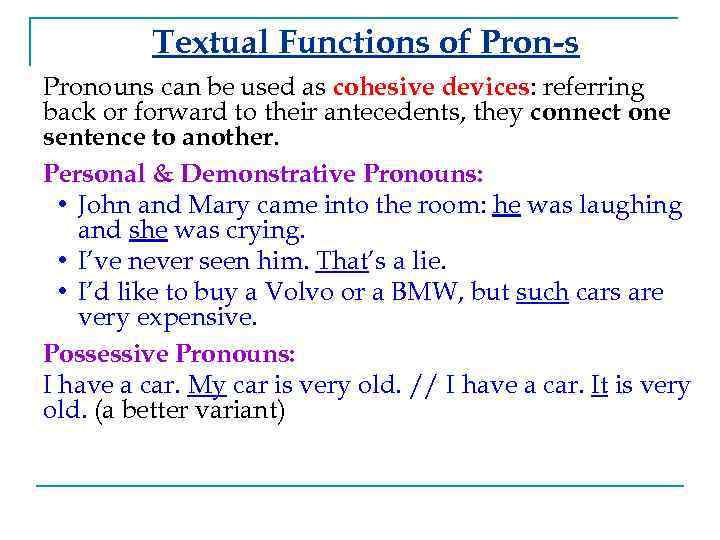 Textual Functions of Pron-s Pronouns can be used as cohesive devices: referring back or forward to their antecedents, they connect one sentence to another. Personal & Demonstrative Pronouns: • John and Mary came into the room: he was laughing and she was crying. • I’ve never seen him. That’s a lie. • I’d like to buy a Volvo or a BMW, but such cars are very expensive. Possessive Pronouns: I have a car. My car is very old. // I have a car. It is very old. (a better variant)
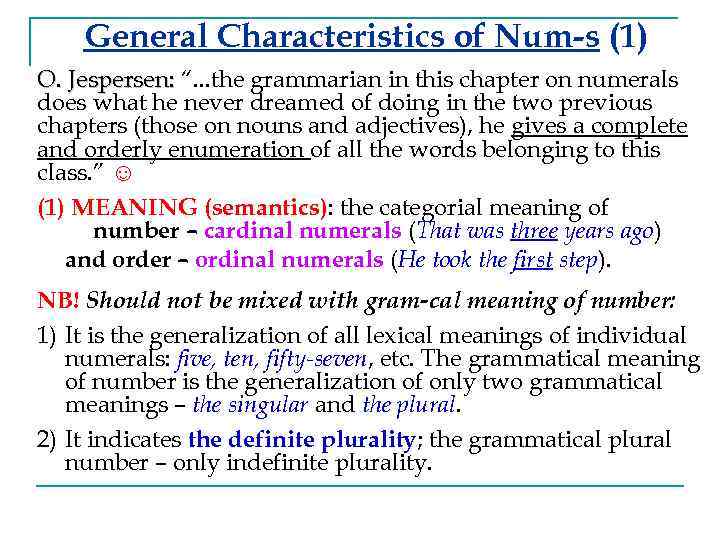 General Characteristics of Num-s (1) O. Jespersen: “. . . the grammarian in this chapter on numerals does what he never dreamed of doing in the two previous chapters (those on nouns and adjectives), he gives a complete and orderly enumeration of all the words belonging to this class. ” ☺ (1) MEANING (semantics): the categorial meaning of number – cardinal numerals (That was three years ago) and order – ordinal numerals (He took the first step). NB! Should not be mixed with gram-cal meaning of number: 1) It is the generalization of all lexical meanings of individual numerals: five, ten, fifty-seven, etc. The grammatical meaning of number is the generalization of only two grammatical meanings – the singular and the plural. 2) It indicates the definite plurality; the grammatical plural number – only indefinite plurality.
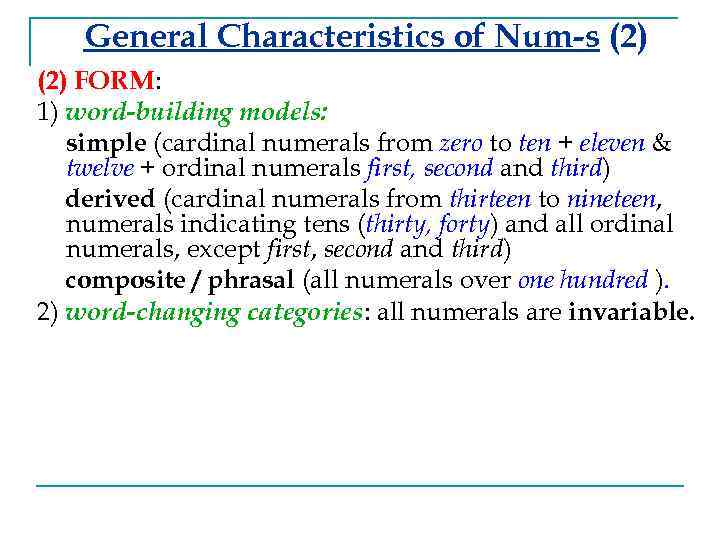 General Characteristics of Num-s (2) FORM: 1) word-building models: simple (cardinal numerals from zero to ten + eleven & twelve + ordinal numerals first, second and third) derived (cardinal numerals from thirteen to nineteen, numerals indicating tens (thirty, forty) and all ordinal numerals, except first, second and third) composite / phrasal (all numerals over one hundred ). 2) word-changing categories: all numerals are invariable.
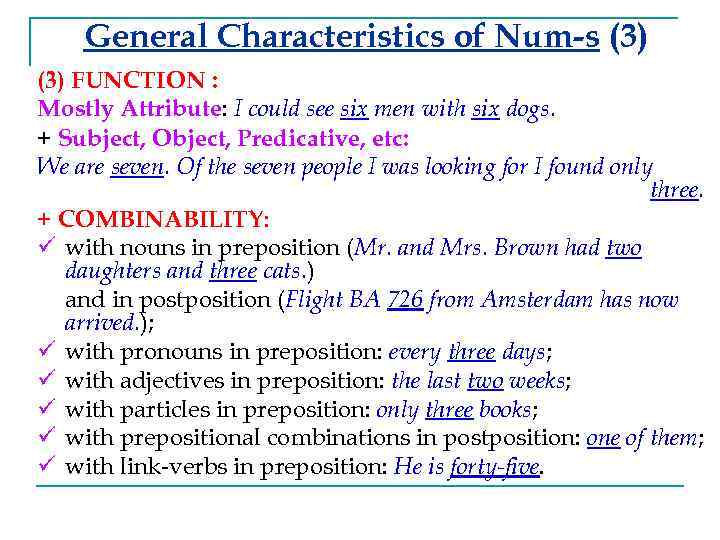 General Characteristics of Num-s (3) FUNCTION : Mostly Attribute: I could see six men with six dogs. + Subject, Object, Predicative, etc: We are seven. Of the seven people I was looking for I found only three. + COMBINABILITY: ü with nouns in preposition (Mr. and Mrs. Brown had two daughters and three cats. ) and in postposition (Flight BA 726 from Amsterdam has now arrived. ); ü with pronouns in preposition: every three days; ü with adjectives in preposition: the last two weeks; ü with particles in preposition: only three books; ü with prepositional combinations in postposition: one of them; ü with link-verbs in preposition: He is forty-five.
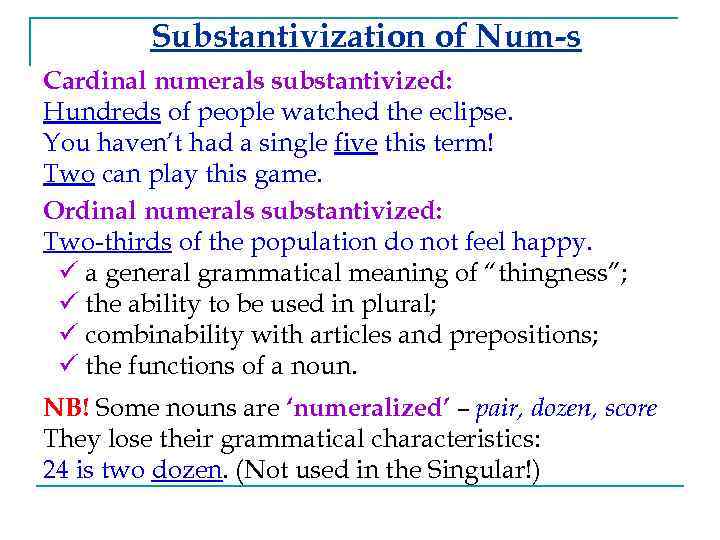 Substantivization of Num-s Cardinal numerals substantivized: Hundreds of people watched the eclipse. You haven’t had a single five this term! Two can play this game. Ordinal numerals substantivized: Two-thirds of the population do not feel happy. ü a general grammatical meaning of “thingness”; ü the ability to be used in plural; ü combinability with articles and prepositions; ü the functions of a noun. NB! Some nouns are ‘numeralized’ – pair, dozen, score They lose their grammatical characteristics: 24 is two dozen. (Not used in the Singular!)
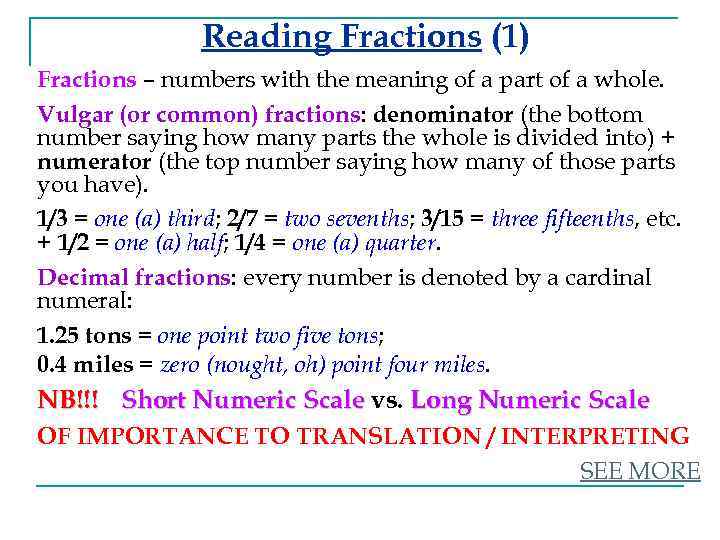 Reading Fractions (1) Fractions – numbers with the meaning of a part of a whole. Vulgar (or common) fractions: denominator (the bottom number saying how many parts the whole is divided into) + numerator (the top number saying how many of those parts you have). 1/3 = one (a) third; 2/7 = two sevenths; 3/15 = three fifteenths, etc. + 1/2 = one (a) half; 1/4 = one (a) quarter. Decimal fractions: every number is denoted by a cardinal numeral: 1. 25 tons = one point two five tons; 0. 4 miles = zero (nought, oh) point four miles. NB!!! Short Numeric Scale vs. Long Numeric Scale OF IMPORTANCE TO TRANSLATION / INTERPRETING SEE MORE
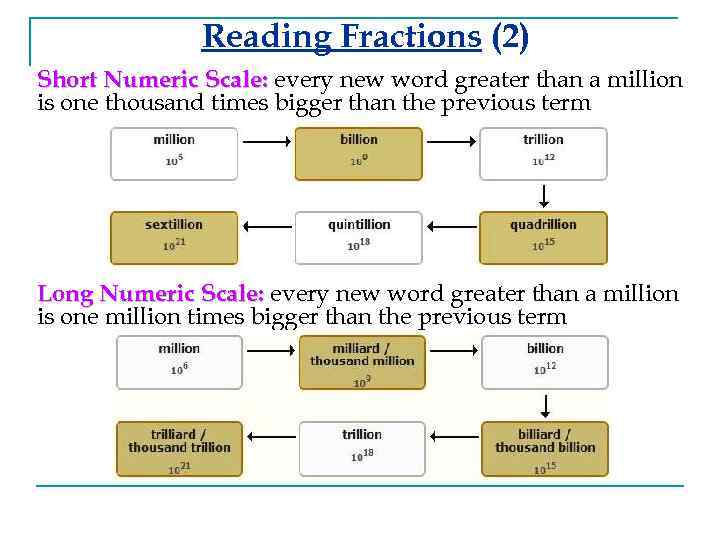 Reading Fractions (2) Short Numeric Scale: every new word greater than a million is one thousand times bigger than the previous term Long Numeric Scale: every new word greater than a million is one million times bigger than the previous term
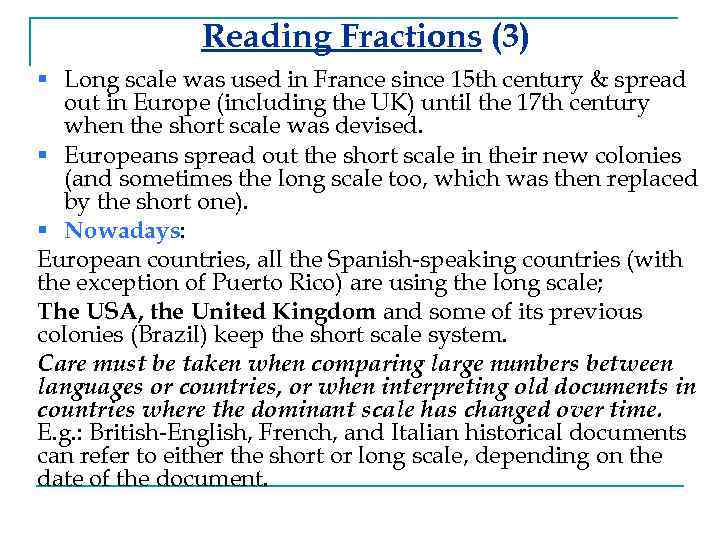 Reading Fractions (3) § Long scale was used in France since 15 th century & spread out in Europe (including the UK) until the 17 th century when the short scale was devised. § Europeans spread out the short scale in their new colonies (and sometimes the long scale too, which was then replaced by the short one). § Nowadays: European countries, all the Spanish-speaking countries (with the exception of Puerto Rico) are using the long scale; The USA, the United Kingdom and some of its previous colonies (Brazil) keep the short scale system. Care must be taken when comparing large numbers between languages or countries, or when interpreting old documents in countries where the dominant scale has changed over time. E. g. : British-English, French, and Italian historical documents can refer to either the short or long scale, depending on the date of the document.
 Feel Easy About Numerals? See This!
 KEY TERMS All types of pronouns with examples ü Deixis – personal, spatial, temporal ü Cohesive device ü Cardinal and ordinal numerals ü Vulgar and decimal fractions ü Denominator and numerator ü Short and Long Numeric Scales ü