 Скачать презентацию Ministry of Industry Trade Labor Ministry of
08681bd1a0d86cf919eaa682dc4d9db5.ppt
- Количество слайдов: 17



Ministry of Industry, Trade & Labor Ministry of Education and Business Cooperation in Israel Torino Process September 18, 2010 Tel Aviv Dr. Eli Eisenberg and Osnat Hachmon
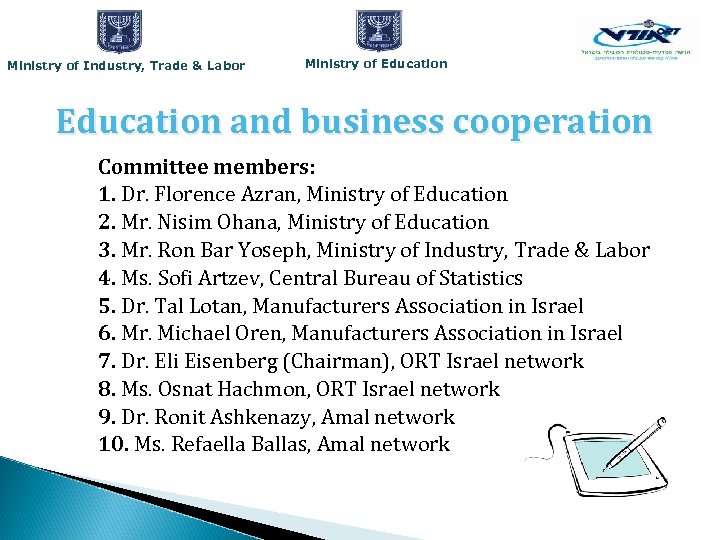
Ministry of Industry, Trade & Labor Ministry of Education and business cooperation Committee members: 1. Dr. Florence Azran, Ministry of Education 2. Mr. Nisim Ohana, Ministry of Education 3. Mr. Ron Bar Yoseph, Ministry of Industry, Trade & Labor 4. Ms. Sofi Artzev, Central Bureau of Statistics 5. Dr. Tal Lotan, Manufacturers Association in Israel 6. Mr. Michael Oren, Manufacturers Association in Israel 7. Dr. Eli Eisenberg (Chairman), ORT Israel network 8. Ms. Osnat Hachmon, ORT Israel network 9. Dr. Ronit Ashkenazy, Amal network 10. Ms. Refaella Ballas, Amal network
Ministry of Industry, Trade & Labor Ministry of Education Introduction Providing a comprehensive overall picture of the cooperation between the education systems and the business sector in Israel: ◦ ◦ Policies Objectives Benefits Challenges
Ministry of Industry, Trade & Labor Ministry of Education Introduction The information was gathered from: ◦ interviews ◦ articles ◦ relevant Hebrew and English language websites The data were taken from: ◦ The Central Bureau of Statistics (CBS) ◦ Government offices ◦ The MAI ◦ The technology education networks – ORT and AMAL
Ministry of Industry, Trade & Labor Ministry of Education National policies Ministry of Education - The Administration for Science and Technology : New policy of the Minister of Education – leading the process for a meaningful , high-quality cooperation between the education system and the business sector.
Ministry of Industry, Trade & Labor Ministry of Education National policies The Ministry of Industry, Trade & Labor – Senior Department of Vocational Training and Human Resource: ◦ Framework for secondary education: Authority granted to TVET by the Education Law 1953 and the Youth Labour Law -1953. ◦ Framework for adults (18+).
Ministry of Industry, Trade & Labor Ministry of Education National policies The Ministry of Industry, Trade & Labor – The Office of the Chief Scientist ◦ Operates to increase the cooperation between industry and universities in order to encourage industrial R&D and to develop knowledge-intense industries.
Ministry of Industry, Trade & Labor Ministry of Education Primary education - business sector Objectives: ◦ Exposure to industry and raising awareness among primary school children. Best practices: FLL, Cultivating entrepreneurship. Challenges: ◦ Taasiyeda and …. ◦ Funding for the activities.
Ministry if Industry, Trade & Labor Ministry of Education Secondary education - business sector Objectives: ◦ Motivate students to choose technological-scientific and vocational subjects. ◦ Professional advancement and development of teachers and trainers. ◦ Relevant and updated curricula.
Ministry of Industry, Trade & Labor Ministry of Education Secondary education - business sector Best practices: Tech-Mat program, in-service courses for technology teachers, cooperation with hitech industries. Challenges: ◦ Structured and systematic model of cooperation. ◦ “Top down” policy.
Ministry of Industry, Trade & Labor Ministry of Education Post secondary education - business sector Objectives: ◦ Professional development: technician, practical engineering and vocational training. ◦ Removing sectors from the cycle of poverty. ◦ Improving attitudes towards work. Best practices: On-the-job training, Telem, ATIDIM for Industry, A Woman of Worth.
Ministry of Industry, Trade & Labor Ministry of Education Post secondary education - business sector Challenges: ◦ Difficulties in locating industries to cooperate with HR training organisations. ◦ Dwindling government support for VT for the stronger strata of society. ◦ Low correlation between the needs and demands of employers and supply in the labour market.
Ministry of Industry, Trade & Labor Ministry of Education Tertiary education - business sector Objectives: ◦ Experience in industry. ◦ Advancing the level and relevance of teaching and learning. ◦ Promoting the institutions’ R&D activities. Best practices: Applications companies, technological initiative incubators, the MAGNET program, Ofakim, student internships in commercial companies. ◦
Ministry of Industry, Trade & Labor Ministry of Education Tertiary education - business sector Challenges: ◦ Difference of priorities in education and industry. ◦ Disagreements on issues of intellectual property. ◦ Shortage of personnel willing to mentor student projects. ◦ Lack of awareness among managers in traditional industries of the importance of R&D processes in their work.
Ministry of Industry, Trade & Labor Ministry of Education Conclusions Awareness of the need for cooperation between the education system and the business sector has grown. The aims, benefits and challenges depend on the different age groups of the students and on the personalities of the key figures either in education or in the business sector. There is no single inter-ministerial body that functions as a consortium to give direction to this necessary cooperation. There is no legislated, budgeted comprehensive policy nor any supervisory or evaluation framework.
Ministry of Industry, Trade & Labor Ministry of Education Recommendations To create a legislated inter-ministerial body with a long term budget. To reduce governmental bureaucratic procedures. Efficient use of the sum total of the available resources.
Ministry of Industry, Trade & Labor Ministry of Education Thank you!
Скачать презентацию Ministry of Industry Trade Labor Ministry of
08681bd1a0d86cf919eaa682dc4d9db5.ppt