


 Скачать презентацию Ministry of Health Welfare and Sport Health care
982896efe328124d638f08e998db6f39.ppt
- Количество слайдов: 18
 Ministry of Health, Welfare and Sport Health care reform in the Netherlands – role of the employer Paul Thewissen Counselor for Health, Welfare and Sport Royal Netherlands Embassy Washington, DC March 2008 1
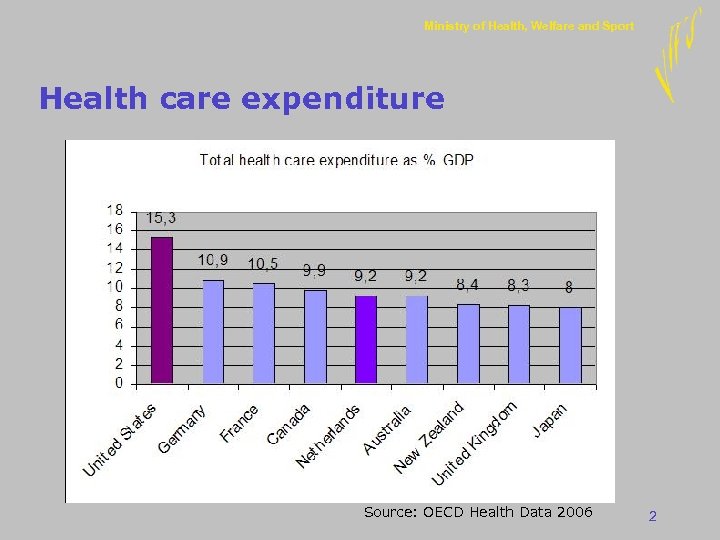 Ministry of Health, Welfare and Sport Health care expenditure Source: OECD Health Data 2006 2
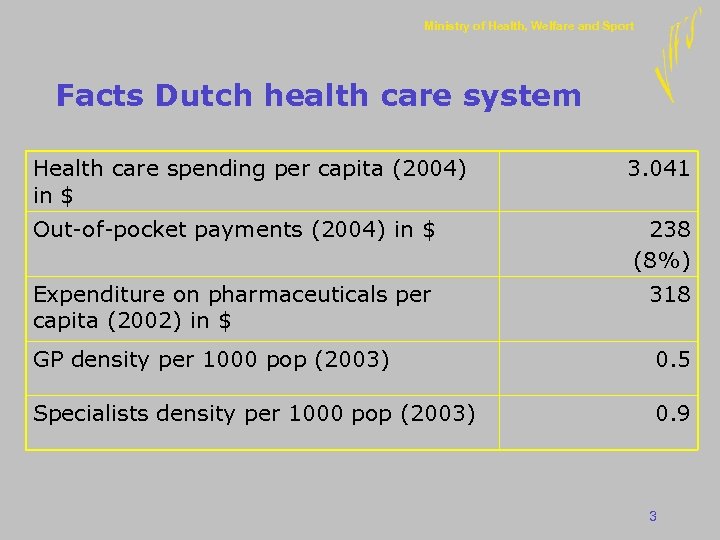 Ministry of Health, Welfare and Sport Facts Dutch health care system Health care spending per capita (2004) in $ 3. 041 Out-of-pocket payments (2004) in $ 238 (8%) Expenditure on pharmaceuticals per capita (2002) in $ 318 GP density per 1000 pop (2003) 0. 5 Specialists density per 1000 pop (2003) 0. 9 3
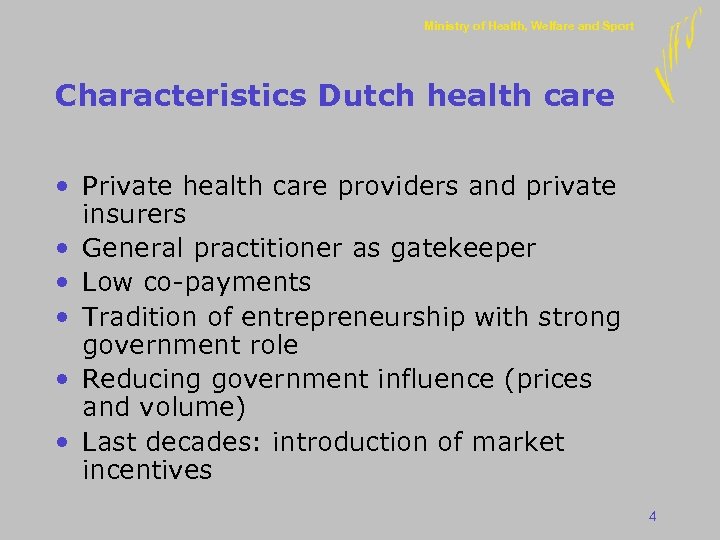 Ministry of Health, Welfare and Sport Characteristics Dutch health care • Private health care providers and private insurers • General practitioner as gatekeeper • Low co-payments • Tradition of entrepreneurship with strong government role • Reducing government influence (prices and volume) • Last decades: introduction of market incentives 4
 Ministry of Health, Welfare and Sport Dutch Health Insurance System Three compartments: • Long-term care insurance • Health care insurance for curative care (reformed in 2006) • Voluntary supplementary private health insurance policies 5
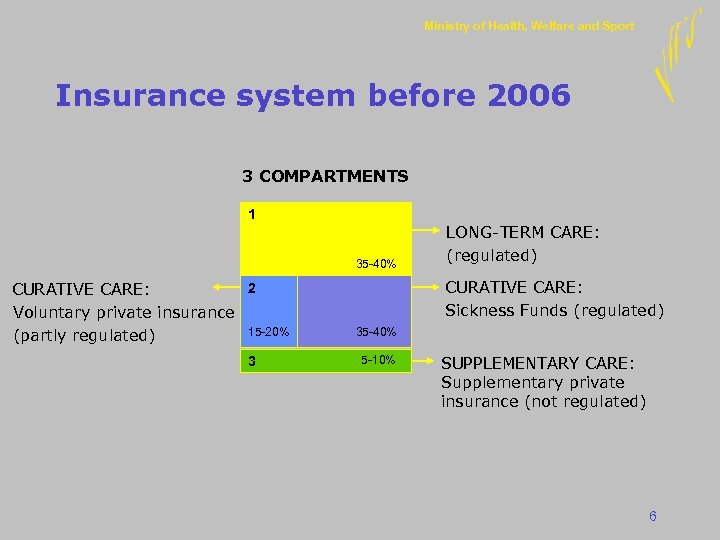 Ministry of Health, Welfare and Sport Insurance system before 2006 3 COMPARTMENTS 1 35 -40% 2 CURATIVE CARE: Voluntary private insurance 15 -20% (partly regulated) 3 LONG-TERM CARE: (regulated) CURATIVE CARE: Sickness Funds (regulated) 35 -40% 5 -10% SUPPLEMENTARY CARE: Supplementary private insurance (not regulated) 6
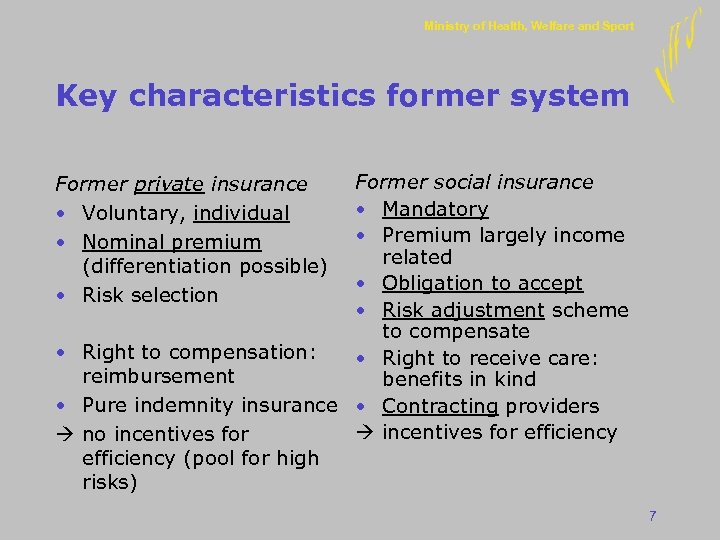 Ministry of Health, Welfare and Sport Key characteristics former system Former social insurance • Mandatory • Premium largely income related • Obligation to accept • Risk adjustment scheme to compensate • Right to compensation: • Right to receive care: reimbursement benefits in kind • Pure indemnity insurance • Contracting providers incentives for efficiency no incentives for efficiency (pool for high risks) Former private insurance • Voluntary, individual • Nominal premium (differentiation possible) • Risk selection 7
 Ministry of Health, Welfare and Sport Basic assumptions Dutch reform Create a sustainable health care system that is: • universal • affordable • of good quality Hypothesis is that competition will increase the value for money. Balance responsibilities for all participants create a level playing field 8
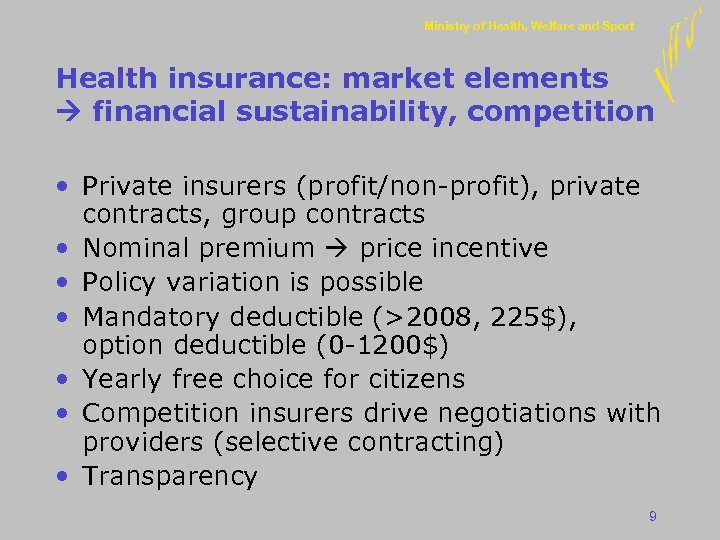 Ministry of Health, Welfare and Sport Health insurance: market elements financial sustainability, competition • Private insurers (profit/non-profit), private contracts, group contracts • Nominal premium price incentive • Policy variation is possible • Mandatory deductible (>2008, 225$), option deductible (0 -1200$) • Yearly free choice for citizens • Competition insurers drive negotiations with providers (selective contracting) • Transparency 9
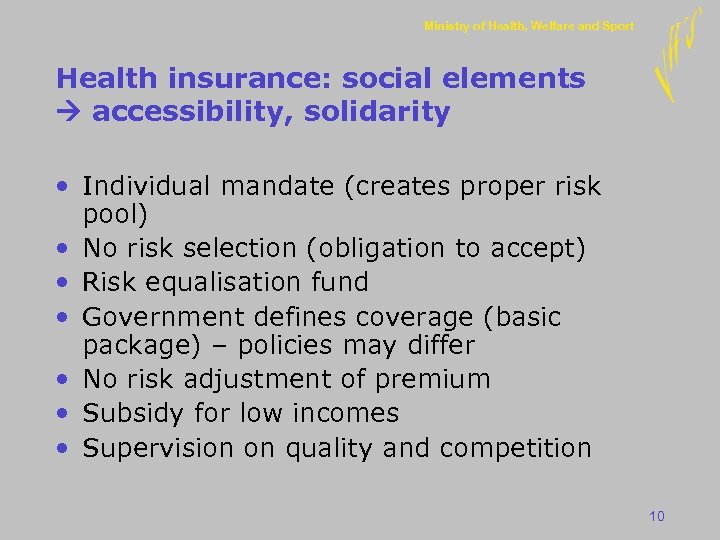 Ministry of Health, Welfare and Sport Health insurance: social elements accessibility, solidarity • Individual mandate (creates proper risk pool) • No risk selection (obligation to accept) • Risk equalisation fund • Government defines coverage (basic package) – policies may differ • No risk adjustment of premium • Subsidy for low incomes • Supervision on quality and competition 10
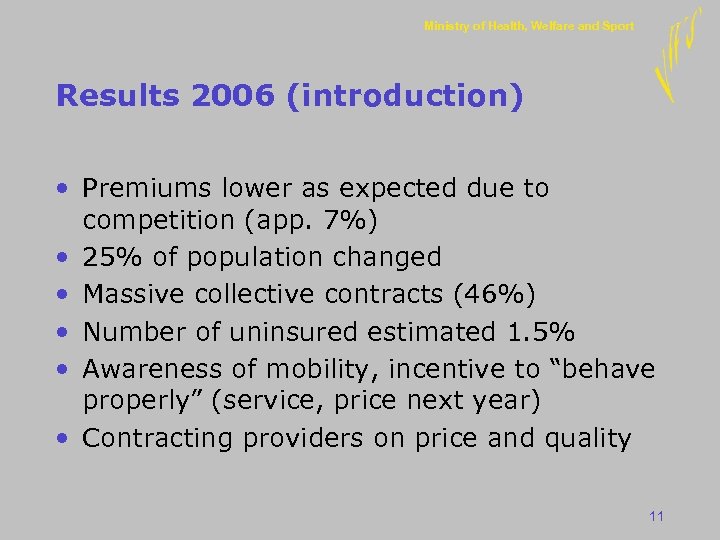 Ministry of Health, Welfare and Sport Results 2006 (introduction) • Premiums lower as expected due to competition (app. 7%) • 25% of population changed • Massive collective contracts (46%) • Number of uninsured estimated 1. 5% • Awareness of mobility, incentive to “behave properly” (service, price next year) • Contracting providers on price and quality 11
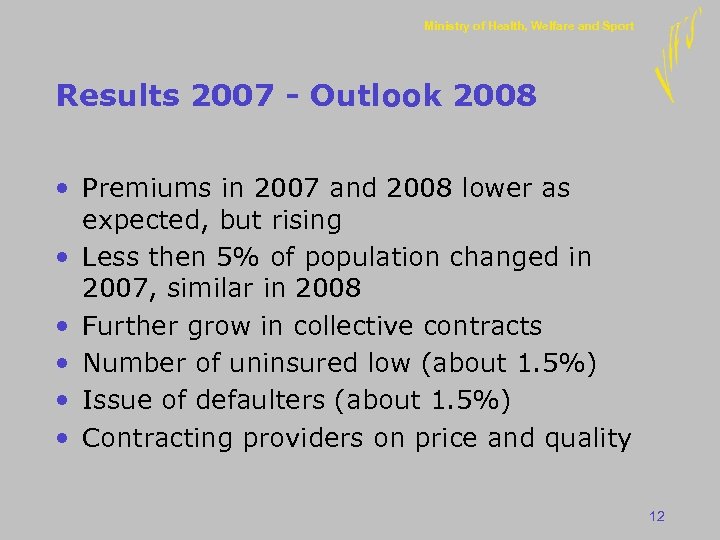 Ministry of Health, Welfare and Sport Results 2007 - Outlook 2008 • Premiums in 2007 and 2008 lower as expected, but rising • Less then 5% of population changed in 2007, similar in 2008 • Further grow in collective contracts • Number of uninsured low (about 1. 5%) • Issue of defaulters (about 1. 5%) • Contracting providers on price and quality 12
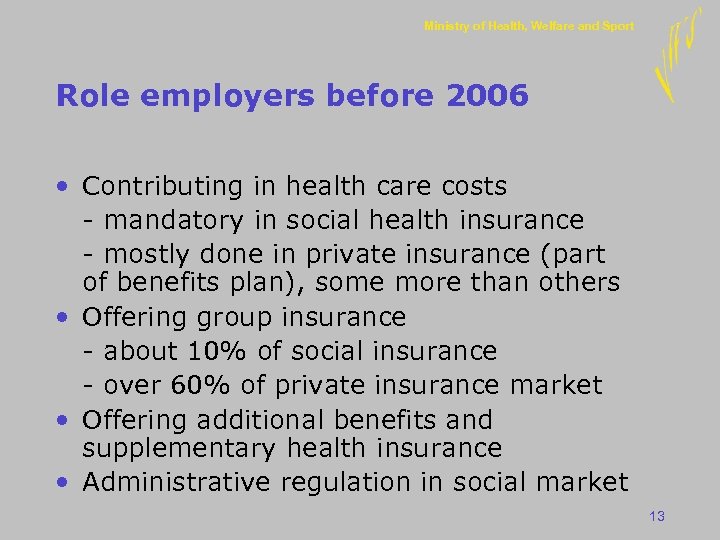 Ministry of Health, Welfare and Sport Role employers before 2006 • Contributing in health care costs - mandatory in social health insurance - mostly done in private insurance (part of benefits plan), some more than others • Offering group insurance - about 10% of social insurance - over 60% of private insurance market • Offering additional benefits and supplementary health insurance • Administrative regulation in social market 13
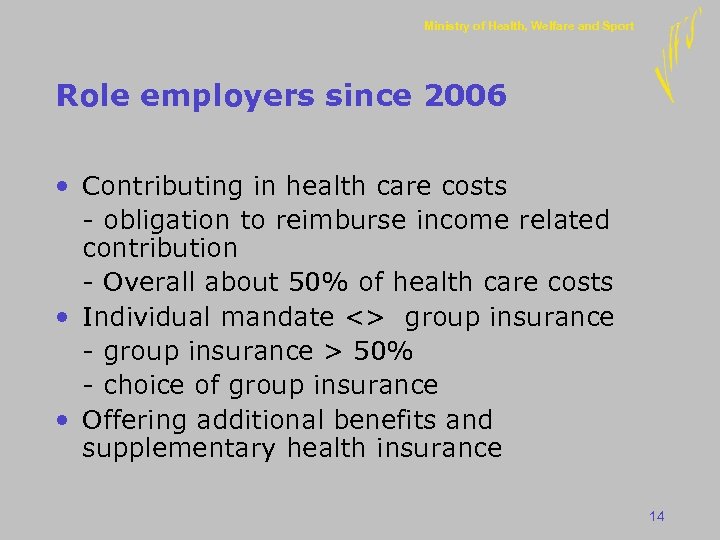 Ministry of Health, Welfare and Sport Role employers since 2006 • Contributing in health care costs - obligation to reimburse income related contribution - Overall about 50% of health care costs • Individual mandate <> group insurance - group insurance > 50% - choice of group insurance • Offering additional benefits and supplementary health insurance 14
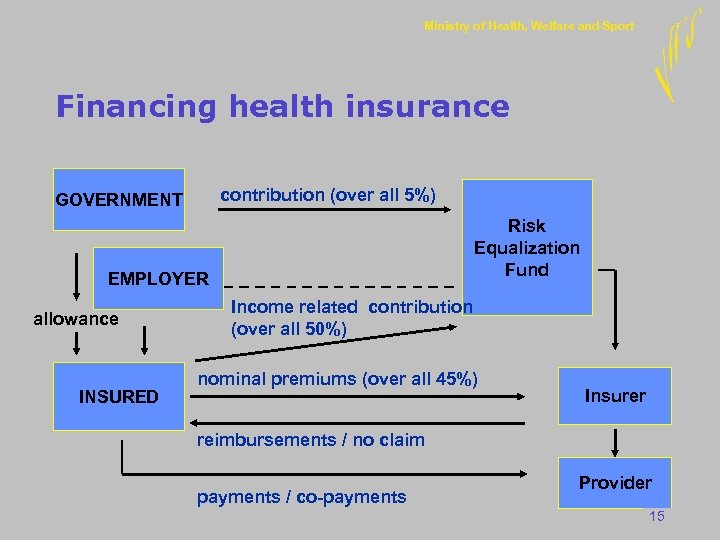 Ministry of Health, Welfare and Sport Financing health insurance contribution (over all 5%) GOVERNMENT Risk Equalization Fund EMPLOYER allowance INSURED Income related contribution (over all 50%) nominal premiums (over all 45%) Insurer reimbursements / no claim payments / co-payments Provider 15
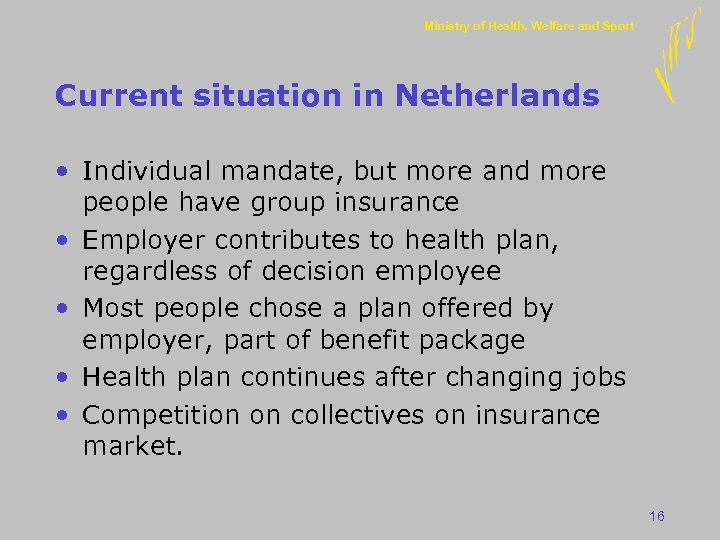 Ministry of Health, Welfare and Sport Current situation in Netherlands • Individual mandate, but more and more people have group insurance • Employer contributes to health plan, regardless of decision employee • Most people chose a plan offered by employer, part of benefit package • Health plan continues after changing jobs • Competition on collectives on insurance market. 16
 Ministry of Health, Welfare and Sport Paul Thewissen vwsusa@earthlink. net Counselor for Health, Welfare and Sport Royal Netherlands Embassy Washington, DC http: //www. minvws. nl/en/themes/health-insurance-system 17
 Ministry of Health, Welfare and Sport Delivering care • Guaranteed coverage – insurer has to deliver care • Health plans can offer in-kind provision or reimbursement of care • DRG kind of system of hospital care • 10% of hospital prices free to negotiate, in 2008 20% • (growing) Transparency on prices and quality 18